
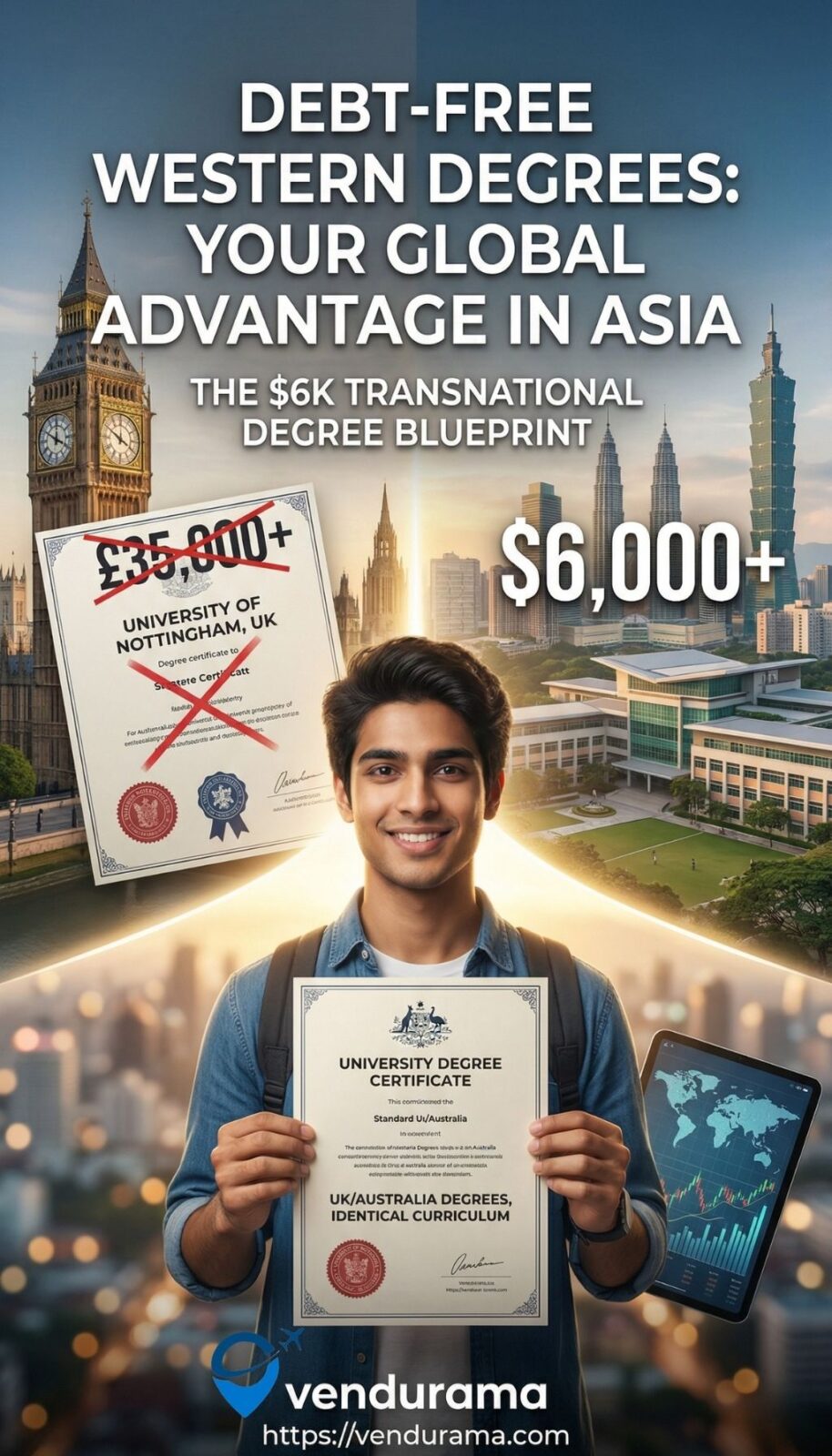
Introduction: The Macroeconomics of Transnational Education in 2026
The Western higher education model has reached a structural inflection point that renders it economically irrational for the middle-class family in 2026. In the United States, the average annual cost of attendance at a four-year institution now exceeds $40,000, with total degree expenditures frequently surpassing $160,000 before accounting for opportunity costs. In the United Kingdom, international student tuition at Russell Group universities ranges from £22,000 to £38,000 annually, while Australian Group of Eight institutions charge AUD $45,000-$55,000 per year for overseas students. These figures represent not merely pricing inflation but a fundamental misalignment of educational supply and economic demand, wherein credential acquisition increasingly requires debt assumptions that compromise post-graduation financial flexibility.
This crisis has catalyzed the emergence of **Transnational Branch Campuses **(TBCs)—a geographic arbitrage strategy wherein students enroll in satellite campuses of Western universities located in lower-cost jurisdictions while receiving identical curricula, assessment standards, and degree credentials as their onshore counterparts. Malaysia and Taiwan represent two distinct but complementary models of this strategy: Malaysia hosts over 60 foreign university branch campuses including Monash University, University of Nottingham, and University of Southampton, while Taiwan has systematically expanded English-taught programs in technology and business disciplines at institutions with direct industry pipelines. The quality differential does not correspond to the price differential because the pricing reflects operational cost structures and demographic policy incentives rather than educational value.
For the rational, financially literate family, the decision matrix extends beyond pure academic considerations. It encompasses preservation of intergenerational wealth, maintenance of post-graduation optionality, and protection of future earning capacity from debt service obligations. This is not educational compromise; this is capital optimization that preserves credential quality while respecting financial constraints. The following analysis examines the institutional architecture, academic equivalence, and logistical frameworks that enable ordinary students to secure Western degrees without surrendering their financial futures to debt servitude.
For families seeking a complete roadmap to navigate application procedures, visa requirements, and housing logistics, The Ultimate Study Abroad Guide: From Dream to Reality 2026 provides comprehensive frameworks at $14.99, including two exclusive audio masterclasses (22 minutes and 50 minutes) that walk parents through every phase of the transnational education relocation process.
Malaysia: Securing Monash and Nottingham Degrees in Southeast Asia
The Economic Architecture of EduCity and Kuala Lumpur
Malaysia’s emergence as the global hub for transnational branch campuses reflects deliberate policy design rather than accidental advantage. Following the establishment of the Private Higher Educational Institutions Act in 1996, Malaysia systematically cultivated an regulatory environment that enabled foreign universities to operate branch campuses with full degree-awarding authority. The result is a concentrated ecosystem of Western educational institutions—Monash University Malaysia, University of Nottingham Malaysia, University of Southampton Malaysia, Heriot-Watt University Malaysia, and others—operating within dedicated education zones such as EduCity in Johor and the Kuala Lumpur metropolitan corridor.
The tuition structure reflects Malaysia’s demographic strategy rather than educational cost recovery. With a domestic population of 33 million and a strategic objective to become a regional education hub, Malaysia views international student recruitment as a mechanism for economic diversification and soft power projection. Consequently, tuition for identical degree programs at Malaysian branch campuses ranges from MYR 25,000-45,000 annually ($5,300-$9,600), compared to AUD $48,000 ($32,000) at Monash’s Melbourne campus or £28,000 ($35,000) at Nottingham’s UK campus. Living expenses in Kuala Lumpur or Johor Bahru—accommodation, food, transportation, and personal expenditures—average MYR 1,500-2,500 monthly ($320-$530), producing total annual costs of $7,500-$12,000, substantially below the $40,000+ threshold for onshore Western study.
| Institution | Program Focus | Annual Tuition (USD) | Estimated Living Costs (USD/month) | Total Annual Cost (USD) |
|---|---|---|---|---|
| Monash University Malaysia | Engineering, Business, Science, IT | $6,800-9,200 | $350-500 | $11,000-15,200 |
| University of Nottingham Malaysia | Business, Engineering, Psychology, Law | $7,200-9,800 | $380-520 | $11,800-16,000 |
| University of Southampton Malaysia | Engineering, Oceanography, Business | $6,500-8,900 | $340-490 | $10,600-14,800 |
| Heriot-Watt University Malaysia | Business, Engineering, Built Environment | $5,900-8,200 | $320-470 | $9,700-13,800 |
Source: Institutional fee schedules and cost-of-living analyses, 2025-2026 academic year
The academic quality of Malaysian branch campuses is validated through multiple mechanisms. All institutions maintain curriculum equivalence protocols with their parent universities, ensuring that course content, assessment methodologies, and grading standards are identical across campuses. External examination systems, wherein faculty from the home campus review a sample of student work from the branch campus, provide additional quality assurance. Degree certificates issued by Malaysian branch campuses bear the identical institutional branding and accreditation statements as those issued onshore, with no notation indicating geographic location of study.
Graduate employment data indicates that 74% of international students at Malaysian branch campuses secure employment within six months of graduation, with starting salaries averaging $28,000-$38,000 in regional markets. For students targeting employment in Singapore, Hong Kong, or mainland China, the Malaysian credential carries equivalent recognition to its onshore counterpart while providing the additional advantage of Southeast Asian cultural fluency—a credential increasingly valuable in global business contexts.
The logistical infrastructure supporting transnational education in Malaysia has matured significantly since 2020. Kuala Lumpur International Airport and Senai International Airport (serving Johor) offer direct connections to major Asian hubs, while student visa processing through the Education Malaysia Global Services (EMGS) platform has been streamlined to 4-6 weeks for complete applications. Student accommodation options range from on-campus residences at $150-250 monthly to private apartments near university clusters at $280-450 monthly, all featuring reliable utilities, high-speed internet, and proximity to academic facilities.
Families must secure reliable temporary housing near the university campus before signing a long-term lease to evaluate neighborhood safety, commute times, and amenity access without commitment pressure. This 2-3 week buffer period allows students to assess accommodation options in person, verify property conditions against marketing materials, and establish local banking relationships before finalizing housing arrangements that typically require substantial deposits.
Taiwan: Semiconductor Capital and High-Tech Academic Integration
Navigating Taipei’s Educational Subsidies and Safety
Taiwan presents a distinct value proposition within the transnational education framework: technological specialization at accessible cost structures. The island’s higher education system, comprising over 150 institutions, has systematically expanded English-taught programs in engineering, computer science, business, and international affairs as a mechanism for internationalization and talent retention. National Taiwan University, National Tsing Hua University, National Cheng Kung University, and National Yang Ming Chiao Tung University now offer over 200 English-taught degree programs, many with direct industry partnerships in the semiconductor, electronics, and advanced manufacturing sectors.
The tuition structure reflects Taiwan’s strategic talent acquisition rather than revenue maximization. With a declining domestic student population and a national objective to strengthen its position in global technology value chains, Taiwan views international student recruitment as essential to maintaining research capacity and innovation ecosystems. Consequently, tuition for English-taught programs at public universities ranges from NT$ 80,000-150,000 annually (2,500-$4,700), with numerous merit-based scholarships reducing effective costs further. Living expenses in Taipei or Hsinchu—accommodation, food, transportation, and personal expenditures—average NT$ 12,000-20,000 monthly (80-$630), producing total annual costs of $5,800-$10,200, substantially below Western equivalents.
| Institution | Program Focus | Annual Tuition (USD) | Estimated Living Costs (USD/month) | Total Annual Cost (USD) |
|---|---|---|---|---|
| National Taiwan University | Engineering, Business, Social Sciences, Computer Science | $3,200-4,800 | $400-600 | $8,000-12,000 |
| National Tsing Hua University | Engineering, Science, Technology Management | $2,800-4,200 | $380-580 | $7,400-11,200 |
| National Cheng Kung University | Engineering, Medicine, Business, Design | $3,000-4,500 | $350-550 | $7,200-11,100 |
| National Yang Ming Chiao Tung University | Computer Science, Electronics, Business | $3,400-5,000 | $420-620 | $8,400-12,400 |
Source: Institutional fee schedules and cost-of-living analyses, 2025-2026 academic year
The academic quality of Taiwanese institutions is validated through global ranking methodologies and industry partnerships. National Taiwan University consistently ranks within the global top 100 according to QS and Times Higher Education, with particular strength in engineering, computer science, and materials research. Program accreditation follows international standards, and many English-taught programs maintain partnerships with Western universities that facilitate exchange opportunities and dual-degree options. Graduate employment data indicates that 71% of international students secure employment within Taiwan or elsewhere in Asia within six months of graduation, with starting salaries averaging $32,000-$45,000 in technology sectors.
Taiwan’s safety profile represents a significant advantage for families concerned about student welfare. The country consistently ranks among the top 25 globally on the Global Peace Index, with violent crime rates substantially below Western averages. For parents sending students abroad for the first time, this risk-adjusted value proposition provides psychological comfort that complements the financial advantage. The efficient public transportation system, reliable healthcare infrastructure, and English-language support services in university international offices further reduce adjustment friction for new arrivals.
To bypass the chaotic public transit systems upon initial arrival in Asia, it is a non-negotiable safety measure to arrange a pre-booked, vetted airport transfer directly to the dormitory. Taoyuan International Airport, while modern and efficiently operated, presents navigation challenges for first-time visitors unfamiliar with Mandarin signage or local currency. Professional transfer services eliminate the stress of negotiating with local taxi operators, managing luggage on public transportation, or locating accommodation in an unfamiliar urban environment. The fixed pricing and pre-verification of drivers provide parental reassurance that complements the student’s independence.
The technological ecosystem surrounding Taiwanese universities provides tangible educational advantages beyond formal coursework. Students gain exposure to advanced semiconductor manufacturing, precision engineering methodologies, and supply chain management practices that differ substantially from Western models. This comparative institutional knowledge becomes a credential in global business contexts, particularly for students pursuing careers in technology, international development, or cross-cultural management. The experience of navigating a high-context, non-Western society also develops adaptive competencies that employers increasingly value in globalized work environments.
Smart parents optimize student flight routes with flexible arrival dates to align perfectly with orientation week, which typically begins 7-10 days before formal instruction at Taiwanese institutions. This buffer period allows students to acclimate to the climate, establish banking relationships, complete residence permit formalities, and attend mandatory international student orientations without academic pressure. Flight flexibility also accommodates potential delays in visa processing, which can vary by consulate workload and seasonal application volumes.
Engineering a Flawless Arrival: Logistical Security for the Transnational Student
The transnational education arbitrage opportunity described above delivers value only if executed with logistical precision. Sending an 18-year-old student to Southeast Asia or Taiwan involves multiple interdependent variables: flight timing, visa documentation, accommodation arrangements, local transportation, and emergency preparedness. Failure in any single component can cascade into academic disruption, financial loss, or safety concerns that undermine the entire investment. For parents who cannot accompany students during relocation, professional logistical support represents not a luxury but a risk mitigation necessity.
The flight component requires particular attention to timing and flexibility. Smart parents optimize student flight routes with flexible arrival dates to align perfectly with orientation week, which typically begins 7-10 days before formal instruction at Malaysian and Taiwanese institutions. Most universities require international students to arrive early to complete residence registration, banking setup, health screenings, and orientation activities. Flights booked with change flexibility accommodate potential visa delays without incurring penalty fees that can erase accommodation savings.
Accommodation logistics present the most complex challenge. University dormitories offer convenience but limited availability; private housing provides flexibility but requires local market knowledge and lease negotiation skills. Families must secure reliable temporary housing near the university campus that features verified amenities and documented safety protocols before signing a long-term lease. This 2-3 week buffer period allows students to assess accommodation options in person, evaluate neighborhood safety and commute times, and establish local banking relationships before finalizing housing arrangements that typically require deposits equivalent to 2-3 months’ rent.
Navigating Asian student visa applications and housing contracts requires a blueprint that accounts for jurisdictional variations and documentation requirements. The 50-minute podcast included in The Ultimate Study Abroad Guide: From Dream to Reality 2026 walks parents through exactly how to set up their child abroad safely, covering visa application sequences, accommodation verification protocols, and emergency contact frameworks. This preparation transforms logistical complexity from a risk factor to a managed variable.
Ground transportation upon arrival represents a critical vulnerability window. To bypass chaotic public transit systems upon initial arrival in Asia, it is a non-negotiable safety measure to arrange a pre-booked, vetted airport transfer directly to the dormitory. This comprehensive service includes assistance with luggage handling, eliminates language barriers with local taxi operators, and removes currency exchange uncertainty. The fixed pricing and pre-verification of drivers provide parental reassurance and transform the arrival experience from a logistical challenge into a supportive transition that sets a positive tone for the academic year ahead.
Comparative Total Cost Analysis: 4-Year Degree Investment
The Complete Economic Picture
The true value of transnational education emerges only when total degree costs are aggregated across all expenditure categories. Tuition savings alone do not capture the compound effect of lower living costs, reduced debt service obligations, and earlier career entry without financial encumbrance. The following analysis presents a comprehensive comparison for a student undertaking a standard four-year bachelor’s degree.
| Cost Category | Australia (USD) | UK (USD) | Malaysia (USD) | Taiwan (USD) |
|---|---|---|---|---|
| Annual Tuition | $32,000-45,000 | $28,000-42,000 | $5,300-9,600 | $2,500-4,700 |
| Annual Living Costs | $18,000-25,000 | $20,000-28,000 | $3,800-6,400 | $4,600-7,600 |
| Total Annual Cost | $50,000-70,000 | $48,000-70,000 | $9,100-16,000 | $7,100-12,300 |
| 4-Year Total Cost | $200,000-280,000 | $192,000-280,000 | $36,400-64,000 | $28,400-49,200 |
| Typical Debt at Graduation | $40,000-80,000+ | £35,000-60,000 ($44k-76k) | $0-15,000 | $0-10,000 |
Source: Institutional fee schedules, cost-of-living analyses, and graduate debt surveys, 2025-2026
The data reveals 80-85% total cost reduction for Malaysian and Taiwanese destinations versus Australian and UK equivalents. This differential persists even when accounting for potentially higher flight costs to Asian destinations—the tuition and living cost savings are substantial enough to absorb airfare variations while producing net savings exceeding $150,000 per degree.
For the middle-class family operating within annual education budgets of $10,000-20,000, this differential determines degree feasibility. The Australian or UK itinerary requires debt financing, parental asset liquidation, or degree postponement. The transnational education itinerary fits within existing budget parameters while enabling the student to graduate without debt encumbrance. This is not educational compromise; this is capital optimization that preserves credential quality while respecting financial constraints.
The Human Capital Return
The economic analysis must incorporate the non-financial returns that justify educational investment. Credential quality, professional network development, cultural competence, and personal growth represent measurable outcomes that degree programs produce. These outcomes do not vary proportionally with expenditure—a $40,000 Malaysian engineering degree produces equivalent professional preparation as a $180,000 Australian engineering degree when program accreditation and graduate outcomes are comparable.
The transnational education dividend enables students to graduate with financial optionality that debt-burdened peers lack. Without monthly loan obligations, graduates can pursue lower-paying but higher-fulfillment careers, invest in entrepreneurial ventures, or save for home ownership earlier in their professional lives. This financial flexibility represents a form of career capital that compounds over decades, producing lifetime earnings advantages that exceed the initial tuition savings.
The Strategic Advantage of Graduating Debt-Free in Asia

The Intelligence Premium
The transnational education strategy rewards informational advantage over financial capacity. Students and families willing to research destinations, plan logistics, and execute preparation capture value that convenience-oriented peers surrender to tuition inflation. This is not a disadvantage for the middle class—it is a competitive advantage. The analytical effort required to identify and execute transnational education arbitrage is accessible to any family with internet access and planning discipline, while the financial capacity to absorb Western tuition pricing is increasingly concentrated among high-net-worth households.
The geographic arbitrage strategy extends beyond Malaysia and Taiwan. Singapore, South Korea, and Japan offer similar value propositions at varying development stages. The analytical framework established through research into Malaysian and Taiwanese education transfers to these adjacent markets, expanding the opportunity set for value-conscious families.
The psychological dimension of this strategy deserves emphasis. Students executing the transnational education strategy experience agency restoration in an education market that has increasingly treated middle-class families as revenue extraction targets rather than valued participants. The knowledge that educational quality is not determined by expenditure level, but by information quality and planning discipline, restores control to households operating within budget constraints. This psychological benefit compounds the financial benefit, producing total utility that exceeds the sum of cost savings.
The 2026 Inflection Point
The current moment represents an inflection point in global higher education economics. Western institutions have optimized pricing for maximum revenue extraction, creating structural barriers to middle-class participation. Asian educational hubs remain in the value-creation phase, where international student recruitment serves national development goals rather than institutional profit maximization. This window will not remain open indefinitely—as program quality becomes widely recognized and demand increases, pricing power will shift toward providers.
Students and families acting in 2026 capture the maximum arbitrage value before market maturation closes the opportunity. The programs remain accessible, the accreditation standards are established, and the pricing reflects development-stage economics rather than scarcity premiums. Waiting for “perfect” conditions or “proven” destinations surrenders this value to early-adopting peers who recognize the opportunity and execute the strategy.
The ultimate investment in a student’s safe and debt-free future is The Ultimate Study Abroad Guide: From Dream to Reality 2026. At $14.99 with its two included podcast masterclasses (22 minutes and 50 minutes), this resource provides the informational infrastructure necessary to execute the transnational education strategy with confidence. The guide covers university selection frameworks, application sequencing, visa documentation protocols, accommodation verification checklists, and emergency preparedness systems—the complete logistical architecture for successful international education.
Conclusion: Debt-Free Graduation as Strategic Advantage
The elite Western degree need not be surrendered to tuition inflation and debt servitude. The transnational education strategy demonstrates that geographic arbitrage enables middle-class students to preserve educational quality while respecting budget constraints. Malaysia and Taiwan offer equivalent academic rigor, comparable credential recognition, and superior value propositions to their Western counterparts.
The execution requires research, planning, and logistical discipline—but these requirements represent manageable investments relative to the $150,000+ savings per degree. For the financially literate family, this trade-off is self-evident. The analytical effort produces financial returns that exceed most investment opportunities available to middle-class households, while simultaneously producing the human capital returns that justify educational expenditure.
The debt-free graduation is not a consolation prize. It is a strategic advantage that provides graduates with career optionality, investment capacity, and psychological freedom that debt-burdened peers cannot access. In an economy increasingly characterized by volatility and disruption, financial flexibility represents a form of resilience that compounds over decades.
In 2026, the question is not whether ordinary students can access elite Western education. The question is whether they possess the analytical capability to identify where value persists. For those who do, Malaysia and Taiwan await—not as compromise destinations, but as superior allocations of educational capital that preserve both academic quality and financial security. The arbitrage opportunity exists. The execution framework is available. The only remaining variable is the willingness to act.
The definitive call to action for rational families is clear: secure The Ultimate Study Abroad Guide: From Dream to Reality 2026 at $14.99. With its two exclusive audio masterclasses and comprehensive logistical frameworks, this resource represents the ultimate investment in a student’s safe and debt-free future. The guide transforms complex transnational education planning from an overwhelming challenge into a manageable, executable strategy. For families committed to educational excellence without financial compromise, this is not an optional purchase—it is an essential foundation for successful execution.