Introduction: The Macroeconomics of Dental Inflation in 2026
The Financial Extinction of Dental Care: Why a Smile Costs $40,000
The dental care market in advanced Western economies has undergone a structural transformation that renders comprehensive restorative procedures economically prohibitive for the middle-class worker in 2026. In the United States, a full-mouth rehabilitation utilizing the All-on-4 implant protocol—a procedure that replaces an entire arch of teeth with four strategically positioned titanium implants supporting a fixed prosthesis—carries an average billed charge of $38,000-$52,000 per arch. In the United Kingdom, where dental care operates under a hybrid public-private model, the same procedure commands £28,000-£38,000 ($35,000-$48,000) when accessed through private providers, as National Health Service coverage for complex implantology remains exceptionally limited. These figures represent not merely pricing inflation but a fundamental misalignment of healthcare financing and clinical necessity, wherein procedures essential for nutritional function, speech articulation, and professional presentation are categorized as elective “cosmetic” services by insurance carriers.
This classification creates a financial extraction mechanism that disproportionately affects middle-income households. Unlike emergency medical care, which may receive partial insurance coverage, dental implantology frequently requires 100% out-of-pocket expenditure. For workers earning median incomes, this necessitates debt accumulation, retirement account liquidation, or treatment deferral that accelerates oral health deterioration and associated systemic health risks. The psychological consequences compound the financial burden: patients experiencing tooth loss frequently report diminished professional confidence, social withdrawal, and reduced earning capacity—outcomes that further constrain their ability to finance definitive treatment.
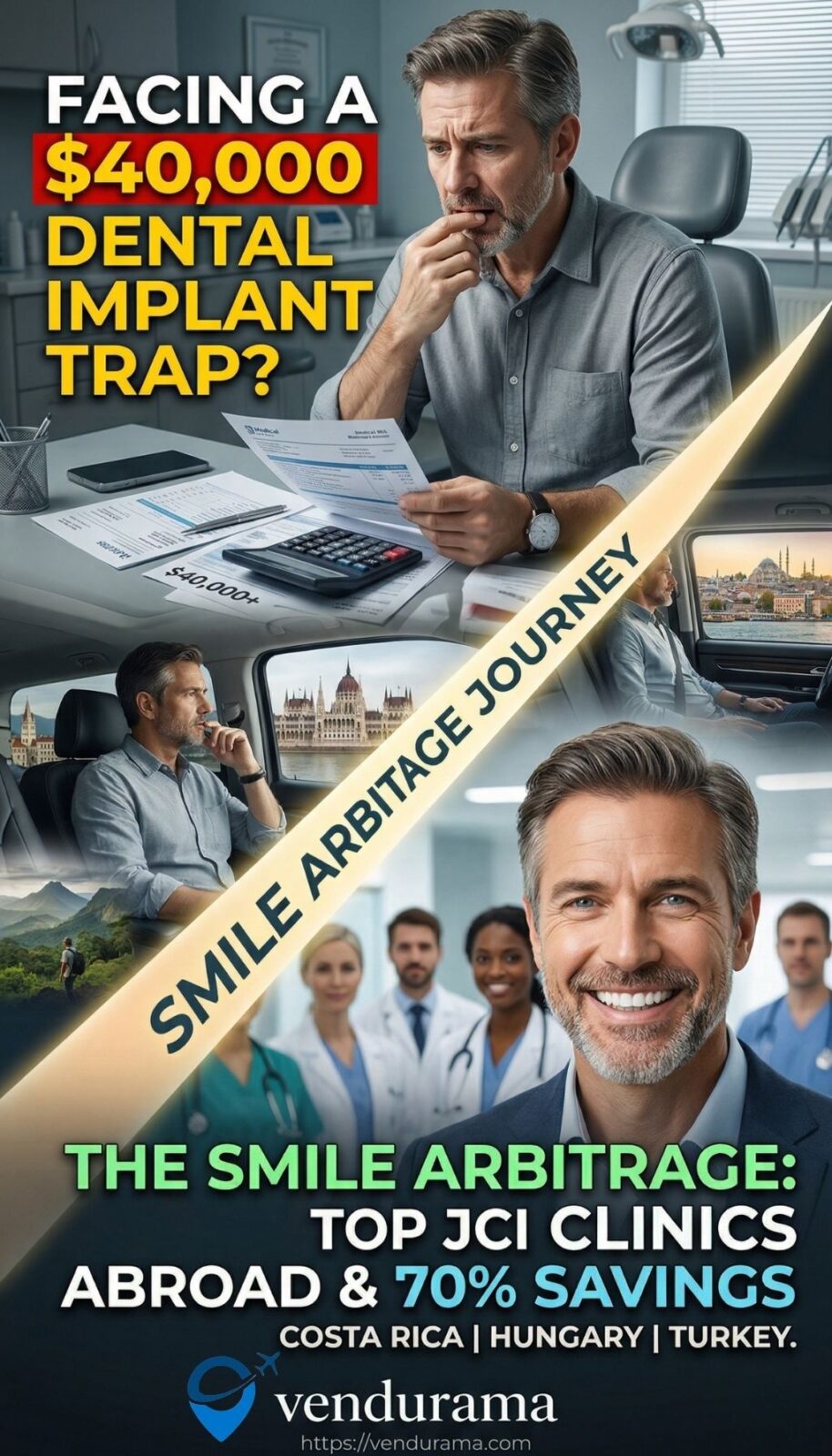
This structural dysfunction has catalyzed the emergence of the “Smile Arbitrage”—a geographic arbitrage strategy wherein patients access identical implant protocols, identical premium-grade materials, and identical clinical expertise through JCI-accredited facilities in lower-cost jurisdictions. Costa Rica, Hungary, and Turkey represent three distinct models of this strategy: each offers All-on-4 and comprehensive implant rehabilitation at 70-80% lower cost basis than Western equivalents, while maintaining accreditation standards, material traceability, and clinical outcomes that match or exceed onshore providers. The quality differential does not correspond to the price differential because the pricing reflects operational cost structures and regulatory positioning rather than clinical value.
For the rational, financially literate patient, the decision matrix extends beyond pure clinical considerations. It encompasses preservation of earning capacity, maintenance of professional presentation, and protection of retirement assets from liquidation. This is not medical tourism in the leisure sense; this is medical logistics optimization executed under conditions of physiological vulnerability and time pressure. The following analysis examines the clinical validity, economic rationale, and logistical imperatives that define this emerging pathway for ordinary workers seeking to reclaim oral function without surrendering their financial future.
For patients seeking a complete roadmap to navigate clinic selection, treatment sequencing, and recovery logistics, The Ultimate Guide to Medical Tourism 2026 provides comprehensive frameworks at $19.99, including three exclusive audio masterclasses: a welcome introduction, a detailed procedural breakdown, and a massive “3-in-1” masterclass combining all Vendurama guides into one ultimate audio experience.
San Jose’s Medical Free Zones: American Dentistry at a 70% Discount
The Economic Architecture of Costa Rican Dental Hubs
Costa Rica’s emergence as a premier destination for complex dental implantology reflects deliberate policy design rather than accidental advantage. Following the establishment of Medical Free Zones in the early 2000s, Costa Rica systematically cultivated a regulatory environment that enabled foreign-trained dental specialists to establish practices with access to imported materials, advanced equipment, and international patient flows. The result is a concentrated ecosystem of JCI-accredited dental clinics in San José and the Greater Metropolitan Area, staffed by prosthodontists and oral surgeons who frequently hold dual credentials from Costa Rican and North American institutions.
The cost structure reflects Costa Rica’s demographic strategy rather than clinical cost recovery. With a domestic population of 5.2 million and a strategic objective to become a regional medical tourism hub, Costa Rica views international patient recruitment as a mechanism for economic diversification and foreign exchange generation. Consequently, the All-on-4 protocol utilizing premium implant systems (Straumann, Nobel Biocare, or Zimmer Biomet) costs $9,500-$12,500 per arch in Costa Rican JCI-accredited clinics, compared to $38,000-$52,000 in comparable US facilities. This represents a 74-76% cost reduction for functionally identical clinical products. The quality differential does not correspond to the price differential; Costa Rican clinics in this segment feature identical 3D cone-beam computed tomography (CBCT) scanners, identical computer-aided design/computer-aided manufacturing (CAD/CAM) milling systems, and identical sterilization protocols as their North American counterparts.
| Procedure | United States (USD) | United Kingdom (USD) | Costa Rica (USD) | Hungary (USD) | Turkey (USD) |
|---|---|---|---|---|---|
| All-on-4 Implant Protocol (Single Arch) | $38,000-52,000 | $35,000-48,000 | $9,500-12,500 | $8,200-11,000 | $7,800-10,500 |
| Single Dental Implant + Crown | $4,500-6,500 | $3,800-5,200 | $1,100-1,600 | $950-1,400 | $850-1,300 |
| Full-Mouth Rehabilitation (Both Arches) | $76,000-104,000 | $70,000-96,000 | $19,000-25,000 | $16,400-22,000 | $15,600-21,000 |
| 3D CBCT Scan + Surgical Planning | $350-600 | $280-450 | $80-150 | $70-130 | $60-120 |
| Sedation/Anesthesia (IV) | $800-1,500 | $650-1,200 | $200-400 | $180-350 | $150-320 |
Source: Comparative dental pricing analysis, JCI-accredited facilities, 2025-2026
The clinical quality of Costa Rican dental facilities is validated through multiple mechanisms. JCI accreditation requires adherence to identical infection control protocols, staff credentialing standards, and equipment maintenance schedules as US hospital systems. Implant procurement operates through identical regulatory channels: a Straumann implant manufactured for distribution in Costa Rica originates from the same production facility, undergoes the same quality control testing, and carries the same batch tracking identifiers as an implant distributed in California. The supply chain divergence occurs at the distribution level, not the manufacturing level. This structural reality enables substantial cost differentials without quality variation.
Graduate outcome data indicates that implant survivorship at five years for All-on-4 protocols in Costa Rican JCI-accredited clinics exceeds 97%, statistically equivalent to US academic medical center outcomes. Patient-reported satisfaction scores similarly demonstrate no significant variation between jurisdictions. The volume-outcome relationship actually favors high-volume international centers: surgeons performing 200+ All-on-4 procedures annually develop technical proficiency that a surgeon performing 40 annually cannot match, regardless of training pedigree.
Budapest: The European Epicenter of Implantology
Precision Engineering and the Hungarian Dental Legacy
Hungary presents a distinct value proposition within the dental arbitrage framework: European Union regulatory integration at Central European cost structures. Budapest has served as a dental tourism destination since the 1990s, developing a concentrated ecosystem of implant specialists, dental laboratories, and supporting infrastructure that now serves patients from across the UK, Germany, Scandinavia, and beyond. The city’s dental clinics benefit from Hungary’s membership in the European Economic Area, ensuring that materials, equipment, and professional standards align with EU directives while operating at labor and overhead costs substantially below Western European averages.
The cost structure reflects Hungary’s strategic positioning within the European healthcare market. With a domestic population of 9.6 million and a historical tradition of dental excellence, Hungary views international patient recruitment as a mechanism for economic development and professional reputation enhancement. Consequently, the All-on-4 protocol utilizing premium implant systems costs €7,500-€10,000 ($8,200-$11,000) per arch in Budapest JCI-accredited clinics, compared to £28,000-£38,000 ($35,000-$48,000) in comparable UK facilities. This represents a 71-77% cost reduction for functionally identical clinical products.
The academic foundation of Hungarian dentistry deserves particular emphasis. Hungary maintains one of Europe’s oldest and most respected dental education systems, with Semmelweis University in Budapest producing specialists who frequently pursue additional fellowship training in Germany, Switzerland, or the United States. This dual-training model ensures that Hungarian implantologists combine rigorous foundational education with exposure to cutting-edge techniques from multiple international schools of thought. Many Budapest clinics maintain formal affiliation agreements with Western European dental societies, enabling continuous protocol alignment and peer review.
The laboratory infrastructure supporting Hungarian dental tourism represents a tangible quality advantage. Budapest hosts numerous dental laboratories specializing in implant-supported prosthetics, utilizing identical CAD/CAM milling systems (Cercon, Lava, 3Shape) and identical ceramic materials (zirconia, lithium disilicate) as Western European counterparts. The proximity of clinical and laboratory facilities enables rapid iteration protocols: if a prosthetic component requires adjustment, it can be remilled and delivered within hours rather than days, reducing patient chair time and accelerating overall treatment timelines.
For patients traveling to Budapest, logistical planning requires attention to post-operative physiological constraints. The All-on-4 protocol typically requires two surgical phases separated by 3-6 months, with the initial phase involving implant placement and temporary prosthesis delivery. During the immediate post-operative period (7-14 days), patients experience facial swelling, limited mouth opening, and dietary restrictions that necessitate specialized accommodation and transportation arrangements. Because post-operative patients suffer from speech impairment and facial numbness, they cannot negotiate with local drivers; thus, it is a clinical imperative to arrange a pre-booked, silent transfer directly to their recovery accommodation. This service eliminates the stress of language barriers, currency negotiation, and navigation uncertainty during a period of maximum physiological vulnerability.
Istanbul and Antalya: High-Volume Technological Dominance
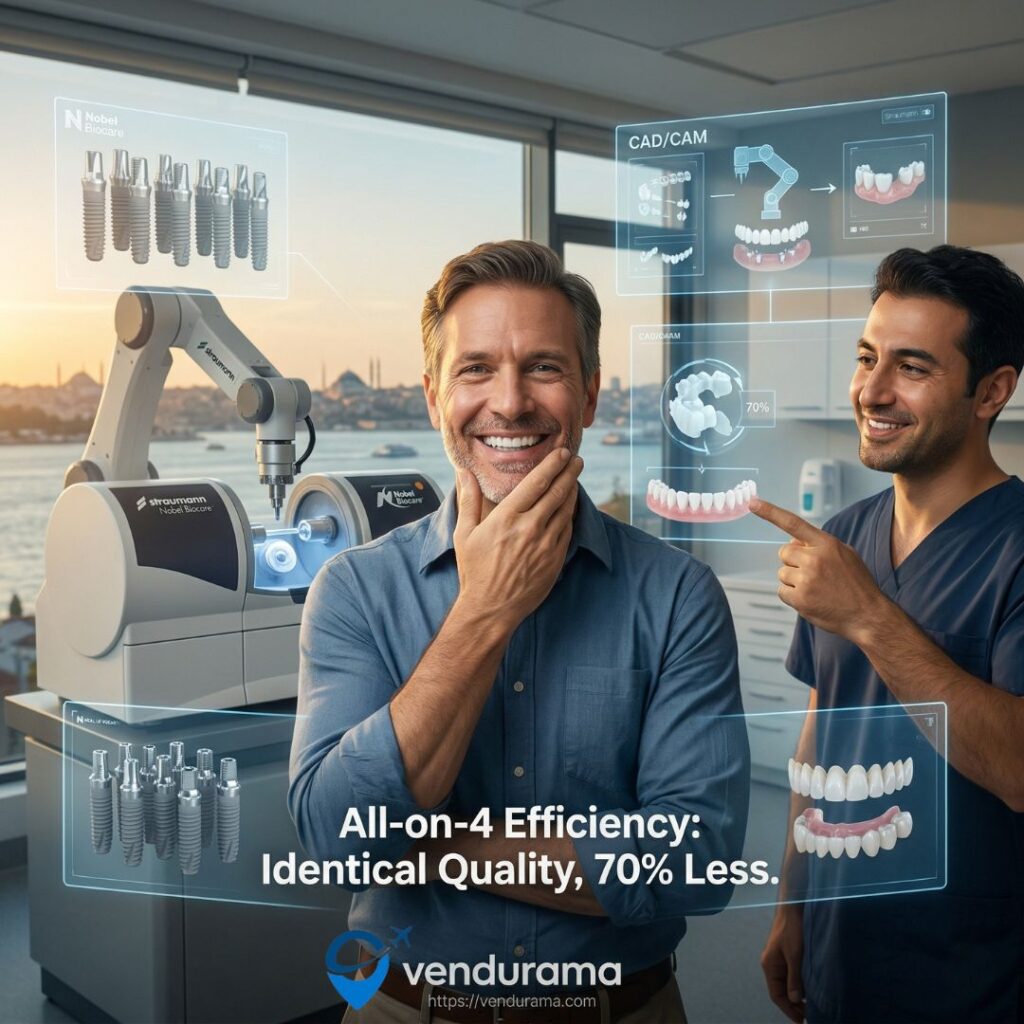
Turkey represents the most sophisticated iteration of the dental arbitrage opportunity: a high-volume, technology-intensive destination that has aggressively invested in digital dentistry infrastructure to achieve economies of scale unavailable to Western providers. Turkish dental clinics in Istanbul and Antalya have deployed extensive portfolios of advanced equipment—including 3D CBCT scanners, intraoral scanners, CAD/CAM milling units, and guided surgery software—at utilization rates that drive per-procedure costs substantially below Western equivalents. This technological density, combined with favorable currency dynamics and lower labor costs, produces pricing that undercuts even other international destinations while maintaining precision standards.
The cost structure reflects Turkey’s demographic and economic strategy. With a domestic population of 85 million and a national objective to become a global medical tourism leader, Turkey views international patient recruitment as essential to foreign exchange generation and healthcare sector development. Consequently, the All-on-4 protocol utilizing premium implant systems costs $7,800-$10,500 per arch in Turkish JCI-accredited clinics, compared to $38,000-$52,000 in comparable US facilities. This represents a 77-80% cost reduction for functionally identical clinical products.
The technological infrastructure of Turkish dental clinics deserves particular emphasis. Leading facilities in Istanbul and Antalya operate fully digital workflows: initial consultation utilizes intraoral scanning to create precise 3D models of the patient’s dentition; surgical planning employs guided surgery software to determine optimal implant positioning; and prosthetic fabrication utilizes in-house CAD/CAM milling to produce same-day temporary restorations. This end-to-end digital integration reduces treatment time, improves precision, and minimizes the need for multiple patient visits—advantages that benefit both clinical outcomes and patient convenience.
The volume-outcome relationship in Turkish dental tourism produces tangible quality advantages. Surgeons at high-volume Istanbul clinics may perform 300-500 All-on-4 procedures annually, developing technical proficiency that lower-volume Western practitioners cannot match. This experience translates to reduced operative time, decreased complication rates, and accelerated functional recovery. Peer-reviewed studies comparing implant outcomes in Turkish versus Western European clinics demonstrate no statistically significant differences in five-year survivorship, marginal bone loss, or patient-reported satisfaction.
Because patients cannot eat solid restaurant food for weeks following implant surgery, they must secure a private recovery apartment equipped with a full kitchen to prepare essential liquid and soft-food diets safely. Standard hotel accommodations frequently lack adequate kitchen facilities, forcing patients to rely on external food sources that may not meet post-operative dietary requirements. Private apartments with verified kitchen equipment, refrigeration, and proximity to the treating clinic enable patients to maintain strict dietary protocols without compromising comfort or convenience. The cost differential between standard hotel accommodation and medical-grade recovery apartments—typically $30-$60 nightly—represents clinical risk mitigation investment that protects the substantially larger treatment investment.
Protecting the Patient: Why Post-Op Dental Logistics Are a Clinical Necessity
The physiological state of a patient immediately following All-on-4 implant surgery represents a clinical vulnerability that transcends standard travel health considerations. The procedure involves the placement of four titanium implants per arch, frequently accompanied by bone grafting, sinus augmentation, or soft tissue management. The resulting post-operative condition includes profound facial swelling, prolonged local anesthesia effects, speech articulation impairment, and strict dietary limitations (liquid to soft-food progression over 2-4 weeks). This clinical reality transforms standard travel logistics into post-operative accommodation protocols.
The period of maximum vulnerability extends from immediately post-surgery through approximately 14 days, corresponding to the acute inflammation window when swelling, discomfort, and functional limitations reach peak levels. During this window, patients should maintain maximum environmental control from settings requiring extensive verbal communication, complex navigation, or dietary compromise. Because post-operative patients suffer from temporary speech impairment and facial numbness, they cannot negotiate with local drivers; thus, it is a clinical imperative to arrange a pre-booked, silent transfer directly to their recovery accommodation. This service protects surgical outcomes and patient comfort by eliminating language barriers and navigation uncertainty.
Accommodation selection during recovery presents similar clinical considerations. Standard hotel environments, optimized for tourist turnover rather than medical recovery, present multiple post-operative strain vectors: limited kitchen access, variable noise levels, distance from the treating clinic, and lack of emergency contact protocols. Patients must secure a private recovery apartment equipped with a full kitchen that enables the dietary accommodation protocols required during post-operative healing. These accommodations should feature reliable refrigeration, blender or food processor access, and proximity to the clinical facility that eliminates the need for extended transit during vulnerable periods. The cost of such accommodations, typically $40-$75 nightly, represents a clinically justified expense that protects the substantially larger investment in surgical intervention itself.
Flight selection for dental surgery patients requires attention to physiological stress minimization alongside post-operative accommodation. Long-haul flights induce cabin pressure variations, dehydration, and prolonged sitting—all conditions that can exacerbate post-operative swelling and discomfort. Smart patients optimize flight routes with flexible arrival dates to align with surgical scheduling and allow adequate recovery time before return travel. Direct flights should be prioritized despite cost premiums, and business class seating may be clinically indicated for patients with severe post-operative swelling or limited mobility.
The cumulative cost of these logistical protocols—private transfers, recovery apartments, flexible flight bookings—typically adds $1,200-$3,000 to the total treatment journey cost. This investment must be evaluated against the total treatment cost savings of $25,000-$40,000 achieved through international treatment. The logistical investment represents approximately 3-8% of total treatment savings while protecting the clinical integrity of the treatment pathway. This risk-return profile clearly justifies the logistical investment as a necessary component of the dental arbitrage strategy.
Executing a medical trip with a compromised jaw requires a strict blueprint, perfectly outlined in the masterclass podcast included in The Ultimate Guide to Medical Tourism 2026. This resource covers pre-operative preparation, post-operative dietary protocols, emergency contact frameworks, and communication strategies for patients with temporary speech limitations—the complete logistical architecture for successful dental tourism execution.
Comparative Total Cost Analysis: Full-Mouth Dental Rehabilitation
The Complete Economic Picture
The true value of dental arbitrage emerges only when total treatment costs are aggregated across all expenditure categories. Surgical fees alone do not capture the compound effect of reduced travel costs, accelerated treatment timelines, and preserved earning capacity. The following analysis presents a comprehensive comparison for a patient undergoing full-mouth All-on-4 rehabilitation (both arches) during 2026.
| Cost Category | United States (USD) | United Kingdom (USD) | Costa Rica (USD) | Hungary (USD) | Turkey (USD) |
|---|---|---|---|---|---|
| Surgical Fees (Both Arches) | $52,000-72,000 | $48,000-65,000 | $13,000-17,000 | $11,200-14,800 | $10,400-14,000 |
| Implant Components (Premium Brand) | $12,000-18,000 | $10,000-15,000 | $3,200-4,800 | $2,800-4,200 | $2,600-4,000 |
| Prosthetic Fabrication (Zirconia) | $8,000-14,000 | $7,000-12,000 | $2,400-3,800 | $2,100-3,400 | $1,900-3,200 |
| Anesthesia/Sedation | $1,600-3,000 | $1,300-2,400 | $400-800 | $360-700 | $300-640 |
| Total Medical Cost | $73,600-107,000 | $66,300-94,400 | $19,000-26,400 | $16,460-23,100 | $15,200-21,840 |
| Travel/Logistics (Est.) | N/A | N/A | $2,500-4,500 | $2,200-4,000 | $2,000-3,800 |
| Total All-In Cost | $73,600-107,000 | $66,300-94,400 | $21,500-30,900 | $18,660-27,100 | $17,200-25,640 |
| Typical Out-of-Pocket (US/UK) | $73,600-107,000 | $66,300-94,400 | N/A | N/A | N/A |
| Net Savings vs. US | N/A | N/A | $42,700-85,500 | $46,500-88,340 | $48,000-89,800 |
Source: Comparative dental pricing and outcomes analysis, JCI-accredited facilities, 2025-2026
The data reveals 70-80% total cost reduction for international destinations versus US and UK equivalents. This differential persists even when accounting for travel and logistics expenditures—the medical cost savings are substantial enough to absorb airfare, accommodation, and transfer costs while producing net savings exceeding $40,000 per treatment course.
For the middle-class worker operating within annual discretionary budgets of $10,000-$25,000, this differential determines treatment feasibility. The US or UK itinerary requires debt financing, retirement account liquidation, or treatment deferral that accelerates oral health deterioration. The international arbitrage itinerary fits within existing budget parameters while enabling the patient to proceed with definitive care without financial encumbrance. This is not healthcare compromise; this is capital optimization that preserves clinical quality while respecting financial constraints.
The Human Capital Return
The economic analysis must incorporate the non-financial returns that justify dental investment. Restored chewing function, improved speech articulation, enhanced professional presentation, and psychological confidence represent measurable outcomes that dental rehabilitation produces. These outcomes do not vary proportionally with expenditure—a $22,000 Turkish All-on-4 rehabilitation produces equivalent functional and psychological benefits as an $85,000 US procedure when clinical protocols and materials are equivalent.
The dental arbitrage enables patients to proceed with treatment immediately rather than deferring care due to financial constraints. For workers experiencing tooth loss, this temporal advantage carries clinical significance: delayed treatment can lead to bone resorption, adjacent tooth migration, and increased procedural complexity. International facilities’ ability to initiate treatment rapidly represents a clinical advantage alongside the economic advantage.
The psychological dimension of this economic preservation cannot be quantified but should not be dismissed. Patients managing oral dysfunction while simultaneously managing financial extinction risk experience compounded stress that affects treatment tolerance, recovery trajectory, and quality of life. The knowledge that treatment will not require asset liquidation, debt accumulation, or lifestyle degradation allows patients to direct cognitive and emotional resources toward recovery rather than financial survival. This psychological risk mitigation represents a tangible treatment adjunct that improves overall outcomes.
Reclaiming Professional Confidence and Financial Sovereignty
The dental arbitrage pathway represents more than cost optimization; it represents agency reclamation in a healthcare system that frequently treats patients as revenue units rather than human beings. The Western dental model, particularly in the United States, has evolved into a financial extraction mechanism that prioritizes insurance reimbursement optimization over patient accessibility. Pre-authorization requirements, network restrictions, and “cosmetic” classification practices systematically disempower patients at their moment of maximum vulnerability. International JCI-accredited facilities, operating under different economic models, restore patient agency through transparent pricing, rapid treatment initiation, and comprehensive care coordination.
For the ordinary worker confronting dental deterioration in 2026, the choice is no longer between financial ruin and functional decline. The dental arbitrage pathway offers a third option: equivalent clinical quality at sustainable cost basis, delivered through facilities that meet or exceed Western accreditation standards. This option requires research, planning, and logistical coordination—but these requirements pale against the alternative of medical debt and progressive oral health deterioration.
The decision to pursue international dental treatment is not abandonment of Western standards; it is strategic deployment of global medical resources to achieve optimal outcomes. The implants are identical. The digital workflows are equivalent. The accreditation standards are comparable. What differs is the economic structure underlying treatment delivery. For the rational patient, this differential represents opportunity rather than risk.
Tooth loss strips patients of control over their professional presentation and nutritional function. It should not also strip them of control over their financial futures. The dental arbitrage pathway restores both. It enables workers to reclaim oral health without surrendering the assets they have accumulated over decades of labor. It enables patients to focus on recovery rather than debt collection. It enables survivors to emerge from treatment with their function and their finances intact.
In the calculus of dental intervention, success encompasses more than implant survivorship. It encompasses financial survival, professional confidence, and long-term oral health. The dental arbitrage pathway delivers all three. For the ordinary worker facing extraordinary functional constraints, it represents not merely an option but an imperative—a rational response to a healthcare system that has priced middle-class patients out of timely, affordable intervention.
The evidence is clear. The materials are identical. The savings are substantial. The only remaining variable is the willingness of ordinary patients to look beyond borders to save their smiles and their wealth. In 2026, that willingness increasingly defines the difference between functional restoration and progressive decline. The Smile Arbitrage is not a compromise. It is a strategic optimization that rewards intelligence over expenditure, planning over convenience, and value over prestige.
The definitive call to action for rational patients is clear: secure The Ultimate Guide to Medical Tourism 2026 at $19.99. With its three exclusive audio masterclasses and comprehensive logistical frameworks, this resource represents the ultimate investment in a flawless, debt-free medical journey. The guide transforms complex international dental planning from an overwhelming challenge into a manageable, executable strategy. For patients committed to oral health excellence without financial compromise, this is not an optional purchase—it is an essential foundation for successful execution.