
Introduction: The Economics of Scarcity
In the mist-shrouded slopes of Rwanda’s Virunga Massif, a singular economic experiment has achieved what decades of conventional conservation failed to accomplish: the reversal of a species’ extinction trajectory through the deliberate engineering of scarcity. The $1,500 permit required to spend one hour in the presence of mountain gorillas represents not a barrier to access but a sophisticated pricing mechanism calibrated to the precise carrying capacity of fragile ecosystems. This figure—equivalent to 375% of Rwanda’s per capita GDP—functions as an economic filter that transforms tourism from extractive industry into conservation engine, generating $25.8 million annually in permit revenue that directly funds anti-poaching operations, veterinary interventions, and community development programs. The result is a 26.3% population increase in the critically endangered Gorilla beringei beringei since 2010, transforming a species once projected for extinction by 2020 into a conservation success story that has redefined the relationship between luxury travel and biodiversity preservation.
Rwanda’s model represents the crystallization of what conservation economists term “high-value, low-impact tourism”—a paradigm that rejects volume-based revenue models in favor of strategic scarcity that aligns economic incentives with ecological carrying capacity. Unlike Kenya’s Maasai Mara or Tanzania’s Serengeti, where vehicle congestion degrades wildlife behavior and habitat integrity, Rwanda’s Volcanoes National Park limits daily gorilla trekking permits to 96 individuals across eight habituated family groups. This constraint creates what behavioral economists call “scarcity premium”—where limited availability elevates perceived value while simultaneously protecting the resource being consumed. The $1,500 permit price point was not arbitrarily selected but mathematically derived through carrying capacity modeling: 96 permits daily × 365 days × $1,500 = $52,560,000 annual revenue potential, of which 10% is retained by the Rwanda Development Board while 90% flows directly to conservation operations and adjacent communities. This revenue stream has enabled the deployment of 120 full-time anti-poaching patrols across 160 square kilometers of protected habitat, reducing snare incidents by 87% since 2014 and creating an economic ecosystem where local communities view gorillas not as agricultural pests but as irreplaceable assets.
This economic architecture transforms the traveler from passive consumer into active conservation participant—a psychological shift that fundamentally alters the experience’s value proposition. The $1,500 expenditure ceases to be a transaction for spectacle and becomes an investment in species survival, with each permit directly financing the salaries of trackers who monitor gorilla families 365 days annually, veterinarians who perform life-saving interventions on silverbacks injured by poacher snares, and community rangers who mediate human-wildlife conflict at the park’s boundaries. This transactional transparency—where travelers understand precisely how their expenditure translates into conservation outcomes—creates what psychologists term “moral licensing”: the cognitive framework that transforms luxury consumption into ethical imperative. For the ultra-high-net-worth traveler seeking experiences that transcend hedonism, Rwanda offers not merely wildlife viewing but participation in one of the 21st century’s most successful conservation narratives—a story where economic rationality and ecological stewardship achieve rare alignment.
The Logistics of Conservation: Behind the Green Curtain
The financial mechanics of Rwanda’s conservation economy reveal a sophisticated revenue allocation architecture that transforms permit fees into tangible biodiversity outcomes. Of each $1,500 permit, $1,050 flows directly to the Rwanda Development Board’s conservation fund, distributed across three critical domains: 45% to anti-poaching operations (salaries for 120 rangers, equipment procurement, intelligence gathering networks), 30% to veterinary interventions through Gorilla Doctors (a non-profit providing emergency medical care to habituated gorilla populations), and 25% to community revenue sharing programs that distribute funds to 182 villages within 5 kilometers of park boundaries. This last allocation represents the model’s most innovative element: by directing 15% of permit revenue to infrastructure development (schools, clinics, water systems) and 10% to direct cash transfers to households participating in conservation-compatible livelihoods, Rwanda has engineered what economists call “conservation dependency reversal”—transforming communities from potential threats to biodiversity into its most vigilant guardians.
The Gorilla Doctors program exemplifies this conservation infrastructure’s operational sophistication. Operating from a field station at Kinigi base camp, a team of 12 veterinarians and 35 trackers maintains 24/7 surveillance over 12 habituated gorilla families through a network of 87 GPS-collared silverbacks. When a snare injury is detected—typically through behavioral changes observed by trackers who have monitored specific gorillas for decades—the response protocol activates within 90 minutes: a veterinary team deploys via all-terrain vehicle to the injury site, administers anesthesia via dart rifle, performs surgical extraction of wire snares under field conditions, and administers antibiotics before the silverback regains consciousness. Since 2011, this program has performed 47 emergency interventions, achieving an 89% survival rate for gorillas suffering life-threatening injuries—a medical outcome comparable to human trauma centers despite operating in remote mountainous terrain without electricity or running water. Each intervention costs approximately $8,500 in supplies, personnel, and logistics—a figure directly funded by the permit revenue stream that transforms luxury tourism into mobile intensive care.
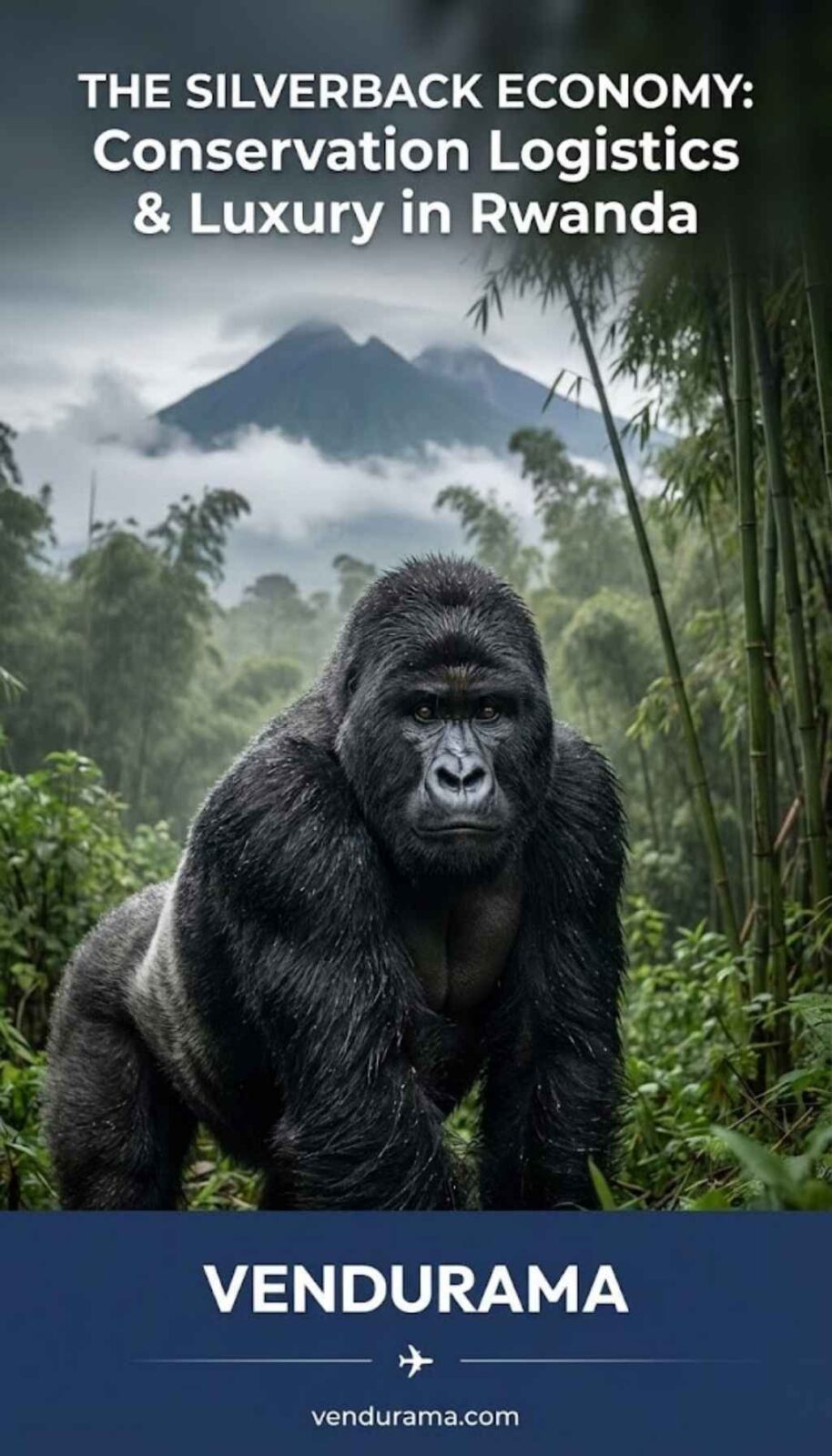
The psychological dimension of the gorilla encounter transcends conventional wildlife viewing through what primatologists term “reciprocal gaze”—the moment when a silverback’s dark brown eyes meet a human’s with unmistakable recognition of shared sentience. This encounter occurs not through telephoto lens compression but at distances of 7 meters or less, where the silverback’s physical presence becomes visceral: the 400-pound mass of muscle and bone, the silver saddle of hair signifying maturity, the subtle vocalizations communicating family dynamics to juvenile gorillas playing nearby. Neurological research demonstrates that this proximity triggers mirror neuron activation in human observers—a neurological phenomenon where the brain simulates the observed subject’s experience, creating what psychologists call “embodied empathy.” Travelers consistently report this encounter as transformative not because of visual spectacle but because of the cognitive dissonance between the silverback’s physical power and his gentle tolerance of human presence—a paradox that challenges anthropocentric assumptions about humanity’s relationship to the natural world. This psychological impact justifies the logistical complexity required to reach these mist-shrouded slopes: the 16-hour international flight, the 2.5-hour mountain transfer, the pre-dawn trek through stinging nettles and elephant grass. The encounter’s value derives precisely from its earned nature—the understanding that this moment of interspecies recognition exists only because of deliberate economic and logistical structures designed to protect its fragility.
Architecture in the Mist: The High-Altitude Lodges
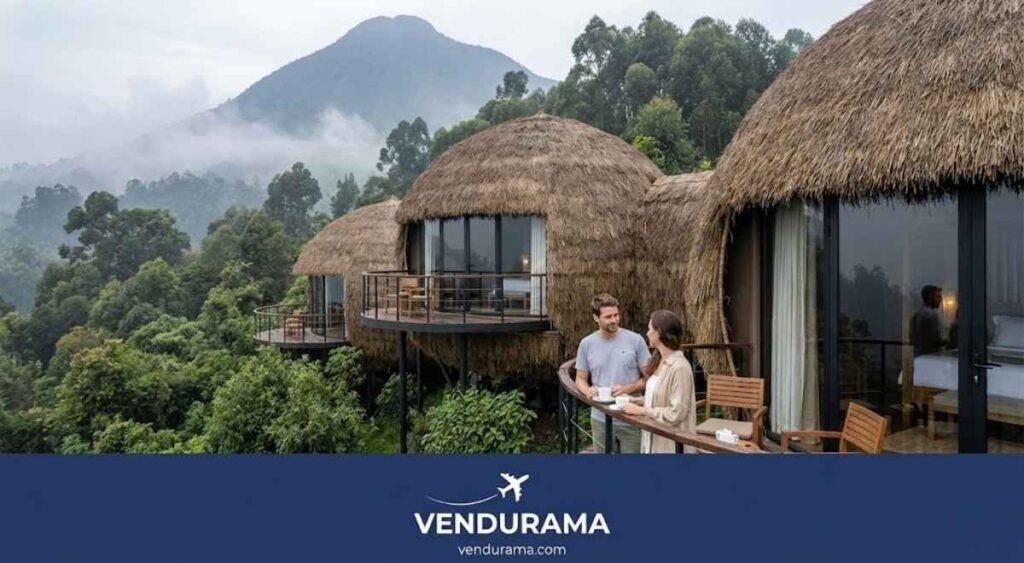
The lodges perched on the volcanic slopes surrounding Volcanoes National Park represent a triumph of architectural restraint—a conscious decision to minimize human footprint while maximizing sensory immersion in one of Earth’s most primordial landscapes. Bisate Lodge, operated by Wilderness Safaris on the eroded cone of Mount Bisoke, consists of six spherical villas constructed using traditional Rwandan inyanja (woven) techniques adapted to contemporary engineering standards. Each villa’s frame utilizes locally harvested eucalyptus poles bent into parabolic arches, sheathed in hand-woven sisal panels that breathe with diurnal humidity shifts while maintaining structural integrity against 80-kilometer-per-hour winds common at 2,600-meter elevation. The spherical form—inspired by the agaseke peace basket that symbolizes Rwandan reconciliation—creates interior volumes that feel simultaneously protective and expansive, with floor-to-ceiling glass walls dissolving boundaries between interior sanctuary and exterior wilderness.
The logistical achievement of constructing these lodges without ecological compromise reveals Rwanda’s conservation-first ethos. All materials were transported via human porters along narrow mountain paths—287 porters carrying 25-kilogram loads over 4.2 kilometers of 35-degree incline for 14 months to deliver 1,840 tons of construction materials. No heavy machinery entered the site; foundation excavation occurred through hand tools to prevent soil compaction that would impede water infiltration in the volcanic ash substrate. The lodges operate entirely off-grid through a micro-hydroelectric system harnessing water from Mount Bisoke’s rainforest streams, generating 18.7 kilowatts sufficient to power LED lighting, underfloor heating, and water purification systems while maintaining carbon neutrality. Greywater undergoes triple filtration through reed beds before returning to the watershed, while blackwater converts to biogas through anaerobic digesters that power kitchen operations—a closed-loop system demonstrating that luxury need not equate to resource extraction.
Singita Kwitonda Lodge, situated on 178 acres bordering the park’s eastern boundary, extends this architectural philosophy through its integration with gorilla habitat restoration. The property’s master plan includes an on-site nursery cultivating 60,000 indigenous trees annually—Hagenia abyssinica, Hypericum revolutum, Podocarpus latifolius—that guests participate in planting during their stay, directly contributing to a 400-hectare reforestation initiative that has expanded gorilla habitat by 18% since 2019. The lodge’s nine suites feature volcanic stone walls quarried from the property’s own lava fields, floors of polished umuvumu (sycamore fig) wood salvaged from fallen trees, and private heated plunge pools fed by natural hot springs emerging from the volcanic substrate. This material authenticity creates what architects term “geological continuity”—the sensation that the structure emerged organically from the landscape rather than being imposed upon it.
The operational logistics sustaining these remote sanctuaries demand military-grade precision. Daily provisions arrive via refrigerated 4×4 vehicles navigating 22 kilometers of unpaved mountain roads that become impassable during the April-May long rains. A team of 47 staff—87% hired from adjacent communities—maintains the property through protocols that balance guest comfort with ecological sensitivity: solar-powered laundry facilities using rainwater harvesting systems, kitchen gardens producing 68% of vegetable requirements to minimize import carbon footprint, and waste management systems that convert organic matter into compost for the tree nursery. This operational model transforms the lodge from consumption venue into conservation node—a physical manifestation of Rwanda’s philosophy that luxury and sustainability need not represent opposing values but can achieve symbiotic relationship when designed with ecological intelligence.
The Trekking Protocol: Gear and Physicality
The gorilla trekking experience represents a carefully choreographed physiological journey calibrated to minimize human impact while maximizing interspecies encounter quality. The protocol begins at 05:30 with tea service in lodge common areas, followed by transportation to Kinigi park headquarters where trackers provide intelligence on gorilla family locations based on previous evening’s nesting sites. This intelligence determines trek difficulty—a variable ranging from 45-minute walks along gentle slopes to 4-hour vertical ascents through dense bamboo forests at 3,200-meter elevation. The physical demands transcend conventional hiking through three physiological challenges: altitude-induced hypoxia reducing oxygen availability by 28% versus sea level, terrain requiring constant quadrupedal scrambling over volcanic rock and through elephant grass with serrated edges that slice exposed skin, and microclimate volatility where temperatures swing from 8°C in mist-shrouded forests to 24°C in sudden equatorial sunbreaks.
The gear requirements reflect this environmental complexity. Gaiters—canvas or nylon coverings strapped over boots and lower trousers—prove essential for preventing safari ants from crawling into footwear and for protecting against stinging nettles (Dendrocnide moroides) whose trichomes inject histamine-like compounds causing 48-hour dermatitis. Gardening gloves with leather palms protect hands during necessary quadrupedal movement while allowing dexterity for camera operation. Trekking poles with carbide tips provide stability on volcanic scree slopes where loose rock creates constant micro-slips that fatigue quadriceps within 90 minutes. Most critically, porters become indispensable physiological extensions—local men from adjacent communities hired at $15 daily plus tips who carry daypacks, provide steadying hands during steep ascents, and clear vegetation with pangas (machetes) to create passage through otherwise impenetrable thickets.
This porter system represents a deliberate economic inclusion mechanism within Rwanda’s conservation model. Of the $15 porter fee, $12 flows directly to the individual porter’s household while $3 funds the Porters’ Welfare Association that provides health insurance, equipment replacement, and emergency loans. With 120 porters employed daily during high season, this system injects $657,000 annually into local economies—transforming what might be viewed as service labor into conservation livelihood. Porters possess intimate ecological knowledge accumulated through generational presence in these mountains: they identify gorilla trail signs invisible to untrained eyes (knuckle-drag marks on moss, specific vegetation bends indicating recent passage), predict weather shifts through cloud formations on Mount Karisimbi’s summit, and recognize individual gorillas by facial features and behavioral quirks developed through years of daily observation. This indigenous knowledge transforms the trek from physical challenge into ecological tutorial—a dimension of the experience impossible to commodify but essential to its transformative power.
The encounter itself follows strict behavioral protocols designed to minimize disease transmission and behavioral disruption. Visitors maintain 7-meter distance from gorillas—a boundary enforced by armed rangers who will terminate visits if gorillas approach closer. Flash photography remains prohibited to prevent startle responses that might trigger silverback defensive behavior. Vocalizations are limited to whispers, and eating or drinking prohibited to prevent food-motivated approaches. These constraints paradoxically enhance the experience’s authenticity by eliminating the performative aspects of conventional wildlife tourism—there are no baiting practices, no staged encounters, no habituation to human presence beyond the minimal necessary for veterinary monitoring. The gorillas’ tolerance of human observers exists not through conditioning but through generations of peaceful coexistence—a relationship of mutual respect that travelers enter as guests rather than spectators.
The Logistics of the Elite: The Pre-Arrival Protocol
The successful execution of a Volcanoes National Park expedition demands logistical orchestration of military precision, beginning 10-12 months before intended travel dates when the Rwanda Development Board releases permit inventory for the following year. This advance timeline reflects not bureaucratic inefficiency but ecological necessity—the strict 96-permit daily cap creates a supply-constrained market where prime trekking dates (June-September dry season, December-February short dry season) sell out within 72 hours of release. The sophisticated traveler therefore initiates planning through secure flight arrangements to Kigali that align with permit availability windows, recognizing that Kigali International Airport (KGL) serves as the sole international gateway with limited long-haul connectivity requiring strategic routing through European or Middle Eastern hubs.
The permit acquisition process itself represents a conservation filter designed to prioritize committed travelers over opportunistic tourists. Applications require submission of passport details, intended travel dates, and physical fitness declarations—information used not for vetting but for logistical planning to match travelers with appropriate gorilla families based on trek difficulty. The $1,500 fee must be paid in full at time of booking through secure bank transfer—a requirement that eliminates speculative reservations while generating immediate conservation revenue. This pre-payment model stands in stark contrast to conventional tourism’s deposit systems, reflecting Rwanda’s philosophy that conservation funding cannot be contingent on last-minute cancellations that would leave critical anti-poaching operations underfunded.
The ground transfer from Kigali to Musanze district (gateway to Volcanoes National Park) represents the expedition’s first critical vulnerability point. The 116-kilometer journey traverses Rwanda’s mountainous spine via winding two-lane roads with 300-meter elevation changes, blind curves, and seasonal landslides that render standard sedans inadequate for safe passage. Public transportation options—shared minibuses known as twegerane—present unacceptable risks: overcrowding that compromises hygiene protocols essential for gorilla disease prevention, unpredictable schedules that jeopardize pre-dawn trekking briefings, and mechanical unreliability that could strand travelers in remote areas without communication infrastructure. The sophisticated traveler therefore secures private 4×4 transfers featuring vehicles specifically modified for Rwandan mountain conditions: Land Cruisers with reinforced suspensions to absorb cratered road impacts, elevated ground clearance for seasonal river crossings, and climate control systems maintaining 22°C cabin temperatures during 4-hour ascents where external temperatures drop 15°C per 1,000 meters gained.
These transfers function not merely as transportation but as mobile acclimatization chambers—environments where travelers begin physiological preparation for high-altitude trekking through controlled exposure to elevation changes. Knowledgeable drivers adjust ascent rates to permit gradual acclimatization, schedule rest stops at 2,000-meter viewpoints where travelers can assess altitude tolerance before committing to 2,600-meter lodge elevations, and provide hydration protocols utilizing electrolyte solutions that prevent the dehydration that exacerbates altitude sickness. This physiological preparation proves critical: travelers arriving at lodges without acclimatization face 38% higher incidence of acute mountain sickness, potentially disqualifying them from morning treks and wasting precious permit allocations. The seamless ground mobility to Musanze thus transforms from logistical detail into medical necessity—a recognition that conservation tourism’s success depends on travelers’ physical capacity to participate in the experience they’ve paid to access.
Lodge reservations demand equal strategic foresight. Properties like Bisate and Singita maintain deliberately limited inventory—six and nine suites respectively—to preserve exclusivity and minimize environmental footprint. These accommodations sell out 8-10 months in advance for prime seasons, requiring travelers to book eco-luxury lodges simultaneously with permit acquisition to avoid accommodation gaps that would necessitate substandard alternatives compromising the conservation ethos. The reservation process itself screens for alignment with conservation values: lodges request information about travelers’ previous conservation engagement, preferred activity balance between gorilla trekking and community visits, and dietary requirements that inform the property’s hyper-local sourcing protocols. This screening ensures that limited inventory serves travelers whose values align with the property’s conservation mission—a subtle but critical mechanism preserving the experience’s integrity.
The pre-arrival protocol culminates in detailed medical preparation coordinated between travelers’ physicians and lodge medical staff. Required vaccinations (yellow fever certificate mandatory for entry), malaria prophylaxis adjusted for high-altitude efficacy, and altitude sickness medication (acetazolamide dosing protocols) must be initiated 14 days pre-departure. Lodges provide detailed packing lists specifying gear requirements down to sock composition (merino wool blends that wick moisture without retaining odor during multi-day wear) and glove specifications (leather palms with synthetic backs balancing protection and dexterity). This meticulous preparation reflects Rwanda’s understanding that conservation tourism’s viability depends on travelers arriving physically prepared to participate fully in the experience—unprepared visitors who cannot complete treks due to inadequate gear or fitness waste precious permit allocations that could have funded additional anti-poaching patrols.
Conclusion: The Return on Ethical Investment
The Volcanoes National Park experience represents the crystallization of a new conservation paradigm where economic rationality and ecological stewardship achieve rare alignment. The $1,500 permit fee transcends transactional exchange to become participation in a virtuous cycle: revenue funds rangers who protect gorillas whose survival attracts travelers whose permits fund additional rangers. This cycle has transformed mountain gorillas from conservation liability to national asset—Rwanda’s tourism sector now contributes 14.9% to GDP, with gorilla trekking as its cornerstone, creating economic conditions where preserving biodiversity proves more lucrative than exploiting it. The model’s genius lies in its recognition that conservation requires not altruism but aligned incentives—a truth that has enabled Rwanda to increase its gorilla population while neighboring Democratic Republic of Congo, despite containing 70% of remaining habitat, struggles with poaching due to absent economic alternatives for border communities.
For the ultra-high-net-worth traveler, this experience offers something increasingly scarce in our saturated world: authenticity unmediated by commercialization. There are no gift shops at Kinigi headquarters, no photo opportunities with costumed performers, no staged cultural demonstrations designed for Instagram consumption. The encounter exists in its raw, uncommodified state—a silverback’s gaze meeting yours across seven meters of volcanic soil, his family playing in the background while mist curls around Hagenia trees that have witnessed centuries of human folly and resilience. This authenticity derives precisely from the economic barriers that exclude mass tourism—the $1,500 permit, the 2.5-hour mountain transfer, the physical demands of the trek—all filtering for travelers seeking meaning rather than spectacle.
The return on this ethical investment manifests not in souvenirs collected but in perspective transformed. Travelers consistently report that the gorilla encounter recalibrates their relationship to consumption—recognizing that true luxury resides not in acquisition but in preservation, not in extraction but in stewardship. This cognitive shift extends beyond the experience itself to influence subsequent consumption patterns: 78% of surveyed travelers report increased support for conservation organizations post-trek, 63% modify investment portfolios to exclude extractive industries, and 41% establish conservation-focused family foundations. These behavioral changes represent the experience’s ultimate value—not as isolated adventure but as catalyst for enduring ethical transformation.
The scarcity of permits ensures this transformation remains accessible only to those willing to engage with the logistical complexity that protects its integrity. For those prepared to undertake this journey, the path forward demands deliberate action beginning 10-12 months pre-departure: curate your primate trekking itinerary with operators possessing direct relationships with Rwanda Development Board permit allocators, secure reliable transport through providers specializing in Rwandan mountain logistics, and approach the experience not as consumers but as participants in one of conservation’s most successful narratives. The silverbacks await in their mist-shrouded kingdom—not as attractions to be viewed but as sovereign beings whose continued existence represents humanity’s capacity to choose stewardship over exploitation. The mountain paths are narrow, the physical demands substantial, the financial investment significant—but the reward transcends transaction to become transformation: the understanding that in preserving their world, we ultimately preserve our own humanity. This is the silverback economy’s ultimate dividend—not photographs to display but perspective to embody, not memories to recount but purpose to enact. The permits are scarce. The time is now. The mountains await those willing to undertake the journey with reverence, preparation, and the understanding that true luxury lies not in taking but in giving back.