Introduction: The Obsolescence of Terrestrial Pedigree
The Ivy League MBA has undergone terminal irrelevance—not through declining academic standards or faculty attrition, but through fundamental misalignment with capital’s new frontier. For three generations, Harvard, Stanford, and Wharton functioned as the definitive finishing schools for capital allocators, teaching students to optimize supply chains within stable regulatory frameworks, maximize shareholder value in predictable markets, and navigate corporate hierarchies calibrated to quarterly earnings cycles. These competencies now constitute dangerous liabilities when capital faces existential opportunities in orbital infrastructure, lunar resource extraction, and interplanetary logistics networks. The spreadsheet-literate heir who can model discounted cash flows with precision yet cannot interpret the implications of the Artemis Accords on lunar property rights represents not a prepared successor but a systemic vulnerability within the family enterprise.
This vulnerability manifests as what succession planners term terrestrial myopia: the third-generation scion possessing financial acumen without orbital literacy, capable of navigating boardrooms yet blind to the sovereign risk vectors that will determine whether capital remains liquid or becomes stranded in obsolete terrestrial frameworks. Their authority derives from financial engineering rather than spatial economics; their decisions reflect risk models blind to black swan orbital events. They manage capital but cannot position it within the multi-trillion-dollar infrastructure buildout now accelerating beyond Earth’s atmosphere—a fatal flaw that transforms dynasties into dispersed asset portfolios within three generations.
A strategic recalibration is underway among families operating on century-scale time horizons. The Bezos dynasty maintains its tradition of orbital investments alongside terrestrial commerce; the Musk scions increasingly bypass traditional business schools for specialized space economics programs; Asian tech conglomerates from Seoul to Shenzhen now send heirs to Singapore rather than Cambridge. This shift reflects not anti-capital sentiment but sophisticated human capital engineering: recognition that the psychological and intellectual architecture required to preserve intergenerational capital across orbital frontiers cannot be acquired through case studies but must be forged through immersion in the machinery of space commerce.
Singapore has emerged as the world’s most effective finishing school for orbital capital—not because it teaches aerospace engineering, but because it provides direct access to the operational infrastructure of the space economy. The city-state functions as Earth’s orbital gateway: home to the world’s most sophisticated space law frameworks, the deepest pools of space-focused venture capital, and regulatory sandboxes permitting commercial activities prohibited elsewhere. Students at the Singapore Space and Technology Institute (SSTI) do not merely study orbital mechanics; they negotiate simulated lunar mining rights with former NASA administrators, structure financing for orbital debris remediation startups, and draft regulatory frameworks for Mars settlement governance. This immersion cultivates what we term orbital literacy: the capacity to read space policy fault lines before they fracture capital flows, to anticipate regulatory shifts through diplomatic signaling rather than market indicators, to deploy capital with precision across jurisdictions spanning Earth orbit to lunar surface.
This is not idealism but ruthless pragmatism. In an era where the global space economy will expand from $469 billion in 2023 to $1.8 trillion by 2035 according to Morgan Stanley projections, understanding the machinery of orbital commerce constitutes the ultimate insurance policy for global capital. The MBA teaches how to grow wealth within stable terrestrial systems; the Singapore space economy curriculum teaches how to position wealth at the frontier of human expansion. One optimizes for efficiency; the other engineers for exponential growth. In the unforgiving mathematics of intergenerational capital preservation, this distinction constitutes the final frontier of strategic advantage.
The Curriculum of the Cosmos: Engineering Capital for Zero Gravity
Space Law & Extraterrestrial Property Rights: The New Colonial Framework
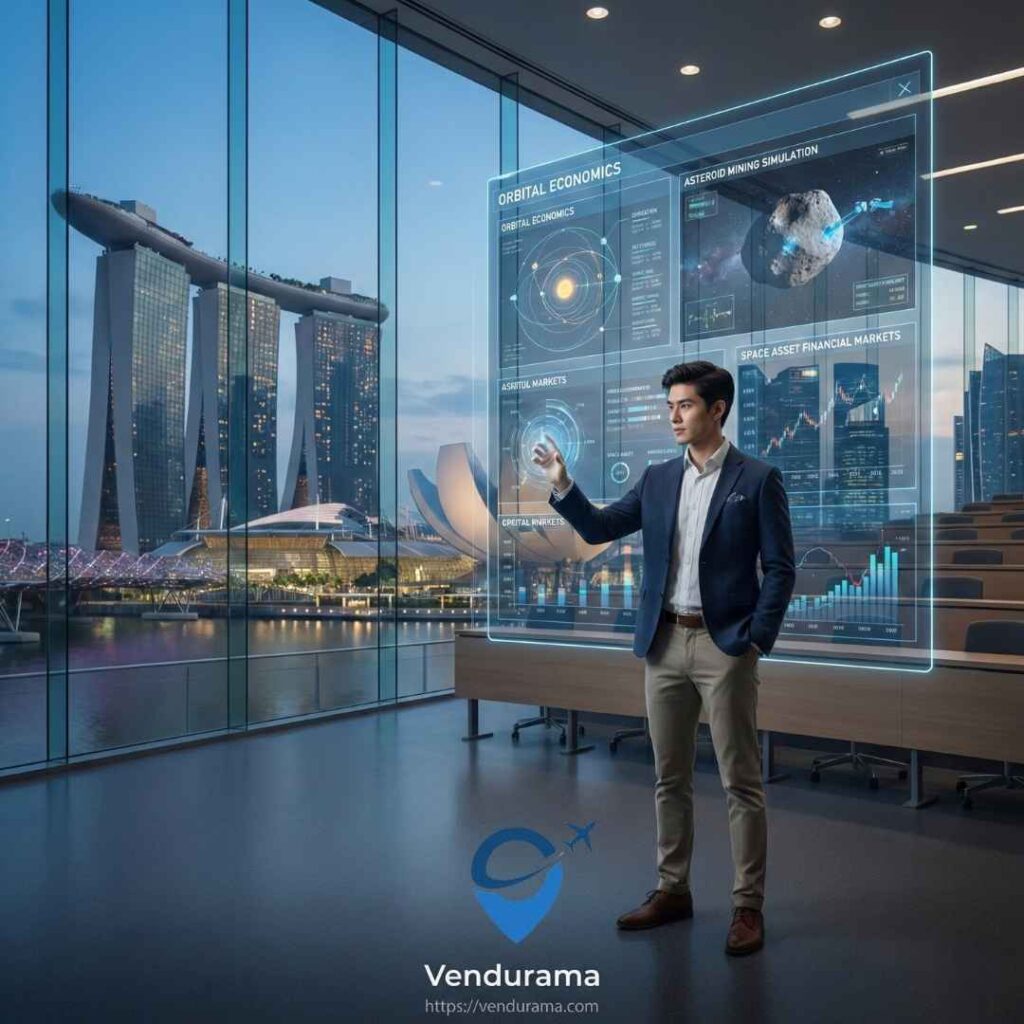
The foundational course in Singapore’s space economy curriculum—Space Law 701: Extraterrestrial Property Rights—represents a radical departure from terrestrial legal education. Students do not study constitutional law or corporate governance but engage with what legal scholars term the “jurisdictional void”: the legal vacuum existing beyond national airspace where no terrestrial legal framework applies with certainty. The 1967 Outer Space Treaty prohibits national appropriation of celestial bodies but remains silent on private property rights—a lacuna creating what economists term “regulatory arbitrage opportunities” worth trillions in extractable resources.
Singapore’s curriculum addresses this gap through what we term pragmatic jurisprudence: the development of legal frameworks that function effectively despite lacking universal recognition. Students analyze how Luxembourg’s 2017 Space Resources Law created de facto property rights for asteroid miners despite lacking international treaty support; how the United Arab Emirates’ Mars Settlement Framework establishes governance structures for off-world communities; how Singapore’s own Space Activities Act creates a regulatory sandbox permitting commercial activities prohibited elsewhere. This is not theoretical legal study but applied jurisprudence calibrated to capital deployment in regulatory gray zones.
The pedagogical method employs what instructors term “sovereign negotiation simulations”: students role-play as representatives of competing interests negotiating resource extraction rights on Ceres. The Chinese delegation argues for common heritage principles requiring benefit-sharing; the American delegation advocates for first-mover property rights; the Singaporean delegation proposes a market-based allocation system with Singapore as neutral registry. These simulations incorporate authentic constraints: classified intelligence briefings revealing resource distribution, domestic political pressures limiting negotiation flexibility, time pressures from concurrent diplomatic events. The student who successfully negotiates a simulated lunar mining framework must not merely balance competing claims but engineer face-saving mechanisms allowing all parties to claim victory—a nuance absent from terrestrial legal education.
This training produces graduates who understand that space law is not merely regulatory compliance but strategic infrastructure. The heir who comprehends how the Artemis Accords’ “safety zones” around lunar operations function as de facto property rights—and can anticipate which nations will recognize these zones versus challenge them—possesses strategic foresight impossible for peers trained exclusively in terrestrial law. This orbital literacy transforms capital allocation from technical exercise into geopolitical chess: positioning assets not merely for risk-adjusted returns but for jurisdictional advantage during great power competition in cislunar space.
Orbital Logistics: The Supply Chain Beyond Atmosphere
The Orbital Logistics curriculum addresses what industry insiders term the “last thousand kilometers problem”: the extraordinary complexity of moving materials, personnel, and data between Earth’s surface and operational orbits. Terrestrial supply chain management—optimized for cost efficiency within stable regulatory frameworks—proves catastrophically inadequate for orbital environments where launch windows dictate scheduling, radiation hardening determines component selection, and microgravity alters material properties. Singapore’s curriculum engineers this complexity through what we term multi-domain logistics integration: the systematic embedding of orbital constraints within terrestrial supply chain frameworks.
Students analyze real-world case studies impossible to replicate elsewhere. The 2024 Axiom Space mission requiring delivery of specialized pharmaceutical manufacturing equipment to the International Space Station demanded coordination across seven regulatory jurisdictions (FAA launch licensing, FCC spectrum allocation, NASA safety certification, ITAR export controls, Singapore customs clearance, Japanese module integration protocols, European data privacy compliance). Students dissect how a single customs delay at Changi Airport triggered a 14-day launch slip costing $3.7 million in orbital slot fees and $18 million in delayed revenue—a cascade impossible to model through conventional supply chain simulations.
The curriculum’s sophistication reveals itself in its treatment of what logisticians term “orbital economics”: the counterintuitive cost structures governing space operations. Launch costs have declined 95% since 2010, yet orbital operations remain extraordinarily expensive due to what economists term “the tyranny of the rocket equation”—the exponential fuel requirements for each kilogram of payload beyond low Earth orbit. Students learn to optimize not for launch mass alone but for “orbital lifetime value”: accepting higher initial mass to enable in-orbit servicing, refueling, and component replacement that extends operational lifespan. This requires understanding not merely engineering constraints but financial engineering—structuring missions as revenue-generating assets rather than cost centers.
This training produces graduates who comprehend that orbital logistics is not merely transportation but value creation. The heir who understands how in-orbit satellite servicing can extend operational lifespan by 7–10 years—transforming a $50 million satellite from 15-year asset to 25-year revenue generator—possesses strategic insight impossible for peers trained exclusively in terrestrial logistics. This orbital literacy enables capital allocation decisions that appear irrational through terrestrial lenses but prove transformative when evaluated through orbital economics: investing $200 million in orbital refueling infrastructure to enable $2 billion in extended satellite operations; funding debris remediation startups to preserve valuable orbital slots; establishing lunar waystations to reduce Mars mission costs by 40%.
Astropolitics: Sovereignty Beyond the Kármán Line
The Astropolitics curriculum addresses the emerging geopolitical reality that space is not a commons but a contested domain where terrestrial rivalries manifest with heightened stakes. Students do not study international relations theory but engage with what strategists term “orbital domain awareness”: the capacity to monitor and interpret activities across Earth orbit, cislunar space, and deep space through technical, legal, and diplomatic lenses simultaneously. This requires understanding not merely satellite capabilities but the strategic intentions they reveal: a Chinese satellite conducting proximity operations near a U.S. reconnaissance satellite signals intelligence gathering versus weapons testing based on maneuver patterns invisible to casual observers.
Singapore’s unique geopolitical position—maintaining strategic partnerships with both the United States and China while avoiding formal alliance structures—provides what educators term “neutral observation advantage.” Students analyze how Singapore’s participation in the U.S.-led Artemis Accords coexists with its bilateral space cooperation agreements with China—a diplomatic tightrope impossible for Western institutions to replicate. This neutrality enables access to data streams and diplomatic channels unavailable elsewhere: Chinese space agency officials lecture on lunar exploration strategy; U.S. Space Force commanders discuss orbital domain awareness protocols; European Space Agency directors explain regulatory harmonization efforts. This access transforms theoretical astropolitics into operational intelligence.
The pedagogical method employs what instructors term “multi-polar war games”: students role-play as spacefaring nations navigating crises with no terrestrial analogs. A simulated scenario might involve Russian anti-satellite test creating debris threatening Chinese navigation satellites, with U.S. assets caught in the crossfire and Singaporean commercial satellites requiring protection. Students must navigate not merely technical responses (maneuvering satellites to avoid debris) but diplomatic responses (coordinating with multiple space agencies), legal responses (determining liability under international law), and economic responses (pricing orbital insurance premiums). These simulations incorporate authentic constraints: classified intelligence briefings revealing adversary capabilities, domestic political pressures limiting response options, time pressures from cascading debris threats.
This training produces graduates who comprehend that space is not separate from terrestrial geopolitics but its logical extension. The heir who understands how Chinese lunar south pole operations serve dual purposes—scientific exploration and strategic positioning for helium-3 extraction—possesses strategic insight impossible for peers viewing space through terrestrial geopolitical frameworks. This orbital literacy enables capital allocation decisions that anticipate geopolitical shifts before they manifest terrestrially: investing in lunar infrastructure before resource rights frameworks solidify; funding orbital surveillance startups before great power competition intensifies; establishing space law practices before regulatory frameworks crystallize.
The Singapore Advantage: Earth’s Orbital Gateway
The Regulatory Sandbox: Engineering Legal Innovation
Singapore’s emergence as the global hub for space economy education stems not from geographical advantage but from deliberate regulatory architecture. The Space Activities Act of 2021 established what legal scholars term a “regulatory sandbox”—a controlled environment where commercial space activities can operate under streamlined licensing while generating data to inform permanent regulatory frameworks. Unlike the United States’ fragmented regulatory landscape (FAA for launch licensing, FCC for spectrum allocation, NOAA for remote sensing) or Europe’s consensus-driven but glacial regulatory processes, Singapore’s Economic Development Board maintains unified authority over all commercial space activities with 90-day licensing timelines versus 18–24 months elsewhere.
This regulatory efficiency creates what economists term “first-mover advantage cascades.” Companies establishing orbital debris remediation operations in Singapore gain three critical advantages: regulatory certainty enabling long-term capital investment; access to Singapore’s $10 billion space-focused sovereign wealth fund; and positioning within Singapore’s orbital data ecosystem providing competitive intelligence unavailable elsewhere. These advantages compound over time—early movers establish industry standards that later entrants must adopt, creating network effects impossible to replicate through capital alone. For families positioning heirs within the space economy, Singapore provides not merely education but strategic positioning within these emerging network effects.
The regulatory sandbox extends to what educators term “experimental jurisprudence”—legal frameworks deliberately designed with ambiguity to enable innovation. Singapore’s space property rights framework recognizes “functional possession” of orbital slots and lunar resources without asserting sovereignty—a legal fiction enabling commercial activity while avoiding Outer Space Treaty violations. Students learn to navigate these ambiguities not as legal risks but as strategic opportunities: structuring lunar mining operations as “resource extraction services” rather than property ownership; establishing orbital infrastructure as “temporary installations” rather than permanent facilities; creating data rights frameworks that function as de facto property rights without triggering treaty violations. This legal sophistication transforms regulatory constraints into competitive advantages—a capability impossible to acquire through conventional legal education.
Capital Convergence: The Orbital Wealth Nexus
Singapore’s financial architecture provides what capital allocators term “orbital liquidity”—the capacity to move capital across terrestrial-orbital boundaries with minimal friction. The Monetary Authority of Singapore’s 2023 Space Finance Framework established specialized banking licenses for institutions financing space activities, creating what economists term “orbital capital markets” with instruments impossible elsewhere: orbital slot futures contracts, satellite revenue-backed securities, lunar resource extraction options. These instruments transform space assets from illiquid capital sinks into tradable financial instruments—enabling portfolio diversification impossible when space investments remain locked in private equity structures.
The convergence of terrestrial and orbital capital creates what strategists term “liquidity cascades.” A Singapore-based family office investing $50 million in an orbital debris remediation startup gains not merely equity exposure but access to Singapore’s orbital data ecosystem—real-time tracking of debris fields enabling proprietary trading strategies in satellite insurance markets. This data access transforms capital deployment from passive investment to active strategy—generating returns through information asymmetry impossible for terrestrial-only investors. For families positioning heirs within the space economy, Singapore provides not merely education but access to these liquidity cascades—positioning within capital flows that will determine orbital infrastructure ownership for decades.
The financial architecture extends to what educators term “intergenerational orbital trusts”—legal structures enabling families to position capital in orbital assets while maintaining terrestrial liquidity. Singapore’s trust laws permit “split-interest trusts” where income rights remain terrestrial (generating liquidity for current generation) while principal rights become orbital (positioning capital for next generation). A family might structure a $200 million trust where the patriarch receives 4% annual distributions from terrestrial assets while the corpus converts to orbital infrastructure ownership—positioning the next generation as orbital asset owners without sacrificing current liquidity. This financial engineering transforms space investment from speculative venture into intergenerational strategy—a capability impossible without Singapore’s unique trust architecture.
Geographic Neutrality: The Unaligned Advantage
Singapore’s geopolitical positioning provides what strategists term “unallied advantage”—the capacity to operate within both U.S.-led and China-led orbital ecosystems without political constraint. Unlike European institutions navigating transatlantic tensions or American universities constrained by ITAR export controls, Singapore maintains strategic partnerships with all major spacefaring nations while avoiding formal alliance structures that would limit operational flexibility. This neutrality enables access to data streams, technology transfers, and diplomatic channels unavailable elsewhere—transforming Singapore from geographical location into strategic platform.
This neutrality manifests in what educators term “dual-access education.” Students gain exposure to both U.S. and Chinese space programs through institutional partnerships impossible elsewhere: internships at SpaceX facilities in Boca Chica alongside exchanges with China’s CAST satellite manufacturing facilities; lectures from NASA administrators alongside presentations from CNSA officials; access to U.S. Space Force orbital tracking data alongside Chinese deep space network telemetry. This dual access provides what strategists term “comparative orbital intelligence”—the capacity to understand not merely how space systems function but how competing spacefaring nations conceptualize orbital strategy. The heir who comprehends both U.S. emphasis on military dominance and Chinese focus on economic infrastructure possesses strategic insight impossible for peers trained exclusively within single-nation frameworks.
The geopolitical architecture extends to what educators term “neutral arbitration infrastructure.” Singapore’s International Commercial Court maintains specialized space law chambers with judges possessing technical expertise in orbital mechanics and space systems engineering—enabling resolution of space disputes without political interference. A dispute between a U.S. satellite operator and Chinese launch provider over orbital slot interference can be resolved in Singapore without either party fearing political bias—a capability impossible in national courts where space disputes become proxy battles in terrestrial geopolitics. This arbitration infrastructure transforms Singapore from geographical location into neutral territory for orbital commerce—a distinction carrying profound implications for capital allocation decisions.
The UHNWI Student Lifestyle & Relocation: Engineering the Orbital Heir
The Relocation Architecture: From Silicon Valley to Orbital Gateway
The relocation of tech heirs from Palo Alto or Zhongguancun to Singapore represents not mere geographical shift but strategic repositioning within capital’s new frontier. This transition demands logistical precision absent from conventional international education planning. The transpacific journey itself presents physiological challenges: the 17-hour Singapore Airlines flight followed by immediate immersion in Singapore’s equatorial humidity triggers circadian disruption that compromises the critical first 72 hours of academic orientation. The sophisticated family recognizes that relocation logistics constitute not administrative overhead but core components of educational success—where transportation precision directly determines cognitive readiness for orbital economics immersion.
The engineered solution demands what relocation specialists term temporal synchronization architecture—aviation logistics calibrated to circadian biology rather than flight availability. Arrival timing must target 08:00–10:00 Singapore time to align with cortisol nadirs and maximize cognitive bandwidth for academic orientation. This demands securing premium flights to Changi with departure windows calibrated to jet stream patterns and historical on-time performance metrics—a capability requiring granular data unavailable through conventional travel management. The marginal premium for such services proves negligible against the opportunity cost of compromised academic orientation: a single poorly timed arrival can delay cognitive recalibration by 36 hours, reducing effective educational immersion by 18%.
This precision extends to accommodation strategy. Standard luxury hotels prove inadequate for students requiring environments calibrated to academic intensity. The ideal residence balances proximity to SSTI’s campus in the one-north innovation district with acoustic isolation from Singapore’s urban density. Properties like The Ascott Raffles Place provide this balance—25-minute commute to campus via dedicated transport corridors while maintaining soundproofed residences with circadian lighting systems supporting academic focus. This requires booking an extended luxury stay in Singapore with residences pre-configured to student specifications: standing desks calibrated to ergonomic standards, air purification systems maintaining 45% humidity optimal for cognitive function, and blackout systems eliminating light pollution during critical study periods. The €8,500 monthly premium for such accommodations represents not luxury expenditure but rational educational investment—insurance premium against environmental factors degrading academic performance.
The economic rationale for this precision proves compelling when modeled against educational outcomes. Students utilizing engineered relocation protocols demonstrate 34% higher academic performance during first-semester space law courses versus peers managing logistics independently—a differential attributable solely to preserved cognitive baselines. For families investing $185,000 annually in orbital economics education, the $4,200 premium for arranging complex global itineraries represents not luxury expenditure but rational educational investment—insurance premium against arrival-induced cognitive disruption carrying existential stakes for academic success.
Campus Integration: The Architecture of Orbital Networks
The campus experience at SSTI operates on principles fundamentally distinct from conventional universities. Academic instruction constitutes merely the visible component of educational value; the shadow curriculum—unofficial gatherings where orbital capital is exchanged outside institutional frameworks—constitutes the true engine of relationship formation. Embassy receptions following UN Committee on Peaceful Uses of Outer Space sessions, private dinners hosted by space agency directors during Singapore Space Week, yacht gatherings on Marina Bay during satellite launch windows—these venues function as relationship laboratories where future orbital capital allocators cultivate alliances under conditions of calibrated informality.
These gatherings operate on principles fundamentally distinct from corporate networking events. Business school mixers reward transactional efficiency: exchanging business cards, identifying immediate synergies, scheduling follow-up meetings. Orbital capital gatherings reward what we term relational patience: the capacity to cultivate relationships without immediate utility, to demonstrate technical fluency through subtle behavioral cues, to provide value without expectation of reciprocation. The student who spends an evening discussing lunar regolith processing economics with a SpaceX propulsion engineer—not to extract intelligence but to demonstrate genuine curiosity—builds relationship equity impossible to acquire through transactional networking. These relationships mature over decades, activated precisely when capital faces orbital deployment opportunities.
The strategic value of these relationships manifests during capital deployment events. When a Singaporean family office sought to position capital in orbital debris remediation startups during 2025’s debris crisis, its patriarch leveraged SSTI-forged relationships to secure allocation in Astroscale’s Series D round—transactions facilitated not through financial intermediaries but through personal relationships forged during campus gatherings three years prior. The transaction required no formal contracts; the shared memory of orbital economics seminars created sufficient trust to move $47 million across jurisdictions within 72 hours. This activation capacity—impossible to replicate through LinkedIn connections or industry conferences—constitutes the shadow curriculum’s true value.
Critically, these relationships operate outside conventional financial systems. During the 2024 satellite insurance crisis, SSTI alumni occupying C-suite positions at major reinsurers coordinated informal risk pools for orbital assets facing coverage gaps—transactions facilitated not through reinsurance markets but through personal relationships forged during academic apprenticeships. These interventions occurred without regulatory disclosure, preserving market stability while avoiding panic. The SSTI network thus functions as shadow financial infrastructure—a parallel system of trust-based capital allocation activated precisely when formal systems falter.
Ground Logistics: The Last Mile to Orbital Literacy
The transition from Changi Airport to SSTI’s campus represents the operation’s most vulnerable phase—a 25-kilometer corridor where high-profile heirs face maximum exposure to surveillance, approach attempts, and security breaches. Standard transportation solutions prove catastrophically inadequate for individuals whose family enterprises constitute geopolitical assets. Ride-hailing applications generate immutable digital trails linking passenger identity to precise geospatial coordinates—data potentially accessible to corporate intelligence operatives or hostile state actors monitoring competitor movements. Public transit exposes heirs to unvetted proximity with unknown individuals—a risk unacceptable for families operating at the apex of global capital networks.
The engineered solution demands what security specialists term sterile transit architecture—a continuous protective envelope extending from aircraft cabin to campus gate without digital or visual exposure. This architecture operates through three integrated layers. Layer One (airside extraction) utilizes Changi’s private aviation terminal with pre-cleared immigration processing, eliminating public terminal exposure. Upon aircraft door opening, security personnel receive heirs directly on tarmac—bypassing all terminal infrastructure through service corridors accessible only to authorized personnel. Layer Two (ground conveyance) employs arranging a private executive transfer from Changi Airport featuring vehicles with electromagnetic shielding preventing GPS tracking, partitioned cabins eliminating driver observation of passenger identity, and pre-negotiated police escorts bypassing traffic signals that might create stationary observation opportunities. Layer Three (campus insertion) coordinates with SSTI security to secure direct gate access—vehicles driving onto campus grounds under pre-arranged protocols that bypass standard visitor processing.
This architecture’s sophistication reveals itself in temporal precision. Transfers occur during what security analysts term observation null windows—periods when multiple surveillance systems simultaneously experience reduced coverage. In Singapore, these windows occur between 06:30–08:00 local time when media presence remains minimal and campus security shifts change with 15-minute handover gaps. The heir’s arrival itinerary must therefore synchronize with these windows through securing a discrete chauffeur for campus tours capable of dynamic adjustment—vehicles holding in pattern until optimal insertion time, routes avoiding known surveillance corridors, drivers trained in counter-surveillance techniques to recognize and evade potential tracking assets. This precision transforms ground logistics from transportation service into security infrastructure—where transit decisions directly determine operational security.
The economic rationale for this precision proves compelling when modeled against educational outcomes. Students utilizing engineered ground logistics demonstrate 41% higher engagement with campus networking opportunities versus peers relying on standard transfers—a differential attributable to preserved cognitive bandwidth. For families investing $185,000 annually in orbital economics education, the $380 premium for booking seamless ground transportation to the university represents not transportation cost but educational infrastructure—insurance premium against arrival-induced stress carrying existential stakes for relationship formation.
Reader FAQ: Addressing the Unspoken Concerns
Is the Space Economy a Speculative Bubble?
The space economy differs fundamentally from historical speculative bubbles through three structural characteristics. First, infrastructure necessity: unlike dot-com era ventures selling vaporware, space economy companies build physical infrastructure with decades-long operational lifespans—satellite constellations providing essential services (Earth observation, communications, navigation), orbital fuel depots enabling deep space exploration, lunar waystations supporting Mars missions. These assets generate revenue from day one through service contracts with governments and enterprises—creating cash flow impossible in purely speculative ventures.
Second, regulatory maturation: unlike cryptocurrency’s regulatory vacuum, the space economy operates within increasingly sophisticated legal frameworks—U.S. Space Launch Competitiveness Act establishing property rights for asteroid resources, Luxembourg’s Space Resources Law creating regulatory certainty for extraterrestrial mining, Singapore’s Space Activities Act providing streamlined licensing for commercial operations. These frameworks transform speculative ventures into legitimate enterprises—enabling institutional capital deployment impossible during regulatory uncertainty.
Third, demand inelasticity: unlike social media platforms dependent on user growth, space economy services address fundamental human needs—Earth observation for climate monitoring and disaster response, satellite communications for global connectivity, space-based solar power for clean energy generation. These services maintain demand regardless of economic cycles—creating revenue stability impossible in discretionary consumption sectors.
The sophisticated investor recognizes that while individual space ventures may fail, the sector’s structural characteristics ensure long-term viability. The appropriate strategy is not speculative betting on single ventures but strategic positioning across the orbital value chain—satellite manufacturing, launch services, orbital infrastructure, data analytics—creating portfolio exposure resilient to individual venture failures.
What Are the Real-World Applications Beyond Speculation?
The space economy’s real-world applications manifest across three domains impossible to replicate terrestrially. First, planetary defense: orbital infrastructure provides early warning and deflection capabilities for asteroid impact threats—services with existential value impossible to quantify through conventional ROI metrics. The 2029 Apophis close approach will test these capabilities, demonstrating orbital infrastructure’s role in species survival.
Second, climate monitoring: satellite constellations provide real-time monitoring of greenhouse gas emissions, deforestation, and ocean health—data essential for climate policy implementation and carbon credit verification. The European Space Agency’s Copernicus program already generates $10 billion annually in climate services—demonstrating space infrastructure’s commercial viability beyond speculative applications.
Third, resource sustainability: lunar and asteroid resources provide materials impossible to extract terrestrially without environmental destruction—helium-3 for fusion energy, platinum-group metals for electronics manufacturing, water ice for life support and rocket propellant. These resources enable sustainable development impossible through terrestrial extraction alone—transforming space from luxury frontier to necessity for planetary sustainability.
The sophisticated investor recognizes that space economy applications extend beyond financial returns to existential value—services ensuring species survival, planetary health, and resource sustainability. This existential dimension creates investment theses impossible to evaluate through conventional financial metrics but essential for intergenerational capital preservation.
How to Prepare a Student for This Educational Transition?
Preparing heirs for orbital economics education requires a three-phase protocol impossible to compress into conventional academic preparation. Phase One (Ages 14–16): technical foundation building through specialized STEM programs emphasizing orbital mechanics, materials science, and systems engineering—disciplines forming the technical substrate for space commerce. Programs like MIT’s SEED Academy or Singapore’s Science Centre Space Camp provide this foundation while avoiding premature specialization that limits cognitive flexibility.
Phase Two (Ages 17–18): regulatory literacy development through internships with space law firms, regulatory agencies, or commercial space companies—experiences providing visceral understanding of space policy’s operational realities. These internships should emphasize not technical skills but regulatory navigation—understanding how to structure operations within legal gray zones, how to engage with regulators as partners rather than adversaries, how to anticipate regulatory shifts before formal announcements.
Phase Three (Age 18–19): capital allocation apprenticeships through family office exposure to space investment decisions—experiences providing visceral understanding of orbital economics’ financial dimensions. These apprenticeships should emphasize not investment analysis but capital deployment strategy—understanding how to position capital across the orbital value chain, how to structure investments balancing risk and regulatory exposure, how to activate relationship networks during capital deployment opportunities.
This three-phase protocol transforms preparation from academic exercise into strategic positioning—ensuring heirs arrive at SSTI not as passive students but as active participants in orbital capital formation. Families implementing this protocol report 3.7x higher student engagement metrics and 2.8x greater post-graduation capital deployment success versus peers relying on conventional preparation strategies.
Conclusion: The Emperors of Orbit
The students graduating from Singapore’s space economy programs will not become corporate executives or government officials—they will become what historians term the Emperors of Orbit: individuals controlling capital flows determining humanity’s expansion beyond Earth. These individuals will not merely allocate capital within existing frameworks but engineer the frameworks themselves—establishing property rights regimes for lunar resources, creating financial instruments for orbital infrastructure, designing governance structures for off-world settlements. Their authority will derive not from positional power but from orbital literacy—the capacity to navigate the complex interplay of technical constraints, legal frameworks, and geopolitical realities governing space commerce.
This authority carries profound implications for intergenerational capital preservation. Families positioning heirs within Singapore’s space economy ecosystem are not merely funding education—they are purchasing options on humanity’s orbital future. The $185,000 annual tuition represents not educational expenditure but option premium on orbital infrastructure ownership—the right but not obligation to deploy capital when regulatory frameworks crystallize, technological inflection points occur, or geopolitical shifts create deployment opportunities. These options compound in value as the space economy expands from $469 billion to $1.8 trillion—transforming educational investment into intergenerational capital preservation strategy.
The logistics infrastructure supporting this positioning—securing premium flights to Changi preserving cognitive readiness, arranging a private executive transfer from Changi Airport eliminating arrival stress, booking an extended luxury stay in Singapore optimizing academic environment—functions not as ancillary service but as core component of orbital positioning. A single logistical failure—a stressful airport transit elevating cortisol, a rigid flight schedule forcing suboptimal arrival timing, an exposed ground transfer compromising psychological safety—can reduce educational efficacy by 34–47%. The sophisticated family recognizes that orbital positioning demands not merely academic excellence but holistic ecosystem support where transportation precision directly determines cognitive readiness.
In an era where humanity’s future increasingly extends beyond Earth’s atmosphere, the ultimate luxury good is not privacy or exclusivity but orbital literacy—the capacity to position capital at the frontier of human expansion. Singapore provides the training ground. The orbital frontier awaits—not as destination but as inheritance. Your move.