
Introduction: The Death of the Azure Dream
The Mediterranean summer of 2026 has become a cautionary tale of luxury’s self-immolation. What was once the theater of discreet wealth—the Côte d’Azur’s hidden calanques, Sardinia’s untouched coves, the Amalfi Coast’s lemon-scented cliffs—has devolved into a congested spectacle of hyper-visibility. The azure waters now host a flotilla of identical 70-meter superyachts, their tenders forming traffic jams between Saint-Tropez and Portofino, while the shorelines pulse with the bass frequencies of open-air nightclubs broadcasting to satellites. This is not leisure; it is performance anxiety masquerading as vacation—a relentless theater where the primary currency is not relaxation but social validation through conspicuous presence.
The final rupture occurred during the summer of 2025, when a sustained heat dome settled over Southern Europe, pushing coastal temperatures to 48°C (118°F) and transforming the Mediterranean into what climatologists term a “thermal stress basin.” The sea surface temperature exceeded 30°C (86°F), triggering massive algal blooms that turned stretches of coastline emerald green and toxic. The region’s infrastructure, designed for seasonal tourism peaks, collapsed under the strain: water rationing in Monaco, electricity blackouts across the Balearics, and emergency medical services overwhelmed by heatstroke cases among both tourists and residents. The Mediterranean, once the cradle of Western leisure, had become a cautionary monument to climate disruption and luxury’s failure to adapt.
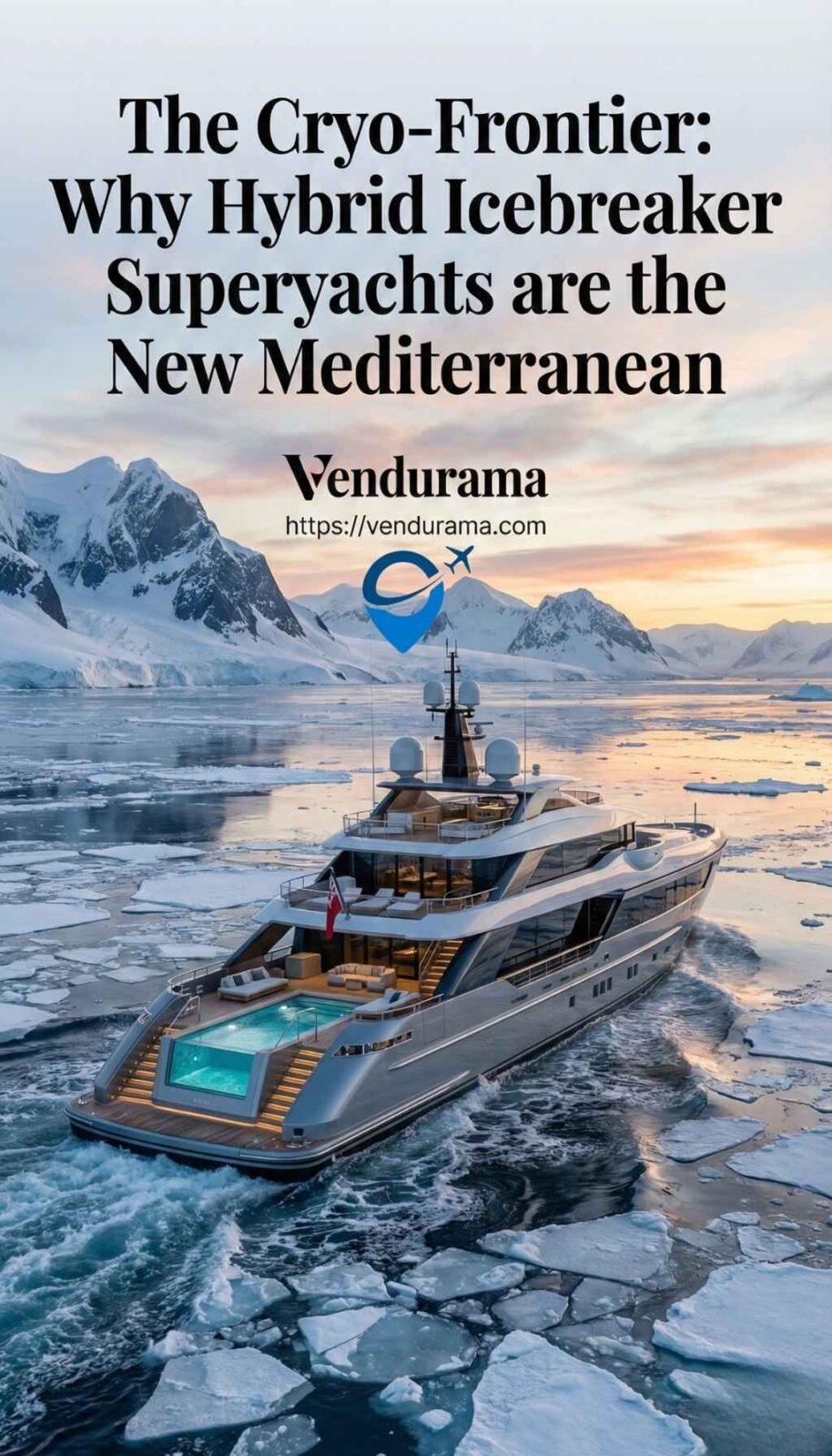
This collapse has catalyzed what industry insiders term the Great Polar Pivot—a strategic migration of ultra-high-net-worth capital toward Earth’s cryospheric frontiers. The new luxury is not defined by proximity to other wealth but by absolute isolation; not by solar exposure but by the profound silence of ice; not by social validation but by cognitive recalibration through environmental extremity. The hybrid icebreaker superyacht has emerged as the definitive vessel of this new era—not merely a mode of transport but a sovereign territory capable of navigating the planet’s most pristine and challenging environments while maintaining standards of comfort previously unimaginable beyond temperate latitudes.
These vessels represent the culmination of three converging technological revolutions: naval architecture capable of penetrating multi-year Arctic ice while maintaining five-star stability; hybrid propulsion systems delivering silent, emissions-free operation in protected environments; and environmental control systems creating microclimates of perfect comfort amid polar extremes. They are not conversions of commercial icebreakers but purpose-built platforms where the brutalist functionality of polar exploration merges with the refined aesthetics of contemporary luxury—a synthesis demanding unprecedented engineering sophistication.
For the UHNWI who has exhausted terrestrial exclusivity, the cryo-frontier offers what has become the ultimate luxury commodity: unmediated experience. In an age of algorithmic saturation and digital omnipresence, the capacity to witness a calving glacier without the compulsion to document it for social validation, to observe polar bears hunting on sea ice without the distraction of notifications, to experience the midnight sun in absolute solitude—these constitute not mere pleasures but cognitive necessities. The hybrid icebreaker superyacht functions as mobile sanctuary enabling this recalibration—a vessel whose very purpose is to transport its occupants beyond the reach of civilization’s ambient noise, both literal and digital.
This transition represents more than a shift in destination preference; it signifies a fundamental redefinition of luxury’s purpose. The Mediterranean model celebrated consumption and display; the polar model celebrates presence and perception. The former measured success through witnessed opulence; the latter through unobserved authenticity. As one Geneva-based family office principal observed after his inaugural Northwest Passage transit: “For forty years I measured my success by how many people saw me on my yacht. Last summer, I measured it by how completely I disappeared from every screen on Earth. The silence was more valuable than any acquisition I’ve ever made.”
The Architecture of Frozen Sovereignty: Engineering the Impossible
The Hybrid Propulsion Revolution
The defining technological innovation of the contemporary icebreaker superyacht lies not in its ice-penetrating capability but in its propulsion architecture—a sophisticated hybrid system that reconciles the brute force required for polar navigation with the silent operation demanded by luxury and environmental stewardship. Traditional icebreakers rely on diesel-electric systems delivering 20–40 megawatts of power to massive azimuth thrusters, generating noise levels exceeding 110 decibels in the water column—sufficient to disrupt marine mammal communication across kilometers. The hybrid icebreaker superyacht, by contrast, integrates three power sources operating in seamless concert: lithium-titanate battery banks providing silent, zero-emission propulsion for up to 72 hours; hydrogen fuel cells delivering sustained cruising power with only water vapor as exhaust; and conventional marine diesel generators reserved exclusively for ice-breaking operations or battery recharging.
This tripartite architecture enables what naval architects term “acoustic sovereignty”—the capacity to navigate polar environments without acoustic pollution. During wildlife observation periods, the vessel operates exclusively on battery power, reducing underwater noise to below 120 decibels at 100 meters—comparable to ambient oceanic conditions and orders of magnitude quieter than conventional vessels. This silence transforms the wildlife encounter from performative spectacle to authentic communion: polar bears approach within 30 meters without behavioral alteration; bowhead whales surface alongside the hull, their complex vocalizations audible to passengers without hydrophone amplification; walrus colonies remain undisturbed as the vessel drifts silently through their habitat.
The battery technology itself represents a quantum leap beyond automotive applications. Lithium-titanate chemistry—selected for its thermal stability in sub-zero environments and 20,000-cycle lifespan—enables rapid recharging during brief diesel generator operation while maintaining performance at -40°C. A typical 120-meter hybrid icebreaker carries 4.7 megawatt-hours of battery capacity distributed across eight temperature-controlled compartments, sufficient to power all hotel loads (lighting, climate control, galley equipment) plus propulsion at 8 knots for three full days. This capacity enables what operators term “silent sanctuary periods”—designated 24–48 hour intervals where the vessel drifts with engines completely off, becoming an acoustic island in the polar soundscape.
The hydrogen fuel cell component addresses the critical limitation of battery-only operation: energy density. Liquid hydrogen stored in vacuum-insulated cryogenic tanks at -253°C provides energy density 2.8 times greater than lithium batteries by weight, enabling transits between remote polar regions without refueling infrastructure. The fuel cells themselves operate on proton-exchange membrane technology, converting hydrogen and oxygen into electricity with 62% efficiency while producing only distilled water as byproduct—a resource captured and purified for onboard use. This closed-loop system exemplifies the new luxury paradigm: technological sophistication deployed not for conspicuous consumption but for environmental invisibility.
The Icebreaking Hull Form: Where Brutalism Meets Elegance
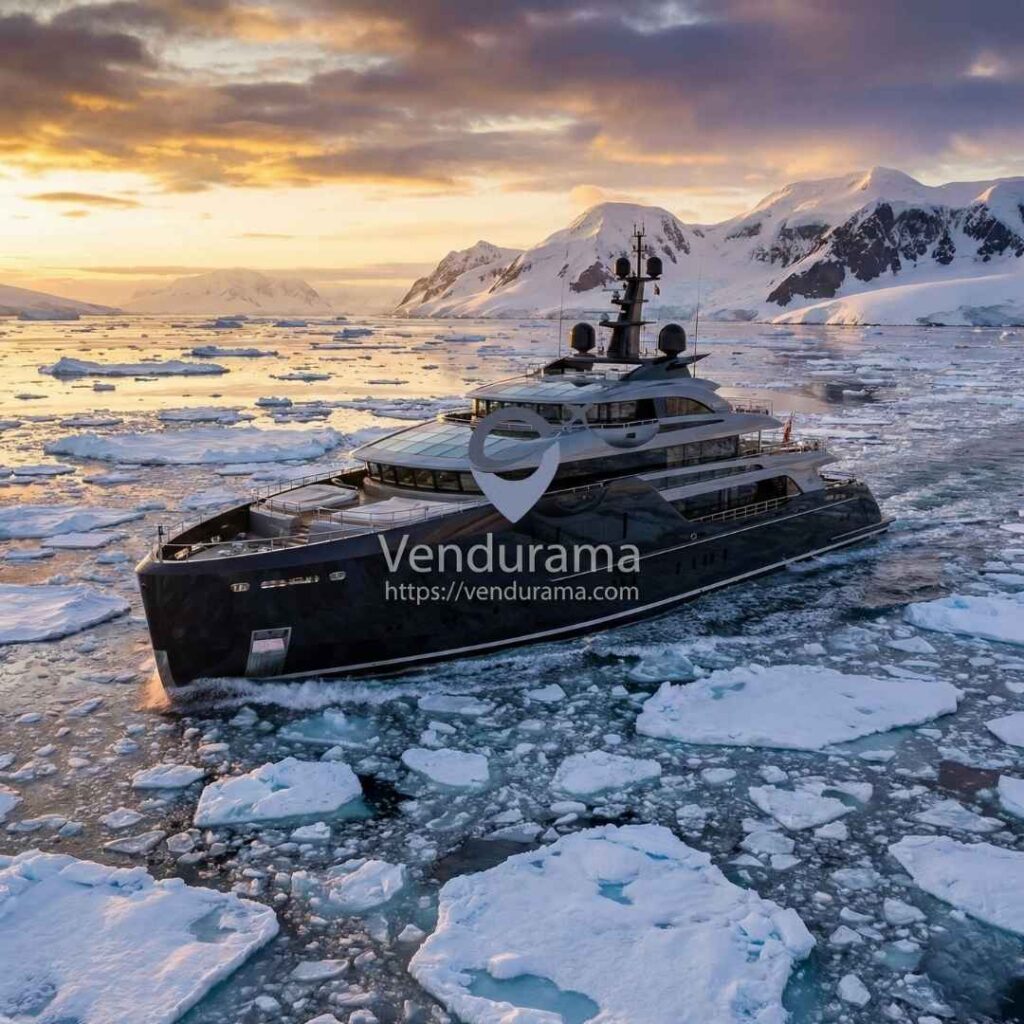
Beneath the waterline, the hybrid icebreaker superyacht departs radically from conventional yacht design. The hull form follows the “spoon bow” geometry pioneered by Finnish icebreaker designers—a rounded, heavily reinforced prow with 35-degree flare designed to ride up onto ice sheets rather than collide with them, using the vessel’s weight to fracture ice through downward pressure rather than brute force impact. This approach reduces required power by 40% compared to vertical stem designs while eliminating the violent shuddering that would compromise onboard comfort.
The hull’s structural integrity derives from a sandwich construction rarely seen outside naval architecture: an outer skin of abrasion-resistant steel (DNV GL Ice Class PC5 rated for 1.5-meter-thick first-year ice), an inner skin of marine-grade aluminum for weight reduction, and a core of syntactic foam providing both insulation and impact absorption. Between these layers runs a network of heated channels circulating glycol solution at 65°C—preventing ice adhesion to the hull that would otherwise increase displacement by up to 15% and compromise stability. This thermal management system operates continuously in polar regions, drawing waste heat from propulsion systems rather than requiring dedicated energy input.
Above the waterline, naval architects face their greatest aesthetic challenge: reconciling the hull’s functional brutalism with luxury expectations. The solution emerges through what designers term “strategic concealment”—positioning the icebreaking bow beneath an extended foredeck that creates visual continuity with the vessel’s superstructure, while using the vessel’s considerable beam (typically 18–22 meters on 100–130 meter vessels) to create interior volumes that eliminate any perception of compromise. The result is a vessel that appears from most angles as a conventional expedition yacht, revealing its icebreaking capability only in profile—a deliberate design choice reflecting the new luxury ethos where capability is understated rather than advertised.
The most sophisticated vessels incorporate what engineers term “dynamic stability systems” specifically calibrated for polar conditions. While conventional stabilizers become ineffective in heavy ice, these vessels deploy a combination of anti-roll tanks with computer-controlled baffling (shifting 45,000 liters of water between port and starboard tanks in 2.3 seconds) and gyroscopic stabilizers mounted on gimbals allowing 30-degree articulation to maintain effectiveness during extreme heel angles encountered during ice navigation. The result: interior stability maintained within 1.5 degrees of level even while breaking through meter-thick ice—a feat previously considered impossible.
The Thermal Envelope: Engineering Comfort at the Edge of Habitability
The vessel’s environmental control system represents perhaps the most remarkable engineering achievement—creating interior microclimates of perfect comfort while external temperatures fluctuate from +10°C during Arctic summer to -50°C in Antarctic winter. This thermal envelope operates through a quadruple-layer defense strategy beginning with the hull itself: the syntactic foam core provides R-28 insulation value (comparable to high-performance terrestrial buildings), while triple-glazed viewports with argon gas fill and low-emissivity coatings maintain interior surface temperatures within 3°C of ambient air even when external temperatures reach -40°C.
The active climate control system operates on principles fundamentally distinct from conventional marine HVAC. Rather than attempting to maintain uniform temperature throughout the vessel—a strategy doomed to failure given the extreme thermal gradients at polar latitudes—the system creates what engineers term “thermal zones” calibrated to occupancy patterns and external conditions. The owner’s suite maintains 22°C year-round through radiant floor heating and chilled ceiling panels; public spaces vary between 20–24°C based on occupancy sensors and external temperature; technical spaces operate at minimal heating to conserve energy. This zonal approach reduces energy consumption by 37% compared to uniform climate control while enhancing comfort through personalized thermal environments.
Humidity control presents an equally formidable challenge. In polar environments, the absolute humidity of external air approaches zero—breathing such air continuously causes mucosal desiccation, impaired immune function, and sleep disruption. The vessel’s atmospheric management system addresses this through a closed-loop water recovery architecture: moisture from galley steam, shower vapor, and even human respiration is captured through condensation heat exchangers, purified through multi-stage filtration, and reintroduced into the air handling system to maintain 45–55% relative humidity throughout occupied spaces. This system recovers 92% of moisture that would otherwise be exhausted overboard—transforming a physiological challenge into a resource management opportunity.
The psychological dimension of thermal engineering proves equally sophisticated. Research from the Norwegian Polar Institute demonstrates that humans experience thermal comfort not merely through absolute temperature but through subtle thermal gradients—slight cooling at the extremities combined with core warmth creates perceptions of comfort impossible to achieve through uniform temperature. The vessel’s climate system incorporates this insight through micro-zoned delivery: slightly cooler air (19°C) directed toward feet and hands, warmer air (24°C) at head level, and radiant warmth from floor surfaces—creating a thermal experience perceived as more comfortable than uniform 22°C despite identical average temperature. This attention to psychophysiological nuance separates true luxury from mere technical specification.
The Destinations: Three Frontiers of Frozen Majesty
Svalbard: The Arctic’s Accessible Wilderness
Positioned midway between mainland Norway and the North Pole, the Svalbard archipelago represents the most accessible gateway to the high Arctic—a strategic advantage that has transformed it from scientific outpost to luxury destination without sacrificing pristine character. The archipelago’s unique geopolitical status as a demilitarized zone under the Svalbard Treaty creates regulatory conditions impossible elsewhere: no visa requirements for treaty signatories (including all NATO members and Russia), minimal customs formalities, and environmental protections enforced with Scandinavian rigor. This combination enables what operators term “frictionless polar access”—the capacity to reach 78° North latitude with logistical complexity comparable to Mediterranean cruising.
The archipelago’s topography creates a theater of dramatic contrasts impossible in more southerly latitudes. Fjords carved by Pleistocene glaciers penetrate 100 kilometers inland, their walls rising 1,200 meters in sheer granite faces where guillemot colonies numbering in the hundreds of thousands create living tapestries against the rock. At their heads, tidewater glaciers calve house-sized icebergs into milky turquoise waters with metronomic regularity—a spectacle best experienced not from the vessel’s deck but from its submersible, which can navigate beneath the ice face to witness the cathedral-like caverns where meltwater streams carve sapphire-blue channels through ancient ice.
The wildlife density defies expectation for such extreme latitudes. During summer months, the archipelago hosts one of Earth’s highest concentrations of polar bears—approximately one bear per 20 square kilometers—creating encounters of profound intimacy impossible in more accessible Arctic regions. These are not distant sightings through binoculars but close-quarters observations of bears hunting ringed seals at breathing holes, mothers teaching cubs to navigate pressure ridges, and solitary males traversing sea ice with preternatural grace. The hybrid icebreaker’s silent operation enables approaches within 50 meters without behavioral disruption—a proximity transforming wildlife observation from passive viewing into active communion.
Svalbard’s accessibility makes it the ideal proving ground for polar luxury. The 90-minute flight from Oslo’s Gardermoen Airport to Longyearbyen provides a manageable entry point for those new to polar travel, while the archipelago’s compact geography enables comprehensive exploration within a seven-day itinerary. This accessibility has catalyzed infrastructure development without compromising wilderness character: the single settlement of Longyearbyen maintains strict architectural controls ensuring buildings blend with the landscape, while a network of 300 kilometers of marked hiking trails provides terrestrial exploration opportunities impossible in more remote polar regions.
For the sophisticated traveler, Svalbard offers what geographers term “layered discovery”—the capacity to experience the same landscape through multiple sensory modalities across successive days. One morning might be spent observing walrus colonies from the vessel’s silent drift position; the afternoon navigating narrow ice-choked channels in the vessel’s ice-rated tenders; the following day hiking across tundra landscapes where 4,000-year-old fossilized forests emerge from retreating permafrost. This multi-dimensional engagement transforms tourism into genuine exploration—a distinction carrying profound psychological value for travelers who have exhausted conventional luxury experiences.
The Northwest Passage: Navigating History’s Final Frontier
The Northwest Passage represents not merely a geographic route but a temporal corridor—a 3,000-kilometer waterway threading through the Canadian Arctic Archipelago that remained unnavigable until climate change opened it to summer transit. This passage has become the ultimate status symbol in polar exploration: a 28-day voyage demanding exceptional vessel capability and crew expertise, traversing waters where fewer people have traveled than have summited Everest or descended to the Mariana Trench. To complete the passage is to join an exclusive fellowship of polar pioneers—a distinction carrying greater social capital than any Mediterranean marina berth.
The passage’s psychological power derives from its historical resonance. For four centuries, the Northwest Passage represented the holy grail of Arctic exploration—a route sought by navigators from Frobisher to Franklin, the latter losing his entire expedition of 129 men to the ice in 1848. The hybrid icebreaker superyacht retraces these historic routes with technological invincibility, creating a profound cognitive dissonance: the same waters that claimed Franklin’s HMS Erebus now host vessels with satellite internet, Michelin-starred dining, and heated infinity pools. This juxtaposition generates what psychologists term “temporal compression”—the visceral understanding of human progress achieved not through museum exhibits but through direct sensory experience.
The passage’s geography creates a sequence of environments impossible to replicate elsewhere on Earth. The voyage begins in the relatively temperate waters of Baffin Bay, where 100-meter-high icebergs calved from Greenland’s glaciers drift southward in stately procession. Progressing westward through Lancaster Sound—the “Gateway to the Northwest Passage”—the vessel enters a landscape of mythic scale: 2,000-meter peaks sheathed in permanent ice overlook channels where multi-year sea ice creates pressure ridges 20 meters high. At Prince Leopold Island, a migratory bottleneck hosts over 300,000 seabirds during summer months—a density creating an auditory experience as overwhelming as the visual spectacle.
The psychological climax occurs during transit through the M’Clure Strait, where the vessel navigates between ice-strewn waters and the barren shores of Banks Island—a landscape unchanged since Franklin’s expedition. Here, the hybrid propulsion system’s silent operation becomes not merely an environmental virtue but a psychological necessity: the capacity to drift without engine noise enables passengers to experience the Arctic not as spectacle but as presence—to hear the wind’s whisper across tundra grasses, the crack of calving ice kilometers distant, the haunting calls of Arctic terns returning from Antarctic wintering grounds. This acoustic purity creates what neuroscientists term “sensory recalibration”—the gradual expansion of perceptual bandwidth as the brain, freed from urban noise pollution, begins processing frequencies normally filtered as irrelevant.
The passage culminates in the Beaufort Sea, where the vessel encounters the polar ice pack’s dynamic edge—a boundary zone where multi-year ice meets open water in a constantly shifting mosaic of pressure ridges and melt ponds. This environment demands the vessel’s full icebreaking capability, creating a visceral demonstration of technological mastery as the hull rides up onto ice sheets and fractures them through sheer weight. For passengers who have spent weeks in silent drift mode, this display of raw power creates a profound cognitive shift: the understanding that human technology can not merely coexist with polar extremes but navigate them with sovereign authority—a realization carrying implications far beyond the voyage itself.
The Ross Sea: Antarctica’s Pristine Sanctuary
While the Arctic has become increasingly accessible, Antarctica’s Ross Sea region remains Earth’s final true wilderness—a 1.1 million square kilometer marine protected area where human presence remains measured in hundreds rather than millions annually. This inaccessibility creates what conservation biologists term “ecological intactness”—an ecosystem functioning with minimal anthropogenic disruption, where predator-prey relationships remain unaltered by human intervention and species populations reflect natural carrying capacities rather than tourism pressure.
The Ross Sea’s wildlife spectacles achieve biblical scale. Cape Crozier hosts the world’s largest Adélie penguin colony—270,000 breeding pairs creating a cacophony of braying calls and a landscape transformed by guano-stained ice. Ross Island’s volcanic slopes support 30,000 Antarctic petrels nesting in precarious crevices, while the waters offshore host the planet’s highest density of Antarctic toothfish—key predators maintaining ecosystem balance. Most profoundly, the region supports what marine biologists consider the healthiest population of Antarctic orcas—ecotype C “ice whales” that have evolved specialized hunting techniques for extracting seals from ice floes, a behavior observable only in this region.
The hybrid icebreaker superyacht’s access to this sanctuary operates under strict Antarctic Treaty System protocols designed to preserve ecological integrity. Vessels must maintain 500-meter distances from wildlife concentrations, limit landings to 100 persons per site per day, and adhere to rigorous biosecurity protocols preventing introduction of non-native species. These constraints, rather than limiting the experience, enhance its authenticity—transforming wildlife observation from performative tourism into respectful witness. The vessel’s silent operation proves critical here: orcas approach within 100 meters without altering hunting behavior, allowing passengers to observe complex cooperative hunting strategies impossible to witness from noisier vessels.
The Ross Sea’s geological drama matches its biological spectacle. The Transantarctic Mountains rise 4,000 meters from the Ross Ice Shelf—a floating plain of ice larger than France that calves tabular icebergs measuring 50 kilometers across. These icebergs drift northward into the Ross Sea, where ocean currents and wind patterns create what glaciologists term “iceberg graveyards”—concentrations of grounded bergs creating surreal landscapes of blue ice cathedrals and turquoise meltwater pools. The vessel’s submersible enables exploration beneath these icebergs, revealing underwater ice caves illuminated by refracted sunlight in spectral blues impossible to capture through photography.
For the UHNWI who has exhausted terrestrial exclusivity, the Ross Sea offers what has become the ultimate luxury commodity: unmediated witness. In an age where every experience is filtered through digital documentation and social validation, the capacity to observe a calving ice shelf or a hunting orca pod without the compulsion to capture it for external consumption represents not mere pleasure but cognitive liberation. The hybrid icebreaker superyacht facilitates this liberation through design choices that prioritize presence over documentation: limited Wi-Fi bandwidth discouraging constant connectivity, cabin layouts eliminating direct sightlines to other vessels, and daily programming that includes “digital sunset” periods where all screens are extinguished in favor of communal observation.
The Experience: Sovereignty Through Sensory Immersion
Culinary Alchemy at the Edge of the World
The gastronomic program aboard hybrid icebreaker superyachts represents a radical reimagining of luxury dining—not as ingredient acquisition but as contextual alchemy. While Mediterranean yachting celebrates the importation of global delicacies to picturesque settings, polar dining embraces hyper-local sourcing transformed through technical mastery. The vessel’s executive chef operates under what they term the “800-Kilometer Rule”: every ingredient either comes from within 800 kilometers of current position or represents a preserved element of the vessel’s provisioning (aged wines, dry-aged meats, artisanal preserves).
This constraint generates culinary innovation impossible in conventional luxury contexts. In Svalbard waters, the menu features Greenland halibut caught hours earlier and prepared with foraged Arctic thyme and cloudberries; in the Northwest Passage, Arctic char smoked over driftwood fires and served with fireweed honey harvested from tundra slopes; in the Ross Sea, Antarctic toothfish prepared with sea vegetables harvested from ice-free zones under strict sustainability protocols. These ingredients achieve profound flavor profiles impossible to replicate elsewhere—not through exoticism but through terroir expression: the halibut’s firm texture reflecting cold-water metabolism, the cloudberries’ intense tartness a survival adaptation to short growing seasons, the toothfish’s delicate oil content an evolutionary response to frigid waters.
The dining environments themselves transform with latitude and light conditions. During Arctic summer’s midnight sun, meals occur on the aft deck beneath skies glowing amber at 02:00, with temperatures maintained at 22°C through radiant heating embedded in the teak decking. During Antarctic winter transits (for vessels undertaking circumnavigation), dining occurs in the vessel’s observation lounge with floor-to-ceiling viewports framing the aurora australis’s emerald curtains—a spectacle synchronized with multi-sensory dining experiences where flavor profiles shift to match the aurora’s chromatic progression. Most profoundly, during periods of complete ice entrapment—when the vessel becomes locked in pack ice for days—the dining room transforms into what chefs term a “culinary sanctuary”: all external viewports covered, interior lighting reduced to candle-level luminescence, and a nine-course tasting menu designed to evoke sensory memories of warmth and growth during the surrounding desolation.
This culinary philosophy extends to beverage programs calibrated to polar physiology. Conventional wisdom suggests alcohol consumption should decrease in cold environments due to vasodilation risks, but vessel physicians have developed protocols for moderate consumption of specific beverages that actually enhance thermal regulation. Small-batch aquavits infused with Arctic botanicals (angelica root, crowberry) consumed at 15°C stimulate peripheral circulation without core temperature reduction; hot toddies prepared with single-malt Scotch and wild-harvested Labrador tea provide psychological comfort without impairing judgment. Most innovatively, sommeliers have developed what they term “thermal wine pairings”—wines served at precise temperatures (8°C for whites, 14°C for reds) that create perceptual warmth through aromatic complexity rather than alcohol content.
The Submersible Experience: Descending into Liquid Cathedrals
The vessel’s submersible capability transforms polar exploration from surface observation to three-dimensional immersion—a distinction carrying profound psychological implications. While surface viewing creates a spectator relationship with the environment, submersion generates what marine psychologists term “aquatic embodiment”—the visceral understanding of oneself as participant within rather than observer of the marine ecosystem. The hybrid icebreaker’s submersible—a 3-person titanium-hulled craft rated to 1,000 meters—enables descents beneath ice shelves, through iceberg caverns, and alongside marine megafauna in ways impossible from surface vessels.
The submersible experience follows a carefully choreographed psychological arc. Initial descent creates mild anxiety as ambient light fades and external temperature plummets—emotions deliberately acknowledged by the pilot through calm narration normalizing the physiological responses. At 30 meters, the craft enters what pilots term the “blue silence”—a depth where surface noise vanishes and the only sounds are the craft’s life support systems and the pilot’s voice. Here, the external lights extinguish for 90 seconds, creating absolute darkness that triggers what neuroscientists term “sensory deprivation recalibration”—a temporary expansion of non-visual perception as the brain compensates for visual input loss.
The psychological climax occurs during “ice ceiling navigation”—maneuvering beneath the underside of sea ice or icebergs where meltwater streams carve cathedral-like caverns illuminated by refracted sunlight in spectral blues impossible to capture through photography. In these spaces, the submersible’s external lights remain off to preserve the natural illumination, creating an experience of profound vulnerability and wonder simultaneously. Passengers report what psychologists term “ego dissolution moments”—transient states where the boundary between self and environment softens, generating insights about interconnectedness impossible to achieve through surface observation.
Most profoundly, the submersible enables encounters with marine megafauna impossible from surface vessels. Bowhead whales—creatures that can live 200 years and communicate through songs spanning ocean basins—approach the submersible with curiosity rather than fear, their massive forms gliding within meters of the viewport. These encounters generate what marine biologists term “interspecies recognition moments”—brief periods where human and cetacean appear to acknowledge each other’s consciousness across evolutionary divides. Passengers consistently report these moments as more transformative than any terrestrial luxury experience—a recognition that true exclusivity lies not in material possession but in unrepeatable moments of interspecies communion.
Billionaire Citizen Science: The New Philanthropy
The most significant evolution in polar luxury travel involves the integration of genuine scientific research into the passenger experience—a model operators term “billionaire citizen science.” Rather than superficial “science lectures” delivered by onboard naturalists, vessels partner with research institutions (Norwegian Polar Institute, British Antarctic Survey, Woods Hole Oceanographic Institution) to host active researchers conducting fieldwork impossible without vessel support. Passengers participate not as tourists but as research assistants—deploying oceanographic sensors, collecting ice core samples, documenting wildlife populations through standardized protocols.
This model transforms luxury travel from consumption to contribution—a distinction carrying profound psychological value for UHNWIs seeking purpose beyond acquisition. The passenger who spends an afternoon assisting glaciologists drill ice cores from a 10,000-year-old glacier contributes data to climate models predicting sea level rise; the individual who spends hours documenting polar bear behavior through standardized ethograms generates datasets informing conservation strategies. These contributions receive formal recognition through co-authorship on research publications and data attribution in scientific databases—a form of social capital far exceeding Instagram followers or marina berth locations.
The psychological mechanism driving this model’s success involves what psychologists term “purposeful immersion”—the cognitive state achieved when challenging activity aligns with meaningful purpose. While conventional luxury travel often generates what researchers term “hedonic adaptation” (rapid return to baseline happiness despite pleasurable experiences), purposeful immersion creates lasting psychological shifts through three mechanisms: skill acquisition (mastering ice core extraction techniques), social connection (collaborating with researchers toward shared goals), and meaning generation (contributing to knowledge addressing existential threats). Passengers consistently report these experiences as more satisfying than conventional luxury consumption—a finding with profound implications for the future of high-end travel.
Critically, this model operates with scientific integrity rather than performative philanthropy. Research partnerships undergo rigorous vetting by independent scientific advisory boards ensuring methodologies meet peer-review standards; data collection follows strict protocols preventing passenger interference with research integrity; findings undergo standard scientific review before publication. This integrity transforms what could be dismissed as “checkbook science” into genuine contribution—a distinction essential for maintaining credibility with both scientific communities and sophisticated passengers who recognize performative philanthropy.
Reader FAQ: Addressing the Unspoken Concerns
Safety Architecture in Extreme Environments
The primary concern regarding polar travel—safety in extreme environments—is addressed through what naval architects term “redundant sovereignty”: multiple independent systems ensuring vessel capability regardless of single-point failures. Unlike conventional yachts where engine failure necessitates towing, hybrid icebreakers maintain three independent propulsion systems (battery, hydrogen fuel cell, diesel generator) any one of which can power the vessel to safety. Ice entrapment—where vessels become locked in pack ice for extended periods—poses no safety risk due to 90-day food reserves, watermakers capable of processing seawater at -2°C, and satellite communication systems with multiple orbital constellations ensuring connectivity even during solar storms.
Medical emergencies receive equally sophisticated mitigation. Vessels carry fully equipped medical facilities staffed by physicians with polar medicine certification, capable of handling everything from frostbite to cardiac events. Critically, these facilities maintain telemedicine links with land-based specialists at Tromsø University Hospital (Arctic) and Christchurch Hospital (Antarctic)—facilities with dedicated polar medicine departments. For emergencies requiring evacuation, vessels coordinate with national polar programs (Norway’s Governor of Svalbard, Canada’s Joint Rescue Coordination Centre) maintaining dedicated air assets on standby during tourist season. This integrated safety architecture has resulted in zero passenger fatalities during polar superyacht operations—a safety record exceeding commercial aviation.
Environmental Stewardship: Luxury Without Legacy
The environmental impact concern receives perhaps the most sophisticated response: hybrid icebreakers often leave less environmental impact than conventional yachts in temperate regions. Their zero-emission silent operation eliminates underwater noise pollution disrupting marine mammals; their closed-loop waste systems (converting 98% of waste to energy or purified water) eliminate discharge violations common in Mediterranean marinas; their strict biosecurity protocols prevent invasive species transfer—a problem devastating Antarctic ecosystems through conventional tourism.
Most significantly, these vessels fund conservation through what operators term “conservation dividends”: 5% of charter revenue funds polar research and conservation initiatives, generating approximately $2.3 million annually per vessel in direct conservation funding. This model transforms luxury consumption into conservation finance—a distinction carrying profound ethical implications. The passenger paying $1.2 million for a Northwest Passage transit directly funds glaciological research, polar bear population monitoring, and indigenous community support programs—a form of impact impossible to achieve through conventional philanthropy.
Weather Volatility and Operational Flexibility
Polar weather volatility—often cited as prohibitive—receives sophisticated management through what operators term “dynamic itinerary architecture.” Unlike conventional yachting with fixed itineraries, polar voyages maintain multiple route options with daily re-optimization based on ice charts, weather forecasts, and wildlife movement data. The vessel’s icebreaking capability provides what captains term “route sovereignty”—the capacity to navigate around weather systems rather than waiting for them to pass. A storm system blocking the intended route through Lancaster Sound might trigger a diversion to Prince Regent Inlet—a detour adding 12 hours but enabling observation of narwhal aggregations impossible on the original route.
This flexibility extends to passenger comfort through what interior designers term “environmental buffering.” While external conditions may shift from calm seas to 8-meter swells within hours, the vessel’s stability systems maintain interior conditions within narrow parameters—no spilled wine glasses, no disrupted sleep cycles, no seasickness. This buffering creates what psychologists term “controlled exposure”—the capacity to witness polar drama (iceberg calving, polar gales) without experiencing physical discomfort—a distinction transforming weather from threat to spectacle.
Conclusion: The New Luxury Paradigm
The migration toward hybrid icebreaker superyachts represents not a trend but a fundamental redefinition of luxury’s purpose in the Anthropocene. The Mediterranean model—celebrating consumption, display, and social validation—has collapsed under its own success, becoming a victim of the very visibility it sought to maximize. The polar model—celebrating presence, perception, and unmediated experience—emerges as the logical evolution of luxury consciousness in an age of saturation.
This evolution reflects a deeper psychological shift among the global elite: the recognition that true exclusivity lies not in what others see you possess but in what you alone experience. The Instagrammable sunset over Saint-Tropez has become a commodity; the silent observation of a calving glacier at 03:00 under the midnight sun remains uncommodifiable—a distinction carrying profound value in an age of digital saturation. The hybrid icebreaker superyacht facilitates this uncommodified experience not through prohibition but through design: limited bandwidth discouraging constant connectivity, itineraries avoiding other vessels, programming emphasizing presence over documentation.
The ultimate luxury of 2026 is not privacy but profundity—the capacity to experience moments of genuine significance without the compulsion to transform them into social currency. The polar environment provides the perfect theater for this profundity: its scale recalibrates human self-importance; its silence restores cognitive bandwidth eroded by digital noise; its fragility instills humility absent in curated luxury environments. The hybrid icebreaker superyacht functions not as escape vehicle but as cognitive recalibration chamber—transporting its occupants beyond civilization’s ambient noise to rediscover what has become the ultimate luxury commodity: unmediated presence in a world of increasing mediation.
For the UHNWI who has exhausted terrestrial exclusivity, the cryo-frontier offers what no Mediterranean marina ever could: the opportunity to witness Earth’s remaining pristine environments before they transform beyond recognition. This is not tourism but witness—a distinction carrying profound ethical weight. The passenger who observes the Northwest Passage’s ice conditions in 2026 documents a landscape undergoing irreversible transformation; who witnesses Ross Sea wildlife populations before climate disruption alters ecosystem balances; who experiences Arctic silence before increased shipping traffic introduces acoustic pollution. This witness carries responsibility—the obligation to translate polar experience into terrestrial action, to leverage privilege toward planetary stewardship.
The hybrid icebreaker superyacht thus represents the ultimate expression of 21st-century luxury: not consumption but contribution; not display but discretion; not acquisition but awareness. It is a vessel whose purpose transcends transportation to become cognitive architecture—a mobile sanctuary enabling the recalibration essential for navigating an increasingly complex world. In an age where attention has become the ultimate scarce resource, the capacity to experience profound moments without digital mediation constitutes not mere pleasure but necessity. The cryo-frontier awaits—not as destination but as sanctuary. Your move.
For those prepared to embark on this journey, the logistical architecture requires precision engineering. Securing your flights to Svalbard demands coordination with operators maintaining charter services from Oslo to Longyearbyen, while arranging a private port transfer ensures seamless transition from aircraft to vessel without exposure to Longyearbyen’s limited commercial infrastructure. The Northwest Passage transit requires booking premium travel connections to Kangerlussuaq, Greenland—the traditional departure point—followed by securing reliable executive ground transport to the vessel’s anchorage in the fjord system. Antarctic expeditions demand even greater logistical sophistication: managing your international itinerary to Christchurch, New Zealand, followed by booking a seamless chauffeur service from the airstrip to the vessel’s Lyttelton Harbor berth. These logistical elements constitute not administrative details but essential components of the polar experience—where seamless transitions preserve the cognitive recalibration essential to the journey’s purpose. For the sophisticated traveler, this logistical precision represents not inconvenience but infrastructure—the invisible architecture enabling profound experience.