

Introduction: The Intersection of Art and Engineering
The human face is a complex topographical landscape, and the nose is its central defining feature. It is the architectural keystone of facial identity. A millimeter of deviation in the nasal dorsum, a slight asymmetry in the tip, or an acute nasolabial angle can dramatically alter the perception of the entire face. Therefore, rhinoplasty—the surgical reshaping of the nose—is widely considered the most challenging, nuanced, and artistic of all plastic surgery procedures. It is not merely a medical operation; it is a form of high-stakes facial engineering.
In the past decade, a significant geopolitical shift has occurred in the field of aesthetic medicine. Istanbul, Turkey, has emerged as the undisputed global capital of rhinoplasty. This is not a title claimed through marketing, but one earned through sheer volume, technical innovation, and a unique convergence of medical expertise and artistic tradition. Thousands of patients from the UK, USA, Europe, and the Middle East travel to Turkey monthly, seeking not just a smaller nose, but a harmonized facial profile that respects their ethnicity while achieving aesthetic balance.
This analytical review serves as a definitive guide for the discerning individual considering this transformative journey. It goes beyond the superficial allure of “before and after” photos on social media to dissect the science of facial harmony, the intricate surgical technologies employed by elite Turkish surgeons, the rigorous process of vetting a provider, and the comprehensive logistical architecture required for a safe and successful medical deployment abroad.
Part I: The Turkish Phenomenon – A Geopolitical Medical Analysis
To understand why one would travel thousands of miles for surgery, one must first understand the unique ecosystem that has cultivated this level of expertise. The rise of Turkey as a rhinoplasty powerhouse is the result of a deliberate and successful national strategy combining education, economics, and specialization.
1. The Volume-Expertise Flywheel
In surgery, volume begets mastery. The “learning curve” for achieving consistent, high-quality rhinoplasty results is notoriously steep, often cited as requiring 500 to 1,000 cases. A typical plastic surgeon in the United States or Western Europe might perform 20 to 50 rhinoplasties a year, as part of a broader practice including breast augmentation and liposuction.
In contrast, top-tier Turkish surgeons often specialize exclusively in rhinoplasty. Due to immense domestic and international demand, a specialized surgeon in Istanbul may perform 300 to 500 rhinoplasties annually. This unprecedented volume allows them to encounter every conceivable anatomical variation, complication, and revision scenario. By their mid-30s, a focused Turkish surgeon may have accumulated a case experience that a generalist Western surgeon would not achieve in an entire career. This concentrated experience is the primary driver of their technical superiority.
2. The Economic Arbitrage of Excellence
The cost difference is undeniable, but it is often misunderstood. A high-quality primary rhinoplasty in the US or UK typically ranges from $12,000 to $20,000 USD. In Turkey, an equivalent procedure with an elite, board-certified surgeon in a JCI-accredited hospital ranges from $3,500 to $6,500 USD.
This price gap is not a reflection of lower quality; it is a reflection of macroeconomics. The lower cost of living, lower overheads for medical facilities, and favorable currency exchange rates allow Turkish clinics to offer premium services at a fraction of the Western cost. Patients are effectively engaging in “medical cost arbitrage,” leveraging their stronger currency to access top-tier medical talent.
Part II: Defining “The Architecture of Aesthetics”
Before a scalpel is ever lifted, a philosophical and mathematical understanding of beauty must be established. A successful rhinoplasty does not create a “perfect” nose in isolation; it creates a nose that belongs perfectly to the face it sits upon.
The Fallacy of the “Cookie-Cutter” Nose
A decade ago, the trend was towards the “ski-slope” nose—an overly resected, scooped-out dorsum with a pointy, upturned tip. This often resulted in an “operated look” that aged poorly and frequently caused functional breathing issues. The modern Turkish approach, pioneered by leading surgeons, has shifted dramatically towards “Structural Rhinoplasty” and “Preservation Rhinoplasty.” The goal is now a natural, refined, and enduring result that respects the patient’s ethnic heritage.
The Mathematics of Facial Harmony
Elite surgeons act as facial architects, using established anthropometric parameters to plan the surgery. They analyze the face in thirds (horizontal) and fifths (vertical) to ensure balance.
- The Nasofrontal Angle: The angle between the forehead and the start of the nose (radix). Ideally between 115-130 degrees.
- The Nasolabial Angle: The angle between the upper lip and the base of the nose (columella). Ideally 90-95 degrees for men, and 95-105 degrees for women, creating a slight, feminine rotation without over-rotation (the “piggy” look).
- Tip Projection: The nose must project far enough from the face to balance the chin and forehead.
Part III: The Surgical Arsenal – Techniques and Technologies
The terminology of rhinoplasty can be overwhelming. Understanding the core techniques is essential for an informed consultation.
1. Open vs. Closed Approach
- Open Rhinoplasty: An incision is made across the columella, exposing the underlying structure. It offers unparalleled visibility and is essential for complex structural work and revisions.
- Closed Rhinoplasty: Incisions are made inside the nostrils. It leaves no external scar and offers faster recovery but has limited visibility. Most elite surgeons in Turkey prefer the Open Approach for international patients to ensure a definitive, precise result in one single operation.
2. The Game Changer: Piezoelectric (Ultrasonic) Rhinoplasty
This is the gold standard technology that has revolutionized the field. Traditional rhinoplasty involves using hammers and chisels to break nasal bones, which is traumatic and imprecise. Piezo technology uses ultrasonic vibrations to sculpt bone without damaging soft tissue (nerves, blood vessels, skin).
- The Benefits: Extreme precision, significantly less bruising (“raccoon eyes”), and faster recovery. Almost all top-tier rhinoplasty specialists in Turkey now use Piezo as their standard of care.
Part IV: The Logistical Architecture of a Medical Deployment
Traveling for major facial surgery requires military-grade planning. This is not a vacation; it is a medical mission.
Phase 1: Strategic Flight Planning
Rhinoplasty requires a minimum stay of 7 to 10 days in Turkey. You must arrive at least 1-2 days before surgery for pre-operative blood tests and anesthesia clearance. You cannot fly home until the external cast is removed (usually Day 7).
Booking flights for medical travel requires flexibility and foresight. You need an itinerary that minimizes stress and layovers, particularly on the return journey when you will still be swollen and congested. Utilizing comprehensive flight analysis platforms allows you to visualize the most efficient routes and secure fares that align perfectly with your surgical window. It is crucial to use these tools to filter for direct flights or optimal connections to Istanbul (IST or SAW) to avoid exhaustion.
Phase 2: The Secure Arrival Protocol
Arriving in Istanbul for surgery is a vulnerable moment. You are about to undergo a life-changing procedure in a foreign metropolis. The transit from the airport to your hotel should not involve navigating public transport with luggage or haggling with taxi drivers. Stress increases cortisol, which is detrimental to pre-surgical preparation.
A professional, pre-vetted transfer is a mandatory component of the safety protocol. Elite clinics often include this, but if you are arranging it independently, you must ensure a “warm handoff.” You need a driver who knows exactly where your clinic or pre-op hotel is. Booking professional private transfer services ensures that a vetted driver is waiting for you in the arrivals hall with your name on a sign, providing an immediate psychological anchor of safety and a seamless, secure transit to your accommodation.
Phase 3: The Surgical Lifecycle
- Day 1 (Surgery): The procedure takes 2-4 hours under general anesthesia. You spend one night in the hospital for monitoring.
- Day 2-6 (Recovery): You are discharged to your hotel. You will be congested due to internal silicone splints. Ice packs and sleeping elevated are mandatory.
- Day 7 (The Reveal): The cast and splints are removed. This is an emotional moment, though significant swelling will still be present.
- The Return Transfer: The return journey to the airport requires the same level of care. You are now a post-operative patient with a healing fracture. Using reliable airport transfers again for this leg is essential to ensure a gentle, stress-free ride directly to the departure terminal, protecting your investment in the crucial early healing phase.
Part V: The Surgeon Selection Matrix – A Vetting Protocol
Choosing a surgeon is the single most critical decision in this process.
- Specialization: Look for a surgeon whose practice is at least 80-90% dedicated to rhinoplasty.
- Credentials: Must be board-certified in Plastic Surgery or Otolaryngology (ENT) in Turkey. Membership in the Rhinoplasty Society of Europe (RSE) is a strong indicator of quality.
- Consistency: Analyze their gallery. Does every nose look the same (cookie-cutter), or do they adapt to the patient’s face?
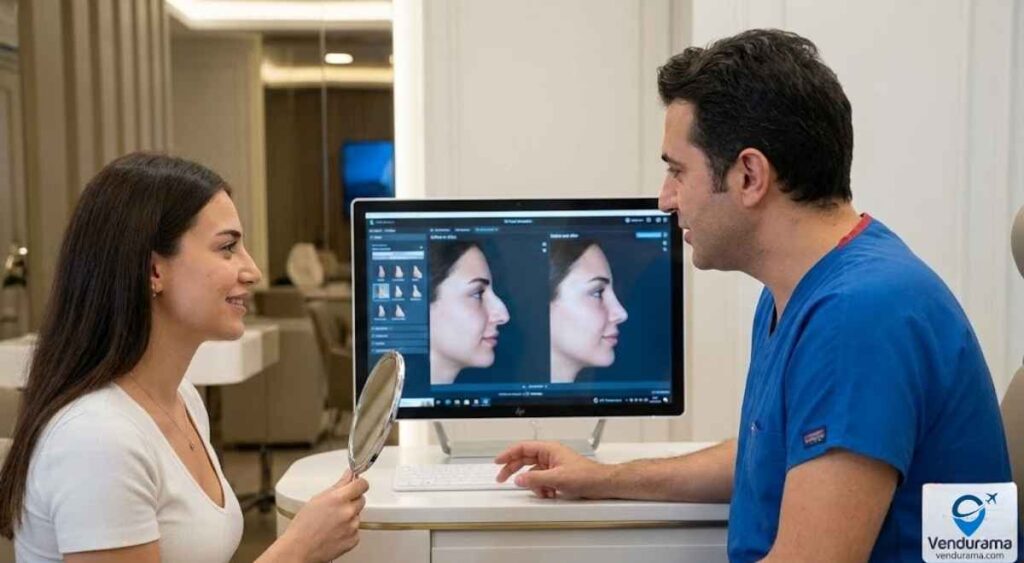
- Simulation: Ensure they use 3D morphing software to set realistic expectations.
Conclusion: The Architecture of Confidence
Rhinoplasty in Turkey represents a unique convergence in the history of medical travel. It is a rare moment where the highest quality of care, the most advanced technology, and competitive pricing intersect.
Choosing to undergo facial surgery abroad is a significant decision that requires immense due diligence. It is not about finding the cheapest deal; it is about finding the best value—the highest probability of a masterful result delivered in a safe, world-class environment. By meticulously planning the logistical architecture of your journey and selecting a surgeon who acts as both artist and engineer, you can achieve a result that is not just a new nose, but a restored sense of balance and confidence.