
Introduction: The Great Educational Realignment
For the past half-century, the global market for international higher education has been defined by a singular, magnetic pull towards the “Anglosphere.” The United States, the United Kingdom, Australia, and Canada have held a near-monopoly on the aspirations of globally mobile students. The prevailing narrative has been simple: if you want a world-class education delivered in the lingua franca of global commerce (English), you must pay the Anglosphere premium.
This narrative, however, has curdled into a financial crisis for millions of middle-class families globally. The cost of attendance at premier institutions in these four nations has outpaced inflation dramatically, turning higher education into a debt-financed gamble. A four-year degree at a mid-tier US university now frequently exceeds a quarter-million dollars, creating a barrier that is less about intellectual merit and more about inherited wealth or a willingness to shoulder crippling long-term debt.
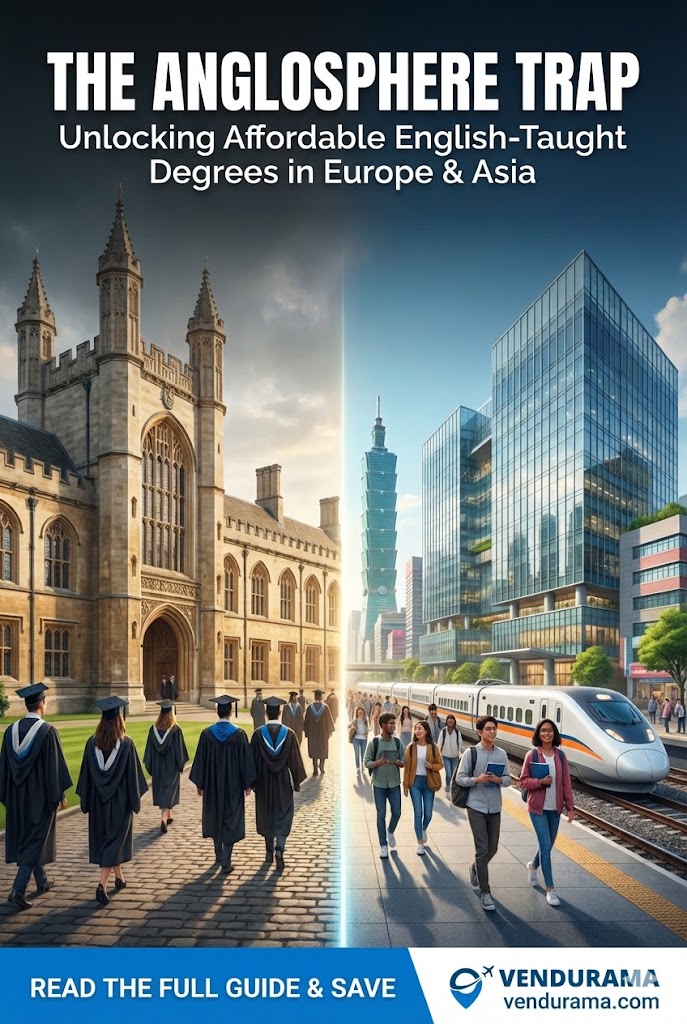
This is the “Anglosphere Trap”: the mistaken belief that high-quality, English-medium education is exclusive to nations where English is the native tongue.
Fortunately, we are living through a profound structural realignment in global academia. Driven by demographic shifts, the need for high-skilled labor, and the desire to internationalize, top-tier universities across Continental Europe and dynamic Asian economies have aggressively pivoted. They are now offering thousands of full degree programs—Bachelor’s, Master’s, and PhDs—taught entirely in English, often at 10% to 20% of the cost of their Anglosphere equivalents, and in some cases, entirely tuition-free.
This guide is a strategic blueprint for the intelligent student ready to bypass the trap. It analyzes the economics, the quality assurance mechanisms, and the complex logistics of pursuing an English-taught degree in non-native English environments. It is a guide to securing high-value human capital without the high-interest mortgage.
Part I: Deconstructing the Trap – The Economics of Prestige
To understand the alternative, one must first dissect why the current model is broken. The Anglosphere higher education model has increasingly shifted from a public good to a highly financialized commodity.
The Inflationary Spiral
In the UK and US especially, the reduction of state funding has forced universities to rely on tuition fees as their primary revenue source. International students, uncapped by domestic fee regulations, have become the cash cows bankrolling these institutions. The “sticker price” often bears little relation to the actual cost of instruction; it is a price set by what the market (and easy credit) will bear.
The Prestige Premium vs. ROI
Students often conflate “rankings” with “return on investment” (ROI). While an Ivy League degree carries undeniable clout, the ROI diminishes rapidly outside the top 20 global institutions when factored against $200,000 in debt. A degree from a top 100 university in Europe, obtained with zero debt, often provides a superior long-term financial trajectory, allowing graduates to invest, save, and take entrepreneurial risks earlier in their careers.
The Saturation Point
Major student cities like London, Sydney, and Vancouver are experiencing severe housing crises, partly fueled by massive influxes of students. The cost of living in these hubs often exceeds the tuition itself, leading to a degraded student experience defined by overcrowding and financial stress.
Part II: The New Paradigm – The Rise of English Taught Programs (ETPs)
The alternative is not to study in a language you don’t know; it is to study in English in a country where English is not the primary language. This phenomenon, known as English Taught Programs (ETPs), has exploded from a few hundred niche courses in the early 2000s to over 20,000 programs across Europe and Asia today.
Why are Non-Anglosphere Countries Doing This?
This is not altruism; it is strategic national interest.
- The Demographic Cliff: Many European nations (like Germany) and Asian tigers (like South Korea/Taiwan) face shrinking workforces due to low birth rates. They need to attract young, high-skilled global talent to sustain their economies.
- Global Rankings Game: Internationalization—measured by the number of foreign staff and students—is a key metric in global university rankings (QS, THE). Offering ETPs is the fastest way to boost these numbers.
- Soft Power: Educating the next generation of global leaders creates long-term diplomatic and trade ties.
This confluence of interests has created a buyer’s market for the smart international student.
Part III: Regional Analysis – Continental Europe
Europe is the epicenter of this revolution, led by the Bologna Process which standardized degree structures (Bachelor/Master) across the continent, making credentials easily transferable.
The Titan: Germany (Low-Cost / High-Quality STEM)
Germany is the gold standard of the alternative model. The majority of its public universities charge zero tuition fees to international students (exceptions exist in the state of Baden-Württemberg). Students pay only a semester contribution (€200-€350), which usually includes a transit pass.
- The English Landscape: While undergraduate programs are still mostly in German, the Master’s level is heavily Anglicized, particularly in Engineering, Computer Science, and Business.
- The Catch: Bureaucracy is formidable. The university application process is rigid, and the visa process requires a “Blocked Account” (Sperrkonto) proving roughly €11,208 in living funds per year.
The International Hub: The Netherlands
The Netherlands has the highest proficiency of English in continental Europe and the highest density of ETPs. Dutch universities are consistently ranked in the global top 100.
- The Financial Model: Not tuition-free, but highly subsidized. Non-EU students typically pay €6,000 to €15,000 per year—still a fraction of UK/US costs for comparable quality.
- The Challenge: A severe national housing shortage makes finding student accommodation in cities like Amsterdam or Utrecht incredibly difficult and expensive.
The Value Frontier: Poland and the Baltics (Estonia, Latvia, Lithuania)
For maximum cost-efficiency without sacrificing EU standards, Eastern and Northern Europe are unbeatable.
- The Value Proposition: Tuition fees range from €2,000 to €5,000 per year. The cost of living in cities like Warsaw, Krakow, or Tallinn is significantly lower than in Western Europe.
- Digital Leaders: Estonia is a global leader in digital governance and startups, offering highly relevant tech degrees in English in a hyper-modern environment.
Part IV: Regional Analysis – Dynamic Asia
Asia offers a different, equally compelling value proposition, blending high academic rigor with proximity to the world’s fastest-growing economic region.
The Hybrid Model: Malaysia
Malaysia has strategically positioned itself as an international education hub. It offers a unique “Twinning” model (2+1 or 3+0 degrees) where students study at a Malaysian campus of a UK or Australian university (like Monash Malaysia or Nottingham Malaysia) or partner institutions.
- The Advantage: You receive the exact same degree certificate as the UK/Australian main campus, entirely in English, but at 40-60% of the cost, with a Southeast Asian cost of living.
The Tech Giants: Taiwan and South Korea
Both nations are desperate for STEM talent and offer generous government scholarships to bypass their difficult local languages.
- Focus: Excellent for advanced manufacturing, semiconductors, and engineering. Universities like KAIST (Korea) or National Taiwan University offer world-class labs and strong industry links.
- The Environment: While campus life is in English, daily life requires navigating a non-English environment, offering a deeper cultural immersion and the chance to learn a valuable third language.
Part V: The Quality Question – Trusting the Non-Traditional
The biggest psychological barrier for students (and parents) is the perceived risk of quality. How does one validate a degree from a university they cannot pronounce?
Understanding Accreditation
In Europe, the guarantee of quality is the European Credit Transfer and Accumulation System (ECTS). A Master’s degree from the University of Helsinki carries the same academic weight and structure as one from the Sorbonne in Paris. This standardization ensures your degree is recognized by employers and PhD programs globally.
Beyond the Big Three Rankings
While QS and Times Higher Education hold sway, smart students look deeper. Look for “Triple Crown” accreditation for business schools (AACSB, AMBA, EQUIS). Look at subject-specific rankings (e.g., Delft University of Technology in the Netherlands may be top 50 overall, but top 10 globally for Civil Engineering).
Part VI: Strategic Logistics and Mobilization
Choosing the university is only half the battle. Moving your life to a country where English is not the native tongue introduces unique logistical complexities that require strategic planning.
The Complexity of Non-Hub Travel
Unlike flying into major Anglosphere hubs like London Heathrow or JFK, reaching a university city in central Poland, southern Germany, or regional South Korea often involves complex, multi-leg journeys beyond major transit corridors. A student might need to fly from their home country to a major hub like Frankfurt or Dubai, transfer to a regional carrier, and then land in a secondary city.
Navigating these complex routes requires tools beyond standard booking sites, which often prioritize expensive direct routes. Savvy international students utilize advanced flight aggregation platforms to visualize multi-city connections, compare budget carriers versus legacy airlines, and identify the most cost-effective entry points into their new host region. Booking these flights 3-5 months in advance, particularly for autumn intakes, is crucial for locking in affordable fares.
The “First Mile” Protocol: Landing in a New Linguistic Environment
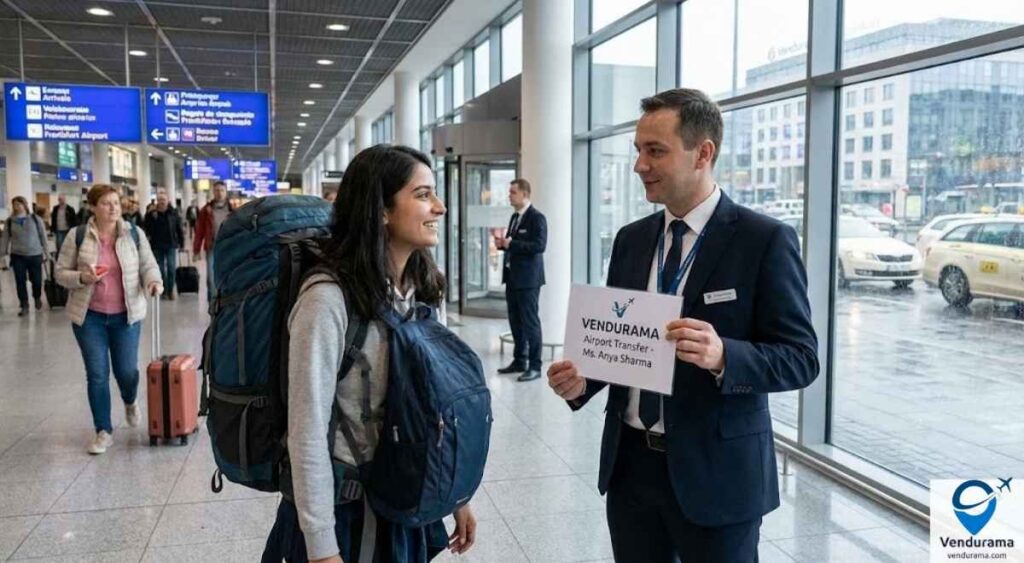
The most intimidating moment of the entire journey is stepping off the plane. Unlike arriving in the UK or US, you may land in an airport where signage is not primarily in English, and taxi drivers or public transport staff may have limited English proficiency. Arriving exhausted with 50kg of luggage and attempting to navigate a foreign transit system to find a dormitory in an unknown city is a recipe for intense stress and potential vulnerability.
To mitigate this “arrival friction,” it is highly recommended to deprioritize thrift in favor of security for the very first leg of the journey on the ground. Arranging a professional, pre-booked airport transfer ensures that a vetted driver is waiting in the arrivals hall, knows exactly where the university accommodation is, and provides a seamless, safe, and direct transit. This acts as a crucial psychological anchor, allowing the student to arrive with dignity and focus on orientation rather than survival.
Part VII: The Financial Ecosystem and Cost of Living
The tuition fee is only one part of the equation. The true cost of education includes rent, food, insurance, and transport.
The “Proof of Funds” Barrier
Almost every European and Asian country requires international students to prove they have enough money to survive for one year before issuing a visa.
- Germany: Requires ~€11,208 deposited into a “Blocked Account” (Sperrkonto) which releases a set amount monthly.
- Other EU Nations: Usually require showing bank statements with €8,000 – €12,000 available. This is liquidity capital that must be available upfront, even if tuition is free.
Geo-Arbitrage in Living Costs
The real savings often come from living expenses.
- Rent: A student room in London might cost £1,200 (€1,400) per month. A similar quality room in Krakow, Poland, might cost €400; in Leipzig, Germany, €500; in Kuala Lumpur, Malaysia, €350.
- Lifestyle: The cost of groceries, dining out, and public transport is significantly lower outside the major Anglosphere capitals. A €1,000 monthly budget provides a comfortable student life in most of Germany, while it would mean near-poverty in Dublin or Sydney.
Part VIII: Post-Graduation Horizons – The Career Dividend
The ultimate goal of the degree is employability. The Anglosphere trap often ends with graduates forced to return home because they cannot secure work visas, burdened by debt in a local currency that cannot service it. The alternative model offers superior pathways.
The Post-Study Work Visa Landscape
Countries hungry for talent have generous post-graduation windows:
- Germany: 18-month Job Seeker Visa after graduation. If you find a skilled job, the path to permanent residency is fast-tracked.
- Netherlands: “Orientation Year” visa allowing 12 months to find work.
- Canada (The Anglosphere Exception): Canada still offers strong post-study work options, but the cost of living crisis there is rapidly eroding its attractiveness.
The Bilingual Advantage
Graduating from an ETP in Germany, even if your course was in English, means you likely picked up some German (many universities offer free courses). Entering the job market as a professional fluent in English, your native tongue, and functionally competent in German/French/Mandarin/Korean gives you a massive competitive advantage over monolingual Anglosphere graduates in the globalized labor market.
Conclusion: The Shift from Prestige Hunting to Value Investing
The era of defaulting to the Anglosphere for higher education is over. It is a model that no longer serves the financial interests of the vast majority of global students.
Choosing an English-taught degree in Europe or Asia is not settling for second best; it is an act of sophisticated financial and strategic planning. It is choosing to receive a world-class education without mortgaging your future. It is choosing to become truly globally fluent, navigating different cultures and systems rather than just staying within the comfortable confines of the English-speaking world.
The doors to high-quality, affordable global education are wide open. They just aren’t the doors the glossy brochures have been pointing to for the last thirty years. The smart money is moving; the question is whether you will move with it, or remain caught in the trap.