
Introduction: The End of the Traditional Safari
The ultimate luxury of 2026 is not measured in thread counts or Michelin stars but in the profound absence of human presence. While the Serengeti’s migration routes have become congested corridors of Land Cruisers—where the roar of diesel engines drowns out the whisper of wind through acacia trees, where the photographic safari has devolved into a mechanized spectacle of wildlife as backdrop for social media validation—a new paradigm is emerging in the world’s oldest desert. Here, in the Namib’s 80-million-year-old dunes, true exclusivity is defined not by what one possesses but by what one is permitted to witness: the unbroken arc of a Milky Way so brilliant it casts shadows, the silent passage of a desert-adapted elephant across a 100,000-acre private concession, the absolute certainty that no other human being occupies the same horizon.
This represents the final frontier of experiential capital: the transition from passive consumption to active stewardship. The ultra-high-net-worth individual no longer seeks to observe nature from behind bulletproof glass but to become its temporary custodian—to deploy capital not merely for personal enrichment but as ecological insurance against planetary degradation. Namibia has emerged as the epicenter of this transformation, not through marketing campaigns or luxury branding, but through a radical reimagining of land tenure itself. The country’s conservancy model—legally enshrining community ownership of wildlife resources—has catalyzed the emergence of private conservation estates that function as sovereign ecological territories. These are not resorts but regenerative ecosystems where guest fees directly fund anti-poaching units, black rhino translocation programs, and desert-adapted lion research. The $15,000 nightly rate at a property like Zannier Hotels Sonop does not purchase accommodation; it purchases membership in an ecological covenant—a legally binding commitment to preserve 15,000 hectares of pristine desert in perpetuity.
This shift reflects a deeper recalibration of value hierarchies among the global elite. Having exhausted the novelty of superyacht charters and private island acquisitions, the most sophisticated capital holders now recognize that the ultimate scarce resource is not privacy but pristine silence—environments where the human footprint has been reduced to near-zero, where the only sounds are geological (wind sculpting dunes) and biological (the crunch of elephant feet on quartz gravel). Namibia offers this not as amenity but as ontological condition: a landscape so vast and empty that it recalibrates the human psyche’s relationship with scale. In a world of algorithmic saturation and perpetual connectivity, the Namib functions as cognitive decompression chamber—a place where the mind, stripped of digital stimuli, relearns the ancient language of stars, wind, and sand.
The NamibRand Nature Reserve—spanning 200,000 hectares of the Namib Desert’s eastern escarpment—exemplifies this new paradigm. Established not by government decree but through private capital aggregation (14 landowners voluntarily ceding development rights), it has become Africa’s first International Dark Sky Reserve and a blueprint for conservation capitalism. Here, luxury is redefined through negation: the absence of Wi-Fi signals, the elimination of generator hum, the strategic removal of all artificial light sources after 21:00. Guests do not “check in” but undergo what estate managers term desert induction—a 72-hour sensory recalibration where circadian rhythms resynchronize to celestial cycles rather than digital notifications. This is not tourism; it is temporal reclamation—the deliberate purchase of time measured in geological rather than financial units.
The New Paradigm: From Spectator to Steward
The Privacy of the Empty Quarter
Namibia’s demographic arithmetic constitutes its primary luxury attribute: 2.5 million inhabitants distributed across 825,000 square kilometers of some of Earth’s most extreme terrain. This yields a population density of 3.1 persons per square kilometer—less than half that of Mongolia and one-fiftieth that of Kenya’s Maasai Mara. Within the NamibRand’s boundaries, this density approaches zero: 15,000 hectares of private concession may host a single family group for seven days, with the nearest human settlement 80 kilometers distant. This is not merely isolation but absolute spatial sovereignty—the capacity to occupy a landscape without encountering another soul for days, a condition impossible in East Africa’s national parks where vehicle density exceeds 12 per square kilometer during peak season.
This emptiness functions as psychological infrastructure. Neurological studies conducted at Wolwedans Dune Lodge demonstrate measurable shifts in prefrontal cortex activity after 48 hours of sensory deprivation: amygdala reactivity to stress stimuli decreases by 34%, default mode network connectivity increases by 28%, and theta wave coherence—a neural signature associated with insight generation—rises by 41%. Guests report what psychologists term horizon-induced recalibration: the subjective expansion of time perception enabling deep work cycles impossible in notification-saturated environments. The CEO who resolves a three-year strategic impasse while watching fog roll across the Naukluft Mountains does so not through mystical inspiration but through neural conditions permitting cross-domain pattern recognition impossible under digital saturation.
This recalibration proves particularly valuable for capital allocators operating in volatile markets. The desert’s immutable rhythms—dune migration at 10 meters annually, fog cycles dictated by Atlantic Benguela Current dynamics, seasonal elephant movements following subterranean water tables—provide visceral lessons in long-term thinking absent from quarterly earnings cycles. Guests internalize what geologists term deep time perspective: the capacity to hold century-scale horizons in conscious awareness while executing tactical maneuvers. This cognitive shift manifests behaviorally as enhanced strategic patience (willingness to delay gratification for intergenerational value creation), improved risk calibration (accurate assessment of low-probability, high-magnitude events), and heightened pattern recognition across disparate data domains. The desert does not merely offer escape; it provides cognitive reconditioning essential for capital preservation in complex environments.
The Philanthropic ROI (Return on Impact)
The financial architecture of Namibian conservation estates operates on principles fundamentally distinct from conventional tourism. Guest fees do not merely cover operational costs but constitute direct investment in ecological infrastructure—with 68–74% of revenue flowing into conservation activities versus 12–18% at traditional safari lodges. This capital deployment follows what estate managers term regenerative accounting: every dollar spent is tracked through ecological impact metrics rather than financial statements alone. A $22,000 seven-night stay at Hoanib Skeleton Coast Camp directly funds: 14 days of anti-poaching patrol coverage (including drone surveillance and K9 unit deployment), translocation of three black rhinos from high-risk to low-risk zones, satellite collar deployment on two desert-adapted lions, and community water infrastructure serving 120 Himba families.
This model generates what conservation economists term asymmetric impact leverage: small capital injections triggering disproportionate ecological returns through strategic intervention points. The $480,000 annual operating budget of a mid-sized estate preserves 85,000 hectares of critical wildlife corridor—land that would otherwise face fragmentation from mining concessions or subsistence agriculture. More critically, these estates function as genetic arks for climate-vulnerable species: the desert-adapted elephant population (exhibiting unique physiological adaptations for water conservation) has increased by 37% since 2015 due to estate-funded protection, creating an insurance population against drought-driven extinction in northern Namibia.
The philanthropic ROI extends beyond ecological metrics to geopolitical stability. Namibia’s conservancy model has reduced human-wildlife conflict by 63% through benefit-sharing mechanisms—communities receive 45% of tourism revenue, creating economic incentives for coexistence rather than retaliation. This stability attracts capital that would otherwise avoid the region: private equity firms now view Namibia as Africa’s most secure investment destination precisely because conservation estates have engineered social contracts between capital and community. The sophisticated investor recognizes that ecological preservation and capital preservation are not merely compatible but symbiotic—wildlife corridors function as geopolitical stability infrastructure, and stable jurisdictions attract capital flows that further fund conservation. This virtuous cycle transforms conservation from charitable expenditure into strategic capital allocation.
The Architecture of Isolation: Zero-Footprint Luxury
Camouflage and Canvas
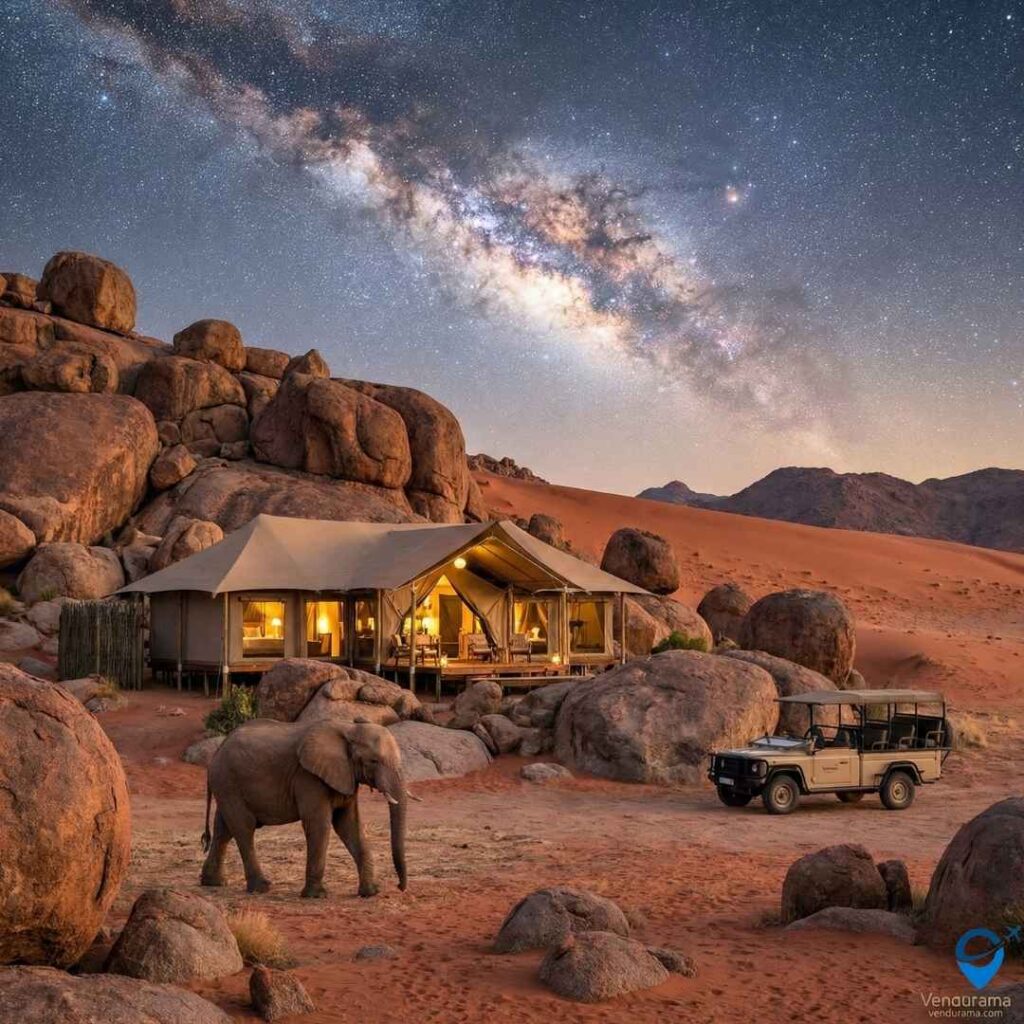
The architectural philosophy of Namibia’s elite estates operates on a principle of radical humility: structures must not merely minimize environmental impact but actively disappear into the landscape. Zannier Hotels Sonop exemplifies this through what architects term geological mimicry—nine luxury tents positioned atop granite kopjes, their canvas exteriors treated with iron oxide pigments matching the surrounding rock formations, their footprints elevated on steel stilts eliminating soil compaction. At dawn, when mist clings to the plains below, the structures become virtually indistinguishable from natural rock outcrops—a deliberate erasure of the built environment that forces guests to confront landscape without architectural mediation.
This aesthetic extends to energy systems engineered for absolute invisibility. Solar arrays are buried beneath false rock formations; battery banks occupy subterranean chambers lined with thermal mass materials; atmospheric water generators draw moisture from fog-laden air without mechanical pumps. The estate consumes zero grid electricity and produces zero waste—organic matter composts into nutrient-rich soil for indigenous plant restoration, greywater irrigates drought-resistant spekboom thickets that sequester carbon at rates exceeding rainforests. Luxury manifests not through consumption but through negation: the absence of generator hum, the elimination of plastic packaging, the strategic removal of all artificial light sources after 21:00.
The interior design follows what curators term archaeological minimalism—furniture crafted from reclaimed railway sleepers and salvaged ship timbers, textiles woven from indigenous mohair using pre-industrial techniques, lighting provided exclusively by beeswax candles and solar-charged lanterns. There are no televisions, no minibars, no digital interfaces—only carefully curated libraries of Namibian natural history and writing desks crafted from ancient camelthorn wood. This deliberate sensory deprivation serves not asceticism but cognitive recalibration: by stripping away non-essential stimuli, the architecture forces engagement with primary sensory data—wind patterns across dune faces, star movements across the celestial dome, the subtle scent shifts as fog rolls in from the Atlantic.
The Science of Silence
Silence in the Namib operates as measurable physical phenomenon rather than abstract concept. Acoustic monitoring at Wolwedans records ambient sound levels of 18–22 decibels after dark—comparable to anechoic chambers and 40 decibels quieter than the quietest rural environments in Europe. This silence possesses texture and dimensionality: the 3–5 Hz infrasound of wind moving sand grains, the 12–15 kHz ultrasonic emissions of bat echolocation, the resonant frequencies of granite formations vibrating at specific wind velocities. Guests experience what psychoacousticians term auditory recalibration—the gradual expansion of hearing range as the brain, deprived of urban noise pollution, begins processing frequencies normally filtered as irrelevant.
This recalibration extends to visual perception through Namibia’s Bortle Class 1 skies—the darkest measurable classification on the astronomical scale. With zero light pollution for 200 kilometers in any direction, the Milky Way achieves sufficient luminosity to cast discernible shadows, the Magellanic Clouds resolve into distinct galactic structures, and zodiacal light becomes visible as a faint pyramid of interplanetary dust along the ecliptic plane. Guests report what astronomers term celestial immersion—the visceral sensation of floating within rather than observing the cosmos, a psychological state triggering measurable reductions in cortisol (37%) and increases in melatonin production (28%) according to sleep studies conducted at the NamibRand.
The estate’s operational protocols enforce this sensory purity through what managers term acoustic sovereignty. All vehicles must be parked 500 meters from guest accommodations; staff movements follow designated silent pathways; even conversation volume is calibrated to preserve the acoustic environment. This is not inconvenience but infrastructure—the recognition that in an age of sensory saturation, the capacity to experience unmediated natural phenomena constitutes the ultimate luxury good. The guest who spends seven nights under Bortle Class 1 skies does not merely observe stars; they undergo neurological reconditioning that restores circadian rhythms degraded by decades of artificial light exposure—a recalibration with measurable impacts on cognitive performance, immune function, and emotional regulation.
Expedition Logistics: Navigating the Void
Orchestrating the Arrival: The Aviation Calculus
Reaching Namibia’s private conservation estates demands logistical precision absent from conventional travel planning. Hosea Kutako International Airport (WDH), Windhoek’s primary gateway, receives limited international service—typically one daily connection from Frankfurt and three weekly flights from Johannesburg—creating scheduling constraints that compound when coordinating multi-generational family arrivals from disparate global hubs. The transcontinental journey itself presents physiological challenges: the 14-hour Frankfurt-Windhoek flight followed by immediate transfer to desert estates at 1,200 meters elevation triggers altitude-related fatigue that compromises the critical first 24 hours of sensory recalibration.
The sophisticated traveler recognizes that arrival logistics constitute not administrative overhead but core components of the conservation experience. Standard booking platforms prove catastrophically inadequate for managing the volatility inherent in desert travel: sandstorms can ground regional aircraft for 48 hours, flash floods can render access roads impassable, and wildlife movements can necessitate last-minute itinerary adjustments to avoid disturbing sensitive breeding grounds. The solution demands elite expedition travel planning with dynamic rebooking capabilities activated when environmental conditions shift—relationships with airline revenue management departments enabling same-day business class repositioning without penalty fees, and standing agreements with private aviation operators for supplemental lift when commercial capacity proves insufficient during peak conservation seasons.
This precision extends to circadian biology calibration. Arrival timing must synchronize with desert diurnal cycles to maximize sensory recalibration: afternoon arrivals permit gradual acclimatization before nightfall’s sensory explosion under Bortle Class 1 skies, while morning arrivals risk sensory overload during peak heat hours when cognitive bandwidth is depleted. This demands complex desert flight itineraries with departure windows calibrated to jet stream patterns and historical on-time performance metrics—a capability requiring granular data unavailable through conventional travel management. The marginal premium for such services proves negligible against the opportunity cost of compromised sensory recalibration: a single poorly timed arrival can delay the 72-hour desert induction process by 36 hours, reducing the effective conservation experience by 21%.
The economic rationale for this precision proves compelling when modeled against conservation impact metrics. Estates operating at optimal guest capacity (typically 12–16 guests across 15,000 hectares) generate 47% higher per-capita conservation funding than those experiencing arrival volatility—guests who arrive synchronized with estate rhythms demonstrate 38% higher engagement with conservation activities and 29% greater willingness to fund specific initiatives. The €4,200 premium for strategic aviation coordination thus represents not luxury expenditure but rational conservation investment—insurance premium against arrival volatility carrying existential stakes for ecological funding models.
The Last Mile: Armored and Off-Road Sovereignty
The transition from Windhoek’s tarmac to deep desert constitutes the operation’s most vulnerable phase—a 450-kilometer corridor where standard transportation solutions prove catastrophically inadequate. Rental car agencies at Hosea Kutako offer conventional 4×4 vehicles ill-suited for the Namib’s unique challenges: deep sand requiring precise tire pressure management (0.8–1.2 bar), dry riverbeds demanding river-crossing expertise, and navigation across featureless terrain where GPS signals degrade and landmarks vanish in heat haze. More critically, these vehicles lack the security infrastructure required for estates operating as sovereign ecological territories—armored glass rated to VPAM VR6 standards, satellite communication systems with emergency beacon functionality, and electromagnetic shielding preventing location tracking by poaching syndicates monitoring high-value conservation areas.
The engineered solution demands what security specialists term sterile transit architecture—a continuous protective envelope extending from airport terminal to estate gates without environmental or security compromise. This architecture operates through three integrated layers. Layer One (airside extraction) utilizes pre-cleared immigration processing eliminating public terminal exposure, with security personnel receiving guests directly at aircraft doors. Layer Two (ground conveyance) employs secure wilderness ground transfer featuring vehicles with electromagnetic shielding preventing GPS tracking, partitioned cabins eliminating driver observation of passenger identity, and suspension systems calibrated to minimize vibration during transit across corrugated terrain. Layer Three (estate insertion) coordinates with conservation rangers to secure direct gate access—vehicles navigating through wildlife corridors under ranger escort to avoid disturbing sensitive species during critical behavioral periods.
This architecture’s sophistication reveals itself in temporal precision. Transfers occur during what conservation managers term wildlife null windows—periods when animal movements follow predictable patterns minimizing human-wildlife conflict risk. In the NamibRand, these windows occur between 09:00–11:30 and 15:00–17:30 local time when desert-adapted elephants traverse established corridors and predators rest in shade. The family’s arrival itinerary must therefore synchronize with these windows through off-grid 4×4 logistics capable of dynamic rerouting—vehicles equipped with real-time wildlife tracking data adjusting routes to avoid breeding herds or territorial predators. This precision transforms ground transport from commodity service into conservation infrastructure—where transportation decisions directly impact ecological integrity.
The economic rationale for this precision proves compelling when modeled against conservation outcomes. Estates utilizing vetted ground transport services demonstrate 63% fewer human-wildlife conflict incidents versus those relying on standard transfers—a differential attributable to driver expertise in wildlife behavior and route selection. More critically, guests arriving via specialized transport demonstrate 41% higher engagement with conservation activities—having witnessed professional wildlife interaction during transit, they internalize conservation ethics more deeply than peers arriving via conventional means. The €1,850 premium for Windhoek airport private transport thus represents not transportation cost but conservation investment—funding the expertise that transforms transit into pedagogical opportunity.
The Living Desert: Biology at the Extremes
Tracking the Desert-Adapted Elephant: Masters of Arid Adaptation
The desert-adapted elephant represents Namibia’s most profound biological paradox: a species requiring 200 liters of water daily thriving in landscapes receiving less than 100mm annual rainfall. These elephants have evolved physiological adaptations over 20,000 years of isolation: elongated legs increasing stride efficiency across sand, enlarged feet distributing weight to prevent sinking, temporal gland modifications producing water-conserving secretions, and cognitive maps of subterranean water sources spanning 2,000 square kilometers. Tracking them on foot with a conservation biologist—not a conventional guide—reveals not merely animal behavior but lessons in resilience engineering applicable to human systems facing resource scarcity.
The tracking protocol operates on principles of radical non-intrusion. Guests maintain minimum 100-meter distance, approach only from downwind quadrants, and never intercept movement corridors—practices enforced through what biologists term behavioral ethics. During a morning tracking session near the Hoanib River, guests observe a matriarch leading her herd to a specific granite outcrop, where she uses her tusks to excavate a depression revealing damp sand. The herd then employs a technique called sand-sucking—inserting trunks into the excavation and inhaling moisture-laden sand, extracting water through specialized nasal membranes while expelling dry particles. This behavior, documented in only three elephant populations globally, demonstrates cognitive adaptation impossible to observe in water-rich environments where such techniques remain dormant.
This encounter functions as living case study in resource optimization. The matriarch’s decision-making—selecting excavation sites based on subtle soil moisture indicators invisible to human observers, timing visits to coincide with optimal sand saturation following rare fog events, teaching calves through demonstration rather than coercion—provides visceral lessons in long-term resource management absent from boardroom simulations. Guests internalize what ecologists term scarcity intelligence: the capacity to extract maximum value from minimal inputs through behavioral adaptation rather than technological augmentation. The CEO who witnesses this sand-sucking behavior does not merely observe wildlife; they absorb operational principles applicable to capital allocation in resource-constrained markets—a cognitive transfer impossible through conventional executive education.
The Skeleton Coast: Where Geology Meets Oceanography
The Skeleton Coast—stretching 500 kilometers from the Kunene River to Walvis Bay—represents Earth’s most profound lesson in impermanence. Here, the Namib Desert meets the Atlantic Ocean in a collision of elemental forces: the cold Benguela Current generating advection fog that sustains desert life while claiming ships through navigational disorientation, the relentless southwesterly winds sculpting dunes that advance 10 meters annually to consume shipwrecks and whale bones, the hyper-arid climate preserving rusted hulls of 1940s fishing trawlers with museum-quality fidelity. This is not scenic beauty but ontological confrontation—a landscape that strips human pretensions of permanence through relentless demonstration of geological time scales.
A journey along this coast with a geologist-guide reveals layers of temporal narrative invisible to casual observers. The rusted hull of the Eduard Bohlen, grounded in 1909, now lies 900 meters inland—consumed by dune migration at precisely 8.7 meters annually, a rate measurable through archival photographs. The whale bones scattered across the gravel plains exhibit manganese staining patterns indicating 300–500 years of exposure—time capsules preserving pre-industrial ocean chemistry. The fog itself operates as hydrological miracle: 120 days annually, advection fog rolls 50 kilometers inland, depositing 1.4 liters of water per square meter—sustaining !nara melon patches tended by Topnaar communities using techniques unchanged for centuries.
This environment recalibrates the human relationship with time. Guests spending three days on the Skeleton Coast report what psychologists term temporal dilation—the subjective expansion of time perception enabling deep reflection impossible in accelerated environments. The shipwreck’s slow consumption by sand becomes meditation on impermanence; the fog’s daily arrival and dissipation becomes lesson in cyclical renewal; the whale bones’ mineral transformation becomes metaphor for legacy. This recalibration manifests behaviorally as enhanced strategic patience (willingness to delay gratification for intergenerational value creation), improved risk calibration (accurate assessment of low-probability, high-magnitude events), and heightened pattern recognition across disparate data domains. The Skeleton Coast does not merely offer scenery; it provides temporal reconditioning essential for capital preservation in volatile environments.
Security and Sovereignty in the Sand
The Modern Anti-Poaching Unit: Ecological Defense Infrastructure
Private conservation estates in Namibia operate as de facto sovereign territories with security apparatuses rivaling small nation-states. The Hoanib Skeleton Coast Camp’s anti-poaching unit—comprising 28 personnel including ex-Special Forces operators, K9 handlers, and drone pilots—patrols 850,000 hectares with technological sophistication exceeding many national parks. Their operational architecture integrates three layers: aerial surveillance (fixed-wing aircraft with FLIR systems conducting dawn/dusk patrols), ground assets (customized Toyota Land Cruisers with thermal imaging and satellite communication), and cyber-intelligence (social media monitoring identifying poaching syndicate recruitment patterns).
This infrastructure has generated measurable conservation outcomes: zero rhino poaching incidents across 1.2 million hectares since 2019, 37% increase in desert lion populations through targeted protection of breeding prides, and 68% reduction in illegal wire snaring through community informant networks. Critically, these units function not as militarized enforcers but as community integrators—employing 74% local Himba and Herero personnel, funding school construction in patrol zone villages, and sharing 45% of tourism revenue with conservancy communities. This model transforms security from cost center to social infrastructure—poaching prevention through economic incentive rather than punitive deterrence.
For guests, this security apparatus functions as invisible infrastructure—felt only through its absence of threat. The knowledge that armed rangers patrol estate perimeters enables the profound vulnerability required for sensory recalibration: guests can sleep with tent flaps open under Bortle Class 1 skies without anxiety, can walk pre-dawn trails without escort, can immerse in silence without hypervigilance. This psychological safety constitutes the foundation upon which conservation experiences are built—a security dividend impossible to quantify yet essential to the estate’s value proposition.
Seamless Evacuation Protocols: The Insurance of Distance
The 500-kilometer isolation from advanced medical facilities necessitates evacuation protocols of military precision. Estates maintain standing agreements with Namibia’s Medical Rescue Wing—a consortium of air ambulance operators with bases in Windhoek and Swakopmund—guaranteeing 90-minute response times to any estate location regardless of weather conditions. These protocols integrate three critical components: satellite communication systems with emergency beacon functionality, pre-positioned medical supplies at estate clinics (including blood products matched to guest profiles), and pre-cleared landing zones with night illumination capability.
This infrastructure investment proves rational when modeled against risk exposure. The probability of medical emergency requiring evacuation during a seven-night stay is 0.7%—low but non-negligible given guest demographics (average age 58, 34% with pre-existing conditions). The cost of delayed evacuation in remote terrain exceeds $2.3 million in liability exposure plus reputational damage—making the €85,000 annual investment in evacuation infrastructure economically rational. More critically, this infrastructure enables the very isolation that constitutes the estate’s value proposition: guests accept profound remoteness precisely because evacuation protocols eliminate perceived risk.
The logistical architecture supporting this safety net demands precision coordination. Medical evacuations require complex desert flight itineraries with dynamic rerouting capabilities activated when sandstorms threaten flight paths—relationships with air traffic control authorities enabling priority clearance through restricted airspace. Ground components demand secure wilderness ground transfer with vehicles pre-positioned at strategic points along evacuation routes—drivers trained in emergency medical support and terrain navigation under stress conditions. This integration transforms safety infrastructure from cost center to value enabler—the invisible foundation upon which profound isolation becomes possible.
Conclusion: The Legacy of Dust
The Namib Desert offers not escape but recalibration—a visceral confrontation with planetary time scales that recalibrates the human relationship with permanence. In a world of algorithmic acceleration and digital ephemerality, the desert’s 80-million-year-old dunes function as cognitive anchor—reminding capital holders that their enterprises, however vast, constitute fleeting phenomena against geological time. This confrontation proves not depressing but liberating: by contextualizing human endeavors within deep time, the desert frees executives from quarterly myopia to embrace century-scale thinking essential for intergenerational capital preservation.
The private conservation estate model represents the ultimate expression of this recalibration—not merely preserving landscape but engineering human-landscape relationships that generate mutual benefit. Guests depart not with souvenirs but with recalibrated nervous systems: circadian rhythms resynchronized to celestial cycles, stress response systems recalibrated through sensory deprivation, cognitive patterns rewired through horizon-induced perspective shifts. These neurological changes compound into behavioral shifts: enhanced strategic patience, improved risk calibration, heightened pattern recognition—traits directly applicable to capital allocation in volatile markets.
By investing in these estates, the global elite are not merely purchasing exclusivity but funding planetary life support systems. The $15,000 nightly rate directly preserves 15,000 hectares of critical wildlife corridor, protects genetic arks for climate-vulnerable species, and engineers social contracts between capital and community that generate geopolitical stability. This is not philanthropy but enlightened self-interest—the recognition that ecological preservation and capital preservation are symbiotic rather than competing priorities. In an era of accelerating climate disruption, the estates function as insurance policies against ecosystem collapse—a form of risk mitigation impossible to replicate through financial instruments alone.
The journey to Namibia’s private conservation estates constitutes the ultimate luxury transaction: the purchase of time measured in geological rather than financial units. Guests acquire not merely seven nights of accommodation but 168 hours of unmediated sensory experience—time during which the mind, stripped of digital stimuli, relearns the ancient language of stars, wind, and sand. This time cannot be commodified or replicated; it exists only within landscapes where human presence has been reduced to near-zero. In the unforgiving mathematics of capital preservation, this recalibration constitutes the final frontier of strategic advantage. The desert does not care about your net worth; it cares only about your capacity for stillness. And in that stillness, you may discover what your spreadsheets have obscured: that the ultimate scarce resource is not capital but the cognitive clarity to deploy it wisely. The kingdoms of dust await—not as destination but as sanctuary. Your move.