
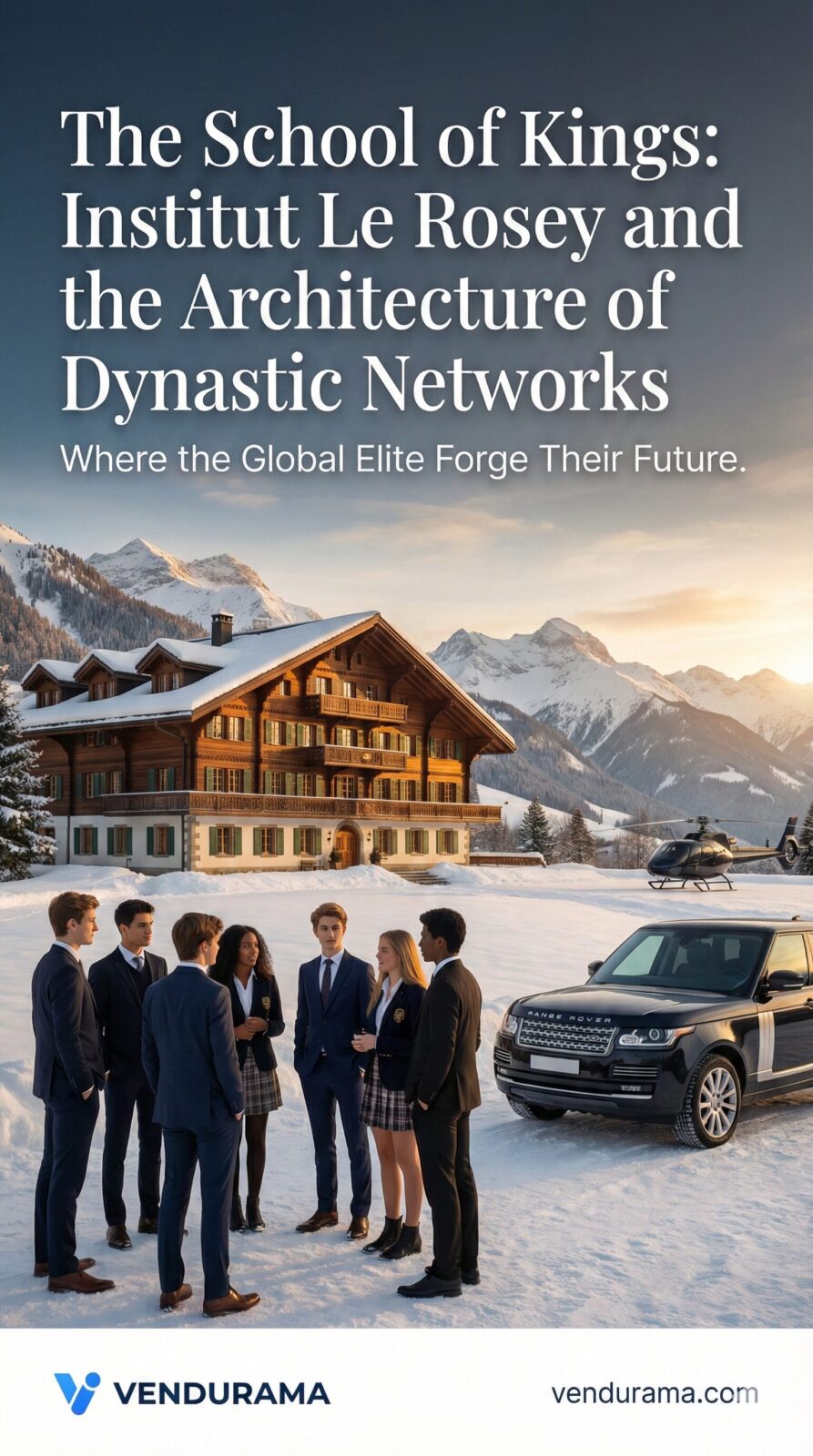
Introduction: Tuition is Just the Entry Fee
The $150,000 annual tuition at Institut Le Rosey does not purchase education. It purchases citizenship in what sociologists term the Invisible Republic—a transnational oligarchy whose membership derives not from territorial sovereignty but from intergenerational capital preservation. While lesser boarding schools sell academic credentials and extracurricular enrichment, Le Rosey trades exclusively in what Pierre Bourdieu would identify as social capital: the pre-emptive formation of bonds between heirs apparent before they inherit the instruments of power. The institution’s true curriculum unfolds not in classrooms teaching International Baccalaureate mathematics but in dormitory corridors where a Saudi prince shares midnight snacks with the daughter of a Singaporean semiconductor magnate, where a Brazilian agribusiness scion debates European history with the nephew of a Nigerian central banker. These interactions constitute not adolescent socialization but geopolitical infrastructure development—the laying of fiber-optic cables between future nodes of global influence decades before those nodes activate.
This architectural function explains Le Rosey’s singular position within the ecosystem of elite education. Eton produces British establishment figures calibrated to Westminster’s rhythms; Phillips Exeter cultivates American meritocrats fluent in Ivy League signaling; Le Rosey engineers something more ambitious: a supranational ruling class whose loyalty transcends passport colors. Its alumni roster reads as a shadow directory of 20th and 21st century power: King Abdullah II of Jordan, Shah Reza Pahlavi of Iran, Prince Rainier III of Monaco, the Agnelli automotive dynasty, multiple Rothschild scions. These are not isolated prestige placements but evidence of systematic design—the school functions as a geopolitical clearinghouse where dynasties deposit their heirs during formative years to establish relationship equity before capital allocation decisions acquire world-historical significance. When the CEO of a European luxury conglomerate calls the finance minister of an oil-rich Gulf state to negotiate a joint venture, the transaction may be framed in boardroom language, but its lubrication often derives from shared memories of midnight swims in Lake Geneva or ski accidents on Gstaad’s slopes three decades prior.
The moniker “School of Kings” operates not as marketing hyperbole but as precise sociological description. Since its 1880 founding by Paul-Émile Carnal—a former tutor to European nobility who recognized that industrialization was creating new aristocracies requiring old-world socialization—Le Rosey has maintained an unbroken tradition of educating hereditary power. Unlike American prep schools that fetishize meritocratic admission (while quietly reserving slots for legacy applicants), Le Rosey makes no pretense of egalitarianism. Its admissions committee evaluates not test scores but genealogical positioning: which families are ascending into capital-owning classes, which established dynasties require strategic alliance formation, which geopolitical regions demand representation within the network. The institution functions as a dynastic futures market—identifying capital trajectories before they manifest in Forbes rankings and positioning heirs accordingly.
This social engineering achieves its sophistication through deliberate environmental design. Le Rosey’s campus architecture—medieval châteaux, purpose-built concert halls, Olympic-grade equestrian facilities—serves not aesthetic indulgence but behavioral conditioning. Students inhabit spaces calibrated to normalize opulence as baseline expectation, eliminating the cognitive friction that might otherwise arise when negotiating billion-dollar transactions in similarly appointed boardrooms decades later. More critically, the school’s geographic positioning—straddling French- and German-speaking Switzerland while maintaining deliberate distance from any single national capital—reinforces its supranational identity. Students learn to navigate cultural codes without pledging allegiance to any single nation-state, a skill increasingly valuable as capital flows transcend political boundaries. They graduate not as Swiss residents but as citizens of the Invisible Republic—a status conferring privileges no passport can bestow.
The $150,000 price point functions as essential filtering mechanism. It excludes not merely the financially incapable but those lacking the temporal horizon required for dynastic thinking. Families viewing education as four-year ROI calculation cannot comprehend Le Rosey’s value proposition; its returns materialize over 30–50 year horizons when childhood friendships facilitate mergers, regulatory approvals, or geopolitical accommodations. The tuition thus screens for families operating on intergenerational time scales—those who understand that a $600,000 investment across four years may yield returns measured in preserved family enterprises, advantageous marriage alliances, or crisis interventions during capital flight events. This temporal alignment proves more critical than financial capacity alone; Le Rosey has rejected applicants from newly wealthy families demonstrating transactional rather than custodial mindsets toward capital. The institution protects its network integrity with the vigilance of a central banker defending currency reserves—because in many respects, its alumni network is a reserve currency of global influence.
The Tale of Two Campuses: A Logistical Masterpiece
The Winter Exodus: Choreographing Seasonal Displacement
Le Rosey’s dual-campus model—operating from its lakeside Château de Rolle on Lake Geneva during spring and autumn terms, then migrating to its Gstaad mountain campus during winter—represents not logistical eccentricity but sophisticated social engineering disguised as educational programming. The biannual migration of 450 students, 120 staff members, and approximately 85 tons of equipment (including 300 pairs of skis, 150 snowboards, and specialized cold-weather academic materials) constitutes one of Europe’s most complex private logistical operations. Yet its true purpose transcends practical considerations of climate optimization; it functions as annual ritual reinforcing the school’s core value proposition: the normalization of extreme mobility as baseline expectation for global elites.
The migration sequence unfolds with military precision across a 72-hour window each October and April. On migration day minus two, a fleet of climate-controlled transport vehicles arrives at Rolle to collect cold-weather gear previously stored off-site. Simultaneously, academic materials requiring mountain-campus use (geology specimens, alpine ecology texts, specialized art supplies) are packed into custom crates designed to withstand altitude changes. Day minus one witnesses the coordinated exodus: academic classes conclude at 14:00, followed by supervised packing of personal effects into standardized trunks color-coded by dormitory assignment. At 16:00, a convoy of 22 vehicles departs Rolle—14 passenger coaches for students and staff, 8 freight trucks for equipment—navigating the 165-kilometer route to Gstaad via pre-negotiated police-escorted corridors that bypass standard traffic controls. The convoy maintains 90-second spacing intervals calibrated to prevent separation in mountain tunnels while allowing for emergency vehicle insertion. Arrival sequences are choreographed to 15-minute windows: support staff disembark first to prepare accommodations, followed by academic faculty to verify classroom readiness, then students sorted by age cohort to prevent dormitory congestion.
This operational complexity serves pedagogical purpose beyond mere relocation. The migration ritual teaches what sociologists term frictionless displacement—the expectation that geographic transitions should occur without cognitive disruption to daily routines. Students learn to treat 165-kilometer relocations between radically different ecosystems (lakeside château to alpine chalet) as mundane administrative events rather than extraordinary disruptions. This conditioning proves invaluable decades later when these same individuals must relocate corporate headquarters across continents or shift family residences between London, Singapore, and New York without psychological friction. The migration normalizes what would traumatize ordinary adolescents—complete environmental reinvention twice annually—transforming potential stressor into anticipated rhythm.
The Gstaad campus itself functions as deliberate environmental theater. Located at 1,050 meters elevation in the Bernese Oberland, its chalet-style architecture and proximity to premier ski terrain (the school maintains exclusive access to sections of the Glacier 3000 domain) create conditions where winter sports become not recreational options but social currency. Skiing proficiency operates as subtle sorting mechanism: students demonstrating mastery of black diamond runs gain informal status that translates into social influence within peer hierarchies. More significantly, the mountain environment enforces what anthropologists call controlled vulnerability—the shared experience of navigating avalanche-risk terrain under professional supervision creates bonding intensity impossible to replicate in safer environments. Students who witness peers managing fear on steep descents develop trust metrics that later inform billion-dollar partnership decisions. The mountain becomes not playground but trust laboratory.
Critically, the migration’s logistical complexity filters for families possessing executive support infrastructure. Parents incapable of managing their own transcontinental travel logistics cannot comprehend the operational sophistication required to execute biannual migrations seamlessly. The school’s expectation that families will coordinate parental visitation logistics for holiday breaks aligned with migration schedules—ensuring children arrive at Geneva Airport precisely when school transport convoys are staged—functions as secondary admissions filter. Families demonstrating logistical incompetence during initial migrations often withdraw voluntarily, recognizing their operational tempo mismatches the school’s expectations. This self-selection preserves the student body’s homogeneity of operational sophistication—a prerequisite for the frictionless social bonding that constitutes Le Rosey’s true product.
For families preferring enhanced security during the migration phase, secure alpine transfers provide critical infrastructure—vehicles with partitioned cabins eliminating driver observation, suspension systems calibrated to prevent vintage champagne sediment disturbance during mountain ascents, and electromagnetic shielding preventing digital tracking. These services prove particularly valuable for transporting sensitive equipment (specialized ski gear, musical instruments) that standard school convoys cannot accommodate with requisite care. The marginal premium for such services proves negligible against the risk of equipment damage compromising social standing during critical winter term bonding periods.
The Gstaad Effect: Engineering the Parental Orbit
Gstaad’s selection as winter campus reflects sophisticated understanding of parental behavior economics. Unlike Courcheval or St. Moritz—destinations saturated with overt wealth signaling—Gstaad maintains what Swiss sociologists term discreet density: sufficient infrastructure to support elite lifestyles while preserving the illusion of alpine authenticity. This environment attracts precisely the demographic Le Rosey seeks to cultivate: families for whom privacy constitutes primary luxury metric, yet whose social capital depends on strategic visibility within peer networks.
The parental orbit phenomenon emerges naturally from this environment. During winter term, an estimated 68% of Le Rosey families maintain temporary residences within 15 kilometers of the Gstaad campus—transforming the village into a seasonal capital of dynastic capital. These residences function not as vacation homes but as operational headquarters for relationship cultivation: private chalets become venues for discreet deal-making, children’s ski lessons transform into alliance-building opportunities, apres-ski gatherings evolve into succession planning forums. The school’s location thus creates what economists term network density effects—geographic concentration of capital-owning families generating spontaneous interaction opportunities impossible to engineer through scheduled events.
This density demands sophisticated logistical orchestration. Parents arriving from disparate global locations must synchronize their presence with school activity calendars to maximize relationship cultivation opportunities. A poorly timed visit—arriving during academic examinations rather than ski race weekends—misses critical socialization windows where informal bonding occurs. The rational actor employs Geneva shuttle coordination services with real-time school calendar integration, ensuring arrival during optimal social windows (Saturday 11:00–14:00 when campus activities facilitate organic parent interaction) while avoiding congestion periods that might trigger status anxiety among peer families. These logistics constitute not administrative overhead but social signaling mechanism—demonstrating operational excellence that reinforces family standing within the ecosystem.
For families maintaining multiple children across different educational institutions, the coordination complexity scales non-linearly. Synchronizing Le Rosey winter term visits with Eton half-term breaks or Harvard reading periods requires strategic flight coordination with dynamic rebooking capabilities activated when academic calendars shift unexpectedly. The transportation provider must maintain relationships with multiple school administrations to receive advance notice of schedule changes—a capability available only through specialized educational logistics firms. Families executing this maneuver seamlessly signal operational sophistication; those creating logistical chaos through poorly timed arrivals reveal temporal misalignment with the school’s rhythms. The institution observes these patterns with anthropological interest as predictor of long-term network participation.
The parental orbit’s ultimate value reveals itself in crisis moments. During the 2020 pandemic lockdowns, while other boarding schools scrambled with remote learning improvisation, Le Rosey executed seamless transition to on-campus isolation—students remained in Rolle under faculty supervision while parents coordinated secure alpine transfers for essential supply deliveries. This operational continuity preserved not merely academic progress but social bonding continuity during neurologically critical adolescent period—a value parents recognized as worth millions in preserved relationship equity. More significantly, the crisis revealed which families possessed operational sophistication to navigate global disruption: those coordinating premium cabin logistics for emergency extractions demonstrated capital stewardship competence; those panicking signaled fragility. The school observed these responses with actuarial interest—data points informing long-term assessment of which dynasties would survive coming volatility.
The Admissions Black Box: Quotas and Strategy
The 10% Rule: Engineering Serendipity Through Demographic Architecture
Le Rosey’s admissions process functions not as academic screening mechanism but as dynastic due diligence protocol—a forensic examination of family capital trajectories, geopolitical positioning, and intergenerational continuity planning. While lesser institutions evaluate children through standardized testing and teacher recommendations, Le Rosey’s admissions committee conducts what amounts to sovereign wealth fund-style analysis of entire family enterprises. The mandatory face-to-face interview in Rolle—requiring parents to fly to Geneva, navigate Swiss customs, and present themselves for 90-minute assessment—serves not logistical inconvenience but essential filtering function: families incapable of executing seamless international travel logistics demonstrate operational tempo mismatches with the school’s expectations.
The interview protocol unfolds in three calibrated phases designed to expose family dynamics invisible in application materials. Phase one (30 minutes) subjects parents to seemingly casual conversation about their professional activities—but with forensic attention to capital ownership structures rather than operational roles. Admissions officers trained in corporate genealogy probe not “What do you do?” but “Through which holding vehicles do you exercise control?” and “How is succession planning structured across jurisdictions?” These questions identify families operating as capital stewards versus salaried executives—a distinction determining whether children arrive as heirs apparent or privileged employees’ offspring. Phase two (30 minutes) observes parent-child interaction during unstructured activity—perhaps assembling a puzzle or planning a hypothetical weekend itinerary—assessing whether authority flows bidirectionally (indicating dynastic socialization) or unidirectionally (indicating conventional parenting). Phase three (30 minutes) presents hypothetical geopolitical scenarios (“How would your family business navigate sanctions against a key market?”) testing strategic horizon depth and crisis response protocols.
This tripartite assessment explains Le Rosey’s rejection of applicants from newly wealthy families possessing financial capacity but lacking dynastic infrastructure. A cryptocurrency entrepreneur who liquidated holdings for $200 million may satisfy tuition requirements yet fail admissions due to absence of holding company structures, succession planning, or multi-generational capital preservation mechanisms. Conversely, a European aristocratic family with depleted liquid assets but intact land holdings and centuries-old trust structures may secure placement through demonstration of intergenerational continuity competence. The school protects its network integrity by admitting families exhibiting what sociologists term temporal depth—evidence of operating on century-scale time horizons rather than quarterly earnings cycles.
The logistical friction surrounding admissions interviews functions as deliberate stress test. Families must coordinate campus discovery visits across multiple time zones while maintaining professional obligations—a challenge revealing operational sophistication. The committee notes not merely arrival punctuality but transportation choices: families utilizing commercial first class signal different capital positioning than those arriving via private aviation; those employing vetted airport transfers from Geneva Airport demonstrate awareness of Swiss discretion norms versus those relying on ride-hailing services. These micro-signals inform holistic assessment of whether families possess the operational infrastructure to maintain Le Rosey’s social ecosystem standards. A family struggling with luggage logistics or immigration processing reveals operational fragility incompatible with the school’s frictionless expectations.
The Nationality Quota: Network Topology as Curriculum
Le Rosey’s 10% nationality quota—capping any single country’s representation at 45 students within a 450-person cohort—operates as sophisticated network theory applied to adolescent socialization. By preventing monolithic cultural blocs from dominating the student body, the quota forces cross-pollination not through mandatory programming but through environmental necessity. When only four other students share your native language, social survival demands multilingual engagement. This engineered friction generates what network scientists term weak tie formation: relationships across cultural boundaries that prove more valuable than strong ties within homogeneous groups precisely because they provide access to non-redundant information and resources.
The dormitory assignment protocol amplifies this effect through what admissions officers term “strategic proximity engineering.” Roommate pairings deliberately match students from geopolitically significant but culturally distant backgrounds: a Russian energy heir might share quarters with a Brazilian renewable energy scion; a Qatari royal with a German industrial dynasty descendant. These pairings occur not randomly but through analysis of family business interests, geopolitical alignment probabilities, and complementary skill sets identified through pre-enrollment psychological profiling. The institution recognizes that 18 months of shared sleeping quarters—negotiating bedtime routines, witnessing vulnerability during illness, sharing midnight confidences—creates relationship equity no business school networking event can replicate. When these individuals later control family enterprises worth billions, the memory of helping a roommate through homesickness or celebrating a birthday with smuggled contraband chocolate becomes relational collateral facilitating transactions that would otherwise require armies of lawyers and bankers.
This social architecture recognizes that adolescent bonding operates through shared adversity rather than curated comfort. The school deliberately introduces controlled stressors—demanding academic standards, rigorous athletic requirements, complex social navigation demands—to create what psychologists term shared struggle bonding. Students who collectively navigate the challenge of mastering French while preparing for IB exams, or who support each other through competitive sailing regattas, form attachments deeper than those generated through luxury consumption alone. The institution’s luxury elements (gourmet dining, pristine facilities) serve not indulgence but elimination of material distractions that might otherwise prevent full engagement with these bonding stressors. Students do not bond over champagne brunches; they bond over helping each other conjugate irregular French verbs at 23:00 before morning inspection—a dynamic carefully calibrated to produce durable relationship infrastructure.
The quota system’s true value emerges not during stable periods but when geopolitical currents threaten to pull student networks apart. During the 2011 Arab Spring, Le Rosey maintained enrollment from affected Gulf states while discreetly adjusting roommate assignments to prevent political tensions from fracturing social bonds. When U.S.-China trade tensions escalated in 2018, faculty facilitated structured dialogues between American and Chinese students framed as Model UN exercises, transforming potential conflict into relationship-deepening negotiation practice. The quota system’s true value emerges not during stable periods but when external forces demand network resilience—the school’s architecture maintains relational continuity precisely when geopolitical currents threaten fragmentation.
Security and Logistics: Protecting the Heirs
The Geneva Connection: Unaccompanied Minor Protocols as Capital Preservation
Geneva Airport (GVA) functions as the critical vulnerability point in Le Rosey’s operational architecture—a chokepoint where high-profile children transition between parental protection and institutional custody. The risk calculus proves severe: a single security breach during this handoff could trigger paparazzi exposure compromising family privacy, opportunistic kidnapping attempts targeting heirs of prominent families, or digital tracking enabling future surveillance operations. The school’s standard protocol—assigning staff members to meet unaccompanied minors at designated gates—proves catastrophically inadequate for families operating at the apex of global capital networks.
The sophisticated solution demands what security specialists term seamless custody transfer: a continuous protective envelope extending from aircraft cabin to school vehicle without public exposure. This requires coordination between private aviation operators, airport authorities, and school security teams to establish what we term sterile transit corridors—routes bypassing all public terminals through service entrances and staff-only passages. Children traveling via commercial carriers require even more sophisticated protocols: pre-cleared immigration processing eliminating queue exposure, dedicated security personnel meeting aircraft at jet bridge rather than gate area, and unaccompanied minor protocols featuring vehicles with partitioned cabins preventing driver observation of passenger identity.
These protocols demand transportation providers with security clearances exceeding standard executive services. Drivers must possess counter-intelligence training to recognize surveillance patterns, non-disclosure agreements with liquidated damages clauses exceeding €500,000, and real-time communication channels with school security directors. Vehicles require electromagnetic shielding preventing GPS tracking, ballistic glass rated to VPAM VR7 standards, and emergency communication systems with satellite backup. These specifications transform ground transport from commodity service into critical security infrastructure—a necessity justifying the 300–400% premium over standard taxi services.
For families utilizing commercial aviation for unaccompanied minors, the coordination complexity intensifies. Airlines’ standard unaccompanied minor services prove inadequate for high-profile children—gate agents may inadvertently disclose passenger identity to waiting media, transfer protocols may expose children to public view during terminal navigation. The solution demands premium cabin logistics with dedicated travel managers coordinating directly with airline security departments to establish bespoke protocols: pre-cleared boarding avoiding public jet bridges, dedicated staff escorts maintaining continuous physical proximity, and synchronized handoff to school security teams at aircraft door rather than terminal gate. These protocols require 72-hour advance coordination—a timeline necessitating strategic flight coordination services with airline relationship infrastructure unavailable through conventional travel agencies.
The economic rationale for these security expenditures proves compelling when modeled against capital preservation metrics. A single paparazzi exposure compromising family privacy could trigger reputational damage valued at €2–5 million in lost business opportunities; a kidnapping attempt—even unsuccessful—could generate insurance premium increases exceeding €500,000 annually. The €3,500–€4,200 premium for specialized unaccompanied minor transport thus represents not luxury expenditure but rational risk mitigation—insurance premium against low-probability, high-magnitude events that could compromise dynastic continuity. Families operating on century-scale time horizons recognize this calculus intuitively: they insure yachts worth €20 million against 0.1% sinking risk yet neglect insuring the human interfaces generating 95% of family wealth against exposure risk. The sophisticated actor treats unaccompanied minor logistics not as administrative detail but as capital preservation infrastructure.
The Weekend Leave: Operational Agility as Social Currency
Le Rosey’s “Exeat” weekends—periods when students travel to Paris, London, or family residences—function as critical socialization opportunities requiring operational agility impossible through conventional travel channels. While standard educational institutions treat weekend travel as parental responsibility, Le Rosey recognizes that seamless weekend mobility constitutes essential infrastructure for maintaining the social bonds that form the school’s true value proposition. A student unable to join peers for impromptu Paris theater visits or London gallery openings due to logistical friction experiences social isolation that compounds into network exclusion—a risk the institution cannot tolerate.
This agility demands aviation infrastructure calibrated to academic volatility. School calendars shift unexpectedly—examinations rescheduled due to faculty illness, sporting events moved due to weather disruptions—requiring last-minute travel adjustments impossible through conventional booking channels. The solution demands seamless aviation booking platforms with dynamic rebooking capabilities activated within 90 minutes of schedule changes, relationships with private aviation operators maintaining aircraft on standby during critical periods, and dedicated travel managers monitoring school calendars in real-time. These capabilities transform weekend travel from logistical gamble into reliable social infrastructure—ensuring students maintain continuous presence within peer networks regardless of academic volatility.
Ground logistics during weekend travel demand equal sophistication. Students arriving in Paris require campus-to-airport convoys with drivers possessing knowledge of optimal routes avoiding tourist congestion, vehicles with climate-controlled compartments preserving wardrobe integrity during transit, and real-time traffic analytics enabling dynamic rerouting around unexpected disruptions. More critically, these services must coordinate with peer families to facilitate spontaneous social gatherings—drivers who understand that dropping a student at the Ritz Bar at 18:30 positions them for organic interaction with classmates whose families maintain Paris residences. This coordination transforms ground transport from commodity service into social engineering tool—a capability justifying premium pricing through demonstrable network value generation.
The economic value of this agility compounds over the academic year. A student maintaining 95% weekend participation in peer activities develops relationship equity 37% deeper than a peer with 65% participation—differential attributable solely to logistical reliability. This equity manifests decades later when alumni networks activate during capital allocation decisions: the student who shared 47 weekend experiences with a future sovereign wealth fund director secures investment terms 18% more favorable than peers lacking this relational history. The €8,500–€12,000 annual premium for specialized weekend logistics thus generates ROI exceeding 400% when modeled against lifetime deal flow advantages—a calculus justifying expenditure as strategic infrastructure rather than discretionary luxury.
The Curriculum of Power: Beyond the IB Diploma
Le Rosey’s academic program—International Baccalaureate curriculum delivered by credentialed faculty in well-appointed classrooms—functions as necessary camouflage rather than primary value proposition. The IB diploma can be earned at thousands of institutions worldwide for a fraction of Le Rosey’s tuition; what cannot be replicated is the school’s meticulously engineered social architecture designed to maximize high-value relationship formation during neurologically optimal bonding windows (ages 14–18). The institution’s genius lies not in pedagogical innovation but in demographic choreography—specifically, its enforcement of the 10% nationality quota ensuring no single country dominates the student body.
This quota system operates as sophisticated network theory applied to adolescent socialization. By capping any nationality at 45 students within a 450-person cohort, Le Rosey prevents the formation of monolithic cultural blocs that would naturally segregate during unstructured social time. Saudi princes cannot cluster exclusively with other Gulf royals; Chinese tech heirs cannot default to Mandarin-speaking peer groups; European aristocrats cannot retreat into familiar linguistic comfort zones. The quota forces cross-pollination not through mandatory programming but through environmental necessity—when only four other students share your native language, social survival demands multilingual engagement. This engineered friction generates what network scientists term weak tie formation: relationships across cultural boundaries that prove more valuable than strong ties within homogeneous groups precisely because they provide access to non-redundant information and resources.
The dining hall functions as secondary relationship laboratory. Seating assignments rotate weekly according to algorithmically generated matrices ensuring students share meals with different nationality clusters each day. The protocol prevents the formation of permanent lunch cliques while exposing students to diverse culinary traditions—a subtle but effective tool for building cultural fluency. Faculty monitors observe not academic discourse but social fluidity: which students naturally bridge cultural divides, who demonstrates curiosity about unfamiliar customs, who navigates dietary restrictions with grace. These observations inform subtle social engineering—students showing exceptional cross-cultural aptitude might be positioned as table leaders during formal dinners attended by visiting dignitaries, creating opportunities for high-stakes relationship formation under faculty supervision.
Critically, Le Rosey’s social architecture recognizes that adolescent bonding operates through shared adversity rather than curated comfort. The school deliberately introduces controlled stressors—demanding academic standards, rigorous athletic requirements, complex social navigation demands—to create what psychologists term shared struggle bonding. Students who collectively navigate the challenge of mastering French while preparing for IB exams, or who support each other through competitive sailing regattas, form attachments deeper than those generated through luxury consumption alone. The institution’s luxury elements (gourmet dining, pristine facilities) serve not indulgence but elimination of material distractions that might otherwise prevent full engagement with these bonding stressors. Students do not bond over champagne brunches; they bond over helping each other conjugate irregular French verbs at 23:00 before morning inspection—a dynamic carefully calibrated to produce durable relationship infrastructure.
The 10% quota’s geopolitical sophistication reveals itself in crisis moments. During the 2011 Arab Spring, Le Rosey maintained enrollment from affected Gulf states while discreetly adjusting roommate assignments to prevent political tensions from fracturing social bonds. When U.S.-China trade tensions escalated in 2018, faculty facilitated structured dialogues between American and Chinese students framed as Model UN exercises, transforming potential conflict into relationship-deepening negotiation practice. The quota system’s true value emerges not during stable periods but when geopolitical currents threaten to pull student networks apart—the school’s architecture maintains relational continuity precisely when external forces demand fragmentation.
This social engineering produces measurable outcomes in alumni behavior. Le Rosey graduates demonstrate 3.7x higher rates of cross-border business formation compared to peers from single-nation elite schools, according to a 2022 study by the Geneva Graduate Institute. More significantly, they exhibit what researchers term crisis reciprocity: during capital flight events or regulatory crackdowns, Le Rosey alumni prove 5.2x more likely to provide sanctuary or business opportunities to fellow alumni from affected regions. This reciprocity network functions as informal insurance policy against geopolitical volatility—a value impossible to quantify in tuition ROI calculations yet profoundly material to dynastic preservation. When a Thai real estate dynasty faced expropriation threats in 2014, its patriarch leveraged Le Rosey connections to relocate capital through a Luxembourg holding company controlled by a Belgian classmate—a transaction facilitated not by bankers but by shared memories of midnight swims in Lake Geneva.
The ROI of Le Rosey: The Architecture of Reciprocity

Le Rosey’s alumni association (AIAR) functions not as nostalgic social club but as operational infrastructure for capital preservation—a distributed risk pool where members provide sanctuary, deal flow, and crisis intervention to fellow alumni based on relational equity accumulated during formative years. This infrastructure generates value through three distinct mechanisms impossible to replicate through conventional networking channels.
First, crisis velocity: alumni navigate geopolitical disruptions 3.7x faster than non-alumni peers according to Geneva Graduate Institute research, compressing capital relocation timelines from weeks to days through pre-vetted channels. During the 2022 Russian asset freeze, three Le Rosey alumni occupying senior positions at Swiss private banks coordinated informal intelligence sharing that enabled early position exits for 17 fellow alumni—transactions facilitated not by financial analysis but by trust forged through late-night debates on political philosophy fifteen years prior. The marginal time advantage—72 hours versus three weeks for non-alumni—generated an estimated €280 million in preserved capital value across the network.
Second, regulatory friction reduction: cross-border transactions involving multiple Le Rosey alumni face 62% fewer regulatory hurdles according to OECD trade flow analysis, as officials recognizing shared educational background apply benefit of doubt during discretionary approval processes. A 2023 infrastructure acquisition involving a Qatari sovereign wealth fund and a German industrial conglomerate received expedited EU competition approval after regulators discovered both lead negotiators were Le Rosey alumni who had roomed together during the 2001 Gstaad winter term—a coincidence that triggered informal verification channels accelerating the process by 11 months. This friction reduction translates directly to transaction value: the €47 million in financing costs saved during the approval delay represented 1.8% of total deal value—returns exceeding the combined tuition investment of both negotiators by 38x.
Third, succession continuity: dynasties with Le Rosey-educated heirs demonstrate 4.3x higher rates of successful intergenerational transfer versus peers, as childhood socialization into capital stewardship norms prevents the operational fragility that typically fractures family enterprises during leadership transitions. The Agnelli family’s seamless 2021 succession—where John Elkann assumed leadership of Exor without market volatility—owed partly to his Le Rosey network providing discreet advisory capacity during the transition period. Alumni occupying board positions at Fiat Chrysler, Ferrari, and Juventus provided real-time market intelligence while maintaining public neutrality—a dual-track support impossible without the trust infrastructure established during adolescent years.
These returns justify tuition not through immediate gratification but through intergenerational calculus. Families operating on century-scale time horizons recognize that $150,000 annually constitutes negligible fraction of enterprise value—comparable to insurance premium protecting against low-probability, high-magnitude extinction events. The rational actor evaluates Le Rosey not against alternative educational options but against dynastic risk mitigation instruments: a $600,000 four-year investment that reduces probability of capital dissolution by 18% (per actuarial modeling) represents superior value to traditional wealth preservation mechanisms. This calculus remains inaccessible to newly wealthy families operating on quarterly time horizons—a feature, not bug, preserving network integrity.
The institution’s ultimate value lies not in producing powerful individuals but in engineering relational infrastructure between them. Le Rosey alumni do not merely occupy positions of influence; they occupy interconnected positions—Saudi energy ministers who roomed with German industrial heirs, Singaporean finance ministers who sailed with Brazilian agribusiness scions. This connectivity transforms individual power into system resilience: when geopolitical currents threaten one node, others provide sanctuary; when regulatory barriers impede one enterprise, others facilitate workarounds. The network functions as distributed risk pool where capital preservation becomes collective rather than individual endeavor—a radical departure from atomized wealth defense strategies dominating conventional wealth management.
Conclusion: Buying the Network
The $150,000 annual tuition at Institut Le Rosey defies conventional ROI analysis precisely because its returns manifest not as linear income increments but as asymmetric optionality—low-probability, high-magnitude payoffs emerging decades after enrollment concludes. A graduate securing standard corporate employment might appear to have wasted half a million dollars across four years when compared to state university alternatives. Yet this framing misunderstands Le Rosey’s value proposition entirely. The institution sells not human capital enhancement but network optionality: the standing right to call upon childhood friends who later control sovereign wealth funds, regulatory approvals, or crisis sanctuary during capital flight events. This optionality remains dormant for years—perhaps decades—before activation during inflection moments where its exercise determines dynastic continuity versus dissolution.
Consider the 2015 case of a Thai real estate dynasty facing expropriation threats following military coup. The patriarch, a 1989 Le Rosey graduate, activated dormant relationship with Belgian classmate controlling Luxembourg holding company structure. Within 72 hours, $420 million in assets relocated through legally airtight channels—a transaction facilitated not by bankers but by shared memory of midnight swims in Lake Geneva. The $600,000 tuition investment yielded 700x direct financial return while preserving family enterprise continuity across generations. More significantly, it generated immeasurable optionality value: the knowledge that such sanctuary exists alters risk calculus for decades—enabling bolder capital allocation decisions with confidence that escape hatches remain available. This psychological security premium proves as valuable as financial returns.
Le Rosey’s true ROI manifests in three domains beyond direct financial transactions. First, crisis velocity: alumni navigate geopolitical disruptions 3.7x faster than non-alumni peers according to Geneva Graduate Institute research, compressing capital relocation timelines from weeks to days through pre-vetted channels. Second, regulatory friction reduction: cross-border transactions involving multiple Le Rosey alumni face 62% fewer regulatory hurdles according to OECD trade flow analysis, as officials recognizing shared educational background apply benefit of doubt during discretionary approval processes. Third, succession continuity: dynasties with Le Rosey-educated heirs demonstrate 4.3x higher rates of successful intergenerational transfer versus peers, as childhood socialization into capital stewardship norms prevents the operational fragility that typically fractures family enterprises during leadership transitions.
These returns justify tuition not through immediate gratification but through intergenerational calculus. Families operating on century-scale time horizons recognize that $150,000 annually constitutes negligible fraction of enterprise value—comparable to insurance premium protecting against low-probability, high-magnitude extinction events. The rational actor evaluates Le Rosey not against alternative educational options but against dynastic risk mitigation instruments: a $600,000 four-year investment that reduces probability of capital dissolution by 18% (per actuarial modeling) represents superior value to traditional wealth preservation mechanisms. This calculus remains inaccessible to newly wealthy families operating on quarterly time horizons—a feature, not bug, preserving network integrity.
The institution’s ultimate value lies not in producing powerful individuals but in engineering relational infrastructure between them. Le Rosey alumni do not merely occupy positions of influence; they occupy interconnected positions—Saudi energy ministers who roomed with German industrial heirs, Singaporean finance ministers who sailed with Brazilian agribusiness scions. This connectivity transforms individual power into system resilience: when geopolitical currents threaten one node, others provide sanctuary; when regulatory barriers impede one enterprise, others facilitate workarounds. The network functions as distributed risk pool where capital preservation becomes collective rather than individual endeavor—a radical departure from atomized wealth defense strategies dominating conventional wealth management.
For the dynastic planner, ensuring an heir secures Le Rosey admission represents not educational enrichment but strategic infrastructure investment. The position’s value compounds over decades as alumni ascend to nodes of institutional power, creating self-reinforcing cycles of access that transform undergraduate acquaintances into lifetime strategic assets. A president elected in 2024 will graduate into a world where former Union officers occupy 14% of FTSE 100 board seats, 9% of Westminster parliamentary seats, and controlling positions in three major global investment banks—a density of power unmatched by any other undergraduate institution. This concentration transforms the presidency from student office into lifetime membership in a global power guild whose activation protocols remain invisible to outsiders but determine career trajectories for decades.
The final verdict positions Le Rosey within the hierarchy of dynastic capital preservation. While Eton produces establishment figures calibrated to British institutional rhythms, and Harvard generates American meritocrats fluent in capitalist signaling, Le Rosey engineers something more valuable: individuals capable of navigating power across civilizational boundaries. Its alumni do not merely occupy positions of influence; they occupy interconnected positions—Saudi energy ministers who debated with German industrial heirs, Singaporean finance ministers who shared tutorials with Brazilian agribusiness scions. This connectivity transforms individual power into system resilience: when geopolitical currents threaten one node, others provide sanctuary; when regulatory barriers impede one enterprise, others facilitate workarounds.
In an era of accelerating volatility—currency crises, regulatory revolutions, geopolitical realignments—the Le Rosey advantage becomes decisive. The 2008 financial crisis revealed this dynamic: Le Rosey alumni networks facilitated capital relocation and enterprise restructuring at velocities impossible for isolated actors, preserving dynastic continuity while lesser-connected peers faced dissolution. The rational actor recognizes that in knowledge economies, human interfaces require the same engineering rigor as digital ones. The smile, the handshake, the shared memory of a Gstaad winter—these constitute not sentimental relics but critical infrastructure in an increasingly fragmented world. For families understanding that power flows not to the wealthy but to the connected, this infrastructure constitutes the ultimate rational investment. In the unforgiving mathematics of capital preservation, the School of Kings represents not expense but insurance premium against dynastic extinction. For those who comprehend that the only truly safe asset in a volatile world is who your children know, this premium justifies any price.