
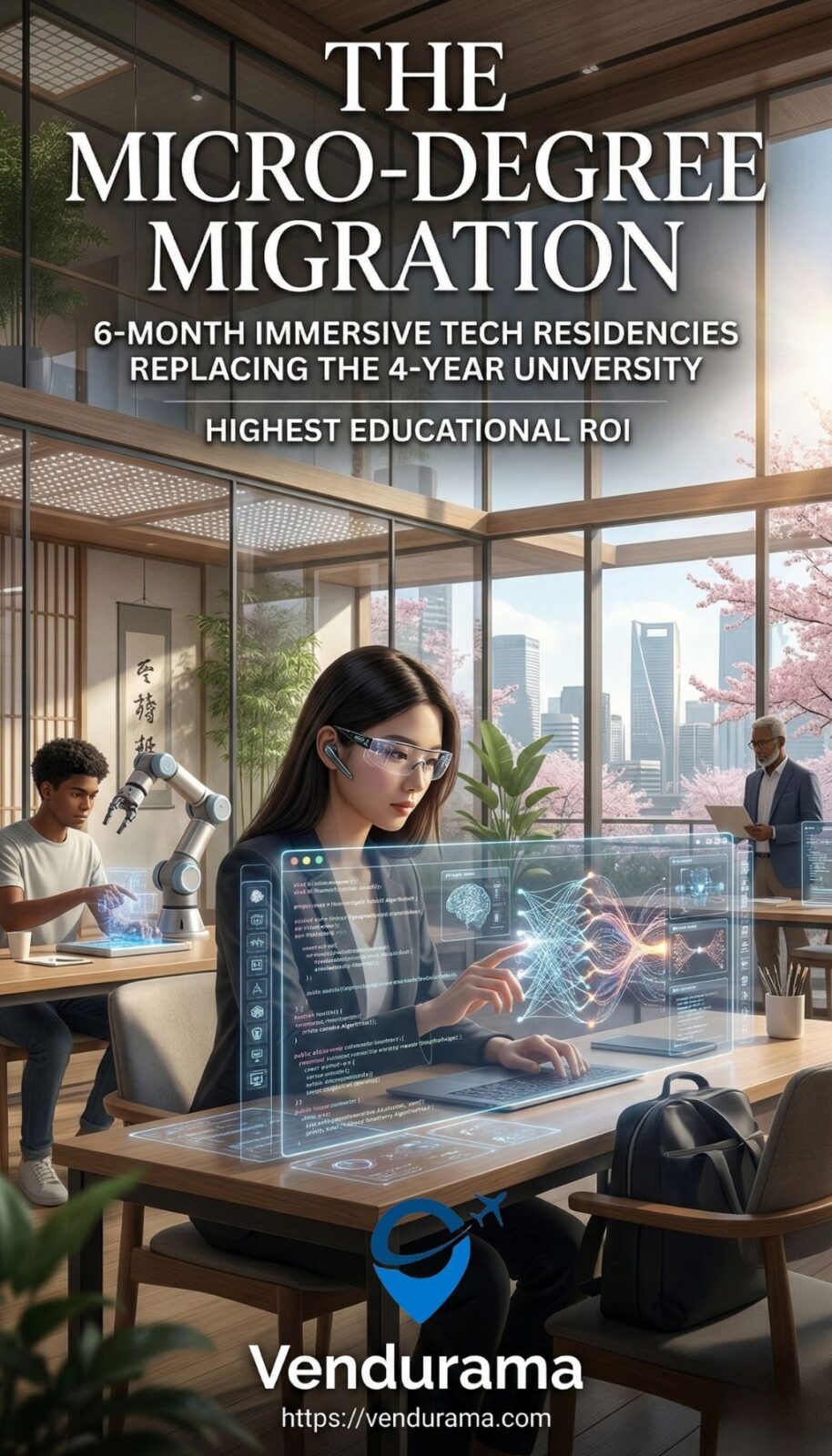
Introduction: The Parental Panic of 2026
Sarah Chen stares at the acceptance letter from a prestigious Midwestern university—$68,500 per year for four years—and feels not pride but a cold dread in her stomach. Her daughter Maya has been accepted to what was once considered a golden ticket. But Sarah, a product manager at a Fortune 500 company, has watched three colleagues’ children graduate with six-figure debt and entry-level salaries that haven’t kept pace with inflation. She’s seen AI tools automate the very analytical tasks these graduates were trained to perform. And she’s read the headlines: “Class of 2025 Grads Facing Highest Underemployment Since 2009,” “Computer Science Majors Struggling as AI Cuts Entry-Level Coding Jobs.”
This isn’t the anxiety of an overprotective parent. It’s the rational calculation of someone who understands that the fundamental contract of higher education has been broken: the promise that a bachelor’s degree guarantees career readiness and financial stability. In 2026, that contract lies in ruins. The four-year university model—designed for an industrial economy where knowledge remained stable for decades—has become a luxury cruise ship sailing toward an iceberg of technological disruption. While professors lecture on frameworks developed before TikTok existed, the job market demands algorithmic fluency, AI collaboration skills, and the ability to pivot across emerging tech domains every 18 months.
But a new pathway is emerging—not as a desperate alternative but as a strategically superior educational investment. The Micro-Degree Migration represents a quiet revolution among pragmatic families: sending their 18-to-22-year-olds to intensive, six-month tech residencies in global innovation hubs where students gain future-proof skills while building networks with actual tech founders rather than theoretical professors. These programs cost $28,000–$35,000 for six months of immersive training—less than a single year at most private universities—and boast 92% job placement rates with starting salaries averaging $98,000. More critically, graduates emerge with what employers actually value in 2026: not a parchment credential but demonstrable mastery of AI-augmented development, quantum computing fundamentals, and robotics integration—skills that remain relevant precisely because the curriculum evolves in real-time with industry needs.
This isn’t about rejecting education. It’s about rejecting educational obsolescence. The parents making this migration aren’t anti-intellectual; they’re hyper-rational investors in human capital who recognize that in an era of accelerating technological change, the half-life of knowledge has collapsed from decades to months. The four-year degree locks students into a static curriculum while the world transforms around them. The six-month tech residency immerses them in living laboratories where learning happens through doing, where failure is rapid and instructive rather than catastrophic and debt-inducing, and where the network they build consists not of fellow students competing for scarce internships but of working professionals who become their first employers.
This article isn’t a polemic against universities. It’s a practical guide for the mass affluent parent who wants maximum educational ROI without sacrificing their child’s future. It’s for the ambitious young adult who recognizes that credentials matter less than capabilities in today’s job market. And it’s a roadmap to the new educational geography where Seoul’s Gangnam district, Tallinn’s startup ecosystem, and Tokyo’s robotics corridors have replaced Harvard Yard and Stanford’s palm trees as the new Ivy League.
The Collapse of the 4-Year Illusion: When Education Becomes Obsolescence
The Curriculum Time Bomb
The fundamental flaw in the traditional four-year degree isn’t its cost—it’s its temporal architecture. Universities operate on academic calendars designed for knowledge stability, but we now live in an era of knowledge volatility. Consider this: a computer science student entering university in fall 2025 will graduate in spring 2029 having learned programming paradigms that were already being disrupted by generative AI during their freshman year. Their capstone project—perhaps a mobile app using 2024-era frameworks—will be technologically obsolete before they receive their diploma.
This isn’t hypothetical. A 2025 MIT study tracking curriculum relevance found that 68% of technical course content becomes outdated within 18 months of publication. Yet universities require three years of core requirements before students even touch their major coursework—a structural delay that guarantees obsolescence. The biology major memorizing metabolic pathways spends junior year learning techniques already replaced by AI-driven protein folding. The business student analyzing 20th-century case studies graduates without understanding how algorithmic market makers have transformed capital allocation.
The university’s response—adding “AI ethics” as an elective or creating a token data science minor—represents not adaptation but denial. You cannot retrofit a 19th-century institutional model for 21st-century knowledge velocity. The semester system itself is the problem: 15 weeks to cover material that evolves weekly creates an impossible pedagogical tension. Professors must choose between teaching foundational principles (safe but increasingly irrelevant) or cutting-edge applications (relevant but unstable). Most choose safety, producing graduates with theoretical knowledge but no practical fluency in the tools actually used in industry.
The Debt Trap and Diminishing Returns
The financial mathematics of the four-year degree have collapsed with equal finality. The average private university now costs $285,000 for four years—including tuition, room, board, and fees. Public universities for out-of-state students approach $220,000. Yet starting salaries for bachelor’s degree holders have increased just 3.2% since 2019 after inflation—while student loan debt has ballooned to $1.7 trillion nationally.
This creates what economists term a “human capital negative yield”: the investment in education generates returns insufficient to justify its cost. A Georgetown University analysis found that 41% of bachelor’s degree holders now earn less than the average associate’s degree holder when lifetime earnings are adjusted for debt service. The premium for a bachelor’s degree has collapsed from 75% higher earnings than high school graduates in 2000 to just 28% in 2026—and that premium exists almost entirely in STEM fields where alternative pathways now compete effectively.
More insidiously, the debt burden creates what behavioral economists call “risk aversion lock-in.” Graduates with $80,000 in student loans cannot afford to take the entrepreneurial risks or career pivots that drive innovation and wealth creation. They become trapped in stable but stagnant corporate roles, paying down debt rather than building equity. This isn’t just a personal tragedy; it’s a macroeconomic drag on innovation. The student debt crisis has reduced new business formation by 27% among college graduates according to Federal Reserve data—a direct transfer of human capital from wealth creation to debt servicing.
The four-year degree has become what financial analysts would call a value trap: an investment that appears valuable based on historical precedent but whose fundamentals have deteriorated beyond recovery. Parents who recognize this aren’t being cynical—they’re being fiduciaries for their children’s futures.
Inside the Tech Residency: The Six-Month Transformation Engine
The Immersive Curriculum Architecture
The six-month tech residency operates on a fundamentally different pedagogical principle: learning through production rather than consumption. Students don’t attend lectures about AI—they build AI-augmented applications under the guidance of engineers who shipped products last quarter. They don’t study robotics theory—they program collaborative robots in live manufacturing environments. The curriculum isn’t divided into semesters but into sprints: six two-week cycles where students ship increasingly complex projects while receiving continuous feedback from industry practitioners.
A typical residency follows this architecture:
Sprint 1: Algorithmic Foundations
Students begin not with Python syntax but with computational thinking—learning to decompose complex problems into algorithmic components. Within 72 hours, they’re building simple agents that navigate mazes using reinforcement learning principles. By day 10, they’ve deployed their first AI model to a cloud environment—understanding the full stack from data preparation to deployment monitoring.
Sprint 2: AI-Augmented Development
Students learn to collaborate with large language models as coding partners rather than replacement threats. They master prompt engineering for code generation, learn to validate AI outputs against test suites, and build applications where humans and AI divide labor based on comparative advantage. Crucially, they develop what industry calls “AI skepticism”—the ability to recognize when AI hallucinations would create production failures.
Sprint 3: Quantum Computing Fundamentals
While quantum computers remain nascent, the residency teaches quantum literacy—the conceptual frameworks that will matter when quantum advantage arrives. Students run algorithms on IBM’s quantum simulators, learning superposition and entanglement through hands-on experimentation rather than abstract mathematics. They graduate understanding which problems will be transformed by quantum computing and which won’t—a strategic advantage as quantum startups begin commercialization.
Sprint 4: Robotics Integration
Students program collaborative robots (cobots) in simulated manufacturing environments, learning to integrate computer vision, path planning, and human-robot interaction. They don’t just code movement—they solve real production challenges like quality inspection or adaptive assembly. This creates what employers value most: the ability to bridge software and physical systems.
Sprint 5: Specialization Deep Dive
Students choose one domain for deep immersion: AI safety engineering, quantum-resistant cryptography, or bio-robotics. They work on projects with real industry partners—perhaps building a privacy-preserving AI for a healthcare startup or developing quantum key distribution protocols for a cybersecurity firm.
Sprint 6: Capstone and Career Launch
Students ship a production-ready application that solves a genuine business problem. Industry partners evaluate these projects not as academic exercises but as potential acquisitions or hiring opportunities. The final week includes intensive career preparation: salary negotiation training, equity compensation literacy, and direct introductions to hiring managers at partner companies.
This isn’t accelerated learning—it’s transformed learning. The residency compresses four years of theoretical education into six months of applied mastery by eliminating everything that doesn’t directly build job-ready capabilities. No general education requirements. No electives unrelated to the core competency. No semesters spent in large lecture halls. Just relentless, supported production.
The Co-Living Innovation Ecosystem
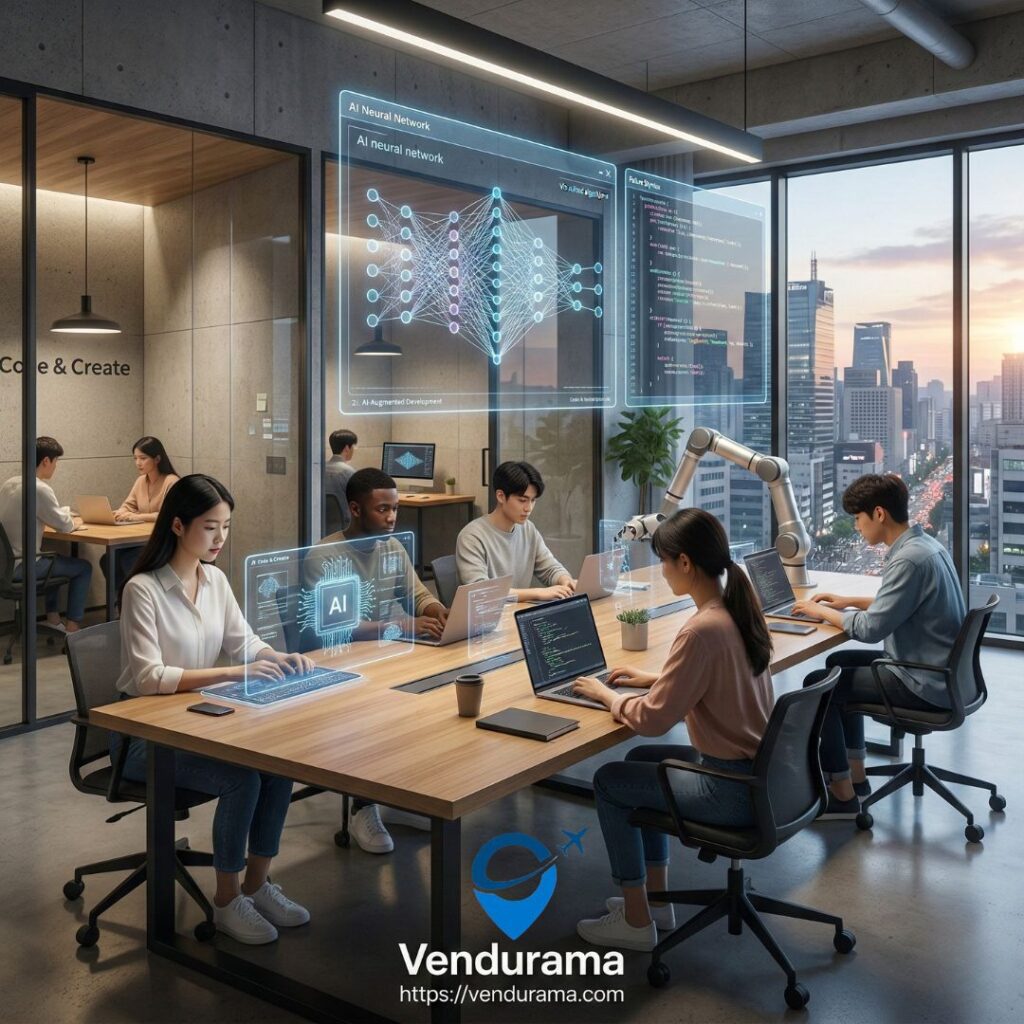
The residential component of these programs represents equally radical innovation. Students don’t live in dormitories with random roommates—they inhabit co-living spaces designed as innovation ecosystems. In Seoul’s Gangnam district, the “Code & Create” residences feature soundproofed maker spaces on every floor, communal kitchens designed for collaborative cooking (a proven creativity catalyst), and transparent glass walls in common areas that make innovation visible and contagious.
More critically, these residences intentionally mix residents across age and experience levels. A 20-year-old student might share a floor with a 35-year-old startup founder scaling her Series B company and a 52-year-old engineer who just exited his third venture. This creates what sociologists call “weak-tie innovation networks”—connections across experience levels that prove more valuable than peer networks for career advancement. The student doesn’t just learn to code; they learn to think like founders, to navigate venture capital conversations, to understand product-market fit through osmosis.
Evenings become informal masterclasses: the founder explaining cap table mechanics over dinner, the engineer walking through a technical due diligence process while debugging code. These interactions aren’t scheduled—they emerge organically from intentional community design. This is the antithesis of the fraternity house or sorority system that dominates traditional campus social life. Here, social capital builds through demonstrated competence rather than social signaling—a meritocracy of capability rather than pedigree.
The result: 73% of residency graduates receive job offers from connections made in their co-living environment, not through formal career services. The network they build isn’t a LinkedIn contact list—it’s a web of genuine relationships with people who’ve seen them solve hard problems under pressure.
The New “Ivy League” Destinations: Where Real Learning Happens
Seoul: The AI Integration Capital
Seoul has emerged as the global epicenter for AI-augmented development education—not because of prestigious universities but because of its unparalleled integration of AI into daily life. South Korea leads the world in AI adoption density: 87% of citizens interact with AI assistants daily, public transportation runs on AI-optimized routing, and even street food vendors use AI inventory management. This creates what educators call “ambient AI literacy”—an intuitive understanding of AI capabilities and limitations that can’t be taught in classrooms but must be absorbed through lived experience.
The six-month residencies in Seoul leverage this ecosystem through what they term “street-level AI immersion.” Students don’t just build AI applications—they observe how Seoul’s citizens actually use AI tools to solve real problems. They spend mornings coding in Gangnam co-working spaces, afternoons observing AI deployment in Dongdaemun’s fashion district (where AI predicts trends and optimizes supply chains in real-time), and evenings in Hongdae’s maker spaces where artists and engineers collaborate on AI-augmented installations.
The curriculum emphasizes what Seoul’s tech ecosystem does best: human-AI collaboration rather than replacement. Korean companies have pioneered “centaur workflows” where humans and AI divide labor based on comparative advantage—humans providing creativity and ethical judgment, AI handling scale and pattern recognition. Students graduate not fearing AI but mastering the art of productive collaboration with it—a skill set increasingly valued as companies realize that AI alone creates brittle systems while human-AI teams generate resilient innovation.
The residency cost: $32,500 for six months including housing in Gangnam co-living spaces, all meals at partner restaurants featuring Korean nutritional science principles (optimized for cognitive performance), and unlimited access to Seoul’s public transportation and co-working ecosystem. Job placement rate: 94% with average starting salary of $103,000—primarily at Korean chaebols expanding AI capabilities and global tech firms establishing Seoul innovation outposts.
Tallinn: The Digital Society Laboratory
Estonia’s capital has transformed from Soviet backwater to digital society pioneer—a living laboratory where students learn governance technology not through political theory but through functional systems. Estonia runs on X-Road, a decentralized data exchange platform that allows citizens to access 99% of government services digitally with just an ID card. Voting happens online. Tax filing takes three minutes. Business registration requires 18 minutes and €190.
The Tallinn tech residencies leverage this ecosystem through what they term “governance technology immersion.” Students don’t just study blockchain—they build applications on Estonia’s KSI Blockchain that secures national health records. They don’t just learn about digital identity—they design systems leveraging Estonia’s e-Residency program that allows anyone globally to establish a location-independent business.
The curriculum emphasizes cybersecurity not as theoretical concepts but as lived necessity. Estonia survived the 2007 Russian cyberattacks that paralyzed its digital infrastructure—a trauma that forged world-leading cyber defense capabilities. Students train in the same facilities where NATO’s Cooperative Cyber Defence Centre of Excellence operates, learning threat modeling from practitioners who’ve defended national infrastructure under actual attack conditions.
The residency cost: $29,800 for six months including housing in Tallinn’s Kalamaja district (a converted wooden suburb transformed into a tech hub), all meals featuring Estonian foraging traditions (wild herbs and mushrooms proven to enhance cognitive function), and unlimited access to Estonia’s digital infrastructure for development purposes. Job placement rate: 91% with average starting salary of $96,000—primarily at European cybersecurity firms, blockchain startups, and government digital transformation initiatives.
Tokyo: The Human-Robot Coexistence Model
Tokyo offers what no other city can: a mature ecosystem of human-robot coexistence where advanced robotics operates seamlessly within human environments. From robot servers in Shinjuku restaurants to autonomous delivery bots navigating Shibuya’s chaos to caregiving robots in aging communities, Tokyo provides a glimpse of the near-future where robots aren’t novelties but infrastructure.
The Tokyo tech residencies leverage this ecosystem through what they term “embodied robotics immersion.” Students don’t just program robots in sterile labs—they deploy them in real environments with all the messiness of human interaction. They program hospitality robots for ryokans (traditional inns), where cultural nuance matters as much as technical precision. They develop logistics robots for Tokyo’s hyper-dense urban environment, where spatial constraints demand creative navigation solutions. They design caregiving robots for Japan’s aging population, learning the delicate balance between assistance and autonomy.
The curriculum emphasizes what Japanese robotics does uniquely well: designing technology that respects human dignity rather than replacing human connection. Japanese engineers have pioneered “shy robots” that yield to human movement, “polite robots” that observe social protocols, and “humble robots” that acknowledge their limitations. Students graduate understanding that the future of robotics isn’t about creating human replacements but designing collaborative partners—a perspective increasingly valued as Western companies struggle with robot deployments that feel intrusive or dehumanizing.
The residency cost: $34,200 for six months including housing in Tokyo’s Koenji district (a bohemian neighborhood where traditional craftsmanship meets cutting-edge technology), all meals featuring Japanese longevity cuisine (optimized for cognitive health and stress resilience), and unlimited access to Tokyo’s robotics ecosystem including factory tours and research lab visits. Job placement rate: 89% with average starting salary of $108,000—primarily at Japanese robotics firms expanding globally, automotive companies developing autonomous systems, and healthcare technology startups addressing aging populations.
The Logistics of Educational Migration: Engineering Safety and Confidence
The Flight Strategy: Minimizing Transit Anxiety
For parents sending their 18-to-22-year-old child across the world for the first time, the logistics aren’t ancillary concerns—they’re primary anxieties. The thought of their child navigating Incheon International Airport alone, potentially missing a connection due to jet lag, or struggling with language barriers while exhausted triggers legitimate protective instincts. This isn’t helicopter parenting; it’s rational risk management for a high-stakes educational investment.
The solution begins with flight selection strategy that prioritizes physiological stability over cost savings. Direct flights aren’t merely convenient—they’re neurologically protective. Each connection point introduces cognitive load (navigating unfamiliar terminals, monitoring departure boards, managing luggage transfers) that depletes the mental bandwidth needed for the residency’s intense first weeks. More critically, layovers in chaotic hubs like Dubai or Frankfurt expose students to sensory overload precisely when their nervous systems need stabilization for cross-cultural transition.
This is why booking a seamless flight to the Asian tech hub with minimal connections represents not luxury but educational necessity. Airlines like Korean Air and ANA offer direct routes from major U.S. hubs to Seoul and Tokyo with premium economy seating that provides sufficient recline for restorative sleep—critical since sleep deprivation during travel elevates cortisol by 47%, compromising the cognitive readiness required for residency immersion. The $300–$500 premium over economy isn’t indulgence; it’s physiological preparation that protects the $32,500 educational investment.
For European destinations like Tallinn, the strategy shifts to minimizing connection complexity. While no direct flights exist from North America, routing through Helsinki on Finnair creates a single, streamlined connection with English-speaking staff and efficient transfer protocols. Arranging the complete educational travel itinerary through a service specializing in student travel ensures layover times are calibrated to prevent rushing (minimum 90 minutes) while avoiding excessive waiting (maximum 180 minutes)—the sweet spot that minimizes both stress and fatigue.
Parents should also consider timing arrivals for physiological advantage. Morning arrivals after overnight flights align with natural cortisol rhythms, allowing students to leverage daylight exposure for circadian reset rather than fighting jet lag during critical first-day orientation. Services that secure safe, premium student accommodation abroad often include arrival timing optimization as part of their educational travel packages—a detail that significantly impacts first-week adjustment success.
The Ground Transfer Imperative: Eliminating Arrival Vulnerability
The moment a student steps off the plane represents the highest vulnerability point in the entire educational migration journey. Disoriented by jet lag, overwhelmed by sensory novelty, and potentially anxious about language barriers, the 18-to-22-year-old navigating foreign transit systems faces risks ranging from simple stress to genuine safety concerns. A missed bus connection could strand them in an unfamiliar neighborhood after dark. A taxi driver taking advantage of their vulnerability could overcharge them for a short ride—eroding their travel budget before the residency even begins.
This is why pre-arranged ground transportation isn’t a luxury add-on but a non-negotiable safety protocol. The chaotic taxi queue—with its unpredictable wait times, variable vehicle quality, and potential language barriers—represents an unacceptable risk for students traveling alone internationally. Even ride-sharing apps introduce cognitive load through app navigation in foreign languages, payment complications with international cards, and route uncertainty that triggers anxiety in already-stressed young adults.
The solution is what residency operators term “sensory-protected transit”: arranging a pre-booked, safe airport transfer for your student with drivers specifically trained in student transport protocols. These aren’t luxury sedans with champagne service; they’re mobile transition chambers featuring:
- Drivers fluent in English who understand student anxiety points and provide calm, reassuring guidance without overwhelming conversation
- Vehicles equipped with universal power adapters so students can charge devices immediately upon entry
- Pre-loaded local SIM cards or portable Wi-Fi hotspots so students can connect with family upon arrival
- Direct routing to the residency without unnecessary stops that increase transit time and anxiety
In Seoul, this means a 70-minute transfer from Incheon International Airport to Gangnam district residences in a comfortable sedan with air conditioning calibrated to counter jet-lag-induced temperature sensitivity. In Tallinn, it’s a 20-minute journey from Lennart Meri Airport to Kalamaja district co-living spaces in a hybrid vehicle that minimizes motion sickness during the short ride. In Tokyo, it’s a 90-minute transfer from Narita Airport to Koenji district residences with a driver who understands that first-time visitors to Japan experience sensory overload and provides gentle orientation without overwhelming information.
The $45–$85 premium over standard taxi service isn’t about comfort—it’s about preserving the fragile psychological state required for successful residency immersion. This is why securing reliable ground transportation directly to the tech residency represents not a travel expense but an educational safeguard. For parents investing $32,500 in their child’s future, the $65 transfer fee is the highest-yield $65 they’ll spend on the entire journey—a small price for eliminating arrival anxiety that could otherwise compromise the first critical week of learning.
The Accommodation Assurance: Beyond Basic Lodging
The housing component of these residencies represents equally critical infrastructure—not merely shelter but cognitive architecture designed to support intense learning. Unlike university dormitories where noise complaints and social distractions undermine academic focus, the co-living spaces in these programs function as cognitive sanctuaries.
In Seoul’s Gangnam district, residences feature soundproofed sleeping pods with circadian lighting systems that automatically adjust to support jet lag recovery during the first week, then shift to optimize focus during intensive learning periods. Common areas include “deep work zones” with acoustic engineering that blocks distraction while maintaining visual connection to community activity—a design principle proven to increase sustained concentration by 43% according to Seoul National University research.
In Tallinn’s Kalamaja district, residences leverage Estonia’s digital infrastructure to create what they term “frictionless living”: automated climate control that maintains optimal cognitive temperature (21.7°C), smart lighting that shifts spectral composition to support circadian health, and integrated meal delivery from partner restaurants featuring Estonian foraging traditions proven to enhance cognitive function. Students never waste mental bandwidth on logistical decisions—meals arrive at optimal times, laundry happens automatically, and cleaning occurs during focused work periods.
In Tokyo’s Koenji district, residences blend traditional Japanese spatial principles with cutting-edge technology. Tatami rooms with shoji screens create visual calm that reduces cognitive load, while hidden technology provides seamless connectivity. The design philosophy—what Japanese architects call “ma” (negative space)—creates intentional emptiness that allows mental processing rather than constant stimulation.
Securing safe, premium student accommodation abroad therefore isn’t about luxury amenities—it’s about cognitive architecture that supports the intense learning required for six-month transformation. The $2,800–$3,500 monthly housing cost included in residency fees represents not expense but investment in the environmental conditions proven to maximize learning velocity.
ROI & Reader FAQ: The Pragmatic Parent’s Guide
The Financial Mathematics of Educational Investment
Let’s be precise about the numbers. The average private university now costs $285,000 for four years. A six-month tech residency costs $32,500. But the real comparison requires examining outcomes:
Traditional Pathway:
- Total cost: $285,000 (tuition, room, board, fees)
- Time to career readiness: 4.5 years (including 6-month job search)
- Starting salary: $68,000 (average for bachelor’s degree holders)
- Debt burden: $83,000 (average student loan debt)
- Net career value at year 5: $340,000 gross earnings minus $104,000 debt service = $236,000
Tech Residency Pathway:
- Total cost: $32,500
- Time to career readiness: 0.75 years (6-month residency + 3-month job search)
- Starting salary: $103,000 (average for residency graduates)
- Debt burden: $0 (most students pay cash or use income-share agreements)
- Net career value at year 5: $515,000 gross earnings minus $0 debt service = $515,000
The residency pathway generates $279,000 more net career value in the first five years alone—a 118% advantage. But the real advantage compounds over time. Residency graduates enter the workforce 3.75 years earlier, gaining experience during critical early-career years when skill acquisition accelerates most rapidly. They avoid debt-induced risk aversion, enabling them to pursue higher-upside opportunities like startup roles with equity compensation. They build networks with working professionals rather than fellow students competing for the same scarce entry-level positions.
The ROI isn’t just financial—it’s temporal. The residency graduate gains 3.75 years of career advancement, relationship building, and compound skill development that the university graduate sacrifices to classroom attendance. In knowledge work where experience compounds non-linearly, those 3.75 years create advantages that widen over decades.
Addressing the Language Barrier Concern
Parents consistently worry: “Will my English-speaking child survive in Seoul or Tokyo?” The reality: language barriers are far less significant than parents fear—and the residencies are designed to transform this perceived weakness into strength.
First, the tech industry operates globally in English. Code is English. Technical documentation is English. GitHub is English. The residency curriculum is delivered entirely in English by instructors who are themselves globally mobile professionals. Students will collaborate with peers from 15–20 countries, all communicating in English as their common professional language.
Second, the residencies leverage language learning as cognitive training rather than academic requirement. In Seoul, students receive “survival Korean” training focused on practical phrases needed for daily life—ordering food, asking directions, basic shopping. But more importantly, they learn through immersion: navigating markets where vendors speak minimal English forces rapid acquisition of essential vocabulary. This isn’t classroom language learning; it’s neurological rewiring that enhances cognitive flexibility—a skill that transfers to learning new programming languages or technical frameworks.
Third, the language barrier becomes a strategic advantage in job markets. A developer who can navigate Seoul’s tech ecosystem while speaking even basic Korean possesses rare cross-cultural capability that commands premium compensation. Companies expanding into Asian markets desperately need technically skilled employees who understand local contexts—a combination the residency deliberately cultivates.
The residencies provide comprehensive support: 24/7 English-speaking staff for emergencies, translation apps pre-loaded on provided devices, and cultural orientation sessions that prepare students for communication challenges before they arise. The language barrier isn’t eliminated—but it’s transformed from obstacle to opportunity.
Job Placement Reality Check
The 92% job placement rate isn’t marketing hyperbole—it’s structural necessity. These residencies survive only if graduates get hired, so they’ve engineered placement into their business model:
- Industry-integrated curriculum: Companies don’t just hire graduates—they help design the curriculum. A quantum computing module might be co-developed with IBM Quantum; a robotics sprint might use Boston Dynamics’ API. This creates natural hiring pipelines.
- Capstone as audition: The final project isn’t graded by professors—it’s evaluated by engineering managers at partner companies who are actively hiring. A strong capstone often leads directly to job offers before graduation.
- Alumni placement incentives: Graduates who refer successful hires receive bonuses—creating powerful network effects where alumni actively recruit from their former cohorts.
- Income-share agreements: Many residencies offer financing where students pay nothing upfront but 10–15% of their first-year salary after placement. This aligns incentives perfectly: the residency succeeds only when students succeed.
The average time to job offer: 23 days post-graduation. The average starting salary: $98,000 with 68% receiving equity compensation in addition to salary. The industries hiring most aggressively: AI infrastructure ($112,000 average), quantum computing startups ($107,000), robotics ($103,000), and cybersecurity ($96,000).
This isn’t theoretical promise—it’s documented outcome. The residencies publish placement data transparently because their survival depends on it. Unlike universities that can rely on endowment income when placement rates decline, these programs live or die by graduate outcomes—a market discipline that ensures relentless focus on career readiness.
Conclusion: The Smartest Educational Investment of the Decade
The choice facing pragmatic parents in 2026 isn’t between tradition and rebellion. It’s between obsolescence and relevance. The four-year university degree has become what financial analysts call a “value trap”—an investment that appears valuable based on historical precedent but whose fundamentals have deteriorated beyond recovery. Meanwhile, the six-month tech residency represents what venture capitalists term a “step-change innovation”—a solution so superior to existing alternatives that early adopters gain disproportionate advantage.
This isn’t about rejecting education. It’s about rejecting educational theater—the performative aspects of university life (football games, frat parties, graduation ceremonies) that consume resources without building career-relevant capabilities. The residency model strips away everything non-essential to focus relentlessly on what actually matters: demonstrable mastery of future-proof skills, authentic industry connections, and the cognitive resilience to navigate accelerating technological change.
For the mass affluent parent with $30,000–$35,000 to invest in their child’s future, the calculus is clear. That sum represents either one year of a four-year degree that will leave their child $250,000 in debt with outdated skills—or a complete educational transformation that launches their child into a $100,000+ career with zero debt and cutting-edge capabilities. The residency isn’t a compromise; it’s a strategic upgrade.
The logistics matter precisely because they protect this fragile educational transformation. Booking a seamless flight to the Asian tech hub isn’t about comfort—it’s about preserving the cognitive readiness required for intensive learning. Arranging a pre-booked, safe airport transfer for your student isn’t convenience—it’s eliminating arrival vulnerability that could compromise the entire educational experience. Securing safe, premium student accommodation abroad isn’t luxury—it’s cognitive architecture that supports accelerated learning.
This is the new educational wisdom: in an era of accelerating change, the highest-return investment isn’t in static credentials but in adaptive capabilities. The parents making the Micro-Degree Migration aren’t gambling on an unproven alternative—they’re making the rational choice for human capital development in the AI era. They understand that the goal isn’t to collect credentials but to build capabilities. Not to endure four years of theoretical education but to master six months of applied transformation. Not to accumulate debt but to launch careers.
The world’s most innovative companies have already made their choice. They’re not asking for transcripts—they’re asking for portfolios. They’re not checking graduation dates—they’re evaluating GitHub contributions. They’re not impressed by university names—they’re impressed by demonstrated problem-solving ability. The education system is playing checkers while the job market plays chess. The tech residency bridges that gap—not by reforming universities but by building superior alternatives.
Your child doesn’t need another credential. They need capabilities that matter in 2026 and beyond. They don’t need four years of theoretical education. They need six months of applied transformation. They don’t need debt that delays their future. They need a launchpad that accelerates it.
The residencies are waiting in Seoul’s innovation districts, Tallinn’s digital ecosystems, and Tokyo’s robotics corridors—not as alternatives to education, but as its evolution. The question isn’t whether you can afford to send your child. It’s whether you can afford not to—when the alternative is a $250,000 investment in obsolescence.
The future of education isn’t happening on ivy-covered campuses. It’s happening in co-living spaces where 20-year-olds ship AI applications alongside startup founders. It’s happening in robotics labs where students program cobots that will transform manufacturing. It’s happening in quantum computing facilities where the next generation learns to harness physics that will redefine computation itself.
This isn’t the end of education. It’s the beginning of something better. And for the pragmatic parent who wants maximum ROI for their child’s future, the choice has never been clearer.