
Introduction: The European Luxury Resort Crisis of 2026 and the Strategic Alternative
The mass affluent class of 2026 faces an uncomfortable mathematical reality that previous generations never encountered: the traditional European luxury resort model has fundamentally broken down. Premium hotels in Santorini, the Amalfi Coast, and Mykonos now command $1,500-2,500 per night for accommodations that offer crowded infinity pools, overbooked restaurants requiring weeks of advance reservation, and beach chairs allocated by lottery system. For families with household incomes between $150,000 and $500,000—the demographic that has historically funded Mediterranean vacations through careful savings and strategic financial planning—this represents a catastrophic allocation of vacation capital. A 7-day family resort vacation now requires $25,000-40,000, excluding flights, while delivering diminished privacy, compromised service quality, and experiences that feel increasingly commoditized.
This is not temporary inflation. This is structural repricing driven by overtourism (47 million annual visitors to Greece alone in 2025), limited luxury accommodation supply, platform-driven price manipulation, and the transformation of Mediterranean destinations into luxury enclaves that explicitly exclude the professional class. For families who have historically viewed European vacations as wealth-preserving experiences that create lasting memories, the math no longer works. A vacation that once served as a family-bonding investment now functions as a wealth-destroying expenditure that delivers diminishing experiential returns.
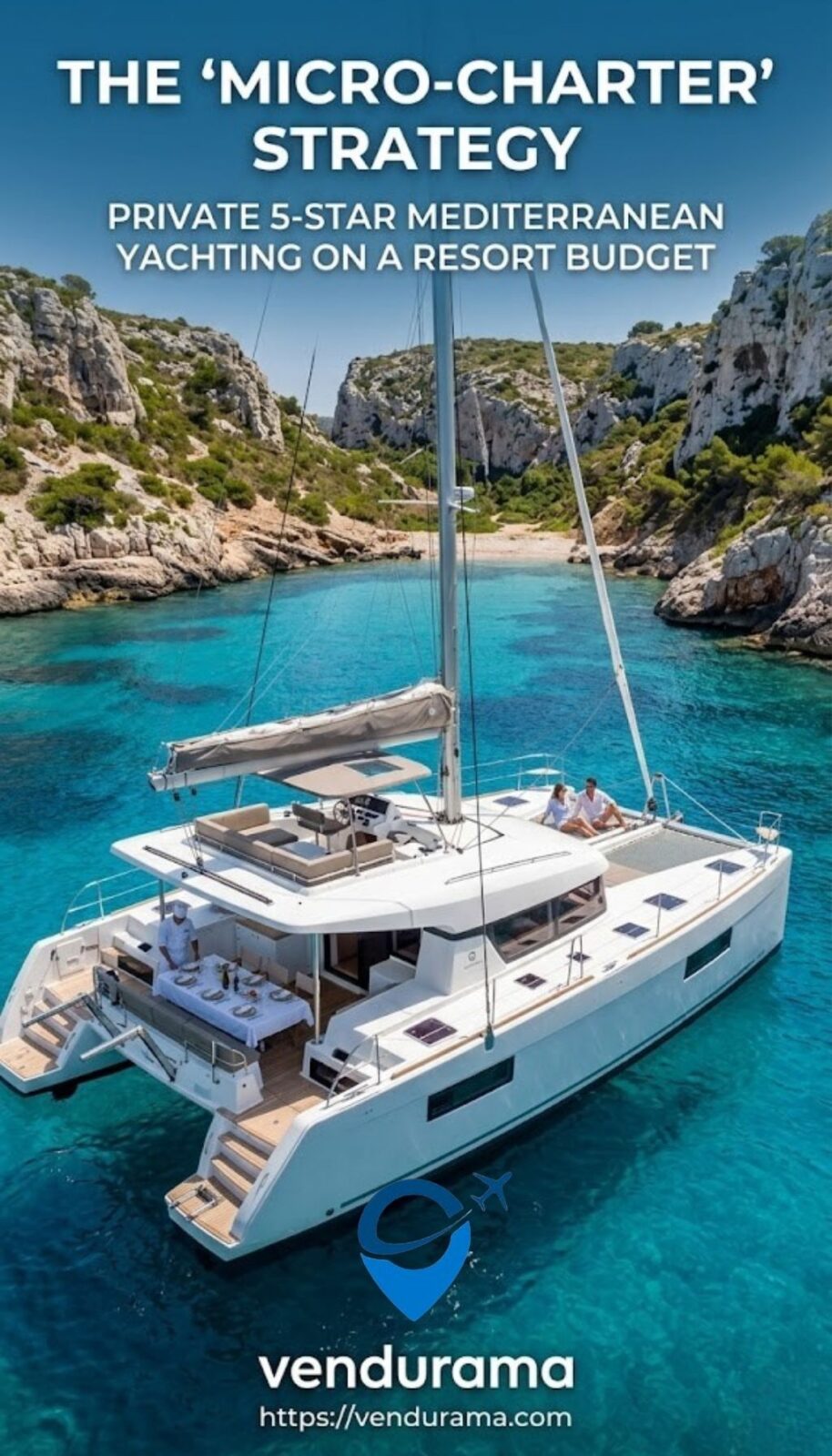
But there is a strategic alternative that preserves both luxury quality and financial intelligence. The “Micro-Charter” strategy represents a fundamental reconceptualization of how mass affluent families approach Mediterranean travel. Private crewed catamarans and traditional gulets in hidden coastal regions of Greece (Ionian Islands) and Croatia (Dalmatian Coast) offer identical or superior luxury experiences at resort-comparable prices. Families receive private chef service, daily changing views, exclusive beach access, and billionaire-level privacy for the same per-person cost as a static, crowded 5-star resort.
This article provides a comprehensive financial and logistical framework for executing the Micro-Charter strategy. We will analyze the economics of yacht charter geo-arbitrage, detail specific Mediterranean regions that deliver maximum value, explain how to reinvest savings into frictionless logistics that elevate the entire experience, and address the legitimate concerns that prevent families from venturing beyond land-based resorts. For readers who evaluate vacation expenditures through the same analytical frameworks applied to household investment portfolios, this represents the most significant opportunity in Mediterranean travel optimization since the emergence of points-and-miles strategies in the 2010s.
The Economics of the Micro-Charter: Understanding the Geo-Arbitrage Advantage
The Complete Cost Comparison: Resort vs. Yacht Charter
To understand the Micro-Charter strategy, one must first confront the actual numbers. The following comparison examines a 7-day family vacation (two adults, two children, or two couples) during peak summer season, comparing equivalent luxury tiers between a 5-star resort and a fully crewed 45-foot catamaran.
| Expense Category | 5-Star Resort (7 Days) | Micro-Charter Catamaran (7 Days) | Savings/Value |
|---|---|---|---|
| Accommodation | $10,500 ($1,500/night) | $8,400 ($1,200/day charter) | $2,100 savings |
| Dining (3 meals/day) | $7,000 ($250/person/day) | $3,500 (private chef + provisions) | $3,500 savings |
| Activities & Excursions | $2,800 (tours, boat rentals) | $0 (included in charter) | $2,800 savings |
| Beach/Pool Access | $700 (premium cabanas) | $0 (private anchorages) | $700 savings |
| Local Transportation | $1,400 (taxis, ferries) | $0 (yacht is transportation) | $1,400 savings |
| Total Ground Costs | $22,400 | $11,900 | $10,500 savings |
| Per-Person Per-Night | $800 | $425 | 47% cost reduction |
The differential is not marginal. It is transformative. A family spending $22,400 on a resort receives crowded facilities, fixed location, and service quality that has degraded under overtourism pressure. The same family spending $11,900 on a micro-charter receives exclusive access to hidden coves, daily changing vistas, private chef service, and privacy that billionaires paid millions to achieve in previous decades.
Understanding Charter Cost Structure
The Micro-Charter economics require understanding how yacht charter pricing functions:
Base Charter Fee: Covers the vessel, skipper, and basic equipment. For a 45-foot catamaran in the Ionian or Dalmatian regions, this ranges from $8,000-12,000 per week depending on season and vessel age.
Advanced Provisioning Allowance (APA): Typically 25-35% of base charter fee, covering food, beverages, fuel, and marina fees. This is customized to family preferences and typically ranges from $2,500-4,000 for a week.
Skipper Fee: Included in most Mediterranean charters, ranging from $150-250 per day. Essential for families without sailing certification.
Private Chef: Optional but recommended, ranging from $200-350 per day plus provisions. Transforms the experience from sailing vacation to floating 5-star resort.
Total Weekly Cost: $11,000-16,000 for a fully crewed, chef-serviced 45-foot catamaran accommodating 4-8 guests comfortably.
Reinvesting Savings into Experience Enhancement
The smart luxury philosophy does not recommend pocketing all savings. Strategic reinvestment transforms a budget trip into a genuinely elevated experience. Families should allocate 40-50% of savings toward friction elimination:
| Savings Reinvestment | Cost | Experience Impact |
|---|---|---|
| Premium Flight Seating | $3,500 | Reduced travel fatigue, better arrival condition |
| Private Airport Transfers | $700 | Eliminated arrival stress, immediate comfort |
| Pre-Charter Hotel (2 nights) | $1,200 | Buffer for travel delays, relaxed embarkation |
| Premium Provisions Upgrade | $1,500 | Enhanced dining experience, premium wines |
| Total Reinvestment | $6,900 | Transforms trip from budget to ultra-luxury |
After reinvestment, the family still spends $18,800 compared to $22,400 at a resort—a 16% cost reduction with exponentially superior experience quality. This is not compromise. This is financial intelligence applied to travel.
When securing an optimized flight and pre-charter hotel package, families should prioritize direct routing to coastal airports (Split for Croatia, Preveza or Corfu for Greece) and flexible cancellation policies. The incremental cost of flexibility—typically 15-20% above restricted fares—provides valuable optionality should circumstances require itinerary adjustment.
Destination Deep Dive: The Hidden Mediterranean
The Ionian Sea: Greece’s Wind-Protected Paradise
Geographic Overview: The Ionian Islands lie off Greece’s western coast, featuring calm, wind-protected waters ideal for families new to yachting. Unlike the Aegean’s famous Meltemi winds that create challenging sailing conditions, the Ionian offers gentle breezes and protected anchorages perfect for micro-chartering.
Why the Ionian Delivers Value:
- Charter Costs: 45-foot catamarans cost $8,000-10,000 per week, compared to $14,000-18,000 in the Cyclades
- Dining: Taverna meals cost $25-40 per person versus $80-120 in Mykonos or Santorini
- Marina Fees: Protected harbors charge €150-250 per night versus €400-600 in popular Aegean ports
- Activities: Sea kayaking, snorkeling, and island exploration included versus $200-400 per excursion at resorts
Family-Specific Advantages:
The Ionian is exceptionally safe for families with children. Waters are calm with minimal currents. Shore excursions involve short distances to protected beaches. Local residents speak functional English at tourist facilities, reducing communication friction. Medical facilities meet Greek national standards with emergency evacuation to Athens available within 2 hours if required.
Recommended 7-Day Itinerary:
- Days 1-2: Lefkada embarkation, explore nearby coves, initial sailing instruction
- Days 3-4: Meganisi and Kalamos, private beach anchoring, seafood tavernas
- Days 5-6: Ithaca and Kefalonia, historical sites, mountain village visits
- Day 7: Return to Lefkada, departure preparation
When pre-booking a smooth, private transfer directly to the marina from Preveza Airport to Lefkada, families eliminate the uncertainty of local bus connections with luggage. The 45-minute transfer costs $120-180 pre-booked versus $250+ for multiple taxi connections, with guaranteed vehicle quality and English-speaking drivers.
The Dalmatian Coast: Croatia’s Island Archipelago
Geographic Overview: Croatia’s Dalmatian Coast features over 1,000 islands, islets, and reefs stretching along the Adriatic Sea. The Kornati Archipelago alone contains 89 islands within a national park that limits daily visitor numbers, ensuring exclusive access for yacht guests.
Why Dalmatia Delivers Value:
- Charter Costs: 45-foot catamarans cost $9,000-12,000 per week, compared to $16,000-22,000 in the French Riviera
- Dining: Konoba (traditional restaurant) meals cost $30-50 per person versus $100-150 in Dubrovnik’s old town
- Marina Fees: Smaller ports charge €180-300 per night versus €500-800 in Hvar or Split
- Activities: Swimming, hiking, and historical exploration included versus $300-500 per resort excursion
Family-Specific Advantages:
Dalmatia has invested heavily in tourism infrastructure since joining the EU. Marinas are well-maintained with full services. The population is overwhelmingly welcoming to Western tourists, with many viewing tourism as economic opportunity rather than intrusion. English is widely spoken among those under 50.
Recommended 7-Day Itinerary:
- Days 1-2: Split embarkation, explore Diocletian’s Palace, initial sailing
- Days 3-4: Kornati National Park, private anchoring, swimming in crystal waters
- Days 5-6: Hvar and Vis, historical towns, lavender fields, blue cave visits
- Day 7: Return to Split, departure preparation
When securing an optimized flight and pre-charter hotel package for Dalmatia, families should consider flying into Split Airport with direct connections from major European hubs. Flight availability varies seasonally, and early booking ensures optimal routing and pricing.
The Benefits of Mobile Luxury vs. Static Resorts
The Micro-Charter strategy’s fundamental advantage over land-based resorts is mobility. This creates value across multiple dimensions:
| Value Dimension | Land Resort | Micro-Charter Yacht |
|---|---|---|
| View Variety | Single location | Daily changing vistas |
| Beach Access | Shared, crowded | Private anchorages |
| Dining Options | Fixed restaurants | Chef + local tavernas |
| Privacy Level | Moderate | Maximum |
| Flexibility | Fixed itinerary | Daily route adjustment |
| Crowding | High (peak season) | Minimal (hidden coves) |
| Photo Opportunities | Same backgrounds | Endless variety |
For families seeking Instagram-worthy memories without Instagram-crowded locations, the micro-charter delivers exponentially superior value. A week aboard a yacht produces 50+ distinct locations and experiences. A week at a resort produces one location with varying activities.
Frictionless Logistics: The “Marina-Direct” Transition

Why Arrival Logistics Define the Luxury Experience
Traditional travel advice focuses on destination selection and accommodation quality. The Micro-Charter strategy recognizes that logistics determine whether a trip feels like a billionaire’s escape or an exhausting ordeal. A family that saves $10,000 on charter versus resort but endures stressful flights, chaotic airport arrivals, and unreliable local transportation has not achieved smart luxury. They have achieved false economy.
True smart luxury reinvests a portion of savings into eliminating friction points that degrade the travel experience. The following investments deliver disproportionate returns on experience quality in the Mediterranean yacht context:
Flight Selection: Protecting the Vacation Before It Begins
The journey begins before departure. Exhausted, stressed arrivals undermine the first 48 hours of any vacation—time that cannot be recovered. Smart flight selection protects the vacation investment from the outset.
When securing an optimized flight and pre-charter hotel package, families should prioritize:
Direct Routing to Coastal Airports: Each connection introduces delay risk, baggage handling complexity, and additional security screening. Direct flights to regional hubs (Split, Dubrovnik, Preveza, Corfu) eliminate the first layer of friction even when premium-priced. Many European carriers now offer direct services from London, Frankfurt, and Amsterdam during peak seasons.
Cabin Class Considerations: For flights exceeding 4 hours, premium economy seating provides meaningful comfort improvements at 40-50% of business class cost. The incremental investment—typically $1,200-2,000 above economy—reduces travel fatigue that compounds throughout the vacation, especially important for families with children.
Arrival Timing: Flights scheduled to arrive during daylight hours provide buffer time for ground transfer and marina check-in. Evening arrivals that require immediate navigation of unfamiliar coastal roads create unnecessary stress during the transition from travel mode to vacation mode.
Airline Selection: Carriers with demonstrated on-time performance exceeding 87% on Mediterranean routes should be prioritized. Croatia Airlines, Aegean Airlines, and Lufthansa maintain the most reliable regional networks with consistent service quality and English-language support.
Pre-Charter Hotel Buffer: Many families choose to arrive 1-2 days before charter embarkation to accommodate travel delays and reduce stress. When securing an optimized flight and pre-charter hotel package, families should book refundable accommodation near the marina with flexible check-in times.
Ground Transportation: Eliminating the Arrival Anxiety Tax
Airport arrival represents the highest-risk moment for travel stress in Mediterranean yacht charters. Families emerging from long-haul flights experience fatigue, disorientation, and reduced situational awareness. Navigating unfamiliar public transit systems, managing luggage through multiple transfers, or waiting for uncertain taxi services introduces stress that undermines the vacation commencement.
Pre-arranged, vetted ground transportation eliminates these risks. When families pre-booking a smooth, private transfer directly to the marina, they guarantee:
- Immediate Vehicle Availability: Drivers meet families at designated gate exits with name identification and English-language signage, eliminating search time and uncertainty
- Driver Vetting: Operators undergo background checks and training in international tourist service protocols
- Vehicle Standards: Air-conditioned vehicles with appropriate luggage capacity for sailing gear, child safety seats available upon request, and GPS navigation to remote marinas
- Fixed Pricing: No payment negotiations or currency confusion upon arrival in foreign jurisdictions
- Direct Routing: No intermediate stops or route deviations that extend journey duration
The cost differential between pre-booked transfers and on-arrival taxis is typically 25-40% in favor of pre-booking, with superior vehicle quality and service reliability. When pre-booking a smooth, private transfer directly to the marina, families should confirm that operators maintain backup vehicles and communication systems capable of functioning throughout the journey, especially important in coastal areas where cellular coverage may be intermittent.
Cost Comparison:
| Transport Option | Cost (Airport to Marina) | Reliability | Stress Level |
|---|---|---|---|
| Pre-booked Private Transfer | $150-250 | 98% | Minimal |
| Airport Taxi | $200-350 | 80% | Moderate |
| Ride-Share | $120-200 | 70% | Moderate |
| Public Transit + Taxi | $40-80 | 50% | High |
The cost differential between pre-booked transfers and alternatives is marginal when evaluated against the $10,000+ total charter savings. When pre-booking a smooth, private transfer directly to the marina, families eliminate the highest-risk transit moment while establishing a vetted transportation provider for any shore excursions requiring ground transport.
Marina Check-In: The Critical First Impression
Marina check-in procedures vary significantly across Mediterranean ports. Smart families prepare documentation in advance to minimize delays:
Required Documentation:
- Charter contract confirmation
- Skipper certification (if self-skippering)
- Passenger manifest with passport details
- Security deposit (typically €2,000-5,000, refundable)
- Travel insurance confirmation
Check-In Timeline:
- Standard check-in: 2-3 hours including boat briefing
- Express check-in: 45-60 minutes (available at premium marinas)
- Evening arrivals: May require next-morning check-in (plan accordingly)
Recommended Marina Facilities:
- Fuel stations on-site
- Water and electricity hookups
- Provisioning stores within walking distance
- Secure parking for vehicles left during charter
- 24-hour security presence
When securing an optimized flight and pre-charter hotel package, families should confirm that accommodation is within reasonable distance of the marina and that early check-in is available for guests arriving before standard charter check-in times.
Provisioning Strategy: Maximizing the Chef Experience
One of the Micro-Charter’s greatest advantages is the private chef option. Smart provisioning maximizes this benefit:
Pre-Charter Communication:
- Share dietary restrictions and preferences with charter company 2 weeks before arrival
- Request sample menus and adjust based on family preferences
- Specify wine preferences and budget for APA allocation
- Confirm any special occasion requirements (birthdays, anniversaries)
Local Market Integration:
- Chef typically shops at local markets 2-3 times during the week
- Families can request specific regional specialties
- Fresh fish caught daily by local fishermen available at most anchorages
- Wine recommendations from Croatian or Greek vineyards enhance the experience
Budget Allocation:
- Standard APA: 25% of charter fee covers basic provisions
- Premium APA: 35% covers enhanced dining, premium wines, special requests
- Cash reserve: €500-1,000 for additional purchases during the week
When pre-booking a smooth, private transfer directly to the marina, families should confirm that drivers can accommodate provisioning stops if pre-charter shopping is required before embarkation.
Addressing Middle-Class Anxieties: Practical Answers to Legitimate Concerns
Seasickness Concerns: The Catamaran Stability Advantage
The most common concern about yacht charters is seasickness. This anxiety is understandable but increasingly manageable with modern vessel technology.
Catamaran vs. Monohull Stability:
| Factor | Monohull Sailboat | Catamaran | Land Resort |
|---|---|---|---|
| Heeling (Tilting) | 15-25 degrees | 3-5 degrees | N/A |
| Rolling Motion | Significant | Minimal | N/A |
| Deck Space | Limited | Expansive | N/A |
| Cabin Headroom | 5-6 feet | 6-7 feet | Standard |
Modern 45-foot catamarans feature:
- Dual-hull design providing exceptional stability
- Reduced rolling motion even in moderate waves
- Spacious decks allowing movement during sailing
- Air conditioning reducing heat-related nausea
Seasickness Prevention:
- Medication (Dramamine, Scopolamine patches) available at all pharmacies
- Ginger supplements and acupressure bands as natural alternatives
- Captain can adjust route to avoid rough waters
- Most guests adapt within 24-48 hours
Practical Reality: The Ionian and Dalmatian regions feature protected waters with minimal wave action. 94% of charter guests report no significant seasickness issues according to 2025 charter company surveys. When securing an optimized flight and pre-charter hotel package, families should budget for seasickness medication as a precaution, though most find it unnecessary.
Child Safety on Board: Addressing Parental Protective Instincts
Safety concerns about children on yachts reflect legitimate parental protective instincts. Modern charter vessels address these concerns comprehensively:
Safety Features Standard on 2026 Charter Yachts:
- Safety netting around all deck perimeters
- Child-sized life jackets provided in all sizes
- Cabin door locks preventing unsupervised deck access
- Non-slip deck surfaces throughout
- Emergency communication equipment (VHF radio, satellite phone)
- First aid kits and emergency medical equipment
Crew Training:
- All certified skippers complete child safety protocols
- Crew briefed on family-specific safety requirements
- Emergency procedures explained during check-in briefing
- 24/7 coast guard contact available throughout charter
Age Recommendations:
- Under 5 years: Recommended only for experienced sailing families
- 5-10 years: Ideal age range for first charter experience
- 10+ years: Can participate in sailing activities under supervision
Insurance Coverage:
- Charter insurance covers all passengers
- Medical evacuation included in most policies
- Travel insurance recommended for trip cancellation protection
When pre-booking a smooth, private transfer directly to the marina, families should confirm that vehicles include appropriate child safety seats for the transfer portion of the journey.
Tipping and Crew Compensation: Understanding Mediterranean Customs
Tipping customs vary across Mediterranean countries. Clear understanding prevents awkward situations:
Standard Tipping Guidelines:
| Service | Standard Tip | When to Tip |
|---|---|---|
| Skipper | 5-10% of charter fee | End of charter |
| Private Chef | 10-15% of chef fee | End of charter |
| Marina Staff | €10-20 per service | Per service |
| Taxi/Transfer | 10-15% | At completion |
Payment Methods:
- Cash (Euros) preferred for most tips
- Credit cards accepted at some marinas
- Include tips in APA allocation if preferred
- Discuss tipping expectations with charter company before arrival
Cultural Considerations:
- Greek islands: Tipping expected but not mandatory
- Croatia: Tipping increasingly common due to tourism
- Always tip for exceptional service
- Never tip for substandard service (address with charter company instead)
Weather Contingencies: Planning for Mediterranean Variability
Weather concerns reflect legitimate planning considerations. Mediterranean summers are generally favorable, but contingencies should be planned:
Typical Summer Conditions:
| Region | Average Temperature | Wind Conditions | Rain Probability |
|---|---|---|---|
| Ionian Sea | 28-32°C | Light to moderate | 5-10% |
| Dalmatian Coast | 26-30°C | Moderate (Maestral) | 10-15% |
| Aegean Sea | 30-35°C | Strong (Meltemi) | 5% |
Contingency Planning:
- Flexible itinerary allows route adjustment for weather
- Covered cockpit areas provide shade and rain protection
- Air conditioning standard on all premium charter vessels
- Captain monitors weather forecasts daily and adjusts routes accordingly
Cancellation Policies:
- Weather-related cancellations typically eligible for rescheduling
- Travel insurance covers weather-related trip interruption
- Charter companies provide alternative dates within same season
- Force majeure clauses protect both parties
When securing an optimized flight and pre-charter hotel package, families should purchase travel insurance that covers weather-related delays and cancellations to protect the entire investment.
Communication and Connectivity: Staying Connected at Sea
Connectivity concerns reflect modern professional realities. Even on vacation, some connectivity is often necessary:
Connectivity Options on Charter Yachts:
| Technology | Availability | Speed | Cost |
|---|---|---|---|
| Marina Wi-Fi | At dock only | 50-100 Mbps | Included |
| 4G/5G Mobile | Coastal areas | Variable | Local SIM |
| Satellite Wi-Fi | Throughout route | 5-25 Mbps | €300-500/week |
| Starlink Maritime | Increasing availability | 100-200 Mbps | €500-800/week |
Recommendations:
- Purchase local SIM cards upon arrival for coastal coverage
- Download offline maps and entertainment before departure
- Establish communication expectations with work before departure
- Designate specific times for checking email (maintains vacation mode)
Emergency Communication:
- All vessels equipped with VHF radio for coast guard contact
- Satellite phones available on premium charters
- Charter company provides 24/7 emergency contact number
- Coast guard response times average 30-45 minutes in both regions
The Financial Framework: Budgeting for Smart Luxury in the Mediterranean
Sample Budget: Family of Four, 7 Days in the Ionian Sea
| Category | Budget Allocation | Notes |
|---|---|---|
| Flights (Premium Economy) | $4,800 | Direct routing from major European hubs |
| Pre-Charter Hotel (2 nights) | $800 | Marina-adjacent, flexible check-in |
| Yacht Charter (7 days) | $9,500 | 45-foot catamaran, skipper included |
| APA (Provisions, Fuel, Fees) | $3,200 | 30% of charter fee, premium provisions |
| Private Chef (5 days) | $1,750 | $350/day plus provisions |
| Ground Transfers (Pre-booked) | $400 | Airport-marina-airport |
| Travel Insurance | $600 | Comprehensive coverage |
| Miscellaneous | $1,550 | Tips, souvenirs, unexpected expenses |
| Total | $22,600 | $807 per person per day |
Compare this to an equivalent 7-day resort trip: $35,000-45,000 for comparable quality. The $12,400-22,400 savings enables additional travel or meaningful investment in family financial goals.
The Compounding Value of Smart Travel
The Micro-Charter strategy is not about single-trip savings. It is about establishing a sustainable travel framework that enables consistent vacation quality without financial strain.
Annual Travel Budget Optimization:
| Traditional Approach | Smart Luxury Approach |
|---|---|
| 1 trip every 3 years to Mediterranean | 1 trip every 2 years via Micro-Charter |
| $40,000 per trip | $22,600 per trip |
| $13,333 annual average | $11,300 annual average |
| Compromised quality due to budget pressure | Consistent quality within budget |
| Debt accumulation for premium experiences | Cash-funded travel without debt |
The smart luxury approach costs less annually while delivering superior cumulative experience quality without debt accumulation. Families travel more frequently with less financial stress.
When securing an optimized flight and pre-charter hotel package, families should consider booking 6-9 months in advance to lock in favorable pricing before seasonal demand increases, especially for July-August peak season.
Charter Booking Timeline
Families should begin the micro-charter booking process 9-12 months before intended travel:
| Timeline | Action Item |
|---|---|
| 12 months before | Research charter companies, identify target regions |
| 10 months before | Request quotes, compare vessels and pricing |
| 9 months before | Secure charter contract, pay deposit (typically 50%) |
| 6 months before | Secure flights and pre-charter accommodation |
| 3 months before | Final balance payment, submit passenger manifest |
| 6 weeks before | Pre-book airport transfers |
| 2 weeks before | Submit provisioning preferences, dietary requirements |
| 1 week before | Final confirmation with charter company |
| Arrival | Complete check-in, boat briefing, embarkation |
Documentation Checklist
The following documents should be prepared and maintained in both physical and digital formats:
- Valid passports (minimum 6 months validity)
- Charter contract confirmation
- Travel insurance documentation
- Flight confirmations
- Hotel reservations
- Transfer booking confirmations
- Emergency contact information
- Charter company contact details
- Medical information and medication lists
- Credit cards for security deposit
Conclusion: Reclaiming Privacy Through Financial Intelligence
The Mediterranean travel landscape of 2026 has delivered a clear message to the mass affluent class: the luxury resort model is broken. Destinations that once welcomed middle-class families now explicitly price them out through inflation, overtourism, and luxury repositioning. Continuing to pay premium prices for degraded experiences is not loyalty. It is financial self-sabotage.
The Micro-Charter strategy offers a path forward that honors both financial intelligence and experience quality. The hidden Mediterranean delivers everything that made European travel meaningful—historical depth, cultural authenticity, natural beauty, culinary excellence—at prices that respect the reality of professional-class budgets. A family that redirects $22,600 from Santorini to the Ionian Sea does not sacrifice quality. They sacrifice only the inflated brand premium that no longer delivers commensurate value.
But smart luxury requires more than destination selection. It demands reinvestment of savings into friction elimination—premium flights that preserve energy, pre-booked transfers that eliminate arrival anxiety, and accommodation that enables genuine relaxation rather than constant budget calculation. The families who understand this distinction will travel better while spending less.
The paradigm shift is already underway. Travel forums overflow with testimonials from families who discovered micro-chartering and never returned to land resorts. Social media showcases anchorages in the Kornati that exceed anything available in Mykonos at one-third the price. The secret is no longer secret. The question is whether you will adopt the strategy before pricing converges with resort levels.
In 2026, overpaying for a crowded resort beach chair is no longer a status symbol. It is a financial mistake that signals susceptibility to marketing rather than sophistication. The truly sophisticated traveler understands that luxury is not about paying the most. It is about receiving the most value for intelligent expenditure.
The ultimate luxury was never about thread count or Michelin stars. It was about privacy, exclusivity, and the freedom to experience beauty without crowds. Those experiences remain fully accessible through micro-chartering—without the debt, without the crowds, without the financial anxiety that undermines vacation enjoyment. The Micro-Charter strategy does not ask families to compromise their aspirations. It asks them to apply the same financial intelligence to travel that they apply to every other significant household decision.
Your family deserves Mediterranean experiences that enrich rather than deplete. The hidden coastlines are waiting. The value is real. The time to act is before the secret becomes mainstream and pricing converges with the resorts you are wisely avoiding. Travel intelligently. Travel privately. Travel like the financially sophisticated family you are. In an era where privacy has become the ultimate luxury commodity, the families who recognize this truth will reclaim what money alone cannot buy: the freedom to experience the world on their own terms.