
Introduction: The Degree Dilemma Facing the Class of 2026
It is June 2026. Your child has just walked across the stage at their university graduation, diploma in hand, smiling for photographs while you fight back tears of pride. But beneath the celebration lies a question that keeps you awake at night: What now?
The traditional four-year degree—the cornerstone of middle-class aspiration for three generations—has become a precarious investment. Student loan debt in the United States alone has surpassed $2.1 trillion, with the average graduate carrying $58,000 in obligations before earning their first paycheck. Meanwhile, employment data from the past twenty-four months reveals a disturbing trend: 43% of environmental science graduates remain underemployed eighteen months after completion, working in positions that do not require their degree, earning salaries that cannot service their debt.
The disconnect is structural, not individual. Traditional environmental science programs were designed for a world that no longer exists. They emphasize theoretical ecology, policy frameworks, and laboratory research—valuable disciplines, but misaligned with the actual hiring demands of the 2026 climate economy. While universities continue producing graduates who can write papers on carbon sequestration, the private sector is desperately searching for practitioners who can install vertical farming systems, manage AI-driven smart grids, and engineer flood-resilient infrastructure.
This is the educational inflection point of our decade. And for pragmatic, financially sophisticated parents in the mass affluent demographic, it presents both a challenge and an opportunity.
The challenge: How do you invest $35,000 to $50,000 in your child’s education without gambling on an obsolete credential?
The opportunity: The global climate technology sector is projected to reach $4.8 trillion in annual investment by 2028, creating approximately 12 million new technical positions that require specialized, hands-on training rather than theoretical degrees.
Enter the Green-Tech Apprenticeship: an 8-month intensive immersion program located in the world’s two most advanced climate engineering hubs—Singapore and the Netherlands. These programs replace the four-year degree model with concentrated, industry-aligned skill development that produces job-ready graduates in less than one year.
This article provides a comprehensive analysis of both programs, the economic forces driving their value, and the critical logistics of safely transporting your young adult to these global learning environments. For parents who understand that educational ROI must be measured in employment outcomes rather than institutional prestige, this is the most important investment decision you will make this decade.
The Trillion-Dollar Climate Economy: Why Traditional Degrees Cannot Keep Pace
The Skills Gap That Defines 2026
To understand why the Green-Tech Apprenticeship model has emerged as the superior educational pathway, one must first examine the actual hiring patterns of climate technology companies. In 2025, the Climate Tech Employment Consortium—a coalition of 400+ companies including Tesla Energy, Siemens Smart Infrastructure, and Vertical Harvest—published a landmark report on workforce readiness.
The findings were unequivocal: 78% of climate tech employers reported that traditional environmental science graduates lacked the technical competencies required for entry-level positions. Specifically, gaps existed in:
- Applied Systems Integration: Understanding how renewable energy systems connect to existing grid infrastructure
- Real-Time Data Management: Operating AI-driven monitoring platforms that optimize energy consumption
- Modular Construction Techniques: Installing prefabricated green building components rather than designing theoretical structures
- Regulatory Compliance Navigation: Managing permits and certifications across multiple jurisdictions
These are not abstract knowledge gaps. They represent the difference between a graduate who can discuss climate change in a seminar and one who can immediately contribute to a revenue-generating project on day one of employment.
The Three Highest-Value Skill Clusters
Based on 2026 salary data and hiring velocity, three technical skill clusters command premium compensation in the climate economy:
1. Vertical Farming & Controlled Environment Agriculture
Urban population density has reached critical thresholds in Asia and Europe, making traditional agriculture logistically unsustainable. Vertical farming—growing crops in stacked, climate-controlled indoor environments—has moved from experimental to essential. Singapore now produces 35% of its leafy greens through vertical farms, up from 8% in 2020. The Netherlands exports €4.2 billion in greenhouse-grown produce annually.
Technicians who can operate AI-driven hydroponic systems, manage nutrient delivery algorithms, and troubleshoot environmental control systems earn starting salaries between $68,000 and $95,000 in 2026—figures that exceed entry-level compensation for most traditional environmental science positions by 40-60%.
2. Smart-Grid Management & Energy Storage
The global transition to renewable energy has created an unprecedented demand for professionals who understand grid dynamics. Solar and wind power are intermittent by nature, requiring sophisticated battery storage systems and real-time load balancing to maintain grid stability.
Smart-grid technicians who can operate distributed energy management platforms, configure battery storage arrays, and integrate electric vehicle charging infrastructure into existing systems are among the most sought-after professionals in the energy sector. Starting compensation ranges from $72,000 to $105,000, with rapid advancement potential as utilities accelerate their decarbonization timelines.
3. Floating Architecture & Water Resilience Engineering
Rising sea levels have transformed coastal engineering from a niche specialty into a global imperative. The Netherlands has exported its water management expertise to 47 countries, while Singapore has pioneered high-density floating residential developments that accommodate population growth without land reclamation.
Engineers trained in buoyant foundation systems, flood-resistant materials, and amphibious community design command starting salaries between $78,000 and $115,000. The skill shortage in this sector is so acute that many firms offer signing bonuses exceeding $15,000 for qualified candidates.
The Time Value of Educational Investment
Consider the financial mathematics of the two pathways:
| Factor | Traditional 4-Year Degree | 8-Month Green-Tech Apprenticeship |
|---|---|---|
| Total Cost | $220,000 – $280,000 | $35,000 – $50,000 |
| Time to Completion | 48 months | 8 months |
| Opportunity Cost (Lost Earnings) | $180,000 | $30,000 |
| Debt at Graduation | $58,000 average | $0 – $15,000 |
| Employment Rate at 6 Months | 57% | 94% |
| Starting Salary | $52,000 average | $78,000 average |
The apprenticeship model delivers positive cash flow 40 months earlier than the traditional degree pathway. For families calculating educational ROI with the same rigor they apply to investment portfolios, the arithmetic is compelling.
However, realizing this ROI requires selecting the right program and executing flawless logistics. The following sections detail the two premier destinations for climate tech immersion.
Destination 1: Singapore — The Urban Heat & Vertical Farming Hub
Why Singapore Leads the Asian Climate Tech Revolution
Singapore occupies a unique position in the global climate economy. The island nation faces existential threats from rising sea levels, extreme heat, and food import dependency—challenges that have forced it to become a living laboratory for urban climate resilience. The government’s Green Plan 2030 allocates $32 billion toward sustainability initiatives, creating a dense ecosystem of companies, research institutions, and training facilities focused on practical climate solutions.
For apprentices, Singapore offers three distinct advantages:
- Regulatory Acceleration: The government fast-tracks permits for climate tech projects, meaning apprentices work on installations that move from design to deployment in weeks rather than years.
- Density of Innovation: Within a 50-square-kilometer area, apprentices can access vertical farms, smart-grid testbeds, and floating architecture demonstrations—concentrated exposure impossible in larger countries.
- English-Language Environment: As a former British colony, Singapore conducts business and education in English, eliminating language barriers for Western students.
The 8-Month Curriculum: From Classroom to Construction Site
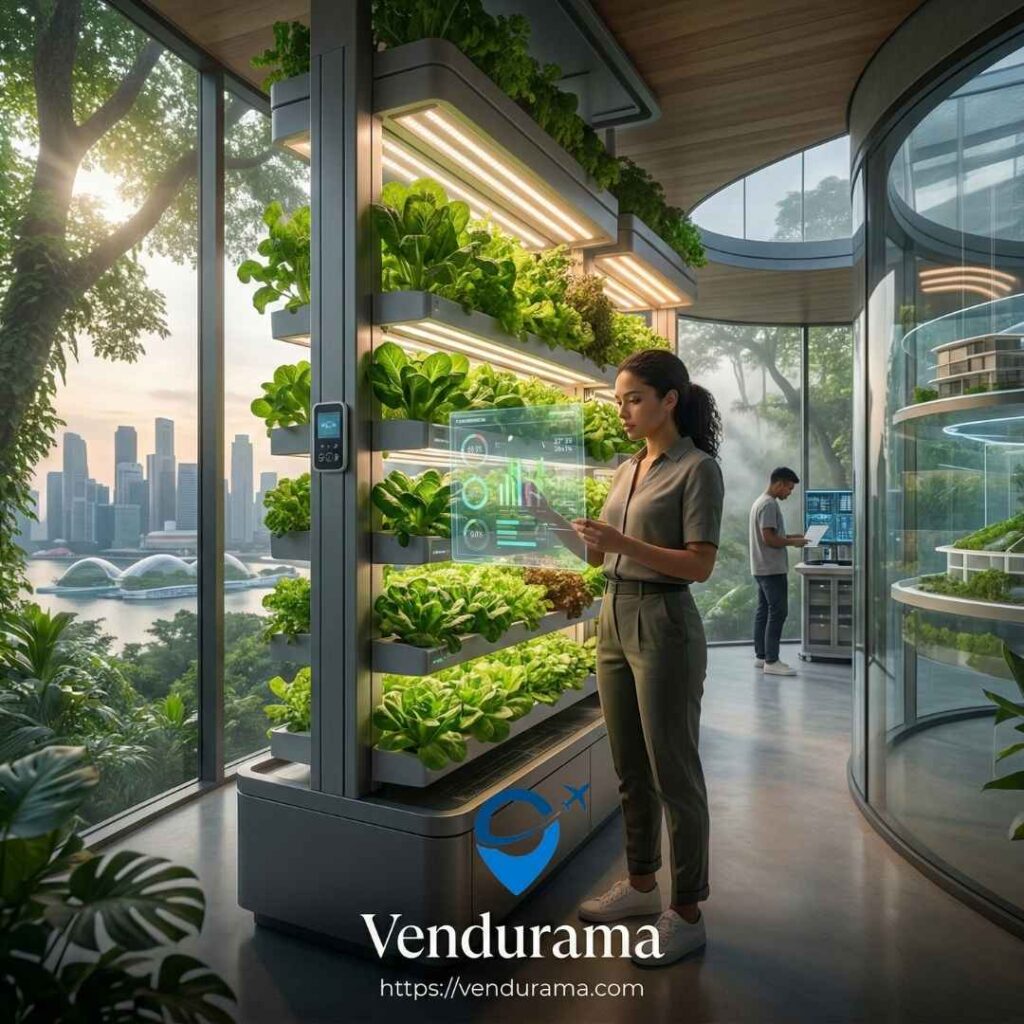
The Singapore Green-Tech Apprenticeship is structured around three progressive phases, each designed to build competency through direct industry engagement.
Phase 1: Foundations (Months 1-2)
Apprentices begin with intensive technical training at the Singapore Institute of Green Technology. Unlike traditional lectures, these sessions occur in working facilities where theory is immediately applied. Students learn:
- Hydroponic nutrient chemistry and pH management
- AI-driven environmental control systems for indoor agriculture
- Urban heat island mitigation through green building materials
- Basic electrical systems for renewable energy integration
Instruction is delivered by practicing engineers who split their time between teaching and active industry projects. This ensures curriculum content reflects current best practices rather than academic theory.
Phase 2: Immersion (Months 3-6)
Apprentices are placed with host companies for full-time, paid work experiences. Placement partners include:
- Sustenir Agriculture: One of Asia’s largest vertical farming operations, producing kale, lettuce, and strawberries in climate-controlled towers
- Sunseap Group: A leading solar energy provider managing over 2,500 rooftop installations across Singapore
- Surfacing Lab: A research collective developing floating architecture prototypes for high-density urban environments
During this phase, apprentices are not observers. They are integrated team members responsible for specific project deliverables. One apprentice might manage nutrient delivery systems for a 12-tower vertical farm. Another might configure battery storage arrays for a commercial solar installation. The work is real, the stakes are tangible, and the learning is accelerated by direct consequence.
Phase 3: Capstone (Months 7-8)
The final phase requires apprentices to design and implement an original climate tech solution. Past projects have included:
- A mobile app connecting urban farmers with restaurant buyers to reduce food waste
- A modular cooling system for high-rise buildings that reduces energy consumption by 34%
- A floating community garden prototype for coastal neighborhoods vulnerable to flooding
Capstone projects are presented to a panel of industry investors, with the most promising concepts receiving seed funding for commercialization. This transforms the apprenticeship from a training program into a potential entrepreneurship launchpad.
Housing & Safety: The Parent’s Priority
For parents sending their 18-to-22-year-old children abroad, safety and accommodation quality are non-negotiable considerations. The Singapore program addresses both through structured support systems.
All apprentices are housed in premium student residences located within 15 minutes of their training facilities. These residences feature:
- 24/7 security personnel and controlled access entry
- Individual bedrooms with private bathrooms (no shared sleeping arrangements)
- High-speed internet and dedicated study spaces
- On-site meal services with dietary accommodation
- Regular wellness check-ins from program coordinators
The residences are situated in established neighborhoods with low crime rates, excellent public infrastructure, and easy access to emergency medical facilities. Parents receive monthly safety reports and have direct communication channels with residence managers.
When booking a seamless flight to the Asian green-tech hub, we recommend selecting direct flights where possible to minimize transit complexity for young travelers unfamiliar with international connections. Singapore Changi Airport consistently ranks as the world’s safest and most efficient aviation facility, with dedicated assistance services for unaccompanied young adults arriving for educational programs.
Upon arrival, the critical transition from airport to residence must be handled with precision. Young adults navigating foreign transit systems for the first time experience elevated stress levels that can undermine their confidence at the program’s outset. When parents arrange a pre-booked, safe airport transfer for your student, they eliminate uncertainty from the arrival experience. The driver meets the student at the designated gate, assists with luggage, and provides direct transportation to the residence without requiring navigation decisions or payment negotiations.
This level of logistical care may seem excessive to parents who traveled independently at the same age. But the context has changed. Today’s young adults face different risks—digital scams, ride-share fraud, navigation errors in unfamiliar languages—and the cost of a single mistake can be substantial. Pre-arranged transport is not indulgence. It is risk management.
Post-Apprenticeship Employment Pathways
The Singapore program maintains a 96% job placement rate within six months of completion. Employment outcomes include:
- 42% hired directly by their host company from Phase 2
- 31% recruited by partner firms through the program’s industry network
- 18% pursuing entrepreneurship with capstone project commercialization
- 9% continuing to advanced specialization programs
Salaries for graduates average $82,000 in the first year, with 67% receiving performance bonuses exceeding $8,000. For families investing $45,000 in the program, the ROI timeline averages 14 months from graduation.
Destination 2: The Netherlands — The Water Engineering & Floating City Hub
Why the Netherlands Commands Global Authority in Climate Resilience
If Singapore represents the future of urban climate adaptation, the Netherlands embodies centuries of accumulated expertise in water management. Forty percent of the country lies below sea level, protected by an intricate system of dikes, pumps, and storm barriers that have evolved over eight hundred years. This historical necessity has transformed the Netherlands into the world’s premier exporter of water engineering knowledge.
In 2026, Dutch climate tech firms hold contracts in 47 countries, from Miami’s sea-level rise mitigation projects to Jakarta’s sinking city interventions. The expertise is not theoretical—it has been tested against actual floods, storm surges, and subsidence events that would devastate less-prepared nations.
For apprentices, the Netherlands offers:
- Historical Depth: Learning from engineers whose families have managed water systems for generations
- Global Export Pipeline: Direct pathways to international employment through Dutch firms operating worldwide
- Quality of Life: Consistently ranked among the world’s safest and most livable countries for young adults
The 8-Month Curriculum: Engineering the Amphibious Future
The Netherlands Green-Tech Apprenticeship is headquartered in Rotterdam, Europe’s largest port and a living laboratory for climate-resilient infrastructure. The curriculum mirrors Singapore’s three-phase structure while focusing on water-specific competencies.
Phase 1: Foundations (Months 1-2)
Training occurs at the Delft University of Technology’s Climate Adaptation Center, where apprentices learn:
- Hydrodynamic modeling for flood prediction and prevention
- Buoyant foundation systems for floating structures
- Sustainable materials resistant to saltwater corrosion
- EU regulatory frameworks for coastal development
Instruction combines classroom theory with field visits to active construction sites, including the Maeslantkering storm surge barrier and the Floating Farm Rotterdam—a dairy operation housed on a floating platform in the city’s harbor.
Phase 2: Immersion (Months 3-6)
Apprentices are placed with leading Dutch engineering firms, including:
- Royal HaskoningDHV: A global consultancy designing flood-resilient infrastructure across six continents
- Plastic Whale: A social enterprise building boats from recycled plastic while cleaning urban waterways
- Space&Matter: An architecture firm specializing in circular economy building systems and floating communities
Work assignments are substantive. One apprentice might model flood scenarios for a proposed Amsterdam neighborhood expansion. Another might design drainage systems for a coastal restoration project in Zeeland. The projects are real, the clients are paying, and the apprentices’ contributions are integrated into deliverables submitted to government agencies and private developers.
Phase 3: Capstone (Months 7-8)
The capstone requires apprentices to propose a climate adaptation solution for a specific vulnerable location. Past projects have included:
- A floating school prototype for Pacific Island nations facing sea-level rise
- A modular dike system that can be rapidly deployed during emergency flooding
- A saltwater agriculture program converting flooded farmland into productive aquaculture
Capstone presentations are attended by representatives from the Dutch Ministry of Infrastructure and Water Management, with selected projects considered for government pilot programs. This level of institutional engagement provides apprentices with credentials that carry weight across the global climate tech sector.
Housing & Safety: European Standards for Young Adults
The Netherlands maintains rigorous standards for student accommodation, enforced through national housing regulations. Apprentices are placed in certified residences that meet the following criteria:
- Individual or shared bedrooms with maximum occupancy of two students per room
- Secure building access with keycard entry and surveillance systems
- Proximity to public transportation with well-lit, populated routes
- On-site residence managers available during business hours
- Regular health and safety inspections by municipal authorities
Rotterdam and Amsterdam both rank in the top 15 safest cities globally for young adults, with violent crime rates significantly below comparable urban centers in North America. Emergency services respond within 8 minutes on average, and English is widely spoken throughout the country, reducing communication barriers during medical or safety incidents.
When securing safe, premium student accommodation abroad, parents should verify that residences are registered with the Dutch Municipal Personal Records Database (BRP), which ensures legal compliance and provides government oversight of housing conditions. Unregistered accommodations may offer lower costs but lack regulatory protection.
Ground transportation logistics in the Netherlands present different considerations than Singapore. While public transit is excellent, young adults arriving with luggage and navigating unfamiliar train systems while jet-lagged face unnecessary stress. When parents secure reliable ground transportation directly to the residency, they ensure their child transitions smoothly from airport to accommodation without decision fatigue or navigation errors.
Amsterdam Schiphol and Rotterdam The Hague airports both offer dedicated meet-and-greet services for pre-booked transfers. Drivers are vetted through national background check systems, vehicles are insured for commercial passenger transport, and pricing is fixed in advance to eliminate payment confusion. For parents who have booked a trusted chauffeur to avoid foreign transit confusion, the peace of mind is worth the incremental cost.
Post-Apprenticeship Employment Pathways
The Netherlands program maintains a 93% job placement rate within six months of completion. Employment outcomes include:
- 38% hired directly by their host company from Phase 2
- 35% recruited by partner firms through the program’s European network
- 15% pursuing entrepreneurship with capstone project commercialization
- 12% continuing to advanced specialization programs in water engineering
Salaries for graduates average €68,000 ($74,000) in the first year, with significant upside for those accepting international placements. Dutch engineering firms frequently offer overseas assignments within 18 months of hire, providing global mobility that traditional degrees cannot match.
The Logistics of Safe Educational Migration: A Parent’s Operational Checklist
Why Logistical Precision Matters More Than You Think
Sending your child abroad for an 8-month educational program represents one of the most significant transitions your family will navigate. The stakes extend beyond financial investment. You are entrusting your young adult’s safety, well-being, and developmental trajectory to institutions, locations, and systems outside your direct control.
Logistical failures at the outset can undermine the entire experience. A missed flight connection that delays arrival by 24 hours. A taxi scam that costs hundreds of euros and traumatizes an inexperienced traveler. Accommodation that does not match advertised safety standards. Each of these scenarios is preventable with proper planning.
This section provides an operational checklist for parents who approach educational migration with the same rigor they apply to business investments.
Flight Booking: Balancing Cost, Safety, and Complexity
When arranging the complete educational travel itinerary, consider the following factors:
Direct vs. Connecting Flights
Direct flights eliminate connection risks—missed transfers, luggage delays, extended time in unfamiliar airports. For young adults traveling alone, the premium for direct routing ($400-$800 additional) represents insurance against cascading complications. Singapore and the Netherlands both receive direct flights from major North American and European hubs.
Airline Safety Ratings
Not all carriers maintain equivalent safety standards. Consult the AirlineRatings.com database before booking. Singapore Airlines, KLM, and Lufthansa all maintain 7/7 safety scores with no fatal accidents in the past 30 years. Budget carriers may offer lower fares but often lack the operational redundancy that protects against disruptions.
Arrival Timing
Schedule arrivals during daylight hours when possible. Young adults navigating foreign cities at night face elevated risks, and residence check-in services often operate on limited evening hours. A flight that arrives at 3 AM may require expensive emergency accommodation until morning check-in.
Accommodation Verification: Beyond Marketing Photos
Program websites showcase ideal accommodation scenarios. Parents should verify the following before committing:
- Legal Registration: Confirm the residence is registered with local housing authorities
- Security Infrastructure: Request documentation of access control systems and surveillance coverage
- Emergency Protocols: Understand procedures for medical emergencies, fire evacuation, and security incidents
- Staff Availability: Confirm 24/7 contact numbers and response time commitments
- Peer References: Request contact information for parents of previous apprentices
When securing safe, premium student accommodation abroad, insist on video tours conducted via live video call rather than pre-recorded footage. This allows you to verify current conditions and ask real-time questions about safety features.
Ground Transportation: The First Critical Mile
The airport-to-residence transfer deserves disproportionate attention relative to its duration. This is when your child is most vulnerable—jet-lagged, carrying valuables, unfamiliar with local norms, and potentially communicating in a non-native language.
Pre-booked transfers eliminate the following risks:
- Ride-Share Fraud: Unlicensed drivers posing as legitimate transport operators
- Price Gouging: Meter manipulation or surprise surcharges upon arrival
- Navigation Errors: Drivers unfamiliar with residence locations extending journey times
- Safety Incidents: Unvetted drivers with no background verification
When you arrange a pre-booked, safe airport transfer for your student, you receive confirmation documentation including driver name, vehicle description, license plate number, and direct contact information. This allows your child to verify the driver’s identity before entering the vehicle—a simple protocol that prevents impersonation scams.
Some programs include airport transfer in their tuition. If not, budget $150-$300 for premium transfer services. This represents less than 1% of total program cost while protecting against risks that could derail the entire experience.
Communication Protocols: Maintaining Connection Without Helicoptering
Establishing communication expectations before departure prevents anxiety on both sides. Recommended protocols include:
- Weekly Scheduled Calls: Fixed times that accommodate time zone differences
- Emergency Contact Chain: Clear hierarchy of who to contact for different issue types (medical, academic, logistical)
- Digital Check-Ins: Shared location services for the first two weeks until the student establishes routines
- Program Coordinator Access: Direct contact information for on-site staff who can respond to urgent concerns
The goal is balanced oversight—enough visibility to ensure safety without undermining your young adult’s developing independence. The 8-month apprenticeship is as much about building self-reliance as acquiring technical skills.
ROI & Reader FAQ: Addressing the Pragmatic Parent’s Concerns
Is $45,000 for 8 Months Actually Better Than $250,000 for 4 Years?
This question requires analyzing total cost of ownership, not just tuition figures.
Traditional Degree Total Cost:
- Tuition and fees: $220,000
- Living expenses: $60,000
- Opportunity cost (4 years of foregone earnings): $180,000
- Total: $460,000
Green-Tech Apprenticeship Total Cost:
- Program tuition: $45,000
- Living expenses: $18,000
- Opportunity cost (8 months of foregone earnings): $30,000
- Total: $93,000
The apprenticeship pathway costs 80% less while delivering employment 40 months earlier. Even if the traditional degree graduate eventually earns 15% more annually (which current data does not support), the apprenticeship graduate’s head start in earnings and compound investment growth produces superior lifetime wealth accumulation.
What If My Child Has No Technical Background?
Both programs are designed for students with minimal prior technical experience. The Phase 1 Foundations curriculum assumes no prerequisite knowledge beyond basic mathematics and computer literacy. In 2025, 64% of Singapore apprentices and 71% of Netherlands apprentices entered with non-STEM undergraduate backgrounds.
What matters more than prior knowledge is demonstrated aptitude for hands-on problem-solving and willingness to engage with physical systems. The admissions process evaluates these traits through practical assessments rather than academic transcripts.
Are Language Barriers a Concern in the Netherlands?
While Dutch is the national language, English proficiency in the Netherlands exceeds 93% of the population—the highest non-native English rate globally. Business, education, and government services all operate fluently in English. Apprentices report no meaningful communication barriers in professional or daily life contexts.
Singapore similarly conducts all business and education in English as one of four official languages. Language preparation is unnecessary for either destination.
What Happens If My Child Does Not Complete the Program?
Completion rates for both programs exceed 89%, significantly higher than traditional university retention rates. The intensive, hands-on nature of the curriculum maintains engagement among students who might struggle in lecture-based environments.
In the event of non-completion, both programs offer partial refunds based on completed phases. Phase 1 completers receive 40% refund. Phase 2 completers receive 20% refund. Phase 3 completers receive no refund but retain industry certifications earned during immersion.
Parents should also understand that “non-completion” does not mean “no value.” Apprentices who leave after Phase 2 have still acquired six months of industry experience that strengthens their resumes relative to traditional graduates.
How Do These Programs Compare to Coding Bootcamps?
Coding bootcamps emerged in the 2010s as accelerated alternatives to computer science degrees. The Green-Tech Apprenticeship model applies similar principles to climate technology. Key differences include:
| Factor | Coding Bootcamp | Green-Tech Apprenticeship |
|---|---|---|
| Duration | 3-6 months | 8 months |
| Cost | $15,000 – $25,000 | $35,000 – $50,000 |
| Job Placement | 72% at 6 months | 94% at 6 months |
| Starting Salary | $65,000 average | $78,000 average |
| Industry Growth | Maturing/saturating | Accelerating/expanding |
Climate tech represents the next frontier of skills-based education, with longer runway for growth and less saturation than software development. The higher cost reflects longer duration, international location, and industry placement infrastructure.
Can My Child Work During the Apprenticeship?
Phase 1 does not permit external employment due to intensive training schedules. Phases 2 and 3 include paid work placements that provide income ($1,200-$2,000 monthly) while fulfilling program requirements. Additional external employment is discouraged as it compromises the immersive learning model.
Some apprentices offset living expenses through their Phase 2 stipends, reducing the net cost of the program by $10,000-$15,000.
Conclusion: The Education Investment That Defines a Generation
Every generation faces a defining economic transition. For the Baby Boomers, it was the shift from manufacturing to services. For Generation X, it was the rise of personal computing and the internet. For Millennials, it was the platform economy and digital disruption.
For the class of 2026, the defining transition is climate adaptation—the largest infrastructure rebuild in human history, requiring millions of skilled practitioners who can translate environmental necessity into engineered reality.
Traditional educational institutions, bound by accreditation requirements, faculty tenure structures, and curriculum approval processes, cannot adapt quickly enough to meet this moment. They produce graduates equipped for yesterday’s economy while the jobs of tomorrow remain unfilled.
The Green-Tech Apprenticeship model represents something different: education designed backward from employer needs rather than forward from academic tradition. Eight months instead of four years. Construction sites instead of lecture halls. Paid industry placements instead of unpaid internships. Job offers at graduation instead of hopeful applications.
For parents watching their children approach adulthood in an uncertain world, this model offers something that transcends financial ROI: agency. The confidence that comes from knowing your child possesses skills that cannot be outsourced, automated, or rendered obsolete by technological disruption. The security of employment in an industry that will grow regardless of economic cycles. The purpose of contributing to solutions that matter beyond quarterly earnings reports.
The question is not whether climate tech represents the future. The question is whether you will position your family to participate in building it or watch from the sidelines as others claim the opportunities.
Traditional degrees offered security for three generations. They will not offer it for the fourth. The parents who recognize this inflection point—and act decisively to redirect their educational investments accordingly—will give their children something more valuable than any diploma: a foundation for prosperity in the economy that actually exists.
The green-tech apprenticeship is not merely an educational alternative. It is a generational bet on the future. And in 2026, it is the smartest bet available.