
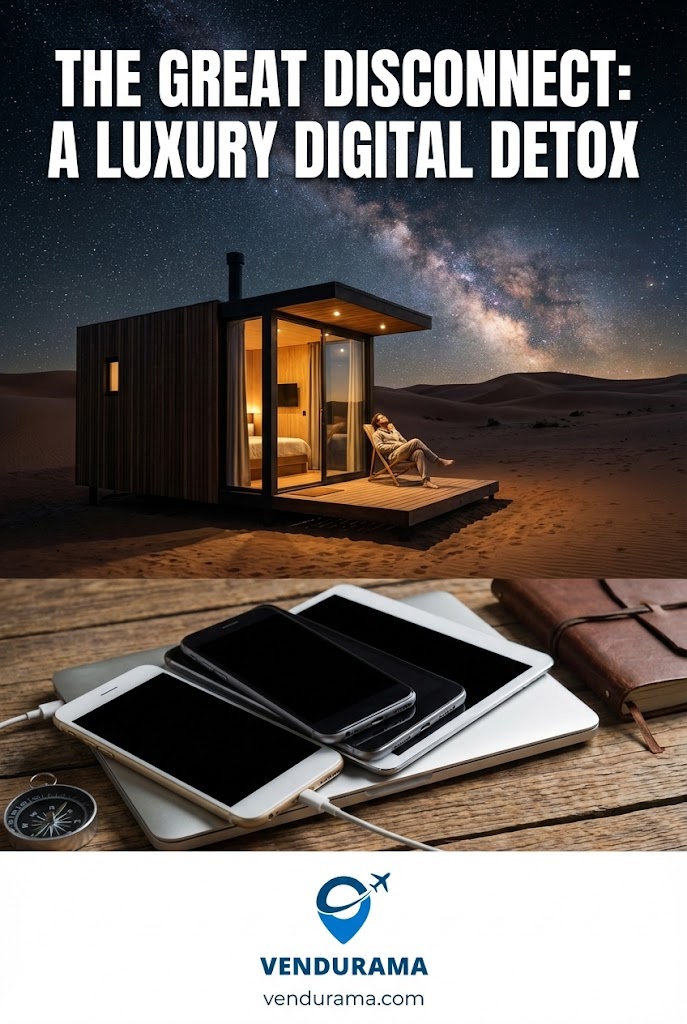
Introduction: The Crisis of the Hyper-Connected Soul
In the year 2026, the most precious commodity on Earth is no longer gold, data, or oil. It is silence.
We live in an era of “Radical Connectivity.” Our nervous systems are bombarded by a relentless stream of notifications, algorithmic feedback loops, and the cold blue light of a thousand screens. The average modern professional toggles between tasks every 47 seconds. Our brains, evolved for the slow rhythms of nature, are being overclocked by a digital infrastructure that never sleeps. The result is a global epidemic of cognitive fatigue, a thinning of the human spirit, and a profound disconnection from the physical world.
This has birthed a new, elite tier of travel: The Great Disconnect.
This is not “vacation” in the traditional sense. It is a strategic withdrawal. High-net-worth individuals and deep-thinking voyagers are now seeking “Dark Sky Sanctuaries” and “Digital Detox Retreats” where the signal dies, the screens go black, and the ancient canopy of the stars becomes the primary source of entertainment.
This guide is an analytical deep-dive into the architecture of silence. We will explore the psychology behind the need to unplug, the science of light pollution, and the logistical roadmap to reaching the world’s most remote, off-grid sanctuaries. This is your blueprint for reclaiming your attention, your sleep, and your sense of wonder.
Part I: The Neuroscience of Noise – Why We Must Unplug
To understand the value of a digital detox, we must first understand the damage of the “Digital Overload.”
1. The Dopamine Trap
Every notification—an email, a like, a news alert—triggers a micro-dose of dopamine in the brain’s reward center. While dopamine is often called the “pleasure chemical,” it is actually the “seeking chemical.” It keeps us in a state of perpetual anticipation. In the hyper-connected world, we are caught in a “Dopamine Loop” that prevents deep concentration and leads to chronic anxiety.
2. The Circadian De-synchronization
The human body operates on a 24-hour internal clock governed by the rising and setting of the sun. The blue light emitted by smartphones mimics the wavelength of morning sunlight, suppressing the production of melatonin—the hormone responsible for deep, restorative sleep. By staying connected until midnight, we are effectively telling our brains that it is forever noon.
3. Cognitive Load and “Attention Residue”
When you check your phone during a meal or a walk, you don’t just lose those few seconds. You suffer from “Attention Residue”—part of your brain remains occupied with the digital task even after you put the phone away. True recovery requires a complete severing of the digital umbilical cord for a minimum of 72 hours, the time required for the prefrontal cortex to begin its “reset” process.
Part II: Defining Luxury in the Age of Deprivation
In the past, luxury was defined by “More”: more marble, more gold, more service, more options. In 2026, luxury is defined by “Less”: less noise, less light, less interruption, less technology.
The “Analog” Premium
A true luxury digital detox retreat is not just a hotel without Wi-Fi. It is a curated environment designed to re-sensitize the human experience.
- Materiality: Instead of plastic and glass, these sanctuaries use raw stone, reclaimed wood, and organic linen.
- Acoustics: The rooms are engineered for “True Silence,” using advanced insulation to block all mechanical noise, leaving only the sound of wind, water, or birdsong.
- The “Black Hole” Service: At these retreats, guests surrender their devices upon arrival. The staff is trained to protect the guest’s solitude, acting as a barrier between the individual and the chaotic outside world.
Part III: The Rise of Dark Sky Tourism (Astro-Tourism)
Light pollution is a modern tragedy. More than 80% of the world’s population lives under “skyglow.” In most major cities, the Milky Way is invisible, reduced to a hazy, orange-grey smear.
The Bortle Scale of Darkness
Astronomers use the Bortle Scale to measure the darkness of the night sky.
- Class 9 (Inner-City): Only the moon and brightest planets are visible.
- Class 1 (Excellent Dark-Sky): The Milky Way is so bright it casts shadows on the ground. You can see the Andromeda Galaxy with the naked eye.
Dark Sky Sanctuaries are locations officially recognized for their exceptional quality of starry nights and a nocturnal environment that is specifically protected from light pollution. Visiting a Bortle Class 1 site is a spiritual experience—it reminds us of our infinitesimal place in the universe, a realization that provides a profound sense of perspective and peace.
Part IV: Global Map of Sanctuaries – Where the Signal Dies
To find true silence, one must travel beyond the reach of standard infrastructure. These are the “Dead Zones” where luxury meets the void.
1. The Atacama Desert, Chile (The Astronomical Frontier)
The Atacama is the driest non-polar place on Earth. Some weather stations here have never recorded a drop of rain. The altitude (2,500m+) and lack of humidity create the clearest skies on the planet.
- The Experience: Staying at a high-end eco-lodge like Awasi Atacama, where there are no televisions and each guest has a private guide to explore the salt flats and star-gaze through research-grade telescopes.
2. Sossusvlei, Namibia (The Desert of Silence)
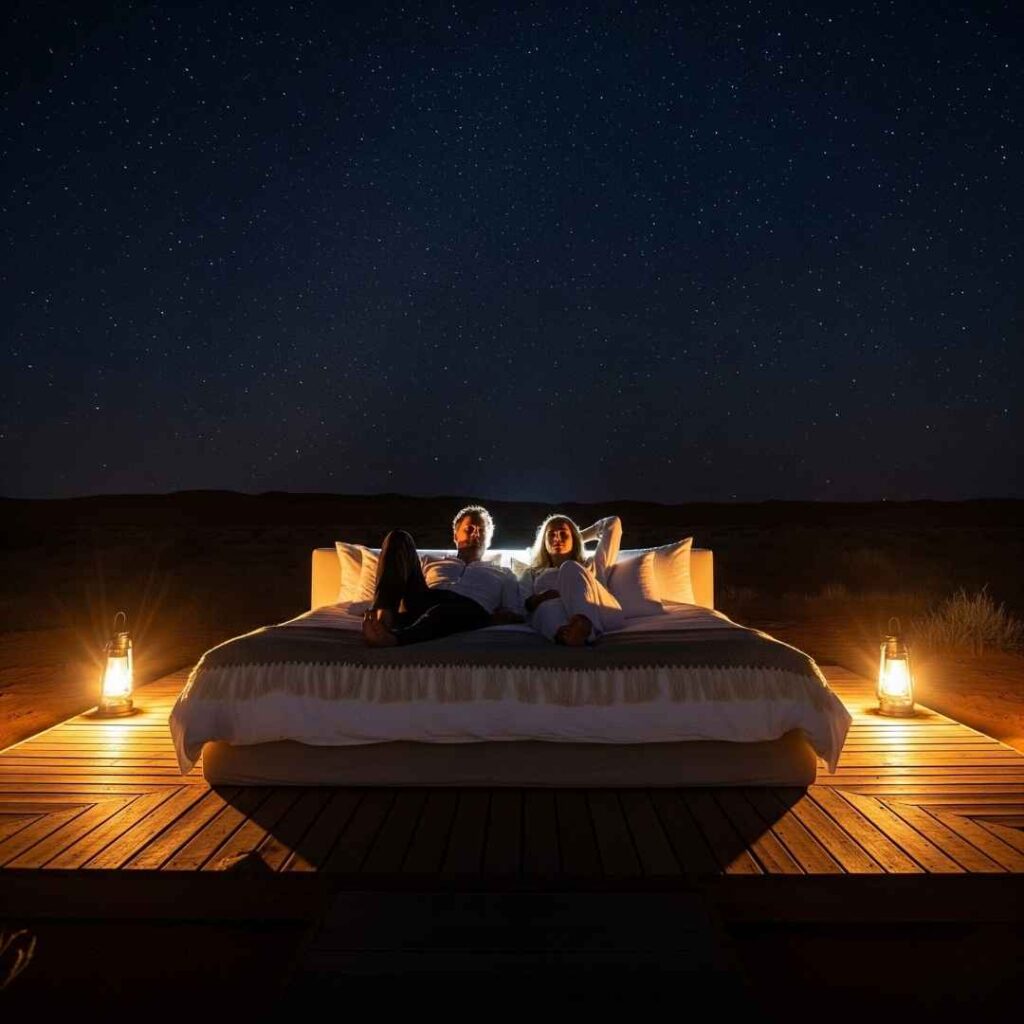
Home to the world’s oldest desert and some of the highest sand dunes, Namibia offers a level of isolation that is almost lunar.
- The Experience: Little Kulala or andBeyond Sosusvlei Desert Lodge. Each villa has a “star bed” on the roof, allowing you to sleep directly under a Bortle Class 1 sky.
3. The Swiss Alps (High-Altitude Solitude)
For those who prefer the cold, certain high-altitude valleys in the Engadin region of Switzerland offer “Silent Hotels.”
- The Experience: Hotels like Schloss Tarasp or remote mountain huts where electricity is minimal, and the focus is on “Slow Movement”—snowshoeing, reading by a fire, and deep sleep.
4. Bhutan (The Kingdom of Gross National Happiness)
Bhutan limits the number of tourists to preserve its culture and environment. It is one of the few places on Earth where “The Great Disconnect” is part of the national policy.
- The Experience: Amankora’s five lodges across the kingdom. Here, the detox is spiritual, rooted in Buddhist principles of mindfulness and presence.
Part V: Navigating the Void – The Logistical Blueprint
Reaching a Dark Sky Sanctuary is, by definition, a complex undertaking. These locations do not have international airports. They require multiple connections, regional carriers, and often, private ground transport through unmapped territory.
1. The Strategic Flight Path
When planning a journey to a remote sanctuary in the Atacama or the Namib Desert, the logistical planning is non-linear. You are not just booking a flight; you are engineering an approach. For example, reaching a retreat in Bhutan involves navigating specific entry points in India or Thailand and coordinating with Druk Air.
To visualize these complex, multi-leg journeys and secure the most efficient connections across disparate regional airlines, travelers must utilize advanced international flight search engines. This allows for “open-jaw” ticketing—flying into one regional hub and out of another—which is crucial for maximizing the time spent in silence rather than in transit.
2. The “Last Mile” Security: Wilderness Transfers
The most critical link in the chain is the “Last Mile.” This is the transition from a regional airstrip (often a gravel runway) to the sanctuary itself. In these environments, standard car rentals are useless, and public transport is non-existent.
Safety and reliability are paramount. You are often traveling through areas with no cell coverage. If your transport fails, you are stranded in a harsh environment. The gold standard for off-grid travel is to pre-arrange private wilderness transfer services. Having a vetted, professional driver waiting at a remote airstrip with a 4×4 vehicle equipped for the specific terrain ensures that your “Great Disconnect” begins with a sense of security, allowing you to mentally let go the moment you step off the plane.
Part VI: The Science of “Darkness Therapy”
Why are we so drawn to the stars? It is not just aesthetic; it is biological.
1. The Overview Effect (on Earth)
Astronauts often report the “Overview Effect”—a cognitive shift in awareness after seeing Earth from space. Watching a Class 1 Dark Sky induces a similar state. It triggers “Awe,” an emotion that psychological research shows can reduce inflammation in the body and increase feelings of altruism and connection to humanity.
2. Melatonin Calibration
Spending 7 days in a Dark Sky Sanctuary, away from artificial blue light, can “re-set” the human circadian rhythm. By synchronizing with the natural cycle of light and dark, guests often report that their chronic insomnia disappears, and their cognitive clarity improves by over 30%.
Part VII: Essential Gear for the Solitary Voyager
When you leave technology behind, you must return to the “Tools of the Senses.”
- Optics: A pair of high-quality 10×42 binoculars. While telescopes are great, binoculars allow for a more immersive, “wide-field” view of the Milky Way.
- Analog Journals: A leather-bound notebook and a fountain pen. Writing by hand engages different neural pathways than typing, facilitating deeper self-reflection.
- Red-Light Flashlights: To preserve your “night vision” (which takes 20-40 minutes to fully develop), you must use red light. White light instantly resets the rods in your eyes.
- Physical Maps: In the sanctuaries, GPS can be unreliable. Learning to read a topographical map is a rewarding skill that reconnects you with the landscape.
Part VIII: The Financial Investment in Silence
The cost of a “Great Disconnect” is high, not because of the gold leaf on the walls, but because of the land-to-guest ratio.
Maintaining a luxury retreat in a Dark Sky Sanctuary requires immense logistical support:
- Water & Power: Most sites are 100% solar-powered with advanced water desalination or atmospheric water generation.
- Staff Ratios: To ensure total privacy and a seamless experience, these retreats often have a 3-to-1 staff-to-guest ratio.
- Conservation Levies: A portion of the fee goes toward protecting the darkness of the region from future development.
Expect to invest between $1,500 and $4,000 USD per night. However, when viewed as an investment in mental health, cognitive longevity, and spiritual recalibration, the ROI (Return on Investment) is unparalleled.
Part IX: The Return – Managing the “Digital Re-entry”
The most difficult part of a digital detox is the “Re-entry” into the noise of the modern world.
- The Buffer Day: Do not return to work the day after you land. Schedule one “buffer day” at home to maintain the calm.
- The “Notification Audit”: Before turning your phone back on, delete 50% of your apps and turn off 90% of your notifications.
- The Morning Ritual: Commit to keeping the first hour of your day “Screen-Free,” carrying the silence of the sanctuary into your daily life.
Conclusion: The Starry Sky Above and the Moral Law Within
Immanuel Kant famously wrote: “Two things fill the mind with ever new and increasing admiration and awe… the starry heavens above me and the moral law within me.”
In our digital age, we have lost sight of both. We have replaced the starry heavens with the glow of the smartphone, and we have replaced our inner moral law with the demands of the algorithm.
“The Great Disconnect” is more than a travel trend. It is a necessary act of rebellion. It is a declaration that our attention is our own, that our time is sacred, and that the universe—in all its silent, shimmering glory—is the only feed we truly need to follow.
The silence is waiting. The stars are burning. It is time to turn off the lights and remember who you are.
Next Step: Are you ready to begin your journey to the void? Start by identifying your sanctuary and mapping your strategic flight itinerary. Once you have your dates, ensure your secure remote arrival is confirmed, and prepare to leave the noise behind.