

Introduction: The Era of the “Nervous System” Traveler
In 2026, we have reached a critical juncture in the evolution of travel. For decades, the primary driver of international tourism was the “Bucket List”—a frantic, high-cortisol pursuit of iconic landmarks and social-media-validated viewpoints. We traveled to do things, to see things, and to prove we were there. However, the modern world has become a pressure cooker of digital noise, urban density, and professional burnout. The result? We often return from our “vacations” more exhausted than when we left.
A new paradigm is emerging: The Geography of Calm. This is the strategic selection of travel destinations based not on their fame, but on their biological and psychological compatibility with the human nervous system. It is an acknowledgment that our environment—the air we breathe, the light we absorb, the noise levels we endure, and the cultural pace we inhabit—directly dictates our internal chemistry.
Choosing a destination is no longer just a matter of budget or interest; it is a matter of “Nervous System Regulation.” This guide is an exhaustive exploration of how to audit the world through the lens of stress reduction, bioclimatology, and lifestyle alignment. We are moving beyond “escapism” into the realm of “environmental medicine.”
Part I: The Physiology of Place – Why Environment Matters
To choose a destination that heals, we must first understand why the wrong environment harms. The human brain, evolved over 150 million years in natural settings, is poorly adapted to the sensory onslaught of the modern megalopolis.
1. The Cortisol of the Concrete Jungle
Urban environments trigger a permanent state of “Hyper-Vigilance.” High decibel levels from traffic, the visual clutter of advertising, and the “crowd stress” of high-density populations keep the amygdala in a state of mild but constant activation. When you travel from one high-stress city to another for a holiday, you aren’t resting; you are merely changing the scenery of your stress.
2. Biophilia and the Restorative Power of Nature
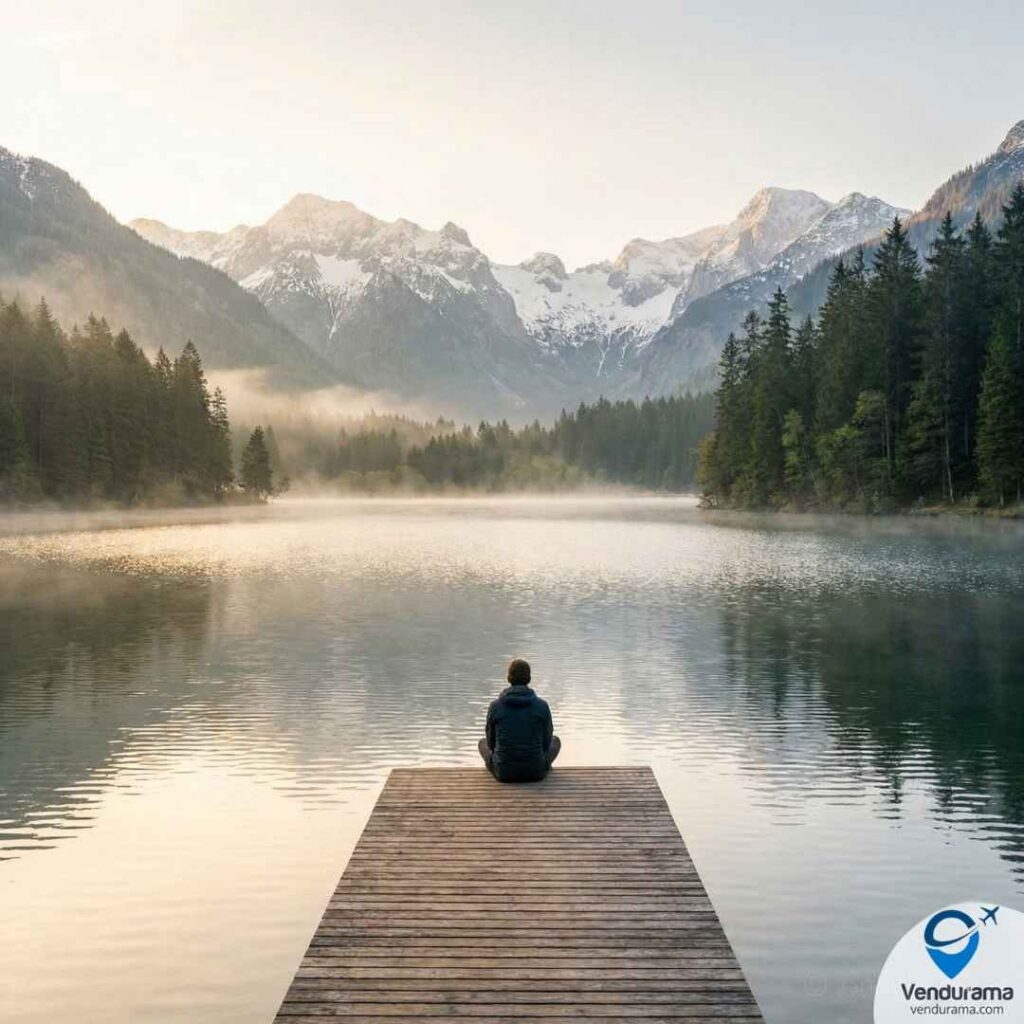
The “Biophilia Hypothesis” suggests that humans possess an innate tendency to seek connections with nature and other forms of life. Studies in environmental psychology show that viewing “fractal patterns” in nature (the way branches grow or waves break) reduces stress levels by up to $60\%$. The “Geography of Calm” prioritizes destinations rich in these natural fractals.
3. Circadian Alignment and Light Pollution
Our internal clocks are governed by the blue light of the morning and the amber light of the evening. Modern cities, with their $24/7$ artificial glow, shatter this rhythm. A destination of calm must offer a “Light Integrity”—an environment where the transition from day to night is biologically respected.
Part II: The Climate-Mood Matrix – Atmospheric Psychology
Climate is the invisible hand that shapes our psychological state. It is not just about “good weather” or “bad weather”; it is about how barometric pressure, humidity, and sunshine duration interact with your specific temperament.
1. The Serotonin of the Sun vs. The Melatonin of the Mist
- The Solar Seeker: For those suffering from Seasonal Affective Disorder (SAD) or low energy, high-latitude destinations with long daylight hours (like the Mediterranean or parts of Australia) are essential. Sunlight triggers serotonin, the “feel-good” hormone.
- The Pluviophile (Lover of Rain): Conversely, for those who feel “over-stimulated” or hyperactive, the soft, grey light and rhythmic sound of rain in places like the Pacific Northwest, Scotland, or the Japanese highlands can be deeply grounding. The low-contrast environment reduces visual noise.
2. The Impact of Humidity and Air Quality
High humidity can increase physical irritability and perceived stress. The “Geography of Calm” often points toward “Dry Air” environments (high altitude or desert fringes) for those seeking mental clarity, or “Salt Air” (coastal regions) for those needing respiratory and sleep improvement.
Part III: The Lifestyle Audit – Pacing and “Slow Cities”
Every destination has a “Pulse.” Some cities vibrate at $140$ BPM (beats per minute), while others hum at a steady $60$. Matching your internal pulse to the destination’s pulse is the key to a transformative trip.
1. The “Cittaslow” Movement
Originating in Italy, the “Slow City” movement focuses on improving the quality of life by slowing down the overall pace. These are towns where transit is prioritized over traffic, where local markets take precedence over franchises, and where the “Art of Doing Nothing” (Il Dolce Far Niente) is a cultural value.
2. Cultural Attitudes Toward Time
In Northern Europe and North America, time is “Monochronic” (linear, scheduled, precious). In many Mediterranean, Middle Eastern, and Southeast Asian cultures, time is “Polychronic” (fluid, relational, abundant). If your goal is to break a cycle of “Time Anxiety,” you must choose a destination where the local culture views time as a circular, infinite resource rather than a dwindling one.
Part IV: Mapping the Calm – Strategic Region Profiles
1. The Nordic Sanctuary (Norway, Iceland, Finland)
- Stress Profile: Extremely low. High social trust, low noise pollution, and vast open spaces.
- The Calm Factor: “Friluftsliv” (Open-air life). The focus is on the silence of the fjords and the purity of the air.
2. The Mediterranean Rhythm (Greece, Southern Italy, Portugal)
- Stress Profile: Moderate in cities, very low in rural “Blue Zones.”
- The Calm Factor: Community and the “Siesta.” The environment encourages long, communal meals and afternoon rest, forcing a physiological reset.
3. The Himalayan Zen (Bhutan, Northern India, Nepal)
- Stress Profile: Low (due to spiritual focus and altitude).
- The Calm Factor: High-altitude air and a culture rooted in mindfulness. The environment demands physical slowness due to the thinning air, which in turn slows the mind.
Part V: The Logistical Framework – Engineering the “Anti-Stress” Trip
The greatest irony of travel is that the process of getting to a “Calm” destination is often the most stressful part of the journey. To protect your nervous system, you must apply “Zero-Friction Logistics.”
1. Strategic Route Planning
A trip that involves three layovers, a long bus ride, and a confusing ferry is not a “Geography of Calm” trip; it is a logistical assault. You must prioritize routes that minimize transit “Touchpoints.”
In 2026, the key is to use highly-optimized travel search engines that allow you to filter not just for price, but for “Quality of Transit.” You should look for direct flights or “Stress-Free Layovers” in airports known for their tranquility (like Singapore Changi or Doha Hamad). Securing your travel through comprehensive flight comparison tools ensures that you are not left at the mercy of unreliable carriers, providing a psychological safety net before you even leave your house.
2. The “Warm Landing” Protocol
The most high-cortisol moment of any trip is the first hour after landing. You are in a foreign environment, potentially sleep-deprived, and vulnerable. Attempting to navigate public transportation with heavy luggage in a new city is a direct violation of the “Clarity Protocol.”
To maintain the “Geography of Calm,” you must engineer a seamless transition from the airport to your sanctuary. This is where vetted airport transfer services become a strategic necessity. Pre-arranging a private professional transfer ensures that the moment you exit the arrivals hall, your logistical responsibilities end. A professional driver handles your belongings and transports you in a quiet, private environment directly to your accommodation. This “Zero-Friction” arrival protects your nervous system and allows you to begin your healing process the moment you touch ground.
Part VI: Implementation – How to Audit Your Next Destination
Before you book, perform a “Calm Audit” using these three metrics:
- The Acoustic Audit: Use tools like Google Earth to check for proximity to major highways, airports, or construction zones. Silence is the ultimate luxury.
- The Walkability Score: Does the destination require a car to get a coffee? High-stress environments are car-centric. Calm environments are pedestrian-centric.
- The “Green-to-Grey” Ratio: What percentage of the visible area is natural vs. man-made? Aim for a $70/30$ split in favor of nature.
Part VII: The Psychological Preparedness – The Traveler’s Mindset
Environment is $50\%$ of the equation; the other $50\%$ is your internal state.
- The Digital Fast: A trip to the most silent valley in the Alps is useless if you are still scrolling through your work emails. You must match the “Geography of Calm” with a “Digital Silence.”
- Radical Presence: Practice “Sensory Grounding” in your new environment. What does the air smell like? What is the specific temperature of the wind? This anchors the nervous system in the present.
Part VIII: The Financial ROI of Calm
Traditional travel is an expense; “Geography of Calm” travel is an investment.
- Increased Productivity: A properly regulated nervous system returns to work with a $30\%$ increase in cognitive focus and creativity.
- Healthcare Savings: Reducing cortisol levels has a direct impact on long-term health outcomes, reducing the risk of stress-related illnesses.
Conclusion: The Destination is Your Health
We are no longer in an era where we can afford to treat travel as a superficial distraction. Our environments are too loud, our lives are too fast, and our stress levels are too high. The “Geography of Calm” is a necessary evolution. It is the realization that the world is a vast pharmacy of environments, and we must learn to prescribe the right ones for our souls.
The journey to tranquility begins with a single, strategic decision: to stop planning for “the list” and start planning for “the self.” By utilizing sophisticated booking platforms to manage your transit and seamless door-to-door transportation to protect your arrival, you can ensure that the “Geography of Calm” is not just a concept, but a lived reality.
The world is waiting to heal you. You just have to choose the right corner of it.
Next Step: Are you ready to audit your stress levels and find your ideal climate? Your first move is to visualize the most direct routes to serenity. And once you’ve chosen your sanctuary, ensure your arrival is as peaceful as your destination.