
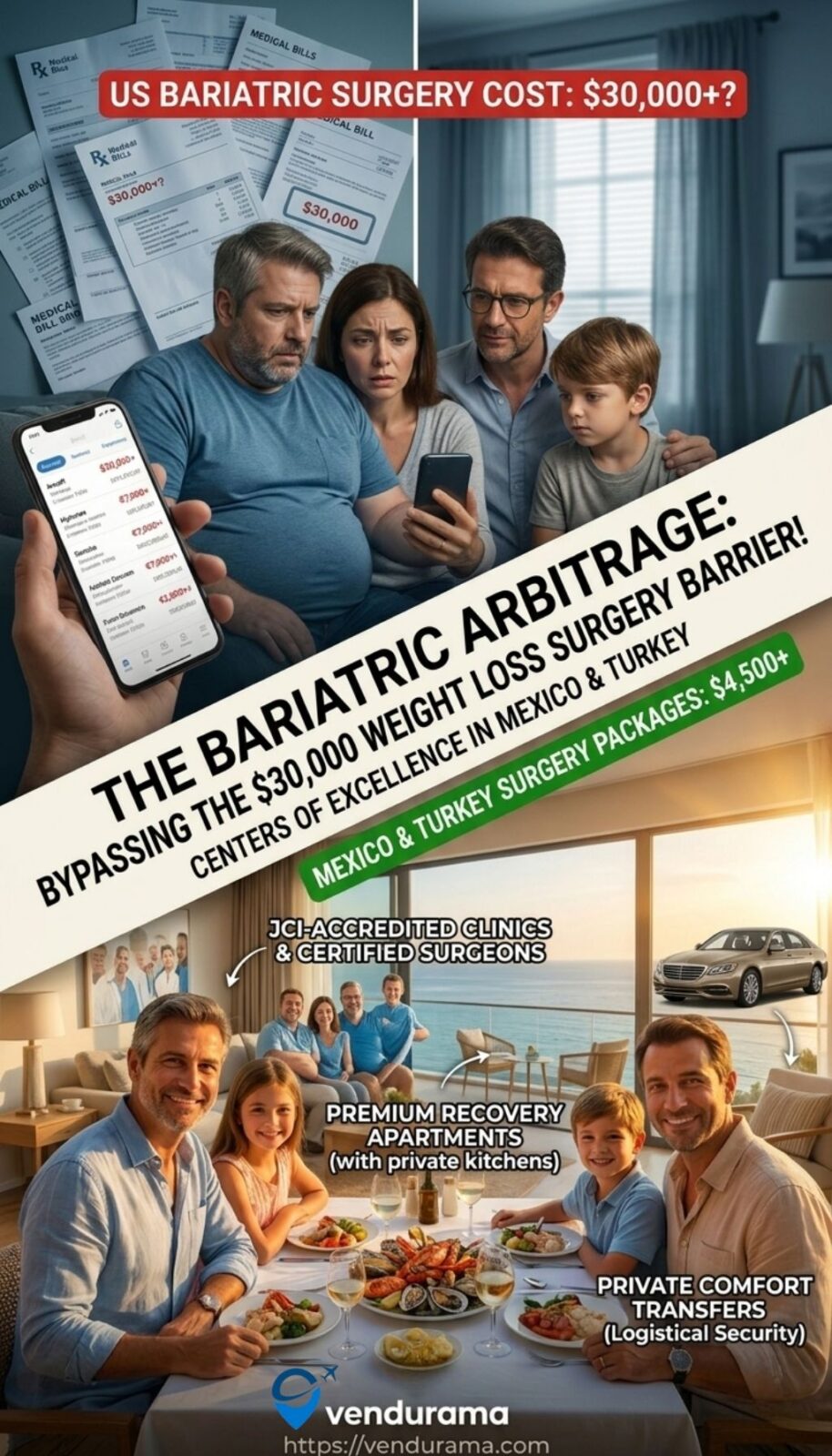
The Financial Barrier to Metabolic Health in the West
The global obesity epidemic represents one of the most significant public health challenges of the twenty-first century, with the World Health Organization estimating that over 650 million adults worldwide now live with obesity—a condition associated with type 2 diabetes, cardiovascular disease, and reduced life expectancy. For patients seeking definitive metabolic intervention, bariatric surgery (including sleeve gastrectomy and Roux-en-Y gastric bypass) remains the most effective long-term treatment, with studies demonstrating 60-80% excess weight loss and significant remission rates for obesity-related comorbidities. Yet in Anglophone healthcare systems, this life-saving intervention has been transformed into a luxury healthcare product, accessible primarily to the wealthy or the exceptionally well-insured.
In the United States, the average out-of-pocket cost for bariatric surgery ranges from $25,000 to $30,000, even for patients with insurance coverage that excludes metabolic procedures or imposes prohibitive deductibles. The United Kingdom presents a parallel barrier: while the National Health Service technically covers bariatric surgery, waiting lists exceed 24-36 months in many regions, and stringent eligibility criteria exclude approximately 40% of clinically appropriate candidates. For the rational, analytically-minded middle-class individual, this represents not merely a financial challenge, but a systemic market failure in the allocation of life-saving care.
Enter the concept of Global Healthcare Arbitrage: the strategic deployment of capital across jurisdictional boundaries to capture equivalent or superior medical outcomes at a fraction of the domestic cost. The emergence of Joint Commission International (JCI) accreditation—the global gold standard for healthcare quality—has created a harmonized framework wherein specialized bariatric centers in Mexico and Turkey demonstrate outcomes metrics that rival or exceed those of Western institutions, while operating at 15-20% of the cost. Crucially, these Centers of Excellence maintain US Board-certified surgical staff, laparoscopic technology parity, and comprehensive post-operative protocols.
The arbitrage opportunity is stark: a comprehensive gastric sleeve or bypass package in Mexico or Turkey costs between $4,000 and $7,500. When factoring in travel, recovery accommodation, and ancillary costs, the total differential still approaches $20,000-$25,000—capital that can instead be deployed toward long-term nutritional counseling or wealth preservation strategies.
Before embarking on this analytical journey, sophisticated patients benefit from a structured framework. The Ultimate Guide to Medical Tourism 2026 serves as the mandatory blueprint for securing safe cross-border healthcare. At a highly discounted price of $19.99, this resource includes three exclusive audio podcasts: a welcoming strategic introduction, a deep-dive masterclass into the guide’s analytical frameworks, and an unprecedented mega-compilation that masterfully merges all three Vendurama arbitrage guides (Leisure, Study Abroad, and Medical) into one ultimate blueprint.
Tijuana and Cancun: US Board-Certified Surgeons and Proximity
Mexico has emerged as the premier nearshore destination for North American patients seeking bariatric surgery, leveraging geographic proximity, regulatory alignment, and targeted infrastructure investment. Cities like Tijuana and Cancun host specialized bariatric Centers of Excellence that explicitly cater to English-speaking patients, with surgical teams comprising US Board-certified bariatric surgeons and American Society for Metabolic and Bariatric Surgery (ASMBS) members.
The Infrastructure of Bariatric Centers of Excellence
The clinical advantage of Mexican bariatric centers lies in their volume-driven expertise. Leading facilities in Tijuana perform over 1,000 bariatric procedures annually, creating a surgical learning curve that translates to superior outcomes: average operative times of 45-60 minutes for sleeve gastrectomy, leak rates below 0.5%, and 30-day readmission rates under 2%. This is supported by cutting-edge laparoscopic technology, including 3D high-definition visualization systems.
Critically, these institutions adhere to US medical standards not merely as marketing claims but as operational imperatives. The cost structure remains remarkably accessible: comprehensive gastric sleeve packages range from $4,000 to $5,500.
For patients executing this arbitrage strategy, the logistical precision of the recovery phase cannot be overstated. Post-operative metabolic patients require strict adherence to a liquid-then-pureed diet progression. Smart medical travelers recognize this clinical necessity and choose to secure recovery-optimized apartments with private kitchens and flexible flights to ensure nutritional control during the critical healing phase. This seemingly ancillary decision directly impacts clinical outcomes by enabling precise dietary adherence.
Istanbul: Blending JCI-Accredited Healthcare with Premium Recovery
Turkey has cultivated a distinctive position in the global medical tourism landscape by combining JCI-accredited clinical excellence with a sophisticated hospitality infrastructure. Istanbul hosts over 50 JCI-accredited hospitals—the highest concentration outside the United States. The Turkish model emphasizes integrated patient journeys: from initial telemedicine consultation through post-operative recovery, patients experience a seamless, concierge-style service model.
The Turkish Medical Tourism Ecosystem
The clinical foundation of Istanbul’s bariatric excellence rests on surgeon credentialing, technology parity, and outcomes transparency. Leading Turkish bariatric surgeons typically hold dual certification and maintain active memberships in the International Federation for the Surgery of Obesity and Metabolic Disorders (IFSO). Technologically, Istanbul’s mega-hospitals invest aggressively in equipment parity, including da Vinci robotic surgical systems and ERAS protocols.
What distinguishes the Turkish ecosystem is its hospitality integration. Istanbul’s bariatric centers offer private recovery suites with hotel-grade amenities and gourmet meal preparation compliant with post-bariatric dietary protocols. The cost structure reflects this value proposition: comprehensive gastric sleeve packages range from $4,500 to $6,500.
Following abdominal surgery, a patient’s physical vulnerability is at its peak. Avoiding public transit or aggressive local taxis is a clinical necessity, leading rational patients to arrange a pre-booked, clinical-grade private transfer from the hospital terminal. This logistical decision reduces exposure to infection vectors and ensures timely arrival at accommodation equipped for post-operative needs.
The $25,000 Differential: Breaking Down Surgery and Recovery Costs
The economic case for bariatric arbitrage is best understood through rigorous comparative analysis. The table below presents a comprehensive breakdown of total costs.
| Cost Component | US (Self-Pay) | UK (Private) | Mexico (Center of Excellence) | Turkey (JCI-Accredited) |
| Surgeon Fee | $12,000 | $10,000 | $2,200 | $2,800 |
| Anesthesia | $3,500 | $3,000 | $800 | $1,000 |
| Hospital Stay | $8,000 | $7,000 | $1,200 | $1,500 |
| Pre-Op Testing | $1,500 | $1,200 | $400 | $500 |
| Post-Op Supplies | $800 | $700 | $200 | $250 |
| Basic Subtotal | $25,800 | $21,900 | $4,800 | $6,050 |
| Recovery Housing | $2,100 | $1,800 | $700 | $900 |
| Transfers/Flights | $300 | $250 | $550 | $1,000 |
| Total Cost | $28,200 | $23,950 | $6,050 | $7,950 |
Source: Institution financial disclosures, Medical Tourism Association 2025 Report, author calculations
Several analytical observations emerge from this data. First, the nominal surgical fee differential understates the true economic advantage when factoring in debt financing costs. Second, the purchasing power parity adjustment reveals that $100 daily in Istanbul or Cancun provides a superior standard of recovery accommodation to $300 in Boston or London. Third, the opportunity cost of delayed care is profound, as postponing bariatric surgery increases long-term healthcare expenditures by an estimated $8,000-$15,000 annually.
Engineering a Flawless Recovery: Logistical Security for the Bariatric Patient

The successful execution of bariatric arbitrage depends as much on logistical precision as on surgical selection. A sophisticated medical travel strategy operates on three temporal planes: pre-procedure preparation, intra-procedure coordination, and post-operative recovery support.
Pre-Procedure (Months 3-1): The foundation of a seamless medical journey is laid during the planning phase. Critical due diligence includes verifying JCI accreditation status and confirming surgeon credentials. During this phase, logistical preparation must account for the unique dietary requirements of post-bariatric recovery. Because patients require strict adherence to a liquid diet, smart medical travelers choose to reserve premium short-term housing tailored for post-operative dietary needs. This proactive accommodation strategy enables precise protein intake and hydration monitoring.
Procedure Phase (Days 0-3): The surgical event itself represents the lowest-risk phase for well-prepared patients. However, the transition from hospital to recovery accommodation requires careful coordination. Following abdominal surgery, rational patients choose to secure reliable, stress-free transportation directly to their recovery suite to eliminate the physical strain of navigating unfamiliar transportation.
Recovery Phase (Days 4-14): Long-term success depends on systematic post-operative support. Leading Centers of Excellence provide comprehensive discharge protocols, including telemedicine follow-up appointments compatible with US time zones. The Ultimate Guide to Medical Tourism 2026 provides methodological scaffolding for this phase: its included 3-part podcast suite acts as a personal logistical consultant during the vulnerable planning phase, offering chronological blueprints for credential verification, travel coordination, and recovery planning.
The logistical framework must also account for contingency planning. A robust strategy includes purchasing specialized medical travel insurance and establishing emergency funds. These measures transform potential vulnerabilities into manageable variables within a controlled risk framework.
Reclaiming Health Through Global Arbitrage
The strategic imperative for middle-class individuals facing the bariatric surgery cost crisis is clear: global healthcare arbitrage is not merely an alternative pathway, but a rational optimization of health capital investment. By leveraging the harmonized quality frameworks of JCI accreditation, patients can secure world-class metabolic intervention at 15-25% of the Anglophone cost. The $25,000 differential is not merely savings; it is capital that can be deployed toward long-term fitness programming or wealth preservation strategies.
This arbitrage strategy requires sophisticated execution. But for the analytically-minded patient willing to conduct this diligence, the reward is profound: a debt-free path to metabolic health that provides not only clinical efficacy but also financial resilience.
The final component of this strategic framework is access to curated, actionable intelligence. The Ultimate Guide to Medical Tourism 2026, at a highly discounted price of $19.99, represents the ultimate investment in a successful, stress-free medical transformation. For patients executing the bariatric arbitrage strategy, this guide provides the methodological scaffolding to transform analytical insight into successful execution—ensuring that the substantial financial advantage of this pathway is matched by equally rigorous clinical and logistical preparation.