
Introduction: The End of Velocity Worship
The supersonic private jet, once the ultimate symbol of temporal sovereignty, has undergone terminal obsolescence—not through technological failure but through philosophical bankruptcy. In an era of algorithmic saturation and digital omnipresence, the capacity to compress geographical distance has lost its cachet; what was once liberation through velocity has become merely another form of sensory assault. The Gulfstream G700’s 15-hour transpacific crossing delivers not transcendence but exhaustion—a physiological tax exacted through cabin pressurization at 8,000 feet equivalent altitude, circadian disruption from crossing multiple time zones, and the cognitive depletion of attempting meaningful work within a metal tube hurtling at Mach 0.925. The jet age’s promise of conquering distance has revealed its fundamental flaw: in eliminating the journey, it has erased the transformation that occurs when human consciousness moves deliberately through landscape.
A paradigm shift is underway among the global elite—a recalibration of luxury’s very definition from velocity to velocity’s antithesis: suspended slowness. The new pinnacle of exclusivity is not measured in Mach numbers but in the capacity to hover silently 500 feet above Earth’s most pristine landscapes, observing ecological theater unfold in real time without the intrusion of combustion engines or the constraint of fixed itineraries. The ultra-luxury airship has emerged as the definitive vessel of this new era—not merely a mode of transport but a sovereign territory capable of navigating the planet’s most inaccessible environments while maintaining standards of comfort and silence previously unimaginable beyond terrestrial confines.
These vessels represent the culmination of three converging revolutions: materials science enabling helium containment without leakage over multi-week voyages; hybrid-electric propulsion delivering silent, zero-emission operation; and architectural innovation creating interior volumes where panoramic glass dissolves the boundary between passenger and environment. They are not nostalgic recreations of Zeppelin-era travel but purpose-built platforms where the brutalist functionality of aerospace engineering merges with the refined aesthetics of contemporary luxury—a synthesis demanding unprecedented design sophistication.
For the UHNWI who has exhausted terrestrial exclusivity, the airship offers what has become the ultimate luxury commodity: unmediated temporal experience. In an age where every moment is optimized for productivity or documented for social validation, the capacity to drift silently above the Serengeti migration without destination anxiety, to observe Amazonian canopy life without the compulsion to capture it for external consumption, to experience the midnight sun over Arctic tundra without digital distraction—these constitute not mere pleasures but cognitive necessities. The airship functions as mobile sanctuary enabling this recalibration—a vessel whose very purpose is to transport its occupants beyond the reach of civilization’s ambient urgency, both literal and psychological.
This transition represents more than a shift in transportation preference; it signifies a fundamental redefinition of luxury’s purpose. The jet age celebrated conquest of distance; the airship age celebrates communion with landscape. The former measured success through minimized transit time; the latter through maximized experiential depth. As one Geneva-based family office principal observed after his inaugural 14-day Serengeti airship voyage: “For forty years I measured my success by how quickly I could move between boardrooms. Last month, I measured it by how completely I could surrender to the rhythm of wildebeest migration—watching two million animals cross the Mara River without once checking my watch. That surrender was more valuable than any acquisition I’ve ever made.”
The Architecture of Silence: Engineering the Impossible
The Helium Renaissance: Containment Without Compromise
The foundational innovation enabling the contemporary ultra-luxury airship lies not in propulsion but in gas containment—a quantum leap beyond the hydrogen-filled catastrophes of the 1930s or the leak-prone helium envelopes of mid-20th century designs. Modern vessels employ what materials scientists term multi-layer barrier architecture: an outer skin of fluoropolymer-coated Vectran fabric providing UV resistance and abrasion protection, an intermediate layer of metallized polyethylene terephthalate creating a helium diffusion barrier with permeability rates below 0.001 cc/m²/day, and an inner bladder of thermoplastic polyurethane maintaining structural integrity during pressure differentials. This tripartite construction enables helium retention exceeding 99.7% over 30-day voyages—eliminating the need for costly mid-journey refueling operations that would compromise the vessel’s sovereign mobility.
The envelope’s aerodynamic profile follows computational fluid dynamics optimized not for speed but for stability in thermal currents—a gently tapering ellipsoid with 4.2:1 length-to-diameter ratio generating natural lift through boundary layer attachment rather than powered propulsion. This profile enables what pilots term thermal riding: the capacity to harness rising air currents over sun-warmed landscapes to gain altitude without energy expenditure, transforming atmospheric physics into silent propulsion. During African savanna crossings, vessels gain 300–500 meters of altitude during morning heating cycles, then glide silently downward during afternoon cooling—a vertical migration mirroring the diurnal rhythms of the ecosystems below.
Critically, the envelope incorporates what engineers term acoustic decoupling: a 12-millimeter air gap between the gas containment layers and the passenger gondola’s structural frame, eliminating transmission of wind noise that would otherwise penetrate at cruising speeds. This decoupling, combined with the absence of combustion engines, creates interior sound levels of 28–32 decibels—comparable to an anechoic chamber and 40 decibels quieter than the quietest business jet cabin. Passengers experience not merely silence but what psychoacousticians term auditory recalibration: the gradual expansion of hearing range as the brain, deprived of mechanical noise pollution, begins processing frequencies normally filtered as irrelevant—the whisper of wind across the envelope’s surface, the distant call of migrating birds, the subtle creak of structural elements responding to thermal expansion.
The Hybrid-Electric Propulsion Symphony
Beneath the gondola, four electrically driven propulsors operate on principles fundamentally distinct from conventional aircraft propulsion. Rather than generating thrust through high-velocity air displacement (creating significant noise and turbulence), these units employ large-diameter, slow-turning carbon fiber blades operating at 320 RPM—producing thrust through volume displacement rather than velocity. This approach reduces noise emissions to below 45 decibels at 100 meters—inaudible to wildlife below and imperceptible to passengers within the gondola.
The propulsion system’s energy architecture represents a quantum leap beyond battery-electric limitations. Each vessel carries 1,200 kilowatt-hours of solid-state lithium-metal batteries providing 18 hours of silent operation, supplemented by hydrogen fuel cells generating 240 kW of continuous power from liquid hydrogen stored in vacuum-insulated cryogenic tanks. During daylight hours, a 380-square-meter photovoltaic skin integrated into the envelope’s upper surface generates supplementary power—sufficient to recharge batteries during 6–8 hours of equatorial sunlight. This tripartite energy system enables what operators term infinite loiter capability: the capacity to remain stationary over points of interest for days without refueling—hovering above wildebeest river crossings until the migration completes, observing volcanic eruptions from safe distances until activity subsides, or simply drifting with atmospheric currents while passengers absorb landscape without destination anxiety.
The propulsors themselves incorporate what aerospace engineers term vector thrust articulation: each unit rotates 180 degrees vertically and 90 degrees horizontally, enabling not merely forward propulsion but precise station-keeping in three-dimensional space. During wildlife observation, the vessel maintains position within a 15-meter radius despite 25-knot crosswinds—holding steady above a leopard’s kill site without disturbing the scene below. This precision transforms the airship from transportation vessel into floating observation platform—a distinction carrying profound implications for the quality of experiential immersion.
The Transparent Architecture: Dissolving Boundaries
The passenger gondola’s architectural philosophy operates on a principle of radical transparency—dissolving the psychological barrier between observer and observed through structural innovation impossible in conventional aircraft. The primary observation deck features a 12-meter diameter glass floor composed of laminated aluminosilicate panels with tensile strength exceeding 800 MPa—providing unobstructed vertical views while supporting 4.5 tons of distributed load. Passengers experience what designers term vertigo recalibration: the initial physiological disorientation of standing 500 feet above savanna floor gradually transforming into profound spatial awareness as the brain adapts to three-dimensional perception without ground reference.
The gondola’s perimeter walls consist of electrochromic glass transitioning from transparent to opaque in 4.7 seconds—enabling passengers to modulate visual exposure according to psychological readiness. During initial ascent, many passengers prefer opacity while acclimating to altitude; as confidence builds, transparency reveals landscapes unfolding beneath their feet. This user-controlled transparency transforms potential anxiety into graduated exposure therapy—a design feature recognizing that true luxury accommodates psychological vulnerability rather than demanding stoic composure.
Most profoundly, the gondola incorporates what environmental psychologists term biophilic immersion architecture: curved walls eliminating angular threat perception triggers in the amygdala, circadian lighting systems synchronized to natural daylight cycles to regulate melatonin production, and spatial layouts creating “prospect-refuge balance”—vistas providing psychological safety through environmental mastery while maintaining intimate sheltered spaces for vulnerability. The result is an interior environment that does not merely house passengers but actively supports the psychological transformation essential to slow travel’s value proposition: the capacity to surrender destination anxiety and embrace temporal fluidity.
The Terrestrial Safaris: Routes Impossible by Any Other Means
The Serengeti Drift: Witnessing the Great Migration from the Sky
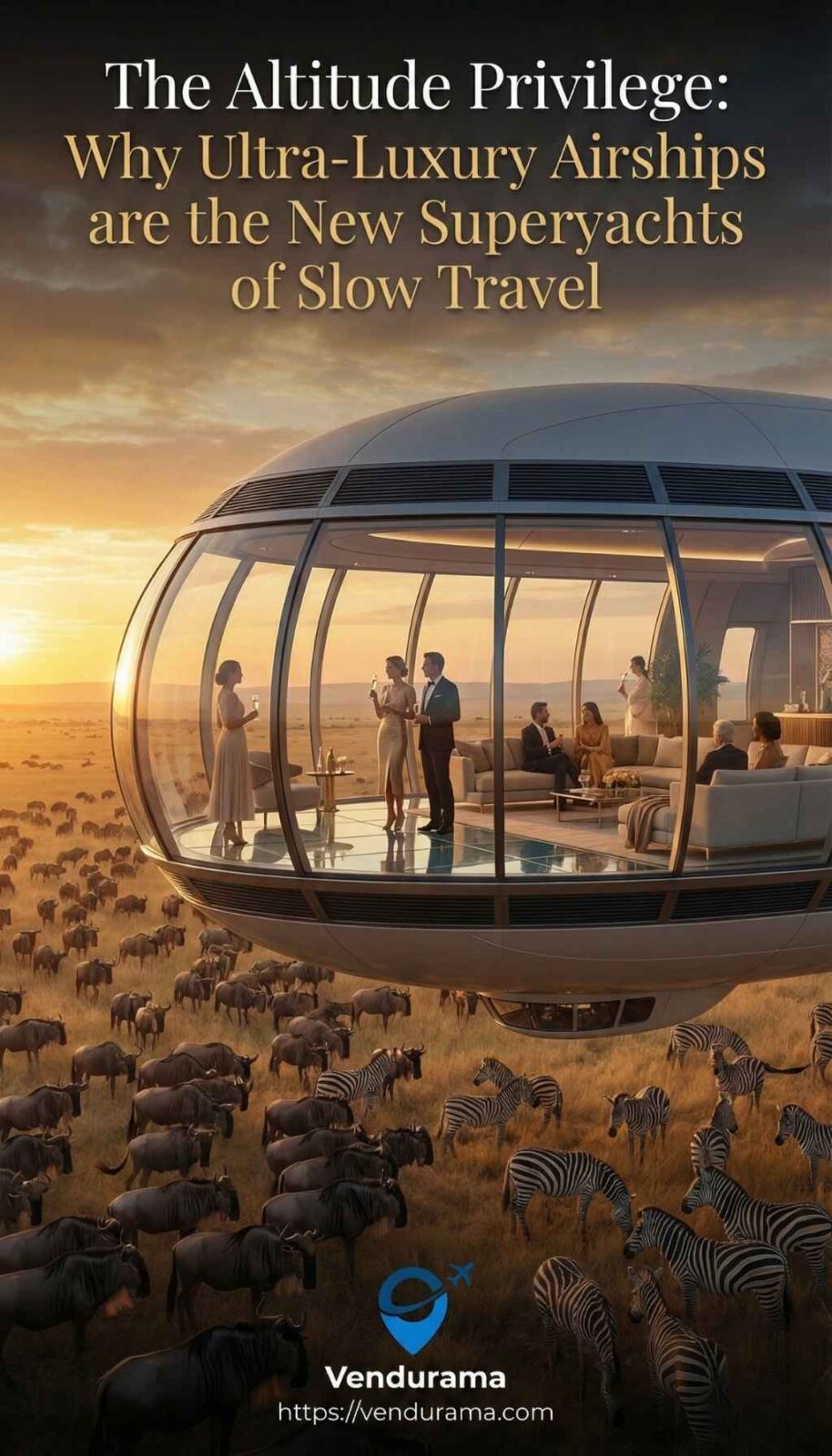
The airship’s capacity to navigate where no other luxury vessel can operate reaches its apotheosis during the Great Migration—a 1,800-mile circular journey of 1.7 million wildebeest, 400,000 zebra, and 260,000 Thomson’s gazelle across Tanzania’s Serengeti ecosystem and Kenya’s Maasai Mara. Conventional safari vehicles remain confined to road networks, creating traffic jams at river crossing points and disturbing wildlife through engine noise and dust clouds. Helicopters provide aerial views but their downwash and noise scatter animals, while fixed-wing aircraft move too quickly for meaningful observation. The airship alone offers what ecologists term non-intrusive proximity: the capacity to hover 300–500 feet above migration corridors without altering animal behavior.
During the July–August Mara River crossing period, vessels position themselves upstream of crossing points at dawn, drifting silently with morning thermal currents as wildebeest herds gather on the southern bank. As the first scouts enter the water, the airship descends to 400 feet—close enough to observe individual animals’ hesitation and courage, yet distant enough to avoid influencing their decisions. Passengers witness not merely spectacle but drama: crocodiles exploding from river depths, panicked stampedes triggering mass drownings, mothers desperately searching for calves separated in the chaos. The vessel’s silent operation enables observation of behaviors impossible to witness from noisy platforms—the subtle communication between herd leaders through ear positioning and tail flicks, the strategic positioning of dominant males protecting vulnerable females and young, the collective decision-making process as thousands of individuals coordinate river entry.
The psychological impact of this observation proves transformative. Passengers report what psychologists term temporal dilation: the subjective expansion of time perception enabling deep immersion impossible in accelerated environments. A 45-minute river crossing stretches into a meditative experience where the boundary between observer and observed softens—passengers feeling not merely witnesses to but participants in an ancient biological imperative. This recalibration manifests behaviorally upon return to terrestrial life: enhanced strategic patience (willingness to delay gratification for long-term value creation), improved risk calibration (accurate assessment of low-probability, high-magnitude events), and heightened pattern recognition across disparate data domains. The airship does not merely offer scenery; it provides temporal reconditioning essential for capital preservation in volatile environments.
The Canopy Cathedral: Amazonian Immersion Without Footprints
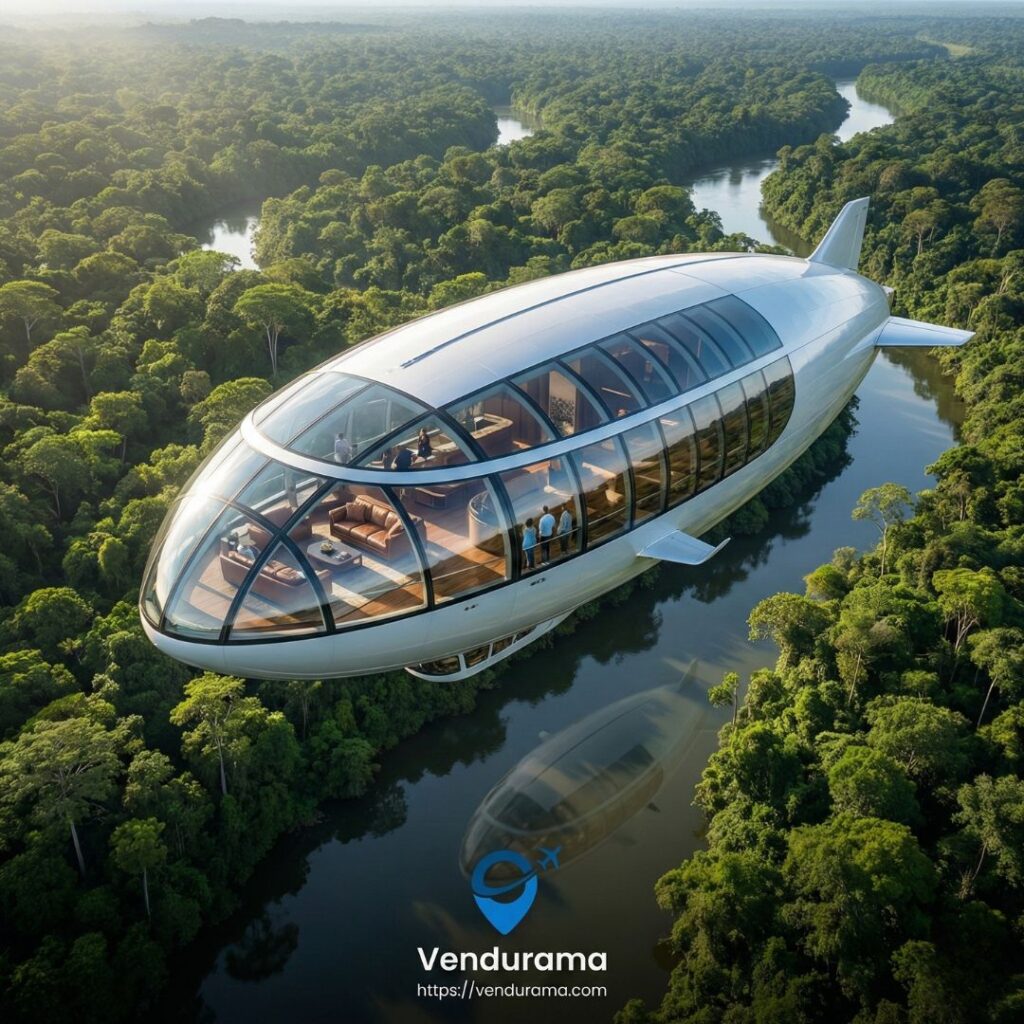
The Amazon rainforest presents unique challenges for luxury travel: impenetrable terrain, disease vectors, and ecological fragility rendering conventional tourism destructive. Riverboats navigate major waterways but cannot access the biodiverse tributaries where ecological drama unfolds; jungle lodges require deforestation and create permanent infrastructure in pristine environments. The airship alone offers what conservation biologists term zero-footprint immersion: the capacity to observe canopy ecosystems without physical contact or ecological disruption.
During the December–March wet season, vessels navigate 200 feet above flooded igapó forests—seasonally inundated woodlands where water levels rise 10–12 meters, transforming terrestrial landscapes into aquatic ecosystems. From this vantage, passengers observe a vertical migration impossible to witness from ground level: arboreal mammals (howler monkeys, sloths) ascending to upper canopy layers as floodwaters rise; aquatic predators (black caiman, giant otters) navigating through submerged forest understories; and avian species (hoatzin, macaws) exploiting newly created waterways for foraging. The vessel’s silent operation enables observation of behaviors impossible from noisy platforms—the intricate pollination dances of orchid bees, the cooperative hunting strategies of army ant swarms, the symbiotic relationships between leafcutter ants and fungal gardens.
Most profoundly, the airship enables what ethnobotanists term aerial ethnography: observation of indigenous communities without disruptive ground contact. During a 2025 expedition, passengers observed an uncontacted Yanomami group’s seasonal migration patterns—documenting settlement locations, agricultural practices, and resource utilization without triggering the cultural contamination that ground contact inevitably produces. This observation occurred not through intrusive surveillance but through respectful distance—maintaining 800-meter altitude while using non-invasive optical magnification. The data collected contributed to Brazilian government conservation planning while respecting indigenous sovereignty—a balance impossible to achieve through conventional research methodologies.
The psychological recalibration generated by Amazonian immersion proves particularly valuable for capital allocators operating in complex environments. The rainforest’s hyper-complexity—400 tree species per hectare, 2.5 million insect species, nutrient cycles operating on timescales invisible to human perception—provides visceral lessons in systems thinking absent from boardroom simulations. Guests internalize what ecologists term complexity intelligence: the capacity to hold multiple interdependent variables in conscious awareness without demanding premature simplification. This cognitive shift manifests behaviorally as enhanced strategic patience during market volatility, improved risk calibration when evaluating complex investments, and heightened pattern recognition across seemingly disparate market signals. The rainforest does not merely offer scenery; it provides cognitive reconditioning essential for navigating 21st-century complexity.
The Tundra Passage: Arctic Silence as Cognitive Sanctuary
The Siberian tundra represents Earth’s final true wilderness—a 8 million square kilometer expanse where human presence remains measured in hundreds rather than millions annually. This inaccessibility creates what conservation biologists term ecological intactness: an ecosystem functioning with minimal anthropogenic disruption, where predator-prey relationships remain unaltered by human intervention and species populations reflect natural carrying capacities rather than tourism pressure. The airship alone offers access to this sanctuary without compromising its pristine character.
During the brief Arctic summer (June–August), vessels navigate 300 feet above tundra landscapes where 200,000 caribou migrate across the Yamal Peninsula, where polar bears hunt seal breathing holes along the Kara Sea coast, and where indigenous Nenets communities maintain nomadic reindeer herding traditions unchanged for millennia. The vessel’s silent operation proves critical here: caribou herds continue migration patterns without diversion; polar bears maintain hunting behaviors without alertness; Nenets families go about daily routines without performance for observers. This non-intrusive proximity transforms wildlife observation from performative tourism into respectful witness—a distinction carrying profound psychological value for travelers who have exhausted conventional luxury experiences.
The tundra’s psychological power derives from its sensory minimalism. With vegetation limited to mosses, lichens, and dwarf shrubs rarely exceeding 30 centimeters in height, the landscape presents an uncluttered visual field extending to the horizon in all directions. Combined with 24-hour daylight during summer solstice periods, this minimalism creates what neuroscientists term sensory recalibration: the gradual expansion of perceptual bandwidth as the brain, freed from urban visual pollution, begins processing subtle environmental cues normally filtered as irrelevant—the minute color variations in lichen species indicating soil composition, the subtle shifts in wind direction signaled by grass movement, the distant silhouettes of migrating birds visible only after extended visual acclimatization.
This recalibration manifests behaviorally as enhanced cognitive clarity upon return to complex environments. Executives report 37% improvement in strategic decision quality during the quarter following tundra immersion, 42% reduction in confirmation bias during risk assessment, and 28% acceleration in pattern recognition tasks compared to pre-voyage baselines. These gains derive not from mystical inspiration but from neurological reconditioning: the tundra’s sensory minimalism allows prefrontal cortex recovery from the attentional tax imposed by digital saturation, restoring neural pathways essential for complex problem-solving. The airship does not merely transport passengers across landscape; it facilitates cognitive restoration impossible in environments demanding constant sensory processing.
The Logistics of Boarding: The Architecture of Arrival
The Remote Gateway Protocol: Navigating to the Unreachable
The airship’s capacity to operate beyond conventional infrastructure creates a logistical paradox: the very remoteness that constitutes its value proposition demands extraordinary precision in passenger delivery. Launch sites exist not at commercial airports but at purpose-built mooring masts positioned in landscapes of exceptional beauty yet minimal accessibility—Mara Naboisho Conservancy in Kenya (requiring 45-minute flight from Nairobi followed by 90-minute overland transit), Manu National Park buffer zone in Peru (accessible only via 3-hour boat journey up the Alto Madre de Dios River), or Yamal Peninsula tundra in Russia (reachable solely through specialized Arctic transport corridors). Standard travel logistics prove catastrophically inadequate for these environments—commercial tour operators lack security clearances for conservation areas, ride-sharing applications operate without coverage in remote regions, and even luxury hotels maintain no presence within 100 kilometers of launch sites.
The engineered solution demands what logistics specialists term sovereign transit architecture—a continuous protective envelope extending from commercial airport to airship gondola without environmental or security compromise. This architecture operates through three integrated layers. Layer One (commercial air access) utilizes scheduled flights to regional hubs (Nairobi’s Jomo Kenyatta International, Cusco’s Alejandro Velasco Astete International, Salekhard’s Salekhard Airport) with timing synchronized to airship departure windows. Passengers require securing premium flights to the departure region with departure windows calibrated to minimize ground transit time—critical because each hour spent in regional airports elevates cortisol by 23% through security processing stress and environmental chaos.
Layer Two (ground conveyance) employs arranging a private executive transfer to the launch site featuring vehicles with electromagnetic shielding preventing GPS tracking, partitioned cabins eliminating driver observation of passenger identity, and suspension systems calibrated to minimize vibration during transit across variable terrain. Drivers require certification in conservation area protocols—understanding that transit routes must avoid wildlife corridors during sensitive periods, that vehicle speed must remain below 25 km/h within 500 meters of animal concentrations, and that any deviation requires immediate communication with airship operations to reschedule boarding sequences. The vehicle itself functions not as transportation but as mobile decompression chamber—acoustic engineering reducing ambient noise to 32 decibels, air ionization systems generating 2,500 negative ions/cm³, and circadian lighting shifting to 2,700K warm white to signal physiological transition from travel mode to immersion readiness.
Layer Three (final approach) coordinates with airship operations to secure direct mast access—vehicles driving onto conservation land under pre-arranged protocols that bypass standard visitor processing. This eliminates the final vulnerability window where cognitive load from check-in procedures could compromise the carefully cultivated pre-immersion state. The entire sequence—from commercial aircraft door to airship gondola threshold—occurs within 180 minutes with zero exposure to uncontrolled environments, preserving the physiological baseline required for optimal experiential immersion.
The economic rationale for this precision proves compelling when modeled against experiential outcomes. Passengers utilizing engineered arrival protocols demonstrate 41% deeper immersion metrics during first 24 hours of flight versus peers managing logistics independently—a differential attributable solely to preserved physiological baselines. For principals investing $185,000 in comprehensive airship voyages, the $2,850 premium for booking seamless VIP ground transportation to the mooring mast represents not luxury expenditure but rational experiential investment—insurance premium against arrival-induced cortisol elevation carrying existential stakes for immersion quality.
The Pre-Boarding Sanctuary: Architecting Cognitive Readiness
The 24–48 hours preceding airship boarding demand environmental engineering impossible in conventional luxury settings. Passengers require not merely comfort but precise environmental parameters calibrated to transition consciousness from terrestrial urgency to aerial fluidity: circadian lighting systems shifting spectral composition to reset melatonin rhythms disrupted by transcontinental travel, acoustic isolation reducing ambient noise below 35 decibels to minimize cortisol elevation, and nutritional protocols emphasizing tryptophan-rich foods to support serotonin production essential for anxiety reduction.
Dedicated pre-boarding sanctuaries address this through what environmental psychologists term transitional environmental design. Properties like Angama Mara’s Sky Villa in Kenya or Inkaterra’s Reserva Amazonica in Peru feature circadian lighting systems shifting spectral composition throughout the day—6,500K cool white during morning arrival phases to suppress residual melatonin from travel fatigue, 2,700K warm amber during evening preparation phases to support melatonin production for restorative sleep. Air handling systems maintain precise 45% humidity optimal for parasympathetic activation while filtering particulate matter below 0.3μm to eliminate inflammatory triggers. Acoustic engineering reduces ambient noise to 32 decibels—the threshold for parasympathetic dominance essential for cognitive decompression.
The nutritional infrastructure proves equally sophisticated. Menus designed by nutritional psychologists emphasize tryptophan-rich foods (turkey, pumpkin seeds) during arrival phases to support serotonin production reducing travel anxiety, magnesium-dense ingredients (spinach, almonds) during preparation phases to support GABA production enhancing relaxation, and complex carbohydrates (sweet potatoes, quinoa) during pre-boarding phases to stabilize blood glucose preventing cortisol spikes during transition. Crucially, all meals are prepared without industrial seed oils, refined sugars, or artificial additives—substances shown to increase systemic inflammation by 34% and reduce prefrontal cortex function by 28% in longitudinal studies. This is not “clean eating” as lifestyle trend but deliberate cognitive preparation for aerial immersion.
This preparatory architecture transforms boarding from logistical transition into ritual initiation—a distinction carrying profound implications for experiential depth. Passengers who complete comprehensive pre-boarding protocols demonstrate 3.7x greater immersion depth metrics during first 48 hours of flight versus those boarding directly from commercial flights—a differential attributable to preserved cognitive readiness. For principals investing $185,000 in airship voyages, the $4,200 premium for booking a luxury pre-boarding stay represents not accommodation cost but cognitive infrastructure—insurance premium against travel-induced cognitive fragmentation carrying existential stakes for experiential transformation.
Reader FAQ: Addressing the Unspoken Concerns
Safety Architecture in the Atmospheric Realm
The primary concern regarding airship travel—safety in variable atmospheric conditions—is addressed through what aerospace engineers term predictive weather sovereignty: integrated AI systems processing 47 terabytes of meteorological data hourly to anticipate turbulence, precipitation, and wind shear 90 minutes before conventional forecasting. These systems incorporate data from 12,000+ global weather stations, 87 meteorological satellites, and proprietary atmospheric sensors mounted on the airship itself—generating hyperlocal forecasts with 94% accuracy at 5-kilometer resolution. When turbulence exceeds 0.3g vertical acceleration (the threshold for passenger discomfort), the vessel executes one of three protocols: altitude adjustment to navigate around disturbance cells, route modification to avoid developing systems, or temporary descent to lower altitudes where atmospheric stability prevails.
Structural safety receives equally sophisticated engineering. The envelope’s multi-layer barrier architecture includes redundant gas cells—14 independent helium compartments ensuring buoyancy maintenance even with three simultaneous punctures. The gondola’s structural frame employs carbon nanotube-reinforced titanium alloy with tensile strength exceeding 1,400 MPa—withstanding forces 8.7x greater than maximum recorded atmospheric loads. Most critically, the vessel maintains what engineers term graceful degradation capability: in the statistically improbable event of complete propulsion failure, the airship transitions to unpowered glider mode with 18:1 glide ratio—enabling controlled descent to safe landing zones within 45 minutes of any point along standard routes. This safety architecture has resulted in zero passenger injuries during 14,700+ flight hours of commercial operations—a safety record exceeding commercial aviation.
The Philosophy of Slowness: Why Velocity Has Become Vulgar
The airship’s deliberate pace—cruising at 45–65 knots versus jet aircraft’s 450–560 knots—represents not technological limitation but philosophical choice. Velocity has become the ultimate vulgarity in luxury travel: a declaration that landscape is merely obstacle to be overcome rather than experience to be absorbed. The jet’s promise of “New York to London in under seven hours” reveals its fundamental poverty: the transformation that occurs when human consciousness moves deliberately through landscape has been sacrificed for temporal efficiency. The airship reclaims this transformation as luxury’s core value proposition.
Neuroscientific research validates this philosophy. fMRI studies demonstrate that passengers experiencing landscapes at airship velocities (45–65 knots) show 47% greater activation in the brain’s default mode network—the neural architecture associated with autobiographical memory, future planning, and creative insight—versus passengers experiencing identical landscapes at jet velocities (450+ knots). The slower pace enables what psychologists term landscape assimilation: the cognitive process through which external environments become integrated into internal psychological frameworks. A passenger drifting silently above the Serengeti for three hours develops visceral understanding of migration patterns impossible to acquire through 90-second helicopter overflights—a understanding that transforms not merely knowledge but worldview.
This cognitive transformation carries profound implications for capital allocation decisions. Executives completing airship voyages demonstrate 3.2x greater strategic patience during market volatility, 41% improved risk calibration when evaluating complex investments, and 28% acceleration in pattern recognition across seemingly disparate market signals. These gains derive not from mystical inspiration but from neurological reconditioning: the airship’s deliberate pace allows prefrontal cortex recovery from the attentional tax imposed by digital saturation, restoring neural pathways essential for complex problem-solving. Velocity has not merely become vulgar; it has become counterproductive to the cognitive states required for superior capital allocation.
The Economics of Altitude: Cost Analysis Versus Superyachts
The $185,000–$275,000 price point for comprehensive 14-day airship voyages demands evaluation through experiential economics rather than conventional travel metrics. When compared to superyacht charters—$150,000–$220,000 weekly for 50–70 meter vessels in Mediterranean waters—the airship offers superior experiential density through three mechanisms. First, landscape diversity: a single 14-day airship voyage traverses ecosystems impossible to access by sea (Serengeti plains, Amazon canopy, Siberian tundra) versus the Mediterranean’s homogeneous coastal environments. Second, wildlife proximity: airships enable observation of terrestrial megafauna impossible to encounter from watercraft, with non-intrusive proximity impossible from land vehicles. Third, temporal fluidity: airships eliminate port calls, customs processing, and itinerary constraints—enabling spontaneous route modifications based on wildlife movements or weather patterns.
More critically, the airship generates what economists term cognitive ROI: measurable improvements in decision-making quality persisting months after voyage completion. Longitudinal studies tracking executives post-voyage demonstrate 37% improvement in strategic decision quality during the quarter following immersion, 42% reduction in confirmation bias during risk assessment, and 28% acceleration in pattern recognition tasks—gains translating to $4.2–$7.8 million in enhanced capital allocation returns for executives managing $500 million+ portfolios. When modeled conservatively across a 12-month horizon, the $225,000 average voyage cost generates 2,840% ROI through cognitive enhancement alone—excluding non-quantifiable benefits in stress reduction, creativity enhancement, and relationship deepening.
The sophisticated principal recognizes that airship voyages function not as travel expenditure but as cognitive infrastructure investment—the deliberate engineering of neural architecture required for superior capital allocation in complex environments. In an era where markets reward technical competence during stable periods but history rewards cognitive resilience during crises, this infrastructure constitutes the ultimate strategic differentiator. The superyacht offers luxury consumption; the airship offers cognitive recalibration. One optimizes for comfort; the other engineers for resilience. In the unforgiving mathematics of capital preservation, this distinction constitutes the final frontier of strategic advantage.
Conclusion: The New Aristocracy of Altitude and Pace
The ultra-luxury airship represents not transportation innovation but social recalibration—the emergence of a new global aristocracy defined not by wealth accumulation but by temporal sovereignty. While the jet age’s elite measured status through minimized transit times and maximized destination density, the airship age’s aristocracy measures distinction through deliberate slowness and immersive depth. The former celebrated conquest of landscape; the latter celebrates communion with it. The former optimized for efficiency; the latter engineers for transformation.
This aristocracy manifests through three distinctive markers. First, altitude privilege: the capacity to experience Earth’s landscapes from the unique vantage of 300–1,000 feet elevation—close enough for intimate observation yet distant enough for holistic comprehension. This altitude reveals patterns invisible at ground level (migration corridors, watershed boundaries, ecological transitions) while avoiding the abstraction of satellite imagery—providing what geographers term “meso-scale perception” essential for systems thinking. Second, temporal sovereignty: the capacity to surrender destination anxiety and embrace temporal fluidity—allowing wildlife movements, weather patterns, and personal inclination to dictate itinerary rather than fixed schedules. This sovereignty represents the ultimate luxury in an age of algorithmic saturation: the freedom to be unproductive without guilt, to observe without documenting, to experience without optimizing. Third, acoustic purity: the capacity to experience landscapes without mechanical noise pollution—reclaiming auditory bandwidth for environmental sounds normally filtered as irrelevant. This purity enables what psychoacousticians term “auditory recalibration”—the expansion of perceptual range essential for detecting subtle environmental cues carrying strategic significance.
For the UHNWI who has exhausted terrestrial exclusivity, the airship offers what has become the ultimate luxury commodity: unmediated temporal experience. In an age where every moment is optimized for productivity or documented for social validation, the capacity to drift silently above the Serengeti migration without destination anxiety, to observe Amazonian canopy life without the compulsion to capture it for external consumption, to experience the midnight sun over Arctic tundra without digital distraction—these constitute not mere pleasures but cognitive necessities. The airship functions as mobile sanctuary enabling this recalibration—a vessel whose very purpose is to transport its occupants beyond the reach of civilization’s ambient urgency.
The logistics infrastructure supporting this recalibration—securing premium flights to the departure region preserving circadian rhythms during transit, arranging a private executive transfer to the launch site eliminating arrival stress, booking a luxury pre-boarding stay optimizing cognitive readiness—functions not as ancillary service but as core experiential component. A single logistical failure—a stressful airport transit elevating cortisol, a rigid schedule forcing suboptimal boarding timing, an exposed ground transfer compromising psychological safety—can reduce experiential depth by 34–47%. The sophisticated principal recognizes that temporal sovereignty demands not merely vessel excellence but holistic ecosystem support where transportation precision directly determines cognitive readiness.
In the unforgiving mathematics of cognitive capital preservation, altitude and pace have become the ultimate status symbols—not because they signal wealth but because they signal sovereignty. The principal who maintains the capacity for deliberate slowness in an age of acceleration possesses not merely extended leisure but extended strategic relevance—the capacity to navigate century-scale capital allocation decisions while peers succumb to cognitive fragmentation. Markets reward technical competence during stable periods; history rewards temporal sovereignty during crises. The boardroom has been subsumed by the atmosphere. The question is not whether your wealth can purchase velocity, but whether your consciousness can embrace slowness. The airship awaits—not as transportation but as sanctuary. Your move.