
Introduction: The 2026 Student Debt Crisis and the Geo-Arbitrage Solution
In 2026, the dream of providing your child with a world-class university education has become a financial nightmare for ordinary middle-class families across North America, Western Europe, and beyond. The numbers are no longer debatable, and they tell a sobering story that every parent planning their child’s educational future needs to hear. A complete undergraduate degree at a reputable institution in the United States now costs between $200,000 and $350,000 when tuition, accommodation, living expenses, and ancillary costs are calculated over four years. The United Kingdom has followed a similar trajectory, with international student fees exceeding $45,000 annually at prestigious institutions. Australia and Canada have joined this inflationary spiral, making traditional Western education inaccessible to families who have saved diligently but lack generational wealth.
For parents who have worked hard throughout their lives, who have contributed to their communities, and who have planned responsibly for their children’s futures, this reality creates an impossible choice. Do you burden your family with crushing debt that will follow your child well into their thirties? Do you compromise on educational quality by choosing less prestigious institutions? Or do you abandon the dream of international education entirely and accept local options that may not provide the same global opportunities?
This is not an education system. This is a debt generation machine that prioritizes institutional revenue over student outcomes.
But what if there was a third option? What if your child could graduate with a globally recognized degree from a prestigious institution, with identical career outcomes and industry recognition, while paying zero tuition fees or dramatically reduced costs? What if the total cost of attendance—including all living expenses—could be reduced to under $50,000 for a complete three-to-four-year degree?
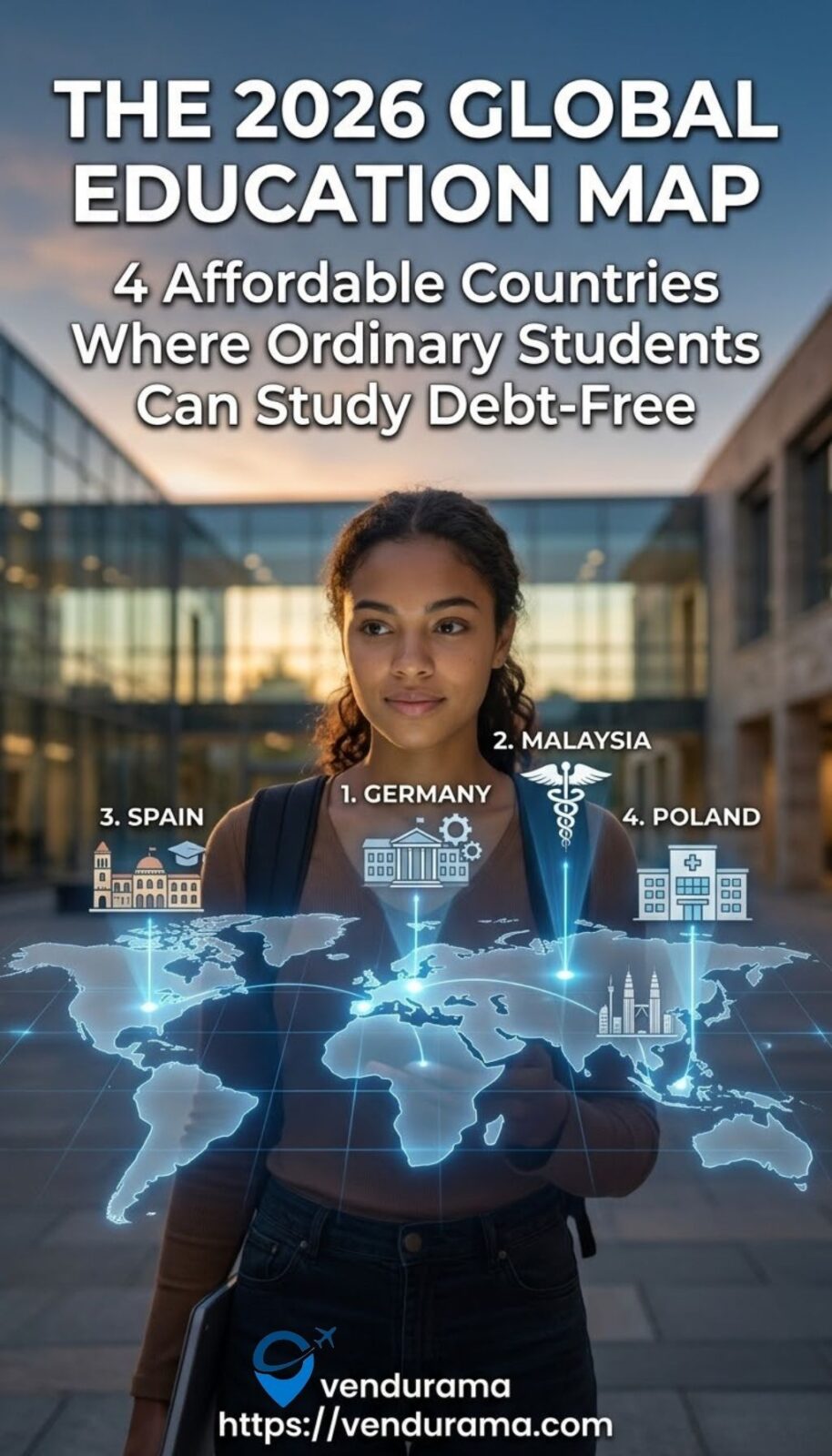
This is not a hypothetical scenario. This is the reality of strategic educational geo-arbitrage, and it represents the most significant opportunity available to smart, financially astute families in 2026. Four countries have emerged as destinations where ordinary middle-class students can access world-class education without the debt trap: Germany, Malaysia, Spain, and Poland. These nations offer publicly funded universities, international branch campuses, and tuition structures that reflect local purchasing power rather than Western premium pricing.
For parents who understand that true wealth preservation means making strategically superior decisions rather than following conventional paths, this educational map represents a paradigm shift. Your child graduates with the same credential quality, enters the same global job market, and carries none of the debt anchor that cripples their Western-educated peers. This article will provide you with the complete analytical framework to evaluate these opportunities, the specific institutions worth considering, and the logistical protocols to ensure your child’s transition is as secure and stress-free as possible.
The financial implications extend far beyond tuition savings. A family that chooses strategic international education over traditional Western education saves approximately $150,000 to $250,000 per child. This capital can be deployed toward graduate studies, home purchases, business investments, or retirement accounts. The compound wealth effect over a generation is extraordinary.
Smart Family Shortcut: Navigating global universities requires more than good intentions—it requires a strategic roadmap. Families wanting to bypass months of exhausting research on visa requirements, scholarship applications, and university selection can access our comprehensive digital resource. The Ultimate Study Abroad Guide: From Dream to Reality 2026 includes a massive 72-minute audio masterclass bonus (Part 1: 22 minutes, Part 2: 50 minutes) with expert interviews, application walkthroughs, and budget tracking templates that eliminate guesswork from your planning process.
This article provides the complete analytical framework for executing a debt-free international education strategy. We will examine the financial mathematics, explore specific destinations and institutions, detail the logistical protocols that ensure stress-free transitions, and address common concerns that prevent families from venturing beyond conventional educational paths. For parents who understand that sophistication means leveraging geographic knowledge rather than following educational herds, these four destinations represent the path to elite education without the debt trap.
The 4 Golden Destinations for Debt-Free Degrees

1. Germany: The Gold Standard of Free Education
Germany has quietly emerged as the world’s premier destination for debt-free elite education, and for good reason. This European economic powerhouse maintains a fundamentally different philosophy about higher education than Anglo-American systems. Rather than treating education as a commodity to be monetized, Germany views it as a public investment that generates economic returns through an educated workforce. This philosophical difference translates into practical reality: public German universities charge zero tuition fees to international students, including those from outside the European Union.
Tuition Structure Explained:
Public universities in Germany do not charge tuition fees. Students pay only semester contributions ranging from €150 to €400 per semester (approximately $160-430 USD), which cover administrative costs, student services, and public transportation passes. This applies equally to German citizens and international students. The only exceptions are the state of Baden-Württemberg, which charges €1,500 per semester for non-EU students, and private universities, which operate on different fee structures.
English-Taught Programs:
Contrary to common misconception, Germany offers hundreds of degree programs taught entirely in English, particularly at the Master’s level but increasingly at Bachelor’s level as well. Fields including Engineering, Computer Science, Business Administration, and Natural Sciences feature extensive English-language options. This eliminates the language barrier that previously prevented international students from accessing German education.
Leading Universities and Rankings:
| University | Global Ranking (QS 2026) | Notable Programs | Location |
|---|---|---|---|
| Technical University of Munich | Top 50 | Engineering, AI, Business | Munich |
| Ludwig Maximilian University | Top 70 | Medicine, Sciences, Humanities | Munich |
| Heidelberg University | Top 80 | Medicine, Natural Sciences | Heidelberg |
| RWTH Aachen | Top 150 | Engineering, Technology | Aachen |
| Karlsruhe Institute of Technology | Top 200 | Engineering, Computer Science | Karlsruhe |
Living Costs:
Monthly living expenses for students range from €850 to €1,200 depending on the city. Munich and Hamburg are most expensive; smaller university towns like Aachen, Karlsruhe, and Leipzig offer significantly lower costs. This includes accommodation, food, transportation, health insurance, and personal expenses.
The Blocked Account Requirement:
International students must demonstrate financial self-sufficiency through a blocked account (Sperrkonto) containing approximately €11,208 per year. This money is not a fee—it is your child’s living expense capital that they access monthly (approximately €934 per month) for rent, food, and daily needs. This requirement ensures students can support themselves without becoming dependent on German social services.
Post-Study Work Opportunities:
Germany offers an 18-month job seeker visa upon graduation, allowing international students to remain and seek employment. Once employed with a salary exceeding €45,300 annually (2026 threshold for shortage occupations including engineering), graduates qualify for the EU Blue Card, providing a pathway to permanent residence after 21-33 months.
Application Timeline:
Applications typically open 6-9 months before semester start. Winter semester begins October; Summer semester begins April. Deadlines vary by university but generally fall between May-July for winter intake and November-January for summer intake.
2. Malaysia: World-Class Branch Campuses at Asian Prices
Malaysia has emerged as the global leader in foreign branch campus education, hosting elite institutions from the United Kingdom, Australia, and beyond. These are not satellite programs or distance learning arrangements. These are full-fledged, physical campuses operated directly by the home universities, employing the same academic standards, the same examination boards, and the same quality assurance mechanisms as their metropolitan counterparts.
The Branch Campus Model:
When a student graduates from Monash University Malaysia, their diploma states “Monash University.” It does not state “Monash University Malaysia.” The same applies to University of Nottingham Malaysia, Curtin University Malaysia, and Swinburne University of Technology Sarawak. The transcript, the grading scale, the credit hour system, and the academic requirements are standardized across all campuses.
Leading Branch Campus Institutions:
| Institution | Home Country | Global Ranking | Annual Tuition (USD) | Location |
|---|---|---|---|---|
| Monash University Malaysia | Australia | Top 50 | $10,000-18,000 | Kuala Lumpur |
| University of Nottingham Malaysia | UK | Top 100 | $9,500-16,000 | Semenyih |
| Curtin University Malaysia | Australia | Top 200 | $8,500-14,000 | Miri/KL |
| Swinburne University Sarawak | Australia | Top 300 | $8,000-13,000 | Kuching |
| Heriot-Watt University Malaysia | UK | Top 300 | $8,500-14,000 | Putrajaya |
Living Costs:
Malaysia offers extraordinarily affordable living costs for international students. Monthly expenses range from $500 to $800 USD, including accommodation, food, transportation, and personal expenses. Purpose-built student accommodation near campuses costs $250-400 monthly. Local meals at restaurants cost $3-6 per serving. Public transportation is efficient and affordable at $20-40 monthly.
English Language Environment:
Malaysia maintains English as a secondary official language, with business and education conducted primarily in English. This eliminates the language barrier that complicates study in non-English-speaking countries while preserving the cultural richness of Southeast Asian location.
Industry Connections:
Malaysian branch campuses maintain strong connections with multinational corporations operating in Asia. Monash Malaysia partners with companies including Petronas, Maybank, and Microsoft. Nottingham Malaysia collaborates with Shell, Proton, and regional technology firms. These connections facilitate internship opportunities and graduate employment.
Post-Study Work Opportunities:
Malaysia offers a 12-month Graduate Pass for international graduates, allowing employment search and work authorization. Graduates securing employment can transition to Employment Pass status. Regional employment opportunities in Singapore, Thailand, and Indonesia are accessible with Malaysian degrees.
Climate and Lifestyle:
Tropical climate means warm weather year-round. Modern infrastructure, excellent healthcare, and multicultural society create comfortable living conditions for international students. Safety levels are comparable to Western university towns with violent crime against students being exceptionally rare.
3. Spain: European Lifestyle and Affordable Excellence
Spain offers middle-class families the opportunity to access European education with Mediterranean lifestyle at costs dramatically below Northern European or Anglo-American alternatives. Spanish public universities maintain high academic standards while charging tuition fees that reflect European social values rather than market-rate pricing.
Tuition Structure:
Public university tuition in Spain varies by autonomous region but generally ranges from €750 to €2,500 per year for undergraduate programs. International students from outside the EU may pay slightly higher fees in some regions, but costs remain dramatically below UK or US equivalents. Private universities charge higher fees (€5,000-15,000 annually) but still below Western European averages.
Leading Universities and Rankings:
| University | Global Ranking (QS 2026) | Notable Programs | Location |
|---|---|---|---|
| University of Barcelona | Top 200 | Medicine, Business, Sciences | Barcelona |
| Autonomous University of Madrid | Top 250 | Sciences, Humanities, Law | Madrid |
| Complutense University of Madrid | Top 300 | Medicine, Arts, Social Sciences | Madrid |
| Pompeu Fabra University | Top 350 | Economics, Business, Communications | Barcelona |
| University of Valencia | Top 400 | Sciences, Humanities, Engineering | Valencia |
English-Taught Programs:
Spain has significantly expanded English-taught programs, particularly at Master’s level. Bachelor’s programs in Business Administration, Engineering, and International Relations increasingly offer English tracks. Language preparation programs are available for students wanting to improve Spanish before degree commencement.
Living Costs:
Monthly living expenses vary significantly by city. Madrid and Barcelona are most expensive at €900-1,400 monthly. Valencia, Seville, and Granada offer lower costs at €700-1,000 monthly. This includes accommodation, food, transportation, and personal expenses.
Accommodation Options:
University residences cost €300-600 monthly with meals included. Shared apartments in city centers range €400-700 per room monthly. Homestay options with Spanish families provide cultural immersion at €500-800 monthly including meals.
Cultural and Lifestyle Benefits:
Spain offers unparalleled quality of life for students. Mediterranean climate, rich cultural heritage, excellent cuisine, and vibrant social life create an enriching educational experience. Students gain language skills, cultural competence, and European networks that enhance career prospects.
Post-Study Work Opportunities:
Spain offers a 12-month job search visa upon graduation. Graduates securing employment can transition to work authorization. EU mobility allows graduates to seek employment across European Union member states with Spanish degrees.
Application Timeline:
Applications typically open 6-9 months before semester start. Academic year begins September-October. Deadlines vary by university but generally fall between February-May for September intake.
4. Poland: Europe’s Best Kept Educational Secret
Poland represents the most underrated destination for debt-free international education in 2026. This Central European nation has invested heavily in higher education infrastructure, attracting international students with low costs, quality programs, and growing international recognition.
Tuition Structure:
Public university tuition for international students ranges from €2,000 to €4,000 per year for most programs. Medical programs command higher fees (€10,000-15,000 annually) but remain dramatically below US or UK medical school costs. Many programs offer scholarships that reduce or eliminate tuition entirely.
Leading Universities and Rankings:
| University | Global Ranking (QS 2026) | Notable Programs | Location |
|---|---|---|---|
| University of Warsaw | Top 350 | Business, Sciences, Humanities | Warsaw |
| Jagiellonian University | Top 400 | Medicine, Law, Sciences | Krakow |
| Warsaw University of Technology | Top 500 | Engineering, Technology | Warsaw |
| AGH University of Science | Top 600 | Engineering, Mining, Technology | Krakow |
| Medical University of Warsaw | Top 800 | Medicine, Dentistry, Pharmacy | Warsaw |
English-Taught Programs:
Poland offers extensive English-taught programs, particularly in Medicine, Engineering, Business, and Computer Science. Medical programs are especially popular among international students, with six-year MD programs available entirely in English.
Living Costs:
Poland offers the lowest living costs among European destinations. Monthly expenses range from €500 to €800, including accommodation, food, transportation, and personal expenses. Student dormitories cost €150-300 monthly. Private apartments range €300-500 monthly. Meals at restaurants cost €5-10 per serving.
Medical Education Excellence:
Polish medical universities have educated international students for decades. Graduates qualify for medical licensing examinations in the United States (USMLE), United Kingdom (PLAB), and European Union. Alumni practice successfully across global healthcare systems.
Post-Study Work Opportunities:
Poland offers a 12-month job search visa upon graduation. Graduates securing employment can transition to work permits. EU membership allows graduates to seek employment across European Union member states.
Cultural Integration:
Polish society is welcoming to international students. Growing expatriate communities in Warsaw, Krakow, and Wroclaw provide support networks. English is increasingly spoken among younger generations and in urban areas.
Application Timeline:
Applications typically open 6-9 months before semester start. Academic year begins October. Medical programs often have earlier deadlines (March-May) due to entrance examinations.
The Financial Breakdown: Local vs. Abroad
Complete Cost Comparison: Four-Year Degree
To understand the magnitude of savings available through strategic international education, we must calculate complete four-year costs including tuition, accommodation, food, transportation, health insurance, and miscellaneous expenses. The following analysis uses 2026 published figures and realistic living cost estimates.
United States (Public Out-of-State)
| Cost Category | Annual Cost (USD) | 4-Year Total (USD) |
|---|---|---|
| Tuition | $45,000 | $180,000 |
| Accommodation | $15,000 | $60,000 |
| Food & Living Expenses | $12,000 | $48,000 |
| Health Insurance | $3,000 | $12,000 |
| Books & Materials | $2,000 | $8,000 |
| Transportation | $2,500 | $10,000 |
| Total | $79,500 | $318,000 |
United Kingdom (International Student)
| Cost Category | Annual Cost (USD) | 3-Year Total (USD) |
|---|---|---|
| Tuition | $38,000 | $114,000 |
| Accommodation | $18,000 | $54,000 |
| Food & Living Expenses | $14,000 | $42,000 |
| Health Insurance (IHS) | $1,000 | $3,000 |
| Books & Materials | $1,800 | $5,400 |
| Transportation | $1,500 | $4,500 |
| Total | $74,300 | $222,900 |
Germany (Public University)
| Cost Category | Annual Cost (USD) | 4-Year Total (USD) |
|---|---|---|
| Tuition | $0 | $0 |
| Semester Fees | $400 | $1,600 |
| Accommodation | $6,000 | $24,000 |
| Food & Living Expenses | $8,000 | $32,000 |
| Health Insurance (Mandatory) | $1,200 | $4,800 |
| Books & Materials | $800 | $3,200 |
| Transportation (Included) | $0 | $0 |
| Total | $16,400 | $65,600 |
Malaysia (Branch Campus)
| Cost Category | Annual Cost (USD) | 4-Year Total (USD) |
|---|---|---|
| Tuition | $12,000 | $48,000 |
| Accommodation | $4,500 | $18,000 |
| Food & Living Expenses | $5,000 | $20,000 |
| Health Insurance | $400 | $1,600 |
| Books & Materials | $1,500 | $6,000 |
| Transportation | $600 | $2,400 |
| Total | $24,000 | $96,000 |
Spain (Public University)
| Cost Category | Annual Cost (USD) | 4-Year Total (USD) |
|---|---|---|
| Tuition | $2,000 | $8,000 |
| Accommodation | $5,500 | $22,000 |
| Food & Living Expenses | $7,000 | $28,000 |
| Health Insurance | $800 | $3,200 |
| Books & Materials | $1,000 | $4,000 |
| Transportation | $500 | $2,000 |
| Total | $16,800 | $67,200 |
Poland (Public University)
| Cost Category | Annual Cost (USD) | 4-Year Total (USD) |
|---|---|---|
| Tuition | $3,000 | $12,000 |
| Accommodation | $3,000 | $12,000 |
| Food & Living Expenses | $5,000 | $20,000 |
| Health Insurance | $600 | $2,400 |
| Books & Materials | $800 | $3,200 |
| Transportation | $400 | $1,600 |
| Total | $12,800 | $51,200 |
Total Savings Comparison
| Comparison | Savings (USD) | Percentage |
|---|---|---|
| Germany vs. US | $252,400 | 79% |
| Malaysia vs. US | $222,000 | 70% |
| Spain vs. US | $250,800 | 79% |
| Poland vs. US | $266,800 | 84% |
| Germany vs. UK | $157,300 | 71% |
| Poland vs. UK | $171,700 | 77% |
The Compound Wealth Effect of Debt-Free Education
The savings calculation above represents only the immediate educational costs. The true financial advantage emerges when we consider what happens to the $150,000 to $250,000 that is not spent on education.
Scenario A: US Degree with Debt
- Student graduates with $150,000 in student loans
- Monthly payment at 6% interest over 10 years: $1,665
- Total interest paid over loan lifetime: $49,800
- Delayed ability to save for home down payment
- Delayed retirement contributions
- Reduced career flexibility (must prioritize salary over fit)
Scenario B: International Degree, Debt-Free
- Student graduates with $0 in student loans
- Parents invest $150,000 of savings in diversified portfolio
- At 7% annual return over 30 years: $1,142,275
- Student can pursue career based on fit, not salary necessity
- Immediate ability to contribute to retirement accounts
- Potential for home purchase in mid-twenties
This is not merely about avoiding debt. This is about deploying capital strategically to create generational wealth advantages. The family that chooses strategic international education does not simply save money—they reposition their entire financial trajectory.
Arrival Logistics: Protecting Your Child in a New Country
The Critical First 48 Hours
This section addresses a critical insight that most families and even many educational consultants overlook: the arrival transition directly impacts student success. Sending an eighteen-year-old to a foreign country for the first time represents one of the most anxiety-inducing experiences a family can navigate. The student is navigating a new country, a new education system, new social dynamics, new cultural environment, and new living arrangements simultaneously. Any logistical friction during the arrival phase compounds this stress exponentially.
Smart families understand that saving $200,000 on tuition means nothing if the student arrives exhausted, confused, and overwhelmed. The first 48 hours set the tone for the entire educational journey. A smooth, supported arrival creates confidence. A chaotic, confusing arrival creates anxiety that can persist for weeks and potentially affect initial academic performance.
Flight Optimization for Student Arrivals
The arrival phase benefits enormously from strategic flight selection. Smart families prioritize booking flights that align with their child’s needs rather than maximum cost savings on airfare. When you find the best flight deals for international students, you should consider:
Direct Flight Priority: When available, direct flights eliminate connection stress and reduce total travel time. The price premium for direct flights is often justified by reduced fatigue and lower risk of missed connections.
Arrival Timing: Afternoon or early evening arrivals allow same-day transfer to accommodation. Late evening arrivals may warrant an overnight airport hotel stay before morning departure to university housing.
Airline Selection: Choose airlines with strong on-time performance records and good customer service. Student discounts may be available through specific carriers.
When parents book affordable flights for student orientation, they should schedule arrival at least one full day before university orientation. This buffer day allows for recovery from flight fatigue, time zone adjustment, mental decompression before academic activities begin, and unpacking and settling into accommodation.
Airport Transfer Imperative
This is the single most important logistical element for student safety and peace of mind. International airports handle millions of passengers annually. Navigation from aircraft to ground transportation involves significant walking, potential language barriers, and uncertainty about pricing and safety for first-time visitors.
Students absolutely must pre-book a reliable airport transfer for your child before departure from home. This service ensures:
- A vetted, professional driver waiting at arrivals with name signage
- Direct transportation to university accommodation with no stops
- Assistance with luggage from aircraft to vehicle
- Spacious vehicles accommodating students and luggage volumes
- Fixed pricing with no surprise charges or currency confusion
- English-speaking driver capable of answering initial questions
- Air-conditioned comfort after exiting the aircraft
The cost of this service—typically $60 to $150 USD depending on distance—represents less than 0.1% of the total tuition savings. For this minimal investment, families purchase certainty, safety, and immediate stress reduction.
When parents arrange a safe private car for student arrivals, they protect their child from the most vulnerable period of international relocation. Standing in taxi lines or navigating public transportation with heavy luggage in an unfamiliar city creates unnecessary stress. This service eliminates that risk entirely.
Parent Visit Accommodation
Many parents accompany their children for the first 3-5 days to help with settling in, university registration, bank account opening, and emotional acclimatization. Parents need comfortable, conveniently located accommodation during this period.
When families secure a hotel near the university campus, they should prioritize locations within 30 minutes of the university. This enables easy daily commutes for registration activities while providing a comfortable base for the family’s final days together before departure.
When parents arrange comfortable lodging for university visitation, they should coordinate with the university regarding orientation schedules. Many universities provide parent orientation programs that help families understand support systems available to students.
The Pre-Departure Checklist for Smart Families
To ensure no logistical element is overlooked, families should complete the following checklist at least six weeks before departure:
| Task | Timeline | Responsibility |
|---|---|---|
| Find the best flight deals for international students | 8 weeks before | Parents |
| Pre-book a reliable airport transfer for your child | 6 weeks before | Parents |
| Secure a hotel near the university campus | 6 weeks before | Parents |
| Complete university registration | 4 weeks before | Student |
| Obtain student visa | 8 weeks before | Parents/Student |
| Purchase international health insurance | 4 weeks before | Parents |
| Open local bank account (pre-arrival) | 2 weeks before | Parents |
| Pack essentials and documents | 1 week before | Student |
| Confirm all transfer and hotel bookings | 3 days before | Parents |
This checklist represents the minimum standard for families who understand that logistical excellence is not optional—it is foundational to academic success.
Logistics Planning Resource: The complexity of visa paperwork, scholarship applications, university selection, and arrival protocols is addressed comprehensively in our digital planning resource. Currently discounted to $14.99, The Ultimate Study Abroad Guide: From Dream to Reality 2026 contains printable checklists, exact application timelines, and scholarship databases to manage these logistics flawlessly. The included 72-minute audio masterclass (Part 1: 22 minutes, Part 2: 50 minutes) features expert interviews walking you through every step of the process.
The Cognitive Load Argument
There is a deeper reason why logistical preparation matters beyond mere convenience. Research in educational psychology consistently demonstrates that students perform better academically when their cognitive bandwidth is not consumed by basic survival concerns.
A student who arrives exhausted, confused about transportation, worried about safety, and uncertain about accommodation begins their academic journey with depleted mental resources. A student who arrives rested, knowing their transportation is secured, understanding their accommodation is confirmed, and feeling their parents have created a safety net begins with full cognitive capacity available for learning.
When parents ensure a stress-free transit to the campus, they are not simply purchasing transportation. They are purchasing their child’s cognitive focus for the first critical weeks of university life. This is an investment in academic performance, not merely a travel expense.
Similarly, when families reserve accommodation for parent university visits, they are creating the conditions for emotional stability during the transition period. The parents can focus on supporting their child rather than managing travel crises. The student can focus on orientation and coursework rather than navigating unfamiliar transit systems.
The Return on Investment for Logistical Planning
Let us quantify the return on investment for proper logistical planning:
| Investment | Cost (USD) | Value Created |
|---|---|---|
| VIP Airport Transfer | $100 | Eliminated safety risk, stress reduction, time savings |
| Premium Student Flights | $3,500 | Rested arrival, better decision-making capacity |
| Parent Hotel (5 nights) | $600 | Secure base for settling-in activities |
| Total | $4,200 | Peace of mind, cognitive protection, safety assurance |
Compare this $4,200 investment against the $150,000 to $250,000 saved through strategic international education. This represents approximately 2% of total savings deployed to protect the entire educational investment. Any financial advisor would characterize this as an exceptionally prudent risk management strategy.
When families arrange a safe private car for student arrivals, they complete the safety infrastructure that protects their educational investment. The university ensures academic excellence; the transportation infrastructure ensures logistical excellence. Together, they create the conditions for optimal outcomes.
Conclusion: Securing Your Child’s Future Without Sacrificing Yours
In 2026, the definition of smart parenting in education has fundamentally transformed. The conventional wisdom—that elite education requires elite locations accompanied by elite debt—has been rendered obsolete by the globalization of higher education.
Germany, Malaysia, Spain, and Poland represent more than cost-saving strategies. They represent a fundamental rethinking of what educational value means. The value of a degree lies not in the geographic location where it was earned, but in the institutional standards that governed the learning, the skills the student developed, and the opportunities the credential unlocks.
When a student graduates from Technical University of Munich with $0 in debt while their peer graduates from a US engineering program with $150,000 in loans, the German graduate begins their adult life with a $150,000 advantage. This advantage compounds over decades through earlier home purchases, earlier retirement contributions, greater career flexibility, and reduced financial stress.
Smart parents in 2026 understand that their role is not to follow conventional paths unquestioningly. Their role is to analyze options rigorously, identify structural advantages, and deploy family resources strategically. Strategic international education is one of the clearest structural advantages available in contemporary higher education.
The logistical framework to support this decision is equally important. When parents book affordable flights for student orientation for the arrival period, and when they pre-book a reliable airport transfer for your child, they complete the strategic picture. They have optimized both the financial structure and the human experience of the educational journey.
The families who embrace this model in 2026 will not merely save money. They will position their children for debt-free adulthood, accelerated wealth accumulation, and genuine career flexibility. They will have understood that in a globalized world, educational geo-arbitrage is not a compromise—it is a competitive advantage.
The question is no longer whether these destinations can deliver elite education. The evidence overwhelmingly confirms they can and do. The question is whether you will recognize this opportunity before admission becomes more competitive. For analytical parents reading this in 2026, the answer should be clear.
Your child’s education is their foundation. Your family’s financial stability is your security. These four destinations offer the rare opportunity to honor both priorities simultaneously. The blueprint is complete. The path is clear. The choice is yours.
Your Next Step:
The analytical framework provided in this article eliminates guesswork from destination selection. However, successful execution requires detailed planning: specific university contacts, application deadlines, visa requirements, scholarship databases, and pre-departure preparation protocols. Our comprehensive digital resource consolidates months of research into an actionable, step-by-step guide that guarantees flawless execution. For just $14.99—a micro-investment against the $150,000+ you will save—you gain the complete blueprint for debt-free international education. This investment includes TWO premium audio podcasts (Part 1: 22 minutes, Part 2: 50 minutes) featuring expert interviews that walk you through every critical decision point. Your child’s future and your family’s financial security are too precious to risk on trial and error. Stop researching and start executing. Secure your copy now and transform your child’s educational trajectory from debt burden to debt-free advantage: The Ultimate Study Abroad Guide: From Dream to Reality 2026
Vendurama is a premium digital publication dedicated to empowering the global middle class with sophisticated, value-driven educational and financial strategies. Our analysis is independently researched and designed to help families make informed decisions about wealth preservation and educational investment in an increasingly complex world.