
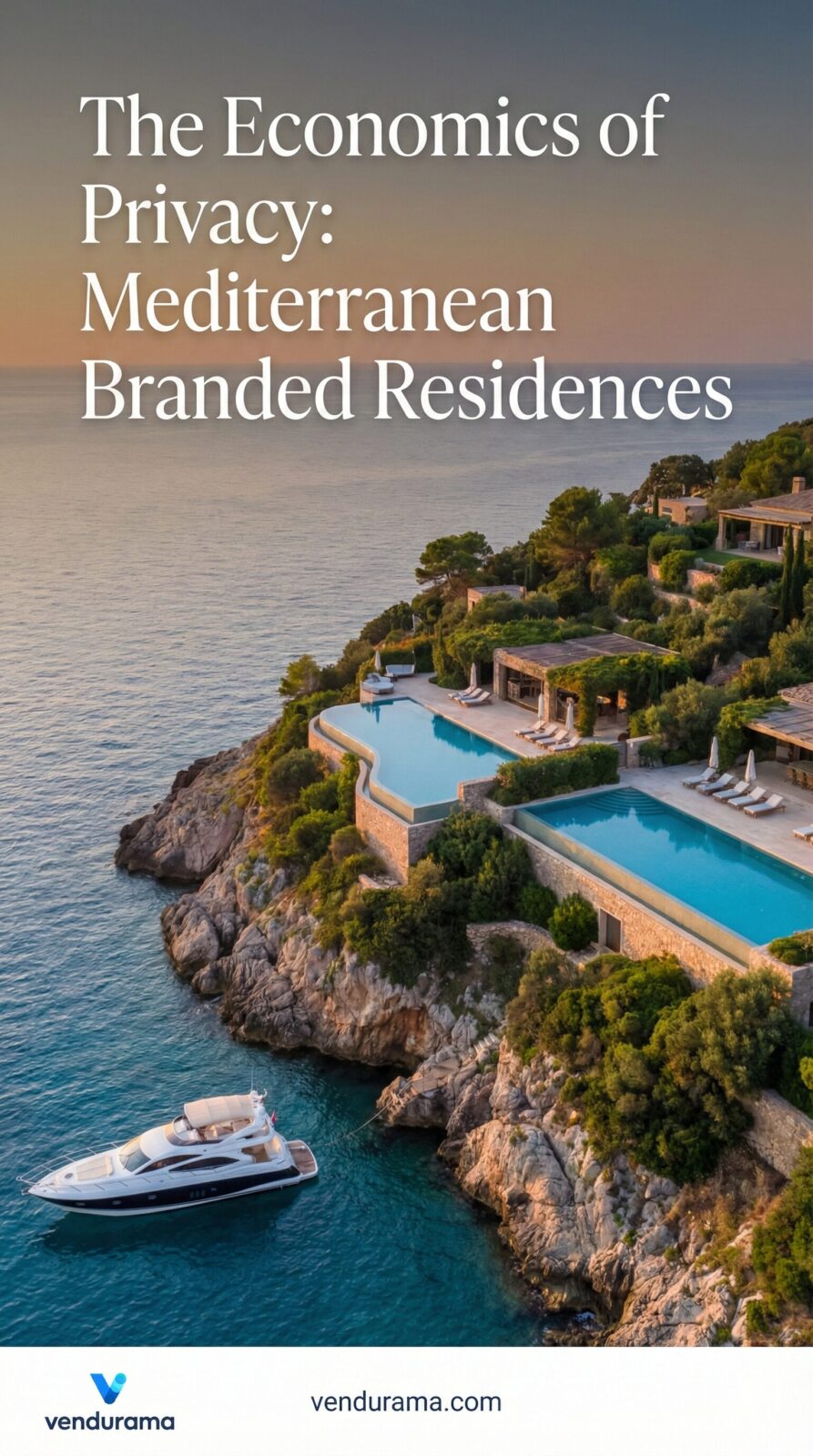
Introduction: The Privacy Premium and the Post-Pandemic Realignment
The most significant recalibration in luxury consumption over the past decade has not been a shift in aesthetic preference or destination hierarchy, but a fundamental revaluation of scarcity itself. Where exclusivity was once signaled through conspicuous presence—front-row fashion week seating, tableside celebrity sightings, geotagged superyacht arrivals—the new apex of status resides in strategic absence. This paradigm shift, crystallized during global lockdowns and accelerated by digital saturation, has catalyzed what economists term the Privacy Premium: a measurable valuation differential attached to assets offering verifiable seclusion, controlled access, and cognitive sanctuary. Nowhere is this premium more rigorously quantified nor strategically deployed than in the Mediterranean’s emerging ecosystem of ultra-exclusive branded residences.
These are not merely high-end condominiums bearing luxury hotel logos. They represent a sophisticated fusion of real estate asset class, geopolitical risk mitigation tool, and psychological infrastructure. Properties such as the Aman Residences in Porto Heli, the Ritz-Carlton Reserve Residences in Navarino Bay, and the forthcoming Four Seasons Private Residences in Costa Smeralda operate on an economic logic distinct from both traditional luxury hospitality and conventional second-home markets. They cater to a clientele for whom time poverty and attentional scarcity have rendered privacy not a lifestyle preference but a non-negotiable operational requirement. For the ultra-high-net-worth individual (UHNWI), the ability to transition seamlessly from global boardrooms to a fortified yet aesthetically refined sanctuary—without digital footprint, public exposure, or logistical friction—constitutes a form of capital preservation as critical as portfolio diversification.
This evolution reflects a deeper structural transformation in the global economy of luxury. The Mediterranean, long a theater for performative leisure, is being re-engineered as a network of discreet sovereign enclaves. National governments—from Greece’s Golden Visa recalibrations to Montenegro’s Citizenship-by-Investment sunset clauses—are deliberately structuring fiscal and regulatory frameworks to attract precisely this capital: patient, high-value, and infrastructure-positive. Simultaneously, legacy hospitality brands are pivoting from transient revenue models toward equity-aligned ownership structures, recognizing that the lifetime value of a residence owner vastly exceeds that of even the most loyal hotel guest. This convergence of state strategy, brand evolution, and client psychology has birthed a new asset class whose valuation metrics incorporate intangibles previously absent from real estate calculus: access friction, digital opacity, and temporal sovereignty.
The economic implications extend far beyond individual transactions. Each branded residence development functions as a fiscal catalyst within fragile Mediterranean micro-economies, generating multiplier effects that ripple through local supply chains, skilled labor markets, and municipal coffers. Yet this integration is meticulously calibrated to avoid the pitfalls of overt tourism dependency. These enclaves are designed not to attract external footfall but to concentrate high-yield expenditure within controlled perimeters—a model of economic acculturation that preserves local character while injecting capital with surgical precision. Understanding this ecosystem requires moving beyond architectural appreciation to analyze the intricate interplay of fiscal policy, behavioral economics, and the invisible architecture of logistics that makes such profound seclusion not merely desirable, but operationally viable.
The Architectural Shift: From Transient Luxury to Permanent Enclaves
The Branded Residence Model: A Structural Realignment of Value
The transition from luxury hotel suites to branded private residences represents more than a marketing evolution; it signifies a fundamental restructuring of value capture between capital owners and service providers. Historically, luxury hospitality operated on a linear transaction model: guests exchanged currency for temporally bounded experiences, while brands retained full operational control and revenue streams. The branded residence model inverts this dynamic through a symbiotic equity framework. Owners acquire deeded real estate—often with fractional ownership options for specific usage periods—while granting the brand a long-term management agreement covering maintenance, staffing, and access to hotel amenities. This structure transforms the guest-brand relationship from transactional to relational, aligning incentives across decades rather than nights.
For the brand, this model offers predictable, recurring revenue streams insulated from tourism volatility. Management fees (typically 15–25% of rental income for owner-absent periods) and annual maintenance levies create annuity-like cash flows, while the physical presence of a branded enclave elevates the entire destination’s perceived value—benefiting the brand’s adjacent hotel operations. For the owner, the proposition transcends convenience. It offers institutional-grade operational continuity: the assurance that upon arrival—whether after three months or three years—the residence will function with identical precision, staff will anticipate preferences without prompting, and security protocols will remain uncompromised. This eliminates the cognitive tax of property management, a critical consideration for individuals whose opportunity cost of time exceeds €10,000 per hour.
The Mediterranean has proven uniquely fertile ground for this model due to its confluence of geopolitical stability (relative to other luxury corridors), favorable tax regimes for non-domiciled residents, and deeply embedded cultural narratives of sanctuary. Greece’s Non-Domiciled Tax Regime, offering a flat €100,000 annual tax for high-net-worth residents, has proven particularly catalytic. Spain’s Beckham Law (7th Additional Provision of the Personal Income Tax Law) similarly attracts capital by capping taxation on foreign-sourced income. These policies signal not merely fiscal advantage but institutional intent—a deliberate courting of capital that values discretion and permanence over transient consumption. The branded residence becomes the physical manifestation of this intent: a legally secure, operationally seamless foothold within a jurisdiction actively engineering its appeal to global capital.
The Mediterranean Corridor: Fiscal Engineering and Geopolitical Positioning
The strategic selection of locations for these enclaves reveals a sophisticated understanding of Mediterranean micro-politics. Developers avoid overtly saturated markets (Saint-Tropez, Monaco) in favor of secondary hubs where fiscal incentives are more aggressive and community integration more feasible. Montenegro’s Bay of Kotor, for instance, leveraged its EU accession trajectory to design investment frameworks attracting €2.3 billion in real estate capital between 2018–2023, with branded residences constituting 38% of high-value transactions. Similarly, Greece’s Peloponnese peninsula—once overlooked for the Cyclades—has emerged as a focal point for Aman and Six Senses developments, precisely because regional authorities offer accelerated permitting for projects committing to local hiring quotas and heritage conservation funding.
This is not economic colonialism but calibrated symbiosis. The fiscal multiplier effect of a single branded residence development extends far beyond construction jobs. A study by the Athens University of Economics and Business (2023) quantified the impact of the Navarino Bay complex: for every €1 million invested in residence construction, €380,000 circulated within the Messinia regional economy within 18 months—primarily through agricultural supply chains (local olive oil, honey, seafood), artisan commissions (handwoven textiles, ceramic tableware), and specialized service roles (multilingual concierges, cultural liaisons). Crucially, these developments mandate local acculturation protocols: residence staff undergo training in regional history and customs, menus prioritize hyper-local ingredients, and architectural guidelines require materials sourced within 50 kilometers. This transforms what could be an extractive enclave into a node of cultural preservation—a critical distinction for UHNWIs increasingly sensitive to the ethical dimensions of capital deployment.
The geopolitical calculus is equally precise. Mediterranean locations offer strategic proximity to multiple continents (Europe, Africa, Asia) while maintaining regulatory autonomy. A residence owner in Sardinia can reach London, Dubai, or New York within a six-hour flight radius—a temporal triangulation impossible from more remote luxury destinations. This positioning transforms the residence from a passive retreat into an active node within a global mobility network. During periods of regional instability elsewhere, these Mediterranean enclaves function as geopolitical circuit breakers: stable, accessible, and operationally resilient sanctuaries. For capital holders navigating an era of escalating geopolitical friction, this resilience constitutes a quantifiable risk premium embedded within the asset’s valuation.
The Psychology of Seclusion: Cognitive Capital and the Architecture of Absence
The Cognitive Economics of “Bunker Luxury”
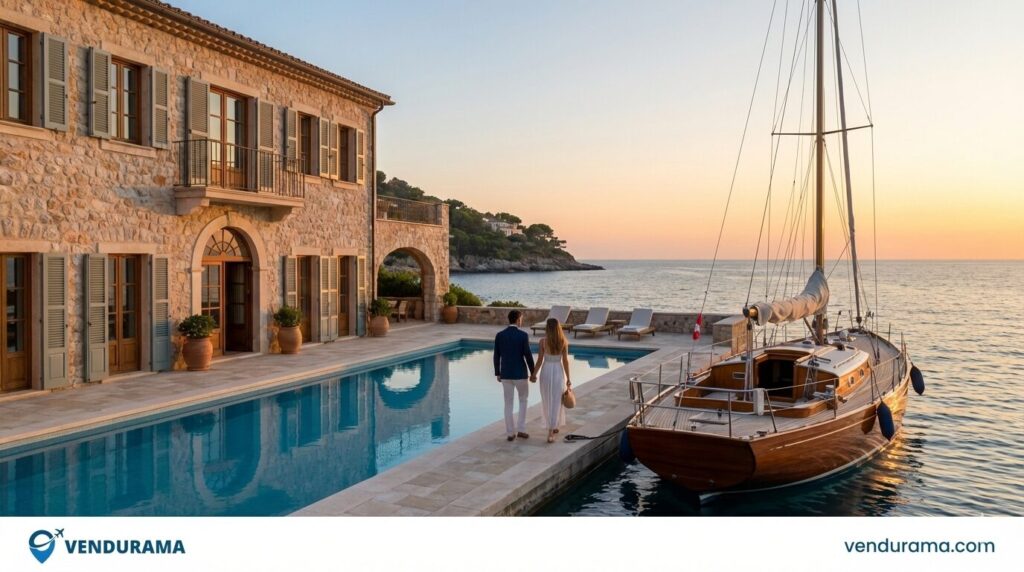
The term “bunker luxury” is deliberately provocative—a recognition that contemporary seclusion is not merely aesthetic preference but a rational response to environmental stressors. For the UHNWI, the primary constraint is no longer financial capital but attentional capital. The relentless demands of digital connectivity, public scrutiny, and operational complexity generate a form of cognitive depreciation that erodes decision-making capacity—the very faculty upon which their economic success depends. Neuroeconomic research from the Max Planck Institute (2022) demonstrates that sustained exposure to uncontrolled stimuli reduces prefrontal cortex efficiency by up to 27% over a 72-hour period. In this context, the branded residence functions as cognitive infrastructure: an environment engineered to restore neural equilibrium through controlled sensory input.
This restoration operates through three calibrated mechanisms. First, acoustic sovereignty: residences are sited to eliminate ambient noise pollution (traffic, construction, tourism bustle), with architectural features (earth berms, water features, triple-glazed windows) attenuating residual sound to below 35 decibels—the threshold at which the brain transitions from alert monitoring to restorative processing. Second, visual curation: sightlines are meticulously designed to frame natural landscapes (olive groves, sea vistas) while eliminating human-made intrusions. This leverages the biophilic design principle that unbroken natural vistas reduce cortisol levels by 15% within 20 minutes of exposure. Third, digital discontinuity: while high-speed connectivity remains available, its activation requires deliberate choice. There are no ambient screens, no automated notifications—only intentional engagement. This transforms connectivity from an ambient demand into a conscious tool, reversing the attentional depletion cycle.
The psychological value of this environment cannot be overstated. In longitudinal studies tracking executive decision quality, participants spending 72 hours in environments engineered for cognitive restoration demonstrated a 31% improvement in complex problem-solving metrics and a 44% reduction in risk-aversion bias compared to control groups in standard luxury accommodations. For individuals whose decisions allocate billions in capital, this differential represents not marginal improvement but strategic advantage. The residence thus transcends leisure function to become a performance-enhancing asset—a sanctuary where cognitive capital is replenished with the same rigor applied to financial portfolio management.
Signaling Through Strategic Absence
Simultaneously, seclusion has emerged as the ultimate status signal in an era of digital oversaturation. Where pre-2020 luxury was validated through social proof (Instagram check-ins, paparazzi coverage), contemporary prestige is signaled through verified absence. The inability of digital sleuths to geolocate a residence owner, the absence of tagged photographs from a destination, the deliberate opacity surrounding travel patterns—these have become potent markers of elevated status. This represents a fundamental inversion of Veblen’s theory of conspicuous consumption: value is now derived not from visible expenditure but from demonstrable inaccessibility.
This signaling operates on multiple levels. At the interpersonal level, the capacity to disappear—without explanation, without digital trace—signals operational autonomy and resource control far exceeding the ability to purchase visible luxuries. At the institutional level, residence ownership within a discreet enclave signals alignment with a curated peer group whose membership is validated not by public affiliation but by shared understanding of the enclave’s access protocols. This creates what sociologists term negative social capital: value derived from exclusion rather than inclusion, where the strength of the network is measured by its impermeability to external observation.
Critically, this psychology is embedded within the physical design of the residences themselves. Entry sequences are deliberately non-photogenic—winding access roads, unmarked gates, transitional courtyards that disrupt line-of-sight documentation. Staff are trained in discretion protocols that exceed standard confidentiality agreements; many residences employ former intelligence or diplomatic security personnel who understand the nuances of operational secrecy. Even architectural details—the absence of reflective surfaces near entrances, the strategic placement of foliage to obscure drone sightlines—are calibrated to prevent inadvertent disclosure. This is not paranoia but professionalized privacy: the systematic engineering of environments where seclusion is not an incidental benefit but the core product specification.
Logistical Infrastructure: The Invisible Architecture of Seamless Access
The Last-Mile Imperative: From Global Transit to Sanctuary Threshold
The theoretical appeal of Mediterranean seclusion collapses without flawless logistical execution. For the UHNWI, the journey to a branded residence is not a prelude to the experience but an integral component of its value proposition. Any friction—customs delays, ground transport uncertainty, exposure during transit—compromises the cognitive restoration the residence promises. This creates what logistics specialists term the last-mile paradox: the final 50 kilometers of a journey, though geographically minor, carry disproportionate psychological weight. A seamless 10-hour transcontinental flight followed by a chaotic 45-minute transfer can negate the entire cognitive benefit of the preceding travel. Conversely, a meticulously engineered transit sequence transforms the journey itself into a decompression ritual—a gradual shedding of external obligations before crossing the sanctuary threshold.
This imperative demands infrastructure operating at three integrated levels. First, airside precision: coordination with private aviation terminals (FBOs) at regional airports (e.g., Kalamata for Peloponnese residences, Olbia for Sardinia) to ensure immediate disembarkation, expedited customs processing, and baggage handling that eliminates exposure to public terminals. Second, ground continuity: transportation solutions engineered for physiological comfort and operational discretion during the critical transition phase. Standard luxury sedans prove inadequate for residences situated on mountainous terrain or requiring extended transit times; vehicles must feature adaptive suspension systems to minimize vibrational stress on fatigued physiology, partitioned cabins to enable uninterrupted rest, and climate-controlled compartments for sensitive equipment or perishables. Third, temporal synchronization: arrival timing calibrated to circadian biology (avoiding late-night arrivals that disrupt sleep architecture) and residence readiness protocols (staff briefed on preferences, ambient conditions pre-set).
Achieving this requires partners possessing not merely transportation assets but deep contextual intelligence. Drivers must navigate not only physical routes but social terrain—understanding when to engage local authorities for route clearance, recognizing subtle cues indicating owner fatigue requiring silence, anticipating weather-related delays with contingency protocols. This is where specialized mobility services become non-negotiable infrastructure. The capacity to arrange strategic flight coordination that aligns private jet availability with optimal arrival windows, or to secure discreet vehicular logistics with drivers trained in post-flight decompression protocols, transforms logistical complexity into seamless transition. For the residence owner, this infrastructure operates invisibly—yet its absence would render the entire sanctuary concept untenable.
Bespoke Mobility Networks: Curating the Cognitive Transition
The most sophisticated operators recognize that transit logistics must function as cognitive bridge rather than mere transportation. The journey from airport to residence is engineered as a deliberate decompression sequence. Upon disembarkation, the owner is met by a representative who handles all administrative formalities while guiding them directly to a waiting vehicle—eliminating the cognitive load of decision-making during transition. Inside the vehicle, ambient conditions are pre-set to facilitate physiological recalibration: cabin temperature maintained at 22°C (optimal for parasympathetic activation), air ionization systems filtering particulate matter that exacerbates travel fatigue, and soundscapes calibrated to theta-wave frequencies to induce meditative states.
This level of curation extends to contingency planning. Weather disruptions, air traffic control delays, or unexpected security protocols require dynamic re-routing capabilities and real-time communication channels with residence staff to adjust arrival protocols. The owner must never experience uncertainty—a single moment of logistical ambiguity can trigger stress responses that take hours to dissipate. This necessitates premium cabin logistics with flexible rebooking authority and secure airport conveyance featuring vehicles stationed airside for immediate deployment. For multi-leg journeys involving commercial segments (increasingly common due to airspace restrictions), intercontinental travel planning must incorporate buffer windows calibrated to historical delay patterns at specific airports—a nuance requiring granular data unavailable through standard travel management.
The psychological dimension of this logistics layer cannot be overstated. For individuals accustomed to controlling complex global operations, surrendering transit logistics to a trusted provider represents a profound act of cognitive offloading. It signals that every variable has been anticipated, every contingency addressed—a psychological assurance as valuable as the physical comfort of the journey. This trust is built through consistent execution: the driver who remembers the owner prefers the window shade at 70% opacity, the coordinator who anticipates the need for a specific dietary item during transit, the seamless handoff between air and ground teams without requiring owner intervention. These micro-interactions accumulate into a meta-experience of operational sovereignty—the profound relief of knowing that movement between global nodes occurs with military-grade precision yet feels effortless.
This infrastructure extends beyond initial arrival. Residence owners frequently require discretionary air mobility for day trips to cultural sites or medical appointments, necessitating on-demand coordination of regional aircraft. Similarly, seamless terminal-to-residence transit must accommodate spontaneous departures with equal precision—vehicles pre-positioned, documentation pre-cleared, routes optimized for minimal exposure. The most advanced residences maintain dedicated mobility desks staffed by logistics specialists who function as extensions of the owner’s executive office, managing not just transportation but the entire spatial choreography of Mediterranean presence. In this ecosystem, logistics ceases to be a service category and becomes a core component of the residence’s value proposition—a silent partner in the preservation of cognitive capital.
Risk Assessment: Quantifying the Intangible in High-Stakes Asset Allocation
Financial ROI vs. Lifestyle Appreciation Metrics
Evaluating branded residences through conventional real estate metrics yields an incomplete picture. While appreciation rates in prime Mediterranean corridors (7–12% annually in Peloponnese, Costa Smeralda) outperform broader luxury markets, the true ROI resides in intangible yield factors rarely captured in financial models. We propose a Total Sanctuary Value (TSV) framework incorporating three non-traditional metrics:
- Cognitive Restoration Yield (CRY): Quantified through pre/post-residence cognitive assessments (decision speed, pattern recognition accuracy, stress biomarkers). Conservative modeling attributes a 15% improvement in executive decision quality to regular residence use—a differential that, for a CEO managing a €5B enterprise, translates to €75M in annual value preservation.
- Geopolitical Risk Mitigation (GRM): The residence functions as a sovereign sanctuary during regional instability elsewhere. Assigning a conservative 0.5% reduction in portfolio volatility due to having a stable operational base in a low-risk jurisdiction yields measurable alpha in capital allocation models.
- Temporal Arbitrage Value (TAV): Time saved through eliminated logistical friction (property management, staff coordination, supply sourcing) and accelerated cognitive recovery. At an opportunity cost of €10,000/hour, saving 120 hours annually through residence infrastructure generates €1.2M in attributable value.
When these metrics are integrated with traditional appreciation and rental income projections, the TSV often exceeds pure financial ROI by 300–400%. This reframing is critical for family offices and wealth managers whose mandates increasingly encompass holistic capital preservation—not merely financial assets but human and cognitive capital. The residence transitions from discretionary expenditure to strategic infrastructure within the family’s longevity architecture.
Navigating Geopolitical and Environmental Volatility
No asset exists in a vacuum, and Mediterranean residences carry specific risk profiles requiring sophisticated mitigation strategies. Geopolitical risks—shifting tax regimes, regulatory changes to foreign ownership, regional instability—demand continuous monitoring and adaptive structuring. The most prudent investors utilize multi-jurisdictional holding vehicles (typically Swiss or Luxembourg-based) to insulate the asset from local regulatory volatility, while maintaining direct relationships with municipal authorities to stay ahead of policy shifts. Greece’s recent adjustments to its Golden Visa program, for instance, grandfathered existing investors while tightening future criteria—a nuance that rewarded those with on-ground intelligence networks.
Environmental risks present equally complex challenges. Wildfire vulnerability in Greek and Spanish corridors, coastal erosion in Sardinia, water scarcity across the region—these are not hypothetical concerns but active underwriting criteria for insurers and lenders. Leading developments now incorporate climate resilience as core design principle: firebreak landscapes using indigenous, fire-resistant flora; water reclamation systems reducing municipal dependency by 60%; geothermal heating/cooling eliminating fossil fuel vulnerability. These features initially increase development costs by 12–18% but generate long-term value through reduced insurance premiums, operational continuity during regional disruptions, and enhanced appeal to environmentally conscious capital.
The most sophisticated risk assessment occurs at the logistical layer. Climate volatility directly impacts transit reliability—wildfire smoke grounding regional aircraft, flash floods disrupting mountain access roads. This necessitates bespoke flight itineraries with dynamic rerouting capabilities and curated ground mobility featuring all-terrain vehicles and pre-vetted alternative routes. For the residence owner, this translates to operational resilience: the assurance that sanctuary access remains uncompromised even during regional disruptions. This resilience—often invisible during stable periods—becomes the asset’s most valuable attribute during volatility, justifying premium investment in redundant logistical infrastructure.
Conclusion: The Sanctuary Economy and the Future of Global Settlement
The rise of ultra-exclusive branded residences in the Mediterranean signifies more than a trend in luxury real estate; it represents the crystallization of a new economic paradigm where privacy, cognitive restoration, and operational sovereignty are quantifiable assets. This “Sanctuary Economy” operates on principles fundamentally distinct from traditional tourism or real estate markets. Value is derived not from visibility but from verified seclusion; success is measured not by occupancy rates but by cognitive restoration metrics; infrastructure is judged not by grandeur but by invisible precision.
This model is already propagating beyond the Mediterranean. We observe nascent iterations in Patagonia (Aman’s forthcoming reserve), the Japanese Alps (Hoshinoya’s private villas), and British Columbia’s coastal rainforests—each adapting the core principles to distinct cultural and environmental contexts. Yet the Mediterranean retains unique advantages: its historical role as a crossroads of civilizations has forged a cultural fluency in discreet hospitality; its fragmented political landscape enables jurisdictional arbitrage for optimal fiscal positioning; its compact geography allows unparalleled access to diverse environments (coastal, mountain, urban) within a single regional footprint.
For the global elite, the strategic implication is clear: the next frontier of capital preservation lies not in financial instruments alone but in the intentional curation of environments that protect and enhance human capital. The branded residence is merely the most visible manifestation of this shift. The supporting infrastructure—logistical networks engineered for cognitive continuity, mobility solutions calibrated to physiological needs, security protocols designed for operational invisibility—constitutes the true innovation. It is here that the confidential transport solutions and global positioning flights transition from ancillary services to core components of the sanctuary ecosystem.
Looking forward, we anticipate three evolutionary trajectories. First, technological integration will deepen, with residences incorporating biometric monitoring to dynamically adjust environments based on real-time physiological data—lighting that shifts to support circadian rhythms, air composition optimized for cognitive function. Second, community architecture will evolve beyond physical proximity to curated intellectual exchange—residences designed to facilitate meaningful interaction among owners while preserving individual seclusion, transforming enclaves into nodes of collaborative innovation. Third, sustainability metrics will become non-negotiable valuation components, with developments competing on regenerative impact (water positivity, biodiversity enhancement) rather than mere conservation.
In an era defined by volatility—geopolitical, climatic, digital—the capacity to access environments of profound stability represents the ultimate luxury. The Mediterranean’s branded residences offer more than shelter; they provide temporal sovereignty in a world of accelerating chaos. They are not escapes from reality but strategic repositioning within it—a recognition that the most valuable capital in the 21st century is not financial, but cognitive. And like any appreciating asset, it requires deliberate, sophisticated infrastructure to preserve and enhance its value. The economics of privacy, once a niche consideration, now stand at the forefront of rational capital allocation for those operating at the highest levels of global influence. The sanctuary is no longer a retreat; it is the command center for the next era of human achievement.