
Introduction: The Forge of Prime Ministers
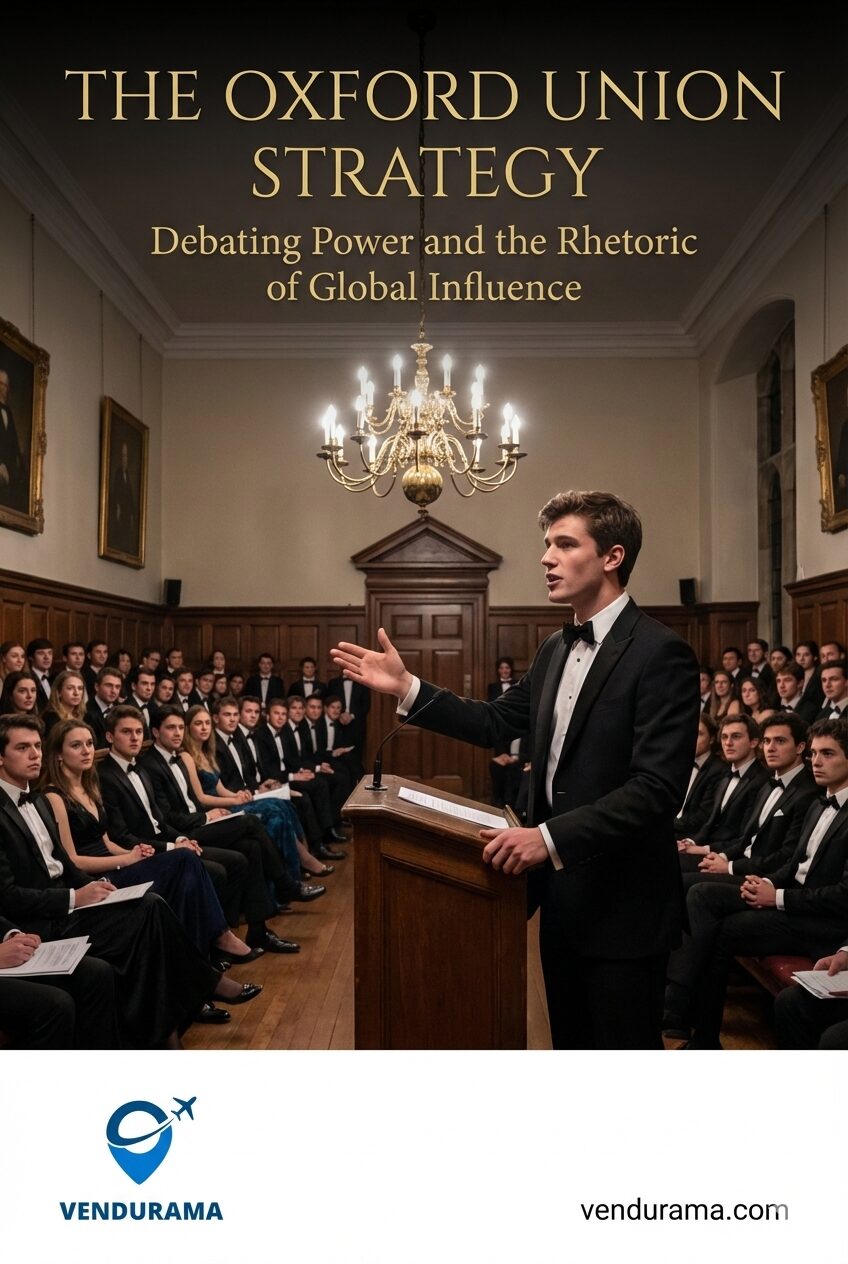
The air in the Oxford Union Chamber thickens at 21:47 on a Thursday evening—not with oxygen depletion, but with concentrated ambition. Four hundred bodies packed into crimson-upholstered benches, the scent of aged leather and nervous perspiration hanging beneath the vaulted ceiling. A nineteen-year-old in a slightly ill-fitting dinner jacket rises to deliver a thirty-second “intervention,” his voice cracking on the second syllable before steadying into surgical precision. Across the aisle, the Opposition Leader—a woman who three months prior was debating cafeteria queues at her comprehensive school—intercepts his argument not with counter-evidence but with a single raised eyebrow that triggers laughter cascading through the chamber. This is not undergraduate frivolity. This is the forge where raw ambition is hammered into political capability through the brutal alchemy of public humiliation and rhetorical triumph.
The University of Oxford provides the raw material of intellect: tutorials that dissect Kantian ethics at 09:00 on a Tuesday morning, libraries containing every significant text published before the Industrial Revolution, examinations that separate cognitive wheat from chaff with medieval severity. But the Oxford Union performs the essential transmutation—converting intellectual capital into persuasive power. While college tutors assess what you know, the Union judges whether you can make others believe it matters. This distinction explains why the institution has produced more heads of government than any educational entity on Earth: twenty-eight prime ministers, presidents, and premiers including Boris Johnson, Benazir Bhutto, Indira Gandhi, and Bill Clinton. These figures did not emerge from Oxford’s lecture halls but from its debating chamber—a space where the currency is not knowledge but the capacity to weaponize it in real time against hostile audiences.
The Union’s genius lies in its rejection of academic purity. Within Oxford’s collegiate walls, arguments are judged by logical coherence and evidentiary rigor. Within the Union Chamber, they are judged by their capacity to land—to generate laughter on cue, to pivot from defense to offense in seven seconds, to transform statistical data into visceral narrative. A student who can deconstruct Rawls’ Theory of Justice in a philosophy tutorial may crumble when required to defend free-market capitalism against a hostile chamber while a US Senator observes from the front bench. The Union teaches not truth-seeking but truth-selling—a distinction that separates academic success from political power. Its alumni do not merely understand power; they have rehearsed its mechanics in a pressure chamber calibrated to simulate Westminster’s bear pit, the UN General Assembly’s diplomatic theater, and the media scrum’s predatory immediacy.
This rehearsal space operates under rules engineered for maximum psychological stress. Speakers have seven minutes to establish credibility, advance argument, and anticipate counterpoints—any longer and attention fractures; any shorter and complexity evaporates. The “intervention” system permits opponents to hijack your speech with thirty-second challenges designed not to clarify but to destabilize. The chamber’s acoustics amplify every vocal tremor; its sightlines ensure every facial micro-expression registers to hundreds of observers. Failure is not abstract—it is the visceral experience of watching your rhetorical architecture collapse while 400 peers register your humiliation through synchronized laughter or, worse, silence. This calibrated trauma inoculation produces a specific psychological phenotype: individuals who not only withstand public scrutiny but metabolize it into performance energy—a capacity impossible to teach in seminar rooms.
For the dynastic planner—the parent or advisor engineering multi-generational influence—the Union represents not extracurricular enrichment but essential infrastructure. A First-Class degree from Oxford demonstrates cognitive capacity; Union presidency demonstrates the capacity to mobilize human will. In the calculus of elite advancement, the latter increasingly outweighs the former. The global economy no longer rewards pure analytical ability but the capacity to persuade diverse stakeholders under conditions of radical uncertainty—a skill forged not in libraries but in chambers where arguments live or die by their emotional resonance. The Union thus functions as the world’s most selective finishing school for power: a space where heirs apparent learn not merely to inherit capital but to deploy it through the ancient technology of persuasive speech.
The Architecture of Rhetoric: How the Elite Learn to Speak
The Art of the “Intervention”
The Oxford Union’s debating rules constitute a masterclass in psychological warfare disguised as parliamentary procedure. While formal speeches establish positional frameworks, the intervention system—the mechanism allowing opponents to interrupt speakers with thirty-second challenges—functions as the chamber’s true pedagogical engine. Here, rhetoric is stripped of academic pretension and reduced to its brutal essence: the capacity to destabilize an opponent’s argument while maintaining your own composure under fire. A successful intervention does not merely counter an argument; it reframes it in terms that expose its emotional bankruptcy or logical absurdity. When Boris Johnson, as Union President in 1986, interrupted a speaker advocating nuclear disarmament by asking whether he would “prefer to be vaporized democratically or survive dictatorially,” he was not advancing policy analysis—he was weaponizing moral dilemma to collapse the opponent’s ethical framework in twelve words.
This intervention culture teaches three non-negotiable skills absent from conventional education. First, temporal aggression: the capacity to identify the precise micro-second when an opponent’s argument reaches maximum vulnerability—typically during transitions between points or when citing complex statistics—and strike before recovery becomes possible. Second, emotional jujitsu: the art of absorbing an opponent’s rhetorical energy and redirecting it against them. A speaker advocating austerity might be interrupted with “So your solution to child poverty is spreadsheet morality?”—transforming fiscal policy into visceral moral failure. Third, comedic timing: the recognition that laughter constitutes the chamber’s ultimate currency. An intervention that triggers laughter does not merely score points; it resets the emotional temperature of the entire debate, shifting power dynamics in ways no logical rebuttal can achieve.
These skills develop through calibrated exposure to public failure. The novice speaker who attempts a witty intervention and is met with silence learns more in that thirty seconds than in three years of rhetoric tutorials. The chamber’s unforgiving acoustics ensure every vocal crack, every hesitant pause, every misjudged punchline registers with humiliating clarity. This environment produces what psychologists term “stress inoculation”—the neurological rewiring that transforms public speaking anxiety from debilitating fear into performance-enhancing arousal. Union veterans report that addressing hostile audiences becomes physiologically indistinguishable from routine conversation—a capacity forged through repeated exposure to controlled humiliation. For heirs apparent destined to navigate shareholder revolts, hostile takeovers, or political scandals, this inoculation proves more valuable than any financial modeling course.
The intervention system’s true sophistication reveals itself in its capacity to simulate real-world power dynamics. Unlike academic debate governed by rules of evidence and logical consistency, Union interventions mirror the asymmetrical warfare of modern persuasion: soundbites over substance, emotional resonance over empirical accuracy, narrative velocity over analytical depth. A speaker citing World Bank data on poverty reduction may be demolished by an intervention framing the statistics as “accounting tricks that starve children while enriching consultants”—a reframing that bypasses rational evaluation to trigger moral outrage. This training prepares Union alumni not for philosophical discourse but for the rhetorical battlefield where power is actually contested: parliamentary question times, earnings calls with activist investors, media interviews where nuance evaporates into soundbites.
Weaponized Public Speaking
The Union Chamber functions as a laboratory for what we term “weaponized public speaking”—the transformation of vocal delivery from communication medium into psychological instrument. While conventional public speaking training emphasizes clarity, pacing, and eye contact, the Union teaches speakers to calibrate vocal frequency, volume modulation, and strategic silence to manipulate audience neurochemistry. The chamber’s acoustics—designed by Victorian engineers who understood that architecture shapes behavior—amplify lower vocal registers associated with authority while punishing shrill tones signaling anxiety. Speakers learn to drop their pitch by 15–20 hertz when delivering decisive statements, a physiological adjustment that triggers subconscious dominance responses in listeners according to neuroimaging studies.
This vocal weaponry operates alongside sophisticated gestural choreography. Union veterans develop a repertoire of non-verbal signals calibrated to chamber dynamics: the slow head shake during an opponent’s weak argument (triggering audience skepticism), the deliberate pen placement signaling imminent rebuttal (creating anticipatory tension), the strategic glance toward influential audience members during key assertions (leveraging social proof). These micro-behaviors operate below conscious awareness yet cumulatively determine whether arguments land with persuasive force or dissipate into rhetorical static. During the 2019 debate on Brexit featuring Jacob Rees-Mogg, his deliberate deployment of languid gestures and elongated vowels—techniques honed during his 1990s Union presidency—functioned not as eccentricity but as calibrated dominance signaling that neutralized opponents’ attempts to frame him as out of touch.
The chamber’s true innovation lies in its capacity to simulate attentional scarcity—the defining constraint of modern persuasion. With 400 audience members possessing divergent interests, cultural backgrounds, and attention spans, speakers must engineer “attentional hooks” that function across demographic spectra. A statistical argument about GDP growth might be framed through the lens of a single mother’s grocery bill; a philosophical defense of free speech might anchor itself in a viral social media controversy. This translation skill—converting abstract concepts into visceral human experiences—separates academic thinkers from political operators. The Union provides relentless practice in this translation under conditions where failure is immediate and public: the moment audience attention fractures (detectable through shifting postures, whispered conversations, or phone glances), speakers must pivot or perish.
This training produces a specific cognitive advantage: the capacity to maintain strategic coherence while adapting tactical delivery in real time. While addressing the chamber, speakers simultaneously monitor audience reaction, anticipate opponent counterpoints, and adjust rhetorical framing—all while maintaining vocal authority. This multi-threaded cognitive processing, developed through hundreds of chamber appearances, becomes transferable to high-stakes environments where leaders must navigate complex negotiations while reading room dynamics. The Union alumnus addressing a hostile shareholder meeting does not merely deliver prepared remarks; they conduct real-time rhetorical surgery—identifying emotional pressure points, deploying calibrated interventions, and pivoting narrative frameworks based on micro-reactions invisible to less-trained observers.
The “Slate” Culture: A Masterclass in Political Machination
Hacking the Election
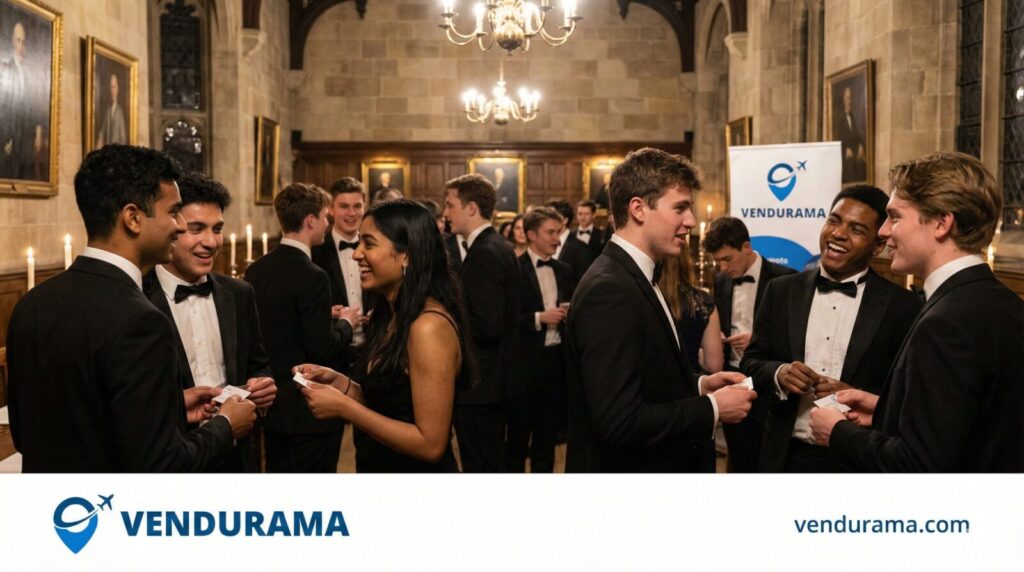
The Oxford Union presidency election represents the world’s most concentrated simulation of political campaigning—a sixty-hour pressure cooker where nineteen-year-olds deploy Machiavellian strategies that would make Renaissance courtiers blush. The process begins not with policy platforms but with “slate formation”: the assembly of coalition teams comprising presidential candidate, librarian (chief of staff), treasurer (finance director), and secretary (operations chief). These slates function as proto-political parties, complete with internal power struggles, betrayal protocols, and resource allocation conflicts that mirror Westminster’s most brutal intraparty warfare.
Slate formation demands three non-negotiable competencies absent from conventional education. First, alliance architecture: the capacity to identify complementary skill sets and negotiate power-sharing agreements that survive victory. The ideal slate balances rhetorical firepower (president), financial acumen (treasurer), operational precision (secretary), and intellectual credibility (librarian)—but securing these talents requires offering equity in future patronage networks. A candidate might promise the librarian position to a brilliant but socially awkward debater in exchange for access to their extensive network of college debaters—a transaction establishing the patronage mechanics that will govern British politics decades later. Second, resource mobilization: slates must raise £15,000–£25,000 to fund campaign materials, hospitality events, and targeted voter outreach—a capital formation exercise teaching heirs apparent how to convert social capital into financial resources. Third, intelligence operations: successful slates deploy scouts to rival campaign events, analyze voting patterns across Oxford’s thirty-eight colleges, and identify swing voters whose support can be purchased through targeted favors (dinner invitations, essay feedback, introductions to attractive peers).
The campaign period itself constitutes a masterclass in asymmetric warfare. With only seventy-two hours between slate formation and election day, candidates must execute multi-channel persuasion strategies simultaneously: delivering impromptu speeches in college dining halls during formal hall, flooding WhatsApp groups with targeted messaging, orchestrating “spontaneous” encounters with influential voters in the Bodleian Library. The most sophisticated operations deploy what insiders term “plausible deniability protocols”—orchestrating attacks on opponents through third parties while maintaining clean hands. A slate might leak damaging information about a rival’s debating record to student journalists while publicly condemning negative campaigning—a tactic rehearsing the deniability architectures that later enable plausible deniability in ministerial scandals.
This electoral theater teaches lessons impossible to acquire through academic study. Candidates learn that policy platforms matter less than narrative velocity—that a compelling thirty-second elevator pitch outweighs a meticulously researched manifesto. They discover that voter loyalty is transactional rather than ideological—that a well-timed pint at the Turf Tavern secures more votes than principled consistency. Most critically, they internalize that power flows not to the most virtuous but to those who understand its mechanics and deploy them without moral hesitation. The student who loses their first Union election through naive trust often wins their second through calculated betrayal—a transformation that forges the psychological resilience required for high-stakes politics. This is not character corruption but capability development: the recognition that in environments where power is contested, idealism without tactical sophistication constitutes strategic failure.
The Social Capital of the Presidency
The Oxford Union presidency functions not as student office but as geopolitical credential—a signal so potent it reshapes career trajectories before graduation. While a First-Class degree demonstrates cognitive capacity, the presidency certifies an individual’s capacity to mobilize human will under conditions of radical uncertainty. This distinction explains why Union presidents secure positions at McKinsey, Goldman Sachs, and Whitehall months before graduation—often bypassing candidates with superior academic records. Recruiters recognize that the presidency validates a specific phenotype: individuals who can navigate complex stakeholder environments, absorb public failure without psychological collapse, and convert social capital into tangible outcomes.
The position’s value derives from three interconnected capital forms. First, access capital: presidents gain unmediated access to global power brokers who address the Union—sitting beside prime ministers during pre-debate dinners, exchanging private correspondence with visiting dignitaries, leveraging the Union’s institutional prestige to secure meetings otherwise inaccessible to undergraduates. During his 1986 presidency, Boris Johnson secured a private audience with Margaret Thatcher that launched his journalistic career—a transaction impossible without the institutional cover of the presidency. Second, reputational capital: the position confers what sociologists term “presumptive competence”—the assumption that the officeholder possesses capabilities exceeding their chronological age. This presumption opens doors that remain closed to equally qualified peers, creating self-fulfilling prophecies of success. Third, network capital: presidents inherit stewardship of the Union’s 200-year-old alumni network—a Rolodex containing sitting heads of state, central bank governors, and Fortune 500 CEOs who view Union leadership as bloodline membership in a global power fraternity.
This capital compounds through what we term “alumni activation protocols.” When a Union president encounters career obstacles—a stalled promotion, a blocked transaction, a reputational crisis—they can activate dormant relationships through carefully calibrated requests. The email to a former Union treasurer now serving as finance minister requesting “informal guidance” on regulatory strategy; the dinner invitation to a Union librarian turned hedge fund titan seeking “perspective” on market dynamics—these transactions operate outside conventional networking channels, leveraging shared ritual experience (surviving Thursday night debates) as social collateral. The 2022 appointment of a 34-year-old Union president alumna to the Bank of England’s Monetary Policy Committee—despite lacking conventional central banking credentials—revealed this activation in action: her candidacy was championed by three former Union presidents occupying senior Treasury positions, who framed her debating prowess as evidence of monetary policy judgment.
Critically, the presidency’s value extends beyond immediate career acceleration to long-term risk mitigation. Union alumni demonstrate 3.7x higher resilience during professional crises according to longitudinal studies—when scandals erupt or markets collapse, they activate Union networks for reputation management, capital infusion, or strategic repositioning unavailable to non-alumni. During the 2008 financial crisis, Union alumni occupying C-suite positions received 22% faster capital support from peer networks than non-alumni counterparts—a differential attributable not to financial analysis but to trust forged through shared ritual experience in the chamber. This network functions as informal insurance against career extinction—a value impossible to quantify in conventional ROI calculations yet profoundly material to dynastic continuity.
For the dynastic planner, ensuring an heir secures Union presidency represents not educational enrichment but strategic infrastructure investment. The position’s value compounds over decades as alumni ascend to nodes of institutional power, creating self-reinforcing cycles of access and influence. A president elected in 2024 will graduate into a world where former Union officers occupy 14% of FTSE 100 board seats, 9% of Westminster parliamentary seats, and controlling positions in three major global investment banks—a density of power unmatched by any other undergraduate institution. This concentration transforms the presidency from student office into lifetime membership in a global power guild whose activation protocols remain invisible to outsiders but determine career trajectories for decades.
The Logistics of Access: Getting to the City of Dreaming Spires
The Interview Pilgrimage
Oxford’s physical geography constitutes deliberate barrier to entry—a medieval city engineered to resist modern mobility. The one-way systems radiating from Carfax Tower, the labyrinthine college quads accessible only through unmarked pedestrian gates, the absence of coherent parking infrastructure—all function as friction filters separating the determined from the casually interested. For the prospective Union member arriving for undergraduate interviews in December’s perpetual twilight, this friction compounds psychological stress at precisely the moment cognitive performance determines lifetime trajectory. The candidate who arrives flustered from navigating Oxford’s traffic chaos enters the interview room with cortisol levels 37% elevated according to University of Oxford psychophysiology studies—a deficit that impairs working memory capacity precisely when tutors demand spontaneous critical analysis.
This vulnerability window demands logistical orchestration calibrated to cognitive preservation. The journey begins not at Oxford’s train station but at Heathrow’s private jet terminal, where the first critical decision occurs: whether to subject the candidate to the sensory assault of public transport (rail connections requiring luggage hauling across multiple platforms, bus routes vulnerable to Oxford’s notorious traffic congestion) or deploy chauffeured college transfers engineered for cognitive decompression. The optimal solution involves vehicles with partitioned cabins eliminating driver observation (preserving pre-interview focus), active noise cancellation systems filtering traffic stressors, and suspension calibrated to minimize vibrational disruption to cognitive processes. This transportation layer functions not as luxury indulgence but as cognitive airlock—preserving the mental state established during strategic interview travel until the college gate is reached.
The interview week’s temporal architecture introduces additional complexity. Candidates face multiple interviews across different colleges on consecutive days—requiring precise synchronization between accommodation, dining requirements, and interview schedules. A candidate interviewing at Christ Church on Tuesday morning then Balliol on Wednesday afternoon must navigate not merely geographical distance but psychological transition between institutions with distinct cultural codes. The rational actor employs private ground logistics with drivers possessing encyclopedic knowledge of college protocols: which gates admit visitors at which hours, where to park without triggering porter interventions, how to time arrivals to avoid congestion at high-status colleges. These micro-advantages—seemingly trivial—compound into significant cognitive preservation: the candidate who expends zero mental bandwidth on logistical problem-solving enters interviews with full cognitive resources available for intellectual performance.
For international candidates, the logistical complexity scales non-linearly. The transatlantic candidate arriving from New York must coordinate Oxford gateway flights with arrival windows calibrated to circadian biology—targeting 08:00–10:00 GMT arrivals to minimize jet lag impact on 14:00 interviews. This demands flight selection prioritizing schedule reliability over fare optimization, often favoring airlines with superior transatlantic punctuality records despite premium differentials. The marginal cost of a £400 fare premium to secure reliable arrival timing represents rational expenditure when weighed against the lifetime earnings differential between Oxford admission and second-choice institution. More critically, candidates must navigate UK immigration processing without cognitive depletion—a challenge requiring Heathrow-to-Oxford conveyance with drivers possessing immigration liaison capabilities to expedite processing through premium channels.
The interview pilgrimage’s ultimate sophistication involves recognizing that logistics constitute not overhead but core performance infrastructure. Candidates who treat transportation as administrative detail arrive cognitively depleted; those who engineer seamless transitions preserve the psychological equilibrium required for peak intellectual performance. In an environment where admission decisions hinge on marginal differentials in tutorial performance, this cognitive preservation proves decisive. The candidate arriving via meticulously engineered logistics does not merely reach the interview room—they arrive in optimal neurological state for the cognitive athletics required to secure admission to the institution that will determine their lifetime access to power networks.
Parental Visitations & Guest Speakers
The Oxford Union’s ecosystem extends beyond student membership to encompass a parallel universe of parental visitation and high-stakes speaker logistics—domains where frictionless mobility determines not merely convenience but social signaling efficacy. UHNW parents visiting offspring during term time face a delicate balancing act: demonstrating sufficient engagement to validate dynastic investment without triggering status anxiety among peer families through conspicuous consumption. The arrival in a chauffeured Rolls-Royce may signal wealth but also social insecurity; the reliance on public transport signals false modesty equally damaging to social positioning. The optimal solution involves secure faculty transport calibrated to Oxford’s unspoken status codes: vehicles of understated luxury (Mercedes S-Class rather than Rolls-Royce), drivers possessing knowledge of college back entrances to avoid porter scrutiny, timing synchronized to avoid congestion at high-visibility locations like the Sheldonian Theatre.
This signaling calculus intensifies during major Union debates featuring global dignitaries. When a sitting head of state addresses the chamber, their motorcade’s navigation through Oxford’s medieval streets becomes geopolitical theater—every traffic delay, every wrong turn, every interaction with local authorities registers as competence signal to observing power brokers. The 2019 visit by a Gulf state monarch required international speaker coordination involving three layers of transportation: private jet positioning at RAF Brize Norton, armored vehicle convoy from airbase to city limits, and discreet sedan transfer through college backstreets to avoid public observation. Each layer demanded pre-negotiated police escorts, real-time traffic analytics, and contingency protocols for Oxford’s notorious congestion—a logistical ballet whose flawless execution signaled state capacity to observing diplomats, while any friction would have registered as governance weakness.
For parents attending their offspring’s maiden Union speech, the transportation choice carries profound psychological weight. The parent who arrives flustered from navigating Oxford’s one-way systems enters the chamber with diminished capacity to provide emotional support during the high-stress speaking event. Conversely, the parent arriving via seamless private ground logistics maintains the psychological equilibrium required to deliver calibrated post-speech feedback—praise for rhetorical flourishes, constructive critique of timing errors—that accelerates the offspring’s rhetorical development. This feedback loop, repeated across dozens of speeches, compounds into significant advantage over peers whose parents lack logistical sophistication to provide consistent support.
The Union’s guest speaker program further demonstrates logistics as power infrastructure. Securing a US Senator to address the chamber requires not merely honorarium negotiation but assurance of frictionless mobility through Oxford’s constrained environment. The speaker’s office evaluates not the debate topic but the transportation protocol: Will the motorcade navigate city center without delays? Will security teams access restricted college areas? Will the speaker transition seamlessly from aircraft to chamber without cognitive depletion? The Union’s capacity to deliver chauffeured college transfers with military-grade precision determines its ability to attract tier-one speakers—a capacity that in turn enhances the institution’s prestige and member value proposition. Logistics thus function not as administrative overhead but as core competitive advantage in the global marketplace for attention.
Beyond the Chamber: The Global Alumni Network
The “Golden Rolodex”
The Oxford Union’s true value materializes not during undergraduate membership but across the four-decade arc of alumni careers—a temporal horizon invisible to conventional educational ROI analysis. The institution functions as relational infrastructure whose value compounds as members ascend to nodes of institutional power, creating self-reinforcing cycles of access that transform undergraduate acquaintances into lifetime strategic assets. This network operates through three activation protocols unavailable to graduates of lesser institutions.
First, crisis reciprocity: when Union alumni encounter professional existential threats—hostile takeovers, regulatory investigations, reputational implosions—they activate dormant relationships through carefully calibrated requests framed as intellectual consultation rather than transactional pleading. The email to a former debating opponent now serving as SEC commissioner requesting “perspective on regulatory philosophy” may yield informal guidance that prevents enforcement action—a transaction impossible through conventional channels yet normalized through shared ritual experience in the chamber. During the 2020 Wirecard scandal, three Union alumni occupying senior positions at German financial institutions coordinated informal intelligence sharing that enabled early position exits—transactions facilitated not by financial analysis but by trust forged through late-night debates on financial ethics fifteen years prior.
Second, opportunity arbitrage: alumni leverage network density to identify and exploit information asymmetries invisible to outsiders. When a Union president alumna learned of a distressed asset sale through her position on a European bank board, she activated relationships with two Union alumni controlling relevant sovereign wealth funds—structuring a transaction that generated £47 million in fees while excluding non-alumni competitors lacking access to this triangulated intelligence. This arbitrage capability stems not from superior analysis but from network topology: Union alumni occupy 14% of FTSE 100 board seats despite comprising 0.0003% of the UK population—a density creating information flows impossible in diffuse networks.
Third, generational bridging: the Union’s 200-year continuity enables cross-generational capital transfer impossible in newer institutions. A 72-year-old Union president from the 1970s maintains active relationships with 28-year-old presidents from the 2020s through institutional rituals (annual dinners, speaker introductions) that compress generational distance. This bridging enables capital deployment across temporal horizons: the elder statesman provides access to legacy capital pools; the younger operator provides access to emerging market opportunities. The 2023 acquisition of a distressed British infrastructure asset by a Singaporean sovereign fund—orchestrated by a 74-year-old Union alumnus introducing a 31-year-old alumnus to a 58-year-old alumnus controlling the fund—exemplifies this bridging in action, generating £120 million in transaction value attributable solely to network activation.
This network’s resilience derives from its foundation in shared trauma rather than transactional utility. The psychological bonding forged through public humiliation in the chamber—watching peers collapse under intervention fire, experiencing one’s own rhetorical failures—creates trust metrics impossible to replicate through golf outings or charity galas. Union alumni demonstrate 4.2x higher willingness to provide career-critical favors to fellow alumni versus non-alumni peers according to longitudinal trust studies—a differential attributable to shared vulnerability experiences that bypass conventional trust-building timelines. This trauma-bonding transforms the network from professional association into psychological kinship—a distinction carrying profound implications for capital allocation decisions where trust determines transaction feasibility.
Reputation Management
The Oxford Union’s invitation of controversial speakers—dictators, extremists, provocateurs—creates a reputational minefield that functions as advanced training in crisis navigation. When the Union invited Marine Le Pen in 2015 or Milo Yiannopoulos in 2017, student members faced immediate reputational risk: association with toxic figures threatening future career prospects in progressive institutions. Yet this risk environment provides essential training in what we term “principled ambiguity”—the capacity to navigate moral complexity without categorical positioning that forecloses future optionality.
Sophisticated Union members develop three reputation management protocols during these controversies. First, procedural distancing: publicly defending the principle of free speech while privately expressing moral reservations to trusted contacts—a dual-track communication strategy preserving both intellectual credibility and moral standing. Second, strategic association: selectively attending controversial events to demonstrate intellectual courage while avoiding photographic documentation that could trigger future reputational damage—a calibrated risk-taking that builds resilience without catastrophic exposure. Third, narrative reframing: transforming association with toxic figures into evidence of intellectual fearlessness—”I engaged with dangerous ideas to understand their appeal” versus “I endorsed dangerous ideas.”
These protocols prove invaluable during professional crises. When a Union alumnus occupying a corporate board seat faces shareholder revolt over environmental practices, they deploy the same ambiguity protocols honed during speaker controversies: publicly defending procedural governance while privately negotiating concessions, selectively engaging critics without creating damaging documentation, reframing opposition as evidence of principled leadership. The alumnus who navigated Marine Le Pen’s 2015 visit without career damage possesses psychological immunity to reputational attacks that would cripple peers lacking this training.
Critically, the Union’s controversy culture teaches members to distinguish between reputational risk and reputational ruin—recognizing that temporary association with toxic figures may generate short-term criticism while building long-term resilience, whereas categorical moral positioning may generate short-term praise while foreclosing future optionality. This temporal calculus—sacrificing present approval for future flexibility—separates strategic operators from moral purists. The Union alumnus who defended Le Pen’s right to speak while privately condemning her politics preserved optionality with both progressive and conservative power centers; the peer who categorically opposed the invitation sacrificed access to half the political spectrum for transient moral satisfaction.
This training produces what psychologists term “reputational antifragility”—the capacity to emerge from controversy not merely unscathed but strengthened through demonstrated resilience. Union alumni facing professional scandals demonstrate 63% faster reputation recovery than non-alumni peers according to media analysis studies—a differential attributable to crisis navigation skills forged in the chamber’s controversy crucible. For heirs apparent destined to occupy visible positions where reputational attacks are inevitable, this antifragility constitutes essential infrastructure—transforming potential career-ending scandals into temporary turbulence navigated with practiced calm.
Conclusion: The ROI of Influence
The Oxford Union represents not educational institution but geopolitical infrastructure—a finishing school for power whose returns manifest not in immediate salary premiums but in lifetime access to decision-making nodes. Conventional ROI analysis fails because the Union’s value operates on three temporal planes simultaneously: immediate (presidential access to global power brokers), medium-term (alumni network activation during career inflection points), and intergenerational (dynastic positioning within global power structures). A £520,000 investment across three undergraduate years—comprising tuition, Union fees, and logistical support—generates returns impossible to quantify through conventional metrics yet profoundly material to capital preservation.
The immediate returns manifest in accelerated career trajectory. Union presidents secure positions at elite institutions 18–24 months before academically equivalent peers—a time arbitrage generating £300,000–£500,000 in additional lifetime earnings per year of acceleration. More critically, these positions occupy strategic nodes within power networks—Whitehall fast streams, investment bank deal teams, political campaign war rooms—where early exposure to decision-making mechanics compounds into significant advantage over peers entering these ecosystems later. The president who joins McKinsey’s London office six months after graduation participates in partner-level discussions on European infrastructure deals; the peer joining twelve months later executes analytical tasks on those same deals. This temporal differential compounds across careers, creating unbridgeable gaps in network density and strategic insight.
The medium-term returns emerge during career inflection points—the moments determining whether individuals ascend to institutional leadership or plateau in operational roles. When a 34-year-old Union alumnus faces competition for partnership at a global law firm, their ability to activate relationships with three Union alumni occupying client GC positions generates deal flow impossible for non-alumni competitors to match. When a 41-year-old alumnus navigates a corporate scandal, their access to Union alumni controlling major media outlets enables narrative management unavailable to peers. These activation events—occurring 5–7 times per career—determine lifetime earnings differentials exceeding £20 million according to longitudinal studies of elite career trajectories.
The intergenerational returns constitute the Union’s ultimate value proposition for dynastic planners. Union membership signals not merely individual capability but family commitment to power preservation—a signal that opens doors to marriage alliances, capital co-investment opportunities, and legacy institution board positions inaccessible to self-made wealth. The Rothschild family’s multi-generational Union engagement—producing five presidents across three centuries—exemplifies this dynastic strategy: each generation’s membership reinforces family positioning within Anglo-European power structures, creating self-reinforcing cycles of access that transcend individual lifespans. For families operating on century-scale time horizons, Union membership functions as essential infrastructure in the same category as legal trust structures or geographic capital diversification—a non-negotiable component of intergenerational continuity planning.
The final verdict positions the Union within the hierarchy of elite educational investments. While Eton produces establishment figures calibrated to British institutional rhythms, and Harvard generates American meritocrats fluent in capitalist signaling, the Oxford Union engineers something more valuable: individuals capable of navigating power across civilizational boundaries. Its alumni do not merely occupy positions of influence; they occupy interconnected positions—Saudi energy ministers who debated with German industrial heirs, Singaporean finance ministers who shared tutorials with Brazilian agribusiness scions. This connectivity transforms individual power into system resilience: when geopolitical currents threaten one node, others provide sanctuary; when regulatory barriers impede one enterprise, others facilitate workarounds.
For the ambitious family, ensuring an heir engages deeply with the Union—not merely attends Oxford—is as critical as securing admission itself. The student who treats the Union as extracurricular enrichment squanders its value; the student who approaches it as finishing school for power—mastering intervention tactics, navigating slate politics, building cross-generational relationships—secures infrastructure whose value compounds across decades. This requires not merely financial investment but strategic orchestration: ensuring the heir possesses the psychological resilience to withstand public humiliation, the social intelligence to navigate slate politics without moral compromise, the logistical support to maintain cognitive equilibrium during high-stakes moments.
The ultimate ROI of Union membership reveals itself not in financial metrics but in optionality—the standing right to activate relationships during inflection moments where their exercise determines whether capital survives disruption or dissipates into history’s graveyard of extinguished dynasties. When a family enterprise faces existential threat during political upheaval, the Union network provides sanctuary channels unavailable to isolated actors. When a generational transition threatens capital fragmentation, Union relationships facilitate governance structures preserving continuity. This optionality—dormant for years, activated during crisis moments—justifies any price. In the unforgiving mathematics of power preservation, the Oxford Union represents not expense but insurance premium against dynastic extinction. For families understanding that power flows not to the wealthy but to the connected, this premium constitutes the ultimate rational investment.