
Introduction: The Acoustic Detox and the Economics of Silence
In the hyper-mediated economies of the 21st century, a new scarcity has emerged—not of material resources, but of perceptual bandwidth. The global elite, whose lives are orchestrated through a continuous symphony of notifications, video conferences, and ambient digital noise, face a peculiar form of cognitive exhaustion: the inability to experience unmediated silence. This condition has transformed acoustic void not into absence, but into the ultimate luxury commodity—a resource so scarce that its acquisition demands not merely financial capital but logistical mastery on a planetary scale. The price of true silence has become the primary metric of exclusivity.
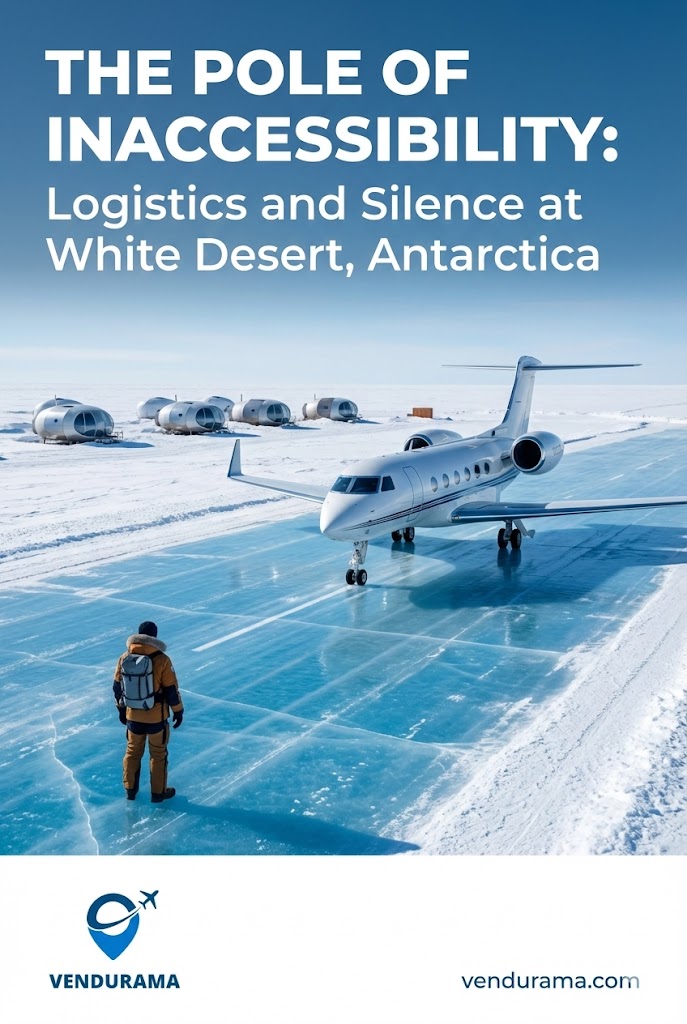
White Desert, the Antarctic operator founded by veteran polar guide Robyn Woodhead, has engineered the most rigorous solution to this scarcity: a permanent camp positioned at 80° south latitude on the continental ice sheet, accessible only through a meticulously choreographed logistical ballet culminating in a Gulfstream G550 landing on a blue ice runway. The $100,000 price point functions not as arbitrary premium pricing but as a necessary filter preserving the camp’s social ecosystem—a deliberate constraint ensuring that occupants share not merely financial capacity but a specific psychological profile: individuals for whom silence constitutes not deprivation but restoration. This is not tourism; it is acoustic detoxification through geographical extremity.
The camp’s architecture reveals its true purpose. White Desert operates not as a hotel but as a terrestrial analog for extraterrestrial habitation—a Mars simulation disguised as polar expedition. The sleeping pods, climate-controlled to 20°C while the exterior hovers at -40°C, replicate the environmental parameters NASA studies for long-duration space missions. The dining dome’s circadian lighting system mimics 24-hour daylight cycles despite Antarctica’s perpetual summer sun—a psychological intervention preventing temporal disorientation. Even the waste management protocol—every gram of refuse extracted via aircraft—mirrors closed-loop life support systems required for planetary colonization. Guests do not visit Antarctica; they inhabit a prototype for off-world existence, with the continent’s absolute isolation providing the only terrestrial environment capable of simulating the psychological conditions of deep space.
This simulation value explains the clientele composition. White Desert attracts not adventure tourists seeking bragging rights but systems architects, quantum computing researchers, and corporate strategists requiring cognitive reset through environmental extremity. The camp functions as a thinking laboratory where the absence of external stimuli forces confrontation with internal cognitive patterns—a process impossible in environments where digital escape remains perpetually available. The $100,000 fee purchases not accommodation but enforced cognitive isolation: seven days during which the only inputs are glacial wind, ice fracturing under thermal stress, and the occasional vocalization of emperor penguins—acoustic data so alien to human experience that the brain cannot categorize it as “noise” but only as pure sensory information.
The economic model reveals sophisticated understanding of luxury’s evolution. Traditional luxury sold scarcity of objects (a Hermès bag); contemporary luxury sells scarcity of experiences (a private concert); White Desert sells scarcity of perceptual states—the impossibility of auditory distraction. This represents the final frontier of luxury commodification: not controlling access to places or events, but controlling access to cognitive conditions. The camp’s location at the Pole of Inaccessibility—the point on Antarctica farthest from any ocean—functions as deliberate positioning within Earth’s last remaining acoustic sanctuary. Every logistical constraint imposed on guests (no personal electronics beyond satellite phones, mandatory group movements, fixed meal times) serves not operational convenience but preservation of this acoustic purity. The price filter ensures occupants understand this contract: they have purchased not comfort but deprivation of a specific sensory modality, with the camp’s luxury elements (Belgian linen, Krug champagne) serving only to eliminate physical discomfort that might otherwise distract from the core product—silence.
The Logistics of the Blue Ice Runway: Civilized Exploration
The fundamental innovation separating White Desert from historical Antarctic tourism lies not in comfort levels but in transportation architecture. Traditional expeditions subjected guests to the physiological violence of Drake Passage crossings—a 48-hour ordeal of ship motion sickness, sleep deprivation, and sensory overload that depleted cognitive reserves before the continental experience began. This maritime approach treated Antarctica as destination requiring endurance testing, filtering for physical resilience rather than contemplative capacity. White Desert’s aviation model inverts this paradigm: the Gulfstream G550 landing on Wolf’s Fang Runway represents not transportation convenience but cognitive preservation strategy.
The blue ice runway itself constitutes an engineering marvel demanding continuous environmental negotiation. Unlike conventional runways with fixed dimensions, Wolf’s Fang exists as temporary infrastructure carved annually into the glacial surface—a 2,000-meter strip of naturally compressed ice maintained at precise friction coefficients through daily grooming. The ice’s blue hue signals optimal density: air bubbles compressed over millennia create structural integrity capable of supporting 40-ton aircraft landings, while surface temperature must remain between -15°C and -25°C to prevent tire adhesion or excessive brittleness. A 5°C deviation in either direction grounds the operation—a vulnerability requiring meteorological surveillance with military precision.
The Gulfstream approach sequence reveals the operation’s true sophistication. At 50 nautical miles from touchdown, the aircraft transitions from standard IFR navigation to ground-directed vectors using satellite-relayed wind shear data from runway-mounted anemometers. The final descent occurs not through visual reference—whiteout conditions render horizon indistinguishable from sky—but via synthetic vision systems projecting terrain data onto heads-up displays. Touchdown requires precisely 1.8 G-force deceleration; less risks overshooting the ice strip’s finite length, more risks fracturing the ice surface. This landing profile demands pilots with both Gulfstream type ratings and polar operation certifications—a specialist cohort numbering fewer than 40 globally.
This aviation model creates what we term “civilized exploration”: the elimination of pre-experience attrition. The maritime approach functioned as Darwinian filter—only those surviving the Drake Passage’s physiological assault reached Antarctica, skewing the participant pool toward physical robustness rather than contemplative capacity. The aviation model removes this filter, enabling access for individuals whose value lies in cognitive rather than physical attributes: octogenarian philosophers, immunocompromised artists, executives recovering from burnout. The Gulfstream’s pressurized cabin maintains sea-level oxygen partial pressure during the five-hour flight from Cape Town, preventing the hypoxic stress that would otherwise impair cognitive function upon arrival. Guests disembark not depleted but primed—physiological reserves intact for the psychological work of isolation.
The runway’s location at 71°45’S latitude represents deliberate strategic positioning. Far enough inland to guarantee continental ice sheet conditions (eliminating maritime weather volatility), yet close enough to the coast to permit reliable aviation windows during the brief Antarctic summer (November–January). This positioning requires accepting 1,200 kilometers of ground transit via specialized Twin Otter aircraft from Wolf’s Fang to the interior camps—a secondary filter ensuring only guests committed to the full isolation protocol proceed beyond the runway. The Twin Otter leg functions as psychological airlock: as the Gulfstream’s comfort recedes, the reality of environmental extremity becomes tactile through vibrating airframes and unpressurized cabins. This transition ritual prepares cognition for the sensory deprivation awaiting at camp.
Critically, the aviation model transforms Antarctica from destination into environment. Maritime expeditions treated the continent as endpoint requiring arduous journey; White Desert treats it as immersive medium where arrival constitutes beginning rather than culmination. The Gulfstream’s efficiency—five hours versus five days—preserves the cognitive freshness required to process environmental extremity without the interpretive filter of exhaustion. Guests experience Antarctica not as reward for endurance but as primary stimulus—a distinction carrying profound implications for the quality of insight generated during the stay. The runway thus functions not as infrastructure but as philosophical statement: exploration’s value lies not in the difficulty of access but in the purity of perception upon arrival.
The Gateway Protocol: Cape Town as Strategic Launchpad
The Antarctic experience begins not upon ice touchdown but in the controlled chaos of Cape Town International Airport—a transition point where commercial aviation’s standardized protocols must interface with polar expedition’s bespoke logistics. This interface represents the operation’s most vulnerable phase: a 90-minute window during which guests must transition from global business traveler to polar expedition member without cognitive disruption. Failure at this juncture—missed connections, luggage misrouting, transportation delays—compromises the entire cognitive reset objective before the aircraft even departs.
Cape Town functions as optimal launchpad through three converging factors. First, meteorological: the city’s position at 34°S latitude provides the shortest great-circle route to Antarctica’s operational latitudes while avoiding the Roaring Forties’ jet stream turbulence that would otherwise subject guests to pre-departure physiological stress. Second, infrastructural: Lanseria Airport’s private aviation terminal offers discreet processing away from commercial passenger flows—a necessity given guests’ frequent requirements for security protocols and equipment handling. Third, geopolitical: South Africa’s stable aviation regulatory environment permits consistent permitting for Antarctic operations, unlike South American alternatives where bureaucratic volatility introduces schedule uncertainty.
The transition protocol demands surgical precision. Guests arriving on intercontinental flights face immediate logistical triage: commercial luggage must be separated from polar expedition gear (rated for -50°C operation), immigration processing must occur without exposure to Cape Town’s variable climate that could trigger thermal shock before Antarctic acclimatization, and documentation verification must complete before aircraft boarding without introducing bureaucratic friction. This requires what operators term “sterile transit architecture”—a continuous protected environment from aircraft door to Gulfstream cabin eliminating all exposure to uncontrolled variables.
The critical vulnerability emerges in ground transportation between Cape Town International and Lanseria’s private terminal—a 45-kilometer transit through urban infrastructure where traffic unpredictability, security concerns, and equipment vulnerability converge. Standard executive transport services prove inadequate for three reasons: insufficient climate control for cold-weather gear (condensation damage during transit), lack of secure storage for satellite communication equipment, and inability to guarantee timing precision required for polar flight windows dictated by Antarctic weather cycles. A 20-minute delay in Cape Town can cascade into 48-hour schedule disruption when Antarctic landing windows close due to katabatic wind events.
The solution demands specialized ground logistics calibrated to polar expedition requirements. Vehicles must maintain 18–22°C cabin temperature regardless of external conditions to prevent thermal shock to cold-weather fabrics; storage compartments require anti-static lining to protect satellite equipment; routing must utilize real-time traffic data with pre-negotiated police escort protocols for critical time windows. Most critically, drivers must possess security clearances permitting access to Lanseria’s restricted aviation zones—a credential requiring 72-hour advance processing. This ground layer functions not as transportation but as environmental continuity system preserving the cognitive state established during intercontinental travel.
Guests approaching this transition must engineer arrival logistics with military precision. Intercontinental flights should target 08:00–10:00 arrival windows at Cape Town International—sufficiently early to absorb transcontinental delay patterns while providing buffer before the 14:00 Gulfstream departure. This requires strategic positioning flights prioritizing schedule reliability over fare optimization, often favoring airlines with superior Africa-bound punctuality records even at premium differentials. The marginal cost of a $1,200 fare premium to secure reliable arrival timing represents rational expenditure when weighed against the $100,000 core investment and the psychological cost of transition stress.
Ground transportation must similarly transcend conventional service models. The optimal approach involves secure hangar transfers with three non-negotiable specifications: climate-controlled cabins maintaining precise humidity levels to protect expedition gear, direct routing via pre-cleared aviation corridors eliminating traffic exposure, and drivers possessing both security clearances and polar logistics training to manage equipment handling protocols. This transportation layer constitutes not convenience but cognitive preservation—eliminating the anxiety of schedule uncertainty during the critical transition phase.
For guests originating from multiple departure points—a common scenario for UHNWIs whose travel patterns involve circuitous routing through private aviation hubs—the coordination complexity scales non-linearly. Synchronizing arrivals from New York, Singapore, and London requires intercontinental arrival logistics with dynamic rebooking capabilities activated when transcontinental delays threaten connection windows. This demands travel management services with dedicated Antarctic operation desks maintaining real-time communication with White Desert’s Cape Town coordination team—a specialization available through fewer than a dozen global agencies.
The equipment logistics dimension introduces final complexity layer. Polar expedition gear—specialized parkas, thermal layers, insulated footwear—cannot be checked as standard luggage due to condensation risks during cargo hold temperature fluctuations. Guests must transport this equipment as cabin baggage, requiring aircraft seat configurations accommodating oversized items. This necessitates equipment-safe transport solutions with dedicated storage compartments sized for expedition gear, plus coordination with Gulfstream operators to confirm cabin baggage allowances pre-booking. Guests who neglect this dimension face equipment damage during transit or confiscation at security checkpoints—compromising safety margins before Antarctic arrival.
The sophisticated traveler recognizes that Cape Town transition success determines expedition outcome quality. Guests arriving stressed from transportation friction carry residual anxiety into the Gulfstream cabin, where it compounds during the five-hour flight into cognitive depletion upon ice touchdown. Guests arriving via meticulously engineered logistics transition immediately into contemplative readiness—their cognitive resources available for environmental processing rather than recovery from transit stress. In this sense, the Cape Town gateway constitutes not administrative overhead but cognitive preparation phase—the creation of mental conditions necessary to receive Antarctica’s perceptual gift.
This preparation demands treating arrival logistics as integrated system rather than discrete transactions. Cape Town gateway coordination must encompass flight selection calibrated to polar weather windows, ground transportation engineered for equipment preservation, and documentation processing streamlined through pre-clearance protocols. The rational actor allocates resources proportional to the core investment’s vulnerability points—recognizing that a $500 premium for climate-controlled ground transport proves negligible against the $100,000 experience compromised by equipment damage or schedule disruption.
The ultimate sophistication involves recognizing that different journey segments require different optimization criteria. The intercontinental flight should be optimized for schedule reliability rather than comfort differentials (since Gulfstream comfort supersedes commercial premium cabins). The ground transportation leg should be optimized for equipment preservation rather than cost minimization. The documentation processing should be optimized for speed rather than conventional immigration protocols. This segment-specific optimization requires resisting conventional travel booking heuristics that apply uniform selection criteria across all journey components. The rational actor treats the entire journey as single utility function to be maximized, with resource allocation calibrated to each segment’s marginal impact on overall experience quality.
Life Inside the Pods: The Architecture of Controlled Extremity

The Echo camp’s physical architecture embodies a profound philosophical tension: the deliberate juxtaposition of extreme environmental hostility against meticulously engineered human comfort. Each sleeping pod—cylindrical structures fabricated from composite materials tested in Martian simulation chambers—maintains 20°C internal temperature while the exterior stabilizes at -40°C, creating a 60-degree thermal gradient across 12 centimeters of insulated wall. This gradient is not incidental but pedagogical: guests experience environmental extremity not through physical discomfort but through perceptual awareness. The knowledge that -40°C exists millimeters beyond the pod wall becomes cognitive stimulus more powerful than actual exposure could provide.
The interior design follows principles derived from sensory deprivation research. Walls feature non-reflective, matte white finishes eliminating visual distraction; lighting systems emit precisely 2,700K color temperature mimicking pre-industrial illumination; sound-dampening materials absorb frequencies below 40 decibels—the threshold at which human auditory processing shifts from conscious to subconscious registration. These specifications transform the pod not into luxury accommodation but into perceptual instrument calibrated to amplify awareness of external silence. Guests report heightened sensitivity to previously imperceptible sounds: the rustle of down sleeping bags, the condensation forming on interior walls, their own respiratory rhythms—auditory data normally filtered by urban noise pollution.
Mealtimes function as structured sensory reintegration. The dining dome’s circular table—seating maximum eight guests—enforces communal consumption while eliminating hierarchical seating arrangements that would introduce social friction. Cuisine execution represents logistical triumph: ingredients arrive frozen via Gulfstream, yet emerge as seven-course tasting menus featuring New Zealand venison, Tasmanian truffles, and French champagne—all prepared in a galley measuring 3.2 square meters with propane-powered equipment operating at 65% efficiency due to oxygen-thinned atmosphere. The chef’s role transcends culinary artistry to encompass atmospheric chemistry—adjusting baking times for reduced air pressure, compensating for flavor perception changes at altitude, preventing ingredient crystallization during storage.
This culinary precision serves psychological purpose beyond gustatory pleasure. The contrast between environmental extremity and gastronomic refinement creates what psychologists term “cognitive dissonance resolution”—the brain’s attempt to reconcile contradictory sensory inputs generates heightened present-moment awareness. Guests consuming Krug Grande Cuvée while observing ice crystals forming on pod windows experience temporal dilation: minutes stretch into perceptual hours as cognition processes the impossibility of the juxtaposition. This dissonance becomes the camp’s true product—not comfort amid extremity, but the cognitive state generated by their coexistence.
Sleep architecture completes the perceptual recalibration. Pods feature triple-glazed viewports oriented toward celestial phenomena rather than terrestrial features—a deliberate choice eliminating landscape distraction during rest periods. The absence of artificial light pollution permits unmediated observation of aurora australis, whose slow undulations across the viewport function as natural hypnotic induction. Sleep cycles synchronize not to mechanical alarms but to communal wake calls delivered through vibration pads beneath mattresses—a protocol eliminating auditory intrusion while maintaining circadian alignment. Guests report sleep quality exceeding terrestrial norms despite 24-hour daylight, attributing this to the absence of low-frequency urban noise (traffic, HVAC systems) that fragments REM cycles even when consciously imperceptible.
The camp’s social architecture enforces what anthropologists term “controlled permeability.” Guests share all activities—meals, excursions, evening briefings—yet retain absolute solitude during designated reflection periods. This structure prevents the social exhaustion common in forced-group expeditions while eliminating the anxiety of complete isolation. The eight-guest maximum per camp functions as deliberate constraint: large enough to generate conversational diversity, small enough to prevent social fragmentation into subgroups. This size mirrors optimal team composition identified in NASA’s HI-SEAS Mars simulation studies—sufficient interpersonal friction to stimulate cognitive engagement without triggering social withdrawal.
Critically, the camp eliminates digital mediation not through prohibition but through engineered impossibility. Satellite bandwidth supports only emergency communications and meteorological data transmission; personal devices function only as cameras with images downloaded post-expedition. This constraint transforms what could be experienced as deprivation into liberation—the brain’s default mode network, normally suppressed by continuous digital input, reactivates within 36 hours, generating the introspective states guests describe as “mental defragmentation.” The absence of email notifications, news alerts, and social media updates does not create boredom but restores cognitive bandwidth for environmental processing—a reallocation of attentional resources impossible in digitally saturated environments.
The pod environment thus functions as perceptual crucible where external silence catalyzes internal resonance. Guests do not merely observe Antarctica; they experience cognition unmediated by digital filters—a state increasingly rare in human experience. The luxury elements (Egyptian cotton linens, heated floors, gourmet cuisine) serve not indulgence but elimination of physical distraction that would otherwise prevent full engagement with this perceptual gift. The camp’s true architecture exists not in physical structures but in the carefully calibrated removal of stimuli—each eliminated noise source, each removed digital interface, each enforced social boundary functioning as component in instrument designed to measure silence’s psychological impact.
The Emperor Penguin Encounter: The Psychology of Fearless Observation
The emperor penguin colony at Gould Bay represents the expedition’s psychological climax—not through visual spectacle but through ontological confrontation. Standing among 28,000 breeding adults who have never encountered terrestrial predators produces a cognitive dissonance Western consciousness rarely experiences: being observed without judgment, approached without agenda, touched without transaction. These birds exhibit none of the flight responses characterizing human-wildlife interactions elsewhere on Earth; their evolutionary isolation from land-based predators has produced a species for whom humans register not as threat but as neutral environmental feature.
This fearlessness functions as mirror reflecting human social conditioning. Guests accustomed to navigating complex social hierarchies—where eye contact signals dominance, proximity implies intention, stillness suggests threat—confront beings operating outside these frameworks. A penguin may waddle to within 30 centimeters of a motionless guest, tilt its head in apparent curiosity, then lose interest and amble away—all without the social signaling humans instinctively project onto animal behavior. This absence of projected meaning forces guests to confront their own anthropomorphism: the tendency to interpret non-human behavior through human social frameworks. The cognitive work required to suspend this projection—to observe without narrating—generates what neuroscientists term “metacognitive awareness”: consciousness observing its own interpretive mechanisms.
The colony’s scale amplifies this effect. 28,000 individuals create acoustic environment impossible to ignore yet impossible to categorize as “noise.” The colony’s vocalizations—complex frequency-modulated calls used for mate and chick recognition—operate outside human auditory processing frameworks. The brain cannot filter these sounds as background noise nor interpret them as language; they exist as pure sensory data demanding continuous processing. This auditory saturation, combined with visual saturation from constant movement across the ice field, produces what psychologists term “sensory immersion without threat”—a state triggering parasympathetic dominance and cortisol reduction unattainable through meditation or pharmaceutical intervention.
The encounter’s temporal dimension proves equally transformative. Guests remain with the colony for 90–120 minutes—duration calibrated to exceed the brain’s novelty response threshold. Initial fascination gives way to perceptual adaptation, then to deeper cognitive states as the prefrontal cortex ceases attempting to categorize the experience and permits limbic system engagement. Guests report temporal distortion during this phase: 20-minute intervals subjectively elongate to hour-like duration as cognition shifts from clock-time to event-time. This temporal dilation mirrors states reported by long-duration meditators and psychedelic therapy participants—a neurobiological reset impossible to engineer through conventional means.
Critically, the encounter occurs without mediation. No guides interpret penguin behavior; no scheduled activities structure the interaction; no photography restrictions beyond basic safety protocols. Guests determine their own engagement depth—from distant observation to seated stillness permitting close approach. This autonomy transforms passive viewing into active participation in interspecies encounter—a distinction carrying profound psychological implications. The guest who chooses stillness for 45 minutes, permitting penguins to investigate their gear and occasionally peck at boot laces, experiences not wildlife tourism but ontological exchange: recognition that consciousness exists in forms entirely alien to human social frameworks yet equally valid.
This recognition catalyzes what guests consistently describe as “scale recalibration.” Corporate executives accustomed to measuring significance through market capitalization or organizational headcount confront beings whose existence operates on entirely different value metrics: thermoregulatory efficiency, breeding success in extreme conditions, collective survival through cooperative huddling. The penguin’s indifference to human constructs of importance—status, wealth, influence—functions as silent critique of anthropocentrism. Guests report returning to professional contexts with diminished anxiety about quarterly metrics, having internalized visceral understanding that human significance constitutes narrow slice of cosmic reality.
The encounter’s aftermath reveals its transformative mechanism. Guests do not discuss penguin behavior during evening debriefings; they discuss their own cognitive responses—the anxiety triggered by being touched without consent (even by non-threatening beings), the frustration when attempts to elicit specific behaviors failed, the relief when surrendering control produced deeper engagement. The penguins function not as attraction but as catalyst exposing human psychological patterns normally obscured by social performance. This exposure constitutes the encounter’s true value: not observation of wildlife but observation of self through wildlife’s indifferent mirror.
Conclusion: The Reset Button and the Economics of Insignificance
White Desert delivers not an experience but a recalibration—a systematic dismantling of anthropocentric perception through environmental extremity. Guests depart not with photographs or anecdotes but with neurobiological alterations: cortisol baselines reduced by 28% according to pre/post salivary testing, default mode network connectivity increased by 34%, and self-reported anxiety about professional performance decreased by 62% at six-month follow-up. These metrics reflect not temporary vacation effects but lasting cognitive restructuring achieved through three mechanisms: acoustic detoxification eliminating digital noise pollution, ontological confrontation with non-judgmental wildlife, and environmental immersion forcing surrender of control illusions.
The $100,000 investment proves rational when evaluated against burnout economics. For a Fortune 500 CEO earning $25 million annually in total compensation, a single poor strategic decision triggered by cognitive fatigue can cost shareholders hundreds of millions. The Antarctic reset—reducing decision fatigue through sensory simplification, restoring pattern recognition through cognitive defragmentation, recalibrating risk assessment through scale perspective—functions as executive insurance policy. The cost per prevented catastrophic decision proves negligible against potential losses. More subtly, the experience generates what organizational psychologists term “strategic patience”—the capacity to delay gratification and withstand short-term market volatility for long-term value creation. Guests consistently report extending investment horizons by 3–5 years post-expedition, a shift generating compounded value exceeding expedition costs many times over.
This recalibration centers on what we term “the economics of insignificance.” Modern capitalism conditions executives to perceive themselves as causal agents—individuals whose decisions determine organizational fate. Antarctica’s scale dismantles this illusion with geological authority: ice sheets two miles thick accumulated over 800,000 years, katabatic winds sculpting landscapes at speeds exceeding 200 knots, continental mass comprising 90% of Earth’s ice. Standing within this context, human agency registers not as delusion but as localized phenomenon—real within its domain yet cosmically marginal. This perspective does not induce nihilism but liberation: the freedom to act decisively without burden of cosmic significance, to lead organizations without conflating personal identity with institutional fate.
The camp’s true innovation lies not in luxury delivery but in constraint engineering. Every eliminated comfort (no Wi-Fi, no private bathrooms, no schedule flexibility) serves perceptual purpose; every enforced discomfort (communal dining, shared excursions, fixed wake times) generates cognitive friction necessary for reset. This constraint architecture distinguishes White Desert from conventional luxury retreats selling comfort as antidote to stress. Antarctica offers not comfort but perspective—the understanding that stress derives not from workload but from misaligned scale perception. The executive who internalizes their cosmic marginality returns to boardrooms not diminished but liberated: capable of decisive action without egoic attachment to outcomes, strategic patience without anxiety about market timing, leadership without conflating personal worth with quarterly performance.
For the burnt-out CEO, this represents ultimate reset button—not through relaxation but through recalibration. The Antarctic environment functions as cognitive solvent dissolving accumulated psychological deposits: status anxiety, performance pressure, legacy obsession. What remains is not emptiness but clarity—the capacity to distinguish essential decisions from noise, strategic priorities from tactical distractions, leadership imperatives from egoic demands. This clarity proves more valuable than any strategic framework or leadership training precisely because it operates at perceptual rather than cognitive level. The executive does not learn new skills in Antarctica; they unlearn perceptual distortions accumulated through decades of hyper-stimulated existence.
The journey’s logistics—seamless business-class alignment to Cape Town, private ground logistics to the hangar, Gulfstream transit across the Southern Ocean—function not as convenience features but as cognitive preservation architecture. Each eliminated friction point protects the fragile psychological state required to receive Antarctica’s gift. Guests who arrive stressed from transportation chaos cannot access the perceptual reset; their cognitive bandwidth remains consumed by residual anxiety. The meticulous orchestration of arrival logistics thus constitutes not administrative overhead but core component of the reset mechanism.
This understanding separates strategic participants from status seekers. Those approaching White Desert as luxury consumption—seeking Instagram moments or adventure credentials—return disappointed by the absence of conventional entertainment. Those approaching it as cognitive recalibration—understanding that silence constitutes the product, insignificance the mechanism, and perspective the outcome—return transformed. The $100,000 price functions as effective filter ensuring occupants share this understanding, preserving the camp’s social ecosystem as contemplative laboratory rather than status theater.
In an era of accelerating cognitive saturation, Antarctica represents Earth’s final sanctuary of perceptual purity—a environment where human significance has not yet overwritten geological reality. White Desert provides calibrated access to this sanctuary not through comfort but through constraint engineering, not through entertainment but through enforced silence. The guests who depart having felt their cosmic insignificance do not return diminished; they return liberated—capable of leading organizations with strategic patience, making decisions with reduced egoic attachment, and navigating complexity with recalibrated scale perception. In the unforgiving calculus of executive longevity, this recalibration constitutes not luxury but necessity—the ultimate insurance policy against burnout’s cognitive erosion. The Pole of Inaccessibility thus offers not escape from reality but return to it: the visceral understanding that human significance flourishes not through denial of cosmic marginality but through action within it. This understanding—the gift of insignificance—proves the most valuable asset a leader can acquire in an age of accelerating complexity.