
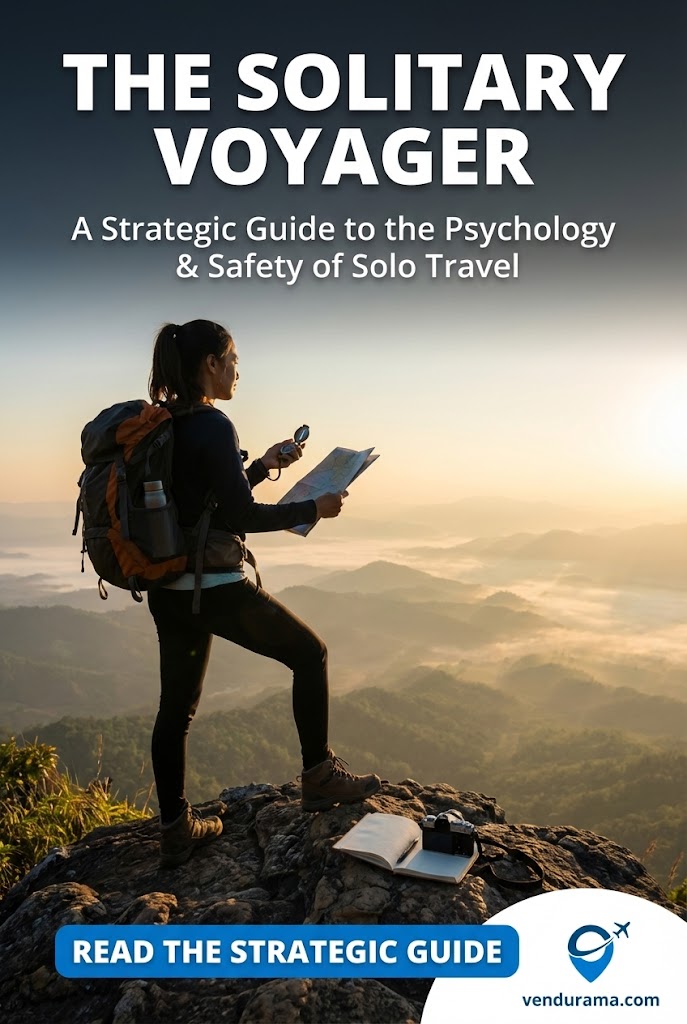
Introduction: The Philosophy of the Solo Journey
In the collective imagination, travel has long been depicted as a communal activity: the honeymoon couple on a gondola in Venice, the family road trip across America, the group of friends backpacking through Southeast Asia. For decades, the solo traveler was viewed with a mixture of pity and suspicion—a figure associated with loneliness, social inability, or reckless danger.
However, as we navigate the complexities of the mid-2020s, a paradigm shift has occurred. Solo travel has shed its stigma to become one of the most coveted forms of modern exploration. It is no longer about “having no one to go with”; it is about “choosing to go alone.” It represents the ultimate expression of autonomy, a deliberate embrace of solitude, and a masterclass in self-reliance.
But to travel alone is not merely to book a ticket for one. It requires a fundamental restructuring of how one interacts with the world. Without the buffer of a companion, the solo traveler is exposed—to the beauty of the environment, to the kindness of strangers, but also to the risks of the unknown and the silence of their own thoughts.
This comprehensive guide is not just a list of tips; it is a doctrine for the solitary voyager. It dissects the psychological architecture of being alone in a foreign land, outlines the rigorous safety protocols necessary for survival, and details the logistical strategies that transform a daunting solo trip into a seamless, life-altering odyssey.
Part I: The Psychology of Solitude vs. Loneliness
The first barrier to solo travel is not financial or logistical; it is mental. The fear of loneliness is primal. Humans are social animals, wired for tribe and community. Removing oneself from the herd voluntarily triggers a deep-seated anxiety known as “separation distress.” To master solo travel, one must first distinguish between two distinct states: Loneliness and Solitude.
The Anatomy of Solitude
Solitude is the state of being alone without being lonely. It is a positive, constructive state of engagement with oneself. In our hyper-connected digital lives, true solitude is rare. Solo travel forces a “dopamine detox.” Without the constant chatter of a companion, your senses heighten.
- Visual acuity: You notice the architectural details on a building that you would have missed if you were debating where to eat lunch with a friend.
- Social permeability: A couple or a group is a closed circle; their body language says “we are occupied.” A solo traveler is an open circle. You become permeable to the local culture. Locals are far more likely to approach a single person than a group, leading to authentic interactions that are impossible to engineer.
The Spotlight Effect
A common psychological hurdle is the “Spotlight Effect”—the cognitive bias where we believe everyone is noticing us more than they actually are. The solo diner feels the entire restaurant is judging them for eating alone.
- The Reality: In major global cities—London, Tokyo, New York, Berlin—dining alone is standard behavior. The businessman reading a paper, the student on a laptop, the traveler with a journal.
- The Reframe: Instead of thinking “I look lonely,” reframe the narrative to “I am independent.” The projection of confidence changes how the world perceives you.
Managing the “Dip”
Every solo trip has a “Dip”—usually on Day 3 or 4. The adrenaline of arrival fades, fatigue sets in, and a wave of acute loneliness hits. This is not a sign of failure; it is a physiological response to a lack of familiar oxytocin triggers.
- The Strategy: Do not stay in the hotel room scrolling social media (which exacerbates FOMO). Go to a public space—a park, a museum, or a coffee shop. Being “alone together” with other humans resets the nervous system.
Part II: Strategic Planning and Destination Tiering
Not all destinations are created equal, especially for the uninitiated solo traveler. A strategic approach involves “Tiering” your destinations based on difficulty, infrastructure, and culture.
Tier 1: The “Soft Landing” (Beginner)
These countries have high English proficiency, robust public transport, low crime rates, and a culture of individualism.
- Examples: United Kingdom, Japan, Netherlands, Scandinavia, Singapore.
- Why: In Tokyo, “Ohitorisama” (the art of doing things alone) is a cultural norm. There are restaurants specifically designed for solo diners (like Ichiran Ramen). In London or Amsterdam, the hostel culture is so developed that meeting people is effortless.
Tier 2: The “challenge” (Intermediate)
Countries with a language barrier, a more chaotic infrastructure, or a moderate “hustle” culture, but still safe.
- Examples: Thailand, Italy, Costa Rica, Mexico (tourist zones), Turkey.
- Why: You need street smarts here. You might need to negotiate a taxi fare or navigate a train system that isn’t in English. The rewards are higher, but the cognitive load is heavier.
Tier 3: The “Frontier” (Advanced)
Destinations that require high resilience, cultural conservatism, or have challenging security environments.
- Examples: India, Egypt, Morocco, parts of South America.
- Why: The sensory overload is intense. As a solo traveler (especially female), you may attract significant attention. These trips require experience in de-escalation, firm boundary setting, and logistical precision.
Part III: The Logistics of Autonomy
When you travel alone, you are the CEO, the CFO, and the Chief Logistics Officer of your journey. There is no one to watch your bags while you go to the bathroom. There is no one to double-check the gate number.
1. The Agility of Flight (Strategic Mobility)
One of the greatest advantages of solo travel is agility. You are not coordinating schedules with a spouse or waiting for a friend’s vacation approval. You can take the last seat on a plane, or book the cheaper flight with the long layover that a group would refuse. This flexibility allows for “Travel Arbitrage”—leveraging dynamic pricing. Solo travelers can utilize complex multi-city itineraries (Open-Jaw tickets) that maximize discovery. For instance, flying into Rome and out of Milan is often cheaper and more efficient for a solo explorer than a round trip. To visualize these complex routes and find the “hidden” inventory that airlines release to fill single empty seats, savvy soloists rely on advanced flight aggregation engines. These tools allow you to toggle “flexible dates” and “nearby airports,” unlocking routes that rigidity would otherwise hide.
2. The “First 24 Hours” Protocol
The most vulnerable period for any solo traveler is the transition from the “Airside” (secure airport zone) to the “Landside” (the city). You are tired, jet-lagged, carrying all your valuables, and likely do not speak the language. This is where 90% of travel scams occur.
- The Rule: Never arrive in a new city after dark if you haven’t been there before.
- The Arrival Architecture: Do not attempt to navigate a complex public bus system or haggle with aggressive taxi touts in the arrivals hall while exhausted. The cognitive load is too high. The gold standard for solo safety is to have a “Secure Handshake” pre-arranged. This means booking a professional airport transfer before you even take off. Seeing a driver holding a sign with your name provides an immediate psychological anchor of safety. It guarantees you are taken directly to your hotel door without the risk of being overcharged, taken on a “scenic route,” or dropped at the wrong location. It is an investment in safety, not a luxury.
3. Accommodation Strategy: The Hostel vs. Hotel Debate
- Hostels: The social engine of solo travel. Modern “Poshtels” offer privacy curtains, secure lockers, and co-working spaces. They are ideal for Tier 1 and 2 countries.
- Hotels: Essential for rest. After 3-4 days of social interaction in a hostel, booking a private hotel room for a night allows for “social decompression.”
- Safety Check: Always ask for a room on the 2nd to 5th floor. Ground floor is accessible from the street; high floors are hard to evacuate in a fire. Never say your room number out loud at the front desk.
Part IV: The Safety Doctrine (Risk Management)
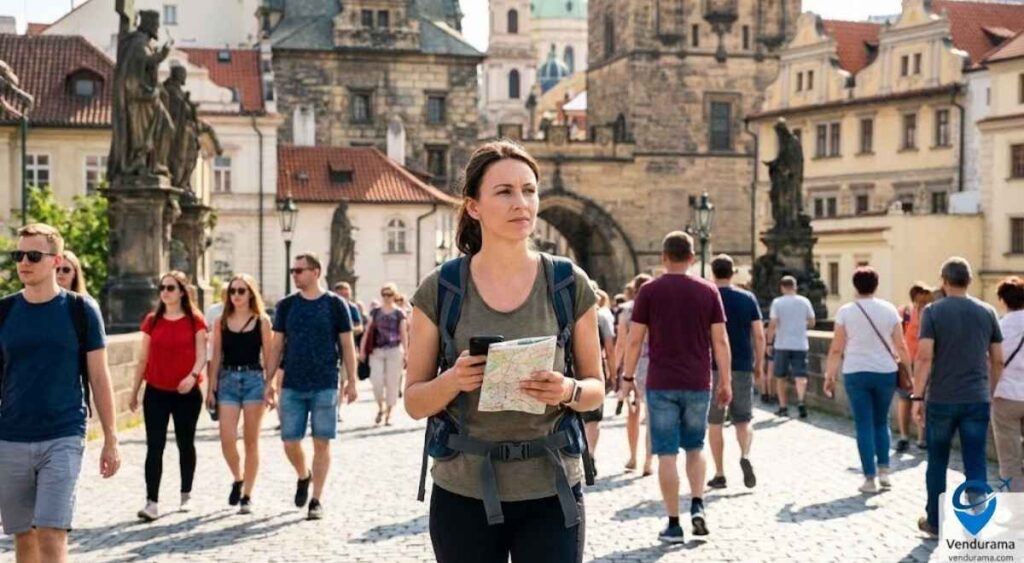
Safety when traveling alone is not about paranoia; it is about “Situational Awareness.” It is the art of looking like you know where you are going, even when you are lost.
1. Digital Hygiene and Cybersecurity
- The Digital Leash: Share your live location (via WhatsApp or Google Maps) with a trusted contact back home. Establish a “Proof of Life” protocol—a simple message sent at the same time every day.
- Public Wi-Fi: Never access banking apps on airport or café Wi-Fi without a VPN. Solo travelers are prime targets for digital identity theft because if your cards are blocked, you have no backup companion to pay the bills.
- The Decoy Wallet: Carry a “dummy wallet” with a small amount of cash and expired credit cards. In the unlikely event of a mugging, you hand this over while your real cards are hidden in a money belt or sewn into your waistband.
2. Social Engineering and Blending In
- Walk with Purpose: Predators look for hesitation. If you need to check Google Maps, do not stand in the middle of the sidewalk. Step into a shop or café.
- The “White Lie”: You are never alone. If a stranger asks “Are you here alone?”, the answer is always “No, I’m meeting a friend at the next corner” or “My husband is resting at the hotel.” Protect your privacy aggressively.
- Dress Code: Research the local dress norms. In conservative countries, wearing shorts or tank tops marks you as a “tourist” and can interpret as disrespect or an invitation for attention. Blending in is a form of camouflage.
3. The Alcohol Rule
When you drink alone, your vulnerability skyrockets. Your reaction time slows, your inhibition drops, and your situational awareness fades.
- The Protocol: Never leave your drink unattended. If you go to the bathroom, you buy a new drink. Know your limit—stop two drinks before your usual limit at home. The goal is to enjoy the atmosphere, not to get intoxicated.
Part V: The Female Solo Traveler Experience
It is a sociological reality that the solo travel experience is gendered. Women face a specific set of risks and challenges that require nuanced strategies.
The “Resting Bitch Face” (RBF) as a Shield
In many cultures, a smile is interpreted as an invitation. Female solo travelers often cultivate a “neutral mask”—a look of detached boredom or slight sternness—when navigating crowded streets or markets. This discourages catcalling and unwanted approaches.
The “Wedding Ring” Tactic
Wearing a fake wedding band is a classic, effective deterrent in conservative cultures where a solitary woman is seen as an anomaly. It signals that you are “claimed” and socially unavailable, which, however archaic, is a language understood globally.
Trusting Intuition (The Gift of Fear)
Women are often socialized to be “polite.” Solo travel requires unlearning this. If an interaction feels wrong, if a taxi driver is asking too many personal questions, if a hotel room feels unsafe—you do not need to be polite. You need to be safe. Remove yourself from the situation immediately without apology. Your intuition is a biological survival mechanism; listen to it.
Part VI: The Art of Dining Alone (Table for One)
For many, the most daunting aspect of solo travel is the restaurant experience. Food is culturally communal. Eating alone can feel like a public performance of loneliness.
Strategies for the Solo Diner
- The Bar Counter: The best seat in the house. You are facing the bartender (a built-in conversation partner) and you are sitting alongside other solo diners. It is dynamic and social.
- The Prop: Bring a book, a journal, or a kindle. It signals that you are busy and content. It creates a “force field” that says you are enjoying your own company.
- The “Main Character” Energy: Treat the solo dinner as a date with yourself. Order the expensive wine. Savor the tasting menu. Observe the room. People watching is a spectator sport best played alone.
- Lunch as the Main Meal: If dinner feels too romantic or awkward, make lunch your big culinary event. Lunch crowds are busier, faster, and less focused on couples.
Part VII: Crisis Management
What happens when things go wrong? When you are alone, a lost passport or a stomach flu is not an inconvenience; it is a crisis.
The Medical Kit
Pack more than you think you need. You do not want to be navigating a foreign pharmacy at 2 AM with a fever. Include: Immodium, rehydration salts, painkillers, broad-spectrum antibiotics (if prescribed by your doctor), and motion sickness pills.
Document Redundancy
- Cloud Backup: Scan your passport, visa, insurance policy, and credit cards (front and back). Upload them to a secure cloud folder (Google Drive/Dropbox) and email them to yourself.
- Physical Copies: Keep paper photocopies of your passport in a different bag than your actual passport.
- Emergency Cash: Hide $100 or €100 USD/EUR in a secret spot (inside a shoe, behind a phone case). This is your “nuclear option” money if you lose everything else.
Conclusion: The Return and The Transformation
The hardest part of solo travel is often the return home. You have climbed mountains, navigated foreign subways, eaten strange foods, and sat in silence with sunsets. You have grown. You have discovered that you are more capable, more resilient, and more adaptable than you ever imagined.
But you return to a world that hasn’t changed. Your friends are talking about the same office politics; your family asks “Wasn’t it lonely?” This disconnect is known as “Reverse Culture Shock.”
Understand that this is part of the journey. The solitary voyager returns with a secret: the knowledge that they are enough. That they can land in a city where they know no one, speak not a word of the language, and not only survive but thrive.
Solo travel is not an escape from reality; it is a confrontation with it. It is the ultimate accelerator of personal growth. The world is vast, and it is waiting for you. You do not need permission, and you do not need a partner. Pack your bag, book that ticket, and step out the door. The only company you truly need is your own courage.