

Introduction: The Macroeconomics of Luxury Travel in 2026
The global luxury travel market, valued at approximately $1.2 trillion in 2025, faces a structural paradox: demand for ultra-premium experiences continues to ascend among educated, aspirational consumers, while the real cost of accessing traditional luxury destinations has escalated beyond the reach of even the upper-middle class. A week in a five-star chalet in St. Moritz now commands an average of $8,500 per night during peak season; a comparable overwater villa in the Maldives exceeds $3,200 nightly, exclusive of seaplane transfers. For the rational, analytically-minded traveler—those with discerning tastes but finite capital—this represents not merely a pricing challenge, but a market inefficiency ripe for strategic exploitation.
Enter the concept of Geographic Luxury Arbitrage: the deliberate reallocation of travel capital across jurisdictional boundaries to capture equivalent or superior experiential value at a fraction of the conventional cost. This is not a compromise on quality; it is an optimization problem solved through rigorous analysis of purchasing power parity, infrastructure quality, and experiential authenticity. In 2026, two destinations have emerged as vanguard opportunities for this strategy: Almaty, Kazakhstan, offering Alpine-caliber mountain luxury at 20% of Swiss prices, and Sri Lanka, delivering tropical sophistication comparable to the Maldives or Seychelles at 30-40% of the cost.
The arbitrage opportunity is quantifiable. A seven-day luxury mountain retreat in Almaty—including boutique chalet accommodation, private guided skiing, gourmet dining, and spa services—totals approximately $2,800 per person, versus $12,000+ for an equivalent Swiss Alps itinerary. Similarly, a week in a heritage boutique villa in Sri Lanka’s cultural triangle, with private chef, curated excursions, and wellness treatments, averages $1,900 per person, compared to $6,500+ for a comparable Maldivian experience. When factoring in flight costs and ancillary expenses, the total differential still approaches $7,000-$9,000 per traveler—capital that can be redeployed toward future travel, investment, or wealth preservation strategies.
For sophisticated travelers willing to conduct diligent due diligence, this represents not merely savings, but a strategic reclamation of experiential capital. Before embarking on this analytical journey, the rational traveler benefits from a structured framework for evaluating arbitrage opportunities. The Ultimate Travel Planning Guide 2026—currently available for just $7.00 and featuring an accompanying expert podcast—provides the methodological scaffolding for assessing infrastructure quality, seasonal pricing dynamics, and logistical risk mitigation, serving as an essential complement to the macroeconomic analysis presented herein.
Almaty: The New Alpine Frontier
The Economic Geography of Kazakhstan’s Luxury Mountain Hub
Almaty, Kazakhstan’s former capital and cultural heart, occupies a unique position in the global luxury travel landscape: nestled against the Trans-Ili Alatau mountains at 700-900 meters elevation, it offers genuine Alpine terrain—glacial lakes, pine forests, and ski slopes exceeding 3,000 meters—without the Alpine price tag. The city’s emergence as a luxury mountain destination stems from three convergent factors: post-Soviet infrastructure investment, strategic geographic positioning along the New Silk Road, and deliberate economic policy to develop high-value tourism as a diversification strategy away from resource extraction.
The real estate quality of Almaty’s luxury accommodations reflects this intentional development. Boutique properties like the Rixos Almaty and The Altyn Alma offer chalet-style suites with underfloor heating, panoramic mountain views, and spa facilities utilizing local botanicals—all at nightly rates of $180-$350, versus $1,200-$2,500 for comparable Swiss properties. Crucially, these establishments maintain international service standards: English-speaking concierge teams, 24/7 room service with globally sourced ingredients, and partnerships with local adventure outfitters for curated experiences. The purchasing power parity advantage extends beyond accommodation: a three-course gourmet dinner featuring Kazakh-Fusion cuisine averages $45 per person in Almaty, versus $180+ in Zermatt; a private guided heli-skiing day costs $650 in the Trans-Ili Alatau, compared to $2,800 in the Swiss Valais.
Local economic dynamics further amplify the arbitrage value. Kazakhstan’s currency, the tenge, has experienced controlled depreciation against major Western currencies since 2022, effectively increasing the purchasing power of dollar- or euro-denominated travelers by 15-20%. Simultaneously, the government has implemented tourism-friendly visa policies: citizens of 75 countries, including the US, UK, and EU member states, enjoy visa-free entry for up to 30 days. This regulatory framework, combined with significant investment in airport infrastructure (Almaty International Airport now handles direct flights from Frankfurt, Istanbul, Dubai, and Seoul), creates a frictionless entry point for Western travelers seeking Alpine experiences without Alpine costs.
Logistical Architecture: Reaching and Navigating Almaty
The successful execution of an Almaty luxury itinerary depends on precise logistical planning. Flight connectivity has improved markedly: Turkish Airlines, Lufthansa, and Air Astana offer one-stop connections from major Western hubs with total travel times of 12-16 hours. For travelers prioritizing time efficiency and comfort, booking strategic flight routes with optimal layovers minimizes transit fatigue and maximizes on-ground experiential time—a critical consideration for short-duration luxury trips. Upon arrival, ground transportation infrastructure presents both opportunities and considerations: while Almaty offers modern taxi apps (Yandex.Taxi, InDrive) and ride-hailing services, the rational traveler prioritizes reliability and comfort during the initial transition phase.
Following a long-haul flight, navigating an unfamiliar city with luggage and potential jet lag requires strategic foresight. Sophisticated travelers mitigate this friction by reserving discrete, chauffeur-driven airport transfers, ensuring a stress-free transition from terminal to accommodation. This logistical decision—seemingly minor in isolation—has disproportionate impact on the initial 24-hour experience: eliminating language barriers, reducing exposure to unregulated transportation, and providing immediate local intelligence from a knowledgeable driver. For the analytically-minded traveler, this represents a classic risk mitigation strategy: paying a modest premium for reliability during the period of greatest vulnerability to logistical friction.
Beyond arrival logistics, Almaty’s internal transportation infrastructure supports seamless luxury travel. The city features a modern metro system, well-maintained roads, and a growing network of premium car rental options. For mountain excursions, reputable outfitters provide 4×4 vehicles with experienced drivers familiar with high-altitude conditions. Seasonal considerations are critical: the optimal window for Alpine activities spans December-March for skiing and June-September for hiking and mountaineering. During these peak periods, advance booking of accommodations and guided experiences is essential, as the combination of limited luxury inventory and growing international demand creates competitive pressure on availability.
Sri Lanka: The Reemergence of Tropical Sophistication
Post-Crisis Economic Reset and Luxury Value Proposition
Sri Lanka’s emergence as a premier tropical arbitrage destination represents a compelling case study in post-crisis economic adaptation. Following the 2022 sovereign debt restructuring and subsequent IMF program, the country has implemented deliberate policies to attract high-value tourism as a foreign exchange earnings strategy. The result is a luxury travel ecosystem that combines colonial-era heritage properties, contemporary eco-lodges, and boutique beachfront villas—all offered at price points 60-70% below comparable Maldivian or Seychellois alternatives.
The real estate quality of Sri Lanka’s luxury accommodations reflects the island’s diverse geographic and cultural assets. In the Cultural Triangle (Anuradhapura, Polonnaruwa, Sigiriya), heritage properties like Ulagalla by Uga Escapes and Jetwing Vil Uyana offer restored colonial bungalows and contemporary eco-villas with private pools, Ayurvedic spas, and curated cultural excursions at nightly rates of $220-$450. Along the southern coast, boutique beachfront properties such as Amanwella and Tri Koggala provide Indian Ocean vistas, infinity pools, and personalized service at $300-$600 nightly—versus $1,500-$4,000 for comparable Maldivian resorts. Crucially, these establishments maintain international hospitality standards: multilingual staff, globally certified culinary teams, and partnerships with local experts for authentic cultural immersion.
Local economic dynamics amplify the arbitrage advantage. Sri Lanka’s currency, the rupee, has undergone significant adjustment since 2022, effectively increasing the purchasing power of foreign travelers by 25-30%. Simultaneously, the government has streamlined tourism infrastructure: electronic travel authorization (ETA) processing now takes under 24 hours for most Western passport holders, and major airports (Colombo Bandaranaike and Mattala Rajapaksa) have expanded capacity to accommodate growing international traffic. The purchasing power parity advantage extends across all expenditure categories: a private guided cultural tour with expert historian averages $85 per person in Sri Lanka, versus $350+ in Southeast Asian luxury destinations; a sunset catamaran cruise with gourmet catering costs $120 per person, compared to $450+ in the Maldives.
The Psychology of Smart Tropical Luxury
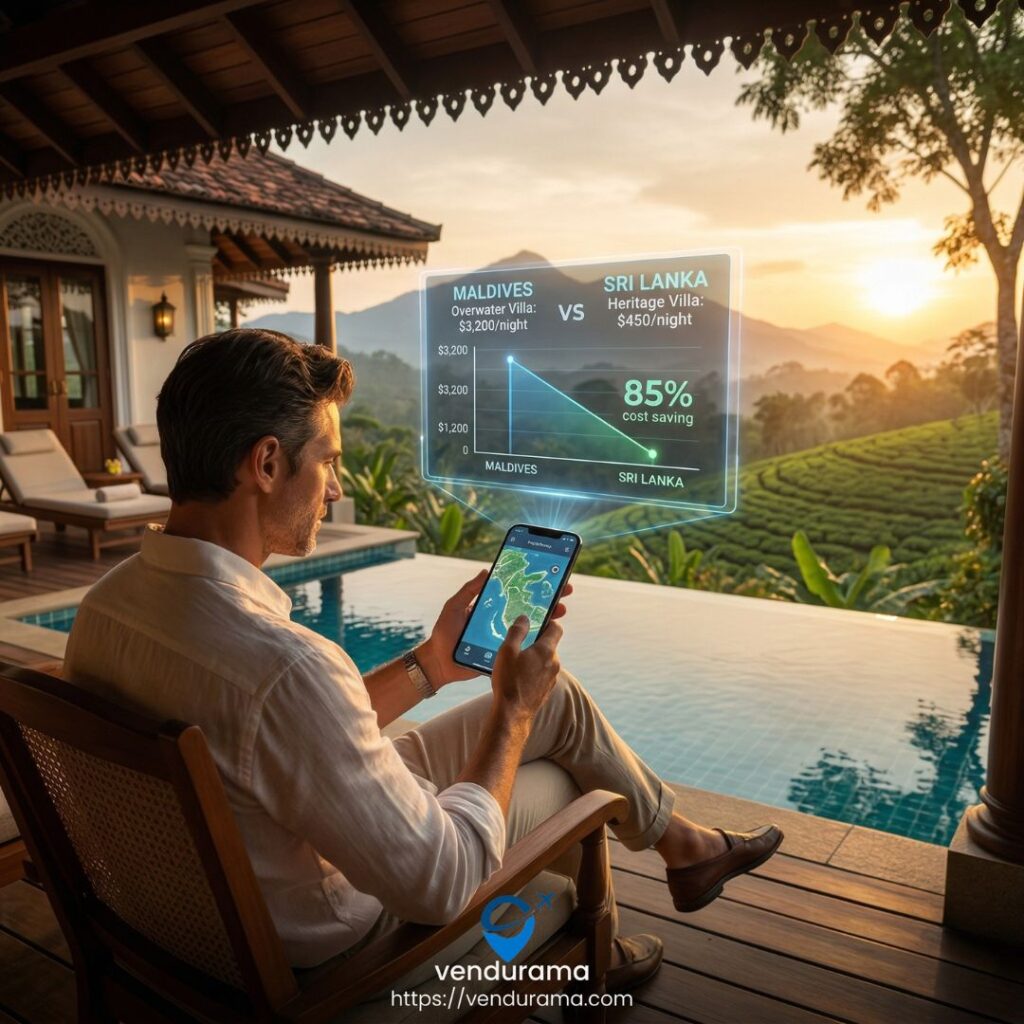
The rational traveler’s decision to pursue tropical arbitrage in Sri Lanka extends beyond pure cost calculus to encompass experiential authenticity and psychological value. Unlike manufactured resort environments that isolate guests from local culture, Sri Lanka’s luxury properties frequently integrate authentic cultural elements: cooking classes with local chefs, traditional mask-carving demonstrations, and guided visits to UNESCO World Heritage sites. This integration satisfies the sophisticated traveler’s desire for meaningful engagement while maintaining the comfort and service standards expected of ultra-premium experiences.
Safety and infrastructure considerations, frequently cited concerns for emerging destinations, warrant definitive analysis. Sri Lanka’s tourism police force, established in 2019, provides dedicated support for international visitors in major tourist zones. Healthcare infrastructure in Colombo and major tourist centers includes internationally accredited hospitals with English-speaking specialists. For the analytically-minded traveler, these factors represent manageable variables within a controlled risk framework—particularly when compared to the financial certainty of substantial cost savings. The psychological benefit of “smart luxury”—the satisfaction of securing exceptional experiences through strategic intelligence rather than brute-force spending—adds a layer of experiential value that transcends mere monetary savings.
The Comparative Economics: Traditional vs. Arbitrage Destinations
The economic case for geographic luxury arbitrage is best understood through rigorous comparative analysis. The table below presents a comprehensive breakdown of total costs for a seven-day luxury itinerary across four destination pairs, incorporating accommodation, dining, activities, and ancillary expenses. All figures are presented in 2026 USD, adjusted for purchasing power parity where applicable.
| Cost Component | Swiss Alps (Premium) | Almaty, Kazakhstan (Luxury) | Maldives (Premium) | Sri Lanka (Luxury) |
| Accommodation (7 nights) | $8,400 | $2,100 | $22,400 | $2,800 |
| Dining (3 meals/day) | $1,260 | $315 | $2,100 | $420 |
| Activities/Excursions | $2,100 | $650 | $1,750 | $490 |
| Spa/Wellness | $840 | $210 | $1,400 | $280 |
| Local Transportation | $420 | $175 | $700 (seaplane) | $210 |
| Subtotal (On-Ground) | $13,020 | $3,450 | $28,350 | $4,200 |
| International Flights (Round-trip) | $1,800 | $1,400 | $2,200 | $1,300 |
| Travel Insurance | $350 | $350 | $450 | $350 |
| Total Economic Cost | $15,170 | $5,200 | $31,000 | $5,850 |
| Opportunity Cost of Capital (5% annual return) | +$758 | +$260 | +$1,550 | +$293 |
| True 1-Year Cost | $15,928 | $5,460 | $32,550 | $6,143 |
Source: Hotel pricing databases, tourism board statistics, World Bank PPP adjustments, author calculations
Engineering the Perfect Arbitrage Itinerary
Pre-Departure Intelligence Gathering
The successful execution of geographic luxury arbitrage depends on meticulous pre-departure preparation. A sophisticated travel strategy operates on three analytical planes: destination research, logistical coordination, and risk mitigation. Each phase requires distinct tools, partnerships, and verification protocols.
Destination research begins with infrastructure validation: confirming accommodation quality through recent guest reviews on multiple platforms, verifying activity provider credentials through local tourism authorities, and assessing seasonal weather patterns through meteorological data. Strategic routing is paramount; securing premium aviation connections early in the planning phase frequently yields access to superior cabin classes without the peak-season premium. The Ultimate Travel Planning Guide 2026 provides methodological scaffolding for this due diligence process: its accompanying expert podcast offers chronological blueprints for research protocols, booking windows, and contingency planning that complement destination-specific intelligence.
Execution: Flights, Transfers, and On-Ground Logistics
The arrival phase represents the period of greatest vulnerability to logistical friction. Following a long-haul flight, navigating an unfamiliar city with luggage and potential jet lag requires strategic foresight. Proactive travelers eliminate arrival friction completely by coordinating seamless terminal-to-hotel logistics well before departure, ensuring immediate access to local intelligence via professional chauffeurs.
On-ground logistics in arbitrage destinations benefit from hybrid approaches that combine local expertise with international standards. In Almaty, reputable outfitters provide bilingual guides for mountain excursions, equipped with satellite communication devices and emergency medical training. In Sri Lanka, luxury properties frequently offer dedicated “experience managers” who coordinate cultural excursions, dining reservations, and wellness treatments with seamless precision.
Contingency planning represents the final pillar of flawless execution. Geographic arbitrage introduces unique variables: potential currency fluctuations, political developments affecting travel advisories, or infrastructure disruptions due to seasonal weather. A robust strategy includes: (1) purchasing comprehensive travel insurance; (2) maintaining emergency funds; (3) cultivating relationships with local fixers.
For travelers executing this strategy, the integration of professional logistical services is not a luxury but a strategic imperative. The ability to optimize first-class or business cabin itineraries during the planning phase, followed by arranging vetted ground transportation prior to arrival on arrival day, creates a seamless logistical continuum that minimizes friction and maximizes cognitive bandwidth for experiential engagement.
Risk Mitigation and the Psychology of Smart Luxury
The rational traveler’s decision framework extends beyond cost comparison to encompass risk-adjusted value assessment. Key evaluation criteria for arbitrage destinations include: (1) political stability metrics; (2) healthcare infrastructure quality; (3) transportation safety records; (4) currency volatility trends. The analytically-minded traveler treats these factors not as binary pass/fail criteria but as continuous variables within a probabilistic risk model.
Psychological considerations play an equally critical role in the arbitrage decision. The “smart luxury” mindset—deriving satisfaction from strategic intelligence rather than conspicuous consumption—creates a positive feedback loop: successful arbitrage experiences reinforce analytical decision-making, which in turn enhances future travel outcomes.
Conclusion: The Strategic Advantage of Geographic Luxury Arbitrage
The strategic imperative for upper-middle-class travelers facing luxury travel inflation is clear: geographic arbitrage is not merely an alternative pathway, but a rational optimization of experiential capital. By leveraging the purchasing power advantages of emerging luxury destinations, travelers can secure ultra-premium experiences at 20-40% of conventional costs. The $7,000-$9,000 differential is not merely savings; it is capital that can be deployed toward future travel, investment portfolios, or wealth preservation strategies.
This arbitrage strategy requires sophisticated execution: rigorous due diligence on infrastructure quality, strategic logistical planning for seamless transitions, and proactive engagement with local expertise. But for the analytically-minded traveler willing to conduct this diligence, the reward is profound: a debt-free path to ultra-luxury experiences that provides not only experiential satisfaction but also financial resilience.
The final component of this strategic framework is access to curated, actionable intelligence. The Ultimate Travel Planning Guide 2026, at a highly discounted price of $7.00, represents the ultimate investment in a successful, stress-free luxury arbitrage experience. This comprehensive resource ensures that the substantial financial advantage of this pathway is matched by equally rigorous logistical and experiential preparation.