
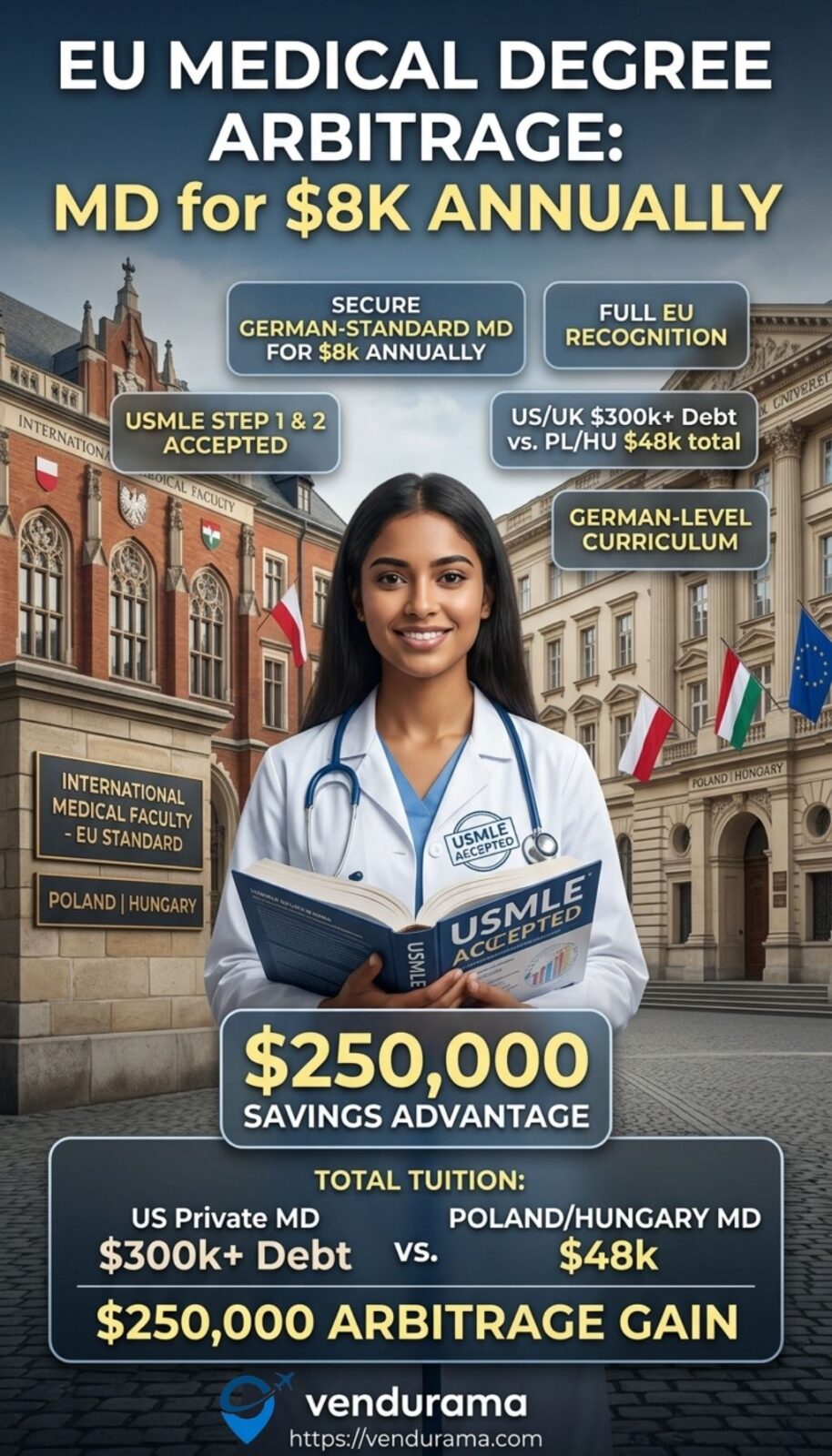
The Financial Extinction of the Western Medical Student
The contemporary calculus of medical education in Anglophone economies has reached a point of structural unsustainability. In the United States, the Association of American Medical Colleges reports that the median debt burden for graduating physicians now exceeds $250,000, with private institution attendees frequently surpassing $400,000 when factoring in opportunity costs and compound interest during residency. The United Kingdom presents a parallel crisis: domestic tuition caps have been abandoned for international students, with annual fees at prestigious institutions now exceeding £45,000, while living costs in London approach £18,000 annually. For the rational, analytically-minded middle-class family—those with sufficient capital to invest in human capital but insufficient wealth to absorb catastrophic financial risk—this represents not merely a challenge, but a systemic market failure.
Enter the concept of Geographic Educational Arbitrage: the strategic deployment of capital across jurisdictional boundaries to capture equivalent or superior educational outcomes at a fraction of the cost. This is not a compromise; it is an optimization problem solved through rigorous analysis of accreditation frameworks, curricular alignment, and post-graduate mobility pathways. The European Union, through the Bologna Process and the European Recognition Directive (2005/36/EC), has created a harmonized higher education area where medical degrees from accredited institutions in Poland and Hungary carry automatic professional recognition across all 27 member states. Crucially, these programs are delivered entirely in English, maintain USMLE Step 1 and Step 2 CK curricular integration, and prepare graduates for successful matching into United States residency programs via the ECFMG pathway.
The arbitrage opportunity is stark: a six-year MD program in Poland or Hungary costs between $48,000 and $84,000 in total tuition, compared to $240,000 to $400,000+ for equivalent programs in the United States. When factoring in living expenses, the total cost differential approaches $250,000—capital that can instead be deployed toward residency application strategies, research fellowships, or early-career wealth accumulation. For parents and students willing to conduct diligent due diligence, this represents not merely savings, but a strategic advantage in an increasingly competitive global medical marketplace.
Before embarking on this analytical journey, sophisticated families benefit from a structured framework for evaluating international educational opportunities. The Ultimate Study Abroad Guide: From Dream to Reality 2026 serves as the foundational starting point, providing the methodological scaffolding for assessing accreditation, visa logistics, and cultural integration. At a discounted price of $14.99, this resource includes two exclusive masterclass podcasts: a highly concentrated 22-minute session on rapid opportunity assessment, and a deep-dive 50-minute blueprint detailing the end-to-end relocation timeline—a critical complement to the macroeconomic analysis presented herein.
Warsaw and Krakow: English-Taught Medicine with USMLE Alignment
Poland has emerged as the vanguard of Central European medical education, leveraging post-1989 academic reforms to create institutions that rival Western European counterparts in both infrastructure and outcomes. The Medical University of Warsaw and Jagiellonian University Medical College in Krakow exemplify this transformation, offering six-year MD programs taught entirely in English that are explicitly designed for global mobility. These programs are not “international tracks” grafted onto domestic curricula; they are purpose-built, with USMLE Step 1 content integrated into pre-clinical coursework and OSCE-style clinical assessments mirroring the format of the United States Medical Licensing Examination.
The Academic Architecture of Polish Medical Universities
The pedagogical innovation underpinning Polish medical education lies in its simulation-centered clinical training. Institutions like the Medical University of Gdańsk have invested over €20 million in state-of-the-art simulation centers featuring high-fidelity manikins, virtual reality surgical trainers, and standardized patient programs. This infrastructure allows students to accumulate hundreds of hours of procedural practice before entering clinical rotations—a significant advantage over many US programs where such resources are reserved for later training stages. Moreover, the Bologna Process alignment ensures that Polish medical degrees adhere to the European Credit Transfer and Accumulation System (ECTS), facilitating seamless credit recognition should students pursue electives or research fellowships elsewhere in the EU.
Crucially, Polish medical universities maintain active partnerships with US teaching hospitals. The Medical University of Warsaw, for instance, has affiliation agreements with institutions like the Mayo Clinic and Johns Hopkins for clinical electives, providing students with invaluable exposure to the US healthcare system and strong letters of recommendation for residency applications. The cost structure remains remarkably accessible: annual tuition ranges from $8,000 at public institutions to $14,000 at elite private programs, with living expenses in Warsaw or Krakow averaging $600-$900 monthly for comfortable student accommodation.
For families conducting initial university evaluations, the logistical precision of the reconnaissance phase cannot be overstated. Proper assessment of a city’s academic infrastructure, clinical affiliate quality, and student support systems requires immersive, on-the-ground evaluation. Families should book optimized flight routes and secure temporary campus-adjacent apartments to properly assess the environment in which their child will spend six formative years. This strategic approach to campus tours ensures that the arbitrage decision is based on comprehensive, firsthand intelligence rather than marketing materials alone.
Budapest and Debrecen: The Legacy of European Medical Excellence
Hungary’s medical education tradition dates to the founding of the University of Budapest in 1635, but its modern renaissance stems from post-Communist investments in English-language programs designed for global export. Today, institutions like Semmelweis University in Budapest and the University of Debrecen attract over 3,000 international medical students annually, creating a cosmopolitan academic environment that mirrors the diversity of modern healthcare practice. The Hungarian model emphasizes early clinical exposure, with students beginning hospital rotations in their third year—a full two years earlier than the US standard—thereby accelerating clinical competency development.
Semmelweis University and the European Recognition Directive
Semmelweis University, consistently ranked among Europe’s top 100 medical schools, exemplifies the Hungarian advantage. Its English-language MD program is fully accredited by the Hungarian Medical Chamber and recognized by the World Directory of Medical Schools, a prerequisite for ECFMG certification and US residency eligibility. More significantly, as an EU institution, its degrees benefit from the European Recognition Directive, which mandates automatic professional recognition across all member states. This creates a powerful optionality value: graduates can pursue residency in Germany, practice in Scandinavia under streamlined licensing, or return to the US via the ECFMG pathway—all with the same foundational credential.
Hungarian medical curricula are explicitly designed for global licensing exam success. The University of Debrecen, for instance, integrates USMLE-style question banks into its pre-clinical coursework and offers dedicated Step 1 preparation modules in the fourth year. The result is measurable: Hungarian medical graduates match into US residency programs at rates exceeding 70% for those who apply.
The logistical security of student relocation cannot be treated as an afterthought. On arrival day, a first-year medical student navigating a new Eastern European city with heavy academic luggage and the psychological weight of a major life transition requires absolute reliability. Parents who prioritize this critical juncture choose to arrange a pre-booked, vetted transfer directly from the airport to the student dormitories, eliminating the uncertainty of public transportation or unregulated taxi services. This small logistical decision significantly reduces arrival-day stress.
The $250,000 Differential: Breaking Down Tuition and Living Costs
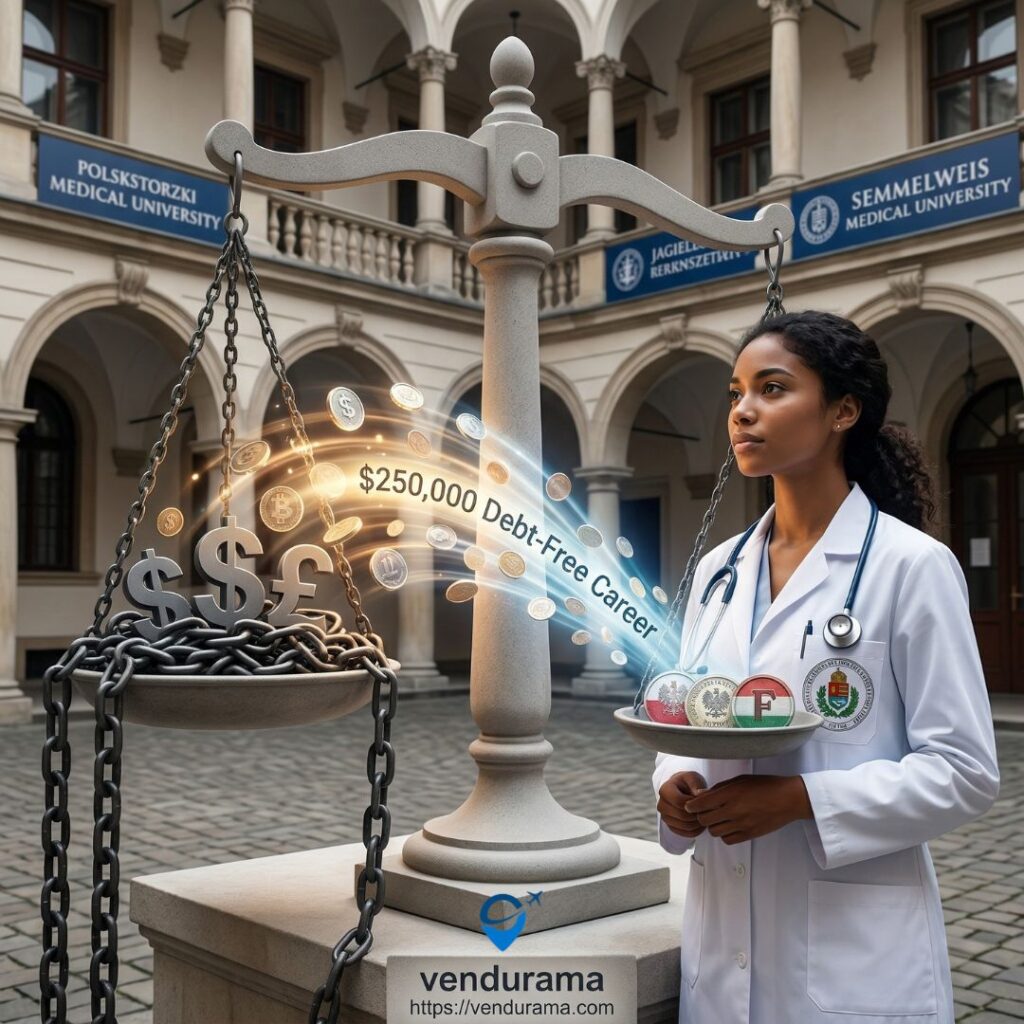
The economic case for EU medical arbitrage is best understood through rigorous comparative analysis. The table below presents a comprehensive breakdown of total costs for a six-year MD program across four jurisdictions, incorporating tuition, mandatory fees, housing, and essential living expenses.
| Cost Component | US Private Institution | UK (International) | Poland (Public) | Hungary (Public) |
| Annual Tuition | $65,000 | $52,000 | $8,000 | $12,000 |
| Mandatory Fees | $3,500 | $2,800 | $500 | $800 |
| Annual Housing | $18,000 | $16,000 | $3,600 | $4,200 |
| Living Expenses | $12,000 | $14,000 | $4,800 | $5,400 |
| Health Insurance | $4,000 | $3,200 | $600 | $700 |
| Books/Supplies | $2,500 | $2,200 | $800 | $900 |
| Annual Total | $105,000 | $90,200 | $18,300 | $24,000 |
| 6-Year Total | $630,000 | $541,200 | $109,800 | $144,000 |
| Debt Financing Cost (6.5% APR) | +$142,000 | +$121,000 | +$24,500 | +$32,200 |
| True Economic Cost | $772,000 | $662,200 | $134,300 | $176,200 |
Source: Institutional financial aid offices, OECD Education at a Glance 2025, Numbeo Cost of Living Index, author calculations
Several analytical observations emerge from this data. First, the nominal tuition differential understates the true economic advantage: when factoring in debt financing costs, the US/UK options carry a 400-500% premium over Polish or Hungarian alternatives. Second, the purchasing power parity adjustment reveals that $800 monthly in Warsaw provides a comparable standard of living to $2,000 in Boston or London. Third, the opportunity cost of debt is profound: a graduate carrying $300,000 in medical school debt at 6.5% APR will pay approximately $1,800 monthly in interest alone during residency.
Engineering a Flawless Transition: Logistical Security for Medical Students
The successful execution of educational arbitrage depends as much on logistical precision as on academic selection. A sophisticated relocation strategy operates on three temporal planes: pre-departure preparation, arrival-phase execution, and long-term integration support.
Pre-Departure (Months 12-3): The foundation of a seamless transition is laid during the reconnaissance phase. Families should conduct at least two campus visits. During these visits, critical due diligence includes verifying university accreditation status and confirming ECFMG eligibility. For families conducting these evaluations, the ability to reserve flexible travel arrangements and strategic short-term accommodations transforms a potentially fragmented scouting process into a coherent, efficient intelligence-gathering operation.
Arrival Phase (Month 0): The first 72 hours in a new country set the psychological and practical foundation for the entire educational journey. Critical success factors include secure airport-to-housing transportation and immediate access to local services. Parents who recognize this vulnerability prioritize reliability over cost savings, choosing to secure a reliable, professional transport service from the terminal directly to their new residence. This provides a predictable, stress-free arrival experience—a small investment with disproportionate impact on early-term adaptation.
Integration Phase (Months 1-24): Long-term success depends on systematic integration support. Leading Polish and Hungarian universities offer comprehensive international student services, including academic advisors for USMLE preparation and cultural orientation programs. Crucially, the Ultimate Study Abroad Guide: From Dream to Reality 2026 provides methodological scaffolding for this phase: its included 50-minute masterclass podcast perfectly outlines the visa and relocation timeline, offering a chronological blueprint for document preparation, embassy appointments, and pre-departure logistics that complements university-provided support.
Reclaiming the Future of Medical Professionals
The strategic imperative for middle-class families facing the medical education cost crisis is clear: geographic educational arbitrage is not merely an alternative pathway, but a rational optimization of human capital investment. By leveraging the harmonized accreditation frameworks of the European Union, the English-language curricular innovations of Polish and Hungarian institutions, and the global mobility pathways of the ECFMG system, families can secure world-class medical training at 15-20% of the Anglophone cost. The $250,000 differential is not merely savings; it is capital that can be deployed toward early-career wealth accumulation—creating a compounding advantage that extends far beyond graduation.
This arbitrage strategy requires sophisticated execution: rigorous due diligence on accreditation status, strategic logistical planning for relocation, and proactive engagement with global licensing pathways. But for the analytically-minded family willing to conduct this diligence, the reward is profound: a debt-free medical education that provides not only clinical competency but also strategic optionality across multiple healthcare systems and geographic markets.
The final component of this strategic framework is access to curated, actionable intelligence. The Ultimate Study Abroad Guide: From Dream to Reality 2026, at a discounted price of $14.99, represents the ultimate investment in a debt-free medical career. This comprehensive resource includes two exclusive masterclass podcasts: a highly concentrated 22-minute session on rapid opportunity assessment, and a deep-dive 50-minute blueprint detailing the end-to-end relocation timeline. For families executing the EU medical arbitrage strategy, this guide provides the methodological scaffolding to transform analytical insight into successful execution.
The future of medical professionalism belongs not to those who accumulate the most debt, but to those who optimize the most value. By embracing the EU medical degree arbitrage, middle-class families can reclaim agency over their educational investments and position the next generation of physicians for success in a globalized healthcare marketplace.