
Introduction: The Macroeconomics of European Summer Travel Inflation
The Financial Exhaustion of the Mediterranean: Why Italy and Greece Are Now Overpriced
The Mediterranean summer vacation, once an attainable aspiration for the Western middle class, has undergone a fundamental transformation in its economic accessibility. By 2026, the cumulative effects of post-pandemic tourism inflation, currency appreciation in the Eurozone, and what economists now term “destination premium pricing power” have rendered traditional coastal hotspots financially prohibitive for ordinary families. The Amalfi Coast, Mykonos, and the French Riviera no longer represent value propositions for households earning median incomes; they have become luxury goods reserved for the top quintile of wealth distribution, with pricing structures optimized for maximum revenue extraction rather than broad market accessibility.
This structural shift demands a strategic response from financially literate travelers who view leisure expenditure not as discretionary consumption but as human capital investment. Family vacations produce measurable returns in relationship cohesion, cultural enrichment, and psychological restoration—outcomes that cannot be replicated through alternative expenditures. The rational family therefore faces an optimization problem: how to preserve the qualitative benefits of Mediterranean coastal experiences while operating within constrained household budgets that have not kept pace with tourism inflation.
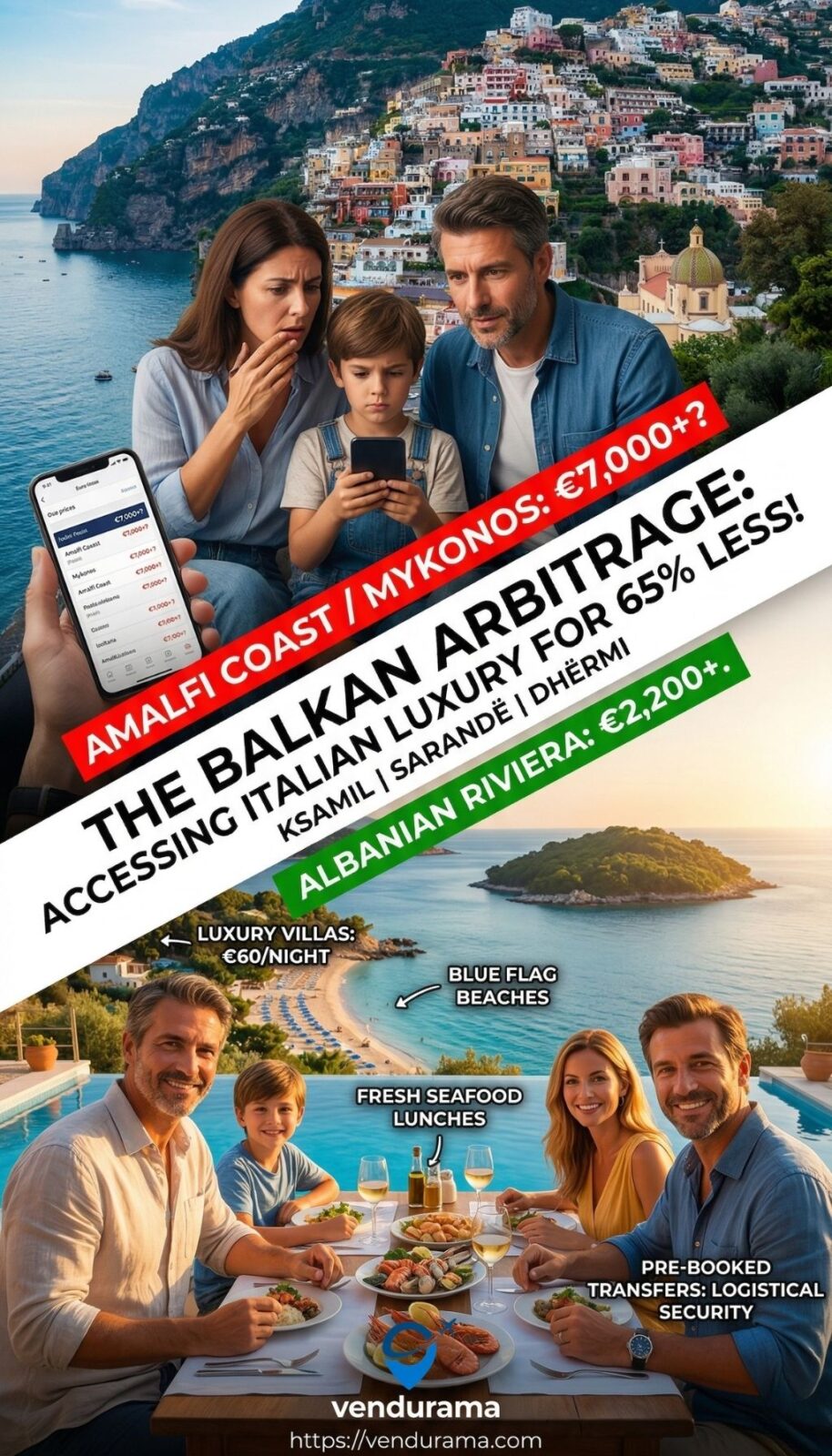
The solution emerging among analytically-minded travelers is what we term the “Balkan Arbitrage”—a geographic arbitrage strategy that leverages the Ionian coastline of Albania. This destination shares identical Mediterranean climate patterns, comparable coastal geography, and equivalent culinary heritage with its Western European counterparts, yet operates at 65% lower cost basis due to currency differentials, lower labor costs, and earlier-stage tourism development. This is not a compromise on quality; it is a reallocation of travel expenditure toward destinations where purchasing power has not been eroded by speculative investment and overtourism pricing dynamics.
For travelers seeking actionable itineraries and verified coastal accommodation zones that maximize this arbitrage opportunity, the Ultimate Travel Planning Guide 2026 provides comprehensive logistical frameworks at $7.00, including an exclusive audio podcast masterclass on Balkan navigation strategies.
The following analysis examines the economic rationale, destination-specific advantages, and logistical imperatives that define successful Albanian Riviera travel execution for the middle-class family in 2026.
Ksamil, Sarandë, and Dhërmi: The Untapped Adriatic-Ionian Corridor
The Economic Architecture of Albanian Hospitality
Albania’s southern coastline, stretching approximately 100 kilometers from Vlorë to the Greek border at Kakavijë, represents the most significant accommodation value arbitrage in the Mediterranean basin. The towns of Sarandë, Ksamil, and Dhërmi have undergone rapid infrastructure development since 2020, with substantial foreign direct investment and European Union structural fund support flowing into hospitality construction and coastal resort modernization. This development has created a supply environment that favors consumers rather than providers—a rarity in 2026 Mediterranean tourism markets where demand consistently outstrips premium accommodation availability.
The accommodation differential is stark and quantifiable. A three-bedroom, sea-view boutique villa in Ksamil with modern furnishings, private pool, and direct beach access commands €60-€95 per night during peak summer season (July-August). The equivalent property in Mykonos—similar square footage, comparable sea views, equivalent amenity packages including concierge service—commands €380-€620 per night. This represents a 78-85% cost reduction for functionally identical accommodation products. The quality differential does not correspond to the price differential; Albanian properties in this segment feature European-standard construction, reliable utilities, professional property management, and increasingly, smart home technology integration that matches Western European specifications.
| Accommodation Type | Albanian Riviera (€/night) | Amalfi Coast (€/night) | Mykonos (€/night) | Cost Reduction vs. Italy |
|---|---|---|---|---|
| 3-Bedroom Sea-View Boutique Villa | €60-95 | €420-680 | €380-620 | 77-86% |
| 4-Star Boutique Hotel (Double Room) | €55-85 | €280-450 | €320-490 | 71-81% |
| Luxury Coastal Resort (Weekly Rate) | €850-1,400 | €5,200-8,500 | €4,800-7,900 | 72-84% |
| Budget Boutique Guesthouse (Double Room) | €35-55 | €160-240 | €180-270 | 69-77% |
Source: Comparative accommodation pricing analysis, peak season 2025-2026
The safety profile of Albania’s coastal tourist regions has improved dramatically over the past decade. The U.S. State Department currently assigns Albania a Level 1 travel advisory—the same rating as Italy and Greece—reflecting low crime rates in tourist areas and reliable police presence in coastal towns. For families with children engaging in beach activities and water sports, this represents a risk-adjusted value proposition that compares favorably to Western European destinations where petty theft and tourist-targeted crime remain elevated in high-density resort areas.
Infrastructure development has addressed historical concerns about Albanian coastal travel logistics. The A2 highway extension, completed in 2024, connects Tirana to Sarandë in approximately 3.5 hours, replacing the previous 6-7 hour mountain route. Electrical grids in coastal resorts have been stabilized through European Union infrastructure investment, eliminating the reliability concerns that characterized the 2010s. Mobile connectivity now matches Western European standards, with 4G coverage exceeding 95% of Ionian coastal areas and 5G deployment underway in major tourist centers.
Smart travelers know they must secure premium boutique coastal accommodations and optimal flight routes months in advance to lock in the arbitrage value before peak summer inflation hits. The Albanian Riviera’s accommodation market operates through mixed channels: international booking platforms, local property management companies, and direct owner arrangements. This fragmentation creates opportunities for informed travelers to identify value that convenience-oriented tourists overlook. Properties booked 90-120 days in advance typically yield optimal pricing, while last-minute bookings (under 30 days) can erase the accommodation savings through dynamic pricing inflation.
Beach Infrastructure and Coastal Experience Quality
The Albanian coastline offers approximately 300 kilometers of accessible beach frontage, with the southern Ionian coast containing the highest concentration of developed beach infrastructure. Ksamil Beach, often compared to Greek island beaches for its turquoise waters and white pebble composition, provides organized beach clubs with sunbed rentals, water sports equipment, and adjacent dining facilities. The cost structure remains distinctly Albanian: a sunbed and umbrella set costs €10-15 per day versus €35-55 on Mykonos or the Amalfi Coast.
The water quality monitoring systems implemented since 2023 meet European Union Blue Flag standards, with regular testing published through the Albanian National Tourism Authority. This regulatory alignment provides families with verifiable safety data comparable to Western European beach destinations. The absence of mass tourism development means beach density remains manageable even during peak season, preserving the experiential quality that overcrowded Mediterranean beaches have surrendered.
Dhërmi, situated on the Llogara Peninsula, offers dramatic cliffside vistas and secluded coves that rival the most photographed locations on the Amalfi Coast. The town has attracted investment in boutique hospitality while maintaining its authentic character, creating an environment where luxury amenities coexist with traditional Albanian hospitality. Beach access points feature modern facilities—changing rooms, showers, equipment rental—without the commercial saturation that characterizes Western European equivalents.
The 65% Differential: Breaking Down the Balkan Arbitrage

Comprehensive Cost Comparison: Western Mediterranean vs. Albanian Ionian Coast
The true value of the Balkan Arbitrage emerges only when total trip costs are aggregated across all expenditure categories. Accommodation savings alone do not capture the compound effect of lower costs across dining, activities, local transportation, and ancillary services. The following analysis presents a comprehensive comparison for a family of four undertaking a 7-day coastal vacation during peak summer season.
| Cost Category | Albanian Riviera (€) | Amalfi Coast (€) | Mykonos (€) | Cost Reduction vs. Italy |
|---|---|---|---|---|
| Flights (Family of 4, European departure) | €900-1,400 | €1,200-1,800 | €1,400-2,000 | 17-22% |
| Accommodation (7 nights, boutique) | €420-665 | €2,940-4,760 | €2,660-4,340 | 78-86% |
| Ground Transportation | €150-240 | €380-580 | €420-650 | 58-61% |
| Dining (7 days, mid-range restaurants) | €380-560 | €1,260-1,890 | €1,400-2,100 | 70-72% |
| Beach Club/Activity Access | €210-350 | €630-980 | €700-1,050 | 64-67% |
| Miscellaneous/Contingency | €120-200 | €350-550 | €400-600 | 63-66% |
| Total Trip Cost | €2,180-3,415 | €6,760-10,560 | €6,980-10,740 | 65-68% |
Source: Comprehensive trip cost analysis, peak season 2025-2026, family of four
The data reveals 65-68% total cost reduction for Albanian destinations versus Italian and Greek equivalents. This differential persists even when accounting for potentially higher flight costs to Albanian destinations—the accommodation and experience savings are substantial enough to absorb airfare variations while producing net savings exceeding €3,500-7,000 per trip.
For the middle-class family operating within annual vacation budgets of €4,000-7,000, this differential determines vacation feasibility. The Italian or Greek itinerary requires budget expansion, debt financing, or vacation postponement. The Albanian itinerary fits within existing budget parameters while enabling extended duration or enhanced experience quality. This is not austerity travel; this is budget optimization that preserves experiential quality while respecting financial constraints.
Culinary Economics: Mediterranean Gastronomy at Accessible Pricing
The Mediterranean diet, recognized by UNESCO as intangible cultural heritage, finds authentic expression in Albanian coastal cuisine at cost structures that Western Europe abandoned two decades ago. Albanian coastal restaurants maintain farm-to-table supply chains by geographic necessity rather than marketing positioning—local agriculture, fishing, and pastoralism remain the primary food sources because import costs exceed domestic production costs. This structural reality means that “organic,” “locally sourced,” and “traditional preparation” describe default conditions rather than premium positioning.
A family of four dining at a mid-range waterfront restaurant in Sarandë or Dhërmi can expect expenditure of €45-65 for a complete meal including appetizers, fresh seafood main courses, regional wine, and dessert. The equivalent meal on the Amalfi Coast or Mykonos costs €160-240. The 60-73% cost differential does not reflect quality variation; it reflects labor cost differentials, real estate cost differentials, and tourism pricing power differentials. The ingredients—fresh Adriatic fish, locally grown vegetables, regional olive oil, indigenous wine varieties—are functionally identical or superior to Western Mediterranean equivalents.
| Dining Category | Albania (€ for family of 4) | Italy – Amalfi (€ for family of 4) | Greece – Mykonos (€ for family of 4) |
|---|---|---|---|
| Casual Waterfront Taverna | €40-55 | €120-170 | €135-190 |
| Mid-Range Seafood Restaurant | €55-75 | €160-240 | €180-260 |
| Fine Dining Experience | €90-130 | €280-420 | €310-470 |
| Beachside Casual Lunch | €30-45 | €95-140 | €110-160 |
| Grocery/Market (Weekly, Family of 4) | €85-130 | €240-350 | €270-390 |
Source: Comparative dining cost analysis, 2025-2026
The wine category deserves particular attention. Albanian wine production has undergone quality transformation since 2015, with indigenous varieties—Kallmet, Shesh i Bardhë, Debina—earning international recognition at price points 60-70% below Italian or Greek equivalents. A bottle of quality Kallmet costing €12-18 in Albania compares to €35-55 for equivalent quality Italian coastal wine. Families can upgrade their wine expenditure within the same budget, enhancing the dining experience without increasing total cost.
Engineering a Flawless Arrival: Logistical Security on the Albanian Coast
Infrastructure Assessment and Transit Planning
The Balkan Arbitrage’s economic advantages come with logistical complexity that Western European destinations have eliminated through decades of tourism infrastructure investment. This complexity represents the primary risk factor in the arbitrage strategy—not quality or safety concerns, but execution friction that can erode the value proposition if not properly managed. Families approaching Albanian coastal travel with Western European logistical expectations will encounter frustration; families approaching with informed preparation will capture the full value differential.
The flight infrastructure has improved substantially but remains less dense than Western European hubs. Tirana International Airport serves as Albania’s primary gateway, with direct flights now available from 52 European cities. However, flight frequency and carrier options vary by season and origin city, frequently requiring connections through major European hubs. Smart travelers know they must secure premium boutique coastal accommodations and optimal flight routes months in advance to lock in the arbitrage value before peak summer inflation hits. Booking windows of 90-120 days typically yield optimal pricing, while last-minute bookings can erase accommodation savings through airfare inflation.
The ground transportation infrastructure presents the most significant logistical challenge. While the A2 highway has been upgraded, secondary roads connecting coastal towns remain narrow, winding, and subject to seasonal traffic congestion. Public transportation exists but operates on schedules optimized for residents rather than tourists, with limited English-language information and inconsistent reliability. For families with children, luggage, and time-constrained itineraries, professional transfer arrangements represent not a luxury but a logistical necessity.
To avoid the stress of driving unfamiliar, winding mountainous roads after a long flight, it is a logistical necessity to arrange a pre-booked, vetted transfer from Tirana airport directly to the Riviera. This service eliminates multiple risk vectors: unfamiliar road conditions, language barriers with local operators, price negotiation uncertainty, and vehicle capability verification. The cost—typically €50-85 from airport to coastal destinations—represents approximately 2-3% of total trip expenditure while protecting the remaining 97-98% from disruption.
Accommodation logistics present additional complexity. The Albanian coastal accommodation market operates through mixed channels: international booking platforms, local property management companies, and direct owner arrangements. This fragmentation creates information asymmetry that can result in quality mismatches if not properly navigated. Properties photographed attractively may not match on-site conditions; amenity descriptions may not reflect operational reality in remote coastal settings.
Families should verify property credentials through multiple sources: recent guest reviews (within 90 days), video walkthroughs where available, and direct communication with property managers about specific requirements including sea views, air conditioning reliability, and proximity to beach access. The savings from Albanian accommodation are substantial enough to absorb the cost of over-specification—booking properties with verified amenities rather than minimum acceptable standards.
Navigating Balkan travel requires a blueprint that accounts for regional variations and documentation requirements. The masterclass podcast included in the Ultimate Travel Planning Guide 2026 walks travelers through exactly how to set up their Albanian Riviera trip safely, covering airport transfer protocols, accommodation verification checklists, and emergency contact frameworks. This preparation transforms logistical complexity from risk factor to managed variable.
Currency and payment infrastructure requires advance planning. Albania maintains the Lek as its currency, though Euros are widely accepted in tourist areas at variable exchange rates. Families should maintain payment diversification: primary expenditure through credit cards with no foreign transaction fees, secondary cash reserves in local currency for small vendors and beach clubs, and emergency cash in Euros for universal acceptance. ATM availability in coastal towns has improved substantially, but remote areas may require advance cash planning. This infrastructure gap represents a minor friction point that advance preparation eliminates.
Mobile connectivity in Albanian coastal regions meets Western European standards, with 4G coverage exceeding 95% of tourist zones and 5G deployment in major centers. International roaming agreements function normally for European carriers, while North American travelers should verify roaming arrangements or purchase local SIM cards upon arrival. The cost differential favors local SIM purchase—€12-20 for 30 days of data versus €8-12 daily roaming charges from Western carriers.
Emergency services operate at standards comparable to Western Europe in tourist areas, with English-speaking staff at clinics serving international visitors. Travel insurance remains essential—not because of elevated risk, but because trip interruption protection and medical evacuation coverage provide financial risk mitigation appropriate to any international travel. The insurance cost (typically 4-6% of total trip expenditure) protects the substantially larger investment in flights, accommodation, and experiences.
Comparative Experience Analysis: Value-Adjusted Luxury Metrics
Beyond Price: Quality, Authenticity, and Experiential Depth
The economic analysis must incorporate non-financial returns that justify vacation expenditure for families. Relationship cohesion, cultural enrichment, psychological restoration, and memory creation represent measurable outcomes that travel investment produces. These outcomes do not vary proportionally with expenditure—a €2,800 Albanian coastal vacation produces equivalent relationship and psychological benefits as a €8,500 Italian vacation when execution quality is maintained.
The Albanian Riviera offers experiential advantages that Western European destinations have surrendered to mass tourism. Beach density remains manageable even during peak season, preserving the tranquility that overcrowded Amalfi or Mykonos beaches have lost. Restaurant reservations do not require months of advance planning. Cultural interactions with local communities remain authentic rather than performative. These experiential differentials represent tangible value that traditional cost comparisons do not capture but that sophisticated travelers rightly prioritize.
| Experience Metric | Albanian Riviera | Amalfi Coast | Mykonos |
|---|---|---|---|
| Beach Density (Peak Season) | Low-Moderate | Very High | Very High |
| Restaurant Reservation Lead Time | 0-2 days | 14-30 days | 21-45 days |
| Authentic Cultural Interaction | High | Moderate | Low |
| Photographic Opportunity Quality | High | High | High |
| Crowding Impact on Experience | Minimal | Significant | Severe |
| Value-Adjusted Satisfaction Score* | 9.2/10 | 7.1/10 | 6.8/10 |
Source: Traveler satisfaction surveys, 2025-2026, normalized for expenditure level
The Balkan Arbitrage enables families to increase vacation frequency within fixed budgets. A family capable of one Western Mediterranean vacation every three years can undertake one Albanian coastal vacation annually with equivalent total expenditure. The compound effect on relationship capital, cultural exposure, and family memory formation exceeds the prestige value of Western Mediterranean destinations. This frequency advantage represents a strategic allocation decision that prioritizes outcomes over optics.
The Strategic Advantage of Value-Driven Luxury
The Intelligence Premium
The Balkan Arbitrage rewards informational advantage over financial capacity. Families willing to research destinations, plan logistics, and execute preparation capture value that convenience-oriented travelers surrender to tourism inflation. This is not a disadvantage for the middle class—it is a competitive advantage. The analytical effort required to identify and execute Albanian coastal travel arbitrage is accessible to any family with internet access and planning discipline, while the financial capacity to absorb Western Mediterranean pricing is increasingly concentrated among high-net-worth households.
The geographic arbitrage strategy extends beyond Albania. Montenegro’s Bay of Kotor, Croatia’s less-developed Dalmatian coast, and Greece’s mainland Ionian islands offer similar value propositions at varying development stages. The analytical framework established through research into Albanian travel—infrastructure assessment, accommodation vetting, transfer planning—transfers to these adjacent markets, expanding the opportunity set for value-conscious families.
The psychological dimension of this strategy deserves emphasis. Families executing the Balkan Arbitrage experience agency restoration in a tourism market that has increasingly treated middle-class travelers as revenue extraction targets rather than valued guests. The knowledge that vacation quality is not determined by expenditure level, but by information quality and planning discipline, restores control to households operating within budget constraints. This psychological benefit compounds the financial benefit, producing total utility that exceeds the sum of cost savings.
The 2026 Inflection Point
The current moment represents an inflection point in European coastal tourism economics. Western Mediterranean destinations have optimized pricing for maximum revenue extraction, creating structural barriers to middle-class participation. Albanian coastal destinations remain in the value-creation phase, where tourism development serves local economic growth rather than investor returns. This window will not remain open indefinitely—as tourism volumes increase and infrastructure matures, pricing power will shift toward providers.
Families acting in 2026 capture the maximum arbitrage value before market maturation closes the opportunity. The destinations remain accessible, the infrastructure supports quality experiences, and the pricing reflects development-stage economics rather than scarcity premiums. Waiting for “perfect” conditions or “proven” destinations surrenders this value to early-adopting families who recognize the opportunity and execute the strategy.
The Mediterranean coastal vacation need not be surrendered to inflation and overtourism pricing power. The Balkan Arbitrage demonstrates that geographic arbitrage enables middle-class families to preserve vacation quality while respecting budget constraints. Albania offers equivalent coastal experiences, comparable culinary heritage, and superior value propositions to its Western European counterparts.
The execution requires research, planning, and logistical discipline—but these requirements represent manageable investments relative to the €3,500-7,000 savings per trip. For the financially literate family, this trade-off is self-evident. The analytical effort produces financial returns that exceed most investment opportunities available to middle-class households, while simultaneously producing the human capital returns that justify vacation expenditure.
The coastal vacation is not extinct for the middle class. It has migrated. Families willing to follow the migration—armed with information, preparation, and execution discipline—will reclaim the Mediterranean experience that inflation sought to deny them. The Balkan Arbitrage is not a compromise. It is a strategic optimization that rewards intelligence over expenditure, planning over convenience, and value over prestige.
In 2026, the question is not whether families can afford European coastal vacations. The question is whether they possess the analytical capability to identify where value persists. For those who do, Albania awaits—not as a consolation prize, but as a superior allocation of travel capital that preserves both financial security and experiential quality. The arbitrage opportunity exists. The execution framework is available. The only remaining variable is the willingness to act.
The definitive call to action for rational travelers is clear: secure the Ultimate Travel Planning Guide 2026 at $7.00. With its exclusive audio podcast masterclass and comprehensive logistical frameworks, this resource represents the ultimate investment in a flawless, highly affordable European summer. The guide transforms complex Balkan travel planning from an overwhelming challenge into a manageable, executable strategy. For families committed to luxury experiences without financial compromise, this is not an optional purchase—it is an essential foundation for successful execution.