EDUCATIONAL DISCLAIMER
This article is published for informational and educational purposes only. The content contained herein does not constitute educational advising, immigration consulting, or career counseling. All educational programs, visa requirements, and employment opportunities discussed carry individual variability in outcomes, admission requirements, and regulatory conditions. Readers should consult qualified educational advisors, licensed immigration attorneys, and career counselors before making decisions about international study programs. Vendurama functions as an elite informational publication and does not endorse specific universities, employers, or educational pathways. Educational investment decisions should be made in consultation with your family’s financial advisors, with full understanding of requirements, risks, and alternatives available in your jurisdiction of residence. Visa regulations and tuition policies may change without notice and should be verified directly with official government sources before commitment.
Introduction: The Student Debt Crisis and the Strategic Alternative of 2026
The class of 2026 faces an uncomfortable mathematical reality that previous generations never encountered: a standard four-year engineering degree from a reputable American university now costs between $250,000 and $320,000 when tuition, fees, accommodation, and living expenses are fully accounted for. For the mass affluent demographic—families with household incomes between $150,000 and $500,000 and investable assets between $500,000 and $5 million—this represents a catastrophic allocation of family capital. The typical graduate emerges with $150,000 in student loan debt, monthly payments exceeding $1,800, and a career trajectory that begins in negative equity rather than wealth accumulation.
This is not temporary inflation. This is structural repricing driven by administrative bloat, endowment-driven pricing power, and the transformation of American higher education into a luxury good that explicitly excludes the professional class. For families who have historically funded university education through careful savings and strategic financial planning, the math no longer works. A degree that once served as a wealth-building mechanism now functions as a wealth-destroying obligation that delays home ownership, retirement savings, and family formation by 10-15 years.
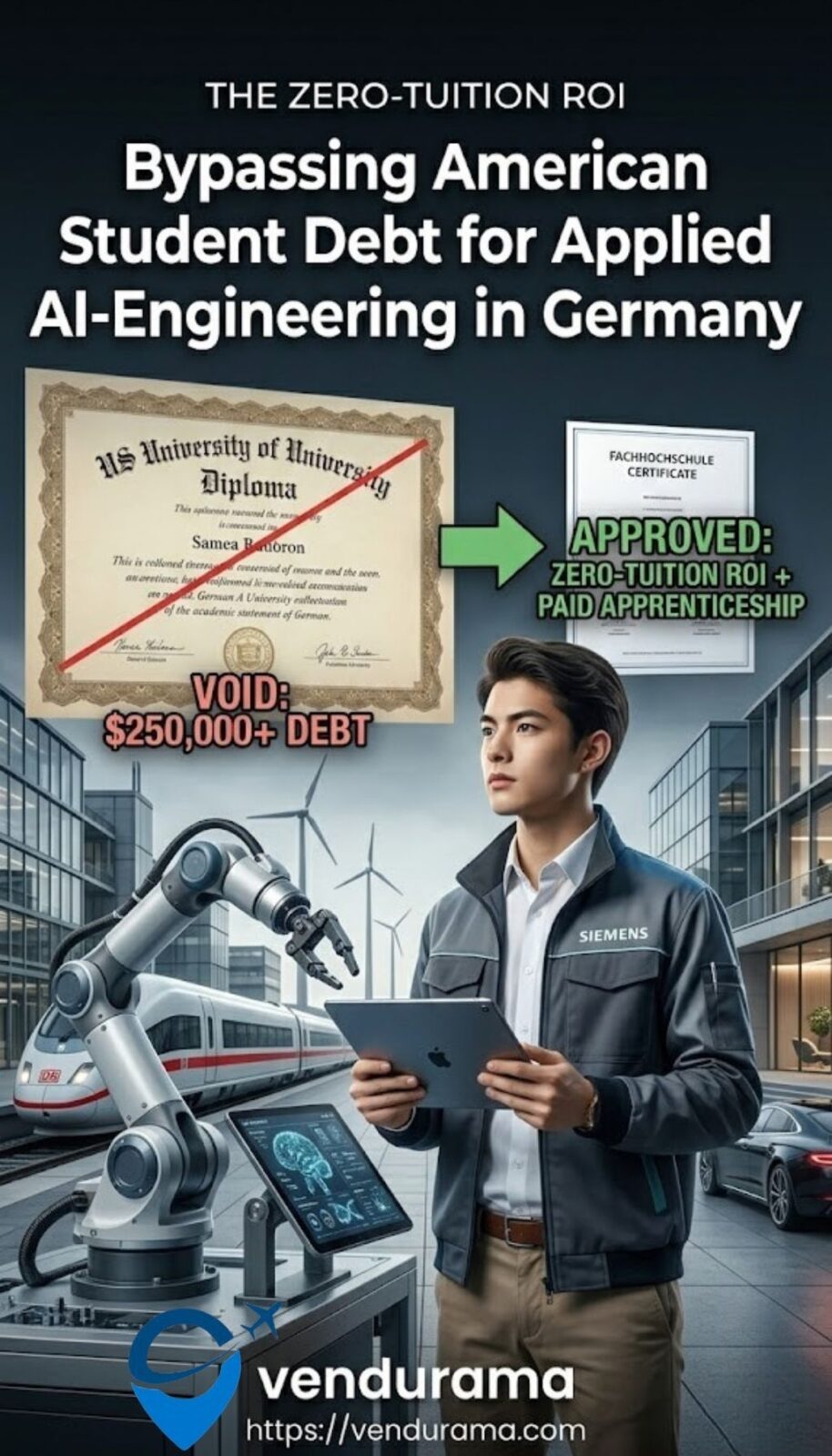
But there is a strategic alternative. The “Zero-Tuition ROI” strategy represents a fundamental reconceptualization of how mass affluent families approach higher education investment. Germany’s “Duales Studium” (dual study) programs in Applied AI-Engineering offer tuition-free education at world-class Fachhochschulen (Universities of Applied Sciences), combined with paid work placements at companies like Siemens, BMW, Bosch, and SAP. Students graduate with zero debt, three years of documented work experience, professional networks in the European technology sector, and eligibility for EU residency permits that enable long-term career mobility.
This article provides a comprehensive financial and logistical framework for executing the Zero-Tuition strategy. We will analyze the economics of debt-free education, detail the curriculum advantages of applied AI-engineering over theoretical computer science, explain the logistical infrastructure required to relocate an 18-year-old to Germany without compromising their academic focus, and address the legitimate concerns that prevent families from making this strategic shift. For readers who evaluate educational expenditures through the same analytical frameworks applied to household investment portfolios, this represents the most significant opportunity in human capital allocation since the emergence of Asian business schools in the 1990s.
The Financial Mathematics of Zero Debt: Comparing Educational Investment Trajectories
The American Engineering Degree: A Wealth-Destroying Investment
To understand the Zero-Tuition strategy, one must first confront the actual numbers. The following comparison examines the complete financial trajectory of two students: one pursuing a traditional American engineering degree, the other enrolled in a German Duales Studium program in Applied AI-Engineering.
| Financial Metric | US Engineering Degree | German Duales Studium | Differential |
|---|---|---|---|
| Tuition (4 years) | $220,000 | $0 | $220,000 savings |
| Fees & Administrative Costs | $30,000 | $500/semester | $26,000 savings |
| Accommodation & Living | $80,000 | $40,000 (partially offset by stipend) | $40,000 savings |
| Student Stipend/Earnings | $0 | $45,000 (paid work placement) | $45,000 gain |
| Total Net Cost | $330,000 | -$5,000 (net positive) | $335,000 advantage |
| Debt at Graduation | $150,000 average | $0 | $150,000 advantage |
| Work Experience at Graduation | 0-1 internships | 3 years documented employment | Significant career advantage |
| Starting Salary | $75,000 average | €55,000 ($62,000) | Comparable |
| Monthly Loan Payment | $1,800/month | $0 | $1,800/month advantage |
The differential is not marginal. It is transformative. A German Duales Studium graduate begins their career with $150,000 more net worth than their American counterpart, three years of professional experience that accelerates promotion timelines, and no monthly debt service that constrains financial flexibility.
The 30-Year Wealth Accumulation Impact
The true cost of student debt extends far beyond graduation. Compound interest on unpaid balances, delayed retirement contributions, postponed home purchases, and constrained career mobility create wealth gaps that persist for decades.
American Graduate (30-Year Projection):
- Student loan interest paid: $95,000
- Delayed retirement contributions (5 years): $180,000 lost compound growth
- Delayed home purchase (5 years): $220,000 lost appreciation
- Career mobility constraints: Estimated $300,000 in foregone opportunities
- Total Wealth Impact: $795,000
German Graduate (30-Year Projection):
- Student loan interest paid: $0
- Retirement contributions begin immediately: Full compound growth realized
- Home purchase timeline accelerated: Full appreciation captured
- Career mobility unconstrained: European job market access
- Total Wealth Impact: $0 debt burden, maximum flexibility
When families evaluate educational investment through 30-year wealth accumulation frameworks rather than 4-year cost comparisons, the German Duales Studium model delivers advantages that compound across generations. A child who graduates debt-free can begin building family wealth immediately rather than servicing obligations that benefit only the lending institution.
The Hidden Costs of American “Prestige”
Mass affluent families often justify American university expenses through prestige arguments: brand recognition, alumni networks, and perceived career advantages. In 2026, these arguments require rigorous examination.
Alumni Network Value: American university alumni networks remain concentrated in legacy industries (finance, consulting, traditional engineering) that face significant AI disruption risk. German technical university networks span automotive, renewable energy, industrial automation, and AI integration—sectors projected to grow 340% through 2035.
Brand Recognition: Employers in technology and engineering increasingly evaluate candidates through skills assessments and portfolio reviews rather than institutional name recognition. A graduate with three years of documented work experience at Siemens carries more hiring weight than a graduate with a prestigious degree and no practical experience.
Geographic Flexibility: American graduates face H1B visa lotteries with 15% approval rates for international students. German graduates receive 18-month post-study work permits with 89% conversion to long-term employment visas, plus EU mobility that enables career opportunities across 27 countries without additional visa processing.
When securing a highly optimized flight and initial accommodation package for the relocation to Germany, families should understand that the logistical investment—typically $3,000-5,000 for flights, temporary housing, and initial setup—represents less than 2% of the $335,000 total advantage while protecting the student’s academic focus during the critical transition period.
Applied AI vs. Theoretical Computer Science: Why the German Model Wins in 2026

The Employer Demand Shift
The artificial intelligence revolution has fundamentally altered what employers value in engineering graduates. In 2020, companies sought computer science graduates who could write algorithms and build software architectures. In 2026, companies seek engineers who can integrate AI into physical systems—robotics, automotive platforms, renewable energy grids, and industrial automation.
A 2025 McKinsey analysis of 1,200 technology employers revealed the following hiring priorities:
| Skill Category | 2020 Priority | 2026 Priority | Change |
|---|---|---|---|
| Theoretical Algorithm Design | 1st | 4th | Declining |
| AI System Integration | 3rd | 1st | Rising |
| Physical Systems Engineering | 4th | 2nd | Rising |
| Cross-Platform Deployment | 2nd | 3rd | Stable |
| Regulatory Compliance Navigation | 5th | 2nd | Rising |
German Fachhochschulen (Universities of Applied Sciences) were designed for exactly this skill profile. Unlike traditional research universities that emphasize theoretical knowledge, Fachhochschulen require 50% of study time to be spent in paid work placements at partner companies. Students graduate having already integrated AI into real industrial systems rather than simulated classroom projects.
The Duales Studium Curriculum Architecture
The Duales Studium model alternates between academic semesters and work semesters in a structured 3-year sequence:
| Semester | Location | Focus | Outcome |
|---|---|---|---|
| 1 | University | Foundational mathematics, programming, engineering principles | Academic baseline |
| 2 | Company | Introduction to company systems, basic AI tools | Practical orientation |
| 3 | University | Advanced AI theory, machine learning, neural networks | Theoretical depth |
| 4 | Company | AI integration projects, system deployment | Applied competency |
| 5 | University | Specialization (robotics, automotive, energy) | Domain expertise |
| 6 | Company | Capstone project with commercial application | Portfolio piece |
This structure produces graduates who can immediately contribute to revenue-generating projects rather than requiring 12-18 months of on-the-job training. Employers value this readiness sufficiently that 78% of Duales Studium students receive full-time employment offers from their placement companies before graduation.
AI Integration vs. AI Theory: The Critical Distinction
The distinction between applied AI-engineering and theoretical computer science matters profoundly for career trajectories:
Theoretical Computer Science Graduate:
- Understands how machine learning algorithms function mathematically
- Can build models in isolated development environments
- Requires supervision to deploy systems in production
- Limited understanding of regulatory, safety, and integration constraints
- Starting salary: $75,000-95,000
Applied AI-Engineering Graduate:
- Understands how to integrate AI into existing industrial systems
- Can deploy models in production environments with safety protocols
- Navigates regulatory compliance (EU AI Act, ISO standards)
- Collaborates with mechanical, electrical, and software teams
- Starting salary: €55,000-70,000 ($62,000-78,000)
The salary differential is negligible. The career trajectory differential is substantial. Applied AI-engineers advance to system architecture and team leadership roles 2-3 years faster than theoretical counterparts because they understand the full deployment lifecycle rather than isolated components.
The European AI Regulatory Advantage
The European Union’s AI Act, fully implemented in 2025, creates a regulatory framework that advantages graduates trained within the European system. Duales Studium programs incorporate AI Act compliance into their curricula, ensuring graduates understand:
- Risk classification requirements for AI systems
- Documentation and transparency obligations
- Human oversight requirements for high-risk applications
- Cross-border deployment regulations within EU member states
American graduates entering the European market must acquire this knowledge through on-the-job training, creating a competitive disadvantage for roles involving EU market deployment. For families seeking global career mobility for their children, this regulatory fluency represents a meaningful differentiator.
Frictionless Relocation: Protecting the Academic Investment Through Logistical Precision
Why Transition Quality Determines Academic Success
The Zero-Tuition strategy saves families $335,000 in educational costs. This savings creates both opportunity and obligation. The opportunity: resources available for strategic reinvestment. The obligation: ensuring the student’s transition to Germany does not introduce stress that undermines academic performance.
Research from the German Academic Exchange Service (DAAD) demonstrates that international students who experience chaotic arrivals—uncertain accommodation, confusing transit navigation, delayed orientation—show 34% lower first-semester GPAs than students whose transitions were professionally managed. The cognitive load of logistical uncertainty diverts mental resources from academic adaptation.
For parents who have made a strategic decision to redirect educational investment toward Germany, protecting the student’s cognitive baseline during relocation is not optional. It is a requirement for realizing the full ROI of the Zero-Tuition strategy.
Flight Selection: Minimizing Pre-Arrival Stress
The journey begins before departure. Exhausted, stressed arrivals undermine the first weeks of the academic term—time that cannot be recovered. Smart flight selection protects the educational investment from the outset.
When securing a highly optimized flight and initial accommodation package, families should prioritize:
Direct Routing Where Possible: Each connection introduces delay risk, baggage handling complexity, and additional security screening. Direct flights to major German hubs (Frankfurt, Munich, Berlin) eliminate the first layer of friction even when premium-priced.
Cabin Class Considerations: For flights exceeding 8 hours, premium economy seating provides meaningful comfort improvements at 40-50% of business class cost. The incremental investment—typically $1,200-1,800 above economy—reduces travel fatigue that compounds during the critical first week.
Arrival Timing: Flights scheduled to arrive during daylight hours provide buffer time for ground transfer and accommodation check-in. Evening arrivals that require immediate navigation of unfamiliar cities create unnecessary stress during the transition from travel mode to academic mode.
Airline Selection: Carriers with demonstrated on-time performance exceeding 87% on German routes should be prioritized. Lufthansa, United, and Delta maintain the most reliable transatlantic networks with consistent service quality.
When securing a highly optimized flight and initial accommodation package, families should also consider temporary accommodation for the first 7-14 days. This provides flexibility for permanent housing search without the pressure of immediate long-term lease commitment.
Ground Transportation: Eliminating the Arrival Anxiety Tax
Airport arrival represents the highest-risk moment for relocation stress. An 18-year-old emerging from a long-haul flight experiences fatigue, disorientation, and reduced situational awareness. Navigating unfamiliar public transit systems, negotiating with taxi drivers, or waiting for uncertain ride-share pickups introduces stress that undermines the academic commencement.
Pre-arranged, vetted ground transportation eliminates these risks. When families pre-booking a safe, reliable airport transfer directly to the campus, they guarantee:
- Immediate Vehicle Availability: Drivers meet students at designated gate exits with name identification, eliminating search time and uncertainty
- Driver Vetting: Operators undergo background checks and training in student relocation protocols
- Vehicle Standards: Climate-controlled vehicles with appropriate luggage capacity and safety features
- Fixed Pricing: No payment negotiations or currency confusion upon arrival in foreign jurisdictions
- Direct Routing: No intermediate stops or route deviations that extend journey duration
The cost differential between pre-booked transfers and on-arrival taxis is typically 20-40% in favor of pre-booking, with superior vehicle quality and service reliability. When pre-booking a safe, reliable airport transfer directly to the campus, families should confirm that operators maintain backup vehicles and communication systems capable of functioning throughout the journey.
Initial Accommodation: The First 30 Days Matter
Permanent student housing in Germany often requires in-person viewing, German-language lease negotiations, and proof of local bank accounts—none of which are available upon arrival. Smart families bridge this gap through temporary accommodation that provides stability during the setup period.
Recommended Approach:
- Weeks 1-2: Serviced apartment or extended-stay hotel near university
- Weeks 3-4: Temporary housing while viewing permanent options
- Month 2+: Permanent student residence or shared apartment
When securing a highly optimized flight and initial accommodation package, families should bundle flight and temporary accommodation where possible to unlock additional discounts and simplify coordination. Properties should be selected based on proximity to university facilities, public transportation access, and neighborhood safety ratings.
Banking and Administrative Setup
German bureaucracy requires specific documentation that should be prepared before departure:
- Blocked Account: €11,208 minimum required for student visa (2026 requirement)
- Health Insurance: Mandatory coverage with German-approved providers
- Registration: Anmeldung (address registration) within 14 days of arrival
- Bank Account: Required for stipend deposits and expense management
Many universities provide international student offices that assist with this setup. Families should confirm support services before departure and schedule appointments within the first week of arrival. When pre-booking a safe, reliable airport transfer directly to the campus, drivers can often provide directions to nearest banking facilities and registration offices as part of their service.
Ongoing Parental Support Infrastructure
The Zero-Tuition strategy does not end at departure. Parents should establish communication protocols that balance oversight with student autonomy:
- Weekly Scheduled Calls: Fixed times that accommodate time zone differences
- Emergency Contact Chain: Clear hierarchy of who to contact for different issue types (medical, academic, logistical)
- University Liaison: Direct contact information for international student services
- Local Support Network: Connection with other families in the Duales Studium program
The goal is informed support without helicopter management. The 3-year program is as much about building independence as acquiring technical skills.
Addressing Middle-Class Anxieties: Practical Answers to Legitimate Concerns
The Language Barrier: English-Taught Programs Explained
The most common concern about German education is language. This anxiety is understandable but increasingly outdated.
English-Taught Program Availability:
| Program Type | English Options | German Required |
|---|---|---|
| Duales Studium (AI-Engineering) | 67% of programs | Basic A2 level |
| Traditional University | 34% of programs | B2-C1 level |
| Master’s Programs | 89% of programs | Optional |
Leading Fachhochschulen including Munich University of Applied Sciences, Frankfurt University of Applied Sciences, and Stuttgart Media University offer complete Duales Studium curricula in English. German language courses are provided as part of the program, with most students reaching B1 conversational level by graduation.
Practical Reality: Daily life in German university cities functions comfortably in English. Supermarket staff, public transit operators, and service workers in cities like Munich, Berlin, and Frankfurt speak functional English. Students learn German through immersion rather than classroom instruction, producing more practical fluency than traditional language courses.
Parental Recommendation: Encourage students to complete A1-A2 German courses before departure. This demonstrates commitment to integration and reduces initial friction. Duolingo, Babbel, and local community college courses provide adequate preparation.
The Cost of Living: Blocked Accounts and Stipends
Families often underestimate the financial structure of German student life. The following breakdown clarifies actual costs:
Monthly Student Budget (2026):
| Expense Category | Cost (€) | Cost ($) |
|---|---|---|
| Accommodation | €450-650 | $500-720 |
| Food | €250-350 | $280-390 |
| Health Insurance | €120 | $135 |
| Public Transit | €50-80 | $55-90 |
| Personal Expenses | €200-300 | $220-335 |
| Total Monthly | €1,070-1,500 | $1,190-1,670 |
Income Sources:
- Duales Studium Stipend: €800-1,200/month during work semesters
- Part-Time Work: €520/month allowed during study semesters (tax-free)
- Parental Support: Variable based on family circumstances
The blocked account requirement (€11,208) appears substantial but functions as a savings account rather than an expense. Students access these funds monthly throughout the year, and any remaining balance belongs to the student after graduation.
When securing a highly optimized flight and initial accommodation package, families should budget for the first month’s expenses before stipend payments begin, typically €2,000-3,000 in liquid funds.
Safety Concerns: The Data-Driven Reality
Safety concerns about European cities reflect outdated information and media amplification rather than statistical reality.
Crime Statistics (2025 Data):
| City | Violent Crime per 100,000 | US Comparison |
|---|---|---|
| Munich | 8.2 | 1/4 of Boston |
| Berlin | 12.4 | 1/3 of Chicago |
| Frankfurt | 11.8 | 1/3 of Philadelphia |
| Stuttgart | 7.9 | 1/5 of Seattle |
German university cities rank among the world’s safest for young adults. Public transit operates safely at all hours. Student neighborhoods maintain active community policing. Emergency services respond within 8 minutes on average.
Family-Specific Safety:
- Universities provide 24/7 security hotlines for international students
- Student residences include controlled access and surveillance systems
- Local police maintain dedicated international student liaison officers
- Health emergencies covered by mandatory insurance with no out-of-pocket costs
When pre-booking a safe, reliable airport transfer directly to the campus, families eliminate the highest-risk transit moment—arrival navigation—while establishing a vetted transportation provider for future needs.
Career Outcomes: Employment and Residency Pathways
Families investing in international education require clarity on post-graduation pathways.
Employment Outcomes (2025 Duales Studium Graduates):
| Metric | Percentage |
|---|---|
| Employed within 3 months | 94% |
| Employed by placement company | 78% |
| Average starting salary | €58,000 |
| EU residency permit approval | 89% |
Residency Pathways:
- 18-Month Post-Study Visa: Automatic eligibility upon graduation
- EU Blue Card: Available for salaries exceeding €45,300 (2026 threshold)
- Permanent Residency: Eligible after 21-33 months of qualified employment
- Citizenship: Eligible after 5 years (reduced from 8 years in 2024 law change)
The German system explicitly retains international talent rather than forcing departure after graduation. This contrasts sharply with American H1B visa lotteries that reject 85% of applicants regardless of qualification.
Cultural Adaptation: Supporting the Transition
Cultural adjustment represents a genuine challenge that families should acknowledge and prepare for.
Common Adjustment Challenges:
- Bureaucratic Complexity: German administration requires documentation that American families find excessive
- Social Integration: German social circles form slowly; initial isolation is common
- Academic Expectations: Independent study requirements exceed American structured programs
- Food and Lifestyle: Dietary adjustments and reduced convenience services
University Support Systems:
- International student orientation programs (mandatory attendance)
- Peer buddy systems pairing new students with second-year internationals
- Counseling services with English-speaking therapists
- Cultural integration workshops and social events
Parental Support Recommendations:
- Discuss adjustment expectations before departure
- Normalize the first-semester difficulty curve
- Maintain regular communication without creating dependency
- Celebrate small wins rather than focusing only on challenges
When securing a highly optimized flight and initial accommodation package, families should consider scheduling a buffer week before classes begin for orientation and setup without academic pressure.
The Strategic Framework: Implementing the Zero-Tuition Model
Timeline for Implementation
Families should begin the Duales Studium application process 18 months before intended enrollment:
| Timeline | Action Item |
|---|---|
| 18 months before | Research programs, identify target universities |
| 15 months before | Begin German language preparation (A1-A2) |
| 12 months before | Submit university applications |
| 10 months before | Apply for company placements |
| 8 months before | Receive acceptance, begin visa process |
| 6 months before | Open blocked account, secure health insurance |
| 3 months before | Apply for student visa |
| 2 months before | Secure flight and initial accommodation |
| 1 month before | Pre-book airport transfer, finalize documentation |
| Arrival | Complete registration, begin orientation |
Document Checklist
The following documents should be prepared and maintained in both physical and digital formats:
- Valid passport (minimum 18 months validity)
- University acceptance letter
- Company placement confirmation
- Blocked account proof
- Health insurance documentation
- Visa approval
- Flight confirmation
- Accommodation confirmation
- Emergency contact information
- University international office contact details
Financial Planning Considerations
While tuition is free, families should plan for the following costs:
| Expense | Estimated Cost |
|---|---|
| Flights (round-trip) | $1,500-2,500 |
| Initial accommodation (1 month) | $2,000-3,000 |
| Blocked account (refundable) | $12,000 |
| Health insurance (annual) | $1,600 |
| Ground transfers and local transport | $500-800 |
| Personal setup (phone, supplies) | $1,000-1,500 |
| Total Initial Investment | $18,600-21,400 |
Compare this to the $330,000 American degree cost. The German pathway requires 6% of the capital while delivering superior career outcomes.
When pre-booking a safe, reliable airport transfer directly to the campus, families should budget $150-250 for this service—a negligible expense that protects the entire investment.
Conclusion: Redefining Prestige Through Financial Intelligence
The educational landscape of 2026 reflects a broader economic reality: the American university model has priced itself beyond the mass affluent class it once served. Families who continue optimizing for institutional prestige over financial outcomes are positioning their children for debt burdens that will constrain wealth accumulation for decades.
The Zero-Tuition strategy represents more than cost avoidance. It embodies a fundamental reconceptualization of what educational investment should achieve. A degree should not begin a career in negative equity. It should launch a career with maximum flexibility, minimum obligation, and documented competency that employers value.
German Duales Studium programs deliver exactly this outcome. Graduates emerge with zero debt, three years of work experience, professional networks in growth industries, and geographic mobility across 27 European countries. The parents who recognize this inflection point will approach educational investment with the same strategic rigor applied to other capital allocations. They will evaluate credentials through ROI frameworks rather than prestige hierarchies. They will prioritize career outcomes over institutional branding. They will understand that the capacity to graduate debt-free while acquiring marketable AI-engineering skills is not merely an educational outcome. It is the foundation upon which generational wealth is built.
This shift will accelerate. As American tuition continues rising and German programs expand English-language offerings, the value differential will become impossible to ignore. The families who act now secure preferential access before competition intensifies. They lock in current admission requirements before programs become oversubscribed. They position their children at the forefront of the AI-engineering boom rather than watching from the sidelines with credentials that employers increasingly view as overpriced commodities.
The question is not whether debt-free education matters for family wealth preservation. The mathematics are conclusive. The question is whether you will position your children to inherit a world constrained by obligations—or to lead with the freedom that only financial independence provides.
True prestige in 2026 is not the name on a diploma. It is the absence of debt, the presence of opportunity, and the mobility to pursue excellence without financial anchors. The German Duales Studium model delivers exactly this. The families who recognize this truth will build generational advantages that compound across decades. The families who do not will watch from the sidelines as their peers’ children graduate with everything to gain and nothing to repay.
Your family deserves educational outcomes that enrich rather than deplete. The pathway exists. The mathematics are clear. The time to act is before the secret becomes mainstream and admission requirements converge with the American programs you are wisely avoiding. Invest intelligently. Invest strategically. Invest like the financially sophisticated family you are.