Introduction: The Death of the Fixed Address
For centuries, the university campus was a fortress—a walled city of stone and ivy where knowledge was hoarded and students were anchored. To get the degree, you had to be in the lecture hall. In 2026, those walls have crumbled. The most disruptive trend in higher education is not AI or VR; it is Mobility.
Welcome to the era of the Tech-Nomad Campus.
This is not simply “taking online classes.” It is a deliberate lifestyle architecture where the student decouples their physical location from their academic institution. It is the German engineering student finishing their thesis from a co-working space in Bali; the American MBA candidate attending live seminars from a café in Lisbon; and the software developer earning a Master’s degree while hopping between time zones in South America.
But let us be brutally honest: this lifestyle is not for the disorganized. Balancing the rigor of a serious degree program with the logistical chaos of constant travel requires a level of operational discipline that rivals a military campaign. This guide is the “Ops Manual” for the academic nomad. We will dissect the best degrees for mobility, the infrastructure of the “Shadow Campus,” and the critical logistics of managing a life in transit without sacrificing your GPA.
Part I: The Anatomy of the Tech-Nomad Degree
Not all remote degrees are created equal. To succeed as a nomad, you must choose a program that is designed for Asynchronous Agility.
1. Synchronous vs. Asynchronous: The Time Zone Trap
The first rule of the Tech-Nomad is: Respect the Time Zone.
- The Trap: A “Synchronous” program requires you to be online at specific times (e.g., 9:00 AM New York time). If you are in Tokyo, this means attending class at 11:00 PM. This is unsustainable for long-term travel.
- The Strategy: You must prioritize “Asynchronous” programs. These allow you to consume lectures and complete assignments on your own schedule, freeing you to travel during the day and study at night, regardless of your longitude.
2. The “Digital-First” Pedagogy
Top-tier universities (like Georgia Tech, University of London, and IU Germany) have built “Digital-First” curriculums. These are not Zoom recordings of a physical class; they are interactive, modular learning environments designed for remote consumption. They use AI-driven grading, virtual labs, and Slack-based peer collaboration, making the physical campus obsolete.
3. The Accreditation Audit
A nomadic degree must be a Global Degree. Before enrolling, you must audit the accreditation. Does this degree hold weight in Berlin, Dubai, and Singapore? In 2026, the “Global Employability Audit” we discussed previously applies heavily here. A degree from a recognized “Brick and Mortar” university that happens to be delivered online is infinitely more valuable than a degree from a “Digital-Only” entity.
Part II: The Infrastructure of the Shadow Campus
Since you don’t have a physical library or dorm, you must build your own infrastructure. This is your “Shadow Campus”—a network of tools and spaces that allow you to perform at an elite level anywhere on Earth.
1. The Co-Working Sanctuary (The New Library)
You cannot write a dissertation from a hostel bunk bed. You need a “Third Space.”
- The Criteria: When choosing a base city (e.g., Chiang Mai, Medellín, Tallinn), your first priority is the quality of its co-working hubs. You need ergonomic chairs, fiber-optic internet, and “Focus Rooms” for exams.
- The Community: These spaces replace the social aspect of the traditional campus. You are not studying alone; you are studying alongside startup founders and freelance engineers.
2. The Connectivity Stack (The New Oxygen)
For the Tech-Nomad, Wi-Fi is oxygen.
- Redundancy: You must have a primary connection (fiber) and a backup connection (5G eSIM or Starlink Roaming).
- Security: A military-grade VPN is non-negotiable to protect your research data and access university portals that might be geo-blocked in certain countries.
3. The Gear Protocol
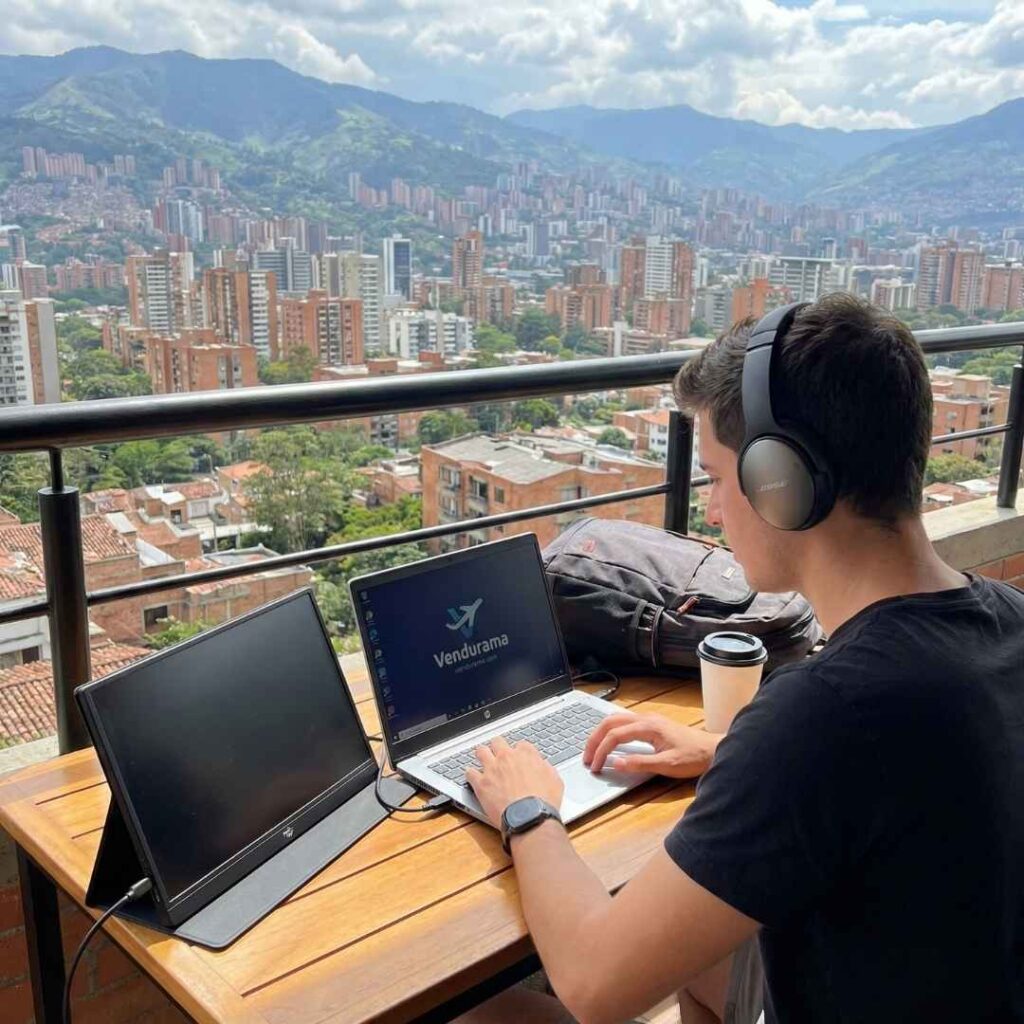
Your entire campus must fit in a backpack. This means:
- The Noise-Canceling Fortress: High-end headphones to create a “Silent Study Hall” on a noisy train or café.
- The Portable Dual-Screen: A portable monitor is essential for coding or writing papers (research on one screen, draft on the other).
Part III: The Logistics of the Nomadic Scholar – Engineering the Movement
The romantic image of the nomad is “spontaneous travel.” The reality of the successful student-nomad is “Strategic Deployment.” You are not wandering; you are relocating to optimize your environment for specific academic phases.
1. The Academic Calendar as a Travel Itinerary
Your travel schedule must bow to your exam schedule.
- Deep Work Phase: During midterms or thesis writing, you deploy to a “Low-Stimulus” environment (e.g., a quiet village in the Alps or a coastal town in Portugal) where distractions are minimal.
- Exploration Phase: During semester breaks or lighter modules, you move to “High-Stimulus” cities (Tokyo, New York) to network and explore.
2. The Art of the “Strategic Flight”
Moving between these bases requires precision. A delayed flight or a lost bag during exam week is a catastrophe. You cannot afford to be a “budget backpacker” when your GPA is on the line.
The Tech-Nomad uses advanced travel search engines to plan relocations with military precision. You are looking for direct routes to minimize “Dead Time.” You need to filter for flights with reliable Wi-Fi if you plan to study in the air. Utilizing a global flight comparison platform allows you to visualize the most efficient routes between your “Study Bases,” ensuring that your transit time is minimized and your study time is maximized.
3. The “Soft Landing” Protocol
The most dangerous moment for a remote student is the arrival in a new city. If you spend the first three days fighting with taxi drivers and figuring out the bus map, you have lost three days of study time.
To maintain academic momentum, you must automate your arrival. This is where professional airport transfers become a productivity tool, not a luxury. By pre-booking a vetted transfer service, you ensure that a driver is waiting for you at the gate. You can hop in the back seat, open your laptop, and continue reading your course materials while being driven directly to your accommodation. This “Zero-Friction” arrival protects your focus and ensures you are operational from hour one. Secure your ground transport as part of your semester planning.
Part IV: The Economics of the Tech-Nomad Degree – Geo-Arbitrage
The financial genius of this model lies in Geo-Arbitrage: earning a degree from a “High-Cost” economy (like the UK or US) while living in a “Low-Cost” economy (like Vietnam or Portugal).
1. The Tuition-Living Delta
- Scenario: A student studies online at a UK university (Tuition: £10,000/year).
- London Living: Rent + Food = £20,000/year. Total = £30,000.
- Bali Living: Rent (Villa) + Food = £8,000/year. Total = £18,000.
- The Result: You save £12,000/year while living a higher quality of life. This savings can be reinvested in travel, better tech, or paying off tuition.
2. The “Nomad Visa” Advantage
Countries are now competing for you. Nations like Estonia, Dubai, Spain, and Malaysia offer “Digital Nomad Visas” that allow you to live legally for 1-2 years without paying local income tax (in some cases). This provides the legal stability required to finish a degree without the stress of “Visa Runs.”
Part V: The Social Curriculum – Building a Global Network
One criticism of remote study is the lack of “Networking.” The Tech-Nomad flips this. Instead of networking with 20-year-old students in a dorm, you are networking with working professionals in global hubs.
- The “Co-Living” Accelerator: Staying in co-living spaces (like Selina or Outsite) puts you in the same room as software engineers, digital marketers, and entrepreneurs. You are learning from people who are doing the job you are studying for.
- Global Conferences: Since you are mobile, you can fly to attend industry conferences in your field (e.g., Web Summit in Lisbon, Gitex in Dubai) as part of your “curriculum.”
Part VI: The Discipline of the Road – A Daily Routine
How do you actually get the work done?
- The “Focus Blocks”: You must work in 90-minute “Deep Work” sprints.
- The “Anchor Habit”: Regardless of the city, you have one habit that never changes (e.g., the morning gym session or the evening review). This signals to your brain that it is “work time,” even if the view outside the window has changed.
Conclusion: The World is Your Campus
The Tech-Nomad Campus is not for everyone. It requires a high degree of self-regulation, logistical competence, and resilience. But for those who master it, the rewards are unmatched. You graduate not just with a degree, but with a global network, a portfolio of international experiences, and the proven ability to manage complex projects in diverse environments.
You are no longer a student of a single university; you are a student of the world. By leveraging smart travel planning tools to manage your mobility and utilizing seamless transfer services to protect your time, you can turn the entire planet into your lecture hall.
The library is open. It’s in Tokyo, it’s in Berlin, it’s in Rio. And your seat is reserved.
Next Step: Ready to design your nomadic semester? Start by mapping out your study bases and flight routes. And remember, your time is your most valuable asset—book your arrival transfers to keep your focus sharp and your journey smooth.