
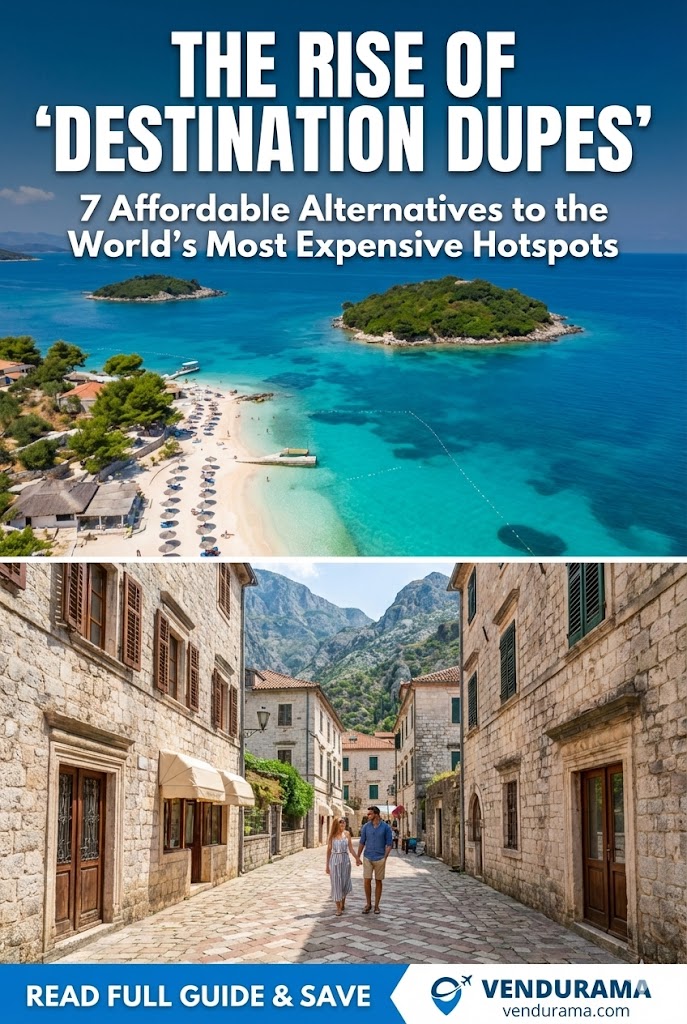
Introduction: The Economic Shift from “Status” to “Value”
In the glossy pages of travel magazines and the curated feeds of social media, the world often appears as a collection of repetitive backdrops: the blue domes of Santorini, the overwater bungalows of the Maldives, the bustling crossing of Shibuya in Tokyo, and the cliffside lemons of the Amalfi Coast. For decades, these “Grade A” destinations have held a monopoly on global tourism desire. They were the status symbols of the jet set, the ultimate markers of a life well-traveled.
However, as we move deeper into the mid-2020s, a profound shift is reshaping the geopolitical landscape of leisure travel. Driven by post-pandemic inflation, the skyrocketing cost of aviation fuel, and the suffocating reality of “over-tourism” in major capitals, a new trend has emerged. It is known in industry parlance as “Destination Dupes.”
A “Dupe” (short for duplicate) is not merely a cheaper knock-off; it is a strategic alternative. It is a destination that captures the essential vibe—the architecture, the climate, the culinary landscape, and the topography—of a famous hotspot, but without the exorbitant price tag or the crushing crowds. This movement represents a maturation of the global traveler. It is a shift from performative tourism (going where everyone else goes) to investigative tourism (finding the hidden value).
This comprehensive guide analyzes seven of the world’s most expensive travel icons and presents their superior, budget-friendly counterparts. We will explore the logistics, the economics, and the cultural nuances of these hidden gems, proving that luxury is not defined by how much you spend, but by the exclusivity of the experience.
The Methodology of the Dupe: How to Identify Value
Before diving into specific locations, one must understand the anatomy of a “Dupe.” A successful alternative destination must satisfy three criteria:
- Atmospheric Parity: It must feel like the original. If you crave the Swiss Alps, a flat forest in Poland won’t suffice. You need jagged peaks and snow.
- Infrastructure Viability: It must be accessible and safe, even if it lacks 5-star chains.
- Cost Efficiency: The total cost of ownership (flights + accommodation + food) must be at least 40-50% lower than the primary destination.
1. The Maldives vs. The Albanian Riviera (Ksamil)
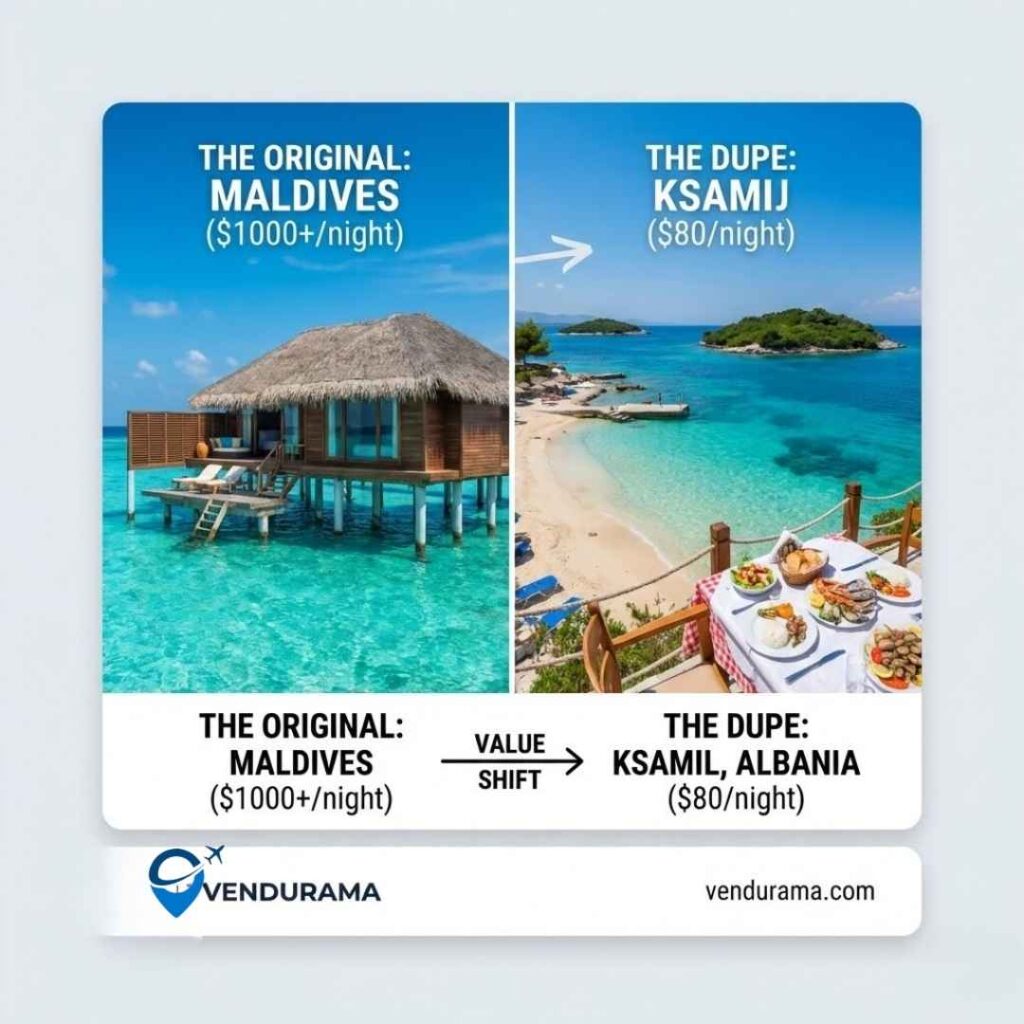
The Original: The Maldives is the archetype of tropical luxury. It is synonymous with isolation, turquoise waters, and bills that can exceed $1,000 per night. The Dupe: Ksamil, Albania.
In recent years, the southern coast of Albania has earned the moniker “The Maldives of Europe.” Located on the Ionian Sea, opposite the Greek island of Corfu, Ksamil offers water of a clarity that rivals the Indian Ocean. The sand is white, the water is a gradient of electric blue, and the tiny islets accessible by swimming create an archipelago feel.
The Economic Argument
While a water villa in the Maldives costs a fortune, luxury apartments in Ksamil overlooking the sea can be secured for $60–$100 per night. The culinary scene, heavily influenced by Italian and Greek proximity, offers fresh seafood platters for under $15—a fraction of the cost of a resort buffet in Malé.
Logistics and Access
Reaching the Albanian Riviera requires strategic planning, as it is not served by a direct major airport. Travelers typically fly into Tirana International Airport (TIA) or fly into Corfu (Greece) and take a ferry across. Because Albania is a developing destination, the public transport infrastructure is fragmented. The drive from Tirana to Ksamil takes about 4 hours through mountain passes. For travelers unaccustomed to Balkan driving styles or navigating unmapped roads, relying on local buses is often inefficient. Therefore, securing professional private transfer services from Tirana Airport directly to the coastal hotel is the standard protocol for those seeking a stress-free start to their vacation. This ensures you arrive at your “European Maldives” refreshed, rather than exhausted by the complexities of local transit.
2. Santorini, Greece vs. Bodrum Peninsula, Turkey
The Original: Santorini is legendary for its whitewashed cubic architecture, sunsets, and caldera views. It is also legendary for being unwalkable due to cruise ship crowds and hotel rates that spike to $800 a night in Oia. The Dupe: Bodrum and the Datça Peninsula, Turkey.
Bodrum offers the same “Aegean aesthetic”—white houses with blue trim, cascading bougainvillea, and crystal-clear waters—but with a distinct Ottoman flair and Turkish hospitality. The Bodrum peninsula is often called the “Saint-Tropez of Turkey,” yet it remains accessible to a wider range of budgets.
The Experience
Instead of fighting for a spot to watch the sunset in Oia, travelers in Bodrum can dine at a seaside meyhane (tavern) in Gümüşlük, watching the sun dip below the horizon while eating fresh octopus and meze. The boutique hotels in areas like Yalıkavak offer the same infinity pools and luxury service as Santorini but at 30% of the price. Furthermore, the sailing culture (Blue Cruise) in Bodrum allows for a nautical experience that rivals any Greek island hopping itinerary.
3. The Swiss Alps vs. The Georgian Caucasus (Mestia/Ushguli)
The Original: Switzerland is the playground of the global elite. Zermatt, St. Moritz, and Gstaad offer pristine alpine beauty, but a simple fondue dinner can cost $100 per person, and ski passes are among the most expensive in the world. The Dupe: The Svaneti Region, Georgia.
Deep in the Caucasus Mountains of Georgia lies a landscape that makes the Alps look almost manicured. The town of Mestia and the UNESCO village of Ushguli offer jagged, snow-capped peaks that soar higher than many in the Alps (Mount Shkhara creates a dramatic backdrop).
The Cultural Twist
What makes Georgia superior to a mere “copy” is its deep history. The Svaneti region is dotted with medieval defensive towers (Koshki) dating back to the 9th century. You are not just skiing or hiking in mountains; you are traversing a living museum. The cost difference is staggering. A hearty Georgian feast (Khachapuri, Khinkali, local wine) costs less than $15. Guesthouses offer warm hospitality for $30 a night. For the adventurous traveler, this is the frontier of mountain tourism—raw, unfiltered, and majestic.
4. Venice, Italy vs. Aveiro, Portugal
The Original: Venice is a marvel of engineering and art, but it is sinking under the weight of its own popularity. The canals are congested, the smell in summer can be pungent, and “tourist trap” restaurants are everywhere. The Dupe: Aveiro, Portugal.
Known as the “Venice of Portugal,” Aveiro is a charming coastal city dominated by a lagoon (Ria de Aveiro) and a network of canals. Instead of gondolas, Aveiro has moliceiros—colorful, slender boats originally used to harvest seaweed.
Art Nouveau and Charm
While Venice is Gothic and Renaissance, Aveiro is a masterpiece of Art Nouveau. The city center is walkable, relaxed, and visually stunning. The crowds are nonexistent compared to St. Mark’s Square. You can enjoy a boat ride for a few euros and eat ovos moles (a local sweet delicacy) without queuing for hours. It offers the romance of a water-based city without the claustrophobia of mass tourism.
5. Kyoto, Japan vs. Taipei, Taiwan
The Original: Kyoto is the custodian of traditional Japanese culture, temples, and tea ceremonies. However, the “over-tourism” crisis in Kyoto has led to bans on photography in geisha districts and crowded temples that destroy the Zen atmosphere. The Dupe: Taipei and Jiufen, Taiwan.
Taiwan offers a fascinating blend of Chinese heritage, Japanese colonial influence, and indigenous culture. Taipei is a modern metropolis, but it is deeply rooted in tradition. Just an hour from the city lies Jiufen, a mountain village of teahouses and red lanterns that looks like it was ripped straight from the anime Spirited Away.
The Culinary and Spiritual Connection
Taipei’s temple culture (such as Longshan Temple) is vibrant and active, not just a museum piece for tourists. The tea plantations in Maokong offer a serene escape similar to Arashiyama. Moreover, Taipei is arguably the food capital of Asia. The night markets offer a culinary adventure that is cheaper and more accessible than Kyoto’s high-end kaiseki dining, while still offering world-class quality.
6. The Amalfi Coast, Italy vs. The Bay of Kotor, Montenegro
The Original: The Amalfi Coast (Positano, Amalfi, Ravello) is iconic for its vertical towns and driving roads. It is also famous for traffic jams where buses get stuck for hours and $20 coffees. The Dupe: The Bay of Kotor (Boka Kotorska), Montenegro.
Just across the Adriatic Sea lies Europe’s southernmost fjord. The Bay of Kotor offers the same dramatic topography: limestone mountains plunging directly into the sea, medieval walled towns clinging to the shoreline, and Venetian-style architecture (as Montenegro was part of the Venetian Republic for centuries).
The Medieval Maze
The Old Town of Kotor is a UNESCO World Heritage site, a labyrinth of cobblestone streets and squares that rivals Dubrovnik or Amalfi but feels more authentic. Perast, a nearby town, offers baroque palaces and island churches (Our Lady of the Rocks) that are visually stunning. Accessing this region often involves flying into Tivat or Podgorica. Because the region is mountainous and the best views are found on winding coastal roads, booking flights to these smaller, regional airports is often smarter than flying into major hubs like Dubrovnik and crossing the border. Savvy travelers use comprehensive flight search engines to compare the costs of flying directly into Montenegro versus neighboring Croatia, often finding that smaller carriers offer significant savings and better proximity to the Bay.
7. Dubai, UAE vs. Baku, Azerbaijan
The Original: Dubai is the city of superlatives—the tallest building, the biggest mall, the most luxury. It is a playground of modern architecture, but it can feel sterile and expensive. The Dupe: Baku, Azerbaijan.
Baku is often called the “Dubai of the Caspian,” but that nickname sells it short. It is a city of incredible contrast. On one hand, you have the Flame Towers, futuristic skyscrapers that light up the night, and the Heydar Aliyev Center designed by Zaha Hadid—a masterpiece of modern parametric architecture. On the other hand, you have the Icherisheher (Old City), a walled medieval fortress dating back to the 12th century.
The Paris of the East
Baku’s boulevards are modeled after Paris, lined with Beaux-Arts buildings from the oil boom of the 19th century. The city feels European, Middle Eastern, and Soviet all at once. The luxury shopping and 5-star hotels are present, but at a third of Dubai’s prices. You can walk along the Caspian promenade, eat world-class caviar, and enjoy a vibrant nightlife scene that is sophisticated yet affordable.
The Strategic Planning: How to execute the Dupe
Choosing a destination dupe is only the first step; executing the trip requires a shift in logistical thinking. These destinations are “alternatives” precisely because they are not major transit hubs. This requires the traveler to be smarter about connectivity.
The Multi-Modal Transit Approach
Unlike flying into London Heathrow or JFK, reaching places like Ksamil, Mestia, or Jiufen often involves a “Flight + Ground” strategy. You fly to the nearest mid-sized city and then engage ground transport. This “last mile” is often where the adventure—and the potential stress—lies.
For instance, when visiting the Georgian Caucasus, one might fly into Kutaisi (a hub for low-cost carriers) rather than the capital Tbilisi. Finding these specific low-cost routes requires a tool that scans budget airlines which standard agents might ignore. Utilizing global travel aggregation platforms allows you to visualize these alternative entry points. You might find that flying into a secondary airport saves you $300, which covers your entire week’s food budget in Georgia.
Once on the ground in these developing tourism markets, the “Uber” economy is not always reliable. In places like Montenegro or Albania, local taxis can be predatory towards tourists, and language barriers are real. The most seasoned travelers mitigate this risk by pre-booking reliable airport transfers. Knowing that a driver is waiting for you in the arrivals hall with a name sign, ready to navigate the winding coastal roads or mountain passes, provides a level of security that allows you to enjoy the “Dupe” experience without the “Budget” stress.
The Ethical Dimension: Why Dupes are Good for the Planet
Beyond the personal savings, the trend of Destination Dupes is a positive force for global sustainability. It addresses the crisis of over-tourism.
- Load Balancing: By diverting traffic from Venice to Aveiro, or from Santorini to Bodrum, we reduce the strain on fragile infrastructures and historical sites that are crumbling under foot traffic.
- Economic Distribution: It spreads tourism revenue to emerging economies (like Albania, Georgia, and Montenegro) that rely on foreign spend to develop their infrastructure, rather than concentrating wealth in already rich nations.
- Cultural Preservation: “Dupes” are often less commercialized. The interactions with locals are more authentic because they are not yet burnt out by millions of tourists. You are treated as a guest, not a nuisance.
Conclusion: The New Golden Age of Travel
The era of the “Bucket List” dominated by the same top 10 destinations is fading. We are entering the era of the “Curated List.” The intelligent traveler understands that a sunset in Montenegro is just as orange as a sunset in Italy, and that the water in Albania is just as blue as in the Maldives.
By embracing Destination Dupes, you are not settling for less; you are opting for more. More discovery, more authenticity, more financial freedom, and more connection. The world is vast, and its beauty is not limited to the locations that appear on a postcard. The true adventure lies in the places that are just becoming famous, the ones that offer the thrill of the unknown combined with the comfort of the familiar.
So, the next time you plan a getaway, look at the map and ask yourself: “Where is everyone going?” And then, go somewhere else. That is the secret to mastering the art of modern travel. The world is full of hidden mirrors; you just need to know where to look.