
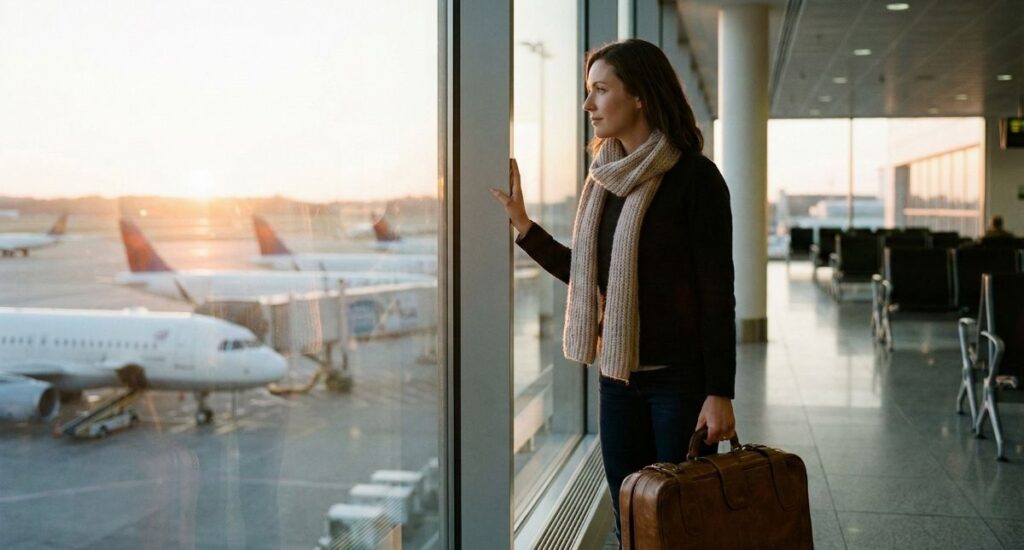
Opening Scene – The Moment of Departure
The airport hums with a peculiar kind of electricity—a symphony of rolling suitcases, distant announcements in half a dozen languages, and the low murmur of a thousand conversations suspended between places. At Gate B17, a woman in her late thirties stands near the window, watching dawn break over the tarmac. Her fingers trace the condensation on the glass as she waits for boarding to begin. In her pocket, her phone has been silent for two hours—deliberately powered off after a final message to her partner: “I’ll be back different.”
She doesn’t know this yet, but the most profound part of her journey has already begun. Not when the plane lifts off the runway, not when she steps onto foreign soil, but in this liminal moment of willing surrender—when she releases her grip on the life that has become too small for the person she’s becoming. Around her, other travelers exist in their own private transitions: the elderly couple holding hands as they face retirement’s uncharted territory; the college student vibrating with nervous excitement before his first solo adventure; the business traveler who has extended his stay by three days, desperate to remember what travel feels like when it isn’t measured in billable hours.
This threshold moment—where one life ends and another begins—is where leisure travel reveals its true nature. It is not escape. It is not consumption. It is recalibration. In a world that measures worth through productivity and connection through digital footprints, the simple act of walking away from your ordinary life has become a revolutionary practice of self-preservation. The woman at the window doesn’t just carry clothes and toiletries in her suitcase. She carries the invisible weight of expectations, the sediment of routine, and the quiet hope that somewhere beyond the clouds, she might find a version of herself that hasn’t been compressed by the pressurized cabin of modern existence.
When we speak of leisure travel, we are speaking of this sacred threshold—the moment when we choose to step outside time as we know it, to become temporarily unmoored from the narratives that define us. The airport, train station, or open road isn’t merely a transportation hub; it’s an altar where we sacrifice our certainty at the altar of possibility. The boarding pass in our hands is more than paper—it’s a permission slip to become someone else, if only for a while.
Why Humans Travel for Pleasure
Beneath the glossy brochures and Instagram-perfect snapshots lies a deeper current that has driven humans to wander since our ancestors first looked beyond the horizon. This impulse isn’t about leisure in the modern sense of consumption or entertainment. It’s coded in our DNA—a biological and spiritual inheritance that recognizes growth only happens at the edges of our comfort zones.
Anthropologists tell us that early humans were nomadic by necessity, following seasons and resources across vast landscapes. But somewhere in our evolutionary journey, movement became more than survival. It became meaning-making. The ancient Greeks practiced theoria—sacred journeys to witness rituals and oracles that transformed their understanding of the divine. Medieval pilgrims walked hundreds of miles not just to visit holy sites but to shed their former selves along the path. Indigenous cultures worldwide maintain traditions where young people venture into wilderness alone as initiation rites, returning with new names and responsibilities.
What drives us to repeat this ancient pattern in our hyper-connected age? Perhaps it’s because we’ve created a world that contradicts our fundamental nature. Our bodies evolved to walk 10-15 kilometers daily across varied terrain, yet we sit in climate-controlled boxes moving our fingers across glass screens. Our minds developed to process complex natural environments with thousands of sensory inputs, yet we filter reality through algorithm-curated feeds. Our social structures evolved for intimate communities of 150 people where trust was survival, yet we navigate anonymous cities of millions while maintaining superficial connections with thousands online.
Leisure travel, at its essence, is a homecoming to our biological and spiritual truths. It’s not the places we visit that change us—it’s the act of moving itself that restores us to our humanity. Neuroscientists have found that physical movement, especially in novel environments, triggers the release of brain-derived neurotrophic factor (BDNF), essentially fertilizer for our neural pathways. This explains why solutions to problems that seemed insurmountable at home often appear while walking unfamiliar streets or gazing at foreign landscapes. The body in motion creates space for the mind to reorganize.
But beyond biology, there’s a psychological yearning that travel satisfies in ways our modern lives often cannot. We travel to remember that we are more than our job titles, more than our social media personas, more than the sum of our responsibilities. In the anonymity of a new place, stripped of the context that defines us at home, we rediscover the core self that exists beneath roles and expectations. That businessman who takes pottery classes in Oaxaca, that mother who finds herself lost in conversation with strangers at a Lisbon café, that retiree who learns to surf in Bali—they are not escaping their lives. They are reclaiming parts of themselves that daily routines have buried.
This is why travel as therapy transcends the cliché of escapism. True escapism would be staying home scrolling through travel photos—a passive consumption of others’ experiences. But active travel—deliberate, present, vulnerable engagement with the unknown—requires us to show up as our authentic selves. It demands that we navigate without the crutches of familiarity, that we communicate without the safety nets of shared context, that we trust without the guarantees of established relationships.
In a world increasingly defined by digital saturation, travel offers what sociologist Zygmunt Bauman called “liquid modernity”—a chance to solidify our identities by testing them against different realities. When we step off the plane into humid Bangkok air or crisp Alpine mornings, we’re not just changing geography. We’re changing frequency. We’re tuning our internal radios to wavelengths that have been drowned out by the static of routine.
The most profound travelers understand this paradox: we journey outward to travel inward. We seek foreign landscapes to find familiar feelings we’ve forgotten how to access at home. We cross oceans to discover that the territory we most needed to explore was within ourselves all along.
The Many Faces of Leisure Travel
Not all journeys are created equal, nor should they be. The beauty of leisure travel lies in its infinite capacity to reflect the multifaceted nature of human experience—each form of travel answering different emotional and spiritual needs.
Consider the family pilgrimage to the same lakeside cabin year after year. To an outsider, this might appear unadventurous, even stagnant. But to those who gather around that weathered wooden table, it represents something profound: continuity in a fragmented world. The parents who met here thirty years ago now watch their grandchildren discover the same hidden swimming spot, the same fireflies that emerge at dusk, the same constellations undimmed by city lights. This kind of travel isn’t about novelty—it’s about ritual. It’s about creating living heirlooms of shared experience that become the emotional architecture of a family’s identity. In these repeated journeys, children learn they belong to something larger than themselves, and adults remember that time doesn’t just slip away—it can be collected in moments that become reference points for a lifetime.
Then there is the solo traveler wandering through Kyoto’s bamboo forests at dawn, deliberately avoiding other tourists. Her journey isn’t about ticking off attractions but about listening to the quiet voice she can’t hear over the noise of her Silicon Valley office. This solitude isn’t loneliness—it’s recalibration. She moves through ancient temples not as a sightseer but as a seeker, finding in the deliberate stillness of Zen gardens a mirror for her own internal landscape. Solo travel at its best isn’t selfish indulgence but necessary recalibration—a deliberate creation of space where the self can expand beyond the containers we build for it at home.
Luxury retreats offer another dimension—not defined by thread counts or champagne flutes, but by the rarest commodity in our accelerated world: undivided attention. At a wellness sanctuary in the Algarve, a man recovering from burnout experiences something radical: a week where no one asks anything of him. No emails, no decisions, no performance metrics. Instead, therapists help him reconnect with his body through massage, chefs nourish him with food grown steps from his table, and the ocean provides a rhythm older than human anxiety. This isn’t hedonism but healing—the recognition that sometimes we need to be held by beauty and care before we can hold anything else.
Budget adventures represent yet another form of travel-as-practice. The backpacker on a night bus through Vietnam isn’t choosing discomfort for its own sake. She’s practicing a different relationship with uncertainty, learning to trust that solutions will appear when needed—a lesson in surrender that her meticulously planned corporate life seldom allows. In hostels where language barriers dissolve over shared meals, she discovers community without credentials, connection without curriculum vitae. This kind of travel strips away the armor of status and achievement, revealing the raw, resilient human beneath.
Cultural immersion takes many forms but always involves crossing the threshold from observer to participant. The photographer who spends months in a Moroccan village doesn’t just document daily life—he learns to make mint tea properly, understands the unspoken rules of hospitality, feels the weight of expectation when the community trusts him with their stories. True cultural travel requires vulnerability—the willingness to be clumsy in a new language, to misunderstand customs, to be the one who doesn’t know. In this discomfort lies transformation: when we stop consuming culture and start experiencing it, we discover that the differences between us are often surface ripples on the same deep human waters.
Nature and adventure escapes answer perhaps the most primal call of all. Standing on a Patagonian ridge with wind whipping across exposed skin, the mountaineer touches something ancient in himself—a recognition that humans evolved not for screen glow but for sunrise, not for climate control but for weather, not for predictable comfort but for the exhilarating edge of our capabilities. These journeys aren’t about conquering nature but remembering our place within it. In the rhythm of paddling down an Alaskan river or the focus required to navigate a desert canyon, we find what psychologist Mihaly Csikszentmihalyi called “flow”—that state of complete absorption where time dissolves and we exist purely in the present moment.
What unites these diverse forms of leisure travel isn’t destinations or budgets, but intention. Each represents a conscious choice to step outside the narrative of ordinary life and write a different story, even if only for a few days. In a world that increasingly values efficiency over experience, speed over depth, and production over presence, these varied forms of travel are acts of quiet rebellion—declarations that we are more than our productivity, that we need more than convenience, that we are worthy of the time it takes to truly live.
How Travel Changes the Brain and the Soul
Science is only beginning to catch up to what travelers have known intuitively for centuries: that journeying beyond familiar territory transforms us at neurological and psychological levels in ways that remain long after our suitcases are unpacked.
Neuroplasticity—the brain’s ability to reorganize neural pathways based on new experiences—is dramatically enhanced when we travel. MRI studies show that exposure to novel environments increases gray matter density in areas associated with spatial navigation and memory. When we navigate Tokyo’s labyrinthine subway system or learn to distinguish subtle flavors in Oaxacan mole sauces, we’re not just collecting experiences; we’re literally growing our brains. The cognitive flexibility required to adapt to different currencies, time zones, and social norms strengthens neural connections in ways that routine simply cannot replicate.
Psychologists have documented what they call the “travel effect”—a measurable increase in openness to experience, one of the five core personality traits. This isn’t merely about becoming more adventurous. It’s about developing what cognitive scientists call “tolerance for ambiguity”—the ability to function effectively without complete information or clear rules. At home, we operate within established frameworks where social cues, expectations, and consequences are largely understood. Travel strips away these familiar structures, forcing us to develop new ways of interpreting situations and responding to challenges. This mental flexibility doesn’t disappear when we return home; it becomes part of our cognitive toolkit, making us more adaptable problem-solvers and creative thinkers in all areas of life.
The stress reduction benefits of leisure travel extend far beyond temporary relief. Cortisol levels—the body’s primary stress hormone—drop significantly within 48 hours of arriving at a vacation destination, according to research from the Global Commission on Destination Management. But the effects persist: people who take regular leisure trips show lower baseline stress levels year-round compared to those who seldom travel. This isn’t just about escaping work emails; it’s about the physiological reset that occurs when we move at nature’s pace rather than technology’s demands. Watching waves roll onto a beach or sitting in a Tuscan piazza as evening light softens the edges of buildings creates what neuroscientists call “soft fascination”—a state of gentle attention that allows the brain’s default mode network to activate, facilitating the kind of reflective thinking associated with emotional processing and meaning-making.
Emotional resilience develops through the micro-challenges of travel that we rarely face in our controlled home environments. The missed train in Switzerland that forces us to spend an unexpected night in a mountain village. The language barrier that leads to a three-hour meal with strangers who become friends. The rainstorm that cancels our planned hike but reveals a hidden café where we discover a passion for local poetry. These aren’t inconveniences to be minimized; they’re the very material through which we develop what psychologists call “adaptive capacity”—our ability to respond effectively to life’s inevitable disruptions. Travel teaches us that plans are maps, not territories, and that often the most meaningful experiences emerge from the detours we never planned.
The soul-level transformations are harder to measure but no less real. Many spiritual traditions recognize journeying as a metaphor for inner transformation—the pilgrim’s path as spiritual practice. When we leave the roles and identities that define us at home, we create space for dormant parts of ourselves to emerge. The quiet accountant discovers she has a gift for connecting with strangers in Marrakech markets. The anxious parent finds unexpected courage navigating Bangkok’s chaotic streets. The retired executive rediscovers his sense of wonder watching sea turtles hatch on a Costa Rican beach.
This shedding of identity isn’t escapism—it’s excavation. Travel provides what psychologist Abraham Maslow called “peak experiences”—moments of such intense aliveness and connection that they shift our fundamental understanding of ourselves and our place in the world. Standing before Angkor Wat at sunrise or hearing traditional fado music in a Lisbon tavern basement doesn’t just create a memory; it creates a new lens through which we see everything else. These experiences accumulate like layers of sediment, gradually forming a different landscape within us.
Most profound of all is travel’s capacity to reconnect us with what philosopher Martin Buber called “I-Thou relationships”—encounters where we see and are seen as whole human beings rather than functional roles. In a world of transactions, travel offers transformation through genuine connection. That conversation with a fisherman in Vietnam about his grandchildren, the shared laughter with fellow hikers caught in an Andean rainstorm, the silent understanding with a stranger watching the same sunset over Santorini—these moments bypass the curated personas we maintain at home and touch something essential in our shared humanity.
When we return from meaningful travel, we often feel that the world has changed. But what has truly shifted is our capacity to see it—not through the narrow lens of our daily routines but with expanded vision forged in the fires of the unfamiliar. The neurological pathways have been rerouted, the emotional muscles strengthened, the soul nourished. We don’t just bring back souvenirs; we bring back new ways of being that permeate every aspect of our lives long after the tan has faded.
The World as a Living Classroom
Beyond the guidebooks and tour buses lies a deeper educational experience that travel offers—one not measured in credits or certificates but in transformations of perspective that no classroom can replicate. The world, when approached with humility and curiosity, becomes our most profound teacher.
Cities, those dense ecosystems of human endeavor, teach empathy through immersion in lives unlike our own. Walking through Mumbai’s Dharavi slum—where half a million people live in an area smaller than Manhattan’s Central Park—we confront not poverty as an abstract concept but human resilience as a daily practice. We see children studying by candlelight in spaces no larger than our closets, families sharing meals on floors that double as beds, entrepreneurs running micro-businesses from spaces we would consider uninhabitable. These encounters don’t offer easy solutions to systemic inequality, but they dissolve the abstractions that allow us to ignore it. In the eyes of a mother carefully washing her child’s uniform in a communal tap area, we recognize our shared humanity across impossible divides. This is empathy not as sentiment but as practice—the daily choice to see ourselves in others, even when their circumstances bear no resemblance to our own.
Food, that universal language of human culture, teaches history in ways textbooks cannot. A bowl of jollof rice in Ghana carries the story of West African empires, the trauma of the transatlantic slave trade, the resilience of diaspora communities, and the complex negotiations of modern globalization. When we learn to prepare mole poblano in a Mexican kitchen, we touch centuries of indigenous and colonial fusion, religious symbolism, and the alchemy that occurs when cultures collide. Food historian Rachel Laudan notes that “what we eat is never just food”—it’s a living archive of migration patterns, trade routes, agricultural revolutions, and social hierarchies. To eat authentically in another culture isn’t consumption; it’s communion. It’s allowing another people’s history to become part of our physical being, if only for a meal.
Landscapes teach humility through their ancient presence and indifferent majesty. Standing before Yosemite’s El Capitan or Norway’s fjords carved by glaciers over millennia, we experience what philosophers call the sublime—a recognition of our smallness against forces and timeframes that dwarf human concerns. This isn’t depressing but liberating. In the face of mountains that have stood since before human language evolved, our daily worries shrink to their proper proportion. Ecopsychologists have found that exposure to “awe-inspiring” natural environments increases prosocial behavior and decreases materialistic values—not because nature is sentimental, but because it recalibrates our sense of significance. The desert doesn’t care about our job titles; the ocean is indifferent to our bank accounts. In this indifference lies freedom: the realization that we are part of something vastly larger than our individual dramas.
People, in their glorious diversity, teach perspective through the simple act of conversation. The elderly woman in Kyoto who has practiced the tea ceremony for sixty years embodies patience in an age of instant gratification. The young activist in Berlin fighting for refugee rights demonstrates hope in the face of cynical politics. The fisherman in Portugal whose family has harvested the Atlantic for generations understands sustainability as lived practice, not marketing buzzword. These encounters don’t provide easy answers but they dissolve easy assumptions. When we truly listen to lives lived along different vectors than our own, we begin to see our certainties as just one perspective among many—valuable but not universal.
Time itself teaches differently across cultures. In Spain, the two-hour sobremesa—the conversation that continues long after the meal has ended—teaches that relationships aren’t scheduled but cultivated. In Ethiopia’s coffee ceremonies, which can last three hours, we learn that some things cannot and should not be rushed. In Japan’s concept of “ma”—the space between things—we discover that emptiness is not absence but potential. These temporal lessons challenge our productivity-obsessed culture by revealing alternative ways of structuring human experience where being often matters more than doing.
Even silence becomes a teacher on the road. The quiet of a Himalayan monastery at dawn, the hush that falls over the Serengeti at twilight, the peaceful calm of a Venetian canal early on a Sunday morning—these moments of stillness teach us to listen to our own inner voices often drowned out by the noise of home. In the absence of familiar distractions, we hear not just the world around us but the world within us. This is perhaps travel’s greatest gift: creating space for the conversations we’ve been avoiding with ourselves.
The classroom of the world doesn’t offer grades or graduation ceremonies. Its lessons come unannounced—in a missed bus that leads to an unexpected friendship, in a language barrier that dissolves through shared laughter, in a moment of vulnerability that opens us to grace. What we learn isn’t information to be stored but wisdom to be lived. We don’t return from these journeys with more answers but with better questions. And in a world drowning in information but starving for wisdom, that may be the most valuable education of all.
When planning your journey through these living classrooms, it helps to have resources that curate meaningful journeys, recognizing that travel isn’t just about getting from one place to another, but about honoring the spaces in between.
The Practical Side of Dreaming
Every transformative journey begins somewhere between dream and spreadsheet—a delicate balance between vision and pragmatism that many travelers struggle to navigate. The romantic in us wants to follow serendipity; the planner knows that the most spontaneous moments often require the most careful preparation. This tension isn’t a compromise but a creative partnership that, when honored, allows dreams to take physical form.
Choosing destinations intuitively doesn’t mean abandoning strategy—it means developing a deeper literacy of your own needs. The burned-out executive seeking stillness might find more restoration in a week at a silent monastery in Bhutan than in ten days bouncing between European capitals. The grieving widow might discover healing not in tropical beaches but in the stark beauty of Iceland’s volcanic landscapes that mirror her internal terrain. Seasoned travelers learn to read their own rhythms: when they need stimulation versus solitude, connection versus contemplation, luxury versus raw authenticity. This self-knowledge transforms travel from generic consumption to personalized medicine for the soul.
Time management in leisure travel requires unlearning the productivity mindset that governs our everyday lives. The most valuable moments often hide in unplanned spaces—the afternoon spent in a Florentine café because rain canceled museum plans, the extended conversation with a local fisherman that means missing the ferry but gaining a deeper understanding of coastal life. This doesn’t mean abandoning schedules entirely but creating what architects call “breathing room”—intentional white space in itineraries where serendipity can emerge. Travel writer Pico Iyer suggests booking only the first three days of a two-week trip, leaving the remainder open to discoveries and connections made along the way. This paradoxical approach—planning enough structure to provide security while leaving enough openness for transformation—is where the magic happens.
Budgeting, when approached as “freedom design” rather than limitation, becomes an act of intentionality. The young couple saving for a year to spend three months traveling slowly across Southeast Asia isn’t delaying life—they’re investing in a different quality of living. The retired teacher choosing to stay in one Italian village for a month rather than ticking off five countries in as many days understands that depth costs less than breadth. Financial constraints often spark the most creative journeys: teaching English in exchange for accommodation in Chile, volunteering on organic farms through WWOOF programs, or house-sitting in exchange for free lodging in desirable locations. These aren’t compromises but alternative currencies that trade money for time, status for authenticity, comfort for connection.
The rhythm of seasons adds another dimension to travel planning that modern transportation has made us forget. There was wisdom in the old ways of journeying with the earth’s cycles—pilgrimages aligned with holy days, trade routes that respected monsoon patterns, migrations that followed harvests. Today’s traveler can reconnect with this wisdom by considering not just when destinations are convenient but when they’re alive. Cherry blossoms in Kyoto aren’t just pretty—they’re a cultural heartbeat that transforms the city. The Venice Biennale turns the floating city into a global conversation about art. The quiet months after monsoon season in India reveal landscapes washed clean and refreshed. When we time our journeys to harmonize with natural and cultural rhythms rather than fighting against them, we don’t just see places—we experience them.
Practical logistics—vaccinations, plug adapters, currency exchanges—can feel like mundane interruptions to romantic visions, but they’re actually the loom on which transformation is woven. The meticulous planner who researches train routes through Portugal isn’t killing spontaneity; she’s buying freedom from anxiety so she can be present for the unexpected. The father who carefully packs medications for his asthmatic child isn’t being overcautious; he’s creating the security that allows his family to relax into new experiences. These practical acts are love letters to our future selves—gifts of peace of mind that allow the soul to roam freely.
The most beautiful journeys often emerge from this dance between dream and detail—the moments when careful preparation creates the space for magic to enter. When the spreadsheet meets the soul, utilizing platforms designed to bridge the gap between inspiration and itinerary, something extraordinary happens: travel transforms from a thing we do into a way we become.
Travel Requirements Without Bureaucracy Fatigue
In our quest to transcend the ordinary through travel, we must first navigate the ordinary machinery of passports, visas, and insurance—a necessary threshold that need not become a burden that drains the romance from our departures. These bureaucratic elements aren’t obstacles to meaningful travel but rather the guardrails that allow us to journey safely into the unknown.
The passport, that small booklet of stamps and signatures, represents more than official permission to cross borders—it’s a physical manifestation of our humanity recognized by nations. Its pages tell stories long before we fill them with travel memories. The process of obtaining or renewing this document can feel impersonal, yet there’s profound significance in this ritual of recognition. In a world where millions exist without documentation, the simple act of presenting a valid passport at an immigration counter is a privilege that carries responsibility. Seasoned travelers treat their passports with reverence—not just protecting them from damage or loss, but understanding them as vessels of trust between nations. The most meaningful journeys begin with ensuring this document has at least six months validity beyond planned return dates—a small act of respect for the systems that make global movement possible.
Visas, those tiny stickers or digital authorizations, often represent the most frustrating aspect of travel preparation. Yet reframing them from bureaucratic hurdles to conversations between cultures can transform our experience. When we apply for a Chinese visa, we’re not just submitting paperwork—we’re entering a dialogue with a civilization that has guarded its borders for millennia. The required documents—invitation letters, detailed itineraries, proof of funds—aren’t arbitrary demands but expressions of a nation’s need to balance openness with security. Approaching visa applications as acts of respect rather than chores changes everything: researching requirements months in advance not as red tape but as cultural literacy; providing complete documentation not as submission but as partnership; understanding processing times not as inefficiency but as the careful rhythm of systems managing millions of human stories.
Health and travel insurance, often purchased as an afterthought, becomes meaningful when viewed not as a cost but as an expression of care—for ourselves and for the communities that welcome us. The responsible traveler recognizes that arriving in a remote village in Nepal without medical coverage isn’t adventure—it’s potential burden on communities with limited resources. Comprehensive coverage that includes emergency evacuation, routine care, and mental health support acknowledges our shared vulnerability as humans. It reflects an understanding that true freedom comes not from pretending we’re invincible but from preparing responsibly for life’s uncertainties. The most thoughtful policies now include coverage for adventure activities and pre-existing conditions—recognizing that meaningful travel often happens beyond comfort zones.
Vaccination requirements, which have fluctuated dramatically in recent years, offer an opportunity to practice global citizenship. When we get yellow fever shots before visiting Tanzania or carry proof of routine immunizations to Southeast Asia, we’re participating in a worldwide project of care that transcends national boundaries. This isn’t about compliance but connection—the recognition that our health is intertwined with the wellbeing of communities we visit. The brief sting of a needle becomes a physical commitment to being a good guest in places that have welcomed us.
Safety considerations need not trigger fear but can cultivate the kind of situational awareness that actually enhances travel experiences. Learning basic phrases in the local language before arriving isn’t just practical—it’s respect. Researching cultural norms around dress, photography, or public behavior isn’t restriction—it’s relationship-building. Registering with your country’s travel advisory program isn’t paranoia—it’s responsibility to loved ones waiting at home. These practices, when approached with curiosity rather than anxiety, deepen rather than diminish our engagement with places and people.
Currency exchange, often reduced to finding the best rate, transforms when we understand money as cultural artifact. The tactile experience of handling unfamiliar coins, learning the faces and symbols on bills, understanding local tipping customs—all these small interactions teach us to move through economic systems different from our own. The wise traveler carries multiple forms of access—some cash in local currency for small purchases and emergencies, a primary card with low foreign fees, and a backup payment method—creating a financial ecosystem that supports freedom rather than limits it.
When planning international journeys, utilizing comprehensive resources to seamlessly manage travel logistics can help navigate these practical complexities without losing sight of travel’s deeper purpose—transforming bureaucratic necessities into meaningful parts of the journey rather than obstacles to overcome.
Transportation and Accommodation as Part of the Experience
Modern travel culture often treats transportation and accommodation as mere necessities to endure between destinations—the flights to survive, the hotels to crash in before the next day’s “real” experiences. But what if these in-between spaces are not interruptions to our journeys but integral chapters in their own right? What if the way we move and rest shapes not just our comfort but our capacity to be transformed?
Airplanes, those pressurized tubes hurtling through the sky, offer a unique liminal space—a threshold between worlds where ordinary rules temporarily dissolve. In this suspended reality above clouds, we exist outside time zones and terrestrial boundaries, invited to practice what philosopher Gaston Bachelard called “the poetics of space.” The window seat becomes a meditation cushion where we witness earth’s curvature at dawn, watch storms illuminate the darkness below, or see human civilization reduced to constellations of light. The confined space of economy class teaches a different but equally valuable lesson: how to find dignity and comfort within limitations, how to create private worlds within shared spaces, how to practice patience when surrounded by strangers in close quarters. Even jet lag, that disorienting shadow of rapid transit, can become a gift if reframed—not as an enemy to defeat with melatonin and caffeine, but as the body’s honest response to moving faster than evolution intended. These hours between worlds aren’t dead time to fill with screens but sacred space to prepare for transformation.
Trains reclaim travel’s rhythm in a world addicted to speed. The gentle rocking of a night train through the Scottish Highlands or the slow unfolding of Vietnamese countryside from a sleeper car window restores us to human scale. Unlike air travel’s disconnection from landscape, trains keep us in conversation with place. The trans-Siberian railway doesn’t just transport passengers from Moscow to Vladivostok—it compresses a continent’s soul into seven days of changing skies and faces. Japan’s Shinkansen bullet trains teach precision and collective care, while India’s toy train through Darjeeling demonstrates how engineering can dance with landscape rather than dominate it. The shared dining car where strangers become temporary community over simple meals, the platform vendors selling regional specialties through open windows, the conductor’s nightly ritual of converting seats to beds—these aren’t service details but the human texture of journeying. In trains, we recover what travel writer Paul Theroux called “the bliss of the unfamiliar routine”—the comforting rhythm of arrival and departure, meal times and sleeping hours, all unfolding against ever-changing backdrops.
Road trips, whether along America’s Route 66 or New Zealand’s South Island coast, offer a different education in freedom and vulnerability. The car or camper becomes a movable home where relationships are tested and deepened through shared navigation challenges, unexpected detours, and the intimacy of confined spaces. Unlike rail or air travel, road journeys surrender control to landscape—mountains dictate routes, weather determines timing, fuel stations structure days. This surrender to geography creates what anthropologist Yi-Fu Tuan called “topophilia”—a love of place born from slow, embodied experience. The family that gets lost on a dirt road in Tuscany and stumbles upon a village festival, the couple who extend their Australian outback trip by weeks after connecting with a cattle station family—these aren’t deviations from travel plans but its very heart. Road trips teach us that the most meaningful destinations are often not on maps but in moments.
Accommodations serve as emotional containers for our journeys, each type shaping experience in subtle but profound ways. Hotels, when chosen thoughtfully rather than algorithmically, become cultural ambassadors. The ryokan in Kyoto that begins each day with a silent tea ceremony in your room, the Parisian boutique hotel where the concierge remembers your name and preferences, the desert lodge in Namibia where floor-to-ceiling windows dissolve boundaries between inside and out—these places don’t just shelter bodies but shape souls. They teach us that hospitality isn’t transaction but transformation, that the spaces we inhabit while traveling imprint on our memories as deeply as the places we visit.
Hostels, often dismissed as merely budget options, offer some of travel’s most authentic communities when approached with intention. The shared kitchen where backpackers from twelve countries collaborate on a meal becomes a microcosm of global cooperation. The dormitory conversation that drifts into philosophy at 2 a.m. reveals why we journey—not just to see new places but to be reminded of our shared humanity. These spaces teach vulnerability and generosity in ways private rooms cannot.
Vacation rentals—apartments, houses, even boats—offer a different kind of intimacy with place. Cooking in a Barcelona kitchen with ingredients from the local market, sitting on a balcony watching the rhythm of an Istanbul neighborhood, tending a small garden at a cottage in Cornwall—these experiences dissolve the boundary between tourist and resident. They teach what writer Alain de Botton calls “the art of dwelling”—the capacity to inhabit a place deeply rather than skimming its surface.
Camping and wilderness lodges reconnect us with elemental truths often lost in climate-controlled environments. The sound of wind in canvas, the ritual of preparing meals by firelight, the morning alarm of birdsong rather than phones—these return us to bodies and rhythms obscured by modern life. The slight discomfort of a sleeping pad on uneven ground, the careful conservation of water, the attention required to build a fire—all these “inconveniences” become teachers of presence and gratitude.
Even transit hubs can transform when approached with awareness. The overnight layover in Singapore’s Changi Airport, with its butterfly garden and movie theater, becomes a lesson in urban innovation. The train station in Lisbon where elderly women sell homemade pastries teaches intergenerational care in public spaces. The bus terminal in Mexico City where families gather with homemade meals for departing loved ones reveals community in unexpected places.
When we stop seeing transportation and accommodation as means to ends and start experiencing them as integral parts of our journeys, travel becomes continuous rather than fragmented. Each mode of movement, each place of rest, becomes a teacher—showing us not just new landscapes but new ways of being within them. The wise traveler knows that sometimes the most profound destination is the space between destinations.
Challenges, Discomfort, and Growth
The glossy magazines rarely show the other side of travel—the moments when the romantic vision meets stubborn reality and we find ourselves crying in a Budapest hostel bathroom at 3 a.m., lost in translation and loneliness. Yet it is precisely in these uncomfortable spaces that travel’s deepest transformations occur. The friction between expectation and reality isn’t failure but the necessary abrasion that polishes our souls.
Jet lag does more than disrupt sleep schedules—it disorients our internal compasses, making us strangers to ourselves just as we’re becoming strangers in new places. That businessman in Tokyo who snaps at a kind hotel clerk isn’t malicious; he’s unmoored from his body’s rhythms, vulnerable in ways he hasn’t felt since childhood. But within this disorientation lies opportunity: when our physical anchors dissolve, we’re forced to find stability elsewhere—in the kindness of strangers, in the rhythm of local life, in the practice of gentle self-compassion. The traveler who learns to surrender to jet lag rather than fight it discovers a deeper lesson about accepting life’s uncontrollable rhythms.
Loneliness stalks even the most connected traveler. The backpacker surrounded by fellow hostel dwellers can feel profoundly isolated when everyone else seems paired off or in groups. The solo female traveler eating alone in a restaurant navigates not just language barriers but the uncomfortable spotlight of being visibly unaccompanied in cultures that value companionship. Yet this loneliness, when embraced rather than avoided, becomes a doorway to authentic connection. The moment when we stop scrolling through our phones to fill the void and instead ask the person next to us about their day—this is where travel’s magic often begins. Psychologists call this “forced extroversion”—the way unfamiliar environments push us beyond social comfort zones into genuine encounter. The loneliness that initially feels like failure becomes the fertile ground where real relationships take root.
Cultural misunderstandings punctuate every meaningful journey. The American who doesn’t realize his loud enthusiasm reads as aggression in Finland. The European woman who offends her Japanese hosts by sticking chopsticks upright in rice. The well-intentioned volunteer who disrupts a community in Guatemala by imposing solutions without understanding context. These moments of misstep hurt precisely because they matter. They reveal our unconscious assumptions and the invisible frameworks that shape our behavior. The mature traveler learns to approach these moments not with shame but with curiosity—to see each misunderstanding as data about both the culture they’re visiting and the culture they carry within them.
Missed connections—trains that depart before we reach the platform, ferries canceled by weather, reservations lost in system glitches—test our capacity for flexibility in a world that prizes control. The family that misses their Alaskan cruise departure after a delayed flight faces a choice: rage against the injustice or discover the unexpected charms of an unplanned night in Anchorage. These moments separate tourists from travelers. The tourist sees disruption as ruining their experience; the traveler recognizes it as creating a new one. In these unplanned detours, we confront our relationship with uncertainty itself—the degree to which we can trust that life will provide what we need even when it doesn’t provide what we planned.
Physical discomfort—blisters from new shoes on cobblestone streets, food poisoning from street vendors, the unrelenting humidity of Southeast Asia—strips away our civilized veneers, revealing raw humanity. The executive who prides himself on composure finds himself weeping with frustration when diarrhea strikes during an important business trip to Thailand. Yet in this vulnerability lies connection: the local pharmacist who stays late to help, the fellow traveler who shares anti-nausea medication, the hotel staff who bring ginger tea to his room. These moments of human kindness, received when we’re at our most vulnerable, restore faith in our shared humanity.
Language barriers, perhaps the most consistent challenge, force us beyond our dependence on words into the deeper language of gesture, expression, and presence. The Italian grandmother who doesn’t speak English but communicates warmth through a plate of homemade pasta. The Japanese shopkeeper who patiently draws maps when verbal directions fail. The Peruvian guide who teaches you that “hello” and “thank you” in his indigenous language opens more doors than fluent Spanish ever could. These encounters teach what linguists call “communicative competence”—the understanding that true communication happens not just through vocabulary but through willingness to be imperfect, to laugh at mistakes, to connect beyond words.
Safety concerns—real or perceived—surface primal fears that modern life usually shields us from. The woman who feels uneasy walking alone in Marrakech at night, the parents worried about their children in crowded Bangkok markets, the traveler who experiences theft for the first time in Barcelona. These moments force us to distinguish between legitimate caution and limiting fear, between wise boundaries and closed hearts. The most transformative journeys aren’t those where nothing goes wrong but those where we discover our capacity to navigate wrongness with grace.
The discomfort of being observed as “other” transforms those accustomed to cultural invisibility. The white American who has never thought about race suddenly noticing stares in rural China. The hijab-wearing woman navigating airport security with extra scrutiny. The LGBTQ+ couple holding hands in places where their love is illegal. These experiences build empathy through lived experience rather than intellectual understanding—what sociologist C. Wright Mills called “the sociological imagination”—the ability to see personal troubles as connected to public issues.
Perhaps the greatest challenge is returning home to find that the person who left no longer fits in the life that remained. The college student who returns from a semester in Ghana unable to participate in dorm gossip about parties. The retiree who finds small talk about lawn care painfully shallow after months volunteering in Nepal. This reverse culture shock—often more profound than the initial adaptation—asks us to integrate our transformed selves into unchanged environments.
Yet every challenge contains its gift. The missed train leads to a conversation with a local philosopher in a station café. The language barrier dissolves when sharing bread with strangers. The bout of food poisoning introduces us to a family who cares for us like their own. The loneliness of solo travel teaches us to be good company for ourselves. These aren’t silver linings but golden threads—woven through discomfort to create stronger, more resilient selves.
The most meaningful journeys aren’t those that go according to plan but those that disrupt our plans enough to disrupt our patterns. They remind us that growth rarely occurs in comfort zones. It happens in the beautiful, messy, uncomfortable spaces between who we were and who we’re becoming—spaces that travel, with its perfect imperfections, creates so generously.
The Ethics of Leisure Travel
As the carbon footprint of a single intercontinental flight weighs heavily on the conscience, as Instagram hotspots buckle under the weight of overtourism, as indigenous communities guard their sacred sites from disrespectful visitors, leisure travel stands at a moral crossroads. The question is no longer whether to travel, but how to travel with integrity in an interconnected world where every journey ripples through ecosystems and communities far beyond our photographs.
Sustainable tourism has moved beyond buzzword to necessity, yet true sustainability requires more than refusing plastic straws or staying in LEED-certified hotels. It demands a fundamental rethinking of travel’s purpose and pace. The old model of “see everything, leave nothing but footprints” has proven insufficient; even footprints, when multiplied by millions of visitors, erode the very places we love. Instead, a new paradigm emerges—one that values depth over breadth, presence over productivity, regeneration over extraction. The conscious traveler asks not “How many countries can I visit?” but “How deeply can I connect with this place?” They choose one region to explore thoroughly rather than five to skim superficially, understanding that true understanding requires time. They stay in locally-owned accommodations where money circulates within communities rather than flowing to international corporations. They eat at family restaurants rather than global chains, not as aesthetic preference but as economic justice.
Respect for local cultures begins with recognizing that we are guests, not customers, in the places we visit. This shifts our relationship from consumption to reciprocity. The ethical traveler learns basic greetings in the local language—not to show off but to acknowledge that they are entering someone else’s home. They research appropriate dress codes before visiting religious sites, understanding that shoulders and knees aren’t mere body parts but sites of cultural meaning. They ask permission before photographing people, recognizing that images have power and dignity costs nothing. Most importantly, they listen more than they speak, approaching cultural differences not as problems to solve but as wisdom to receive. The Balinese concept of “Tri Hita Karana”—harmony between humans, nature, and the divine—teaches sustainability more effectively than any Western manifesto. The Maori principle of “kaitiakitanga”—guardianship rather than ownership of land—offers a model for environmental stewardship that corporate sustainability programs struggle to match. These aren’t exotic philosophies to consume but living wisdom to honor.
Environmental responsibility extends beyond carbon offset programs to encompass daily choices that collectively transform travel’s impact. The train journey through the Alps may take longer than flying, but it returns us to human scale and reconnects us with landscapes we’d otherwise miss. The decision to skip that bucket-list flight to Antarctica preserves a fragile ecosystem for future generations. Choosing destinations closer to home rediscover wonders we’ve overlooked in our quest for the exotic. Even small choices matter: refusing single-use toiletries in hotels, carrying reusable water bottles with filters instead of buying plastic, walking or cycling rather than taking short car rides. These practices aren’t deprivation but reconnection—to our bodies, to landscapes, to the physical reality of place.
Overtourism represents perhaps the greatest ethical challenge of modern leisure travel. The streets of Venice now see over 30 million visitors annually—more than 50,000 people daily in a city built for 70,000 residents. Barcelona residents protest tourism that has transformed neighborhoods into theme parks with unaffordable rents. Maya Beach in Thailand, made famous by “The Beach,” closed for years to recover from visitor damage. The ethical traveler responds not with guilt but with strategic choices: visiting popular destinations in shoulder seasons when crowds thin and local businesses need support; choosing emerging destinations with infrastructure to handle visitors responsibly; supporting community-based tourism initiatives that distribute benefits beyond hotspots. Some of the world’s most transformative places exist beyond Instagram’s algorithm—Portugal’s Azores islands instead of Lisbon, Bulgaria’s mountain villages instead of Paris, Namibia’s Skeleton Coast instead of Safari circuit parks. These alternatives aren’t compromises but opportunities to experience authenticity before it becomes performance.
The ethics of photography requires special attention in our image-saturated age. The viral shot of a Buddhist monk checking his phone at sunrise may win social media likes but reduces sacred practice to spectacle. The ethical traveler considers: Does this photo respect the subject’s dignity? Would I want this image of me shared online? Does it perpetuate stereotypes or deepen understanding? Many sacred sites—from India’s Ajanta Caves to Peru’s Machu Picchu—now ban photography not to limit experience but to protect it from becoming mere content. The most powerful travel images often emerge from relationship rather than opportunism—from the portrait made after hours of conversation, the landscape captured after sitting silently to understand its spirit, the moment of daily life witnessed through trust rather than intrusion.
Voluntourism—short-term volunteer trips—requires particular ethical scrutiny. The desire to “give back” while traveling is noble but often misdirected. Building schools without proper construction skills, teaching English without pedagogical training, or working with vulnerable children without background checks can cause more harm than good. Ethical volunteering requires asking hard questions: Is this work something locals cannot do? Does it create dependency rather than capacity? Would I be qualified to do this at home? Better alternatives exist: supporting organizations led by local communities, contributing skills that match genuine needs, making financial donations to vetted nonprofits rather than paying program fees that primarily cover volunteer accommodations. Sometimes the most ethical contribution is to be a respectful visitor who supports local economies through conscious consumption.
The privilege of travel becomes most apparent when we recognize that while we choose to cross borders, many cannot. The ethical traveler uses this privilege responsibly—speaking up when witnessing exploitation, supporting fair labor practices in tourism industries, choosing operators with transparent supply chains. When booking accommodations or tours, they research ownership structures and labor practices. They tip fairly but thoughtfully—not as charity but as recognition of dignity and skill. They use their outsider perspective to amplify local voices rather than speaking over them. This isn’t political posturing but practical compassion—the understanding that our journeys should lift others rather than tread on them.
Perhaps the deepest ethical question leisure travel poses is this: How do we receive the gift of other places without depleting them? The answer lies not in traveling less but in traveling differently—in shifting from extraction to reciprocity, from consumption to contribution, from visiting to belonging (even temporarily). The most ethical journeys leave places not just as we found them but better than we found them—through the relationships we build, the economies we support, the stories we share with respect. They transform us not just through what we see but through how we learn to see—developing what poet Mary Oliver called “the eyes of the heart” that witness without taking, receive without depleting, and depart with gratitude rather than entitlement.
When coordinating the practical aspects of these ethical journeys, specialized platforms can help travelers plan responsible itineraries that honor both their desire for meaningful experiences and their commitment to responsible travel—finding routes that minimize environmental impact while maximizing cultural connection.
The Future of Leisure Travel
As climate change accelerates and digital technology transforms human connection, leisure travel stands at the threshold of profound reinvention. The old paradigms of mass tourism and bucket-list checklists are giving way to more intentional, sustainable, and transformative models of journeying that reflect our evolving understanding of what it means to be human in a globalized world.
Digital nomadism—once a fringe lifestyle—has entered mainstream consciousness, challenging the artificial separation between work and travel that industrial society created. The laptop-toting professionals in Lisbon cafés or Bali co-working spaces aren’t just escaping offices; they’re pioneering new relationships with place, time, and community. This movement raises profound questions: What does it mean to belong when home is everywhere and nowhere? How do we build authentic relationships as perpetual newcomers? Can we be good guests while living temporarily in communities that are permanent homes to others? The most thoughtful digital nomads are evolving beyond the initial “work from anywhere” excitement toward what some call “slow nomadism”—staying in places long enough to learn languages, understand seasons, and contribute meaningfully before moving on. They recognize that true belonging requires time, and that the privilege of mobility carries responsibility to the places that shelter them.
Artificial intelligence is transforming travel planning from tedious logistics to intuitive curation, but the most meaningful applications extend beyond algorithmic recommendations. AI that learns our travel patterns can suggest not just “similar destinations” but experiences that address our unspoken needs—recommending a silent monastery retreat when our calendar shows back-to-back meetings, suggesting community-based tourism when our browsing history reveals interest in social justice, or proposing train routes over flights when carbon footprint is a priority. The technology that once threatened to standardize travel experiences is evolving toward personalization that honors individual rhythms and values. Yet the wisest travelers maintain human curation alongside AI convenience—consulting local friends, independent travel writers, and community tourism boards for insights no algorithm can replicate. They understand that the soul of a place resides not in data points but in stories, and that stories require human tellers.
Slow travel, the deliberate practice of journeying at human scale, emerges as the antidote to both climate anxiety and digital saturation. This isn’t merely taking longer routes but cultivating different relationships with time and place. The family that rents an apartment in a single Italian village for a month rather than touring five countries in as many days discovers that depth costs less than breadth—in carbon emissions, financial expense, and emotional exhaustion. The retiree who walks Spain’s Camino de Santiago at 15 miles per day learns that transformation occurs in the rhythm of footsteps rather than the speed of transit. Slow travel restores what philosopher Byung-Chul Han calls “deep attention”—the capacity to focus without distraction that our notification-driven lives have eroded. In slow journeys, we reclaim the ability to notice subtle changes in light across a single afternoon, to taste the difference between Tuesday’s market produce and Thursday’s, to recognize neighbors in a local café. This attention, more than any landmark, makes us human.
Eco-conscious journeys are evolving beyond carbon offsetting toward regenerative travel that leaves places better than we find them. Some tour operators now require guests to participate in beach cleanups or tree planting as part of their itineraries. Hotels measure success not just by occupancy rates but by biodiversity restored on their properties. Travelers choose destinations based on “green visas”—programs like Portugal’s that reward visitors who engage in conservation work. The most forward-thinking journeys incorporate what indigenous cultures have always known: that humans are part of ecosystems, not separate from them. A safari in Botswana might include learning traditional tracking from San guides who read landscapes like texts. A culinary tour in Oaxaca might begin with participating in milpa farming practices that have sustained communities for millennia. These experiences don’t just reduce harm—they actively heal, teaching travelers to be participants in Earth’s flourishing rather than passive observers.
Post-pandemic travel reveals a deeper shift in motivation—from collecting passport stamps to cultivating meaning. Travel psychologists report increased interest in “purposeful journeys” that align with personal values: pilgrimages for spiritual seekers, heritage tours for diaspora communities reconnecting with roots, service-learning trips for students seeking context for global issues. Luxury travel evolves from conspicuous consumption to conscious curation—private guides who are scholars rather than salespeople, accommodations that are conservation projects rather than consumption venues, experiences that build skills rather than simply provide entertainment. The most coveted travel currency becomes not exclusivity but authenticity—the genuine connection that can’t be bought or faked.
The democratization of once-exclusive destinations creates both opportunities and challenges. As Antarctica sees record visitor numbers and Bhutan struggles to balance tourism revenue with cultural preservation, the travel industry confronts hard questions about carrying capacity and cultural sustainability. The most innovative solutions emerge from local communities themselves: Palau’s mandatory eco-pledge that visitors sign upon arrival, Venice’s tourist tax that funds conservation, Rwanda’s strict gorilla trekking limits that protect endangered species while supporting local economies. These models recognize that the right to visit carries responsibility to preserve.
Technology paradoxically enables deeper disconnection in some travelers—those who retreat to digital detox retreats where phones are locked away and watches forbidden. In a world of constant connectivity, the ability to be truly offline becomes luxury. These travelers seek not just new places but new states of being—learning to navigate by stars rather than GPS, to tell time by shadows rather than screens, to find direction through human connection rather than algorithms. They recognize that the most endangered resource in modern life isn’t clean water or rare minerals but unmediated attention.
Perhaps the most profound shift emerges in how we define “destination.” The future of leisure travel may not be about faraway places at all but about reimagining home. The pandemic revealed hidden wonders in our own regions—national parks we’d overlooked, historic neighborhoods we’d rushed through, local festivals we’d never attended. The conscious traveler discovers that transformation can occur through depth rather than distance—becoming a tourist in their own city, learning its hidden histories, engaging with communities just streets away but worlds apart. This “radical proximity” challenges the assumption that meaning exists only elsewhere, teaching us to find wonder in the familiar.
These evolving patterns suggest a future where travel is less about escaping our lives and more about discovering how to live—more sustainably, more connectedly, more meaningfully. The journey ahead isn’t measured in miles but in metamorphosis, not in sights seen but in selves transformed. As the world changes, so too must our understanding of what it means to journey through it—moving from tourists who take to travelers who give, from visitors who consume to guests who contribute, from wanderers seeking novelty to pilgrims seeking meaning.
Conclusion – Returning Home Changed
The suitcase sits open on the bedroom floor, a gaping mouth spilling sand from Santorini beaches, receipts from Tokyo restaurants, a hand-carved wooden bird from Oaxaca. Outside, the familiar street looks the same—same houses, same trees, same mail truck making its rounds—but nothing will ever be the same again. Not the traveler who unpacks these souvenirs, and not the home that receives her.
This is the sacred paradox of meaningful travel: we journey to distant lands only to discover that the most foreign territory was within us all along. The woman who left her office job to walk the Camino de Santiago didn’t find herself in the hills of northern Spain—she found herself in the space between exhaustion and persistence, between doubt and determination, between the identity she carried and the one she was becoming. The sand in her shoes, the blisters on her feet, the kindness of strangers who shared their bread—these weren’t experiences to check off a list but mirrors reflecting parts of herself she’d forgotten or never knew existed.
Homecoming after transformative travel is its own journey—a subtle migration from who we were to who we’ve become. The first days back often feel disorienting, like wearing clothes that no longer fit. The friend who asks “How was your trip?” expects stories about monuments and meals, not the unspoken transformation that occurred between them. The colleague who complains about Monday traffic can’t understand why you suddenly see the privilege in having a commute at all. The grocery store with its overwhelming choices feels alien after weeks making do with simple ingredients in a mountain village. This reverse culture shock isn’t failure to readjust—it’s evidence of genuine change.
The true measure of travel isn’t in photographs or passport stamps but in how it rewires our daily lives. The executive who learned to slow down during a silent retreat in Thailand now begins meetings with a minute of silence rather than rushing into agendas. The college student who studied water conservation in Rajasthan installs a rainwater harvesting system on his parents’ house. The grandmother who connected with her ancestry in Sicily starts cooking Sunday meals that fill her home with aromas that tell stories. These aren’t grand gestures but quiet revolutions—ripples moving outward from the still center of transformation.
The most profound changes are often invisible to others but seismic to the traveler. That moment when stress rises and instead of reaching for your phone, you close your eyes and remember the rhythm of waves on a Portuguese beach. The decision to say no to an opportunity that once would have defined success but now feels misaligned with values clarified on a monastery stay in Bhutan. The ability to sit with uncertainty after navigating language barriers and getting lost in foreign cities. These internal shifts don’t announce themselves but steadily reshape the landscape of a life.
Travel teaches us that home isn’t a fixed point on a map but a practice of belonging. We carry within us the monasteries of Kyoto, the markets of Marrakech, the mountains of Patagonia—not as memories to revisit but as living landscapes that inform how we move through our everyday worlds. The patience learned from missed trains becomes patience with difficult coworkers. The flexibility required to navigate cultural differences becomes flexibility in family conflicts. The awe inspired by natural wonders becomes a lens through which we see beauty in ordinary moments.
Perhaps the greatest gift travel gives us is the ability to hold multiple truths simultaneously—to know that our way of living isn’t universal but one thread in humanity’s rich tapestry. The mother who nursed her baby on a night train through Vietnam understands maternal love differently after seeing women nurture children under vastly different circumstances. The businessman who shared tea with strangers in Istanbul sees commerce not just as transaction but as relationship. The artist who sketched in Florentine piazzas discovers that beauty exists not just in galleries but in the geometry of daily life. This expanded perspective doesn’t erase our roots but deepens them, allowing us to be more fully who we are while honoring who others are.
The suitcase will eventually be emptied, the souvenirs placed on shelves, the photos uploaded to cloud storage. The sand from Santorini will be swept away, the receipts recycled, the wooden bird taking its place among other objects. But what can’t be contained in suitcases or captured in photographs remains—the subtle shift in how we see, the softening of rigid edges, the quiet confidence that comes from knowing we can navigate the unknown. We return with invisible souvenirs: expanded hearts, flexible minds, and the unshakeable knowledge that beyond the borders of our comfort zones lies not danger but the possibility of becoming more fully human.
When we travel well, we don’t just change places—we change pace. We slow down enough to see what was always there. We listen deeply enough to hear what was always speaking. We open wide enough to receive what was always offering. And in that opening, we discover that the journey never really ends. It continues in how we move through our days, how we see the faces we pass on the street, how we make our homes not just shelters from the world but portals to it.
The true destination was never across oceans or beyond mountains. It was always here, waiting for us to return with new eyes. The world didn’t change while we traveled. We did. And in that change, everything changes.
In planning future journeys that honor this transformative potential, digital tools can help translate wanderlust into reality—serving as bridges that understand travel isn’t about seeing the world but allowing the world to change how we see.
As our lives increasingly blur into digital sameness, leisure travel remains one of the last sacred spaces where we can reclaim our humanity through the ancient practices of moving, noticing, and belonging. Not as tourists consuming destinations but as pilgrims receiving gifts. Not as escapees from life but as seekers of more life. Not as collectors of experiences but as students of existence. When we journey with this intention, we don’t just visit places—we allow places to visit us, to rearrange our insides, to whisper truths that only distance can make audible.
The world is not just out there to be explored. It is within us, waiting to be uncovered. Every journey home is ultimately a journey inward, where the souvenirs we collect aren’t objects but expanded ways of being human. This is the quiet revolution of leaving—and the even quieter miracle of returning, forever changed.