
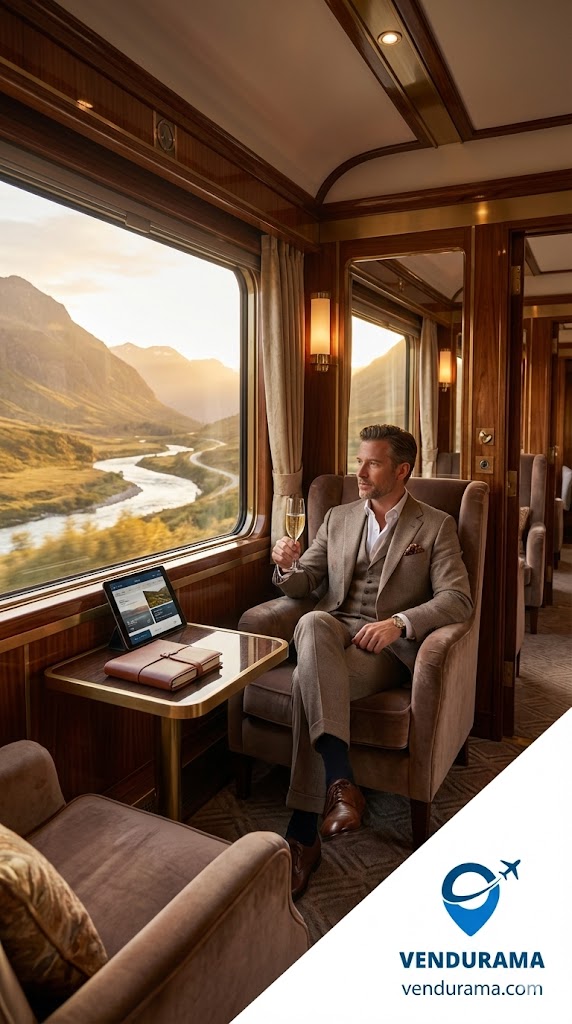
In the hyper-accelerated landscape of 2026, where sub-orbital flights and supersonic transit have turned global movement into a clinical exercise in efficiency, a counter-revolution has taken hold of the global elite. The concept of “displacement” has shifted from the necessity of reaching a destination to the psychological indulgence of the journey itself. This is the era of the Iron Palace—a revival of ultra-luxury rail travel that transcends the mere nostalgia of the 19th-century Orient Express, evolving instead into a sophisticated, technologically advanced, and deeply philosophical mode of existence.
To understand the resurgence of luxury rail is to understand the contemporary crisis of time. In a world defined by instant connectivity, “slowness” has become the ultimate luxury commodity. Rail travel, particularly in its most opulent iterations, offers a controlled suspension of the digital routine. It is a “kairos” moment—a qualitative period of time where the traveler is not merely moving through space but inhabiting it. This masterclass explores the strategic, technical, and logistical architecture of modern luxury rail, providing the nomadic elite with a blueprint for navigating this global cultural phenomenon.
1. The Architecture of the Rail Suite: Engineering the Mobile Sanctuary
A luxury train in 2026 is a masterpiece of spatial engineering. Unlike the cramped quarters of a first-class aviation cabin, a rail suite must function as a legitimate residence. The technical challenge lies in managing the physics of motion while maintaining the aesthetics of a five-star hotel.
Vibration Dampening and Acoustic Engineering
The hallmark of a true “Iron Palace” is silence. Modern luxury carriages utilize advanced magnetic stabilization and multi-stage suspension systems to isolate the living quarters from the rhythmic “click-clack” of the tracks. The acoustic profile is managed through heavy-gauge insulation and double-glazed, reinforced glass that filters out the wind shear of high-speed passes. For the traveler, this means a stable environment where a glass of vintage wine remains undisturbed, even as the train carves through the Alpine passes.
Materials Science and the Aesthetic of Permanence
In an age of plastic and composites, the luxury rail industry has doubled down on “The Aesthetic of Permanence”. Suites are designed using rare hardwoods like macassar ebony and polished teak, accented with hand-stitched leather from heritage tanneries. These materials are not chosen solely for their beauty but for their haptic feedback—the way they feel to the touch. The goal is to create a sensory anchor for the traveler, a physical manifestation of stability in a world of constant motion.
2. The Global Routes of 2026: A New Cartography of Elegance
The luxury rail map of 2026 is no longer confined to the traditional corridors of Europe. It has expanded into emerging markets, following the flow of global capital and the desire for “undiscovered” vistas.
The European Heartland: The Venice Simplon-Orient-Express (VSOE)
The VSOE remains the undisputed sovereign of the tracks. In 2026, its new “Grand Suites” offer a level of opulence that rivals any stationary palace. Each suite is themed after a city on its route—Paris, Venice, Istanbul—incorporating regional craftsmanship into the design. The strategy here is “Living History,” maintaining the original 1920s Art Deco carriages while retrofitting them with 21st-century climate control.
The Asian Frontier: Seven Stars in Kyushu
In Japan, the Seven Stars has redefined the concept of the “Cruise Train”. The focus here is on craftsmanship (Takumi). Every detail, from the delicate Kumiko woodwork to the hand-painted porcelain sinks, is a tribute to Japanese heritage. The route itself is a strategic curation of the island’s most dramatic landscapes, accessible only by rail.
3. The Gastronomy of Motion: Michelin-Starred Logistics
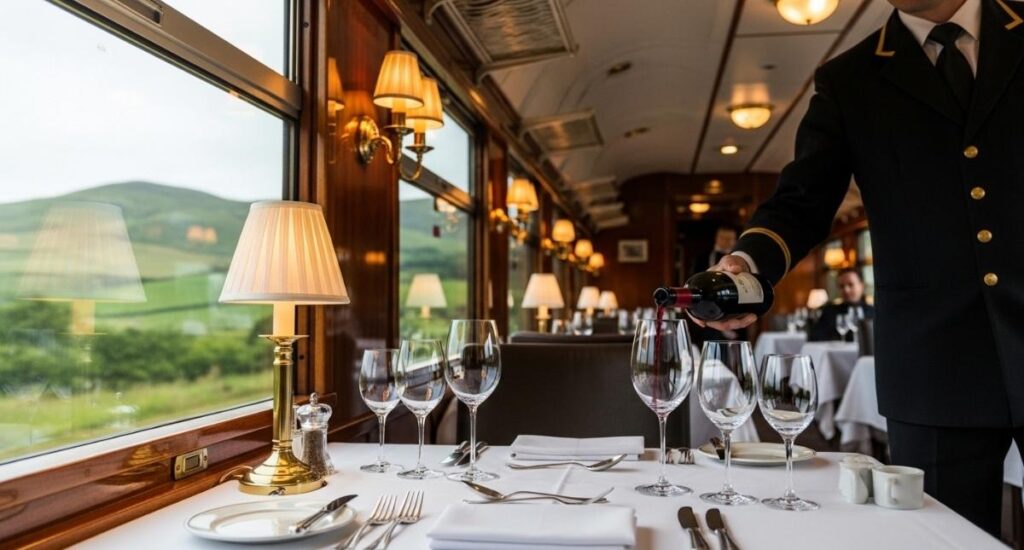
One of the most complex technical aspects of luxury rail is the delivery of world-class gastronomy. A kitchen on a moving train is a study in logistical precision, where space is at a premium and heat management is critical.
The High-Altitude Kitchen
On routes like the Andean Explorer, executive chefs must adjust recipes for atmospheric pressure and motion. Flavors are perceived differently at altitude; humidity levels affect the rise of bread and the oxidation of wine. In 2026, these kitchens utilize induction technology and vacuum-sealing to maximize efficiency and safety.
The Sourcing Chain
The logistics of provisioning a luxury train are staggering. Ingredients are often sourced from local producers at various stops—fresh truffles in the Piedmont or seafood from the Adriatic. This requires a highly synchronized supply chain where producers meet the train at precise timestamps, ensuring that the menu is a reflection of the geography passing outside the window.
4. Technological Integration: The Silent Digital Backbone
While the visual aesthetic of the Iron Palace is often historic, the digital infrastructure is cutting-edge. The 2026 luxury traveler requires seamless connectivity for global asset management, even while traversing remote regions.
- Satellite Connectivity: Modern luxury trains are equipped with low-earth orbit (LEO) satellite arrays, providing high-speed internet.
- Quiet Tech: Connectivity is integrated into wood-paneled walls, and smart-room controls are hidden within antique-style brass switches.
- Sustainable Propulsion: Newer routes utilize hydrogen-cell locomotives or hybrid-electric systems to ensure a significantly lower carbon footprint than private aviation.
5. The Logistical Blueprint: Managing the “First and Last Mile”
The primary friction point in any luxury rail journey is the transition. A traveler’s experience can be compromised by the chaos of a public station or the difficulty of transporting high-volume luggage.
Synchronizing Global Schedules
For the professional traveler, the journey does not begin at the station platform; it begins at the point of origin. Success in luxury travel is built on the foundation of comprehensive travel arrangements that synchronize flight arrivals with train departures. This requires a macro-view of global schedules to avoid any disruption in the luxury narrative.
The Vital Role of Professional Transfers
The “Last Mile”—the journey from the train to a private villa—is where logistical failures often occur. Navigating a foreign city with bespoke luggage is a strategic risk. To ensure the integrity of the experience, the nomadic elite rely on bespoke luxury transfers. A pre-arranged chauffeur service provides the necessary security and discretion to bridge the gap between the rail sanctuary and the final destination.
6. Conclusion: The Return to the Grand Narrative
The revival of the Iron Palace is a testament to the enduring human desire for the “Grand Narrative”. We are not meant to be teleported from point A to point B; we are meant to see the world change—to watch the architecture shift and the light transform as we cross borders.
The luxury rail traveler of 2026 is a cartographer of their own experience. By embracing the slowness of the tracks and the opulence of the suite, they reclaim their time. But this freedom is only possible through rigorous planning, from securing the right cabin to arranging the private chauffeur services that await at the end of the line.
Next Step: To ensure your journey is as seamless as the silk linens in your suite, begin by coordinating your global flight and accommodation schedules to align with your chosen rail route. For a truly frictionless experience, always secure your professional ground transportation to maintain the standard of excellence from the station to your doorstep.