Introduction: The Intersection of Aesthetics, Globalization, and Dentistry
In the contemporary visual culture, dominated by high-definition media and social platforms, the dental aesthetic known colloquially as the “Hollywood Smile” has transcended its origins as a cinematic luxury to become a globally recognized marker of vitality, health, and social status. This paradigm shift has transformed cosmetic dentistry from a localized medical service into a massive transnational industry. At the epicenter of this global phenomenon stands Turkey.
Over the past decade, Turkey has successfully positioned itself as the premier destination for high-end dental restoration, attracting hundreds of thousands of international patients annually. This is not merely a trend driven by aggressive marketing; it is the result of a sophisticated convergence of factors: advanced domestic medical infrastructure, high-volume clinical expertise, favorable macroeconomic conditions creating significant cost arbitrage for Western patients, and strategic government support for health tourism.
This article provides a high-authority, comprehensive analysis of the Turkish cosmetic dentistry sector. It dissects the technical anatomy of the procedures (veneers, crowns, implants), explores the economic drivers that make high-quality care accessible, details the intricate logistics of the patient journey, and critically examines the clinical standards and ethical considerations inherent in this booming industry. It serves as a definitive primer for understanding the mechanisms of global dental mobility.
Defining the “Hollywood Smile”: Anatomy and Materials Science
The term “Hollywood Smile” is a marketing nomenclature for a complex set of prosthodontic procedures designed to achieve an idealized dental aesthetic characterized by perfect alignment, brightness, and symmetry. It is rarely a single procedure but rather a customized treatment plan involving multiple modalities.
The Core Modalities: Laminate Veneers vs. Full Crowns
The fundamental distinction in achieving this aesthetic lies in the invasiveness of the preparation.
- Porcelain Laminate Veneers: These are ultra-thin shells (typically 0.3mm to 0.7mm) of ceramic bonded to the front surface of the tooth. They are considered minimally invasive, requiring only a slight reduction of the enamel. They are ideal for correcting minor discoloration, chips, or spacing issues on otherwise healthy teeth.
- Full Coverage Crowns (Zirconia/E-Max): A crown covers the entire tooth structure, “capping” it completely. This requires significant reduction of the natural tooth (sometimes up to 60-70%). While necessary for heavily damaged or root-canaled teeth, their aggressive use on healthy virgin teeth for purely cosmetic reasons is a point of clinical controversy (often associated with the derogatory term “Turkey Teeth” when done poorly).
Materials Science: The Engine of Aesthetics
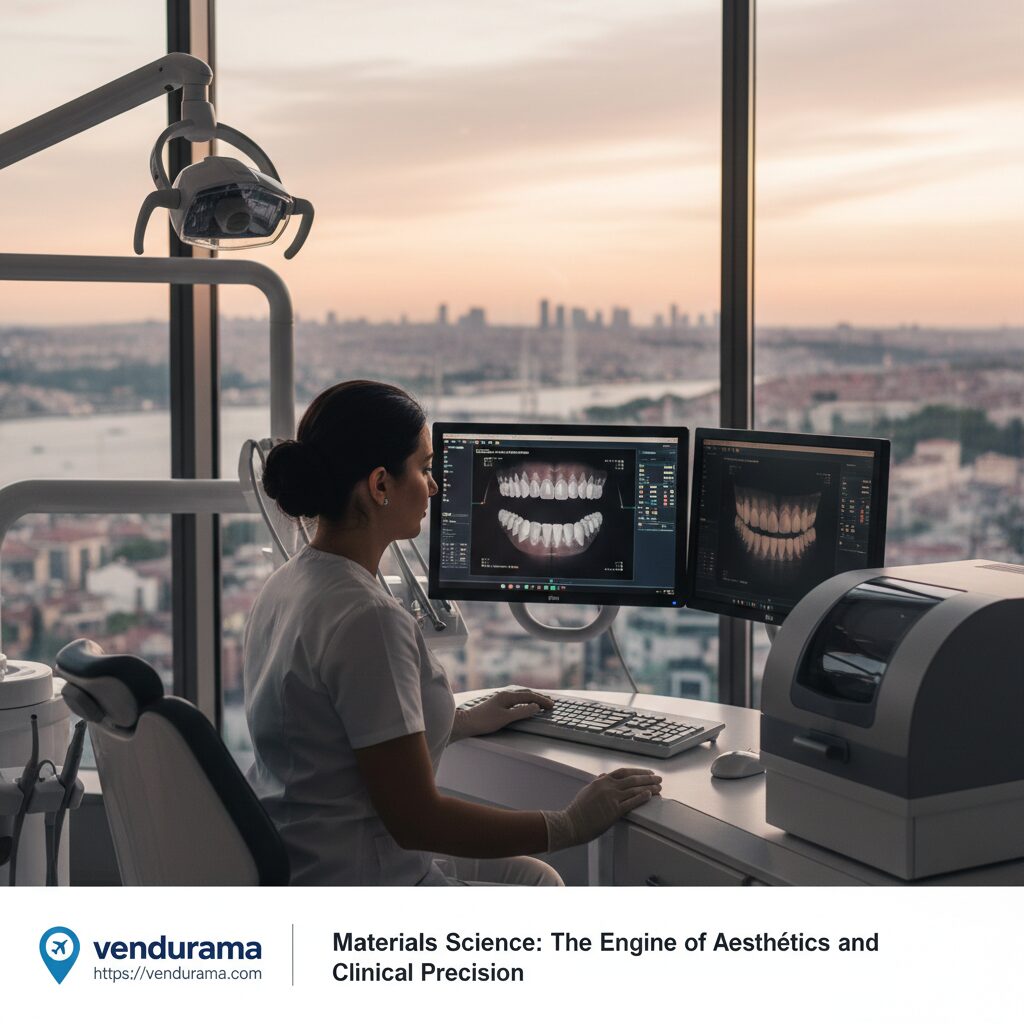
The evolution of dental materials is central to the modern Hollywood Smile, moving away from metal-fused porcelain toward advanced ceramics that mimic natural tooth translucency.
- Lithium Disilicate (E-Max): Renowned for its superior aesthetics and translucency, E-Max is often the material of choice for anterior (front) teeth where mimicking natural light reflection is paramount.
- Zirconium Dioxide (Zirconia): Known as “ceramic steel,” zirconia offers exceptional strength and fracture resistance. Modern monolithic zirconia is increasingly translucent, making it suitable for both posterior (back) teeth requiring durability and anterior teeth requiring aesthetics.
Turkey’s dental infrastructure is heavily invested in CAD/CAM (Computer-Aided Design/Computer-Aided Manufacturing) technology, allowing clinics to mill these advanced materials in-house with micron-level precision, often within 24 hours.
The Geoeconomics of Dental Tourism: Why Turkey Dominates
The driving force behind the migration of dental patients to Turkey is an undeniable economic value proposition combined with high clinical standards.
The Cost Arbitrage Equation
A full-mouth restoration (e.g., 20-28 units of Zirconia crowns or veneers) in the United States, United Kingdom, or Western Europe can easily exceed $30,000 to $50,000 USD. In Turkey, the same procedure, utilizing identical international materials (e.g., Ivoclar Vivadent ceramics) and performed by experienced prosthodontists, typically ranges between $3,000 and $7,000 USD.
This 70-80% cost reduction is not due to inferior materials. It is a macroeconomic reflection of:
- Lower Operational Overheads: Rent, utilities, and administrative costs in Turkey are significantly lower than in Western capitals.
- Labor Cost Differentials: While highly skilled, salaries for dental technicians and auxiliary staff are lower relative to the Eurozone or US.
- Currency Exchange Rates: The valuation of foreign currencies against the Turkish Lira provides massive purchasing power for international patients.
High-Volume Expertise and Specialization
Turkish dentists in major hubs like Istanbul, Antalya, and Izmir perform thousands of cosmetic procedures annually. This high volume creates an accelerated learning curve, leading to extreme proficiency in complex full-mouth rehabilitations that a typical general dentist in a Western suburb might encounter only occasionally. The industry has specialized to the point where clinics often focus exclusively on international cosmetic cases.
The Patient Journey: Logistics, Timeline, and Execution
Executing a complex dental restoration in a foreign country requires precise logistical coordination. The treatment window is tight, usually compressed into a 5 to 7-day itinerary.
Pre-Clinical Planning and Virtual Triage
The process begins remotely. Patients submit high-resolution photos and panoramic X-rays via encrypted digital platforms. Prosthodontists analyze the patient’s occlusion (bite), gum line architecture, and facial symmetry to draft a preliminary treatment plan and cost estimate.
Strategic Travel Coordination
Unlike leisure travel, dental tourism is scheduled around clinical necessity. The timeline is rigid; a full set of veneers requires specific intervals for laboratory fabrication between appointments. Missing an appointment can derail the entire process. Therefore, aligning international flights with the clinic’s production schedule is critical. To ensure they arrive within the necessary window for their initial consultation and preparatory session, many patients utilize advanced flight aggregation platforms to find routes that offer the most reliable connections and appropriate arrival times relative to their clinic bookings.
Arrival and Ground Logistics Integration
Upon arrival, the patient enters a structured service ecosystem. The period immediately following landing can be stressful, navigating a new culture while anticipating medical procedures. Recognizing this, premium dental clinics often integrate ground logistics into their service packages. To guarantee a seamless, secure, and stress-free transition from the airport arrivals terminal directly to their hotel or the clinic for immediate check-ins, many medical tourists prioritize booking professional private transfer services in advance, avoiding the unpredictability of local taxis.
The Clinical Protocol: The 5-Day Turnaround
A typical full-mouth restoration follows an intensive schedule:
- Day 1: Preparation and Impression. The longest clinical day. Teeth are prepared (shaved down based on the chosen modality), and highly accurate digital or physical impressions are taken. Temporary acrylic teeth are fitted to protect the sensitive prepared tooth structure.
- Day 2-3: Laboratory Fabrication. The patient has free time while the on-site laboratory technicians design and mill the permanent restorations using CAD/CAM systems.
- Day 4: The “Try-In” Session. A critical stage where the permanent teeth are temporarily placed without final cement. The patient and dentist evaluate the aesthetics, phonetics (speech), and bite. Adjustments to color, shape, or length are requested here.
- Day 5: Final Cementation. Once approved, the restorations are permanently bonded to the teeth using high-strength resin cements. A final bite check is performed.
Risk Management and Ethical Considerations
The rapid explosion of the industry has inevitably led to variations in quality and ethical concerns that prospective patients must navigate.
The “Aggressive Preparation” Controversy
The most significant ethical risk is overtreatment. Some profit-driven clinics may push patients—particularly young patients with healthy teeth—toward invasive full crowns instead of minimally invasive veneers because crowns are faster to prep and less technically demanding for the technician to fit. This irreversible removal of healthy enamel can lead to long-term complications, including nerve damage requiring root canals.
Finding Accredited Quality
Navigating the marketplace requires due diligence. High-quality clinics in Turkey are often accredited by international bodies like the Joint Commission International (JCI) or are members of reputable organizations like the Turkish Dental Association (TDB) or international aesthetic academies. Verifying the credentials of the specific prosthodontist performing the work, rather than just the clinic brand, is essential.
Long-Term Maintenance and Complications
A Hollywood Smile is not a “fit and forget” solution. Veneers and crowns have a lifespan (typically 10-20 years). Patients must understand that they will likely need replacements in the future. Furthermore, if complications arise (chips, debonding, sensitivity) after returning home, local dentists may be hesitant to touch work performed abroad, or repairs may be costly.
The Psychological Impact: Beyond the Physical
The demand for cosmetic dentistry is deeply rooted in psychology. The mouth is a primary point of social interaction. Severe dental issues can lead to profound social anxiety, hiding one’s smile, and diminished self-esteem.
For many patients, the journey to Turkey is transformational. The restoration of a functional, aesthetic smile often leads to significant improvements in psychosocial well-being, confidence in professional settings, and overall quality of life. It is this psychological ROI, combined with the financial savings, that drives the industry’s growth.
Conclusion: The Global Future of Cosmetic Dentistry
The phenomenon of the Turkish “Hollywood Smile” is a crystallization of modern globalization in healthcare. It demonstrates how technology, specialized labor pools, and economic disparities can converge to create a world-class service industry that disrupts traditional medical markets.
Turkey has democratized access to high-end cosmetic dentistry, making what was once an exclusive luxury attainable for a broader global middle class. As the sector matures, the focus is shifting towards sustainable practices, stricter regulations on ethical treatment planning, and the integration of even more advanced digital workflow technologies. For the informed global patient, Turkey remains the definitive nexus where medical necessity, aesthetic ambition, and economic reality meet.