
The Strategic Imperative of International Education in the Modern Global System
In an era defined by interconnected economies, transnational challenges, and a competitive knowledge race, international education has transcended its status as a personal enrichment opportunity to become a strategic necessity for nations, institutions, and individuals. The movement of students across borders—a phenomenon encompassing over 6.4 million individuals globally—represents one of the most significant flows of human capital in the modern world. This mobility is not merely an academic exercise; it is a fundamental driver of innovation capacity, diplomatic soft power, and economic vitality. For nations, attracting international talent bolsters research output, fills critical skill gaps, and fosters long-term geopolitical alliances through the cultivation of alumni networks. For universities, it is a cornerstone of financial sustainability, campus internationalization, and academic prestige. For the individual student, it has evolved from a luxury to a critical component of global employability and cognitive development. In a labor market that increasingly values cross-cultural competency, adaptive problem-solving, and global networks, an international educational experience provides a decisive competitive edge. Thus, study abroad operates at the nexus of education policy, economic strategy, and cultural diplomacy, making it an indispensable element of the modern global system.
Defining Study Abroad: Distinguishing Purpose and Practice
Study abroad is defined as the temporary, purpose-driven mobility of a student across a national border to enroll in an educational program. Its core characteristic is its non-permanent, academic intent, which sharply differentiates it from related forms of mobility.
- Distinction from Migration: While migration implies a permanent or long-term change of residence with the intent to settle, study abroad is inherently temporary. The primary legal status is that of a student permit holder, not an immigrant, with the explicit understanding that the individual will return to their country of origin upon program completion, barring subsequent changes in status.
- Distinction from Tourism: Although both involve cross-border movement, tourism is primarily recreational and consumption-oriented. Study abroad is productive and credential-seeking, centered on enrollment in an accredited institution, structured academic work, and integration into a campus community. The duration is typically longer, and the engagement with the host society is fundamentally deeper and more regulated.
- Distinction from Domestic Education: The defining factor is the immersion in a foreign socio-cultural and academic environment. This context forces adaptation, challenges ethnocentric perspectives, and provides a comparative lens on one’s field of study that domestic education cannot replicate. The educational value extends far beyond the formal curriculum to include the lived experience of navigating daily life in another culture.
A Historical Overview: From the Wandering Scholar to Mass Mobility
The history of international student mobility mirrors the evolution of knowledge, power, and global connectivity.
- Ancient and Medieval Foundations: The tradition of the itinerant scholar is ancient. In the classical world, students traveled to centers of learning like Athens, Alexandria, and later Rome. During the Middle Ages, the rise of medieval universities in Bologna, Paris, and Oxford attracted scholars from across Christendom, united by the common language of Latin. This era established the university as a transnational institution.
- The Colonial and Cold War Eras: The colonial period saw subjects traveling to imperial centers like London and Paris for education, often as part of a “civilizing mission.” The post-World War II era, particularly the Cold War, politicized student mobility. Initiatives like the U.S. Fulbright Program (1946) and the Soviet Union’s patronage of students from allied states used educational exchange as a direct instrument of ideological influence and diplomatic alliance-building.
- Late 20th Century: Massification and Marketization: The late 20th century witnessed the massification of higher education and the concomitant rise of mobility. The Bologna Process (1999), aimed at creating a European Higher Education Area, dramatically standardized degree structures and facilitated intra-European exchange through programs like Erasmus. Concurrently, the rise of English as the global academic lingua franca and the marketization of higher education transformed international students into a crucial source of revenue for universities in Anglophone countries (the U.S., U.K., Australia, Canada).
- 21st Century Dynamics: The current landscape is characterized by multipolar competition. Traditional Western destinations now compete with emerging hubs in Asia (China, Singapore, Malaysia) and the Middle East (Qatar, UAE). Mobility is further shaped by geopolitics (shifting visa policies), economics (rising costs), and technology (the growth of digital and hybrid options, accelerated by the COVID-19 pandemic).
A Taxonomy of Global Academic Mobility: Program Types and Structures
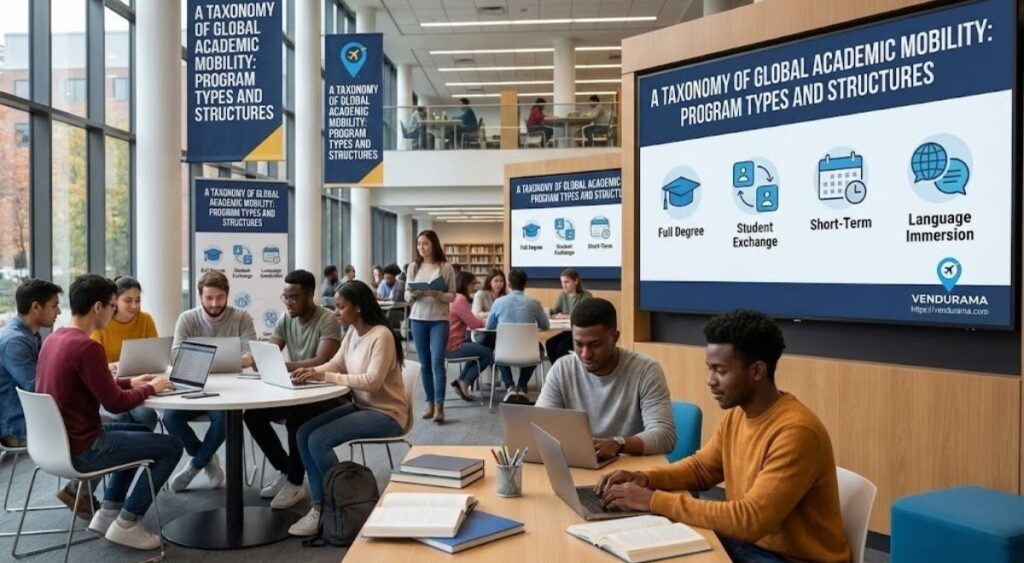
The modern study abroad ecosystem offers a diverse array of structures to suit different academic goals, timelines, and financial considerations.
- Full Degree Programs: The student enrolls for an entire undergraduate, graduate, or doctoral program at a foreign institution, culminating in a degree from that host university. This represents the deepest level of immersion and commitment, often leading to the most significant long-term career and migration outcomes.
- Student Exchange Programs: Typically built on bilateral agreements between universities, these programs allow students to study at a partner institution for one or two semesters while paying tuition to their home university. Programs like the European Union’s Erasmus+ are the archetype, emphasizing cultural exchange and academic integration without prohibitive cost increases.
- Short-Term and Faculty-Led Programs: These are intensive experiences ranging from a few weeks to a summer, often led by home-institution faculty and focused on a specific theme, language, or research topic. They provide accessible entry points into international education for students unable to commit to a full semester abroad.
- Language Immersion Programs: The primary focus is intensive language acquisition, often through enrollment in a specialized language school or university language institute, combined with homestay accommodations to maximize linguistic and cultural practice.
- Pathway and Foundation Programs: Designed primarily for international students who need to meet academic or language requirements for direct degree entry, these programs provide bridging coursework. They are a significant recruitment tool for universities in key destination countries.
Global Academic Destinations and Institutional Strengths
The global landscape of study destinations is stratified, with different regions and nations building distinct value propositions based on academic tradition, institutional strength, and post-study opportunities.
- The United States: Continues to lead in research output and institutional prestige, particularly in STEM fields, business, and the liberal arts. Its primary draws are the flexibility of its undergraduate curriculum, the resources of its major research universities, and its extensive network of alumni and industry connections. Challenges include high cost and complex visa processes.
- The United Kingdom: Offers a tradition of academic rigor and shorter, more intensive degree programs (three years for undergraduate, one year for many master’s). Strengths lie in humanities, law, finance, and creative arts. Post-Brexit immigration rules have created a more challenging but structured path for international graduates seeking work.
- European Union (Germany, France, Netherlands): Germany is renowned for its tuition-free or low-cost education at public universities, exceptional engineering (Technische Universitäten), and strong research institutes (Max Planck, Fraunhofer). France attracts students to its grandes écoles for business and political science, while the Netherlands offers a vast array of English-taught programs in a highly internationalized environment.
- Australia and Canada: Both have leveraged post-study work rights and pathways to permanent residency as major attractions. They are perceived as offering high-quality education in safe, multicultural, English-speaking environments. Australia excels in environmental sciences, medicine, and hospitality; Canada is strong in computer science, engineering, and public policy.
- Emerging Hubs (China, Singapore, Qatar): China has invested heavily in creating world-class universities (e.g., Tsinghua, Peking) and now ranks among the top destinations, particularly for students from Asia and Africa, with strengths in engineering, technology, and business. Singapore positions itself as a global education node with satellite campuses of top Western institutions and strong local universities (NUS, NTU). Qatar’s Education City hosts branch campuses of several elite American universities, creating a unique concentrated hub in the Middle East.
Navigating the Gateway: Admissions, Visas, and Legal Frameworks
Gaining entry to a foreign academic program is a dual process involving institutional admission and state authorization.
- Admission Requirements and Academic Eligibility: This is institution-specific but generally includes a completed application, official academic transcripts (often requiring evaluation by a credential service), standardized test scores (e.g., SAT, ACT, GRE, GMAT), proof of language proficiency (TOEFL, IELTS, Duolingo), letters of recommendation, and a statement of purpose. Competitive programs also may require portfolios, writing samples, or interviews.
- Visa Policies and Student Permits: A letter of admission does not confer the right to enter or reside in a country. Students must apply for a student visa or residence permit. Core requirements almost universally include proof of admission, proof of sufficient financial resources to cover tuition and living expenses, valid health insurance, and sometimes a medical examination or police clearance certificate. Key considerations include:
- Financial Evidence: Often the most stringent requirement, demanding bank statements or sponsorship letters meeting a specific threshold.
- Intent to Return: Many countries (like the U.S. with its F-1 visa) require applicants to demonstrate strong ties to their home country and a non-immigrant intent.
- Work Rights: Most student permits allow limited part-time work during studies (e.g., 20 hours per week), with specific rules varying by country.
- Post-Graduation Options: An increasing differentiator is the availability of a post-study work permit (e.g., the U.S. OPT, the U.K. Graduate Route, Canada’s PGWP), which allows graduates to gain professional experience in the host country.
The Human Dimension: Language, Culture, and Student Life
Academic success is inextricably linked to socio-cultural adaptation and personal well-being.
- Language Preparation and Cultural Adaptation: Pre-departure language study is crucial, even for programs taught in English, as daily life requires local language skills. Cultural adaptation typically follows a curve from initial euphoria (“honeymoon phase”) through culture shock—characterized by frustration and anxiety as differences become salient—to gradual adjustment and eventual bicultural competence. Institutions provide support through orientation programs, intercultural workshops, and buddy systems pairing international students with local peers.
- Student Life, Housing, and Campus Integration: Housing is a primary concern. Options include on-campus dormitories (offering community but less independence), off-campus private rentals (more autonomy but logistically challenging), and homestays (excellent for language and culture, but variable). Campus integration is facilitated by joining student clubs, sports teams, and academic societies. Proactive engagement is necessary to move beyond the “international student bubble.”
- Health, Safety, and Support Services: Comprehensive international student health insurance is typically mandatory. Students must understand the healthcare system of the host country. Universities provide essential support through dedicated international student offices, counseling centers, and legal advisors. Personal safety requires learning about local norms, scams, and areas to avoid, much like any informed traveler. For logistical ease upon arrival, many students and institutions arrange reliable private airport transfers in advance to ensure a smooth, secure transition to their new city and accommodation.
The Transformative Payoff: Academic, Cognitive, and Career Outcomes
The investment in study abroad yields dividends across multiple domains of human development.
- Academic Benefits and Cognitive Development: Exposure to different pedagogical styles—from the lecture-heavy approaches of some systems to the tutorial-based models of others—enhances intellectual flexibility. Students develop stronger critical thinking and problem-solving skills by confronting knowledge from diverse cultural perspectives. Research consistently shows that study abroad experiences correlate with higher academic retention and graduation rates.
- Career Impact and Global Employability: In the global labor market, employers highly value the soft skills honed abroad: intercultural communication, adaptability, resilience, and foreign language ability. A study abroad experience signals independence, initiative, and the capacity to navigate ambiguity. The professional networks built with peers from around the world can become a lifelong career asset. Furthermore, specific destinations can provide direct pathways to internships and employment in key industries.
The Economics of Mobility: Financial Planning and Sustainability
The financial aspect is often the most significant barrier and requires meticulous management.
- Cost Structure: Major costs include tuition fees (which can be double or triple the rate for domestic students), accommodation and living expenses, airfare, visa/application fees, and mandatory health insurance. Costs vary enormously by destination (e.g., Germany vs. the U.K., small city vs. major metropolis).
- Funding Strategies:
- Scholarships and Grants: Offered by governments (e.g., Fulbright, Chevening, DAAD), home and host universities, and private foundations. These are highly competitive and require early research and application.
- Student Loans: Available from home-country providers or, in rare cases, international lenders.
- Part-Time Work: A common way to offset living expenses, subject to the legal limits of the student permit.
- Financial Planning: Requires creating a detailed budget, utilizing global travel aggregators to estimate flight and travel costs accurately, understanding currency exchange risks, and establishing a local bank account.
Ethical Imperatives and Future Trajectories
As the scale of mobility grows, so do questions of its equity, ethics, and future direction.
- Ethical Challenges and Inclusivity: The current system often replicates global inequalities. Students from the Global South face disproportionate financial and visa hurdles. There is a risk of “brain drain,” where the most talented individuals from developing countries do not return. Ethical practice demands greater South-North and South-South mobility, more need-based scholarships, and institutional commitments to support underrepresented students.
- Sustainability: The carbon footprint of academic mobility, primarily from air travel, is increasingly scrutinized. This is driving interest in virtual exchange, hybrid programs that blend short-term mobility with online collaboration, and a greater emphasis on “green” campus policies.
- The Future of Global Student Mobility: The future will be characterized by hybridization. Digital education platforms, micro-credentials, and Collaborative Online International Learning (COIL) will expand access. However, the irreplaceable value of physical immersion for deep cultural learning and relationship-building will ensure that traditional mobility remains central. The landscape will be shaped by geopolitics, technological innovation, and a collective push to make global education more accessible, equitable, and sustainable. The student of the future will likely curate a portfolio of international experiences—a semester abroad, a virtual internship with a global team, a short-term research fellowship—building the global competence required for the complex challenges of the 21st century.
In conclusion, study abroad stands as one of the most potent forms of global mobility, integrating the flow of knowledge, economic capital, and cultural understanding. It is a transformative rite of passage for the individual, a strategic asset for the nation, and a critical mechanism for fostering the global interconnectedness upon which our collective future depends. As the world grows more complex, the demand for the perspective, skills, and empathy cultivated through international education will only intensify.