
Introduction: The Great Academic Realignment
In 2026, the global job market has undergone a “Great Realignment.” The era where a prestigious university name on a resume acted as an automatic “fast-pass” to an executive office is officially over. Today, a degree is no longer viewed as a trophy; it is viewed as a Diagnostic Report of a candidate’s adaptability, technical niche, and cultural intelligence.
Employers at firms like Google, Goldman Sachs, and Siemens have moved toward “Skill-First” hiring models. In this environment, an international degree is subjected to a “Global Employability Audit.” Hiring managers are no longer asking, “Where does this school rank on a list?” Instead, they are asking: “Did this specific environment prepare you for the chaos of the modern global economy?”
For the international student, this shift is both a challenge and a massive opportunity. It means that choosing a university in a strategic “Industry Hub” (like Warsaw for FinTech or Hamburg for Aviation) can often carry more weight than a generalist degree from a high-ranked but isolated institution. This guide is a deep-dive analysis into the metrics that actually matter to employers in 2026 and how you can audit your education to ensure it has maximum market value.
Part I: The Metrics of the Modern Audit – What HR Sees
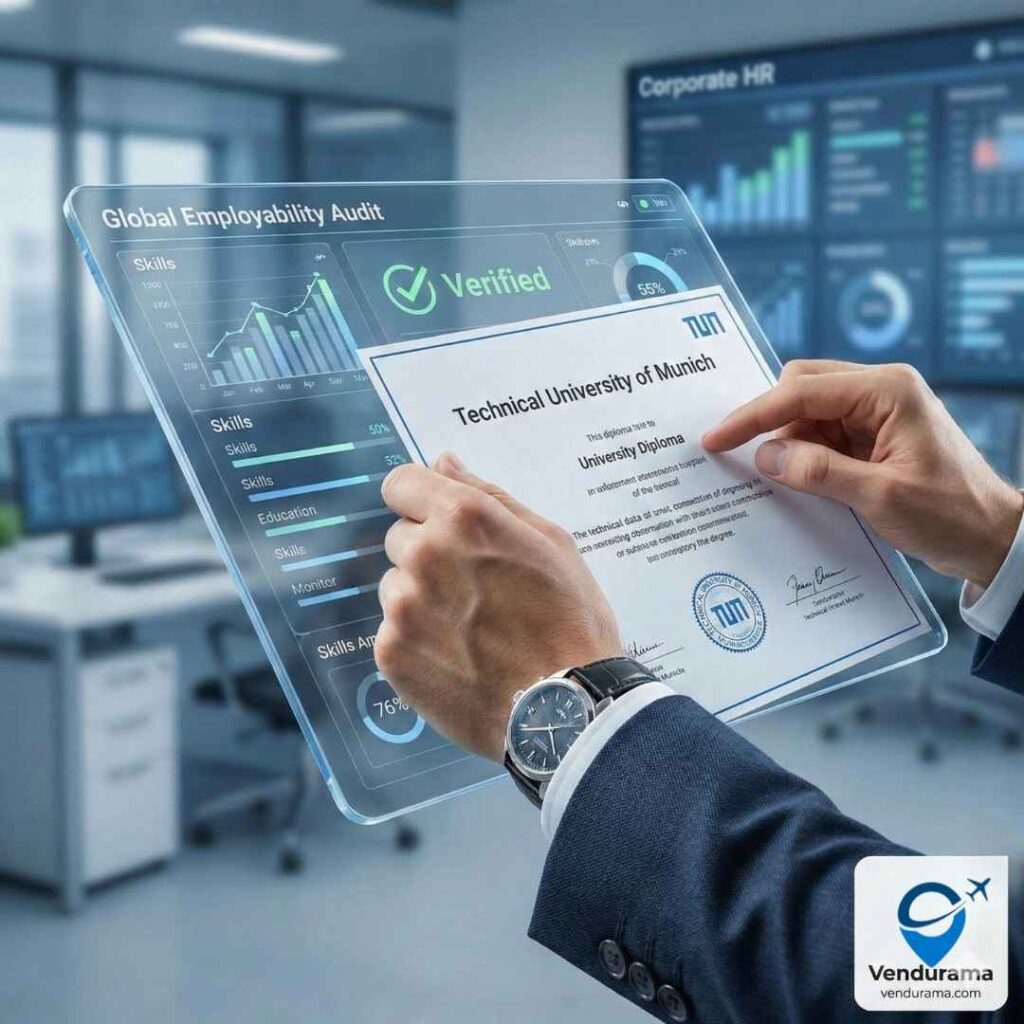
When a recruiter looks at your foreign degree in 2026, they are performing a three-dimensional analysis that goes far beyond your GPA.
1. The “Industry Hub” Validation
Employers now value Geographical Context. If you studied Automotive Engineering in Stuttgart, Germany, your degree has an “Inherent Validation” that a similar degree from a higher-ranked university in a non-industrial city lacks.
- The Logic: Employers assume you have been “breathing” the industry. They assume your guest lecturers were engineers from Mercedes-Benz and that your internships involved real-world proximity to the supply chain.
2. Cultural Intelligence ($CQ$) and Cognitive Flexibility
In a world of remote, cross-border teams, Cultural Quotient ($CQ$) is a high-value currency. An employer looks at your international degree as proof that you can:
- Navigate foreign bureaucracies.
- Communicate across linguistic barriers.
- Adapt your cognitive framework to a new set of social norms.
“A student who survives and thrives in a foreign educational system has already passed the ultimate test of ‘Soft Skill’ resilience.”
3. The “Applied Niche” vs. General Reputation
The 2026 audit favors specialization. A degree in “Sustainability Management” from a specialized Scandinavian university often ranks higher in the eyes of a Chief Sustainability Officer than an “MBA” from a top-10 global school that only offers one elective on the subject.
Part II: The Geography of Hiring – Mapping Industry Clusters
The most successful students in 2026 are those who choose their university based on “Cluster Mapping.” You want to be where the money and the innovation are flowing.
1. The Rise of the “Secondary” Hubs
We are seeing a massive shift toward cities that offer specialized excellence:
- The FinTech Corridor (Vilnius & Warsaw): Employers in European finance now prioritize graduates from these regions due to the high density of digital banking headquarters.
- The Green Tech Belt (Scandinavia & Northern Germany): If your goal is Renewable Energy, a degree from this region is the global gold standard.
- The AI & Data Logic Hubs (Montreal & Tallinn): These cities have built ecosystems that feed directly into global tech firms.
2. The ROI of Local Internships
Employers evaluate your degree based on the “Local Ecosystem Access” it provided. If your university doesn’t have a direct pipeline to the local chamber of commerce, the degree’s value drops significantly in the global audit.
Part III: The Practical Audit – How to Vet Your Degree’s Market Value
Before you commit to a university, you must perform your own “Employability Audit.”
1. The LinkedIn “Alumni Trajectory” Test
Don’t look at the university’s brochure. Look at LinkedIn. Filter alumni from the last 3 years who studied your specific course.
- Where are they working?
- Did they get hired in the country of study, or did they return home?
- If 80% of them are in high-value roles, the “Audit” is positive.
2. The “Professor-Practitioner” Ratio
In 2026, the value of a degree is tied to the Network of the Faculty. Audit the professors: Are they pure academics, or are they consultants for the industry? A professor who spent 20 years at a global firm is a “Walking Recommendation Letter.”
Part IV: The Logistics of the “Career Scout”
In 2026, you cannot afford to be a “passive” student. You must treat your education as a series of professional deployments. This requires high-level logistical agility.
1. The Interview & Networking Deployment
As you approach graduation, you will likely need to travel across regions for high-stakes interviews, networking events, or to visit specific industry hubs. You cannot rely on a single location.
Strategic career building requires the ability to move quickly and efficiently between cities like London, Berlin, or Dubai. To manage these “Professional Scouting Missions,” you need a platform that offers real-time data and the most direct routes to maximize your time on the ground. Utilizing sophisticated travel search engines is essential for the modern student-professional. These tools allow you to book multi-city itineraries that align with your interview schedule, ensuring you arrive at your networking events without the fatigue of poor logistical planning.
2. The “First Impression” Arrival
Whether you are arriving for a crucial internship or your first day at a global firm in a foreign city, your “Landing” dictates your performance. Navigating a complex foreign city with heavy luggage and professional attire is a high-stress scenario that can compromise your focus.
The professional move is to ensure a “Frictionless Transition.” Pre-arranging a vetted, private executive transfer to your accommodation or the corporate office is a strategic investment. It ensures you arrive composed, punctual, and ready to perform. A professional driver waiting at the airport—handling your logistics while you review your interview notes—is the difference between a “Stressed Candidate” and an “Executive Professional.” Arranging your transfer in advance is the final step in the “Employability Audit”—proving you value your time and your professional image.
Part V: The $ROI$ of Reputation – Calculating the Long-Term Yield
In 2026, the Return on Investment ($ROI$) is calculated using the formula:
$$ROI = \frac{(Expected Salary \times Industry Hub Multiplier) – Total Cost of Degree}{Years to Debt Clearance}$$
1. The “Hidden” Costs of Cheap Degrees
A low-cost degree in a city with no industry presence often has a negative $ROI$. You save money on tuition, but you spend 10 years trying to break into a network that you could have accessed in 6 months at a more strategic (even if more expensive) location.
2. The Currency of “Soft Power”
An international degree provides you with “Cultural Soft Power.” This is the ability to act as a bridge between your home country and your country of study. Employers in 2026 pay a premium for “Bridges.”
Part VI: The Skills Employers Audit (The 2026 List)
If your degree doesn’t explicitly foster these three skills, it will fail the audit:
- AI Orchestration: The ability to lead teams that use AI tools.
- Cross-Cultural Negotiation: Solving problems in diverse environments.
- Complex System Thinking: Understanding how your niche fits into the global supply chain.
Conclusion: Becoming the “Audited” Professional
The “Global Employability Audit” is not something that happens to you after graduation; it is something you engineer from day one. By choosing your university based on industry clusters, prioritizing cultural intelligence, and managing your professional logistics with precision, you transform your degree from a piece of paper into a high-yield global asset.
The 2026 job market does not reward those who followed the rankings; it rewards those who followed the opportunity. Secure your flights for your next career scout, ensure your arrival is managed with executive care, and build a degree that the world cannot ignore.
Next Step: Ready to audit your career path? Start by identifying the top 3 industry hubs for your niche. Then, check the most direct flight routes to begin your networking mission. And once you land that dream interview, book your professional transfer to ensure you arrive like the executive you are.