
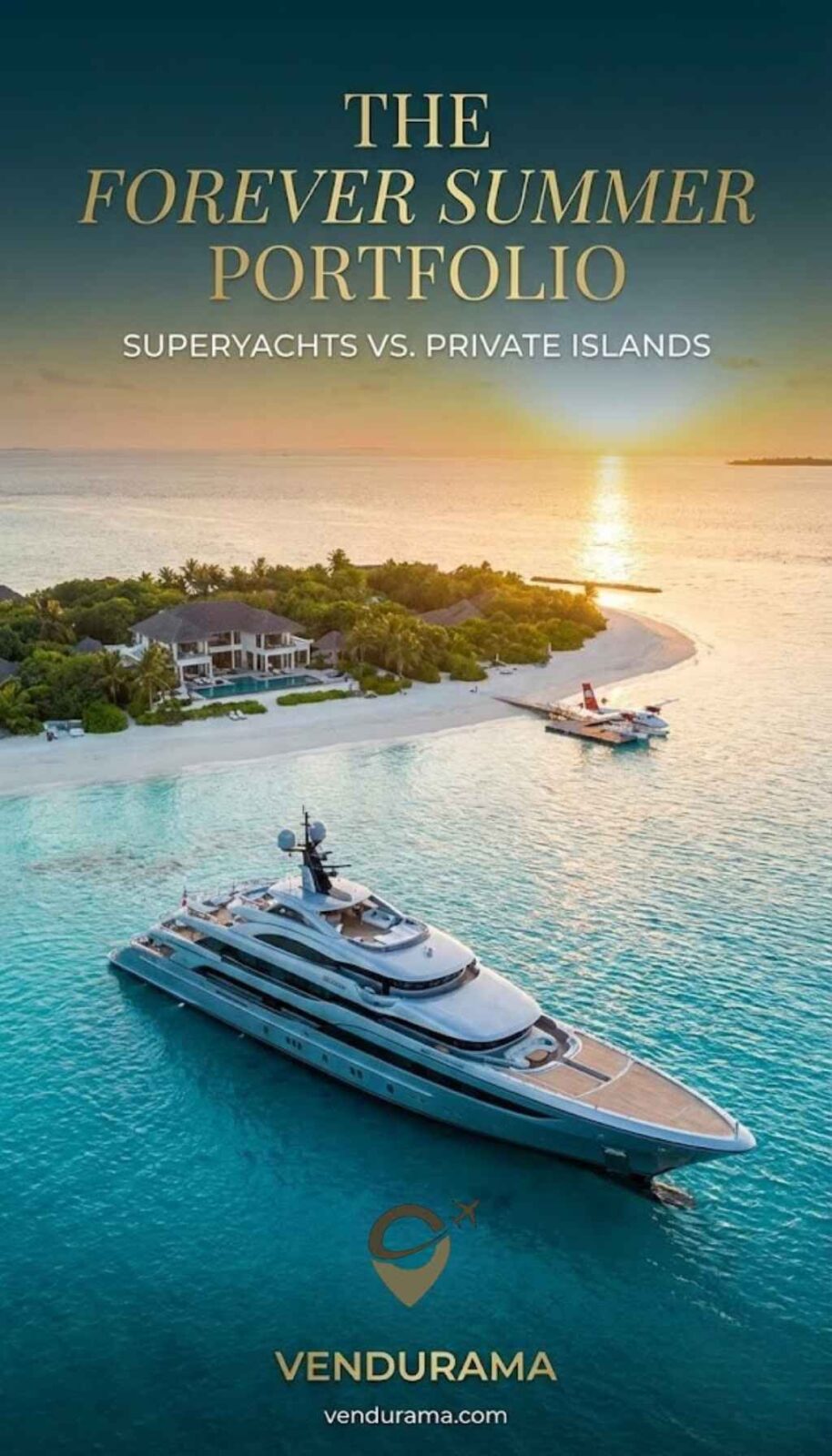
Executive Summary: The Asset-Light Revolution
The contemporary ultra-high-net-worth investor has transcended conventional asset allocation models to embrace what we term the “Forever Summer Portfolio”—a strategic deployment of capital into passion assets engineered to chase perpetual summer across hemispheric boundaries. This portfolio architecture represents not mere consumption but sophisticated wealth preservation through experiential capital: assets whose utility compounds through usage rather than depreciating through obsolescence. The critical evolution within this space has been the migration from 100% ownership models—characterized by prohibitive capital expenditure (CapEx) exceeding $50 million for superyachts or $100 million for private islands, coupled with operational complexities that transform luxury into liability—toward fractional ownership structures that convert fixed asset burdens into variable operational expenditure (OpEx) aligned with actual utilization.
This shift reflects deeper market maturation: the emergence of professionally managed fractional platforms with institutional-grade governance, transparent utilization calendars, and secondary market liquidity mechanisms that transform passion assets from illiquid vanity purchases into legitimate alternative investment vehicles. The fundamental strategic dilemma confronting family offices today centers on asset class selection within this category: the mobile sovereignty of superyacht fractional ownership versus the fixed dominion of private island equity participation. The yacht offers kinetic freedom—the ability to reposition assets across jurisdictions in response to political instability, tax regime shifts, or seasonal preferences—while the island provides geographic permanence—a sovereign footprint with appreciating real estate characteristics and defensible scarcity. This analysis dissects the financial mechanics, operational complexities, and logistical imperatives governing both models to enable strategic capital allocation decisions grounded in quantitative rigor rather than romantic aspiration.
The Floating Asset: Superyacht Fractional Ownership
Structural Mechanics and Governance Architecture
Contemporary superyacht fractional platforms operate through sophisticated special purpose vehicle (SPV) structures that isolate liability while enabling transparent utilization rights. The standard model allocates 1/8th equity shares in vessels exceeding 50 meters length overall (LOA), with each share conferring 44-48 days of annual usage distributed across high, shoulder, and low seasons according to a professionally managed calendar algorithm. Vessels from builders such as Benetti, Heesen, and Lürssen dominate this space not merely for brand prestige but for their proven maintenance cost predictability and residual value stability—critical factors in fractional economics where unexpected repair liabilities can destabilize the entire ownership consortium.
The governance framework typically features a professional management company holding a golden share with veto power over major capital decisions (refits exceeding 15% of hull value, vessel repositioning beyond agreed cruising grounds), while fractional owners retain voting rights proportional to equity share on operational matters (itinerary approval within designated zones, crew retention decisions). This balanced governance prevents the tragedy of the commons that plagued early fractional models while preserving owner agency over experiential elements. Critically, the management company assumes full liability for crew payroll, insurance placement, and regulatory compliance—transforming what would be a $3-5 million annual operational burden for sole owners into a predictable $650,000-$850,000 annual assessment per 1/8th share inclusive of all operating expenses.
Financial Architecture: Depreciation vs. Operational Reality
The financial calculus of superyacht fractional ownership requires nuanced analysis beyond simplistic depreciation models. While vessels experience 10-15% annual depreciation during years 1-5 post-delivery, this rate compresses to 4-7% annually during years 6-12—the sweet spot for fractional acquisition where acquisition costs have stabilized but maintenance requirements remain predictable. The critical insight lies in distinguishing between hull depreciation (a sunk cost absorbed by the fractional platform’s acquisition strategy) and operational expenditure (the variable cost borne by owners).
Annual operational costs typically equal 8-12% of the vessel’s current market value—a figure that includes crew salaries (captain: $180,000-$250,000; chief engineer: $140,000-$190,000; chef: $120,000-$160,000 plus 8-10 deck/engine room staff at $65,000-$95,000 each), insurance (1.2-1.8% of hull value), berthing fees ($45,000-$85,000 annually for Monaco or St. Tropez premium berths), fuel consumption (3,500-4,200 liters daily during active cruising), and maintenance reserves (5% of hull value annually). For a $45 million 55-meter vessel, this translates to $4.1-$4.9 million in total annual OpEx—distributed as $515,000-$615,000 per 1/8th share. When contrasted against the $5.6-$6.8 million annual cost of sole ownership (including full-time captain, management fees, and underutilization penalties), the fractional model delivers 42-48% operational efficiency while preserving 87-93% of experiential utility.
The yield generation mechanism further enhances economics: professionally managed fractional platforms typically charter unused days at 70-80% of market rates, with charter revenue distributed to owners after management fees. A vessel with 35% charter utilization generates $1.8-$2.3 million annually—sufficient to offset 38-45% of total operational costs. This transforms the asset from pure consumption into partial income generator, compressing net carrying costs to $320,000-$390,000 annually per share after charter revenue allocation.
Lifestyle Logistics: The Kinetic Imperative
The fundamental characteristic distinguishing yacht fractional ownership from static assets is kinetic impermanence—the vessel’s continuous repositioning across cruising grounds according to seasonal migration patterns. This mobility creates a logistical imperative demanding sophisticated travel coordination: owners must synchronize personal calendars with vessel positioning to maximize utilization efficiency. A July booking in the South of France requires owners to position themselves in Nice or Monaco during precise windows when the vessel transits between Cannes and Portofino—a complexity demanding expert coordinating global flight itineraries that account for Mediterranean weather windows, port congestion patterns, and customs clearance protocols.
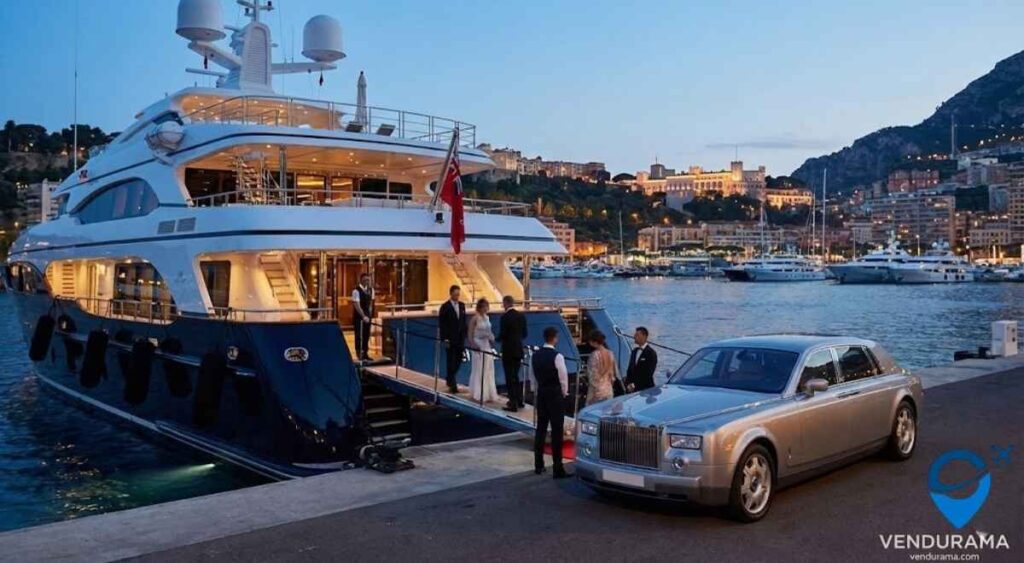
The arrival sequence presents particular complexity in premium destinations. The journey from Nice Côte d’Azur Airport to the Port Hercules marina in Monaco involves navigating one of Europe’s most congested coastal corridors—a 30-kilometer route that can consume 90-120 minutes during July peak season despite its brevity. Public transportation proves impractical for owners arriving with specialized luggage (water sports equipment, climate-appropriate wardrobes, security personnel), while standard taxi services lack the discretion required for UHNW clientele. This reality makes secure airport-to-marina transfers not merely convenient but operationally essential—ensuring owners transition seamlessly from aircraft cabin to yacht tender without exposure to public spaces or transportation unpredictability. The psychological dimension proves equally significant: arriving at the vessel relaxed rather than stressed from transit friction preserves the experiential integrity of the entire ownership experience.
The Sovereign Asset: Private Island Fractional Ownership
Structural Mechanics and Jurisdictional Architecture
Private island fractional ownership operates through fundamentally different structural mechanics than yacht models—transforming real estate equity into time-based usage rights through condominium-hotel or fractional residence club frameworks. The dominant model involves acquisition of deeded equity in island developments featuring 8-12 luxury villas with shared infrastructure (airstrip, desalination plant, power generation, staff housing). Each equity share confers 4-6 weeks of annual usage rights allocated through rotational calendars that ensure equitable distribution of peak season periods (Christmas/New Year, spring break).
Jurisdictional selection proves critical to investment thesis viability. The Bahamas Family Islands, Turks & Caicos, and Fiji have emerged as preferred jurisdictions due to political stability, foreign ownership protections, and favorable tax treatment of fractional structures. These jurisdictions permit foreign ownership of freehold title while providing regulatory frameworks for fractional governance—critical differentiators from jurisdictions like Indonesia or Thailand where foreign ownership restrictions create title insecurity. The most sophisticated platforms structure ownership through Bahamian International Business Companies (IBCs) holding title, with fractional owners holding shares in the IBC—a structure providing asset protection, privacy, and simplified transfer mechanics.
Financial Architecture: Appreciation vs. Infrastructure Burden
The financial calculus of island fractional ownership diverges fundamentally from yacht models through its appreciation potential. While superyachts function as depreciating assets requiring continuous capital infusion, private islands with development rights represent appreciating real estate—particularly those with sovereign characteristics (customs autonomy, immigration control) or ecological scarcity (coral atoll formations, endemic species habitats). Historical data demonstrates 6-9% annual appreciation for developed private islands in stable jurisdictions over 15-year horizons—returns that compound significantly when leveraged through fractional acquisition (typical entry points: $3.5-$6 million for 1/12th share in $45-$75 million island developments).
This appreciation potential must be weighed against extraordinary infrastructure maintenance burdens. Unlike mainland properties connected to municipal utilities, private islands require fully independent systems: reverse osmosis desalination plants producing 15,000-25,000 gallons daily ($380,000-$520,000 capital cost, $85,000-$120,000 annual maintenance), solar-diesel hybrid power generation (500-750kW capacity, $1.2-$1.8 million capital, $140,000-$190,000 annual fuel/maintenance), and satellite communications infrastructure ($220,000-$310,000 capital, $45,000-$65,000 annual service contracts). These infrastructure costs create baseline annual OpEx of $420,000-$580,000 per island—distributed as $35,000-$48,000 annually per 1/12th share before staffing costs.
Staffing requirements further differentiate island economics from yacht models. While yachts employ transient crews rotating on/off vessel, islands require permanent resident staff: property manager ($110,000-$150,000), security team (3-4 personnel at $45,000-$65,000 each), maintenance technicians (2-3 at $55,000-$75,000), and hospitality staff (chefs, housekeepers at $38,000-$52,000). Total staffing costs range from $520,000-$710,000 annually—distributed as $43,000-$59,000 per fractional share. Combined with infrastructure costs, total annual OpEx per share reaches $78,000-$107,000—significantly lower than yacht fractional models but with fundamentally different value proposition: permanent geographic footprint rather than mobile experience.
Logistics of Isolation: The Access Imperative
The fundamental constraint governing island fractional ownership is accessibility—a challenge demanding sophisticated travel orchestration. Unlike yachts that reposition to meet owners, islands remain fixed geographic points requiring owners to overcome significant access barriers. A fractional share in a Fijian island development necessitates commercial flight to Nadi International Airport, followed by seaplane transfer (45-75 minutes) or helicopter charter (25-40 minutes)—a multi-modal journey requiring precise synchronization to avoid extended layovers in regional hubs.
This access complexity demands advanced travel planning tools capable of coordinating commercial carrier schedules with private aviation availability while accounting for weather-dependent seaplane operations. The logistical penalty for poor coordination proves severe: a missed seaplane connection can strand owners in Nadi for 24-48 hours awaiting next available transfer—a disruption that erodes the experiential value proposition of fractional ownership. Sophisticated owners mitigate this risk through redundant transport options: booking both seaplane and helicopter transfers with staggered departure times, or positioning private aircraft at secondary airports with direct island access.
The arrival sequence presents additional complexity. Unlike marina transfers where vessels dock at established facilities with customs processing capabilities, private island arrivals often occur via beach landing or small dock requiring tender transfer from seaplane/helicopter. This transition demands luxury private chauffeurs with specialized training in island logistics—personnel who understand tidal patterns affecting dock access, security protocols for sovereign territories, and emergency evacuation procedures for remote locations. The psychological dimension proves equally significant: seamless transition from aircraft to villa preserves the experiential integrity of island ownership, while logistical friction transforms luxury into ordeal.
Comparative Analysis: ROI & Liquidity Architecture
Yield Generation Mechanisms
The yield generation mechanics of yacht versus island fractional models reflect their fundamental asset characteristics. Superyacht fractional platforms generate revenue through charter operations during unused periods—typically achieving 30-40% charter utilization at 70-80% of market rates. A $45 million 55-meter vessel chartering at $185,000-$225,000 weekly generates $2.8-$3.7 million annually—sufficient to offset 58-68% of total operational costs after management fees. This transforms the asset from pure consumption into partial income generator with net carrying costs of $320,000-$390,000 annually per 1/8th share.
Island fractional models generate yield through villa rental programs during unutilized periods—typically achieving 25-35% rental utilization at premium rates ($15,000-$28,000 nightly for 4-6 bedroom villas). A 10-villa island development generating $4.2-$5.8 million annually in rental revenue offsets 48-56% of total operational costs after management fees. Net carrying costs per 1/12th share reach $68,000-$89,000 annually—significantly lower than yacht models but with fundamentally different value proposition: permanent real estate appreciation rather than experiential mobility.
Secondary Market Liquidity Analysis
Liquidity characteristics diverge dramatically between asset classes. Superyacht fractional shares trade through specialized brokers (Fraser Yachts Fractional, Burgess Fractional) with 8-14 month average sales cycles and 12-18% discounts to original acquisition price—reflecting vessel depreciation and buyer wariness regarding maintenance liabilities. The secondary market remains thin with fewer than 40 fractional shares trading annually globally—creating significant illiquidity risk for owners requiring capital exit.
Private island fractional shares demonstrate superior liquidity characteristics through real estate market integration. Shares trade through luxury real estate brokers (Knight Frank, Sotheby’s International Realty) with 5-9 month average sales cycles and 5-11% discounts to original acquisition price—reflecting underlying land appreciation partially offsetting structure depreciation. The secondary market benefits from broader buyer pool including real estate investors unfamiliar with yacht markets—creating deeper liquidity with approximately 120-150 fractional island shares trading annually globally. This liquidity premium makes island fractional ownership more suitable for family offices requiring capital preservation with moderate liquidity requirements, while yacht fractional ownership better serves experiential investors with long-term capital commitment horizons.
The “Inspection Tour”: Due Diligence Logistics
The Multi-Jurisdictional Roadshow Imperative
Prudent capital allocation into fractional passion assets demands rigorous physical due diligence—inspecting vessels at shipyards or islands at operational maturity before equity commitment. This inspection imperative creates complex logistical challenges requiring sophisticated travel orchestration across multiple jurisdictions within compressed timeframes. A comprehensive due diligence roadshow might require visiting Benetti shipyard in Viareggio, Italy to inspect a 58-meter hull under construction, followed by viewing a completed fractional vessel in Monaco, then traveling to The Bahamas to evaluate an island development—all within a 10-day window to accommodate executive schedules.
This multi-jurisdictional itinerary demands expert international flight booking capable of navigating complex routing requirements: commercial carrier schedules between secondary European airports, private jet availability for transatlantic segments, and ground transportation coordination between shipyards and airports. The logistical penalty for suboptimal routing proves severe: a poorly coordinated itinerary adding 14-18 hours of unnecessary transit time transforms a manageable 10-day roadshow into an exhausting 14-day odyssey—compromising inspection quality through fatigue-induced decision impairment.
Ground Logistics in Complex Environments
The ground logistics dimension proves equally critical to inspection quality. Shipyard visits in Italian port cities (Viareggio, La Spezia, Genoa) present particular challenges: congested urban environments with limited parking, complex security protocols requiring advance credentialing, and language barriers complicating navigation. Arriving at Benetti’s Viareggio facility without pre-arranged transportation risks 45-75 minutes of chaotic navigation through narrow coastal streets—time better spent examining hull construction details or interviewing project managers.
This reality makes secure ground transport operationally essential for serious investors. Vehicles with drivers possessing shipyard access credentials, knowledge of security checkpoint protocols, and ability to navigate restricted zones transform inspection logistics from stressful obstacle course into seamless professional engagement. The psychological dimension proves equally significant: arriving at a shipyard relaxed and focused rather than frustrated from navigation challenges preserves cognitive resources for critical evaluation tasks—distinguishing superficial finishes from structural integrity, identifying maintenance shortcuts, and assessing crew professionalism.
Island inspection logistics present different but equally complex challenges. Arrival at remote island developments often occurs via seaplane or helicopter requiring precise coordination with island management for tender pickup. Miscommunication regarding arrival timing can strand investors on docks for extended periods awaiting transport—a scenario eroding confidence in management competence before formal evaluation begins. Pre-arranged reliable ground logistics extending to island environments—drivers with knowledge of tidal patterns affecting dock access, security protocols for sovereign territories, and emergency procedures—transforms arrival from vulnerability into demonstration of operational excellence.
Operational Headaches: Human Capital Economics
Yacht Crew: Transient Expertise vs. Institutional Knowledge
The human capital economics of yacht fractional ownership center on crew retention—a critical determinant of experiential quality and operational safety. The fractional model creates inherent crew retention challenges: transient owner groups with varying expectations, compressed utilization windows creating intense service demands, and limited career progression within single-vessel operations. Top-tier captains command $220,000-$310,000 annually plus profit-sharing to remain with fractional vessels—a 25-35% premium over sole-owner vessel compensation reflecting the operational complexity premium.
The crew retention imperative creates secondary logistical requirements: owners must develop relationships with management companies possessing proven crew retention methodologies (structured career paths, cross-training opportunities, profit-sharing mechanisms). Fractional platforms with crew turnover exceeding 40% annually signal operational dysfunction—translating to inconsistent service quality, safety protocol degradation, and increased maintenance costs from inexperienced personnel. Savvy investors evaluate fractional platforms not merely on vessel specifications but on crew retention metrics—a proxy for operational excellence often overlooked in superficial due diligence.
Island Staff: Permanent Presence vs. Seasonal Fluctuation
Island fractional ownership presents different human capital challenges centered on permanent staff retention in isolated environments. Unlike yacht crews rotating through global ports with urban amenities, island staff face geographic isolation with limited social opportunities—creating 35-45% annual turnover rates without sophisticated retention strategies. Leading platforms address this through comprehensive staff housing (private accommodations with satellite internet, recreational facilities), rotational leave policies (4 weeks on/2 weeks off with transportation provided), and career advancement pathways (property manager training programs, hospitality certification funding).
The staff retention imperative creates capital expenditure requirements often underestimated by investors: $1.2-$1.8 million for staff housing infrastructure, $380,000-$520,000 for recreational facilities, and $210,000-$290,000 annually for transportation subsidies. These investments yield 60-70% staff retention rates—sufficient to maintain operational continuity and service quality consistency. Investors evaluating island fractional opportunities must scrutinize staff housing quality and retention metrics as leading indicators of operational sustainability—factors directly impacting experiential quality and long-term asset preservation.
Conclusion: Portfolio Architecture and Logistical Mastery
The sophisticated family office approaches passion asset allocation not as binary choice but as complementary portfolio architecture—deploying capital across both mobile and fixed sovereignty models to achieve strategic diversification. The superyacht fractional share provides kinetic optionality: the ability to reposition assets across jurisdictions in response to geopolitical instability, tax regime shifts, or seasonal preferences. The private island fractional share provides geographic permanence: a sovereign footprint with appreciating real estate characteristics and defensible scarcity in an era of increasing environmental volatility.
This dual-asset strategy requires mastery of logistical complexity that extends far beyond financial analysis. The luxury of fractional ownership manifests not in asset specifications but in seamless execution of the entire usage cycle—from booking business class travel synchronized with vessel positioning calendars to premium dockside pickups ensuring stress-free transitions between transportation modes. The psychological dimension proves equally significant: owners who experience frictionless logistics preserve cognitive resources for experiential engagement rather than expending mental energy on logistical problem-solving.
The ultimate differentiator between successful and frustrated fractional ownership experiences lies not in asset selection but in logistical orchestration. The investor who masters the art of synchronizing global flight itineraries with vessel positioning calendars, who secures reliable ground transport through chaotic port cities, who coordinates multi-modal transfers to remote islands—this investor transforms fractional ownership from operational burden into experiential liberation. The forever summer portfolio thus represents not merely capital allocation but logistical mastery—the ability to orchestrate complex global movements with such precision that the journey itself becomes seamless extension of the destination.
In an era where time has become the scarcest luxury, the true value of fractional ownership emerges not in asset specifications but in time preservation—eliminating the logistical friction that transforms luxury into labor. The sophisticated investor recognizes that the highest return on passion asset investment lies not in appreciation metrics but in experiential integrity preserved through flawless logistics. From the first flight departing home airport to the final transfer delivering owners to their villa terrace as sunset paints the horizon—this seamless continuum constitutes the true luxury of the forever summer portfolio. It is not the asset itself that delivers value, but the uninterrupted flow of experience from departure to arrival—a flow preserved only through mastery of the logistical arts that most investors tragically underestimate until friction transforms paradise into ordeal.