
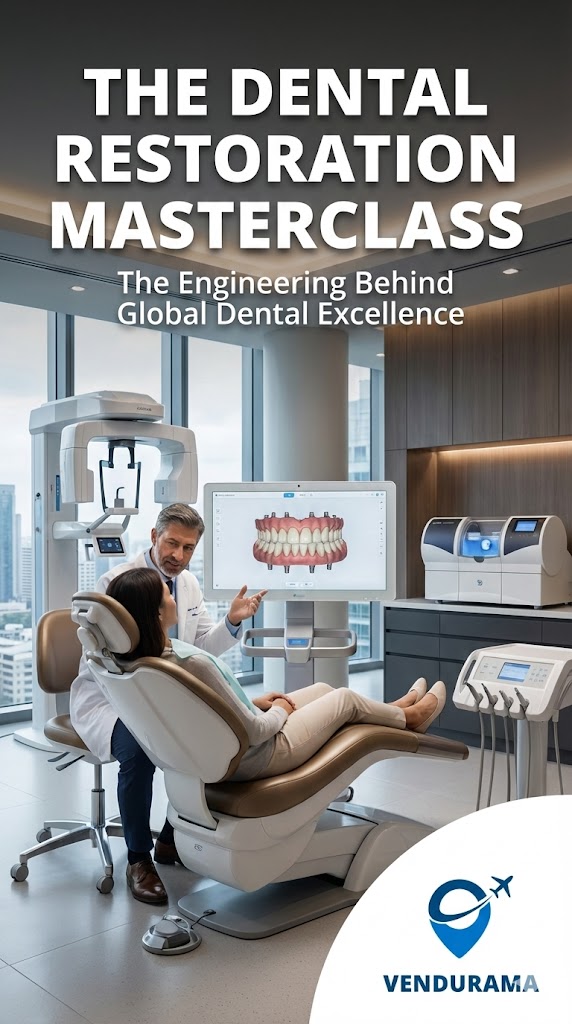
Introduction: From Aesthetics to Bio-Engineering
In the global medical landscape of 2026, dental tourism has evolved far beyond the pursuit of “Hollywood White” veneers. We have entered the era of Restorative Bio-Engineering. For the millions of individuals suffering from chronic tooth loss, severe periodontal disease, or total edentulism (complete tooth loss), the challenge is no longer just cosmetic—it is structural.
When a patient loses a full arch of teeth, they don’t just lose their smile; they lose the mechanical ability to process nutrition, the structural support for their facial features, and the integrity of their jawbone. Traditional dentures, once the only solution, are now seen as a “primitive” fix that fails to stop bone resorption.
The modern solution lies in advanced implantology, specifically the All-on-4 protocol and its sophisticated successors. This is not just dentistry; it is a masterclass in engineering, requiring a deep understanding of load distribution, material science, and osseointegration. This guide explores the technical brilliance behind these procedures and the logistical strategy required to access global centers of dental excellence.
Part I: The Mechanics of the Human Jaw
To understand why a restoration fails or succeeds, one must first understand the “foundation.” The human jaw is a complex mechanical system that exerts hundreds of pounds of pressure per square inch during mastication (chewing).
1. The Bone Resorption Crisis
When teeth are lost, the jawbone loses its purpose. Without the stimulation of the tooth root, the body begins to reclaim the minerals in the bone, leading to “atrophy.” Over time, the jaw shrinks, the face collapses, and traditional dentures lose their fit.
- The Engineering Fix: Dental implants act as “artificial roots.” By placing titanium or zirconia posts into the bone, we re-stimulate bone growth through a process called Osseointegration, where the living bone cells literally fuse with the implant surface.
2. The Sinus and Nerve Constraints
In the upper jaw, the maxillary sinuses often limit the available bone space. In the lower jaw, the alveolar nerve must be avoided at all costs. Traditional vertical implants often required painful and expensive bone grafts or sinus lifts to create enough space. This is where the “All-on-4” engineering breakthrough changed everything.
Part II: The All-on-4 Protocol – A Biomechanical Revolution
Developed by Dr. Paulo Malo, the All-on-4 treatment concept is a marvel of structural engineering. It allows for a full arch of prosthetic teeth to be supported by only four dental implants.
1. The Geometry of Stability
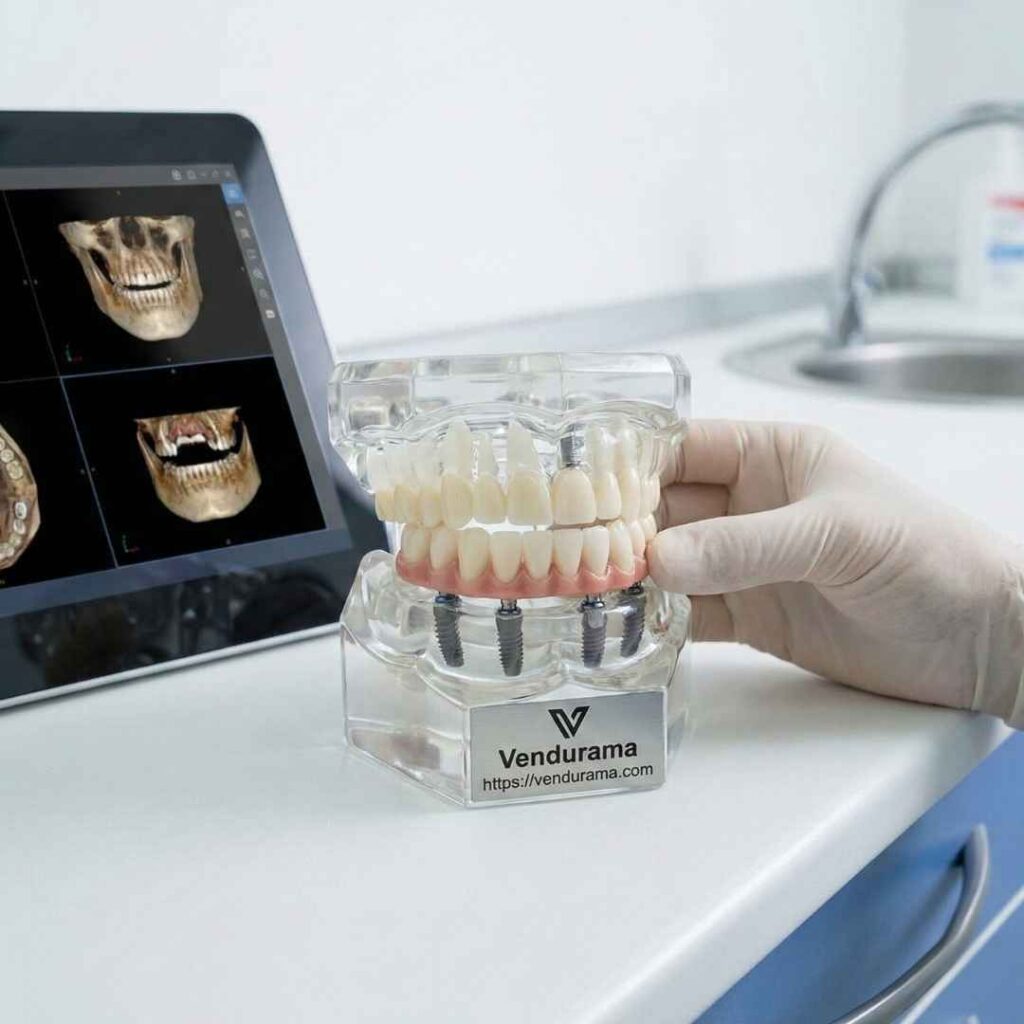
How can four posts support an entire bridge? The secret is in the Tilting Protocol:
- The Anterior Implants: Two implants are placed vertically in the front where bone density is highest.
- The Posterior Implants: Two implants are placed at the back, tilted at an angle of up to $45^{\circ}$.
- The Result: This tilting allows the implants to bypass the sinus cavities and the nerves while providing a wider “base” for the bridge, similar to the legs of a chair being angled outwards for stability. It maximizes the use of existing bone, often eliminating the need for bone grafting.
2. Immediate Function (Teeth-in-a-Day)
Because the four implants are “cross-braced” by the prosthetic bridge, they achieve Primary Stability immediately. This allows for a temporary, non-removable bridge to be attached on the same day as the surgery, allowing the patient to leave the clinic with a functional, fixed smile.
Part III: Beyond All-on-4 – Advanced Structural Solutions
While All-on-4 is the standard, modern engineering offers “upgrades” for specific physiological challenges.
1. All-on-6 and All-on-8: Increasing the Load Points
In cases where the patient has a particularly heavy “bite force” or wider jaw, surgeons may opt for All-on-6 or even All-on-8. This adds more “pillars” to the bridge, distributing the mechanical load more evenly across the jaw and reducing the stress on any single implant.
2. Zygomatic Implants: The Last Resort
For patients with extreme bone loss in the upper jaw who have been told they are “not candidates” for implants, Zygomatic Implants provide the answer. These are extra-long implants that bypass the jawbone entirely and anchor into the Zygomatic bone (the cheekbone). This bone is incredibly dense and never resorbs, providing a rock-solid foundation for a full-arch restoration.
Part IV: Material Science – Zirconia, Acrylic, and Titanium
The “teeth” themselves are a product of high-tech material science. A prosthetic bridge must be light enough to be comfortable but strong enough to withstand millions of bite cycles.
- Acrylic (Hybrid): The traditional choice. It’s lightweight and easy to repair but can stain and wear down over 5-10 years.
- Zirconia (The Gold Standard): A ceramic material that is virtually indestructible. It is biocompatible, resists stains, and has a translucency that mimics natural tooth enamel. A Zirconia bridge is the “luxury” choice for long-term durability.
- PEEK (Polyether Ether Ketone): A high-performance polymer used in aerospace and spinal implants. It provides a slight “flex” that mimics the natural movement of teeth, reducing the shock to the jawbone.
Part V: The Global Landscape – Mapping Dental Excellence
Medical tourism for dental restoration is no longer just about “cheap prices.” It is about accessing Concentrated Expertise. Certain regions have become global hubs because their surgeons perform these complex procedures thousands of times per year.
1. Turkey and Hungary: The European Powerhouses
These destinations offer world-class clinics equipped with 3D CBCT scanners, in-house CAD/CAM labs, and digital smile design (DSD) software. The engineering precision here often exceeds that of local clinics in the UK or US.
2. Mexico and Thailand: Regional Leaders
Serving North America and Asia respectively, these hubs specialize in “Full-Mouth Rehabilitation,” often providing all-inclusive packages that integrate the clinical work with the recovery phase.
Part VI: The Logistics of Restoration – Engineering the Trip
For a patient undergoing full-mouth surgery, the journey is as important as the procedure. You are not a “tourist”; you are a “post-surgical patient” in transition.
1. Strategic Flight Planning
A full-mouth restoration usually requires two trips: one for the surgery and temporary bridge, and one (4-6 months later) for the final permanent Zirconia bridge. These flights must be planned with recovery in mind.
A patient with a healing jaw cannot tolerate the stress of long layovers or disorganized transit. You must search for and secure the most direct flight paths to these dental hubs. Utilizing comprehensive travel booking platforms allows you to audit flight durations and airline quality, ensuring you remain in a low-stress state before your surgery. Planning your clinical visits with strategic travel tools is the first step in your restoration roadmap.
2. The “Safety First” Transfer Protocol
The most critical moment for a dental patient is the 24 hours following surgery. You will be tired, possibly under the lingering effects of sedation, and your face will be sensitive. Navigating a foreign airport or trying to find a random taxi is not just stressful—it is a safety risk.
To protect the integrity of your surgery, a private, professional airport transfer is a medical necessity. By pre-booking a vetted driver, you ensure that you are met at the gate and transported in a quiet, climate-controlled vehicle directly to your hotel or clinic. This “Door-to-Door” care allows you to focus entirely on your recovery, avoiding the physical strain of managing luggage and local navigation in a post-operative state. Secure your medical-grade transfer to guarantee a frictionless start to your healing process.
Part VII: The Long-Term ROI – Investing in Longevity
A full-mouth restoration is an investment in your “Healthspan.”
- Systemic Health: Chronic dental infections are linked to heart disease and diabetes. Clearing these infections improves overall health.
- Nutritional Density: The ability to eat a diverse, healthy diet (nuts, vegetables, proteins) increases as chewing efficiency returns to $90\%+$ of natural teeth.
- Psychological Renewal: The “social death” caused by missing teeth is reversed, leading to a massive increase in self-confidence and professional opportunity.
Conclusion: Engineering Your Second Chance
The “Dental Restoration Masterclass” is a testament to how far medical engineering has come. We can now rebuild what was once lost forever, using titanium, zirconia, and mathematical precision.
But the success of the engineering depends on the strategy of the patient. By choosing the right clinic, understanding the logistics of the journey, and ensuring professional care during transit, you turn a complex medical procedure into a life-changing success.
Your second chance at a perfect smile is not just a dream—it’s an engineered reality.
Next Step: Ready to consult with global experts? Find the most direct flight routes to the world’s leading dental hubs. To ensure your comfort and safety post-surgery, arrange your private professional transfer today and travel with peace of mind.