
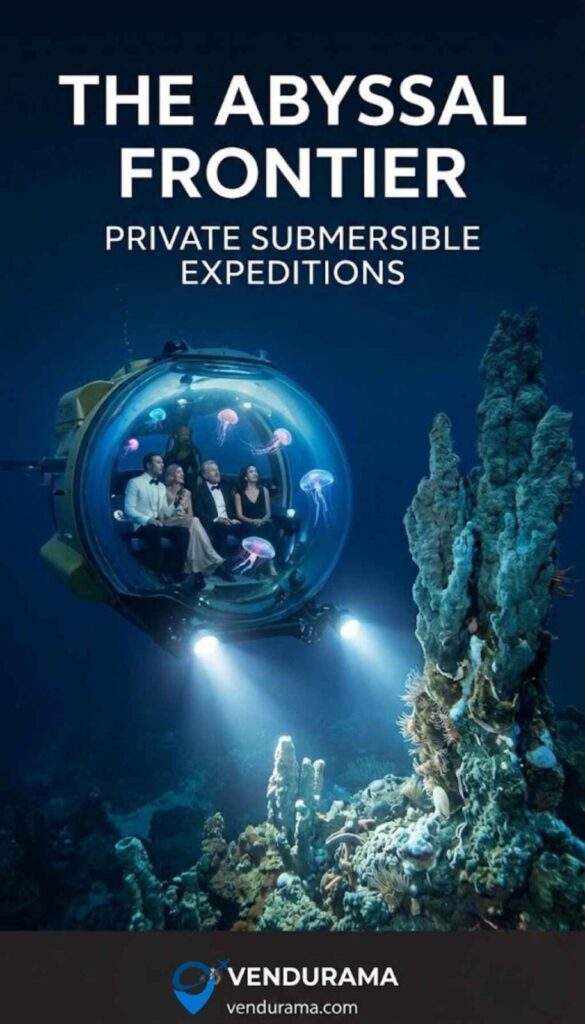
Introduction: The Inversion of the Explorer’s Gaze
For the better part of the twenty-first century, the collective gaze of the ultra-high-net-worth individual (UHNWI) has been fixated upwards. The “New Space Age” promised a vertical escape, turning the Karman Line into the ultimate velvet rope. However, as sub-orbital flights become increasingly commercialized and the novelty of zero-gravity parabolic arcs begins to wane, a profound psychological and strategic inversion is taking place. The true frontier of exclusivity—the domain that remains genuinely alien, hostile, and mapped with less precision than the surface of Mars—lies not above the clouds, but beneath the waves.
We are entering the era of the Abyssal Frontier. This is not merely a shift in coordinates; it is a fundamental reimagining of what it means to travel. Unlike space tourism, which offers a sterile, fleeting glimpse of the void, deep-ocean exploration offers an immersion into a living, breathing biosphere of infinite complexity. It is a journey into the “Hadal Zone,” a realm of crushing pressures and absolute darkness where life has evolved in defiance of terrestrial logic.
For the modern explorer, the private submersible expedition represents the apex of logistical and intellectual luxury. It is an endeavor that combines the engineering rigor of a military operation with the aesthetic refinement of a superyacht lifestyle. It transforms the traveler from a passive passenger into a pioneer, often granting them access to landscapes and biological phenomena that no human eye has ever witnessed before. This comprehensive treatise dissects the multifaceted world of private submersible exploration, analyzing the engineering of survival, the complex logistics of deployment, the biology of the deep, and the economic architecture required to sustain a presence in the most inhospitable environment on Earth.
Part I: The Physics of the Void – Engineering Survival at 1,000 Atmospheres
To understand the exclusivity of deep-ocean travel, one must first respect the physics that forbid it. At sea level, the human body experiences 1 atmosphere (atm) of pressure. For every 10 meters of descent, pressure increases by 1 atm. At the bottom of the Mariana Trench (10,925 meters), the pressure exceeds 1,000 atmospheres—roughly equivalent to an elephant standing on a postage stamp, or 8 tons per square inch.
The Material Science of the Pressure Hull
The “Pressure Hull” is the singular barrier between life and instantaneous annihilation. In the luxury sector, the engineering philosophy has diverged into two distinct schools of thought: The Acrylic Sphere and The Titanium Sphere.
- The Acrylic Revolution (The View): Companies like Triton Submarines and U-Boat Worx have revolutionized the industry by mastering the use of hyper-thick, optical-grade acrylic. Unlike the tiny portholes of military submersibles (like the famous Alvin), modern luxury subs utilize a transparent pressure hull. This acrylic is virtually invisible underwater due to its refractive index being nearly identical to seawater (1.49 vs. 1.33), creating a sensation of floating unprotected in the abyss. However, acrylic has a depth limit. Currently, the certified safety ceiling for large acrylic spheres is approximately 2,300 meters. Beyond this, the material dynamics become unpredictable under cyclic loading.
- The Titanium Fortress (The Depth): For “Full Ocean Depth” (FOD) expeditions—reaching the Challenger Deep—titanium remains the gold standard. The Limiting Factor (now DSSV Pressure Drop), the only vehicle certified for repeated dives to 11,000 meters, utilizes a 90mm thick Grade 5 titanium sphere. The engineering precision required here is absolute; a deviation in sphericity of less than a millimeter could lead to catastrophic buckling instability at depth.
Life Support and Atmospheric Scrubbing
The interior of a luxury submersible is a closed-loop biosphere. Unlike aircraft which cycle outside air, a sub must scrub carbon dioxide and inject oxygen. The standard is a 96-hour life support redundancy for a dive that typically lasts 8-10 hours. This involves:
- $CO_2$ Scrubbing: Using sodalime curtains or lithium hydroxide panels to chemically bind exhaled carbon dioxide.
- $O_2$ Replenishment: Computer-controlled solenoids releasing medical-grade oxygen from high-pressure flasks.
- The “Cold Soak” Problem: At depth, water temperature is near freezing. Titanium is highly conductive, turning the hull into a heat sink. Modern luxury subs combat this with sophisticated thermodynamic insulation and humidity control systems to prevent condensation “rain” inside the cabin, ensuring the explorer remains in a shirt-sleeve environment while the world outside is freezing.
Part II: The Mothership – Complexities of Deployment and Integration
A submersible does not exist in a vacuum; it is a parasitic vessel dependent on a “Mothership.” The logistical integration of a 12-ton deep-sea vehicle into the operational profile of a luxury superyacht is one of the most complex challenges in maritime architecture.
The LARS (Launch and Recovery System)
The most critical phase of any dive is the transition across the “splash zone”—the turbulent interface between air and water. Deploying a multimillion-dollar vehicle with passengers inside during a 2-meter swell requires a specialized LARS.
- A-Frame Cranes: The traditional method, robust but requiring significant deck space and exposing the sub to pendulum swinging.
- Hydraulic Swim Platforms: Modern explorers prefer submersible-specific hydraulic platforms that lower the vessel gently below the waterline, allowing it to float off. This “garage-to-sea” transition must be seamless to maintain the luxury illusion.
Crew Competency and Support Infrastructure
Owning a submersible requires a dedicated “Sub Team.” This is not part of the standard deck crew. It typically includes:
- The Pilot: Often a former military or commercial pilot with specific class certification.
- The Surface Officer: Manages comms and tracking (USBL systems).
- The Mechatronics Engineer: Responsible for the daily maintenance of ballasts, thrusters, and life support.Provisioning for this crew and the specialized equipment (high-pressure oxygen compressors, lithium-polymer battery banks) adds a significant layer to the yacht’s operational logistics.
Part III: Strategic Geographies – Mapping the Underwater Grand Tour
The itinerary of a deep-ocean expedition is dictated by bathymetry (ocean depth maps) and biology. The “Abyssal Grand Tour” visits locations that offer a blend of historical significance, geological drama, and biological rarity.
1. The Mid-Atlantic Ridge & The Hydrothermal Vents
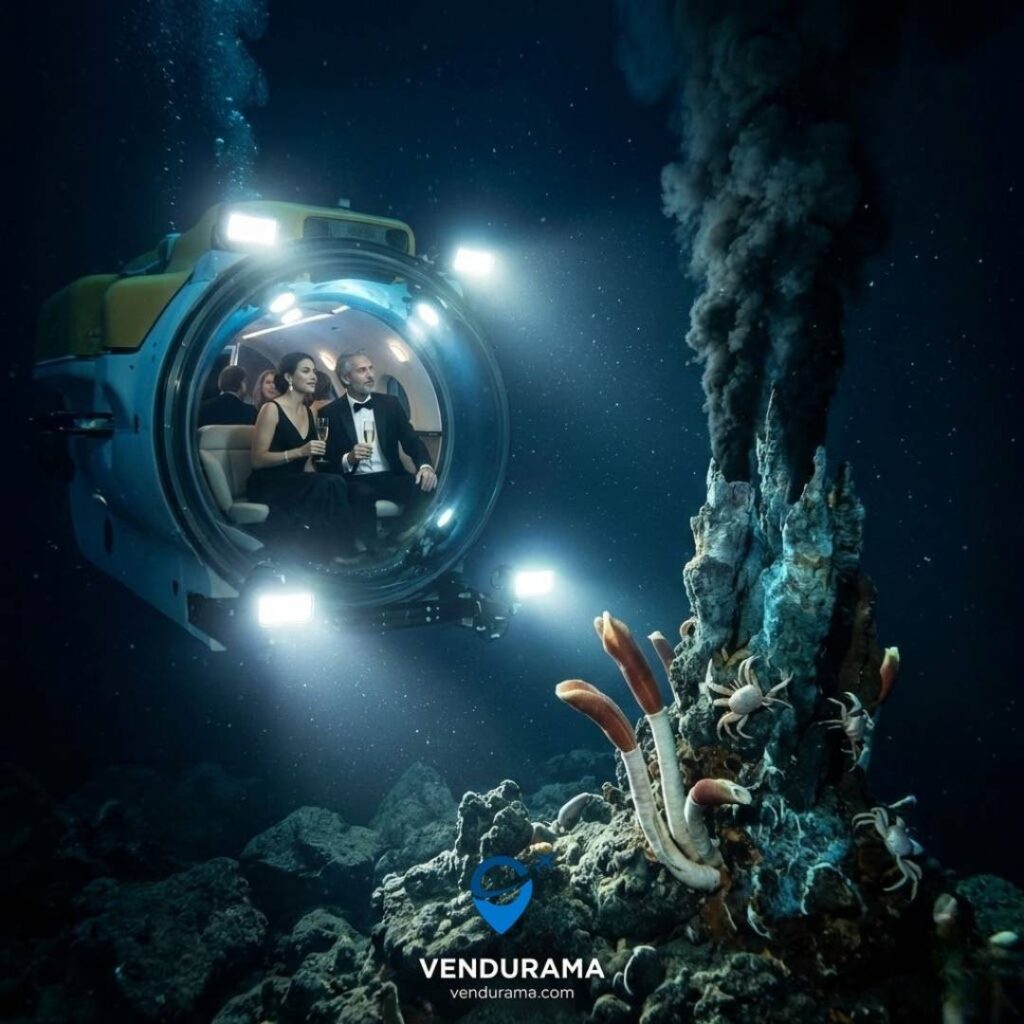
Diving the hydrothermal vents (Black Smokers) is a journey into the origins of life. Located along tectonic plate boundaries, these chimneys spew mineral-rich water at 400°C. The sight of 2-meter tube worms and chemo-synthetic shrimp living in total darkness is a profound biological lesson.
- Logistics: Requires a vessel capable of holding station in the open Atlantic. Access is often staged from the Azores or Bermuda.
2. The Antarctic Sound
Diving beneath the icebergs of Antarctica is the visual pinnacle of cold-water exploration. The “Ice Keels”—the submerged portions of icebergs—sculpted by currents, glow with an ethereal turquoise light. The biodiversity on the seafloor (sea spiders, giant isopods) is characterized by “Deep-Sea Gigantism.”
- Logistics: This is an expeditionary frontier. Coordinating the arrival of guests to King George Island or Ushuaia to rendezvous with the explorer yacht is critical. Utilizing advanced flight aggregation platforms is essential to align commercial or private jet arrivals with the narrow weather windows of the Southern Ocean. A delay of 24 hours can mean missing the dive window entirely.
3. The Pacific Ring of Fire & The Trenches
For those seeking depth records, the trenches of the Western Pacific (Mariana, Tonga, Kermadec) are the ultimate prize. This is a technical dive, focusing on the descent into the “Hadal Zone.”
- Logistics: Staging usually occurs from Guam or Fiji. The remoteness requires a robust supply chain for the mothership.
4. The Galápagos and Cocos Island
The “Pelagic Magic.” These dives are shallower (300-500 meters) but focus on the “Deep Scattering Layer”—the massive migration of biomass. Submersibles here allow interaction with schools of hammerheads or deep-sea squid without the limitations of SCUBA.
Part IV: The Logistics of the “First Mile” – Securing the Human Payload
While the engineering of the submersible is paramount, the logistical chain that delivers the UHNWI guest to the vessel is equally critical. A failure in the “First Mile” can derail an expedition before it begins.
Precision in Global Transit
Expedition yachts often operate from “Shadow Ports”—remote harbors or anchorages far from commercial hubs to ensure privacy and proximity to dive sites. Whether the rendezvous point is in Raja Ampat, Indonesia, or a remote fjord in Norway, the complexity of getting the guest to the deck is high.
Elite travelers must synthesize vast amounts of scheduling data. Using centralized travel coordination resources allows expedition managers to visualize flight paths, connecting private aviation hubs with commercial long-haul routes, ensuring that the guest arrives decompressed and ready for the rigors of the expedition.
The Ground-to-Deck Transfer
The transition from the airport to the marina is the point of highest vulnerability regarding security and comfort. In regions like Papua New Guinea or parts of Central America, local transport infrastructure is unreliable.
To maintain the integrity of the “luxury bubble,” it is non-negotiable to pre-arrange secure private ground transportation. A vetted, professional chauffeur service bridging the gap between the private jet terminal (FBO) and the tender dock ensures that the explorer is insulated from local logistical friction. This “sterile corridor” is vital for carrying high-value equipment or sensitive scientific instruments often brought by the guests.
Part V: The Biology of the Deep – The Citizen Scientist
The modern submersible expedition is rarely about passive observation; it is about contribution. We know less about the ocean floor than the moon’s surface. Every dive has a high statistical probability of encountering an undocumented species.
The Bioluminescent Symphony
Below 1,000 meters, sunlight vanishes. In this “Midnight Zone,” 90% of animals produce their own light. Luxury submersibles are now equipped with ultra-sensitive low-light cameras and red-light spectrum floodlights (which most deep-sea creatures cannot see) to observe this bioluminescence without disturbing the animals. Witnessing a siphonophore—a colony of creatures acting as one, stretching 40 meters and glowing like a fiber-optic cable—is a transformative aesthetic experience.
Scientific Collaboration
Leading expedition yachts now operate “Yachts for Science” programs. They host marine biologists who use the owner’s submersible to collect samples using robotic manipulator arms. The guest becomes a “Mission Specialist,” actively participating in the collection of deep-sea corals or geological samples. This elevates the experience from tourism to philanthropy and scientific patronage, adding a layer of purpose that justifies the immense capital expenditure.
Part VI: The Economics of the Abyss – Capital and Risk
The Cost of Ownership vs. Charter
Acquiring a luxury submersible is a capital commitment ranging from $3 million (for a compact 2-seater) to $35 million (for a Full Ocean Depth system).
- Annual Opex: Running costs are roughly 5-10% of the capital cost annually, covering insurance, classification surveys (DNV/GL), and crew salaries.
- The Charter Premium: Yachts equipped with submersibles command a massive premium on the charter market—often adding $100,000 to $150,000 per week to the base charter rate. It is a unique selling proposition (USP) that differentiates a yacht in a crowded Mediterranean or Caribbean market.
Insurance and Classification
Following the Titan incident, the industry has bifurcated. “Classed” submersibles—those certified by bodies like DNV (Det Norske Veritas) or ABS (American Bureau of Shipping)—remain insurable and operational. “Experimental” or unclassed vessels have effectively been exiled from the luxury market. The rigorous annual surveys required for Class maintenance ensure that every O-ring, viewport, and life support valve is tested to limits exceeding operational parameters.
Part VII: Psychological Dimensions – The Overview Effect of the Deep
Astronauts speak of the “Overview Effect”—the cognitive shift that occurs when seeing Earth from space. Deep-ocean explorers report a similar, inverted phenomenon: the “Abyssal Sublime.”
Descending into the darkness, watching the color spectrum disappear (red is lost at 5 meters, yellow at 15, until only blue remains), induces a meditative state. The silence is absolute. When the external lights are extinguished at depth, the total darkness dissolves the sense of spatial boundaries. The realization that one is suspended in a volume of water that constitutes 99% of the Earth’s habitable space, yet is entirely hostile to human life, forces a confrontation with one’s fragility and significance.
It is a humbling, spiritual experience. Unlike the ego-driven conquest of mountain climbing, deep diving is an exercise in surrender to technology and nature. It requires a psychological resilience and a capacity for stillness that appeals deeply to the hyper-stimulated executive mind.
Conclusion: The Final Earthly Frontier
The Abyssal Frontier is not for the faint of heart, nor for the shallow of pocket. It is the ultimate expression of 21st-century curiosity. As terrestrial destinations become homogenized and over-touristed, the deep ocean remains the last sanctuary of the unknown.
For the traveler willing to engage with the complex logistics of global deployment, willing to invest in the engineering of survival, and willing to trust the professional teams managing their ground and sea transitions, the rewards are incalculable.
To dive is to travel back in time to the primordial soup of creation. It is to see the planet not as a surface dweller, but as a three-dimensional entity. In the silence of the deep, illuminated only by the bioluminescent pulse of an unknown creature, the luxury explorer finds the rarest commodity of all: a genuine, unscripted, and untouched moment of discovery. The surface is mapped; the abyss is waiting.