
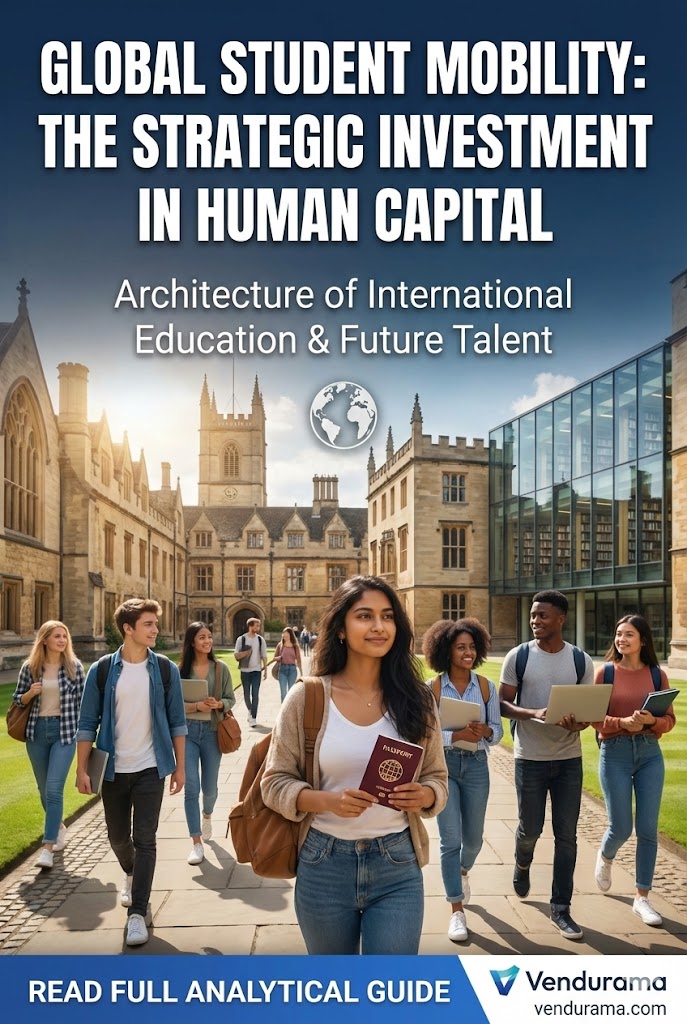
Introduction: Education as the Currency of a Borderless World
In the intricate tapestry of the 21st-century global economy, the movement of students across international borders has evolved from a scholarly niche into a geopolitical and economic imperative. International education is no longer merely a pursuit of academic enrichment; it is a central pillar of global workforce development, a primary vehicle for soft power diplomacy, and a critical mechanism for the transfer of knowledge between nations. As borders become increasingly porous to information and capital, the mobility of talent—specifically, the migration of students seeking higher education abroad—has emerged as a defining feature of our time.
This phenomenon represents a strategic investment in human capital. For nations, attracting international students is a means to bolster innovation, subsidize domestic higher education systems through revenue generation, and cultivate a skilled workforce to address demographic deficits. For the individual, studying abroad is a transformative acquisition of “global competence”—a synthesis of adaptability, cross-cultural communication skills, and specialized knowledge that commands a premium in the transnational labor market. As the number of internationally mobile students is projected to surpass eight million by 2030, understanding the complex architecture of this system is essential for stakeholders ranging from policymakers and university administrators to the students themselves. This article provides a comprehensive analysis of the study abroad ecosystem, examining its operational mechanics, diverse modalities, and profound impact on the trajectory of global talent.
Defining Academic Mobility: Distinct from Tourism and Migration
To analyze study abroad effectively, one must establish a precise definition that distinguishes it from other forms of cross-border movement. Study abroad refers to the temporary, legally sanctioned residence of an individual in a foreign country for the explicit purpose of engaging in a structured educational program, typically leading to academic credit, a degree, or a professional credential.
It differs fundamentally from other travel typologies:
- Vs. Tourism: While tourism is characterized by leisure and consumption of place, study abroad is characterized by production of knowledge and integration into a host institution. The tourist is an observer; the student is a participant.
- Vs. Migration: Although study abroad can be a precursor to migration, its primary intent is educational. Migration implies a permanent change of domicile, whereas study abroad is often governed by temporary visa statuses that presuppose an eventual return or a specific legal transition.
- Vs. Vocational Travel: Unlike business travel or short-term training (which focus on immediate skill application), study abroad focuses on foundational learning, theoretical development, and long-term capability building.
The core of this definition lies in the institutional connection. The mobility is anchored by a university, college, or language school that sponsors the student’s legal presence and structures their daily activity.
Historical Context: From the Peregrinatio Academica to the Global Campus
The roots of international education run deep in human history. In the medieval period, the peregrinatio academica saw scholars wandering across Europe to sit at the feet of masters in Bologna, Paris, and Oxford. Latin served as the lingua franca, creating a borderless “Republic of Letters” where intellectual merit superseded national identity.
The modern era of study abroad began to crystallize in the post-World War II landscape. The establishment of the Fulbright Program in 1946 marked a turning point, positioning student exchange as a tool for peacebuilding and mutual understanding. The late 20th century witnessed the commercialization and massification of the sector. The European Union’s Erasmus Programme (established in 1987) institutionalized regional mobility, creating a generation of “Euro-citizens.” Simultaneously, the Anglosphere (USA, UK, Australia, Canada) began to view international education as a major export industry, actively recruiting students from emerging economies in Asia and the Middle East. Today, the landscape is shifting again, moving from a West-centric model to a multi-polar system where countries like China, Malaysia, and Turkey are emerging as both source and destination markets.
The Spectrum of International Programs: Modalities of Learning
The architecture of study abroad is diverse, offering various pathways tailored to different academic and professional goals.
1. Full Degree Mobility (Diploma Mobility)
This constitutes the most significant commitment, where a student completes an entire undergraduate (Bachelor’s), graduate (Master’s), or doctoral (PhD) program abroad. This pathway offers the deepest immersion and the highest potential for long-term integration into the host country’s labor market.
2. Credit Mobility (Exchange Programs)
Typically lasting one semester or one academic year, these programs are based on bilateral agreements between a home and host institution. Students continue to pay tuition to their home university while studying abroad, ensuring that credits earned transfer back seamlessly. This model emphasizes cultural exposure without delaying graduation.
3. Pathway and Foundation Programs
Designed for students who do not yet meet the linguistic or academic requirements for direct entry, these programs act as a bridge. They combine intensive language instruction with academic preparatory courses, often guaranteeing admission to a degree program upon successful completion.
4. Language Immersion Programs
Focusing exclusively on linguistic acquisition, these short-term to medium-term courses place students in environments where the target language is spoken natively. They range from summer intensives to year-long preparatory courses.
5. Research Mobility and Fellowships
Targeted at doctoral candidates and post-docs, this mobility is driven by access to specific laboratories, archives, or research mentors. It is highly specialized and often funded by government grants or international research councils.
Global Education Hubs and Regional Academic Ecosystems
The geography of international education is defined by specific “hubs” that attract high concentrations of mobile students.
- The Big Four: The United States, United Kingdom, Australia, and Canada have traditionally dominated the market, driven by the prestige of their universities, the global utility of the English language, and robust post-study work rights.
- Continental Europe: Countries like Germany, the Netherlands, and France have become increasingly competitive by offering English-taught programs at very low or zero tuition costs, appealing to value-conscious students.
- Asian Hubs: Singapore, Hong Kong, and Malaysia have positioned themselves as regional education centers, offering high-quality Western-style education at a lower cost and closer proximity to home for students in the Asia-Pacific region.
- Emerging Players: Nations such as the United Arab Emirates (specifically Dubai) and Qatar have developed “Knowledge Villages” hosting branch campuses of prestigious Western universities, allowing students to earn international degrees without leaving the region.
The Admissions Ecosystem: Gateways to Global Institutions

Entry into this global system is guarded by rigorous admission frameworks designed to ensure academic and linguistic readiness.
- Academic Eligibility: This is the primary filter. Institutions assess secondary school transcripts (GPA), standardized test scores (SAT, ACT, GRE, GMAT), and the rigor of the applicant’s previous curriculum (IB, A-Levels, AP).
- Linguistic Proficiency: For non-native speakers, demonstrating command of the language of instruction is non-negotiable. The IELTS (International English Language Testing System) and TOEFL (Test of English as a Foreign Language) are the industry standards. Scores serve as a proxy for a student’s ability to comprehend complex lectures and participate in seminars.
- Holistic Review: In many systems, particularly in North America, admissions officers also evaluate the “whole person” through personal statements, letters of recommendation, and extracurricular achievements. This qualitative assessment seeks to identify leadership potential and cultural fit.
The Psychology of Choice: Factors Influencing Destination Selection
The decision to study abroad is a high-stakes investment, influenced by a complex interplay of “push” and “pull” factors.
- University Ranking and Reputation: Global league tables (QS, Times Higher Education) exert immense influence, signalling prestige and signaling quality to future employers.
- Cost and Financial Viability: The total cost of ownership—tuition plus living expenses—is often the deciding factor. Currency exchange rates and the availability of scholarships play crucial roles.
- Post-Study Work Opportunities: Students increasingly treat education as a migration pathway. Countries with generous Post-Study Work (PSW) visa regimes attract more talent, as they offer a return on investment through potential foreign earnings.
- Safety and Social Stability: Political stability, low crime rates, and a welcoming environment for international visitors are prerequisite conditions for parents sending children abroad.
Academic Systems and Pedagogical Differences
Crossing a border often means crossing into a new intellectual tradition. A student accustomed to one style of learning may face “academic shock” in another.
- The Anglo-Saxon Model: Emphasizes critical thinking, debate, and continuous assessment. The relationship between professor and student is relatively informal, and participation in class discussions is often graded.
- The Continental European Model: Often focuses more on theoretical grounding and independent study. The final exam frequently determines the entire grade for the course, requiring high levels of self-discipline.
- The Asian Model: Traditionally more teacher-centered with a focus on mastery of content and respect for hierarchy, though this is rapidly evolving towards more interactive pedagogies in top-tier universities.
Understanding these differences is vital. A student must learn not just the subject matter, but the rules of the game—how to cite sources, how to structure an argument, and what constitutes academic integrity in the new system.
Career Impact: Employability in the Transnational Labor Market
The ultimate value proposition of study abroad lies in its impact on employability. Research consistently shows that international experience enhances career trajectories in several ways:
- Skill Acquisition: It fosters “soft skills” that are hard to teach in a classroom—adaptability, problem-solving in ambiguous situations, and cross-cultural communication.
- Network Expansion: It provides access to a global alumni network and professional contacts in a major economic hub.
- Signal Value: It signals to employers that the candidate possesses ambition, resilience, and the ability to step outside their comfort zone.
- Language Capital: Professional fluency in a second language opens doors to multinational corporations and diplomatic services.
Pre-Departure Logistics: The Mechanics of Relocation
Once admission is secured, the process shifts from academic to logistical. The relocation phase is a complex project requiring precise timing and coordination.
Students must synchronize their departure with the start of the academic term and mandatory orientation weeks. This often involves booking long-haul flights months in advance to secure favorable rates and baggage allowances. The coordination of arrival dates is critical; arriving too early may violate visa entry windows, while arriving too late can mean missing essential registration events. To manage this complexity, students often utilize comprehensive flight planning platforms to analyze routes, compare layover times, and align their travel itinerary with the university’s specific intake schedule.
Furthermore, preparation involves gathering authenticated documents (apostilled transcripts, birth certificates), securing long-term prescriptions, and setting up international banking solutions.
Arrival and Settlement: Navigating the First 72 Hours
The first few days in a new country are often the most disorienting. The “soft landing” is crucial for long-term success.
Upon landing, students face the immediate challenge of navigating a foreign transport infrastructure with significant luggage. This “last mile” from the airport to the campus or temporary accommodation can be fraught with stress due to language barriers and unfamiliar currency. To mitigate this friction and ensure safety, many universities and international student offices recommend arranging private airport transfer services in advance, guaranteeing a secure and direct journey to the dormitory or housing unit without the confusion of navigating public transit systems while exhausted.
Early settlement tasks include:
- Sim Card Acquisition: Establishing local connectivity immediately.
- Bank Account Opening: Essential for paying rent and receiving transfers.
- University Registration: Obtaining the student ID card, which grants access to libraries and buildings.
- Police Registration: Many countries require foreign residents to register their address with local authorities within a specific timeframe.
The Housing Ecosystem: Shelter as a Determinant of Success
Where a student lives profoundly impacts their academic performance and social integration.
- University Dormitories (Halls of Residence): The most common option for first-year students. They offer convenience, safety, and instant community, though often at a premium price and with less privacy.
- Private Student Housing (PBSA): Purpose-built student accommodation run by private companies. These offer high-end amenities (gyms, study lounges) and are increasingly popular in the UK and Australia.
- Private Rentals: Sharing an apartment with other students. This offers independence and lower costs but requires navigating local tenancy laws and utility bills.
- Homestays: Living with a local family. This provides deep cultural immersion and language practice but requires adherence to the family’s house rules.
Visa Systems, Residence Permits, and Legal Compliance
The student visa is the legal tether binding the student to the host country. It is a conditional permit, not a right.
- Application Rigor: The process involves proving acceptance, financial solvency (proof of funds), and intent to return home. Biometric data collection and interviews are standard.
- Conditions of Stay: Visas typically mandate full-time enrollment and satisfactory academic progress. Dropping below a certain credit load can result in visa cancellation and deportation.
- Work Rights: Most jurisdictions allow international students to work part-time (usually 20 hours per week) during the term and full-time during breaks. This helps offset living costs but is rarely sufficient to cover tuition.
- Post-Study Options: Understanding the pathway from a student visa to a graduate work visa (e.g., OPT in the USA, Graduate Route in the UK) is essential for those seeking international work experience.
Financial Architecture: Funding the Global Classroom
The economics of study abroad are substantial. International tuition fees are often double or triple those of domestic students.
- Tuition Structures: Fees vary wildly, from $50,000+ per year in the US to near-zero in Germany.
- Living Costs: Rent, food, transport, and insurance often exceed tuition costs in major cities like London, New York, or Sydney.
- Scholarships and Aid: A vast ecosystem of funding exists, including university-specific merit scholarships, government-sponsored awards (like Chevening or Fulbright), and external foundation grants.
- Budgeting: Financial literacy is a survival skill. Students must manage exchange rate fluctuations and international transaction fees.
Health Insurance and Well-being
Healthcare systems vary globally, and international students are often excluded from free national healthcare.
- Mandatory Insurance: Most visas require proof of comprehensive health insurance (e.g., OSHC in Australia). This covers doctor visits, hospitalization, and prescriptions.
- Mental Health: The psychological toll of acculturation, academic pressure, and isolation can be heavy. Universities are increasingly investing in culturally sensitive counseling services to support international students.
- Emergency Protocols: Students must understand how to access emergency services (911, 999, 112) and navigating the local pharmacy system for minor ailments.
Intercultural Competence and the Adaptation Cycle
Living abroad triggers a psychological process known as the acculturation curve.
- Honeymoon Phase: Excitement and fascination with the new culture.
- Culture Shock (Crisis): Frustration with daily differences, language fatigue, and homesickness.
- Adjustment: Developing routines, understanding cultural cues, and making friends.
- Mastery: Feeling comfortable and bicultural.
Developing Intercultural Competence—the ability to communicate effectively and appropriately with people of other cultures—is perhaps the most enduring outcome of study abroad. It involves moving from an ethnocentric view (judging others by one’s own standards) to an ethnorelative view (understanding behavior within its cultural context).
Ethical Dimensions and Future Trends
As the sector matures, ethical questions arise.
- Brain Drain: Does study abroad strip developing nations of their best talent? Or does it create “Brain Circulation” where diasporas contribute back to their home countries?
- Sustainability: The carbon footprint of student mobility is significant. The sector is exploring “Green Mobility” and carbon offsets.
- Digital Learning and Hybrid Mobility: The future will likely see more “Collaborative Online International Learning” (COIL) and hybrid models where students do part of their degree online and part on campus, democratizing access and reducing costs.
Conclusion: The Imperative of Global Engagement
Study abroad is a complex, multi-faceted global system that reshapes individuals and nations. It is a strategic investment that yields dividends in the form of knowledge, resilience, and global connectivity. As the world faces challenges that respect no borders—climate change, pandemics, economic instability—the need for leaders who have crossed borders, learned new languages, and navigated foreign systems is greater than ever. The international student is not just a visitor; they are a bridge-builder in a fragmented world. By engaging with this global mobility architecture, students position themselves at the forefront of the future, ready to navigate the complexities of an interconnected humanity.