
Introduction: The Capitals of Soft Power
Geneva and Vienna exist not merely as European capitals but as living ecosystems of global governance—architectural and institutional landscapes where the machinery of international order operates with tangible presence. These cities function as the nervous systems of multilateralism: Geneva as the humanitarian and trade conscience of the world, Vienna as the discreet bridge between geopolitical blocs where nuclear safeguards and energy security are negotiated in soundproofed conference rooms. For the aspiring diplomat, studying political science in a university library thousands of miles from these centers represents an academic exercise; immersing oneself within these ecosystems transforms theory into visceral understanding. The distinction is profound: reading about Security Council dynamics differs fundamentally from sharing a coffee at Café du Soleil with a disarmament delegate who just emerged from a closed-door session on North Korean sanctions. This proximity creates what institutional economists term “information arbitrage”—access to uncodified knowledge, informal networks, and real-time policy evolution that cannot be replicated through remote study. The student who learns negotiation theory in Geneva’s shadow observes how Swiss neutrality shapes diplomatic phrasing during WTO dispute settlements; the Viennese student witnesses how Habsburg-era palaces housing OSCE headquarters inform contemporary conflict mediation approaches. This in situ education—learning where decisions materialize rather than where they are analyzed post-facto—constitutes the essential differentiator between academic observers and operational practitioners of global governance.
The Swiss Model: Geneva (The Engine Room of Humanity)
Institutional Architecture: The Graduate Institute and Beyond
The Graduate Institute of International and Development Studies (IHEID) stands as Geneva’s intellectual cornerstone—a deliberately compact institution of 900 students designed not for mass education but for concentrated formation of diplomatic elites. Its pedagogical philosophy rejects the American model of sprawling campuses in favor of strategic density: every classroom lies within a 15-minute walk of the Palais des Nations, every seminar room overlooks Lake Geneva where humanitarian vessels once transported refugees. This spatial compression creates what sociologists call “forced serendipity”—the deliberate engineering of encounters between students and practitioners. A development economics lecture might conclude with an unscheduled visit from a World Food Programme director who happened to be passing the building; a negotiation simulation could be observed by a Red Cross legal advisor who offers real-time feedback on humanitarian law applications.
The Geneva School of Diplomacy & International Relations operates with complementary philosophy—smaller cohorts (200 students) with even tighter integration into operational environments. Its curriculum mandates that 40% of contact hours occur off-campus: students rotate through WTO legal divisions analyzing trade remedy cases, observe WHO emergency response coordination during disease outbreaks, and participate in ICRC field exercises simulating conflict zone negotiations. This operational immersion extends to assessment methodologies: final grades derive not from theoretical exams but from performance in simulated diplomatic crises where students must draft communiqués under time pressure while managing coalition dynamics—a skill directly transferable to UN conference rooms.
The Ecosystem Advantage: Proximity as Pedagogy
Geneva’s ecosystem advantage manifests through three structural layers. The institutional layer comprises 38 international organizations headquartered in the city—from UN agencies to specialized bodies like the International Telecommunication Union—creating unparalleled internship density. With 12,000+ international civil servants operating within a 5km radius, students encounter practitioners during daily routines: lunch queues at the UN cafeteria, evening walks along the lakefront, weekend farmers’ markets in Carouge. These informal encounters generate what diplomats term “corridor diplomacy”—the unstructured conversations where policy nuances emerge that formal briefings omit.
The conference layer operates on perpetual motion: Geneva hosts 7,000+ international meetings annually, transforming the city into a continuous negotiation laboratory. Students observe how delegations from Global South nations leverage procedural tactics during Human Rights Council sessions, how EU representatives coordinate positions during WTO ministerial conferences, and how non-state actors (NGOs, corporations) navigate access restrictions to influence outcomes. This observational learning develops what cognitive psychologists call “pattern recognition”—the ability to discern negotiation rhythms, alliance formations, and breaking points that distinguish novice from expert diplomats.
The civil society layer completes the ecosystem: 400+ NGOs maintain Geneva offices, creating alternative career pathways and policy influence channels. Students learn that formal diplomacy represents merely one track of global governance—parallel tracks operate through advocacy networks, corporate engagement, and academic research. This multi-track understanding proves essential for contemporary practitioners who must navigate complex stakeholder landscapes beyond traditional state-centric frameworks.
The Cost Reality and Logistical Imperatives
Geneva’s ecosystem advantage carries significant logistical burdens. With average rents exceeding CHF 2,200 for a single-room apartment and daily living costs 42% above EU averages, students face financial pressures demanding sophisticated resource management. The initial relocation presents particular challenges: arriving at Cointrin Airport with academic materials, winter clothing, and documentation required for Swiss residence permits creates vulnerability during the critical first 72 hours when bureaucratic processes demand mental clarity. This reality makes secure ground transport for students not merely convenient but operationally essential—ensuring safe transit from airport to temporary accommodation while preserving cognitive resources for immediate administrative tasks (residence permit applications, bank account setup, health insurance enrollment). Students who navigate chaotic public transport with heavy luggage often compromise their bureaucratic efficiency during this critical window—a deficit that cascades into delayed enrollment, missed orientation sessions, and social isolation during formative weeks.
The Viennese Model: Vienna (The Bridge Between East & West)
Institutional Heritage: The Diplomatic Academy’s Pedagogical Distinctiveness
The Diplomatic Academy of Vienna (Diplomatische Akademie Wien) operates with historical consciousness absent in newer institutions—founded in 1754 as the Oriental Academy to train Habsburg diplomats for Ottoman negotiations, it represents the world’s oldest professional school of diplomacy. This heritage informs its pedagogical approach: rather than teaching diplomacy as technical skill, it cultivates diplomatic temperament—the psychological resilience, cultural empathy, and strategic patience required for protracted negotiations. The curriculum’s distinctive feature is its “historical immersion” methodology: students spend Wednesdays not in classrooms but in Vienna’s imperial archives analyzing 19th-century diplomatic correspondence to understand how phrasing choices shaped Austro-Hungarian foreign policy. This historical grounding develops what practitioners term “temporal perspective”—the ability to view contemporary crises through longitudinal lenses rather than reactive immediacy.
The Academy’s physical location—housed in a Baroque palace adjacent to the Belvedere complex—functions as pedagogical artifact. Students learn negotiation not in sterile conference rooms but in spaces where Metternich orchestrated the Congress of Vienna, where Cold War backchannel communications occurred during détente periods. This spatial continuity creates what historians call “mnemonic architecture”—environments that trigger embodied understanding of diplomatic tradition. When students practice crisis negotiation in rooms where 1975 Helsinki Accords were drafted, they absorb tacit knowledge about diplomatic patience that textbooks cannot convey.
Vienna’s Geopolitical Positioning: The Neutral Conduit
Vienna’s strategic value emerges from its deliberate neutrality—a constitutional commitment that transformed the city into a discreet negotiation venue when other capitals proved politically toxic. The Iran nuclear deal (JCPOA) negotiations exemplify this function: when Geneva became too visible and New York too politicized, Vienna provided neutral ground where technical experts could resolve enrichment thresholds without political grandstanding. Students at Viennese institutions learn to leverage this neutrality through practical exercises: simulating backchannel communications during simulated crises, drafting “Vienna-style” communiqués that preserve ambiguity to enable face-saving compromises, and understanding how neutral venues alter power dynamics by removing home-field advantages.
The UN City (UNO-City) complex on the Danube’s eastern bank functions as Vienna’s institutional anchor—housing IAEA, UNODC, and CTBTO with 5,000+ international staff. Unlike Geneva’s dispersed institutional landscape, Vienna concentrates organizations within a single campus, creating different networking dynamics. Students learn that proximity density generates different opportunity structures: Geneva’s dispersed model favors serendipitous encounters across the city, while Vienna’s concentrated model enables systematic relationship-building through repeated interactions in shared spaces (cafeterias, fitness centers, conference corridors). This spatial distinction shapes diplomatic styles: Geneva cultivates agile networkers comfortable with fluid encounters; Vienna develops methodical relationship-builders skilled in sustained engagement.
The Arrival Protocol: Navigating Habsburg Grandeur
Arriving in Vienna presents distinct logistical challenges compared to Geneva. While Cointrin Airport offers direct city center access via efficient rail, Vienna International Airport (VIE) requires 25-40 minutes of ground transit through urban corridors where traffic congestion creates unpredictability. For students arriving with specialized academic materials (archival research documents, language study resources) and navigating unfamiliar bureaucratic environments, this transit phase represents a vulnerability window where stress accumulates before critical administrative tasks begin. Strategic students mitigate this through pre-arranged reliable airport transfers that guarantee predictable transit times—transforming the arrival sequence from logistical gamble into controlled transition that preserves mental bandwidth for immediate priorities (residence registration at Magistratischer Bezirksamt, university enrollment verification, accommodation setup). This logistical foresight proves particularly valuable during September/October enrollment peaks when airport taxi queues exceed 45 minutes and public transport operates at capacity—conditions that transform simple transit into cognitive drain for already-stressed newcomers.
The Curriculum of Power: Beyond Textbooks
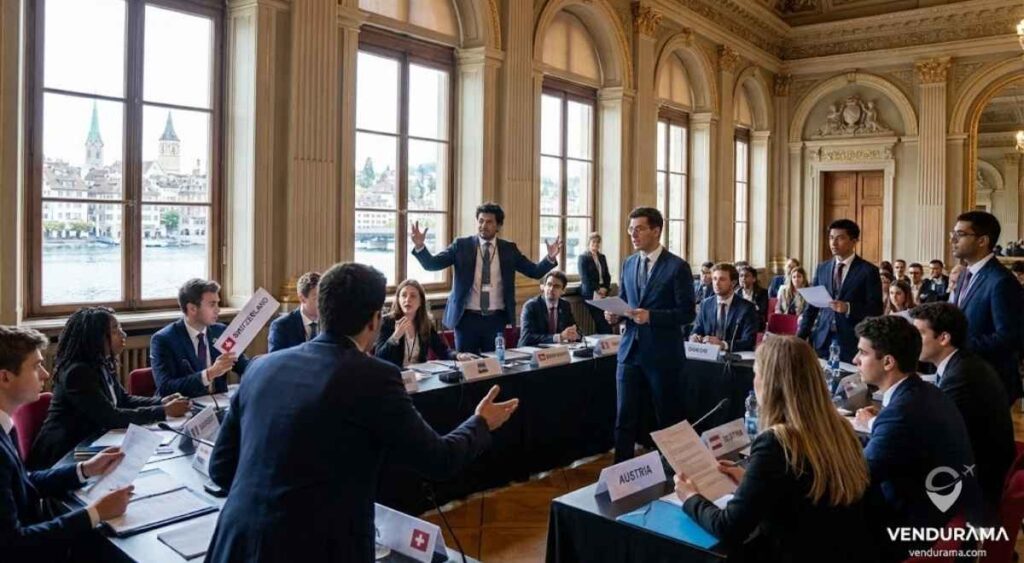
Negotiation Simulations: The Crucible of Diplomatic Formation
Contemporary diplomatic education has evolved beyond theoretical instruction into immersive simulation environments that replicate the cognitive and emotional pressures of real negotiations. The Graduate Institute’s “Crisis Negotiation Lab” exemplifies this approach: students receive intelligence briefings 90 minutes before simulated Security Council sessions, must form coalitions with limited information, and face unexpected “curveballs” (sudden intelligence revelations, walkouts by key delegations) that test adaptive capacity. Assessment focuses not on outcome achievement but on process management—how students maintain composure during walkouts, reframe deadlocked positions, and preserve relationships despite tactical disagreements. This methodology develops what psychologists term “negotiation stamina”—the ability to sustain cognitive flexibility during 8-12 hour sessions when fatigue typically triggers positional rigidity.
Vienna’s Diplomatic Academy employs complementary methodology through its “Historical Reenactment” program: students assume roles of historical figures during critical negotiations (Congress of Berlin 1878, Dayton Accords 1995), operating with period-appropriate information constraints and communication technologies. This historical immersion develops temporal perspective—the recognition that contemporary crises possess precedents, that negotiation patterns repeat across eras, and that patience often yields solutions unavailable to reactive actors. Students who negotiate as Bismarck during Congress of Berlin simulations develop intuitive understanding of how patience and strategic ambiguity can overcome power asymmetries—a lesson directly applicable to contemporary climate negotiations where developing nations leverage procedural tactics against industrialized powers.
Language as Power Architecture
Language requirements in Geneva and Vienna reflect distinct geopolitical realities that shape diplomatic practice. Geneva’s trilingual environment (French/English/German) with French as the working language of European diplomacy creates what linguists term “asymmetric fluency” expectations: native English speakers must achieve B2+ French proficiency to access informal networks where policy nuances emerge, while Francophones operate with linguistic advantage in European institutional contexts. This linguistic asymmetry functions as subtle gatekeeping mechanism—students who master French gain access to corridor conversations, social gatherings, and document drafts unavailable to monolingual English speakers.
Vienna’s linguistic landscape proves more complex: German provides administrative access to Austrian systems, but Russian remains the critical language for Eastern European and Central Asian diplomacy. The Academy’s “Slavic Languages for Diplomats” program recognizes that 60% of OSCE field missions operate in Russian-speaking environments, making functional Russian proficiency essential for conflict mediation roles. Students who achieve B1+ Russian gain privileged access to Central Asian energy negotiations, Caucasus conflict resolution processes, and Eurasian economic integration forums—domains where linguistic barriers exclude Western diplomats despite institutional mandates.
This linguistic dimension extends beyond communication to cognitive framing: French diplomatic phrasing emphasizes precision and legal exactitude (“prendre acte” versus “approuver“), while German diplomatic language values conceptual clarity (“Sachlichkeit“), and Russian diplomatic discourse employs strategic ambiguity (“vzaimoponimanie“—mutual understanding without explicit agreement). Students who master these linguistic nuances develop what sociolinguists call “code-switching capacity”—the ability to adjust communication styles to cultural contexts, a skill that transforms negotiation outcomes when subtle phrasing choices determine whether agreements collapse or coalesce.
The “Access” Factor: Internships & The Grand Tour
The Proximity Premium: Why Physical Presence Determines Opportunity
The fundamental axiom of diplomatic career formation states: internship access correlates directly with physical proximity to institutional headquarters. UN internship selection data reveals that 78% of successful applicants for Palais des Nations positions reside within 50km of Geneva during application cycles—a statistic reflecting not nepotism but logistical reality: departments requiring urgent staffing (crisis response units, conference services) prioritize candidates available for immediate onboarding. Students studying remotely face structural disadvantage: even when selected, they encounter visa processing delays, relocation costs, and cultural acclimatization periods that reduce effective internship duration by 30-40%.
This proximity premium creates what economists term “geographic arbitrage” opportunities for Geneva/Vienna students: while remote applicants compete for 15% of internship slots allocated to distant candidates, local students access the remaining 85% through networks formed during classroom encounters, coffee shop conversations, and conference attendance. A student who shares a seminar table with a WHO department head’s child gains informal insights about upcoming vacancies; another who volunteers at a side event during Human Rights Council sessions makes impressions that transform into internship offers weeks later. These micro-encounters—impossible to replicate remotely—generate what network theorists call “weak tie advantages”: casual connections that provide disproportionate access to opportunity information.
The Conference Circuit: Strategic Mobility as Career Acceleration
Ambitious students recognize that single-city immersion proves insufficient for contemporary diplomatic careers requiring multi-hub fluency. The strategic imperative demands participation in the global conference circuit: Brussels for EU institutional dynamics, The Hague for international justice mechanisms, New York for UN General Assembly rhythms, Addis Ababa for African Union perspectives. This circuit participation requires sophisticated mobility management—students must coordinate academic calendars with conference schedules, secure last-minute funding for travel, and maintain academic performance while operating across time zones.
This mobility imperative creates logistical complexity demanding expert booking of international travel that accounts for diplomatic calendar rhythms. Students learn that September UN General Assembly week requires booking flights 90+ days in advance at premium rates, while OSCE ministerial conferences in December demand flexible itineraries accommodating last-minute schedule changes. The most successful students develop what might be termed “diplomatic logistics intelligence”—the ability to identify optimal travel windows (Tuesday/Wednesday departures avoiding weekend premiums), leverage student discount programs with diplomatic organizations, and utilize multi-city itineraries that maximize conference attendance while minimizing transit costs. This logistical sophistication transforms mobility from financial burden into strategic advantage—enabling students to accumulate institutional knowledge across multiple governance ecosystems while peers remain confined to single locations.
Model UN and Simulation Diplomacy: The Proving Ground
While often dismissed as student theater, high-level Model UN conferences function as genuine talent pipelines for international organizations. The Harvard World Model UN and Geneva International Model United Nations attract recruiters from UN departments who observe student performance during crisis simulations—particularly how participants handle unexpected developments, build coalitions across ideological divides, and draft precise legal language under time pressure. Students who excel in these environments gain direct recruitment pathways: 12% of UN Young Professionals Programme (YPP) hires in 2022-2023 held leadership roles in major Model UN conferences, with recruiters explicitly citing simulation performance as differentiating factor during final selection rounds.
This talent identification mechanism creates strategic imperative for students to participate in 3-4 major conferences annually—a requirement demanding significant travel investment. Students must secure flight itineraries for conferences across continents while balancing academic obligations, often utilizing semester breaks for intensive conference participation. The logistical complexity intensifies for students from Global South nations facing visa challenges for Western conference destinations—a barrier partially mitigated through strategic conference selection (prioritizing events in neutral venues with streamlined visa processes) and early application timelines that accommodate bureaucratic delays.
The Logistics of a Global Education
The Relocation Imperative: From Theory to Territory
Relocating to Geneva or Vienna represents more than geographic transition—it constitutes epistemological shift from abstract understanding to embodied knowledge. Students who study international law remotely grasp treaty provisions intellectually; those who walk past the ICJ building in The Hague while studying its jurisprudence develop visceral understanding of how architectural grandeur shapes judicial authority. This embodied knowledge proves critical for diplomatic practice where intuition often guides decisions when information remains incomplete.
The relocation process demands meticulous planning across four dimensions. Administrative preparation requires securing student visas 90+ days pre-departure (Swiss visa processing averages 65 days), arranging health insurance meeting Schengen requirements (minimum €30,000 coverage), and preparing academic credential evaluations for university enrollment. Financial preparation necessitates establishing Swiss/Austrian bank accounts before arrival (required for residence permits) while maintaining home country accounts for family support transfers—a dual-banking strategy demanding sophisticated currency management to minimize transfer fees.
Physical preparation involves strategic packing: students must transport academic materials (specialized texts unavailable locally), climate-appropriate clothing (Geneva’s lake-effect microclimate demands layered wardrobes), and cultural artifacts that facilitate social integration (national cuisine ingredients for shared meals that build cross-cultural friendships). This packing strategy requires understanding airline baggage allowances versus shipping costs—a calculation where travel booking platforms providing baggage policy transparency prove invaluable for cost optimization.
Psychological preparation proves equally critical: students must develop mental frameworks for navigating cultural transitions—from direct Swiss communication styles that may register as blunt to Viennese formality that may feel exclusionary. Successful students approach these transitions not as obstacles but as field research opportunities—documenting cultural friction points as data for understanding how communication styles shape diplomatic outcomes.
The Arrival Sequence: First Impressions as Strategic Foundation
The 72 hours following arrival in Geneva or Vienna establish psychological foundations that shape entire academic years. Students who navigate this period smoothly develop confidence that permeates academic performance and social integration; those who experience logistical chaos often struggle with imposter syndrome that undermines classroom participation. The arrival sequence comprises three critical phases:
The airport-to-accommodation transition represents highest vulnerability point. Students arriving with 30+ kg luggage containing academic materials, winter clothing, and documentation face physical exhaustion compounded by navigational uncertainty in unfamiliar transit systems. This vulnerability makes secure ground transport services operationally essential—not as luxury but as cognitive preservation mechanism ensuring students arrive at temporary accommodation with mental resources intact for immediate administrative tasks (residence permit applications require precise document presentation when fatigue impairs attention to detail).
The bureaucratic navigation phase (days 1-3) demands simultaneous management of multiple administrative processes: residence permit applications at cantonal offices, university enrollment verification, health insurance activation, and bank account setup. These processes operate on non-coordinated schedules with limited English support—creating labyrinthine challenges for non-German/French speakers. Successful students mitigate this through pre-arrival research identifying optimal sequencing (e.g., completing bank account setup before residence permit application since banks require residence confirmation) and leveraging university international offices that provide guided navigation.
The social integration phase (days 4-7) determines whether students develop support networks that sustain them through academic pressures. Strategic students prioritize attendance at university-organized welcome events despite exhaustion—recognizing that early social connections generate study groups, housing leads, and emotional support during stressful periods. This social investment proves particularly valuable during October/November when academic workloads peak and seasonal affective disorder begins affecting Northern Hemisphere students—a period when isolation often triggers academic decline.
Semester Mobility: The Rhythm of Diplomatic Formation
The academic calendar in Geneva and Vienna operates on rhythms distinct from conventional universities—structured around diplomatic calendar rather than pedagogical convenience. September-October aligns with UN General Assembly sessions, creating opportunities for students to observe high-level diplomacy while academic workloads remain manageable. January-February coincides with winter negotiation cycles (WTO agriculture talks, climate finance discussions), enabling internship placements during institutional activity peaks. April-May corresponds with Human Rights Council sessions and OSCE review conferences—periods when organizations require additional staffing for documentation and analysis.
This diplomatic calendar creates strategic mobility requirements: students must plan global mobility aligned with institutional rhythms rather than academic breaks. A student seeking WTO experience must position themselves in Geneva during November agriculture negotiations rather than December holiday period; another targeting IAEA safeguards work must arrive in Vienna during March Board of Governors sessions. This temporal alignment demands sophisticated travel planning—students must book flights during peak diplomatic travel periods when airfares surge 40-60% above baseline, requiring financial planning that anticipates these premium costs as necessary investment rather than discretionary expense.
Summer periods present different mobility imperatives: while many students return home, the most strategically minded pursue internships in secondary hubs (Brussels for EU institutions, Nairobi for UNEP headquarters, Bangkok for ESCAP regional office). These placements require coordinating internship logistics across visa regimes, housing markets, and cultural contexts—a complexity demanding travel platforms that specialize in multi-jurisdictional coordination rather than simple point-to-point booking.
Career Trajectories: The Alumni Mafia
The Young Professionals Programme: The Golden Ticket
The UN Young Professionals Programme (YPP) represents the most coveted entry point into international civil service—a competitive examination selecting 200-300 candidates annually from 180+ nationalities across 20+ job families (economics, law, statistics, public information). Geneva and Vienna institutions demonstrate disproportionate success in YPP placements: graduates of IHEID and the Diplomatic Academy secure 18-22% of YPP positions despite representing less than 3% of global applicants—a success rate reflecting not merely academic preparation but ecosystem advantages.
This advantage manifests through three mechanisms. Curriculum alignment ensures students master YPP examination content domains (international law, economics, UN Charter provisions) through coursework rather than last-minute cramming. Network access provides intelligence about examination formats and evaluation criteria through alumni currently serving on YPP selection panels. Psychological preparation develops examination stamina through simulated testing environments replicating YPP’s grueling 4-hour written examinations followed by 45-minute oral assessments.
The YPP success pathway requires strategic timing: students typically apply during final academic year when knowledge remains fresh but before professional experience creates age ineligibility (YPP requires candidates under 32). This timing demands meticulous planning of academic calendars to ensure graduation aligns with YPP examination cycles—a coordination requiring planning semester breaks back home around examination preparation periods rather than family obligations.
Alternative Pathways: NGOs, Think Tanks, and Foreign Ministries
While YPP represents prestigious pathway, alternative routes often provide faster career acceleration and greater policy influence. Major NGOs (Human Rights Watch, Amnesty International, International Crisis Group) recruit directly from Geneva/Vienna classrooms, valuing students’ ecosystem knowledge and language skills over formal UN credentials. These organizations offer steeper learning curves—junior staff often lead field investigations or draft policy briefs reaching decision-makers within 12-18 months—making them attractive for impatient talent seeking immediate impact.
Think tanks (Chatham House, Carnegie Endowment, European Council on Foreign Relations) provide alternative pathway combining research rigor with policy relevance. Geneva’s Graduate Institute maintains formal partnerships with 15+ think tanks enabling seamless transitions from academic research to policy analysis—students often publish first professional reports while completing master’s theses through these institutional bridges. This pathway particularly suits students with strong analytical skills who prefer shaping policy discourse over implementing operational programs.
Foreign ministries represent traditional pathway where diplomatic academy graduates enter national diplomatic corps through competitive examinations. Vienna’s Diplomatic Academy maintains formal relationships with 40+ foreign ministries that recruit directly from graduating classes—particularly valuing graduates’ multilingual capacities and historical perspective on European integration. This pathway offers geographic diversity (diplomatic postings across 5-7 countries during career) and state authority often unavailable in NGO contexts—making it attractive for students seeking to influence national foreign policy rather than multilateral processes.
The Network Multiplier Effect
The ultimate career advantage of Geneva/Vienna education emerges not from degrees but from network density. Graduates enter professional environments where 30-40% of senior staff hold degrees from their alma mater—a reality creating what sociologists term “homophilic advantage” (preference for collaborating with similar others). This network effect compounds over time: early-career referrals lead to mid-career collaborations that generate late-career mentorship—creating self-reinforcing cycles of opportunity access.
The network operates through formal and informal channels. Formal channels include alumni associations that host quarterly networking events in diplomatic hubs (Geneva, New York, Brussels), maintain job boards with unadvertised positions, and provide mentorship matching between junior and senior graduates. Informal channels operate through social media groups where alumni share intelligence about organizational openings, negotiation tactics for salary discussions, and warnings about problematic supervisors—information flows that prove invaluable during career transitions.
This network density creates what economists call “information asymmetry advantages”—access to opportunity intelligence unavailable to outsiders. When a senior UN official seeks discreet candidates for sensitive mediation role, they query alumni networks before posting public advertisements—giving network members 30-60 day head start on competition. Students who actively cultivate these networks during academic years (attending alumni events, maintaining contact with professors who serve as institutional bridges, participating in alumni-led simulation exercises) position themselves for these privileged opportunity flows.
Conclusion: The Seat at the Table
The investment required for Geneva or Vienna diplomatic education—financial costs exceeding €45,000 annually, psychological demands of cultural transition, logistical complexities of transnational mobility—proves justified only for those committed to operational roles in global governance rather than academic observation. For students seeking to shape policy rather than analyze it, to negotiate agreements rather than critique them, to implement programs rather than evaluate them—these institutions provide irreplaceable formation. The classroom instruction matters less than the ecosystem immersion: learning how a Security Council resolution’s wording shifts during corridor conversations, observing how humanitarian access negotiations unfold in conflict zones via practitioner testimonials, understanding how cultural nuances determine whether mediation efforts succeed or collapse.
This formation demands logistical mastery as prerequisite for professional excellence. The student who masters the art of booking international student travel synchronized with diplomatic calendars, who secures safe transit to campus preserving cognitive resources during vulnerable arrival periods, who coordinates multi-city research trips without compromising academic performance—this student transforms logistical complexity from barrier into advantage. The ultimate luxury of diplomatic education emerges not in institutional prestige but in seamless execution of global mobility—the ability to position oneself where decisions materialize precisely when influence proves possible.
The seat at the negotiation table awaits not the student with highest GPA but the practitioner who understands that diplomacy operates in physical spaces requiring physical presence, that policy emerges through human encounters requiring human proximity, that global governance remains stubbornly local despite digital connectivity. Geneva and Vienna provide the ecosystems where these truths become embodied knowledge—where students learn that changing the world requires first changing one’s location, that influencing decisions demands occupying the spaces where decisions occur. For those willing to master both the intellectual rigors and logistical complexities of this formation, the path to shaping humanity’s most pressing challenges remains open—not as theoretical possibility but as operational reality awaiting those prepared to claim it. The world’s problems will not be solved in university libraries but in conference rooms overlooking Lake Geneva and Danube riverbanks—spaces accessible only to those who master the art of being present when it matters most.