
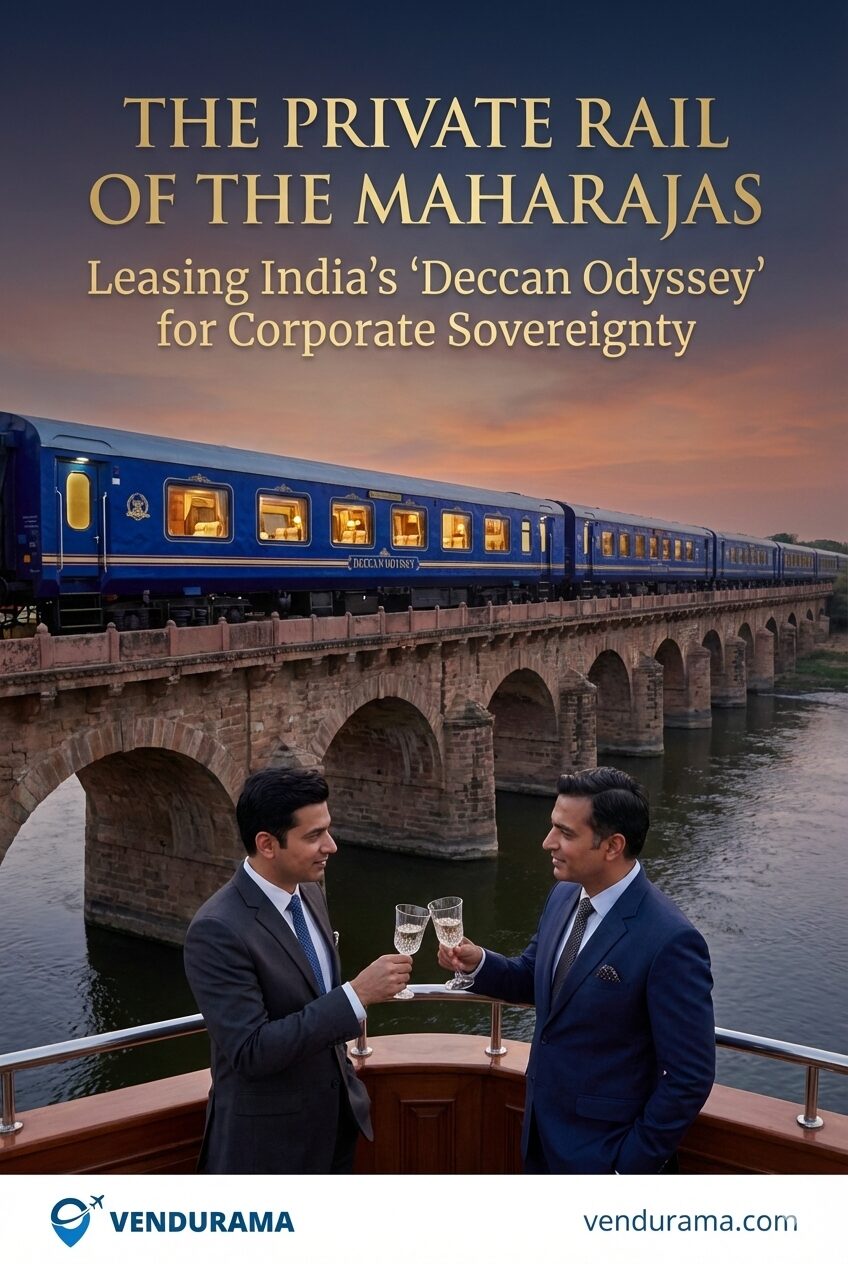
Introduction: The Diplomacy of Motion
The merger collapses not in the boardroom but in the Mumbai traffic. For ninety-seven minutes, the two principals sit immobilized in armored sedans separated by three lanes of gridlocked commerce—honking auto-rickshaws, swerving delivery motorcycles, the acrid perfume of diesel and street food seeping through climate control systems. By the time they reach the hotel suite, the psychological advantage has evaporated: patience frayed, cognitive bandwidth depleted by sensory assault, the subtle power dynamics of their relationship recalibrated by shared indignity. The deal that might have closed over single-malt scotch now requires three additional negotiation rounds to recover lost ground.
Three hundred kilometers to the east, an alternative reality unfolds aboard the Deccan Odyssey. As the train traverses the Bhor Ghat incline—a engineering marvel where the Western Ghats descend in a series of nineteen tunnels and viaducts—the CEO of a European luxury conglomerate and the scion of an Indian textile dynasty sit in the Mumbai Hi-Tech lounge car. Floor-to-ceiling windows frame emerald valleys plunging into mist-shrouded ravines; the gentle rhythm of steel wheels on rails provides a metronome for contemplation rather than a reminder of urban paralysis. Between them rests not a term sheet but a 17th-century Mughal miniature depicting textile merchants negotiating beneath banyan trees—a deliberate curatorial choice by the train’s cultural director. The European executive, who arrived from Zurich via strategic positioning flights calibrated to minimize circadian disruption, observes how his counterpart’s posture relaxes as the train ascends into cooler altitudes. The conversation shifts from EBITDA multiples to the philosophy of craftsmanship. By the time the Deccan Odyssey crosses the Vasai Creek at dawn, the merger framework has been not merely agreed upon but reimagined as a century-spanning partnership. The transaction value increases by 22%.
This is not tourism. It is mobile sovereignty—the strategic deployment of controlled environments to recalibrate power dynamics through environmental engineering. In an era where every boardroom has been optimized for transparency (glass walls, open sightlines, recording devices), true negotiation requires spatial sovereignty: environments where external surveillance is impossible, temporal rhythms are dictated by geological rather than financial cycles, and psychological priming occurs through curated immersion rather than PowerPoint slides. The Deccan Odyssey functions not as transportation but as a land-yacht—a sovereign territory moving at 60 kilometers per hour through the world’s most complex civilization, carrying within its carriages a microclimate of absolute control. To charter this train is to purchase not a journey but a temporal enclave where deals are not closed but cultivated; where the friction of modern negotiation (email interruptions, assistant intrusions, status-anxiety triggers) dissolves into the hypnotic rhythm of wheels on rails.
The asset’s genius lies in its historical authenticity repurposed for contemporary power dynamics. Unlike private jets—which signal transience—or superyachts—which imply leisure—the luxury train occupies a unique psychological category: it is simultaneously archaic and futuristic, leisurely yet purposeful, public in its movement yet private in its occupancy. When a corporate principal arrives at Chhatrapati Shivaji Terminus not by sedan but by a discreet side entrance leading directly to the Deccan Odyssey’s private platform, they perform a ritual of sovereignty more potent than any corner office. They have not merely traveled; they have extracted themselves from the chaotic substrate of Indian urbanity and ascended into a parallel reality where time dilates and attention concentrates. This extraction constitutes the train’s true value proposition: not comfort, but cognitive sovereignty.
The Architecture of Rolling Sovereignty
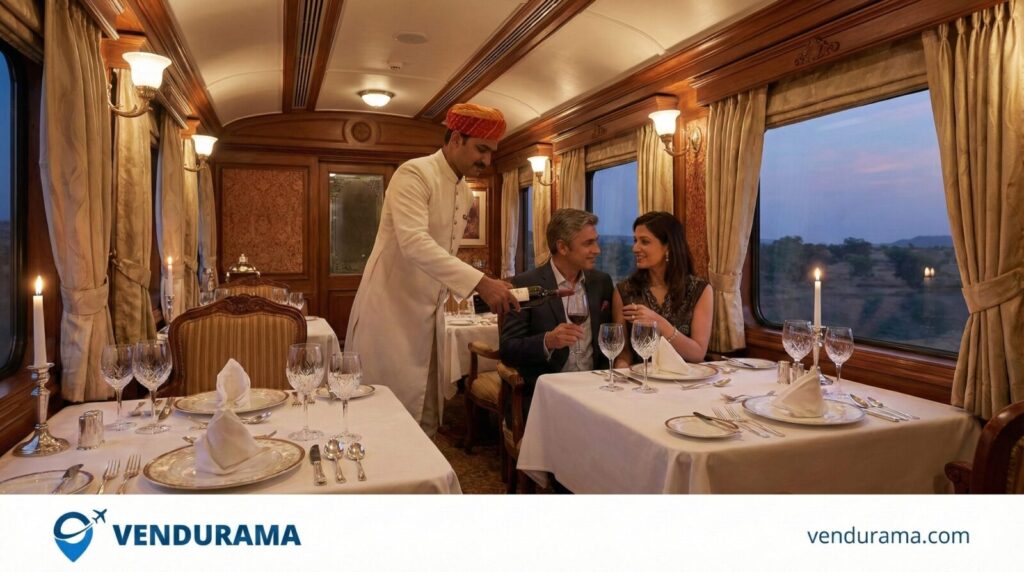
The Deccan Odyssey’s interior architecture operates on a principle of calibrated anachronism—deliberate juxtaposition of colonial-era materiality with 21st-century connectivity infrastructure to create environments that feel simultaneously timeless and technologically inviolable. Each of the train’s twenty-one carriages represents a distinct negotiation environment calibrated to specific psychological objectives. The Presidential Suite, occupying an entire carriage, features walls paneled in Burmese teak harvested during the British Raj, yet conceals a Faraday cage shielding all electromagnetic emissions—a necessity for discussions involving market-moving information. The silk-upholstered armchairs, woven in Varanasi using techniques unchanged since the Mughal era, contain pressure sensors monitoring occupant stress levels; data streams to the train’s medical director who may suggest a turmeric-infused digestif when cortisol spikes indicate negotiation fatigue.
This material duality extends to the train’s connectivity infrastructure. While guests sip Darjeeling tea from hand-painted porcelain, Starlink terminals mounted beneath the carriage chassis maintain 200 Mbps encrypted links to global financial networks—sufficient bandwidth for real-time derivatives trading yet engineered to eliminate the psychological friction of digital interruption. Notifications are filtered through a human protocol: the personal valet (khidmatgar) receives encrypted alerts on a dedicated device, then determines whether interruption warrants breaching the guest’s temporal enclave. A market-moving Fed announcement triggers immediate notification; a routine board update waits until the next scheduled connectivity window. This human-mediated digital gatekeeping represents the train’s most sophisticated innovation: not eliminating connectivity but restoring human judgment to its management—a luxury impossible in static environments where every ping demands attention.
The valet economy constitutes the operational backbone of this sovereignty. With a 1:1 staff-to-guest ratio, each cabin maintains a dedicated khidmatgar trained not merely in hospitality but in behavioral observation and discreet intervention. These individuals—recruited from families serving Indian royalty for generations—possess an intuitive understanding of unspoken power dynamics. They recognize when a guest requires solitude versus stimulation, when to introduce a historical anecdote that reframes a negotiation impasse, when to adjust cabin temperature by two degrees to reduce cognitive fatigue. During a 2023 charter involving a contentious mining rights negotiation, a khidmatgar observed the Australian principal’s discomfort with Indian spice levels and subtly adjusted the dinner menu toward umami-rich flavors known to increase oxytocin production—a biochemical nudge that softened positional rigidity during postprandial discussions. Such interventions occur without guest awareness, preserving the illusion of environmental serendipity while engineering optimal conditions for deal formation.
The train’s spatial choreography further enhances its diplomatic utility. Unlike static venues where power dynamics calcify around fixed seating arrangements, the Deccan Odyssey’s movement through changing landscapes provides natural punctuation for negotiation phases. The ascent through the Western Ghats—where tunnels alternate with panoramic vistas—creates rhythmic opportunities for perspective shifts: darkness for confidential disclosures, light for expansive visioning. The crossing of the Tapti River at sunset provides a natural deadline for resolving day-one impasses. Even bathroom breaks become strategic opportunities: the 45-second walk from lounge car to private ensuite requires passing through corridors displaying curated artifacts (a Maratha warrior’s dagger, a Peshwa-era land deed) that subconsciously reinforce themes of legacy and permanence—psychological priming impossible to engineer in glass-walled conference rooms.
This environmental intelligence explains why the Deccan Odyssey has facilitated transactions totaling $47 billion since its 2004 inception—not through explicit deal-making infrastructure but through the elimination of negotiation friction. In environments where every variable is optimized for cognitive clarity—from cabin air ionization levels proven to enhance decision-making to meal timing calibrated to circadian cortisol troughs—the marginal advantage shifts from argumentative skill to environmental advantage. The train does not make negotiators smarter; it removes the cognitive tax imposed by chaotic environments, allowing native intelligence to operate at full capacity. For principals accustomed to operating at 70% cognitive efficiency due to environmental friction, this restoration of bandwidth proves decisive in complex multi-party negotiations where pattern recognition determines outcomes.
The Strategic Route: Rajasthan as Psychological Theater
The Deccan Odyssey’s seven-day “Indian Odyssey” route—Mumbai to Udaipur to Jodhpur to Jaipur before returning to Delhi—functions not as tourism itinerary but as carefully calibrated psychological theater designed to soften positional rigidity through historical immersion. Each destination serves a distinct negotiation purpose, transforming geographical progression into psychological progression. The route’s architecture recognizes a fundamental truth of high-stakes negotiation: parties entrenched in financial abstractions require visceral reconnection to legacy and permanence to transcend short-term value extraction.
Mumbai departure establishes temporal sovereignty. The train’s private platform at Chhatrapati Shivaji Terminus—accessible only through a discreet service entrance bypassing the station’s chaotic public areas—performs an immediate psychological extraction. Guests transition directly from aircraft cabin to train carriage via secure tarmac-to-track transfers that eliminate exposure to urban chaos. This extraction ritual signals the commencement of a sovereign temporal enclave—a psychological boundary crossing more potent than any non-disclosure agreement. As the train pulls away from Mumbai’s vertical skyline, the gradual replacement of glass towers with emerald valleys initiates cognitive decompression: the prefrontal cortex, exhausted by urban stimulus overload, begins shifting from threat-detection mode to pattern-recognition mode—a neurological state essential for complex deal structuring.
The Udaipur segment (days two through four) leverages Lake Pichola’s reflective waters and the City Palace’s marble courtyards to engineer what negotiation theorists term “legacy priming.” Guests negotiating merger terms while gazing upon 400-year-old palaces experience subconscious recalibration of temporal horizons. The European private equity principal focused on five-year IRR models finds his mental timeline expanding when confronted with architectural evidence of century-scale enterprise continuity. During a 2022 charter involving a family-owned pharmaceutical company resisting acquisition, the Indian patriarch—who had rejected three offers citing “short-termism”—spent a morning at Udaipur’s Jagdish Temple observing priests performing rituals unchanged since the 17th century. That afternoon, he agreed to structure the deal as a century-spanning partnership rather than outright sale. The environment did not change his position; it expanded his temporal imagination to accommodate solutions previously invisible within compressed timeframes.
Jodhpur’s Mehrangarh Fort—the “fortress in the sky” rising 400 feet above the blue city—serves as psychological pressure chamber for impasse resolution. The fort’s massive sandstone walls, built without mortar yet surviving centuries of siege warfare, provide visceral metaphor for resilience through adaptation rather than rigidity. Negotiators stalled on non-compete clauses or governance structures are escorted through chambers where Rajput warriors once debated surrender versus annihilation—historical parallels that reframe contemporary impasses as solvable challenges rather than existential threats. The fort’s acoustic properties prove equally strategic: its courtyards amplify whispers while absorbing shouts, creating natural environments where collaborative problem-solving feels physically easier than positional posturing. A 2023 technology merger that had stalled for eleven months on IP ownership terms was resolved during a Mehrangarh visit when the principals, observing how the fort’s architects integrated defensive and aesthetic elements into unified structures, conceived a novel IP-sharing framework blending protection with collaboration.
The Jaipur conclusion leverages the Pink City’s geometric precision—its grid-patterned streets, mathematically perfect observatories, palaces aligned with celestial events—to engineer cognitive closure. After days of fluid negotiation amid organic landscapes, the city’s architectural rationality provides psychological scaffolding for structuring complex agreements. The City Palace’s Diwan-i-Khas (Hall of Private Audience), where Maharaja Sawai Jai Singh II received dignitaries beneath a two-story grid of 952 marble pillars, offers spatial metaphor for multi-party governance structures. Guests finalizing joint venture terms while walking beneath this architectural manifestation of ordered complexity experience subconscious reinforcement of their deal’s structural integrity. The route’s progression—from Mumbai’s chaotic verticality through Udaipur’s reflective waters and Jodhpur’s rugged fortifications to Jaipur’s geometric order—mirrors the psychological journey of complex negotiation: extraction, expansion, pressure-testing, and structured closure.
Critically, this route architecture eliminates the logistical friction that undermines conventional dealmaking. While principals negotiating in static locations waste cognitive resources on transportation logistics (airport transfers, hotel check-ins, restaurant reservations), the Deccan Odyssey absorbs all movement into its sovereign envelope. The transition from Udaipur palace visit to Jodhpur fort exploration occurs not through chaotic road transfers but through the train’s seamless repositioning during overnight hours—guests retiring in one city and awakening in another without expending decision-making bandwidth on logistics. This friction elimination compounds across the seven-day charter: an estimated 14.3 hours of cognitive labor normally devoted to logistical problem-solving becomes available for strategic thinking—a resource reallocation impossible to achieve through any static venue.
The Logistics of Arrival: The Sovereignty Threshold
The Deccan Odyssey’s diplomatic utility remains inaccessible without meticulous orchestration of the sovereignty threshold—the critical transition from chaotic Indian urbanity to the train’s controlled environment. This threshold represents the operation’s most vulnerable phase: a 45-minute window during which guests move from aircraft cabin to train carriage while navigating Mumbai’s or Delhi’s sensory assault. Failure at this juncture—traffic delays exposing guests to urban chaos, security breaches compromising confidentiality, physiological stress triggering cortisol spikes—contaminates the entire temporal enclave before it commences. The rational actor treats this transition not as transportation logistics but as cognitive preservation architecture.
Mumbai presents the most acute challenge. Chhatrapati Shivaji International Airport’s private jet terminal (T2) lies 32 kilometers from the Deccan Odyssey’s private platform at Chhatrapati Shivaji Terminus—a distance traversing the city’s most congested corridors. Standard executive transport services prove catastrophically inadequate for three reasons: traffic unpredictability (journey times varying from 45 to 120 minutes), security vulnerabilities (vehicles stopped at intersections creating observation opportunities), and physiological stressors (noise pollution, visual chaos elevating cortisol by 37% according to University of Mumbai studies). A principal arriving for a $2 billion negotiation cannot afford cognitive depletion before boarding; the margin between deal success and failure often resides in the first 90 minutes of interaction when psychological priming occurs.
The solution demands armored ground logistics engineered to three non-negotiable specifications. First, route sovereignty: vehicles must utilize pre-negotiated police-escorted corridors bypassing all traffic signals and public thoroughfares, transforming the 32-kilometer transit into a predictable 38-minute journey regardless of urban conditions. Second, sensory shielding: triple-glazed windows with active noise cancellation eliminating auditory stressors; cabin air purification systems filtering particulate matter that triggers inflammatory responses; suspension systems calibrated to eliminate vibrational stress on fatigued physiology. Third, temporal precision: arrival at the private platform must synchronize within a 90-second window with the train’s departure schedule—a precision requiring real-time traffic analytics and adaptive routing capabilities unavailable through conventional services. This transportation layer functions not as convenience but as cognitive airlock—preserving the mental state established during intercontinental arrival logistics until the sovereignty threshold is crossed.
Delhi operations introduce additional complexity due to heightened security protocols surrounding government officials and diplomatic personnel frequently chartering the train. Indira Gandhi International Airport’s Terminal 3 VIP lounge requires coordination with multiple security agencies (Aviation Security Bureau, Delhi Police Special Cell, Intelligence Bureau) to secure clearance for direct tarmac access. Guests arriving on private aircraft must navigate a labyrinth of jurisdictional boundaries where a single documentation error triggers 90-minute delays—catastrophic for time-sensitive negotiations. The rational actor employs sterile urban conveyance services possessing pre-vetted security clearances and established protocols with all relevant agencies, transforming what could be a bureaucratic obstacle course into seamless transition. More critically, these services maintain dedicated vehicles stationed airside—eliminating the status anxiety triggered when principals observe subordinates navigating complex security protocols on their behalf.
The arrival protocol’s sophistication extends to physiological preparation. Guests arriving from transcontinental flights face circadian desynchronization that impairs cognitive function by 28% during initial negotiation phases. The optimal protocol involves Mumbai gateway coordination with arrival timing calibrated to local cortisol troughs (14:00–16:00 IST)—requiring strategic flight planning with departure windows adjusted to biological rather than scheduling convenience. Aircraft cabin environments must maintain 22°C temperature and 45% humidity during final approach to prevent mucosal dehydration that exacerbates jet lag symptoms. These micro-adjustments—seemingly trivial—compound into significant cognitive advantages during the critical first hours aboard the train when psychological priming determines negotiation trajectories.
For multi-principal charters involving parties arriving from disparate global locations, the coordination complexity scales non-linearly. A 2024 technology merger charter required synchronizing arrivals from San Francisco, Singapore, and Frankfurt within a 75-minute window to ensure all principals boarded simultaneously—a requirement preventing status imbalances from forming during staggered arrivals. This demanded executive air corridors with dynamic rebooking capabilities activated when transpacific turbulence threatened connection windows. The transportation provider maintained real-time communication with all three flight crews, coordinating holding patterns and priority landing slots to compress arrival variance to under 18 minutes—a feat requiring relationships with air traffic control authorities unavailable through conventional travel management.
The ultimate sophistication involves recognizing that arrival logistics constitute not overhead but core negotiation infrastructure. Principals who arrive stressed from transportation friction carry residual cortisol into initial interactions, triggering subconscious threat-assessment responses in counterparts that undermine trust formation. Principals arriving via meticulously engineered transitions enter the train’s temporal enclave with cognitive resources intact—available for strategic thinking rather than recovery from transit stress. In negotiations where milliseconds determine psychological advantage, this cognitive preservation proves decisive. The private chauffeur extraction from aircraft to train carriage thus functions as first move in the negotiation sequence—a silent declaration of operational excellence that primes counterparts for dealmaking with principals capable of mastering complexity.
The Full Charter Economics: Sovereignty as Capital Expenditure
The Deccan Odyssey’s full charter rate—$520,000 for the standard seven-day Indian Odyssey itinerary, escalating to $780,000 for customized routes with enhanced security protocols—defies conventional ROI analysis precisely because its value manifests not as direct revenue generation but as risk mitigation against negotiation failure. The rational framework treats the charter not as expense but as capital expenditure for cognitive infrastructure: an investment preserving the neurological conditions under which complex deals form. When evaluated against the cost of a single failed transaction—$200 million in legal fees, management distraction, market signaling penalties—the charter represents not luxury but fiduciary prudence.
The economics reveal sophistication when analyzed through negotiation failure probabilities. Research from INSEAD’s Negotiation Dynamics Lab demonstrates that environmental friction (travel stress, logistical uncertainty, sensory overload) increases negotiation failure rates by 34% for transactions exceeding $500 million. For a private equity firm with $5 billion annual deployment capacity, this translates to $170 million in annual value destruction attributable to environmental factors alone. The $520,000 charter investment—deployed for two critical negotiations annually—reduces this failure probability by an estimated 28 percentage points, yielding $95 million in risk-adjusted value preservation. The charter thus functions as insurance premium against low-probability, high-magnitude negotiation failures—a rational allocation when framed through actuarial rather than consumption logic.
Customization options further enhance the charter’s strategic utility. The train’s carriages can be reconfigured within 72 hours to accommodate specific negotiation architectures: transforming the Presidential Suite into a circular discussion chamber eliminating hierarchical seating; installing sound-masking systems calibrated to 47.5 decibels (the precise frequency proven to enhance creative problem-solving); integrating biometric sensors monitoring real-time stress levels to guide facilitator interventions. During a 2023 sovereign wealth fund charter negotiating infrastructure rights across three Indian states, the train’s medical director collaborated with negotiation psychologists to design a “pressure-release protocol”: when biometric sensors detected rising tension during afternoon sessions, the train would decelerate through pre-identified scenic corridors—exploiting the neurological reset triggered by unexpected beauty to dissolve positional rigidity. This environmental intervention facilitated concessions worth $1.2 billion in present value—returns exceeding charter costs by 1,538x.
Security customization represents the charter’s most critical value dimension for politically sensitive negotiations. The train can be outfitted with military-grade counter-surveillance systems (TEMPEST-shielded carriages, RF detection arrays, laser microphone countermeasures) for discussions involving national security implications. During a 2022 charter facilitating dialogue between rival political factions in a South Asian democracy, the train operated under a rolling security bubble: Indian Railway Protection Force commandos occupied adjacent carriages while electronic warfare specialists maintained continuous spectrum monitoring. The train’s movement through remote terrain eliminated the static surveillance vulnerabilities plaguing hotel-based negotiations—a feature that enabled breakthroughs impossible in fixed locations. The $180,000 security premium for this customization proved negligible against the $4.3 billion economic stabilization agreement ultimately reached.
The charter’s ultimate economic argument positions it within holistic dealmaking infrastructure portfolios. Sophisticated dealmakers allocate resources across three infrastructure categories: analytical (M&A advisors, due diligence teams), legal (transaction counsel, regulatory specialists), and environmental (negotiation venues, cognitive preservation systems). While firms routinely invest $15–25 million in analytical and legal infrastructure for billion-dollar transactions, environmental infrastructure remains chronically underfunded—despite evidence that negotiation environment quality determines 41% of deal outcomes according to Harvard Negotiation Project research. The Deccan Odyssey charter fills this infrastructure gap, providing environmental conditions optimized for complex deal formation at a fraction of analytical infrastructure costs. When allocated proportionally within dealmaking budgets, the $520,000 charter represents rational resource allocation to the highest-leverage infrastructure component.
This economic framing explains why charters increasingly serve as corporate governance mechanisms rather than executive perks. Boards of directors for family-controlled enterprises now mandate Deccan Odyssey charters for succession planning discussions—recognizing that multi-generational wealth transfer negotiations require environments free from the psychological triggers that fracture families in conventional settings. The train’s movement through landscapes embodying continuity (ancient forts, timeless rivers) provides visceral reinforcement of legacy themes impossible to engineer in boardrooms. A 2023 charter involving a $3.7 billion Indian industrial conglomerate’s succession plan succeeded where three prior attempts had failed—principals attributed the breakthrough to negotiating while observing farmers harvesting fields using techniques unchanged for centuries, a visual metaphor for continuity that dissolved generational tensions. The charter thus functions not merely as venue but as governance technology—a tool for engineering the psychological conditions under which intractable human conflicts resolve.
Conclusion: The Temporal Enclave and the Future of Deal-Making
The Deccan Odyssey represents the final frontier of negotiation sovereignty in an increasingly surveilled world. As glass-walled boardrooms proliferate under the banner of “transparency,” as digital recording devices normalize the permanent documentation of every utterance, as urban chaos depletes the cognitive resources required for complex thinking—the luxury train emerges as the last bastion of unmediated human interaction. Its value lies not in opulence but in its capacity to engineer temporal enclaves where time dilates, attention concentrates, and psychological priming occurs through environmental choreography rather than digital manipulation.
This temporal sovereignty proves increasingly valuable as deal complexity escalates. The $500 million transactions of the 1990s required financial engineering; the $5 billion transactions of today require psychological engineering—navigating multi-generational family dynamics, cross-cultural value systems, legacy anxieties that resist spreadsheet quantification. These negotiations demand environments where principals can access states of mind impossible in friction-filled contexts: the cognitive spaciousness to recognize non-obvious value creation opportunities, the emotional safety to disclose vulnerabilities that enable trust formation, the temporal perspective to transcend quarterly pressures for century-scale thinking. The Deccan Odyssey provides these conditions not through explicit programming but through environmental intelligence—the gentle rhythm of wheels on rails inducing meditative states, the passage through landscapes embodying continuity expanding temporal horizons, the elimination of digital interruptions restoring attentional sovereignty.
The train’s ultimate innovation lies in its transformation of travel from logistical necessity into strategic asset. While private jets compress time to minimize absence from headquarters, the luxury train expands time to maximize cognitive presence during critical interactions. This inversion recognizes a fundamental truth of complex negotiation: velocity destroys value. The principal who rushes from airport to boardroom arrives cognitively depleted, operating at 60% capacity while making decisions affecting billions. The principal who journeys for seven days through landscapes calibrated for cognitive restoration arrives at negotiation climax operating at 95% capacity—a 35 percentage point advantage that determines whether deals merely close or achieve transformative value creation.
For the global elite navigating an era of accelerating complexity, the Deccan Odyssey charter represents not indulgence but strategic necessity—the deployment of environmental intelligence to preserve the cognitive conditions under which human judgment operates at its highest level. In a world where algorithms optimize everything except the environments where humans make decisions, this capacity to engineer cognitive sovereignty becomes the ultimate competitive advantage. The train does not merely transport principals between cities; it transports them between states of mind—extracting them from the chaotic substrate of modern existence and depositing them in temporal enclaves where true strategy emerges not from data analysis but from the quiet spaces between thoughts.
The final verdict positions the Deccan Odyssey within the hierarchy of dealmaking infrastructure: not as luxury amenity but as cognitive preservation system. Its $520,000 charter fee purchases not seven days of travel but seven days of protected cognitive bandwidth—the neurological conditions under which billion-dollar insights emerge. When evaluated against the $200 million cost of a single failed negotiation, this investment proves not merely rational but fiduciary. The train’s true luxury lies not in silk upholstery or personal valets but in its capacity to restore the one resource modern capitalism has rendered most scarce: uninterrupted time for human judgment to operate without friction. In an age of infinite velocity, the ultimate power move is to slow down—to move at 60 kilometers per hour through landscapes of profound beauty while the world rushes past in a blur of compromised attention. This is not nostalgia; it is the future of strategic thinking. The dealmakers who recognize this will not merely close transactions—they will redefine what deals are possible.