
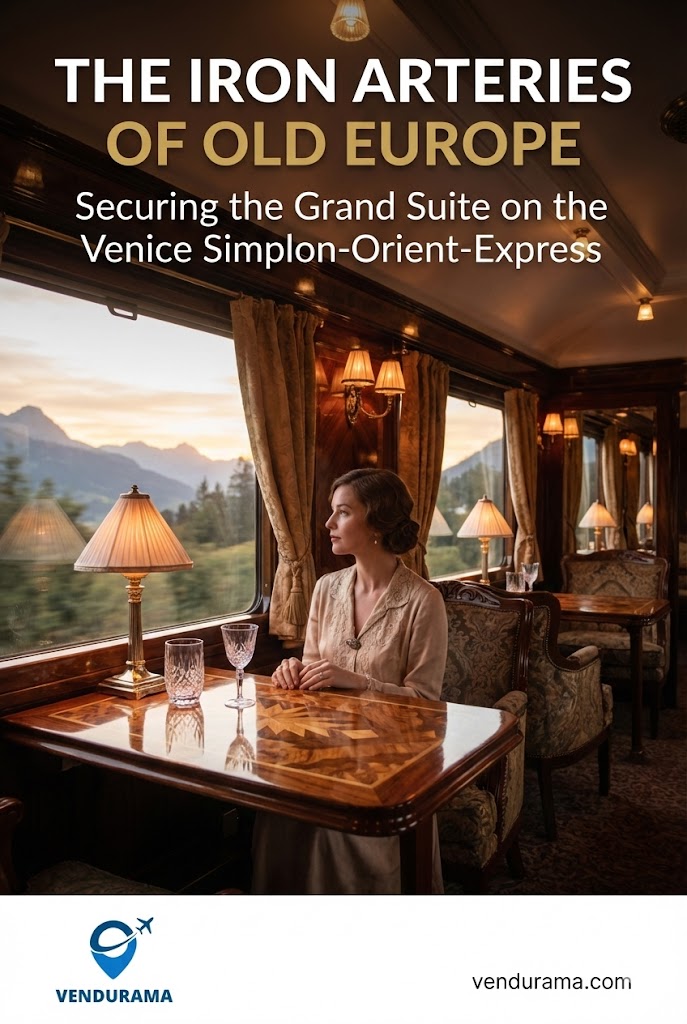
1. The Economic Thesis: Scarcity, Temporal Arbitrage, and the Re-commodification of Time
In an era defined by the relentless compression of temporal and spatial barriers—the gigahertz processor, the transcontinental flight, the instantaneous digital transaction—a counterintuitive economic phenomenon has emerged at the apex of luxury consumption: the deliberate re-expansion of time. The Venice Simplon-Orient-Express (VSOE), operated by Belmond Limited, represents not merely a transportation service but a sophisticated financial instrument trading in temporal scarcity. Its Grand Suites—three meticulously restored carriages designated Côte d’Azur, L’Étoile du Nord, and Oriental—function as a hyper-exclusive asset class whose value derives not from velocity but from enforced deceleration. This represents a fundamental inversion of conventional transportation economics, where value has historically been correlated with speed. The Grand Suite commands premiums exceeding €30,000 for the Paris-to-Venice itinerary not despite its 35-hour duration, but precisely because of it.
The economic architecture underlying this pricing model rests upon three interlocking pillars of scarcity. First, absolute physical scarcity: only three Grand Suites exist across the entire VSOE fleet, each accommodating a maximum of two passengers per journey. With approximately 120 annual departures on core routes, this yields a theoretical maximum capacity of 720 passenger-nights annually—a volume smaller than a single luxury hotel suite in London or Paris might generate in a year. Second, temporal scarcity: unlike static real estate assets, the Grand Suite’s availability exists only within narrow, pre-scheduled temporal windows dictated by railway infrastructure, border crossings, and the operational constraints of vintage rolling stock. A cancellation does not create fungible inventory; it creates a unique, non-replicable void in the calendar that cannot be monetized retrospectively. Third, and most critically, experiential scarcity: the Grand Suite experience cannot be disaggregated, resold, or experienced asynchronously. It is an indivisible temporal unit—what economists might term a “non-storable service good” with zero elasticity of supply in the short term.
This tripartite scarcity framework enables what we term temporal arbitrage: the strategic acquisition of time perceived as qualitatively distinct from chronologically equivalent intervals in alternative contexts. For the ultra-high-net-worth individual (UHNWI), whose primary constraint has shifted from financial capital to attentional capital, the Grand Suite offers a rare commodity—uninterrupted, device-mediated time within an environment engineered to resist external intrusion. The carriage’s lack of Wi-Fi connectivity (a deliberate design choice rather than technical limitation) transforms a potential liability into a premium feature, creating a walled garden of attentional sovereignty. In this context, the passenger pays not for transportation but for the enforced suspension of digital obligations—a service increasingly valuable as the attention economy reaches saturation.
The pricing mechanics reflect sophisticated yield management principles adapted from luxury hospitality but constrained by railway operational realities. Unlike a hotel that can dynamically adjust room rates based on daily demand fluctuations, the VSOE operates with fixed departure dates and immutable capacity. This necessitates a pre-emptive pricing strategy calibrated to extract maximum value from the certainty of scarcity. Grand Suite rates remain relatively stable year-round, with modest seasonal adjustments, because the operator recognizes that its clientele values predictability and exclusivity over opportunistic discounting. The absence of last-minute inventory liquidation mechanisms—a standard practice in aviation and hospitality—further reinforces the perception of immutable scarcity. When a Grand Suite sells out six months in advance, the operator does not deploy algorithmic repricing to capture additional consumer surplus from late-booking premium clients; it simply records the sale as evidence of correct initial pricing. This restraint, counterintuitive in contemporary revenue management theory, actually enhances long-term brand equity by signaling that access is governed by temporal precedence rather than financial escalation.
The economic thesis extends beyond the transaction itself to encompass signaling value within UHNWI social networks. The Grand Suite functions as a Veblen good—a commodity whose demand increases as its price rises—because its acquisition communicates not merely expenditure capacity but temporal sovereignty. In an age where visible consumption has become socially problematic among elites, the VSOE offers a form of inconspicuous consumption: the experience leaves minimal digital footprint (few Instagrammable moments compared to a yacht charter), requires no permanent asset acquisition (unlike a private jet), and generates social capital through narrative rather than display. The passenger returns not with photographs of possessions but with a story of temporal privilege—the ability to surrender 35 hours to a single, linear journey in an era of fractured attention. This narrative capital often exceeds the monetary expenditure in long-term social ROI, particularly within circles where time poverty constitutes the ultimate status marker.
Critically, the Grand Suite’s economic model depends upon the preservation of operational constraints that would be eliminated in rationalized transportation systems. The requirement to change trains at Calais Fréthun due to gauge differences between British and continental rolling stock; the adherence to schedules dictated by heritage infrastructure rather than optimal routing; the prohibition of onboard digital connectivity—all represent deliberate maintenance of friction points that would be engineered out of a utility-focused service. These constraints are not inefficiencies but value-generating features. They transform transportation from a means to an end into an end in itself—a temporal enclave where the journey’s duration becomes the product’s core specification. The passenger purchases not displacement but duration, not arrival but immersion. This represents a fundamental re-commodification of time itself, repackaged from a diminishing resource to be optimized into a luxury environment to be inhabited.
2. Psychological Architecture: The Paradox of Voluntary Confinement in an Age of Hyper-Mobility
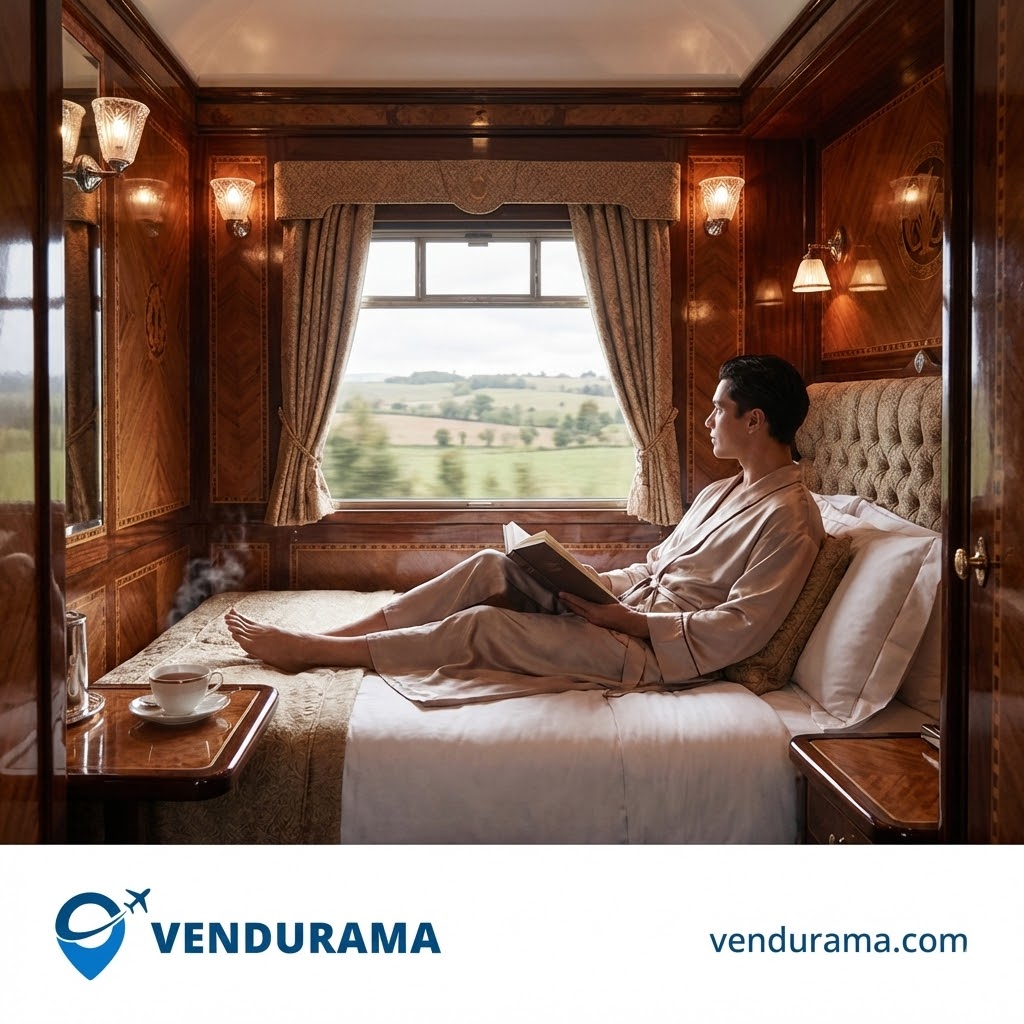
The decision to pay a five-figure sum for confinement within 5.5 square meters of meticulously appointed space for 35 consecutive hours presents an apparent psychological paradox. Contemporary luxury consumption typically emphasizes expansion—of space, of options, of autonomy. The private jet offers route flexibility; the superyacht provides territorial sovereignty; the sprawling estate delivers spatial dominion. The Grand Suite, by contrast, imposes severe spatial constraints while simultaneously restricting temporal agency (the schedule is immutable) and digital connectivity (the environment is deliberately offline). Yet this very constriction constitutes the experience’s psychological appeal for its target demographic. Understanding this requires analysis beyond conventional luxury psychology into the domain of what we term volitional constraint theory—the human tendency to derive satisfaction from self-imposed limitations that create psychological boundaries against ambient chaos.
For the UHNWI cohort—individuals whose professional lives are characterized by perpetual availability, decision fatigue, and spatial fluidity—the Grand Suite offers a rare commodity: bounded temporality. The carriage’s physical dimensions, fixed itinerary, and operational constraints create a hermetically sealed temporal container. Within this container, the cognitive load associated with choice-making evaporates. Meals occur at predetermined times in designated carriages; the route unfolds according to a century-old schedule; movement options are limited to three carriages and the observation platform. This elimination of trivial decisions—what to eat, when to depart, which route to take—frees cognitive resources for higher-order reflection or genuine rest. Neuroeconomic research suggests that decision fatigue disproportionately affects high-agency individuals whose daily lives consist of continuous micro-choices; the Grand Suite functions as a cognitive decompression chamber where the passenger surrenders agency to a trusted system, thereby recovering decision-making capacity.
This phenomenon intersects with emerging research on environmental determinism in attentional states. The carriage’s Art Deco interior—featuring Lalique glass panels, marquetry by René Lalique, and fixtures faithful to 1920s specifications—creates a sensory environment that actively discourages digital engagement. The absence of flat surfaces optimized for laptop use; the warm, non-reflective lighting unsuited for screen visibility; the gentle rhythmic motion of the train—all constitute environmental nudges steering behavior toward analog engagement. Passengers report reading entire books, engaging in sustained conversation, or simply observing the European landscape unfold with an attentional depth impossible in environments designed for digital multitasking. This is not nostalgia but environmental engineering: the carriage functions as a carefully calibrated attentional habitat that makes certain cognitive states more probable through material design.
The psychological appeal extends to the ritualization of transition. Contemporary travel has largely eliminated meaningful thresholds between states of being. The business traveler moves seamlessly from office to airport lounge to aircraft cabin to hotel room—all environments sharing similar aesthetic codes, connectivity standards, and functional purposes. This creates what psychologists term experiential flattening: the inability to cognitively register transition between life domains. The Grand Suite journey, by contrast, imposes a deliberate, multi-stage transition ritual. The transfer from modern airport to historic Gare de l’Est; the boarding process with its period-costumed stewards; the initial acceleration through Parisian suburbs before the landscape transforms to pastoral idyll—each phase marks a cognitive boundary crossing. By the time the train reaches the Burgundy vineyards, passengers report a palpable psychological shift: the professional self has been ceremonially disrobed, making space for an alternative mode of being. This ritualized transition holds particular value for individuals whose lives lack natural boundaries between work and personal domains—a growing demographic among global elites.
Perhaps most significantly, the Grand Suite experience addresses what sociologists have identified as relational atrophy among hyper-mobile elites. The private jet, while offering spatial exclusivity, often intensifies social isolation—traveling with a small entourage or alone, with interactions limited to crew providing transactional service. The VSOE’s social architecture deliberately engineers serendipitous interaction while preserving privacy. The restaurant cars operate on a reservation system that subtly mixes parties; the bar car functions as a neutral convivial space; the observation platform encourages spontaneous conversation among passengers sharing the unique experience. Yet crucially, retreat to one’s private compartment remains immediately available. This creates what anthropologists term a controlled permeability social environment—more socially fertile than private aviation, yet more exclusive and comfortable than commercial rail travel. For individuals whose social networks have become professionally instrumentalized, the opportunity for unstructured interaction with similarly situated but non-transactional peers holds significant psychological value. The carriage becomes a temporary heterotopia—a space that exists outside normal social rules where professional identities can be temporarily suspended.
The confinement paradox resolves when understood not as spatial restriction but as attentional liberation. The physical boundaries of the carriage create psychological boundaries against the infinite demands of hyper-connectivity. In surrendering control over movement, schedule, and digital access, the passenger purchases something increasingly scarce: the right to be unreachable. This represents not regression but recalibration—a strategic withdrawal from the attention economy to preserve cognitive sovereignty. The Grand Suite functions as a temporal monastery for the digitally besieged elite, where the vows taken are not of poverty or chastity but of disconnection and deceleration.
3. Engineering & Preservation: The Economics of Maintaining Rolling Heritage
Beneath the Lalique glass panels and Savoir Beds mattresses lies an engineering reality that contradicts the romantic narrative of timeless elegance: the Grand Suite carriages represent some of the most economically irrational assets in contemporary transportation. Their continued operation depends upon a preservation model that defies conventional capital allocation logic, sustained only through premium pricing that effectively cross-subsidizes heritage conservation. Understanding this requires examination of three intersecting domains: material conservation economics, regulatory adaptation, and the hidden costs of operational authenticity.
The carriages comprising the Grand Suite fleet—Pullman cars originally constructed between 1929 and 1931 by the Birmingham Railway Carriage and Wagon Company—operate far beyond their designed service life. Railway rolling stock of this era was engineered for 25–30 years of revenue service under maintenance regimes that accepted progressive degradation. Their continued operation 90+ years later requires a conservation approach more akin to museum artifact preservation than transportation asset management. Each carriage undergoes a comprehensive restoration cycle every 8–10 years at Belmond’s specialized workshops in Poland, a process consuming 18–24 months per carriage and costing approximately €1.2 million—roughly equivalent to the purchase price of a new high-speed train carriage. Yet unlike the new carriage, which would generate revenue immediately upon completion, the restored heritage carriage returns to service with identical capacity and speed characteristics as before restoration. This represents pure capital consumption rather than investment in productivity enhancement—a financial model sustainable only through extreme price discrimination.
The material conservation challenges extend beyond cosmetic restoration to fundamental engineering adaptations. Original bogies (the chassis assemblies supporting carriages) cannot meet contemporary safety standards for derailment prevention or crashworthiness. Rather than replacing them with modern equivalents—which would alter ride characteristics and carriage height relative to platforms—Belmond engineers have developed hybrid bogies that incorporate modern safety systems within period-correct housings. This requires custom fabrication of components no longer manufactured, often reverse-engineered from archival drawings or surviving examples. Similarly, the original electrical systems—designed for 600V DC power collection from third rails—have been comprehensively replaced with modern 1,000V AC systems compatible with European mainline infrastructure, yet all visible fixtures retain period appearance. Wiring runs through custom conduits hidden within restored timber frameworks; circuit breakers are housed in replica 1920s junction boxes. This dual-layer approach—modern engineering concealed beneath heritage aesthetics—multiplies maintenance complexity and cost. A simple lighting fault may require disassembly of historically significant marquetry panels to access wiring conduits, necessitating conservator supervision alongside electrical technicians.
Regulatory compliance presents an equally complex challenge. European Railway Agency safety directives, progressively tightened following accidents in the 1990s and 2000s, impose requirements fundamentally incompatible with 1920s design philosophy. Fire safety standards mandate materials with specific flame-retardant properties, yet original carriage interiors featured extensive timber paneling, fabric wall coverings, and rubber flooring—all highly combustible by modern standards. The solution has required material science innovation: timber panels are now fabricated from laminated composites that mimic period appearance while meeting EN 45545 fire safety standards; fabrics undergo proprietary chemical treatment that preserves texture and color while achieving required ignition resistance; even the iconic mosaic floors in washrooms use modern resin-bonded aggregates that replicate original appearance while meeting slip-resistance requirements. Each material substitution requires approval from heritage bodies in multiple jurisdictions (France, Italy, UK), creating a regulatory labyrinth that adds 12–18 months to restoration timelines.
Perhaps the most economically significant hidden cost involves operational constraints imposed by heritage infrastructure. The VSOE cannot operate on high-speed lines (LGV in France, Alta Velocità in Italy) because vintage carriages lack the aerodynamic profiles and suspension systems required for speeds exceeding 160 km/h. This forces routing through secondary mainlines with lower traffic priority, resulting in schedule vulnerability to freight train congestion and infrastructure maintenance. Delays cascade through the tightly choreographed service model—meals prepared in narrow-gauge kitchen cars cannot be held indefinitely; border crossing procedures at Calais require precise timing to coordinate with French and British immigration officials. The economic cost of this operational fragility manifests not in direct expenses but in revenue risk: a single significant delay can trigger passenger dissatisfaction that undermines the premium pricing model, yet schedule padding to accommodate potential delays would erode the temporal exclusivity that constitutes the product’s value proposition.
The preservation economics become sustainable only through what we term experiential price anchoring. Passengers paying €30,000+ for the Grand Suite experience are not purchasing transportation; they are purchasing participation in a living museum. The visible patina on brass fixtures, the subtle asymmetry in hand-laid marquetry, the gentle sway distinct from modern train stability—all constitute authenticity markers that would be eliminated in a rationalized service model. Belmond has correctly identified that its clientele values these imperfections as evidence of genuine heritage rather than perceiving them as quality deficiencies. This allows the operator to avoid the capital expenditure required for modernization while simultaneously charging premiums that far exceed rational transportation pricing. The €1.2 million restoration cost per carriage becomes economically rational when amortized against the €3–4 million annual revenue generated by a single Grand Suite carriage—revenue that would collapse if the carriages were modernized and thereby stripped of their heritage premium.
This preservation model represents a broader economic phenomenon: the financialization of cultural heritage through experiential consumption. The Grand Suite carriages function as revenue-generating conservation vehicles, where luxury tourism cross-subsidizes heritage preservation that would otherwise depend upon public funding or philanthropy. Each passenger effectively purchases a conservation bond disguised as a travel experience. This model has proven more sustainable than traditional museum funding for certain heritage assets, particularly those requiring operational preservation (as opposed to static display). The economic irrationality of maintaining 1920s rolling stock becomes rational when viewed not as transportation asset management but as heritage conservation financed through premium experiential consumption. The passenger pays not for the privilege of movement but for the privilege of sustaining a fragment of interwar European civilization in operational condition—a transaction that transforms luxury consumption into inadvertent cultural patronage.
4. Strategic Logistics: The Friction Architecture of Seamless Experience
The Grand Suite experience presents a logistical paradox: its marketed value proposition centers on seamlessness—a frictionless transition from daily life into a temporal enclave of curated elegance—yet its operational reality depends upon navigating multiple high-friction interfaces between contemporary transportation systems and heritage infrastructure. The passenger’s journey begins not at Gare de l’Est but at an international airport, where the first critical misalignment emerges between aviation scheduling logic and railway operational constraints. Commercial aviation has evolved toward hub-and-spoke networks optimized for aircraft utilization and passenger volume aggregation, resulting in flight banks that concentrate arrivals during specific windows. The VSOE, by contrast, departs Paris at 14:30 precisely—a schedule determined by daylight considerations for optimal Alpine crossing views, border control staffing at Calais, and arrival timing in Venice for disembarkation before evening. This creates a structural misalignment: a passenger arriving at Charles de Gaulle Airport (CDG) on transatlantic flights faces either a six-hour airport wait (if arriving on morning banks) or significant risk of missing departure (if arriving on afternoon banks with potential transatlantic delays).
This temporal misalignment represents more than inconvenience; it constitutes a threat to the experience’s core value proposition. The psychological transition into the VSOE’s temporal enclave requires cognitive decompression—a shedding of travel stress before boarding. A passenger rushing from immigration to baggage claim to ground transportation under time pressure arrives at the train with elevated cortisol levels, diminished capacity for presence, and residual anxiety that may persist through the first hours aboard. The experience’s marketed serenity becomes compromised before it begins. Mitigating this requires what operational analysts term temporal buffering: the strategic insertion of slack time between flight arrival and train departure sufficient to absorb variability in flight punctuality while providing psychological decompression space. For transatlantic travelers, this typically necessitates arrival in Paris the day prior to departure—a solution that introduces its own complexities regarding accommodation, ground transportation, and luggage management.
The accommodation challenge reveals another layer of logistical friction. The optimal pre-departure lodging would balance proximity to Gare de l’Est with an aesthetic and service standard that constitutes a seamless prelude to the VSOE experience. Luxury hotels in central Paris meet the latter criterion but introduce ground transportation friction on departure day—navigating Parisian traffic to reach the station with precise timing. Hotels adjacent to the station often lack the aesthetic continuity required for experiential seamlessness. This dilemma forces passengers into suboptimal compromises unless they deploy sophisticated logistical planning that treats the entire journey as an integrated system rather than discrete transactions. The solution space involves either securing accommodation within walking distance of the station that meets luxury thresholds—a scarce inventory category—or engineering ground transportation with sufficient time buffers to absorb urban traffic variability without introducing excessive waiting time.
Ground transportation between airport and station represents the most acute friction point in the entire journey architecture. Charles de Gaulle Airport lies 30 kilometers northeast of Gare de l’Est, connected by a transportation ecosystem characterized by modal fragmentation and reliability variance. The RER B commuter rail offers predictable journey times but requires navigation of crowded platforms with luggage, transfer at Gare du Nord, and a 15-minute walk between stations—introducing physical friction and cognitive load precisely when passengers seek decompression. Taxis offer door-to-door convenience but face unpredictable journey times due to Parisian traffic patterns, with 45-minute journeys potentially extending to 90 minutes during peak congestion. Ride-hailing services introduce additional uncertainty through driver availability fluctuations and variable routing algorithms. For a passenger whose entire experience value proposition depends upon arriving at the train relaxed and present, this ground transportation leg constitutes a critical vulnerability point.
The friction intensifies for passengers originating from multiple departure points—a common scenario for UHNWIs whose travel patterns involve circuitous routing through private aviation hubs or secondary commercial airports. A passenger arriving via private jet at Le Bourget faces different ground transportation challenges than one arriving commercially at CDG; a passenger connecting through London must navigate the Channel crossing logistics before even addressing Parisian ground transportation. Each origin point introduces unique friction vectors that compound the core misalignment between aviation and railway scheduling logics. The operational complexity scales non-linearly with passenger party size: coordinating arrival times for four passengers on separate flights from New York, Hong Kong, and São Paulo—then synchronizing their ground transportation to arrive simultaneously at Gare de l’Est—requires logistical orchestration approaching military campaign planning.
The solution architecture for these friction points requires treating the entire journey as an integrated operational system rather than a sequence of discrete transactions. This begins with flight selection calibrated not to airline preference or fare optimization but to temporal alignment with the VSOE’s immutable schedule. Transatlantic passengers should target flights arriving between 08:00 and 10:00 at CDG—sufficiently early to absorb typical transatlantic delay patterns while providing adequate buffer before the 14:30 departure. This requires precise strategic flight coordination that prioritizes schedule reliability metrics over conventional selection criteria, often favoring airlines with superior transatlantic punctuality records even at premium fare differentials. The marginal cost of a €500 fare premium to secure a reliably timed flight represents rational expenditure when weighed against the €30,000+ investment in the core experience and the psychological cost of arrival stress.
Ground transportation solutions must similarly transcend conventional consumer choice models. The optimal approach involves eliminating modal uncertainty through pre-commitment to a single, reliability-optimized transport mode with sufficient time buffers engineered into the schedule. This typically manifests as pre-arranged executive transfers with two critical specifications: first, vehicles staffed by drivers possessing detailed knowledge of Parisian traffic patterns and real-time adaptive routing capability; second, journey timing calibrated to 95th percentile traffic conditions rather than average conditions, with the understanding that arriving at the station with 45 minutes of buffer time constitutes optimal rather than wasteful scheduling. The psychological value of this buffer—transforming potential anxiety into anticipatory calm—justifies the premium over standard taxi services. For parties with complex arrival patterns (multiple flights, private aviation connections), the transfer service must incorporate dynamic coordination capabilities, with drivers maintaining real-time communication with all party members to adjust pickup sequencing based on actual arrival times rather than scheduled times.
The luggage logistics dimension introduces a final layer of operational complexity often underestimated in journey planning. The Grand Suite’s spatial constraints—while luxurious by railway standards—cannot accommodate the voluminous luggage typical of extended luxury travel. Passengers must make strategic decisions about what accompanies them aboard versus what follows via separate logistics channels. This requires either pre-positioning luggage at the Venice destination hotel (for one-way journeys) or utilizing specialized luggage forwarding services that operate on railway-compatible schedules. Critically, these services must navigate the same temporal constraints as passenger transportation: luggage must arrive at Gare de l’Est with sufficient lead time for loading but not so early as to require extended secure storage. The operational window for luggage handover typically spans just 90 minutes before departure—a narrow corridor demanding precise synchronization with passenger arrival times.
For passengers extending their journey beyond Venice—perhaps connecting to private yachts in the Adriatic or onward flights from Marco Polo Airport—the logistical complexity compounds geometrically. The VSOE’s Venice arrival at approximately 09:30 creates similar misalignments with aviation schedules: early afternoon flights require hours of waiting in airport terminals; late morning flights risk missing departure due to train delays. The optimal solution often involves overnight accommodation in Venice, but this introduces additional coordination requirements for luggage transfer between train, hotel, and onward transportation. The entire journey architecture—from origin airport to final destination—must be engineered as a single integrated system with buffer zones at each modal transition point.
The sophisticated passenger recognizes that the Grand Suite experience’s advertised seamlessness is not an inherent property of the service but an emergent property of meticulous logistical orchestration. Belmond provides the temporal enclave; the passenger must engineer the frictionless approach to its threshold. This requires treating journey planning not as administrative overhead but as integral to experience design—deploying resources proportional to the core expenditure to eliminate vulnerability points. The €30,000 Grand Suite fare represents only the centerpiece of a total experience investment that rationally includes premium flight selection, executive ground transportation, strategic accommodation positioning, and luggage logistics engineering. Passengers who treat these elements as optional cost-saving opportunities often discover that minor friction at journey interfaces can disproportionately degrade the core experience’s psychological value—arriving stressed negates the carriage’s tranquility; luggage complications overshadow culinary excellence; time pressure diminishes landscape appreciation.
The ultimate logistical sophistication involves recognizing that different journey segments require different optimization criteria. The transatlantic flight should be optimized for schedule reliability rather than comfort differentials (since premium cabin comfort differences become negligible relative to the Grand Suite experience). The ground transportation leg should be optimized for temporal predictability rather than cost minimization. The pre-departure accommodation should be optimized for proximity and aesthetic continuity rather than brand loyalty points. This segment-specific optimization requires resisting conventional travel booking heuristics that apply uniform selection criteria across all journey components. The rational actor treats the entire journey as a single utility function to be maximized, with resource allocation calibrated to each segment’s marginal impact on overall experience quality.
This logistical architecture ultimately serves the experience’s core psychological proposition: the creation of a bounded temporal container where external chaos cannot penetrate. Every friction point eliminated in the approach phase strengthens the psychological boundary between ordinary time and VSOE time. The passenger who arrives having navigated airport chaos, traffic uncertainty, and luggage anxiety carries that residual stress into the carriage, where it slowly dissipates over hours. The passenger who arrives via meticulously engineered logistics transitions immediately into the temporal enclave, their cognitive resources available for presence rather than recovery. In this sense, the pre-journey logistics constitute not mere transportation but psychological preparation—the creation of mental conditions necessary to receive the experience’s full value. The iron arteries of Old Europe can only deliver their promise when approached not as destinations but as thresholds requiring careful ritual preparation.
Conclusion: The Calculus of Curated Time
The Venice Simplon-Orient-Express Grand Suite represents more than a luxury travel product; it constitutes a sophisticated response to temporal scarcity in late-stage capitalism. Its economic model, psychological architecture, and logistical requirements coalesce around a single insight: for the global elite, time has become the ultimate scarce resource, and its quality—measured in attentional sovereignty, cognitive restoration, and experiential depth—has become the ultimate luxury metric. The Grand Suite succeeds not by accelerating movement but by decelerating experience; not by expanding spatial options but by contracting them to eliminate decision fatigue; not by embracing technological connectivity but by engineering its absence.
This model’s sustainability depends upon maintaining operational constraints that would be eliminated in rationalized transportation systems. The very frictions that make the service economically irrational—gauge changes requiring train transfers, vintage rolling stock limiting speed, heritage infrastructure dictating routing—constitute the experience’s value-generating features. They transform transportation from utility into ritual, from means to end. The passenger pays a premium not despite these constraints but because of them, recognizing that temporal quality requires environmental boundaries against the infinite optionality of contemporary life.
The logistical complexity surrounding the experience—flight coordination, ground transportation, luggage management—reveals a deeper truth about contemporary luxury consumption: seamlessness is not inherent but engineered. The advertised tranquility of the Grand Suite emerges only when the approach journey has been meticulously orchestrated to eliminate friction points. This requires treating the entire journey as an integrated system rather than discrete transactions, with resource allocation calibrated to each segment’s marginal impact on overall experience quality. The rational expenditure on premium flight selection and executive ground transportation represents not ancillary cost but core investment in psychological readiness—the creation of mental conditions necessary to receive the temporal enclave’s full value.
As digital acceleration continues fragmenting attention and compressing temporal experience, the market for curated deceleration will likely expand beyond its current UHNWI base. The Grand Suite model may inspire derivative offerings—shorter journeys, regional routes, fractional ownership models—that democratize access to temporal sovereignty while preserving the core value proposition. Yet the fundamental economic principle will remain: in an age of infinite digital velocity, the ultimate luxury becomes the right to move slowly through physical space, uninterrupted and unobserved. The iron arteries of Old Europe, with their deliberate pace and sensory richness, offer not escape from modernity but recalibration within it—a reminder that human experience requires temporal texture, and that some journeys retain value precisely because they cannot be optimized.
The Grand Suite’s enduring appeal lies in its refusal to solve the fundamental human condition of temporal finitude. It does not promise more time; it promises better time. And in an era where attention has become the ultimate currency, this distinction constitutes the final frontier of luxury consumption. The carriage doors close not on a mode of transport but on a temporal contract—a 35-hour agreement to surrender velocity for depth, connectivity for presence, and optimization for experience. For those capable of honoring its terms, the return on investment transcends monetary calculation, measured instead in restored cognitive capacity, deepened relational connection, and the rarest commodity of all: the memory of time well inhabited.