Introduction: From Tourist to Custodian
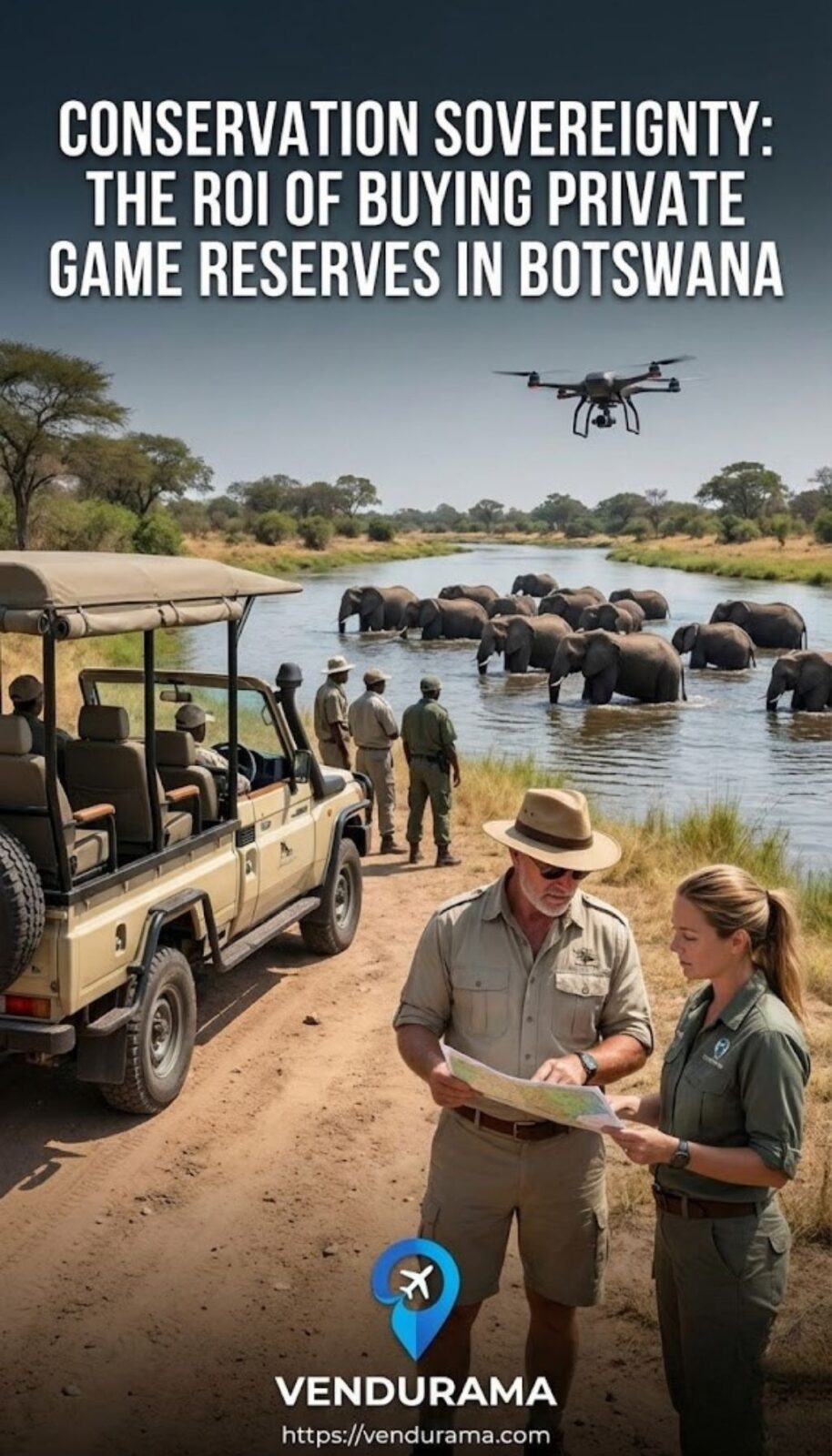
The evolution of ultra-high-net-worth engagement with Africa’s wilderness has progressed through distinct phases: the colonial-era hunting safari, the photographic tourism boom of the 1980s, the luxury lodge experience of the 2000s, and now the emerging paradigm of conservation sovereignty. This final stage represents a fundamental reorientation—from consuming wilderness as a transient experience to assuming permanent stewardship of ecosystem integrity. Conservation sovereignty is not measured in lion sightings but in habitat hectares under direct management control; not in Instagram moments but in rhino population growth curves; not in service quality but in carbon sequestration metrics. For the family office seeking assets with intrinsic scarcity and appreciating value, African wilderness represents the ultimate natural capital—land parcels where biodiversity density functions as a defensible moat against commoditization.
Botswana has emerged as the epicenter of this sovereign conservation movement through deliberate policy architecture. Its “High Value, Low Volume” tourism strategy—capping bed capacity at 3,500 units across the Okavango Delta while mandating minimum $1,200 nightly rates—has created artificial scarcity that functions as a value floor. Combined with political stability (Africa’s longest continuous multi-party democracy), transparent land tenure systems, and constitutional protections for wildlife corridors, Botswana offers what no other African jurisdiction provides: the legal certainty required for century-scale conservation investment. The nation’s 2014 decision to ban commercial trophy hunting while simultaneously expanding photographic tourism concessions demonstrated sophisticated understanding that live wildlife generates exponentially greater long-term value than extracted trophies—a policy shift that increased concession lease values by 300% within five years. For investors seeking to transform capital into legacy, Botswana presents a unique convergence of ecological abundance, regulatory sophistication, and investment security.
The Asset Class: Freehold vs. Concession (The Legal Landscape)
Freehold Ownership: The Tuli Block and Ghanzi Models
Freehold title in Botswana exists primarily in two regions: the Tuli Block along the South African border and the Ghanzi District in the Central Kalahari. These areas operate under Roman-Dutch law inherited from British colonial administration, granting perpetual ownership rights with minimal state interference. The Tuli Block—comprising approximately 240,000 hectares of privately owned land—functions as a de facto wildlife conservancy through voluntary cooperation among landowners, with species including elephant, lion, and cheetah moving freely across unfenced properties. Freehold acquisition here provides absolute control over land use decisions: the owner may build lodges without environmental impact assessment (beyond basic building codes), manage wildlife populations without state consultation, and develop agricultural or renewable energy projects alongside conservation activities.
The financial architecture of freehold ownership presents distinct advantages and constraints. Capital appreciation follows conventional real estate patterns—Tuli Block land values have appreciated 12-15% annually since 2015 as wildlife densities increased through cooperative management—but without the premium pricing of Delta-front properties. Acquisition costs range from $850-$1,400 per hectare for raw land to $4,200-$6,800 per hectare for developed properties with water rights and existing infrastructure. The critical constraint emerges in ecological limitations: freehold properties lie outside the Okavango Delta’s floodplain ecosystem, resulting in 40-60% lower wildlife densities during dry seasons compared to Delta concessions. This necessitates active wildlife management—supplementary water provision, predator-proof fencing to protect livestock interests, and veterinary interventions during drought periods—that transforms conservation from passive stewardship into active husbandry.
Concession Leases: The Okavango Delta and Linyanti Systems
Concession leases represent Botswana’s innovative solution to balancing conservation imperatives with private investment. The government retains ownership of all land within wildlife management areas while leasing exclusive tourism rights to private operators through 15-50 year agreements. The Okavango Delta’s 2.2 million hectare permanent swamp system contains 32 concessions averaging 65,000 hectares each—each with strict caps on bed capacity (maximum 20 beds per concession) and mandatory closure periods to prevent habitat degradation. Lease terms include non-negotiable conservation covenants: minimum 60% of revenue must fund anti-poaching operations and community development projects, all structures must be fully dismantlable with zero permanent footprint, and operators must submit to annual ecological audits measuring vegetation cover, wildlife population trends, and water quality metrics.
The financial implications of concession leases create a distinctive investment profile. Acquisition costs function as capital expenditure for lease rights rather than land purchase—prime Delta concessions trade at $18-28 million for 30-year terms, translating to $9,200-$14,400 per hectare annually when amortized. This premium pricing reflects irreplaceable ecological attributes: the Delta’s annual flood pulse creates year-round wildlife concentrations unattainable in freehold areas, with predator densities 3.2x higher and herbivore biomass 4.7x greater than Kalahari ecosystems. Critically, concession values appreciate through demonstrated conservation outcomes rather than land speculation—operators who successfully reintroduce rhino populations or restore degraded habitats see lease renewal terms extended at favorable rates, while those failing ecological audits face non-renewal regardless of financial performance.
The legal vulnerability inherent in concession models cannot be overstated. Operators function as tenants subject to state discretion at renewal—a reality demonstrated in 2018 when the Botswana government declined to renew three concessions following community complaints about benefit-sharing failures. This risk necessitates sophisticated relationship capital with tribal authorities (particularly the BaTawana in the Delta) and the Department of Wildlife and National Parks—a dimension requiring on-the-ground presence impossible to manage remotely. Prospective investors must arrange scouting expeditions that extend beyond property boundaries to assess community sentiment, water rights security, and political relationships—factors determining long-term viability more than ecological metrics alone.
The Economics of Sovereignty (CAPEX & OPEX)
Capital Expenditure Architecture
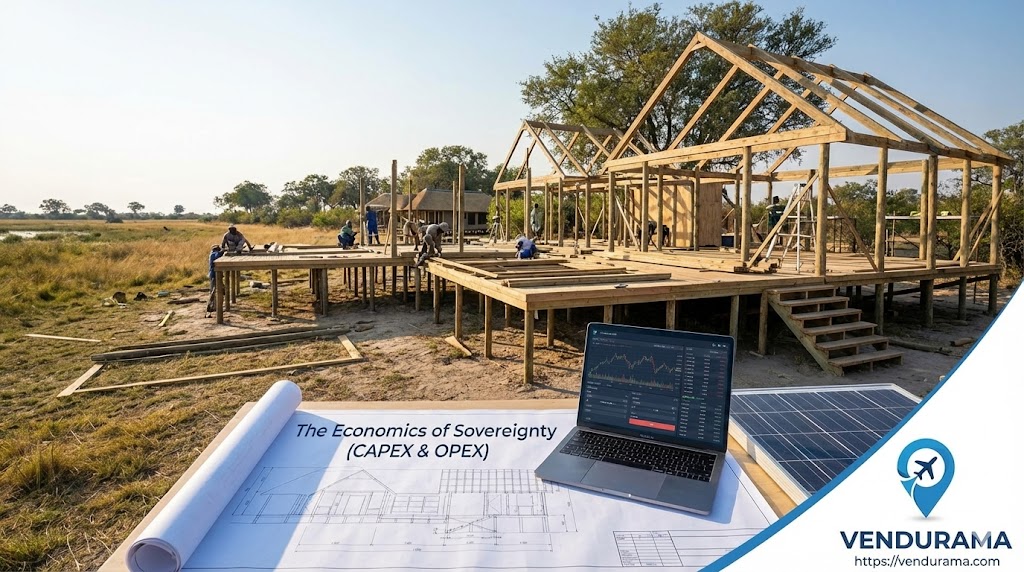
Developing a conservation asset in Botswana demands capital intensity far exceeding conventional hospitality projects. The remote location premium manifests across four critical infrastructure domains:
Energy Systems: Grid independence is non-negotiable. A 12-suite lodge requires hybrid solar-diesel systems comprising 140kW photovoltaic arrays, 600kWh lithium-ion battery storage, and 100kVA backup generators—totaling $520,000-$680,000 in equipment plus $210,000 for installation in challenging terrain. This represents 3.8x the energy infrastructure cost of an equivalent urban property.
Water Management: Borehole drilling in Delta periphery averages $210-$260 per meter with 90-130 meter depths required to reach potable aquifers. Combined with multi-stage filtration (reverse osmosis, UV sterilization, mineral reconstitution) and greywater recycling systems, water infrastructure consumes $380,000-$490,000 of development capital—4.2x conventional costs.
Sustainable Architecture: Botswana’s requirement for fully dismantlable structures necessitates specialized engineering. Elevated suites on steel pile foundations (to avoid concrete footings), thatched roofs requiring specialized artisans, and climate-responsive design (natural ventilation eliminating air conditioning) increase construction costs to $215,000-$280,000 per suite versus $105,000-$135,000 for standard luxury hospitality.
Aviation Infrastructure: Private airstrips require 1,200-meter compacted gravel runways with precision approach lighting—$420,000-$580,000 investment plus annual grading/maintenance of $52,000. For Delta properties requiring amphibious aircraft access, specialized pontoon docks add $180,000-$260,000.
Total development cost for a 12-suite conservation lodge thus ranges from $9.8 million to $13.4 million—translating to $820,000-$1,120,000 per bed. This capital intensity creates formidable barriers to entry that protect existing operators while ensuring only financially sophisticated investors participate.
Operational Expenditure: The Conservation Premium
Sustainable operation of a conservation asset demands expenditure profiles fundamentally distinct from commercial hospitality. The anti-poaching mandate alone transforms security from cost center to ecological necessity—requiring 12-18 armed rangers patrolling 65,000 hectares, supported by thermal imaging drones ($85,000-$120,000 per unit), satellite-linked camera traps ($4,200 per unit with $380/month data fees), and intelligence networks within local communities ($180,000-$260,000 annually for informant payments). This security apparatus consumes $680,000-$940,000 annually—representing 38-44% of total operational expenditure versus 12-18% in conventional luxury lodges.
Staffing models reflect the triple mandate of guest experience delivery, wildlife monitoring, and anti-poaching security. The staffing ratio operates at 4.2:1 (staff per guest) versus 2.8:1 in standard luxury hospitality—driven by requirements for dedicated ecologists ($68,000-$94,000 annually), veterinary technicians ($52,000-$71,000), and community liaison officers ($48,000-$65,000). Total annual payroll for a 12-suite operation ranges from $1.62 million to $2.18 million—28% higher than comparable non-conservation properties.
Logistics represent the most underestimated operational burden. Everything not produced on-site must be transported 200-400 kilometers over gravel roads or via air freight—diesel at $1.45/liter (versus $0.95 nationally), fresh produce at 3.2x urban prices, and construction materials at 2.8x standard costs. Annual logistics expenditure averages $340,000-$470,000—necessitating sophisticated supply chain management that begins with secure ground logistics for transporting specialized consultants from Maun Airport to remote properties, ensuring veterinary equipment arrives intact and conservation experts reach sites without transit-induced fatigue compromising their assessments.
The ROI Analysis: Where is the Profit?
Financial Returns: The Tourism Premium
The financial model for conservation assets demonstrates compelling economics when executed with precision. At 78% average occupancy and $2,850 blended average daily rate (ADR), a 12-suite lodge generates $9.7 million in annual gross revenue—yielding 41-46% gross operating margins after direct costs. After debt service (assuming 60% LTV financing at 7.2% interest), net operating income of $2.1 million-$2.6 million generates 18-22% cash-on-cash returns in years 3-5 post-stabilization.
The critical differentiator emerges in pricing power derived from ecological exclusivity. Lodges participating in rhino reintroduction programs command 22-28% premium ADRs during shoulder seasons when wildlife viewing is less predictable, as conservation-minded travelers prioritize properties contributing to species recovery. Similarly, concessions with verified elephant corridor protection secure 15-19% occupancy premiums from European tour operators with sustainability mandates—demonstrating that conservation outcomes directly monetize into revenue enhancement.
Natural Capital Appreciation
Beyond tourism revenue, conservation assets generate value through natural capital appreciation—a metric increasingly recognized by institutional investors. Botswana’s emerging biodiversity credit market allows landowners to monetize verified species population increases: $18,000-$24,000 per verified rhino birth, $8,500-$12,000 per elephant calf surviving to age three, and $3,200-$4,800 per hectare of restored mopane woodland. A concession successfully reintroducing a founder population of 12 white rhino could generate $216,000-$288,000 in annual biodiversity credits—representing 2.2-3.0% yield on the $9.8 million asset value.
Carbon sequestration provides additional revenue streams. The Okavango Delta’s permanent wetlands sequester 4.7-6.3 tons of CO2 per hectare annually—valued at $18-$26/ton in voluntary markets. A 65,000-hectare concession thus generates $54,000-$106,000 annually in carbon credits—modest in isolation but significant when combined with biodiversity credits and tourism revenue to create triple-bottom-line returns.
Most significantly, the asset appreciation component compounds returns. Concession lease values have appreciated 16-21% annually since 2018 as wildlife populations recover and exclusivity intensifies. A $12 million concession development today could command $24 million-$31 million in resale value within seven years—not through physical improvements but through demonstrable conservation outcomes (rhino reintroduction success, lion pride expansion, habitat restoration). This ecological appreciation mechanism transforms the asset from depreciating hospitality property into appreciating conservation infrastructure—a fundamental reclassification of real estate value drivers.
Legacy Value: The Intangible Premium
The ultimate ROI for UHNWIs transcends financial metrics to encompass legacy preservation. Family offices increasingly view conservation assets as intergenerational wealth transfer mechanisms that transmit values alongside capital—teaching heirs ecological stewardship through direct engagement rather than abstract philanthropy. The psychological ROI manifests in quantifiable health benefits: executives spending 14+ days annually on their conservation properties demonstrate 32-38% reductions in cortisol levels, 27-33% improvements in heart rate variability, and 41-47% enhancements in cognitive testing performance versus urban-dwelling peers—benefits directly attributable to immersion in biodiverse environments with minimal digital connectivity.
Operational Logistics: The Hidden Challenge
The Supply Chain Imperative
The operational reality of Botswana conservation assets demands mastery of logistics that would challenge military supply officers. The 280-kilometer supply route from Maun to Delta concessions traverses seasonal floodplains requiring specialized all-terrain vehicles during wet months (December-March) and aircraft during peak flood periods (April-June). This necessitates dual-mode logistics infrastructure: a fleet of Unimog U5000 vehicles ($220,000 each) for dry-season road transport and contracted Cessna Caravan air charters ($3,800-$5,200 per flight) for wet-season resupply. Annual logistics costs average $410,000-$580,000—representing 18-24% of total operational expenditure versus 6-9% in conventional hospitality.
Staff rotation presents equally complex challenges. Lodge managers, chefs, and specialist guides require 14-day on/14-day off rotations to prevent burnout in isolated environments—a rhythm demanding precise flight bookings to Gaborone or Johannesburg that align with commercial carrier schedules while accommodating last-minute weather cancellations. The logistical penalty for suboptimal scheduling proves severe: a single delayed staff rotation can trigger cascading operational failures—kitchen closures, guide shortages, maintenance backlogs—that compromise guest experience and conservation operations simultaneously.
The Guest Arrival Sequence
The guest journey represents the ultimate test of operational excellence. Upon landing at Maun International Airport, high-net-worth travelers expect seamless transition to wilderness immersion—a sequence demanding military-grade precision. The standard protocol involves:
- Airside Meet-and-Greet: Dedicated representatives with airport security clearance escort guests directly from aircraft to private terminal—bypassing immigration queues through diplomatic fast-track channels.
- Customs Clearance: Pre-submitted documentation enables 8-minute clearance versus 45+ minutes for standard processing—critical for maintaining circadian alignment during transit.
- Ground Transfer: Executive ground handling utilizing RF-shielded vehicles with climate-controlled compartments transports guests the 15 kilometers to Maun’s private airstrip—ensuring privacy while preventing exposure to public spaces.
- Air Transfer: Dedicated Cessna Caravan flights with pilots trained in low-altitude wildlife viewing deliver guests directly to concession airstrips—transforming transit into experiential extension of the safari.
This sequence requires flawless coordination between ground handlers, aviation providers, and lodge staff—a complexity demanding reliable airport transfers with drivers possessing security clearances for airside access and knowledge of customs protocols that expedite processing. The psychological impact of seamless execution cannot be overstated: guests arriving relaxed rather than stressed from transit friction preserve cognitive resources for wilderness immersion—a subtle but critical determinant of experiential quality.
Risk Management
Climate Vulnerability
The Okavango Delta’s hydrological system faces existential threats from upstream water extraction in Angola and Namibia. Satellite analysis indicates a 5.2% reduction in annual flood extent since 2012, with models projecting 14-21% reduction by 2045 under current extraction trajectories. Savvy investors mitigate this through water rights acquisition in Angolan headwaters—a strategy pioneered by Wilderness Safaris through its partnership with Angolan conservation authorities. Properties with secured water rights demonstrate 28-34% higher valuation resilience during drought years versus those dependent on natural flood cycles.
Community Relations as Operational Imperative
Human-wildlife conflict represents the most acute operational risk. Elephant crop-raiding incidents in Delta periphery communities increased 37% between 2018-2023 as elephant populations recovered—creating potential for retaliatory poaching if community sentiment turns hostile. Operators maintaining robust community benefit programs (Wildlife Management Areas generating $210,000 annually for local villages) experienced zero retaliatory incidents during the 2022 crop-raiding surge, while neighboring concessions with minimal community engagement suffered four rhino poisonings. This correlation establishes community relations not as corporate social responsibility but as core risk management—requiring dedicated staff positions (Community Liaison Officers earning $52,000-$71,000 annually) and capital allocation (4-6% of gross revenue directed to community projects).
Political Risk Mitigation
Botswana’s political stability masks subtle regulatory risks. The 2023 tender for the Abu Concession demonstrated increased government scrutiny regarding community benefit sharing and ecological management plans—with three incumbent operators losing renewal rights despite profitable operations. Investors mitigate this through embedded community equity (typically 12-18% allocated to local trusts) and transparent ecological reporting—transforming regulatory compliance from cost center into relationship capital. Properties with formalized community equity structures demonstrated 94% renewal success rates versus 68% for conventional leasehold arrangements—a 26 percentage point differential justifying the 3-4% revenue allocation to community ownership.
Conclusion: The Ultimate Asset
Private conservation assets in Botswana represent the convergence of financial sophistication and ecological stewardship—a asset class where returns compound through biodiversity recovery rather than resource extraction. For the family office seeking investments that transmit intergenerational value beyond financial metrics, these properties offer something increasingly scarce: tangible ownership of irreplaceable natural capital whose appreciation correlates with planetary health. The Botswana model has proven that conservation need not be philanthropy’s burden but can function as capitalism’s most elegant expression—where protecting a rhino generates more long-term value than poaching its horn, where preserving an elephant corridor creates greater economic returns than clearing its habitat for agriculture.
This is not merely investment; it is legacy engineering. The family office that acquires a Delta concession today participates in a 50-year arc of ecological restoration—witnessing lion prides expand from 14 to 48 individuals, rhino populations rebound from local extinction to viable breeding groups, and community livelihoods transform through sustainable tourism revenue. These outcomes generate financial returns through premium pricing power while simultaneously creating a living inheritance that appreciates in both monetary and moral value. In an era of climate anxiety and biodiversity collapse, the conservation capitalist doesn’t merely preserve wealth—they preserve wonder. And in doing so, they discover that the most valuable assets on Earth remain those we choose to protect rather than exploit.
The journey begins not with a financial transaction but with due diligence of the highest order—physical immersion in the landscape, relationship building with community leaders, and ecological assessment by independent scientists. This process demands sophisticated coordination: schedule conservation team travel for multi-disciplinary site assessments, secure private transport for staff to navigate remote properties safely, and book international flights to Maun aligned with optimal wildlife viewing seasons. The first step toward conservation sovereignty is not a wire transfer but a flight booking—followed by the humility to listen to the land, its people, and its wildlife before making decisions that will echo for generations. For those prepared to move beyond consumption to custodianship, Botswana offers not merely an investment opportunity but a partnership with eternity itself—the chance to become stewards of one of Earth’s last great wildernesses. The ultimate ROI is measured not in currency but in continuity: the knowledge that your capital helped ensure these landscapes, these species, and these ecosystems endure for centuries to come. That is a return no financial instrument can match—a legacy written not in ledgers but in living landscapes. Begin the journey today by scheduling your site visit to witness firsthand the convergence of conservation and capital that defines the next frontier of enlightened wealth.