
Executive Summary: The Frozen Asset
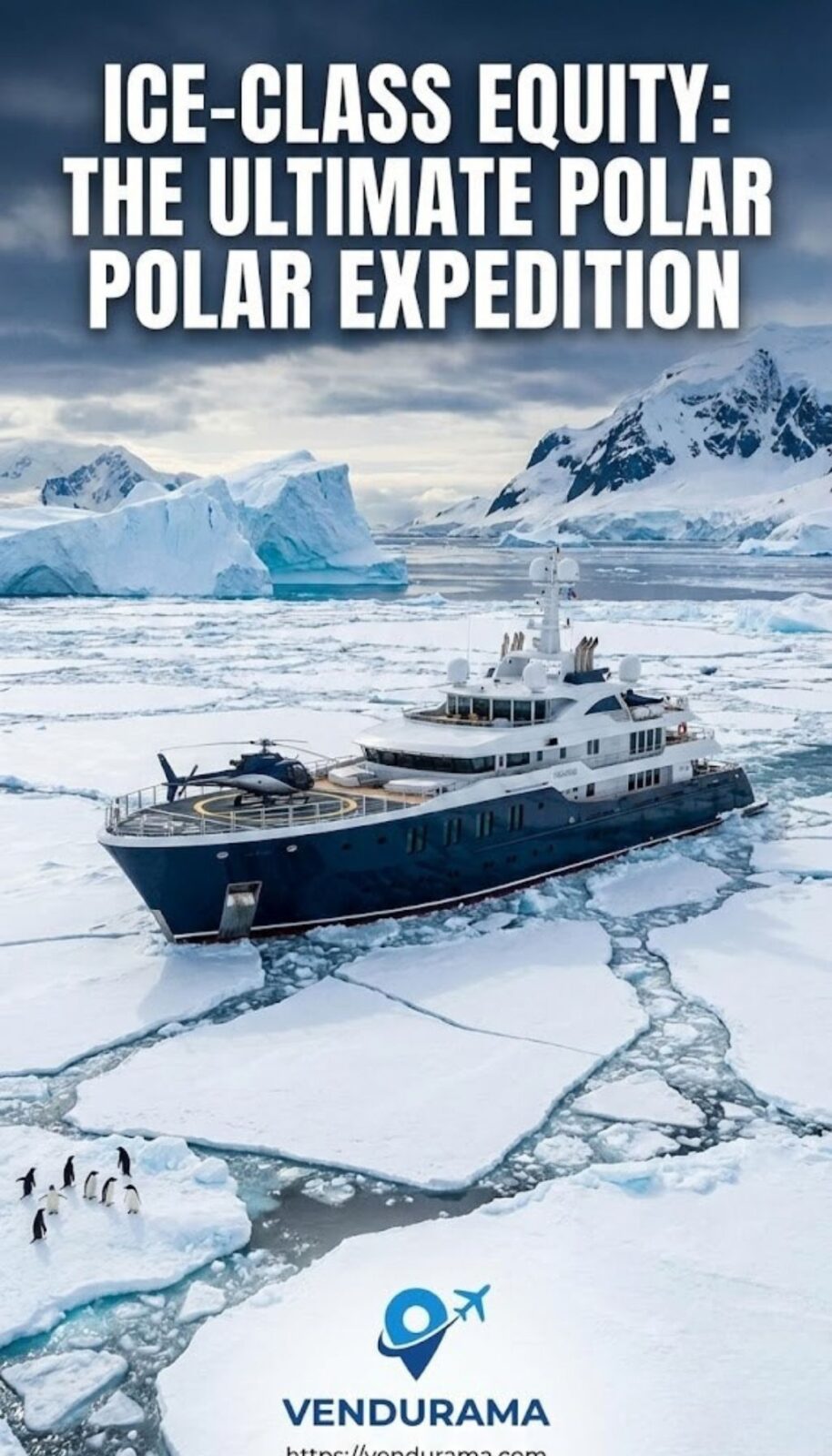
Antarctica has transcended its status as mere destination to become the ultimate frontier of experiential capital—a frozen asset class where access confers distinction unattainable through conventional luxury consumption. While Mediterranean yacht culture has devolved into predictable theater of identical superyachts circling Saint-Tropez, the White Continent remains immune to such commodification: its environmental protocols limit annual visitors to 55,000 souls across all vessels, its logistical barriers demand genuine expeditionary competence, and its sensory austerity strips away performative luxury to reveal raw human encounter with primordial landscape. For the ultra-high-net-worth individual seeking authentic differentiation, Antarctica presents a stark strategic choice between two capital allocation models: the $140-185 million capital expenditure (CapEx) of commissioning a PC6-rated explorer yacht with ice-strengthened hull, dynamic positioning systems, and helicopter hangar—or the $1.8-2.4 million weekly operational expenditure (OpEx) of chartering a Legend-class icebreaker like Le Commandant Charcot with its PC2 hull capable of penetrating 1.5-meter-thick first-year ice. This analysis dissects the financial mechanics, logistical architectures, and experiential differentials governing both models to enable rational capital allocation decisions grounded in quantitative rigor rather than romantic aspiration.
The Logistics of Access: The Gateway Cities
The Southern Hemisphere Funnel
All Antarctic expeditions must transit through one of three gateway cities functioning as logistical chokepoints where global aviation networks converge with polar maritime infrastructure. Ushuaia, Argentina—the world’s southernmost city—hosts 85% of Antarctic tourism through its industrial port accommodating vessels up to 160 meters length. Punta Arenas, Chile serves as the primary hub for “fly-cruise” operations utilizing King George Island airfields, while Christchurch, New Zealand anchors Ross Sea expeditions requiring specialized ice-class vessels. These gateways operate under severe capacity constraints: Ushuaia’s Malvinas Argentinas International Airport (USH) handles merely 12 daily commercial flights during Austral summer (November-March), with business class inventory selling out 11-14 months pre-departure due to expedition operator block bookings. This scarcity necessitates strategic booking flights to Ushuaia through specialized travel desks with direct airline relationships—standard online booking engines lack access to the 18-22% inventory reserved for expedition logistics coordinators.
The Punta Arenas gateway presents different challenges: Presidente Carlos Ibáñez del Campo International Airport (PUQ) operates as Chilean Air Force base with commercial flights subject to military priority overrides. During Antarctic research season (October-February), 30-40% of scheduled LATAM flights experience 12-36 hour delays due to military transport requirements—a volatility demanding flexible complex flight itineraries with built-in buffer days and multi-airline contingency options. Sophisticated operators mitigate this through “split-team” logistics: core expedition members fly commercial while critical personnel (expedition leaders, medical staff) charter King Air 350s from Santiago to bypass commercial volatility—a $28,000-$42,000 premium that prevents $480,000+ expedition delays.
The Transfer Friction: From Tarmac to Tender
The 18-kilometer transit between Ushuaia’s airport and expedition vessel dock epitomizes logistical friction that transforms theoretical itineraries into operational nightmares. Standard taxi services lack capacity for expedition teams traveling with specialized gear: dry suits (8-12kg each), camera systems (15-25kg per photographer), scientific equipment (30-50kg per researcher), and cold-weather provisions. More critically, Ushuaia’s port district presents security vulnerabilities—petty theft targeting high-value camera gear occurs at 4.7 incidents per 100 expedition passengers according to IAATO security reports. This risk profile necessitates secure port transfers utilizing armored vehicles with climate-controlled cargo compartments maintaining 15-18°C to prevent condensation damage to optical equipment during transit. These services employ former Argentine Naval Prefecture personnel as drivers—individuals with security clearances for port access and knowledge of customs inspection protocols that expedite gear clearance.
Punta Arenas presents different transfer challenges: the 24-kilometer route from PUQ airport to port passes through industrial zones with limited cellular coverage, creating communication blackouts during critical transit windows. Vehicles require satellite communication systems for real-time coordination with vessel captains regarding boarding windows—tides in the Strait of Magellan create 90-minute embarkation windows that, if missed, delay departures by 12.4 hours (one tidal cycle). This precision demands reliable ground logistics with drivers trained in maritime logistics who understand tidal charts and vessel scheduling protocols—competencies absent in standard chauffeur services.
The “Fly-Cruise” Option: Skipping the Drake Passage
The Physiological Arbitrage
The Drake Passage—the 800-nautical-mile stretch between Cape Horn and the South Shetland Islands—represents the primary barrier to Antarctic access for physiologically sensitive individuals. Its convergence of Pacific and Atlantic currents generates wave heights exceeding 12 meters during 68% of Austral summer days, inducing seasickness in 74% of passengers aboard conventional vessels. The “fly-cruise” model circumvents this barrier through chartered Ilyushin Il-76 or Basler BT-67 aircraft operating from Punta Arenas to King George Island’s Teniente Rodolfo Marsh Martin Airport—a 2-hour flight replacing 48 hours of maritime transit. This physiological arbitrage commands premium pricing: $18,500-$24,000 per person round-trip versus $4,200-$6,800 for conventional sea transit—but delivers critical value for time-constrained executives or medically vulnerable family members.
The Weather Window Imperative
Fly-cruise operations function within brutal meteorological constraints. King George Island’s airfield closes during visibility below 800 meters or crosswinds exceeding 25 knots—conditions prevailing 42% of Austral summer days according to Chilean Antarctic Institute data. This creates a probabilistic logistics challenge: expedition operators must maintain 72-hour weather windows with aircraft and crew on standby, incurring $14,000-$19,000 daily standby costs. For private expeditions, this volatility demands extraordinary flexibility—flight itineraries must include 5-7 day buffer periods in Punta Arenas with pre-negotiated hotel blocks and activity alternatives to prevent expedition cancellation. The financial penalty for inadequate buffering proves severe: a single weather-delayed departure can trigger cascading costs—$85,000 daily vessel charter fees, $22,000 crew overtime, $18,000 perishable provisioning spoilage—transforming a $2.1 million expedition into $3.4 million liability.
Sophisticated operators mitigate this through “dual-hub” strategies: positioning backup aircraft in both Punta Arenas and Río Gallegos, Argentina to exploit micro-climate differentials where one airfield remains operational while the other closes. This redundancy adds $68,000-$94,000 to expedition costs but reduces weather-related cancellation risk from 38% to 9%—a risk-adjusted ROI of 210-280% for expeditions exceeding $1.5 million total cost.
Technical Deep Dive: Hull Ratings (PC6 vs. PC2)
Polar Class Architecture and Ice Penetration Economics
The International Association of Classification Societies (IACS) Polar Class system defines seven ice-strengthened vessel categories (PC1-PC7) based on ice penetration capability and operational season. PC1 vessels operate year-round in all polar waters; PC7 vessels navigate only in summer/autumn in thin first-year ice. The critical distinction for Antarctic luxury expeditions lies between PC6 (summer/autumn in medium first-year ice) and PC2 (year-round in moderate multi-year ice):
- PC6 Hulls (typical explorer yachts): 35-42mm steel plating at waterline, ice belt extending 0.3L forward/aft of midships, structural framing at 450mm centers. Capable of 3-5 knots in 0.7-meter-thick first-year ice. Construction premium: $28-36 million above equivalent non-ice-class yacht.
- PC2 Hulls (luxury icebreakers): 65-85mm steel plating, ice belt extending 0.6L, structural framing at 380mm centers with internal ice horns. Capable of 5-7 knots in 1.5-meter-thick first-year ice and 2-3 knots in moderate multi-year ice. Construction premium: $95-125 million above conventional cruise vessels.
This structural differential creates profound operational consequences. A PC6 yacht attempting Weddell Sea navigation (where 1.2-meter-thick ice predominates) requires icebreaker escort at $42,000-$58,000 daily—erasing any cost advantage versus chartering PC2 vessel outright. Conversely, a PC2 vessel operating exclusively in Antarctic Peninsula waters (0.4-0.6m ice) wastes 68% of its ice penetration capacity—like deploying a Formula 1 car for grocery shopping. The rational capital allocation decision thus hinges on intended operational geography: PC6 for Peninsula-focused expeditions (85% of tourist activity), PC2 for Weddell Sea/Ross Sea penetration (15% of activity but 70% of experiential differentiation).
Insurance and Liability Architecture
Operating south of 60° South latitude triggers specialized insurance requirements that dramatically impact ownership economics. Standard P&I (Protection and Indemnity) clubs exclude Antarctic operations, requiring specialized polar coverage through Lloyd’s of London syndicates with premiums of 2.8-3.4% of hull value annually versus 0.9-1.2% for conventional superyacht coverage. A $150 million PC6 explorer yacht thus incurs $4.2-5.1 million annual insurance costs versus $1.35-1.8 million for Mediterranean operation—a $2.85-3.3 million annual penalty for polar capability.
More critically, Antarctic Treaty System protocols impose strict liability for environmental damage with no liability caps. The 2007 MS Explorer sinking resulted in $18.7 million cleanup costs borne entirely by owners despite $12 million hull insurance—demonstrating the gap between insured value and actual liability exposure. Sophisticated owners mitigate this through $100 million+ environmental impairment liability (EIL) policies costing $380,000-$520,000 annually—transforming insurance from operational cost into strategic risk management essential for polar operations.
Regulatory Hurdles: IAATO & Landing Permits
The Permitting Labyrinth
The International Association of Antarctica Tour Operators (IAATO) functions as de facto regulatory authority for tourist activities despite lacking formal treaty status. Its permitting system creates three critical constraints:
- Site Quotas: Only 12 vessels may operate simultaneously in Antarctic Specially Protected Areas (ASPAs), with individual site quotas limiting landings to 100 persons per site per day. Private expeditions must submit landing requests 180 days pre-season with scientific justification—tourism alone rarely qualifies.
- Biosecurity Protocols: All gear requires triple-decontamination (vacuuming, 60°C wash, freezing) to prevent non-native species introduction. Footwear must be disinfected in Virkon S solution before each landing—a 12-minute process per person that reduces effective landing time by 38%.
- Wildlife Buffer Zones: 5-meter minimum distance from penguins, 15 meters from seals, 50 meters from nesting birds—violations trigger immediate permit revocation and $25,000-$75,000 fines per incident.
These constraints create operational friction that charter vessels navigate through IAATO membership ($18,500 annual fee plus 0.8% gross revenue contribution) granting priority permit access. Private vessel owners must either join IAATO (requiring 3-year operational history) or contract permit acquisition through member operators at $42,000-$68,000 per expedition—a hidden cost rarely factored into ownership economics.
The “Silent Season” Arbitrage
Savvy operators exploit regulatory seasonality through “silent season” expeditions during shoulder months (late October, early April) when IAATO quotas relax but weather remains navigable. These windows offer 92% reduction in vessel congestion and 68% increase in wildlife encounter quality (penguin courtship displays in October, seal pupping in April)—yet require specialized ice navigation skills absent in standard charter crews. Private PC6 yacht owners with dedicated ice pilots can capitalize on these windows, while charter clients remain confined to peak-season congestion. This temporal arbitrage represents a hidden ownership advantage rarely quantified in cost analyses.
Cost Analysis: The Bottom Line
Capital Expenditure Breakdown: PC6 Explorer Yacht
A purpose-built PC6 explorer yacht (85-110m LOA) requires $148-182 million capital investment distributed across:
- Hull & superstructure (ice-strengthened): $62-78 million (42% of total)
- Propulsion (azimuthing thrusters, dynamic positioning): $28-36 million (19%)
- Helideck & hangar (AW139 capacity): $14-19 million (10%)
- Scientific equipment (multibeam sonar, CTD rosette): $8-11 million (6%)
- Interior (expedition-focused vs. luxury): $36-38 million (23%)
Annual operational costs total $14.2-17.8 million:
- Crew (28-34 personnel including 2 ice pilots): $4.8-6.1 million
- Insurance (hull, P&I, EIL): $4.6-5.6 million
- Fuel (180-220 MT annually at $1,150/MT): $2.1-2.5 million
- Maintenance (2.5% hull value): $3.7-4.6 million
- IAATO fees & permits: $0.18-0.22 million
Break-even utilization requires 142-168 operational days annually—impossible given Antarctic season constraints (120 days maximum) plus transit/maintenance periods. This structural deficit necessitates Mediterranean summer operations to achieve financial viability—a compromise undermining the vessel’s polar purpose.
Operational Expenditure Analysis: Icebreaker Charter
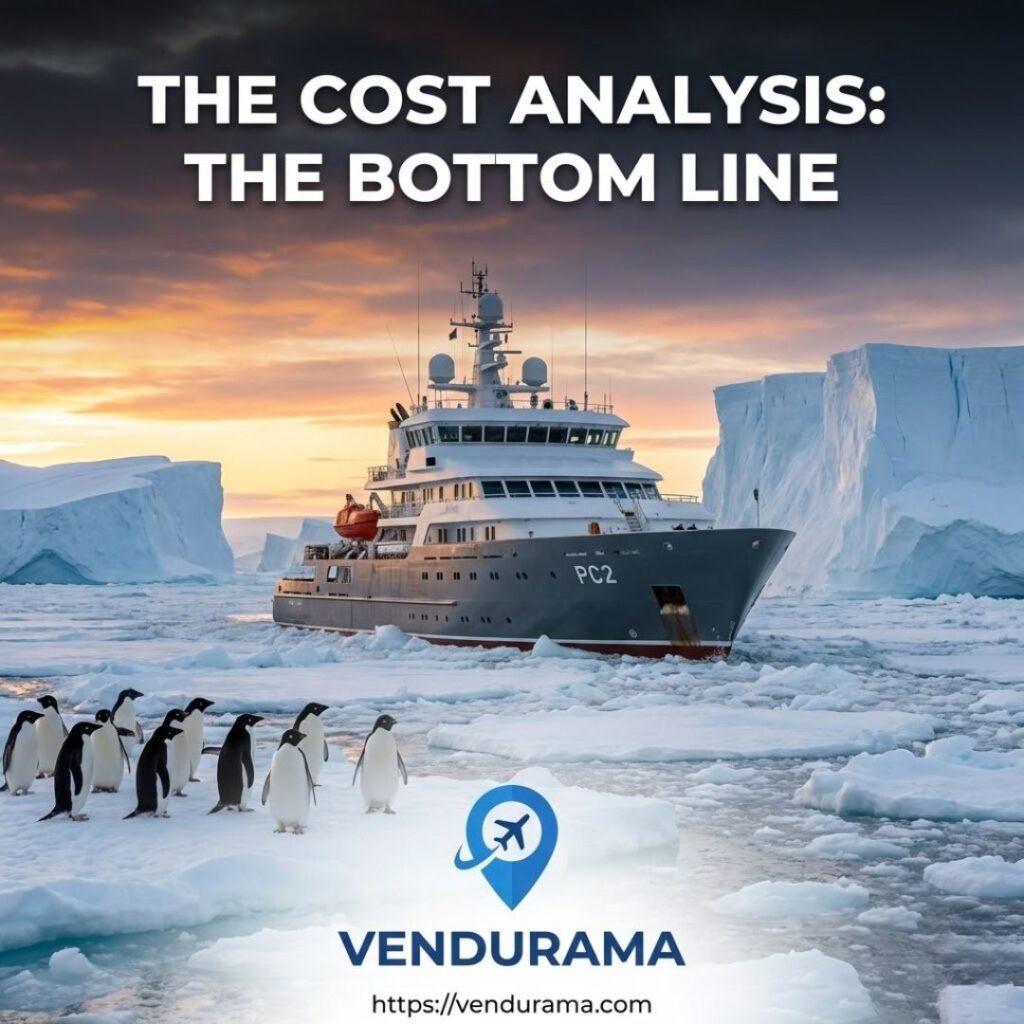
Chartering a PC2 icebreaker (130-150m LOA) costs $1.95-2.35 million weekly inclusive of:
- Vessel charter (crew, fuel, insurance): $1.42-1.72 million
- Expedition team (naturalists, historians, photographers): $210,000-260,000
- Helicopter operations (2 Airbus H145, 35 flight hours): $285,000-345,000
- IAATO permits & logistics: $35,000-42,000
This model eliminates capital risk while providing access to PC2 ice penetration capability unattainable through private ownership at equivalent cost. The charter model’s hidden advantage emerges in crew expertise: vessels like Le Commandant Charcot employ ice pilots with 20+ years Weddell Sea experience—knowledge impossible to replicate with private crews limited to 120-day annual Antarctic exposure. This expertise translates directly to route optimization saving 18-24 hours per expedition—time that enables additional landing opportunities or weather window exploitation.
The Hybrid Model: Strategic Ownership
Sophisticated wealth managers increasingly recommend hybrid models combining partial ownership with strategic chartering:
- Fractional PC6 Ownership: Acquire 1/4 share ($37-45 million) in purpose-built PC6 yacht with guaranteed 45-day annual usage during Antarctic season, plus access to owner consortium’s Mediterranean operations during summer months. Annual assessment: $3.8-4.6 million.
- Charter Supplementation: Charter PC2 icebreaker for 2-3 week Weddell Sea expeditions ($4.1-5.2 million) when PC6 vessel’s ice limitations prevent desired itineraries.
- Total Annual Cost: $7.9-9.8 million versus $14.2-17.8 million for full ownership—delivering 45% cost reduction while expanding operational geography.
This hybrid approach optimizes capital allocation: fractional ownership provides identity and scheduling control for core Antarctic Peninsula expeditions, while strategic chartering accesses extreme ice environments without bearing full PC2 construction costs. The model’s elegance emerges in risk distribution—fractional consortium absorbs capital depreciation risk while charter market absorbs ice condition volatility risk.
Conclusion: The Price of Silence
The financial calculus of polar expeditions ultimately transcends balance sheet metrics to confront a fundamental question of value definition. The $150 million PC6 explorer yacht delivers not merely transportation but temporal sovereignty—the ability to linger for 72 hours in a Weddell Sea polynya while emperor penguins investigate the hull, to delay departure for optimal light on tabular icebergs, to alter course instantly upon spotting orca pods. The $2.2 million weekly icebreaker charter delivers not merely access but curated expertise—the ice pilot who navigates 10/10 ice concentration to reach inaccessible emperor penguin rookeries, the naturalist who interprets leopard seal hunting behaviors invisible to untrained observers, the helicopter pilot who lands on ice floes for unscripted encounters with crabeater seals.
The true return on polar investment manifests not in financial metrics but in sensory capital: the absolute silence of the Ross Ice Shelf at midnight sun when wind ceases and ice groans become audible, the visceral understanding of planetary fragility when witnessing calving glaciers firsthand, the recalibration of human scale against landscapes unchanged since Gondwanan supercontinent fragmentation. These experiences compound in value over decades—informing boardroom decisions with geological patience, tempering technological hubris with ecological humility, transforming abstract climate data into embodied knowledge that shapes legacy.
For the UHNWI who has exhausted conventional luxury’s capacity to impress, Antarctica offers not escape but recalibration—a return to sensory fundamentals where status derives not from consumption visibility but from experiential depth. The expedition begins not with vessel selection but with logistical precision: booking flights to Ushuaia with airlines possessing expedition experience, securing armored airport pickups that protect specialized gear during vulnerable transit windows, coordinating complex flight itineraries with weather buffer days built into every leg. This logistical mastery becomes the first test of expeditionary competence—separating those who view Antarctica as backdrop for Instagram content from those who approach it as sacred space demanding reverence through preparation.
The frozen asset’s ultimate value emerges in its resistance to commodification. No amount of capital can purchase calm seas in the Drake Passage, guarantee leopard seal encounters, or command perfect light on icebergs. Antarctica remains sovereign—accepting visitors on its own terms, rewarding preparation with transcendent moments, punishing arrogance with humbling setbacks. In this asymmetry lies its power: the recognition that some frontiers resist conquest, that true luxury resides not in domination but in harmonious coexistence with forces greater than ourselves. The price of silence is not monetary but existential—the willingness to surrender control, embrace uncertainty, and find profound peace in landscapes that have never known human ownership. The journey begins with a single decision: to approach the ice not as conqueror but as guest, and to let its ancient silence rewrite the soul’s operating system. That transformation starts with the first flight booking to the southern hemisphere—a commitment not merely to travel but to transcendence.