
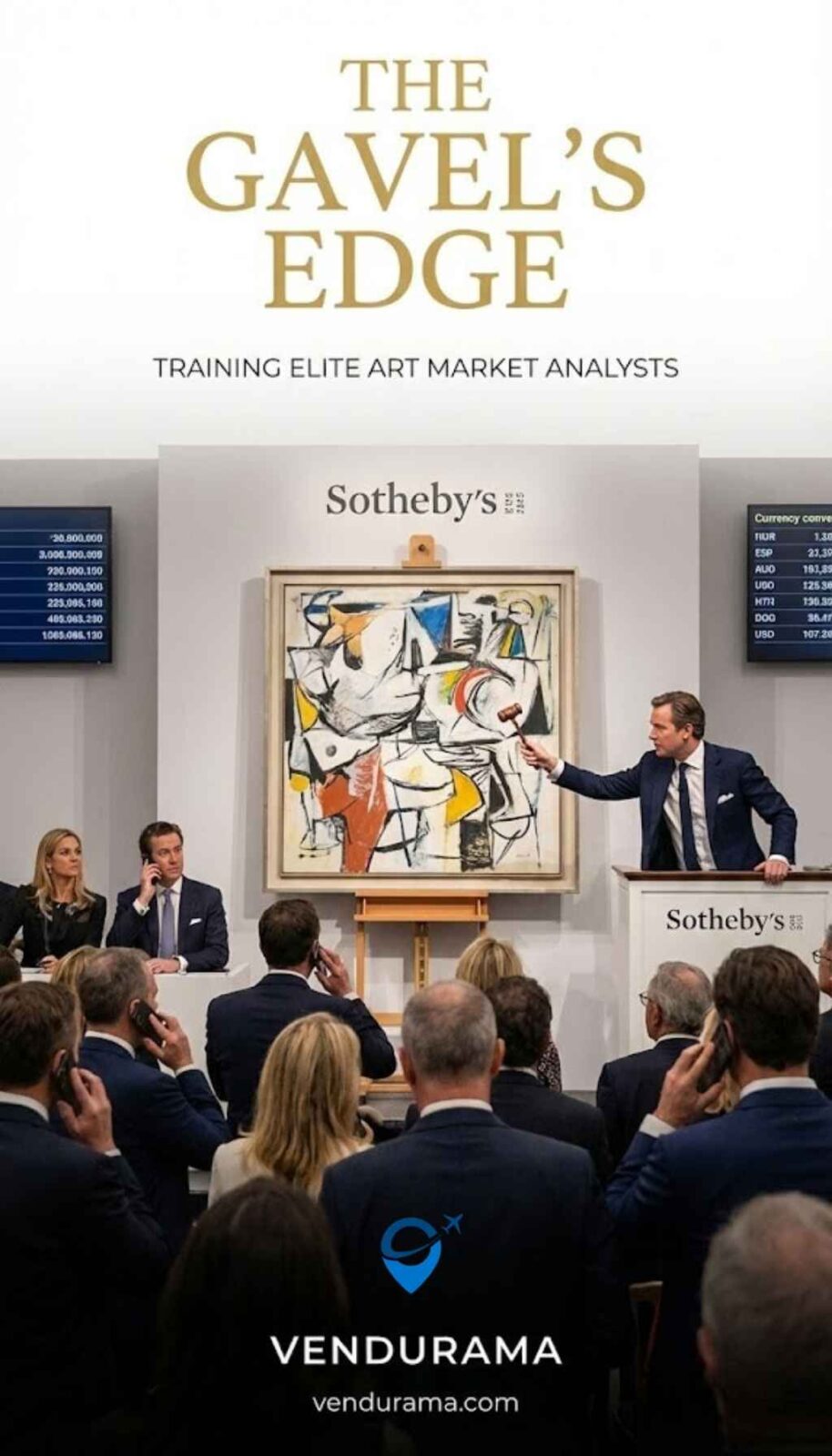
Introduction: The Billion-Dollar Classroom
The contemporary art market has evolved beyond aesthetic appreciation into a sophisticated financial ecosystem where a single canvas can function simultaneously as cultural artifact, inflation hedge, and status signifier. Within this $67.8 billion global marketplace, two institutions stand as the undisputed academies of connoisseurship and commerce: Sotheby’s Institute of Art and Christie’s Education. These are not mere degree-granting bodies but the essential gatekeepers to an industry where trust, expertise, and access determine who may participate at the highest levels. Their London, New York, and specialized campus programs function as the Harvard and Yale of art market education—places where future auctioneers, private dealers, and family office art advisors learn not just to identify a genuine Rothko but to navigate the complex triangulation between provenance, market sentiment, and collector psychology that determines whether that Rothko sells for $30 million or $80 million.
What distinguishes these programs from conventional art history degrees is their unapologetic focus on the commercial mechanics underpinning aesthetic value. Students don’t merely study brushstrokes; they master the actuarial mathematics of art valuation, the geopolitical nuances of cultural patrimony laws, and the psychological choreography of the auction room. This education demands global immersion—students must witness the Venice Biennale’s curatorial discourse while simultaneously analyzing its impact on secondary market prices, attend Art Basel’s VIP previews with an eye toward inventory acquisition strategies, and understand how TEFAF Maastricht’s vetting standards create pricing premiums. Such an education necessitates sophisticated international travel planning as an extension of pedagogy itself, where the journey between art capitals becomes as instructive as the classroom hours.
The Titans Compared: DNA of the Institutes
Sotheby’s Institute of Art: The Academic Architect
Sotheby’s Institute, with its flagship campus occupying a Georgian townhouse on London’s Bedford Square and its New York presence near Rockefeller Center, has cultivated an identity centered on academic rigor fused with commercial pragmatism. Its Master’s in Art Business represents the gold standard for those seeking to understand art as an asset class—courses dissect everything from art-secured lending structures to the tax implications of cross-border acquisitions. The curriculum’s distinctive strength lies in its systems-thinking approach: students learn to model how a single major auction result ripples through insurance valuations, museum acquisition budgets, and even cryptocurrency-backed art funds.
The Institute’s pedagogical philosophy emphasizes contextual intelligence over pure connoisseurship. While students certainly develop the ability to distinguish a genuine Giacometti bronze from a sophisticated cast, they simultaneously analyze how the artist’s market has been shaped by strategic gallery representation, museum retrospectives, and collector concentration. This dual focus produces graduates who function as market architects—individuals capable of designing collection strategies that appreciate not merely through aesthetic merit but through calculated market positioning. The Institute’s location in London’s Fitzrovia district places students within walking distance of Mayfair’s gallery nexus, allowing theoretical frameworks to be stress-tested against real-time market dynamics—a proximity that proves invaluable when securing ground transport between campus and gallery appointments during critical market weeks.
Christie’s Education: The Object-Centric Apprentice
Christie’s Education operates with a fundamentally different epistemology—one rooted in the primacy of the physical object. Where Sotheby’s emphasizes market systems, Christie’s immerses students in material culture through direct, tactile engagement with artworks. Its London program, housed near King’s Cross, leverages unparalleled access to Christie’s auction house operations: students don’t just study condition reporting—they conduct hands-on examinations of works in the saleroom under master specialist supervision. This object-based learning extends to conservation studios where students witness the delicate science of canvas lining and pigment stabilization firsthand.
The program’s distinctive value emerges during auction week, when students transition from observers to participants—assisting with cataloging, condition checking, and even serving as bid spotters during live sales. This apprenticeship model creates an intuitive understanding of auction mechanics that cannot be replicated through case studies alone. Students learn to read the subtle choreography of the auction room: how a specialist’s eye contact with a telephone bidder can extend bidding by three increments, how the rhythm of the hammer fall influences buyer psychology, and why certain works are strategically positioned within the sale sequence. For international students arriving with specialized equipment and fragile portfolios, arranging secure airport pickups becomes not merely logistical convenience but a necessary safeguard for valuable academic materials during their critical first days in London.
The Curriculum: What They Actually Teach
Valuation & Appraisal: The Science Behind Subjectivity
Beneath the art world’s romantic veneer lies a rigorous analytical discipline governing valuation. Students at both institutes master three distinct valuation methodologies that operate in parallel: comparable market analysis (tracking auction results for similar works), replacement cost valuation (calculating what it would cost to commission an equivalent work today), and intrinsic value assessment (evaluating historical significance, exhibition history, and scholarly attention). The sophistication emerges in understanding when each methodology dominates—contemporary art pricing leans heavily on comparable analysis and market momentum, while Old Masters valuation incorporates extensive provenance research and condition science.
Students learn to deconstruct a painting’s price into its constituent value drivers: the artist premium (40-60% of value), subject matter premium (religious scenes versus landscapes in certain periods), provenance premium (ownership by notable collectors adding 15-35%), and condition discount (damage potentially reducing value by 50-90%). This granular understanding transforms appraisal from guesswork into a defensible analytical practice—one where a $5 million estimate carries the same methodological rigor as a Wall Street equity valuation. When students travel to Paris for specialized Old Masters research trips, they must coordinate complex flight itineraries that align with museum archive access schedules and specialist availability—a logistical challenge demanding precision equal to their analytical work.
Art Law & Restitution: Navigating Ethical Minefields
The contemporary art market operates within an increasingly complex legal framework where a single acquisition can trigger international disputes spanning decades. Students master the intricate web of regulations governing cultural property: UNESCO conventions restricting antiquities trade, national patrimony laws claiming state ownership of certain artworks, and the evolving landscape of Holocaust-era restitution claims. The curriculum addresses not merely legal compliance but ethical risk management—teaching students to conduct provenance research with forensic thoroughness, identifying red flags in ownership histories that might surface years after acquisition.
This legal literacy proves particularly crucial when advising ultra-high-net-worth collectors whose acquisitions may face scrutiny from multiple jurisdictions simultaneously. Students learn to navigate export license requirements that vary dramatically by country—France’s stringent cultural heritage protections versus Switzerland’s relatively permissive framework—and understand how freeport storage in Luxembourg or Singapore creates both logistical advantages and regulatory complications. The practical application emerges during field research when students must arrange reliable transfers between national archives and private collections while maintaining chain-of-custody documentation for research materials—a microcosm of the logistical precision required in high-stakes art transactions.
Logistics & Storage: The Invisible Infrastructure
Beneath every public auction lies a sophisticated logistics ecosystem that students must master to operate professionally. The curriculum covers fine art shipping protocols—climate-controlled transport requirements that maintain 50-55% relative humidity and 18-22°C temperatures regardless of external conditions, specialized crating techniques for fragile media, and the insurance implications of different transit methods. Students learn why a $20 million sculpture might travel by dedicated cargo jet rather than commercial air freight, and how customs brokers specializing in cultural property navigate complex import/export declarations.
The freeport phenomenon receives particular attention—students analyze how Luxembourg’s and Singapore’s freeport facilities function as tax-deferred storage ecosystems where artworks may reside for years without clearing customs, creating both financial advantages and market opacity. This infrastructure knowledge proves essential when graduates manage collections requiring frequent rotation between storage, exhibition, and loan venues—a reality demanding constant travel coordination to oversee condition checks and installation supervision across global locations.
The “Grand Tour”: Field Trips & Global Mobility

The European Circuit: Education Through Immersion
The pedagogical philosophy of both institutes recognizes that art market education cannot be confined to classrooms—students must experience the industry’s seasonal rhythms firsthand. The academic calendar synchronizes precisely with the art world’s ritual calendar: February for TEFAF Maastricht’s vetting intensity, May-June for the New York and London auction seasons, September for Frieze London’s contemporary focus, and November-December for Miami Art Week’s market spectacle. These field trips are not optional excursions but graded components requiring students to produce market analysis reports based on direct observation.
The logistical complexity of these immersions cannot be overstated. A single week might require students to travel from London to Maastricht for TEFAF’s opening days, then to Basel for the fair’s VIP launch, followed by Venice for the Biennale’s curated exhibitions—all while maintaining academic obligations. This compressed itinerary demands sophisticated planning: securing last-minute hotel inventory near fairgrounds, navigating European rail networks with heavy research materials, and timing arrivals to coincide with exclusive preview hours when market intelligence flows most freely. Savvy students leverage platforms for planning complex itineraries that account not merely for flight connections but for customs processing times, baggage transfer logistics, and the critical window between landing and fair admission.
The Arrival Protocol: First Impressions in Foreign Capitals
Arriving in Maastricht or Venice during fair week presents unique challenges that test a student’s professional mettle. Airports operate at maximum capacity with private jets dominating tarmacs, taxi queues stretching for hours, and navigation complicated by unfamiliar road systems. For students carrying valuable research equipment—high-resolution cameras for documentation, specialized lighting for condition assessment, fragile reference materials—the transition from aircraft to fairground requires seamless execution. A single mishandled transfer resulting in damaged equipment could compromise an entire research project and graded assignment.
This reality has made pre-arranged reliable ground transfers not merely a convenience but an academic necessity. Students who arrive at TEFAF’s entrance with equipment intact, having avoided the stress of navigation and baggage handling, begin their market analysis with cognitive resources fully allocated to observation rather than logistical recovery. The psychological advantage proves equally significant: stepping from a professional vehicle directly into the fair’s hushed, carpeted halls establishes an immediate mindset of professional engagement rather than tourist observation—a subtle but critical distinction that shapes the quality of market intelligence gathered.
Student Life & Relocation Logistics
The Transatlantic Transition: Establishing a New Base
Relocating to London’s Bedford Square or New York’s Rockefeller Center represents more than a change of address—it signifies entry into the art world’s nerve centers. For international students, this transition demands navigating complex housing markets where short-term leases near campus command premium rates, understanding local banking requirements for international students, and establishing the professional networks that will sustain careers long after graduation. The initial weeks prove particularly challenging as students balance orientation requirements with the urgent need to secure accommodation before the market tightens.
The arrival moment carries disproportionate significance. Stepping off a transatlantic flight burdened with art books, specialized equipment, and the psychological weight of a $60,000 educational investment requires a transition that preserves both physical materials and mental equilibrium. Students who arrange secure airport pickups in advance transform this vulnerable moment into a seamless entry ritual—allowing them to process their new environment with presence rather than preoccupation. This logistical foresight proves particularly valuable when arriving during London’s unpredictable weather or New York’s chaotic traffic patterns, where exposure to elements could damage valuable research materials.
The Weekend Research Imperative
The academic intensity of these programs extends beyond scheduled classes into self-directed research that often requires weekend travel to secondary markets and specialized collections. A student focusing on Dutch Golden Age painting might spend Saturday in The Hague studying works at the Mauritshuis, while a contemporary specialist might travel to Berlin to visit emerging galleries in Mitte. These research excursions demand efficient flight booking tools that identify affordable same-day return options or economical overnight stays that maximize research time while minimizing costs.
This weekend mobility creates a distinctive student culture—one where conversations in campus cafés revolve not around party plans but around the merits of different European rail passes versus budget airlines for research travel, or strategies for accessing private collections through alumni networks. The most successful students develop what might be termed “logistical intelligence”—the ability to orchestrate complex multi-city research itineraries that yield maximum market intelligence per hour invested. This skill proves directly transferable to professional roles where art advisors must coordinate global viewing trips for clients with limited availability.
Career Trajectories: The ROI of a $60,000 Master’s Degree
The Specialist Pathway: Deep Expertise as Competitive Advantage
Graduates entering auction house specialist roles follow a carefully structured progression that leverages their institute training. Starting as cataloguers or junior specialists, they gradually assume responsibility for specific categories—perhaps Impressionist paintings or post-war sculpture—building connoisseurship through direct handling of thousands of objects. The institutes’ training proves particularly valuable in the critical transition from junior to senior specialist, when individuals must begin cultivating their own collector networks and developing sale strategies that maximize both hammer prices and seller satisfaction.
This career path demands constant global mobility. Senior specialists regularly travel to Hong Kong for Asian market development, Dubai for Middle Eastern collector cultivation, and Los Angeles for West Coast client servicing—a rhythm requiring sophisticated travel coordination that balances commercial imperatives with personal sustainability. The most successful specialists develop logistical systems that transform travel from disruptive necessity into strategic advantage—using transit time for research, structuring itineraries to maximize face time with key collectors, and leveraging location data to anticipate market shifts before competitors.
The Art Advisor Model: Managing Ultra-High-Net-Worth Collections
For graduates entering private art advisory, the institutes’ training provides the credibility required to counsel clients with nine-figure collection budgets. These advisors function as fiduciaries—conducting due diligence on potential acquisitions, developing collection strategies aligned with client values and financial objectives, and navigating the complex interpersonal dynamics of family collections spanning generations. The compensation model reflects this responsibility: top advisors earn 3-5% on acquisitions plus annual retainer fees ranging from $150,000 to $500,000 for comprehensive collection management.
This role demands extraordinary logistical sophistication. Advisors might simultaneously coordinate a client’s acquisition of a $12 million sculpture in Basel, oversee conservation treatment of a Renaissance painting in Florence, and negotiate a private sale of contemporary works in New York—all while maintaining discretion that protects client privacy. This operational complexity necessitates mastery of global flight logistics that enable rapid response to time-sensitive opportunities while maintaining the appearance of effortless execution that ultra-high-net-worth clients expect.
Networking: The “Black Book”
The Cohort Effect: Future Market Makers
Perhaps the institutes’ most valuable asset lies not in their curricula but in their student bodies—cohorts comprising heirs to collecting dynasties, scions of auction house families, and exceptionally talented individuals from diverse backgrounds who will shape the art market’s next generation. The social architecture of these programs intentionally fosters deep connections: shared field trips to art fairs create bonding experiences under pressure, studio visits to artists’ studios generate shared aesthetic revelations, and late-night study sessions in campus libraries forge intellectual trust.
These relationships evolve into what industry insiders term the “black book”—an informal network of trusted colleagues who provide market intelligence, facilitate introductions, and offer discreet advice on sensitive transactions. When a graduate needs to discreetly place a major collection, their first call isn’t to a database but to a former classmate now heading a private sales department. When a new gallery seeks credible early collectors for an emerging artist, they consult alumni networks rather than cold-calling potential buyers. This network effect compounds over decades, transforming the initial $60,000 educational investment into a lifetime of professional advantage.
The Alumni Advantage: Institutional Memory as Currency
Both institutes maintain robust alumni networks that function as informal market intelligence systems. Graduates occupying senior positions at major auction houses, museums, and private collections share insights through alumni events, creating information flows that benefit recent graduates entering the field. This institutional memory proves particularly valuable during market transitions—when new regulations emerge, technological disruptions occur, or generational collecting preferences shift—allowing alumni to navigate uncertainty with guidance from those who have weathered previous market cycles.
The logistical dimension of maintaining these networks requires its own sophistication. Alumni gatherings in New York during November auctions or London during June sales demand coordination of premium ground transportation that accommodates the schedules of time-pressed professionals while preserving the intimacy essential for meaningful connection. These gatherings function not as nostalgic reunions but as vital market intelligence exchanges where information shared might influence eight-figure transactions.
Conclusion: The Final Hammer Price
The question of whether these programs deliver adequate return on investment cannot be answered through conventional metrics alone. While graduates certainly achieve strong placement rates—85-90% securing art market positions within six months of graduation—and command starting salaries 30-40% above conventional art history graduates, the true value emerges over decades. The institutes provide something increasingly scarce in our accelerated culture: legitimate entry into a closed ecosystem where trust determines access and expertise commands premium compensation.
This legitimacy proves particularly valuable in an era of market democratization, where online platforms and social media have created the illusion of art market accessibility. While anyone can now bid on an artwork online, the ability to navigate complex private treaty sales, structure art-secured loans, or advise on cross-border collection transfers remains the domain of those with institutional training and network access. The institutes provide both—the analytical frameworks to understand art as asset and the social capital to operate within elite market segments.
For the aspiring collector’s child seeking to transform inherited passion into professional competence, for the finance professional seeking to pivot into a more meaningful vocation, for the art historian determined to bridge academic rigor with commercial relevance—these programs offer not merely education but transformation. They provide the vocabulary to speak with equal authority to museum curators and hedge fund managers, the confidence to handle a $50 million painting with the casual competence of a seasoned professional, and the network to convert expertise into opportunity.
The final hammer price on this education cannot be calculated in dollars alone. It is measured in the quiet authority of a specialist’s voice in a crowded auction room, in the trust of a collector entrusting a lifetime collection to a former student’s care, in the satisfaction of placing an important work with an institution where it will be preserved for future generations. In an industry where value is ultimately determined by human judgment rather than algorithmic calculation, these institutes produce the individuals whose judgment will shape the art market’s next chapter. And in that capacity, their value proves not merely substantial but essential.