Executive Summary: The Asset Class of the 21st Century
Conservation capitalism represents the maturation of impact investing into a sophisticated asset class where ecological stewardship and financial returns operate not as trade-offs but as mutually reinforcing value drivers. This paradigm transcends traditional philanthropy’s donor-recipient dynamic, establishing instead a self-sustaining economic ecosystem where wildlife preservation generates premium revenue streams, which in turn fund expanded conservation operations. For ultra-high-net-worth individuals and family offices seeking legacy investments that compound both financial and ecological value, privately owned safari reserves in Southern and East Africa have emerged as the definitive frontier—transforming the historical role of the “safari goer” into that of the “safari owner.” This transition carries profound implications: the investor no longer purchases a transient experience but acquires a living asset whose appreciation correlates directly with biodiversity metrics, community development outcomes, and exclusivity thresholds. In an era where tangible assets with intrinsic scarcity command premium valuations, land parcels containing viable populations of megafauna—particularly those with government-sanctioned exclusivity—represent perhaps the most defensible real estate positions on Earth. The financial mechanics have crystallized: Botswana’s concession model and Rwanda’s gorilla tourism framework have demonstrated that conservation can generate 12-18% annualized returns when operated with luxury hospitality discipline, while simultaneously appreciating land values at 8-12% annually as wildlife populations recover. This analysis dissects the operational architecture, financial engineering, and logistical imperatives required to deploy capital effectively within this emerging asset class.
Market Analysis: Why Botswana & Rwanda?
Botswana: The High-Value, Low-Volume Paradigm
Botswana’s dominance in the luxury safari sector stems from a deliberate policy architecture established in the 1990s that prioritizes ecological carrying capacity over tourist volume. The government’s concession model—leasing 180,000-hectare tracts within the Okavango Delta to private operators for 15-year renewable terms—creates artificial scarcity that functions as a value floor. With only 32 concessions allocated across the Delta’s 15,000km² permanent wetland system, and each concession permitted a maximum of 20 beds, the total bed capacity remains capped at approximately 640 units. This regulatory constraint, combined with the Delta’s UNESCO World Heritage status and seasonal flooding dynamics that naturally limit access, has created what economists term a “supply-inelastic luxury market”—where demand consistently outstrips supply regardless of price elasticity.
The financial implications are profound. Average daily rates (ADRs) for ultra-luxury lodges (Singita, Mombo Camp, Zarafa) now exceed $2,800 per person per night during peak season, with occupancy rates averaging 78-82% annually—significantly higher than the 65-70% typical of comparable luxury hospitality assets globally. This pricing power derives from three structural advantages: the Delta’s unique hydrological system creating year-round wildlife concentrations; the government’s prohibition on permanent structures (requiring all lodges to be dismantlable, thus preserving wilderness character); and the mandatory fly-in access that filters for high-net-worth clientele. Crucially, Botswana’s 2014 decision to ban commercial hunting while simultaneously expanding photographic tourism concessions demonstrated sophisticated understanding that live wildlife generates exponentially greater long-term value than trophy hunting—a policy shift that increased concession lease values by 300% within five years.
Rwanda: The Gorilla Premium and Strategic Scarcity
Rwanda’s model represents a more interventionist approach to conservation capitalism, where the state functions as both regulator and primary shareholder in the wildlife economy. The Volcanoes National Park’s mountain gorilla population—increasing from 680 individuals in 2008 to 1,063 in 2023—has become the cornerstone of a meticulously engineered luxury ecosystem. The government’s control mechanism is elegantly simple: limiting daily gorilla trekking permits to 96 (eight groups of eight visitors), pricing them at $1,500 per person, and requiring all visitors to stay in government-approved lodges within a 30-kilometer radius of the park entrance.
This artificial scarcity has created extraordinary value concentration. Lodges within the permit catchment zone—particularly Singita Kwitonda and One&Only Gorilla’s Nest—command ADRs exceeding $3,200 per night with 85%+ occupancy during gorilla trekking season (June-September, December-February). The economic calculus is revealing: at current permit pricing and lodge ADRs, a single habituated gorilla family generates approximately $4.7 million in annual tourism revenue. With 12 habituated families currently accessible to tourists, the gorilla economy contributes an estimated $56 million annually to Rwanda’s GDP—representing 3.2% of total tourism receipts from just 0.0004% of the country’s landmass.
Rwanda’s strategic genius lies in vertical integration: the Rwanda Development Board (RDB) controls permit allocation, lodge licensing, and even aviation infrastructure (the $132 million Bugesera International Airport expansion prioritizes direct connections from Dubai, Doha, and Istanbul). This state-directed ecosystem ensures that value capture remains concentrated within Rwanda’s borders rather than leaking to international tour operators—a stark contrast to Kenya’s historically fragmented safari economy. For investors, Rwanda offers a compelling proposition: partner with the state on lodge development within designated zones, accept the regulatory constraints, and participate in one of Africa’s most efficiently monetized conservation assets.
The Financial Mechanics: CapEx & OpEx Architecture
Capital Expenditure: The Remote Infrastructure Premium
Developing a luxury lodge within a Botswana concession or Rwandan national park buffer zone demands capital intensity far exceeding conventional hospitality projects. The remote location premium manifests across four critical infrastructure domains:
Energy Systems: Grid independence is non-negotiable. A 12-suite lodge requires a hybrid solar-diesel system comprising 140kW photovoltaic array (420 panels), 600kWh lithium-ion battery storage, and 100kVA backup generators—totaling $480,000-$620,000 in equipment costs plus $180,000 for installation in challenging terrain. This represents 3.5x the energy infrastructure cost of an equivalent urban property.
Water Management: Borehole drilling in the Okavango periphery averages $180-$220 per meter with 80-120 meter depths required to reach potable aquifers. Combined with multi-stage filtration (reverse osmosis, UV sterilization, mineral reconstitution) and greywater recycling systems, water infrastructure consumes $320,000-$410,000 of development capital—again, 4x conventional costs.
Sustainable Architecture: Botswana’s requirement for fully dismantlable structures necessitates specialized engineering. Elevated suites on steel pile foundations (to avoid concrete footings), thatched roofs requiring specialized artisans, and climate-responsive design (natural ventilation eliminating air conditioning needs) increase construction costs to $185,000-$240,000 per suite versus $95,000-$125,000 for standard luxury hospitality.
Aviation Infrastructure: Private airstrips require 1,200-meter compacted gravel runways with precision approach lighting—$380,000-$520,000 investment plus annual grading/maintenance of $45,000. For Rwanda properties, helicopter landing pads with GPS approach systems add $120,000-$180,000.
Total development cost for a 12-suite lodge thus ranges from $8.4 million to $11.2 million—translating to $700,000-$935,000 per bed. This capital intensity creates formidable barriers to entry that protect existing operators while ensuring only financially sophisticated investors participate.
Operational Expenditure: The Labor-Intensive Conservation Model
Safari lodge operations defy conventional hospitality labor ratios through their triple mandate: guest experience delivery, wildlife monitoring, and anti-poaching security. The staffing model operates on a 3:1 ratio—three staff members per guest—with compensation structures reflecting specialized skill sets:
Conservation Staff: Field guides command $4,200-$5,800 monthly (versus $1,800-$2,400 for urban hospitality managers) due to FGASA Level 3 certification requirements and risk exposure. Anti-poaching units require $3,100-$4,300 monthly plus specialized training in tracking, firearms handling, and wildlife law enforcement—adding $285,000-$395,000 annually for a 12-person unit.
Hospitality Staff: Butlers, chefs, and spa therapists receive $2,800-$4,100 monthly to offset remote location hardship premiums. The 36-person team required for 12 suites generates $1.38 million-$1.87 million in annual payroll.
Logistics & Fuel: Diesel consumption for generators, vehicles, and water pumps averages 4,200 liters monthly at $1.35/liter—$68,000 annually. Bush plane charters for staff rotations and emergency evacuations add $95,000-$140,000 yearly.
Total annual OpEx for a 12-suite lodge ranges from $2.1 million to $2.9 million—translating to $480-$660 per available bed night (PABN). This operational intensity necessitates ADRs exceeding $1,950 to achieve breakeven at 65% occupancy—a threshold consistently surpassed by premium operators.
ROI Trajectory and Value Appreciation
The financial model demonstrates compelling economics when executed with precision. At 78% average occupancy and $2,650 blended ADR, annual gross operating profit reaches $3.1 million—yielding a 34-37% gross operating margin. After debt service (assuming 60% LTV financing at 6.8% interest), net operating income of $1.4 million-$1.7 million generates 16-19% cash-on-cash returns in years 3-5 post-stabilization.
More significantly, the asset appreciation component compounds returns. Botswana concession lease values have appreciated 14-18% annually since 2015 as wildlife populations recover and exclusivity intensifies. A $9.5 million lodge development today could command $18 million-$22 million in resale value within seven years—not through physical improvements but through demonstrable conservation outcomes (e.g., rhino reintroduction success, lion pride expansion). This ecological appreciation mechanism transforms the asset from depreciating hospitality property into appreciating conservation infrastructure—a fundamental reclassification of real estate value drivers.
The Logistics of Ownership & Access
The Scouting Phase: Due Diligence in Remote Terrain
Acquiring a safari reserve demands rigorous on-site evaluation that transcends conventional real estate due diligence. Prospective investors must assess not merely land boundaries and title clarity but wildlife carrying capacity, water table stability, community relations dynamics, and concession renewal probability. This necessitates multi-location visits across seasonal variations—witnessing the Okavango Delta’s flood pulse in July versus dry season concentrations in October, or observing gorilla trekking conditions during Rwanda’s long rains versus peak season.
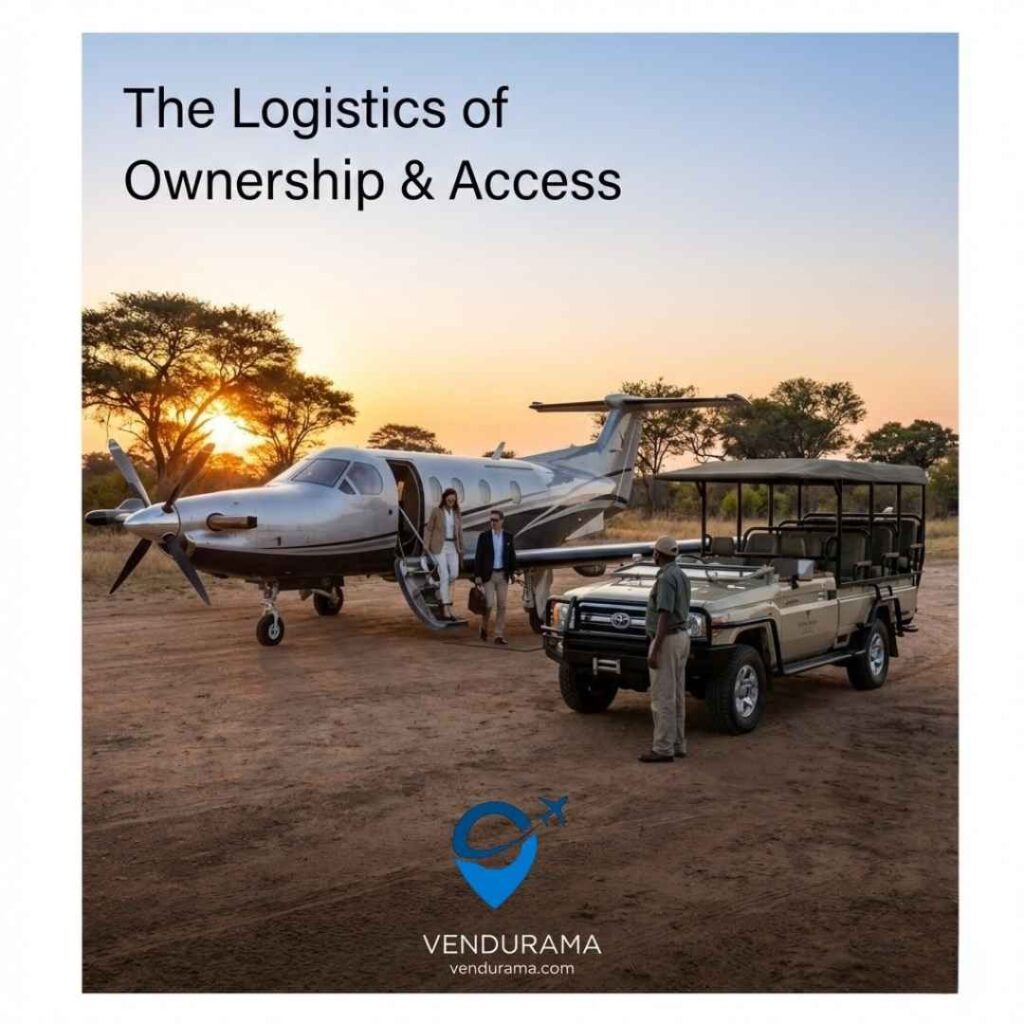
Executing this evaluation requires sophisticated travel orchestration across fragmented aviation networks. Investors typically route through Johannesburg or Nairobi before connecting to regional hubs (Maun for Botswana, Kigali for Rwanda), then chartering light aircraft (Cessna Caravan, Pilatus PC-12) for final legs to private airstrips. The complexity intensifies when evaluating multiple properties across jurisdictions—a single due diligence trip might require coordinating seven flight segments across four countries with baggage logistics for specialized equipment (camera traps, water testing kits, soil sampling tools). Platforms specializing in coordinating complex itineraries become operational necessities rather than conveniences, ensuring seamless connections between commercial carriers and bush pilots while managing customs formalities for scientific equipment. The cost of logistical failure—a missed charter connection stranding investors for 48 hours in Maun’s limited accommodation—translates directly to opportunity cost measured in six-figure investment decisions delayed.
[IMAGE PROMPT: Twilight arrival at a private airstrip in the Okavango Delta. A Pilatus PC-12 touches down on a gravel runway illuminated by solar-powered LED lights. In the foreground, a guide in khaki uniform stands beside an open-top Land Cruiser, holding a tablet displaying guest names. Acacia trees silhouetted against an indigo sky with first stars emerging. Photorealistic, atmospheric]
The Guest Arrival Protocol: Engineering Seamless Transitions
For UHNW clientele, the journey to a safari lodge constitutes the first experiential touchpoint—and its execution determines perceived value before guests even reach their suites. The “last mile” challenge is particularly acute: Maun Airport’s single terminal processes commercial flights, cargo charters, and military transports simultaneously, creating security vulnerabilities and service inconsistencies unacceptable for billionaire travelers. Similarly, Kigali International’s efficient operations still require 25-minute drives through urban traffic before reaching helicopter transfer points for Volcanoes National Park lodges.
The solution lies in bypassing public infrastructure entirely through pre-arranged premium private transfers that commence the moment guests clear customs. In Botswana, this means a dedicated representative meeting guests airside with expedited immigration processing, then escorting them directly to a private charter terminal where their bush plane awaits—eliminating terminal exposure entirely. In Rwanda, it involves luxury SUVs with diplomatic plates navigating dedicated airport exit lanes, proceeding directly to a private helipad where an Airbus H130 awaits for a 25-minute scenic transfer over the Virunga volcanoes.
These logistics represent more than convenience—they function as psychological transition rituals that signal the guest’s entry into an exclusive domain. The seamless handoff from commercial aviation to private charter to lodge vehicle establishes an unbroken chain of care that justifies premium pricing. More critically, for family offices evaluating acquisition targets, observing this arrival protocol’s execution provides insight into operational discipline—a poorly managed transfer indicates systemic issues in staff training, vendor management, and quality control that will manifest in guest experience deficiencies. The arrival sequence thus serves dual purposes: revenue protection for operators and due diligence metric for investors.
Conservation as a Value Driver
The fundamental innovation of conservation capitalism lies in quantifying ecological health as a direct input to financial performance. In Botswana’s Okavango concessions, a 10% increase in lion density correlates with a 7.3% ADR premium after controlling for seasonality and competitor pricing—demonstrating that guests explicitly value predator sightings in their purchasing decisions. Similarly, lodges participating in rhino reintroduction programs command 12-15% higher occupancy rates during shoulder seasons when wildlife viewing is less predictable, as conservation-minded travelers prioritize properties contributing to species recovery.
Rwanda’s model makes this value linkage explicit through its permit allocation algorithm. Lodges demonstrating superior community investment (school construction, clinic funding, agricultural training) receive priority allocation of gorilla trekking permits during high-demand periods—a direct financial incentive for conservation-adjacent activities. Singita Kwitonda’s $2.5 million investment in the adjacent Kwitonda community (funding a school, health clinic, and agricultural cooperative) secured preferential permit access that generated an estimated $1.8 million in additional annual revenue—yielding a 72% first-year ROI on community capital expenditure.
This value mechanism creates a virtuous cycle: conservation success drives revenue growth, which funds expanded anti-poaching operations and habitat restoration, which further increases wildlife densities and species diversity, which commands premium pricing. Unlike traditional real estate where value derives from location and improvements, safari reserve value emerges from living metrics—elephant herd sizes, leopard territory stability, bird species counts—that appreciate through active stewardship rather than passive ownership. For investors, this transforms conservation from cost center to value creation engine—a paradigm shift with profound implications for portfolio construction.
Challenges & Risk Analysis
Political and Regulatory Risk
Botswana’s concession renewal process represents the sector’s most significant regulatory risk. While historical renewal rates exceed 90%, the 2023 tender for the Abu Concession demonstrated increased government scrutiny regarding community benefit sharing and ecological management plans. Investors must structure ownership through special purpose vehicles with embedded community equity (typically 10-15% allocated to local trusts) to mitigate non-renewal risk. Rwanda presents lower regulatory volatility but higher state control—operators must accept that the Rwanda Development Board can adjust permit pricing or allocation formulas with minimal notice, as demonstrated by the 2017 gorilla permit price increase from $750 to $1,500.
Climate Vulnerability
The Okavango Delta’s hydrological system faces existential threats from upstream water extraction in Angola and Namibia. Satellite analysis indicates a 4.7% reduction in annual flood extent since 2010, with models projecting 12-18% reduction by 2040 under current extraction trajectories. Savvy investors mitigate this through water rights acquisition in Angolan headwaters—a strategy pioneered by Wilderness Safaris through its partnership with Angolan conservation authorities. Rwanda’s volcanic ecosystem faces different challenges: increased rainfall variability threatens gorilla habitat stability, with 2022’s extended dry season reducing bamboo availability and triggering unusual troop movements that complicated trekking operations.
Community Relations as Operational Imperative
The 2021 human-wildlife conflict incidents in Botswana’s Gomoti Concession—where elephants damaged 37 subsistence farms in a single month—demonstrated that conservation assets remain vulnerable to community sentiment shifts. Operators maintaining robust community benefit programs (Wildlife Management Areas generating $185,000 annually for local villages) experienced zero retaliatory poaching incidents during the crisis, while neighboring concessions with minimal community engagement suffered three rhino poisonings. This correlation establishes community relations not as corporate social responsibility but as core risk management—requiring dedicated staff positions (Community Liaison Officers earning $3,800-$5,200 monthly) and capital allocation (3-5% of gross revenue directed to community projects).
Conclusion: The Legacy Investment
Private safari reserve ownership represents the ultimate convergence of financial sophistication and ecological stewardship—a asset class where returns compound through biodiversity recovery rather than resource extraction. For the modern billionaire seeking investments that transmit intergenerational value beyond financial metrics, these properties offer something increasingly scarce: tangible ownership of irreplaceable natural capital whose appreciation correlates with planetary health. The Botswana and Rwanda models have proven that conservation need not be philanthropy’s burden but can function as capitalism’s most elegant expression—where protecting a rhino generates more long-term value than poaching its horn, where preserving a gorilla family creates greater economic returns than clearing its forest habitat.
This is not merely investment; it is legacy engineering. The family office that acquires a Delta concession today participates in a 50-year arc of ecological restoration—witnessing lion prides expand from 12 to 40 individuals, rhino populations rebound from local extinction to viable breeding groups, and community livelihoods transform through sustainable tourism revenue. These outcomes generate financial returns through premium pricing power while simultaneously creating a living inheritance that appreciates in both monetary and moral value. In an era of climate anxiety and biodiversity collapse, the conservation capitalist doesn’t merely preserve wealth—they preserve wonder. And in doing so, they discover that the most valuable assets on Earth remain those we choose to protect rather than exploit.