
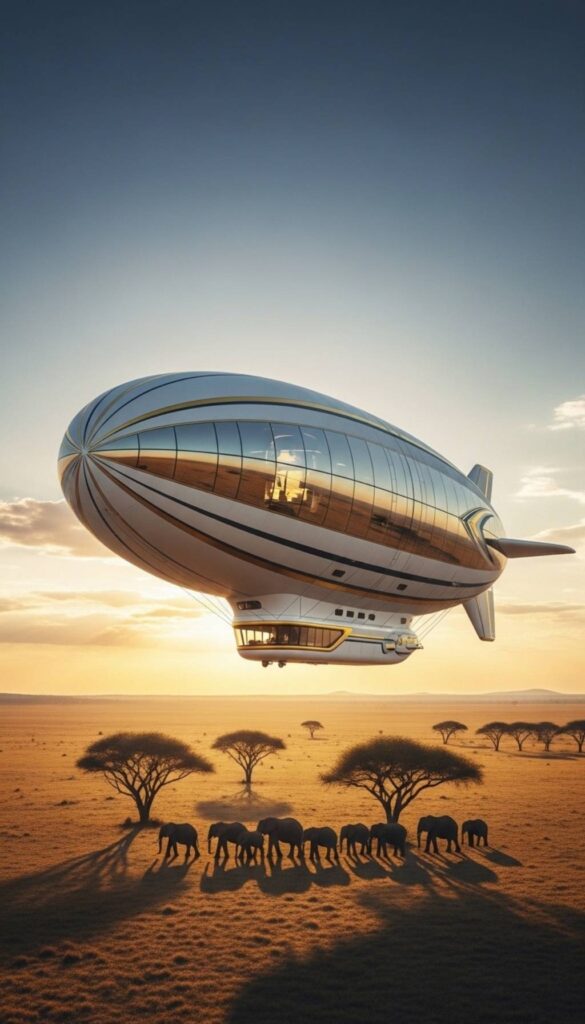
Introduction: The Renaissance of Slow Luxury
The luxury travel landscape of 2026 has undergone a profound psychological recalibration—one that privileges temporal depth over geographic velocity, presence over propulsion, and contemplative immersion over destination accumulation. This paradigm shift, crystallizing after years of pandemic-induced introspection and climate consciousness, has elevated “slow luxury” from niche preference to dominant ethos among the global elite. High-net-worth individuals no longer measure travel prestige through Mach numbers or time-zone conquests; instead, they seek experiences where the journey itself becomes the destination—a continuous state of arrival rather than a series of departures.
Within this renaissance, the rigid airship has emerged not as a nostalgic curiosity but as the definitive symbol of “quiet luxury”: the deliberate rejection of conspicuous consumption in favor of experiential refinement. Unlike the sonic boom of private jets—a sound that has become increasingly associated with ecological disregard and social dissonance—the near-silent passage of a modern airship represents a philosophical statement. It embodies the luxury of time reclaimed, of landscapes observed with geological patience rather than blurred through pressurized windows, of movement that harmonizes with atmospheric currents rather than dominating them.
This is not merely transportation reimagined; it is temporal architecture. The airship expedition transforms travel from a utilitarian function into a contemplative practice—where hours stretch into meaningful intervals, where the horizon reveals itself incrementally rather than instantaneously, and where the traveler experiences geography as a living continuum rather than a series of disconnected waypoints. In an era where carbon accounting has become as fundamental to luxury consumption as craftsmanship or exclusivity, the airship offers a rare synthesis: the ability to traverse vast distances while maintaining ecological integrity, to access remote frontiers without leaving footprints, and to experience the sublime majesty of Earth’s ecosystems without disrupting their delicate equilibrium.
The vertical horizon—the sky as a navigable dimension rather than merely a transit corridor—represents the next frontier in experiential luxury. It is a space where engineering precision meets philosophical intention, where sustainability is not a compromise but the very foundation of the experience, and where the most exclusive commodity becomes not speed, but stillness.
Part I: Engineering the Sky Palace
Hybrid-Electric Propulsion Systems
Contemporary rigid airships operating in the luxury expedition sector have transcended the technological limitations that constrained their historical predecessors through sophisticated hybrid-electric propulsion architectures. These systems integrate multiple power sources to optimize performance across varying operational phases while maintaining near-silent operation—a non-negotiable requirement for wildlife observation and wilderness immersion.
The primary propulsion architecture employs distributed electric ducted fans mounted along the airship’s longitudinal axis, each independently controlled to enable precise vector thrust management. During cruise phases at altitudes between 3,000 and 10,000 feet, these fans draw power from high-density lithium-sulfur battery arrays, supplemented by regenerative systems that capture energy during descent phases. For extended missions exceeding 48 hours, auxiliary hydrogen fuel cells provide continuous baseline power without combustion emissions, with hydrogen stored in cryogenic composite tanks integrated within the airship’s structural framework.
The hybrid system’s sophistication lies in its dynamic power management algorithms, which continuously optimize energy distribution based on atmospheric conditions, payload requirements, and mission profiles. During vertical takeoff and landing operations, maximum power is channeled to the aft-mounted thrust vectoring units, while cruise flight engages the full array of distributed fans for aerodynamic efficiency. Crucially, the entire propulsion system operates below 45 decibels at 100 meters—a sound pressure level comparable to a quiet library—enabling approaches to wildlife habitats without behavioral disruption.
This engineering approach represents a fundamental reimagining of aerial mobility: propulsion not as domination of the atmosphere, but as conversation with it. The airship moves with meteorological intelligence, adjusting altitude to harness favorable wind currents, reducing power requirements by up to 60% compared to fixed-wing aircraft operating in the same corridors. This symbiotic relationship with atmospheric dynamics is not merely an efficiency consideration; it is the philosophical cornerstone of the low-impact expeditionary model.
Non-Flammable Lifting Media and Structural Integrity
The structural engineering of contemporary luxury airships resolves the historical vulnerability associated with hydrogen-filled predecessors through a multi-layered approach to lift generation and envelope integrity. Modern vessels utilize helium as the primary lifting gas—a non-flammable, inert element that provides approximately 92% of the lift capacity of hydrogen while eliminating combustion risk. However, helium’s scarcity and cost have necessitated innovative engineering solutions to maximize lifting efficiency.
The rigid framework employs a geodesic carbon-fiber lattice structure, engineered using topology optimization algorithms that distribute structural loads with minimal material mass. This framework supports multiple independent helium cells constructed from multi-layer metallized polymer films with helium permeability rates below 0.1% per 24 hours—critical for extended missions where gas loss would compromise buoyancy control. Between these primary cells, secondary air ballonets enable precise buoyancy management through controlled inflation and deflation, compensating for atmospheric pressure changes during altitude transitions without venting valuable helium.
The envelope’s outer skin represents a significant materials science advancement: a self-healing polymer composite embedded with microcapsules containing polymerizing agents that automatically seal punctures up to 5mm in diameter. This technology, originally developed for space applications, provides critical redundancy for operations in remote regions where immediate maintenance access is impossible. The skin’s exterior features a hydrophobic nano-coating that minimizes moisture accumulation—a critical consideration for operations in tropical environments—while its interior surface incorporates anti-static properties to prevent electrostatic discharge in dry atmospheric conditions.
VTOL Capabilities and Aerostatic Control
The vertical takeoff and landing capability that defines modern luxury airships emerges from sophisticated aerostatic control systems rather than brute-force thrust generation. Unlike rotorcraft that require significant power expenditure for hover operations, airships achieve VTOL through precise buoyancy management combined with vectored thrust—enabling operations in locations without prepared landing infrastructure while maintaining energy efficiency.
The buoyancy control system operates through a closed-cycle process that manipulates the airship’s density relative to the surrounding atmosphere. During descent preparation, compressors transfer atmospheric air into high-pressure storage tanks, increasing the vessel’s overall density. For ascent, this stored air is vented while simultaneously heating the helium within the primary cells through waste heat recovery systems—expanding the gas volume and decreasing density. This thermal management approach requires minimal energy expenditure compared to thrust-based altitude changes, with the entire VTOL sequence consuming less energy than five minutes of cruise flight.
Landing precision is achieved through a combination of aerostatic control and low-velocity thrust vectoring. As the airship approaches within 50 meters of the landing zone, distributed fans transition to downward vectoring while maintaining minimal forward momentum. The final descent occurs at rates below 0.5 meters per second—slower than human walking pace—allowing ground crews to secure mooring lines with minimal physical effort. Crucially, this entire sequence generates negligible downwash, eliminating the dust clouds, vegetation damage, and wildlife disturbance associated with helicopter operations.
Part II: The Architecture of the Airship Suite
Vibration Dampening and Atmospheric Stability Systems
The interior environment of a luxury airship presents unique engineering challenges. Unlike airplanes that experience turbulence-induced vibrations, airships encounter low-frequency atmospheric oscillations—gentle undulations that would disrupt fine dining service. Contemporary airship suites employ a multi-stage isolation architecture to achieve what engineers term “atmospheric stillness.” The primary living compartments are suspended within the rigid framework through a hexapod active vibration control system comprising six electromechanical actuators that continuously adjust position at 1,000 cycles per second.
Complementing this mechanical isolation, the airship’s flight management system employs predictive atmospheric modeling to anticipate turbulence zones. Using LIDAR-based atmospheric sensing extending 20 kilometers ahead of the vessel, the system identifies thermal boundaries and wind shear layers, adjusting flight path and altitude to avoid disruptive air masses rather than reacting to them. This proactive approach transforms the airship’s movement from passive drifting to intelligent atmospheric navigation—reading the sky’s invisible topography to maintain optimal stability.
Panoramic Structural Glass Engineering
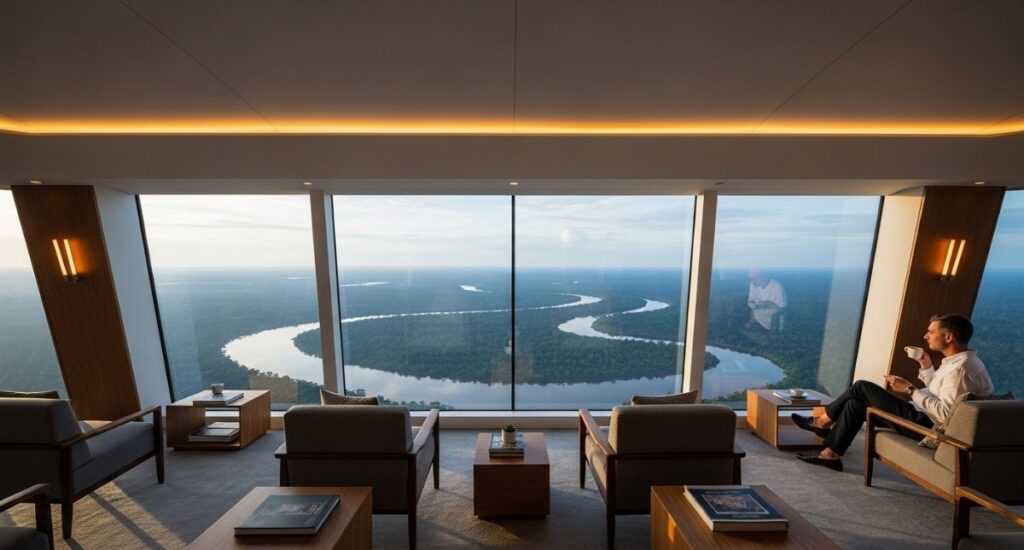
The visual connection between interior space and external environment represents the defining architectural feature of the luxury airship suite. Contemporary vessels feature continuous panoramic glazing spanning up to 270 degrees of the forward observation lounge, constructed from laminated structural glass composites that maintain integrity at operational altitudes while providing optical clarity exceeding terrestrial architectural standards.
These glass assemblies comprise seven layers: two outer layers of chemically strengthened aluminosilicate glass, three interlayers of polyvinyl butyral with integrated UV filtration, and two inner layers of electrochromic glass that transition from transparent to opaque in 15 seconds. The electrochromic layers incorporate micro-channel networks circulating temperature-controlled fluid to prevent condensation during rapid altitude transitions while maintaining interior climate stability. During high-solar-exposure operations in equatorial regions, the electrochromic layer automatically tints to block 99.5% of infrared radiation without compromising visible light transmission.
Life Support and Environmental Control at Altitude
Maintaining a five-star environment at 10,000 feet requires life support systems that transcend conventional aircraft environmental controls. Unlike pressurized jet cabins that maintain sea-level pressure regardless of altitude, luxury airships operate with partial pressurization—maintaining cabin pressure equivalent to 5,000 feet while cruising at 10,000 feet. This approach eliminates the physiological stress of rapid pressurization cycles while providing sufficient oxygen partial pressure for comfort without supplemental systems.
The environmental control system operates as a closed-loop ecosystem. Atmospheric water vapor harvested from cabin air through condensation provides 60% of the vessel’s potable water requirements, with the remainder drawn from atmospheric moisture during flight through specialized intake systems. Air quality management employs a tripartite filtration system: HEPA-14 filters capture particulate matter, activated carbon remove volatile organic compounds, and photocatalytic oxidation units neutralize microbial contaminants. Crucially, the system maintains precise humidity levels between 45-55%—a range demonstrated to optimize respiratory comfort and olfactory perception of fine cuisine.
Part III: The Low-Impact Imperative
Carbon Footprint Analysis: Airships vs. Private Jets
The environmental calculus of luxury air travel has undergone fundamental recalibration in the post-2023 regulatory landscape. Within this framework, the comparative analysis between private airships and conventional business jets reveals disparities of magnitude. A transcontinental journey from London to Cape Town aboard a mid-size business jet generates approximately 32.4 metric tons CO2e when accounting for radiative forcing effects.
The equivalent journey aboard a luxury expedition airship, while requiring 72 hours of flight time, generates only 1.8 metric tons CO2e through its hybrid-electric propulsion system. The absence of high-altitude emissions eliminates radiative forcing impacts, resulting in a direct 1:1 CO2e accounting. This represents a carbon intensity of 0.025 metric tons CO2e per passenger-hour—two orders of magnitude lower than jet travel. Airships generate lift through buoyancy rather than wing loading, eliminating the energy expenditure required to overcome gravity through forward velocity.
Noise Pollution and Wildlife Disturbance Metrics
The acoustic signature of aerial platforms has emerged as a critical environmental metric in wilderness conservation. Luxury airships redefine this paradigm through near-silent operation that falls below ambient environmental noise levels in most natural settings. Modern airships generate sound pressure levels of 38-42 decibels at 100 meters distance—comparable to rustling leaves in a light breeze. This contrasts sharply with helicopter operations (85-95 dB at 100m) and fixed-wing aircraft (75-85 dB at 100m).
This acoustic advantage enables a fundamentally different relationship with natural environments. Rather than observing wildlife from disruptive distances, airship expeditions facilitate prolonged observation of undisturbed animal behavior—mating rituals, parental care patterns, and social dynamics that remain invisible to conventional aerial platforms. Conservation researchers have documented previously unrecorded behavioral sequences during airship-based observation missions, including nocturnal foraging patterns in big cat species.
The Zero-Impact Expeditionary Protocol
The operational philosophy governing luxury airship expeditions has evolved beyond carbon neutrality toward what industry leaders term the “zero-impact protocol.” This protocol begins with pre-mission environmental assessment using satellite-derived ecological sensitivity mapping to identify zones requiring special operational constraints. Surface interaction protocols eliminate physical footprint through strict no-landing policies in ecologically sensitive zones.
When ground operations are necessary, the airship maintains station-keeping hover at 30-meter altitude while passengers transfer via silent electric winch systems to minimal-impact landing platforms. All waste streams undergo rigorous segregation and compaction aboard the vessel, with organic matter processed through onboard composting systems. The propulsion system undergoes pre-mission calibration to ensure exhaust particulate counts remain below ambient atmospheric levels—a standard achieved through catalytic converters and electrostatic precipitation systems that remove 99.97% of combustion byproducts.
Part IV: Global Expeditionary Logistics
Strategic Route Planning for Remote Ecosystems
The operational geography of luxury airship expeditions has evolved toward scientifically significant yet logistically challenging environments. Amazon Basin expeditions capitalize on the airship’s ability to navigate complex river systems and forest canopies without surface infrastructure. Arctic Circle operations exploit the unique atmospheric stability of polar regions, focusing on documenting cryosphere dynamics—calving events and sea ice edges—with minimal disturbance.
For high-net-worth individuals coordinating these transcontinental shifts, the success of the mission is inextricably linked to the underlying data architecture. Navigating these remote frontiers requires a macro-view of global mobility, where travelers utilize comprehensive travel data and flight aggregation platforms to synchronize their arrival with the airship’s specific launch windows. Filtering the deluge of global scheduling data into a coherent itinerary ensures that the logistical transition from international hubs to remote expedition zones remains frictionless and aligned with clinical precision.
Landing Zone Identification and Environmental Assessment
The absence of dependency on prepared landing infrastructure represents both the greatest operational advantage and most complex logistical challenge. Landing zone selection requires multidimensional analysis integrating ecological sensitivity, geological stability, and meteorological conditions. The primary screening layer employs satellite-derived datasets to eliminate zones with slope gradients exceeding 5 degrees or vegetation height exceeding 2 meters.
When ground operations prove necessary—for cultural exchange programs—the airship employs a minimal-impact landing protocol. The vessel descends to 10-meter altitude while ground crews deploy temporary landing platforms constructed from cross-laminated timber panels that distribute weight across 50 square meters, reducing ground pressure to less than 25 kilograms per square meter—comparable to a human footprint. These platforms incorporate integrated sensors monitoring soil compaction and vegetation stress.
Supply Chain Integration for Extended Missions
The logistical architecture supporting extended airship expeditions—missions exceeding seven days without resupply—represents a significant advancement in supply chain management. The primary resupply methodology employs rendezvous operations with ground-based support vehicles at predetermined coordinates. These operations occur during brief hovering sequences lasting 15-20 minutes, during which electric winches transfer pre-packaged supply modules containing fresh provisions and scientific equipment.
Critical to this system is the cold chain integrity maintained throughout the supply chain. Perishable provisions travel in vacuum-insulated containers that maintain temperatures between 0-4°C for 72 hours without active refrigeration. This passive cooling approach eliminates the energy expenditure and mechanical complexity of conventional refrigeration systems while ensuring culinary standards remain uncompromised during extended missions. For ultra-remote operations beyond ground vehicle range, resupply occurs through coordinated rendezvous with maritime vessels.
Part V: The Economics of the Airship Sector
Capital Expenditure and Operational Cost Structures
The economic architecture of private airship ownership reflects the vessel’s dual nature as both transportation asset and mobile real estate. A bespoke luxury expedition airship accommodating eight passengers represents a capital investment of $42-58 million. This acquisition cost positions airships between mid-size business jets ($25-40 million) and large private yachts ($60-100 million).
Annual operational expenditures average $3.8 million, comprising crew salaries ($1.2M), maintenance reserves ($1.1M), insurance ($450K), and mission-specific costs. Crucially, these costs remain relatively fixed regardless of utilization intensity—a fundamental distinction from business jets where fuel consumption scales directly with flight hours. The maintenance cost structure reflects the airship’s mechanical simplicity; with no high-stress rotating components, major component lifespans extend 3-4 times beyond equivalent jet aircraft.
Charter vs. Fractional Ownership Models
The ownership economics of luxury airships have evolved sophisticated models balancing capital commitment with operational flexibility. Fractional ownership has emerged as the dominant model, with programs offering 1/8 to 1/4 shares providing 45-120 annual flight days. These programs achieve economic viability through guaranteed minimum utilization—operators commit to chartering unused share time, ensuring owners recoup 60-70% of their allocated days’ value.
The charter market has developed distinct segmentation. Standard expedition charters command $38,000-45,000 daily rates, while scientific research charters command premiums of 25-30%. The first generation of luxury airships delivered between 2023-2025 has begun entering the resale market with 65-75% residual value retention after five years—significantly outperforming business jets (40-50% retention) and approaching the appreciation trajectory of blue-chip art assets.
Part VI: Managing the “First and Last Mile”
Ground Transition Protocols for Discreet Arrival
The seamless integration of airship expeditions with terrestrial logistics represents a critical determinant of quality—the “first and last mile” challenge. Unlike airport-based operations where ground transportation begins at a fixed point, airship expeditions conclude at dynamically determined locations often lacking any infrastructure. This requires sophisticated protocols to maintain the expedition’s experiential continuity.
The transition protocol begins 72 hours pre-arrival with meteorological analysis determining the precise landing coordinates within a 50-kilometer radius of the intended destination. This flexibility enables selection of landing zones optimizing ground transfer logistics while maintaining authenticity. Ground support teams deploy to these coordinates 24 hours in advance with mobile infrastructure including climate-controlled passenger lounges and communications hubs.
To ensure the sensory tranquility cultivated during the journey is not severed upon disembarkation, seasoned travelers secure reliable private transfer services in advance. Securing a professional, pre-arranged chauffeur who understands the nuances of remote arrival provides a regulated alternative to on-the-spot negotiation. This connectivity layer bridges the gap between the airship’s landing zone and the final private residence, ensuring a seamless, dignified, and secure transition for the elite traveler.
Professional Chauffeur Integration and Fleet Coordination
The ground transportation segment requires vehicle specifications and operational protocols aligned with the expedition’s experiential standards. Luxury expedition operators have developed specialized ground fleets comprising electric off-road vehicles modified with enhanced suspension systems and panoramic glass roofs. Chauffeur selection emphasizes expeditionary competence—individuals trained in wilderness first response and wildlife behavior interpretation.
Fleet coordination leverages predictive logistics algorithms, with ground vehicles prepositioned based on 48-hour weather forecasts. This distributed positioning ensures maximum transfer efficiency regardless of final landing coordinates, with average ground transfer times maintained below 25 minutes from airship disembarkation to arrival at the expedition’s terrestrial destination. The most sophisticated operators have even explored modular cabin units that detach from the airship and transition to electric ground propulsion, allowing passengers to continue their journey without changing vehicles.
Conclusion: The Horizon of Contemplative Travel
The emergence of private airship expeditions signifies a fundamental recalibration of luxury’s relationship with time, space, and planetary stewardship. In an era where conspicuous consumption has lost its cultural currency, the airship offers a rare synthesis: the ability to traverse Earth’s most magnificent landscapes while honoring their fragility. This mode of travel restores the dignity of slowness, the wisdom of observation, and the humility of moving with rather than against natural systems.
As we stand at the threshold of 2026, the vertical horizon beckons not as escape from Earth’s challenges but as elevated perspective upon them. The airship expedition provides the contemplative space where answers might emerge, the sensory immersion that rekindles reverence for our shared home, and the temporal luxury to consider our place within Earth’s delicate balance. In the end, the most exclusive commodity the airship offers is a different state of mind—one where speed surrenders to presence, where consumption yields to contemplation, and where luxury finds its highest expression in the manner of our passage.