
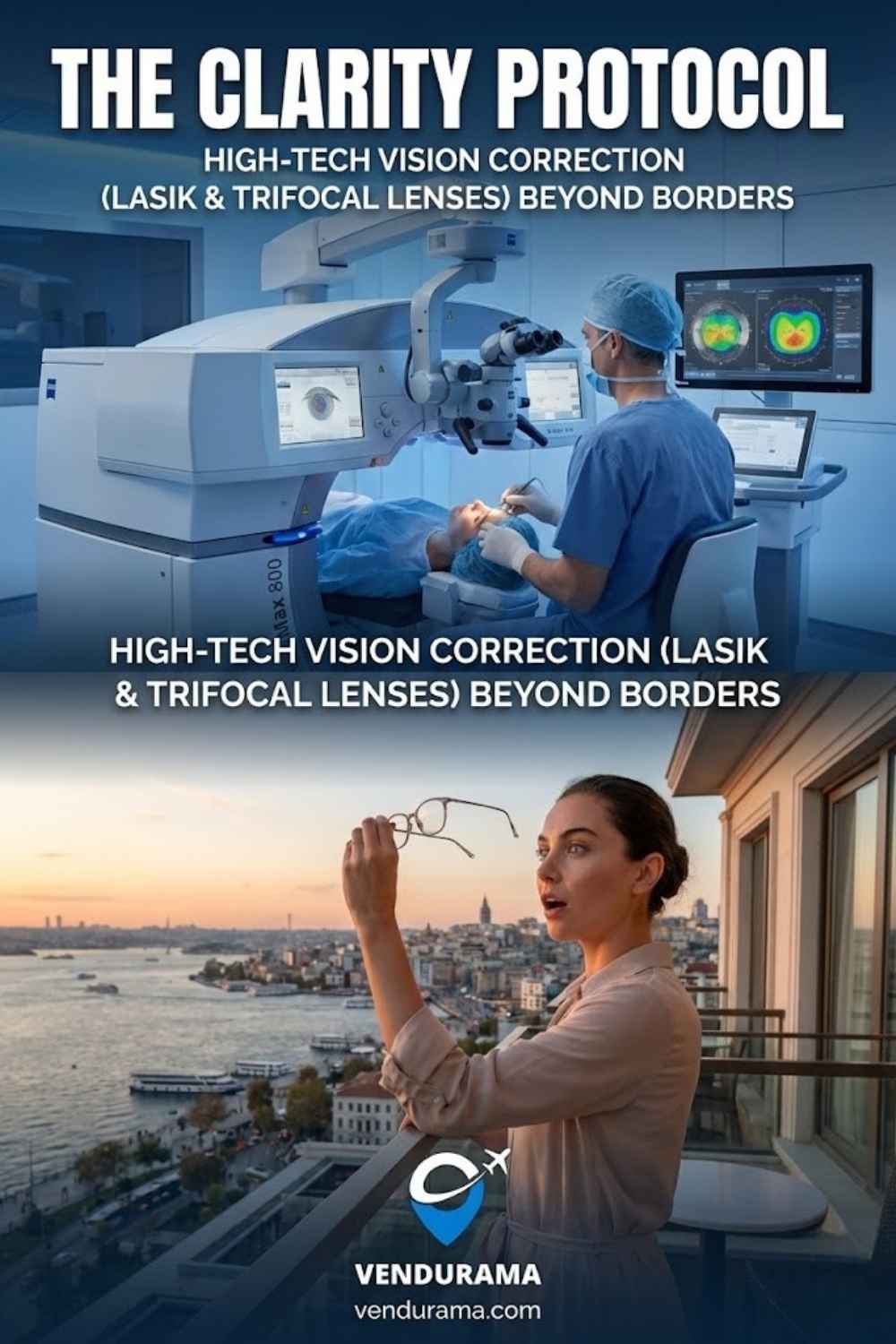
Introduction: The Interface of Reality
Vision is not merely a sense; it is our primary interface with reality. More than 80% of the sensory information the human brain processes comes through the eyes. To live with compromised vision—dependent on external prosthetics like glasses or contact lenses—is to live with a permanent barrier between oneself and the world. It is a functional limitation that affects everything from professional performance in high-stakes environments to the simple, profound joy of seeing a child’s face across a room unassisted.
For decades, the solutions to refractive errors were analog: ground glass or molded plastic. Surgery was viewed as a risky last resort. However, the last fifteen years have witnessed a quantum leap in ophthalmological technology. The convergence of femtosecond laser physics, wavefront-guided topography, and advanced optical engineering in intraocular lenses has transformed eye surgery from a reparative procedure into a performance-enhancing one.
Yet, access to this top-tier technology is unevenly distributed globally. In many Western healthcare systems, advanced procedures like SMILE Pro or premium Trifocal lens replacements are prohibitively expensive or perpetually stuck in bureaucratic approval pipelines. This has given rise to “The Clarity Protocol”—a strategic approach to medical tourism where discerning patients travel to specialized, high-volume centers of excellence abroad to access the world’s best technology at a fraction of the domestic cost.
This analytical review is the definitive guide for those considering this journey. We will move beyond marketing brochures to dissect the engineering behind the latest procedures, analyze the geopolitical shift in surgical expertise towards hubs like Istanbul and Berlin, provide a rigorous vetting methodology for surgeons, and lay out the precise logistical architecture required to execute a flawless medical deployment for your eyes.
Part I: The Geopolitical Shift in Refractive Surgery
Why travel for eye surgery? The answer lies at the intersection of economics, technology adoption cycles, and surgical volume. The traditional assumption that the best medical care is always found in the US or UK is rapidly becoming obsolete in specific high-tech niches.
1. The Technology Adoption Gap
The US FDA approval process is notoriously slow. Many groundbreaking technologies, particularly European-engineered laser platforms (like certain Carl Zeiss Meditec or Schwind systems) and advanced multifocal intraocular lenses, are approved for use in Europe and Asia years before they reach the US market.
Consequently, elite clinics in medical tourism hubs like Turkey, Germany, and South Korea are often equipped with diagnostic and surgical platforms that are one or two generations ahead of the average clinic in the American Midwest or the British NHS. Traveling abroad often means traveling into the future of eye care.
2. The Volume-Mastery Corollary
In microsurgery, repetition is the mother of skill. A high-volume refractive surgeon in a specialized hub like Istanbul may perform 20 to 30 procedures per day, focusing exclusively on LASIK, SMILE, or Lens Replacement. In contrast, a general ophthalmologist in a Western suburb might perform that many in a month, interspersed with treating glaucoma and general eye exams.
This immense concentration of cases means these high-volume surgeons have encountered every conceivable corneal topography, every unusual healing response, and every micro-complication. Their “surgical intuition” is honed to an elite level through sheer statistical exposure.
3. The Economic Arbitrage of High-Tech
Eye surgery is technology-intensive. The cost of a femtosecond laser suite exceeds half a million dollars. In high-cost-of-living countries, the procedure fee is heavily padded by real estate costs, insurance premiums, and staff salaries. In hubs like Turkey, lower operational overheads combined with favorable currency exchange rates allow clinics to offer premium procedures using the exact same German or American technology for 30% to 50% of the Western price, without compromising quality.
Part II: The Science of Sight – Understanding the Deficit
Before diving into solutions, one must understand the architecture of the problem. The eye is essentially a biological camera. Light passes through the clear front window (the cornea), then through a flexible lens behind the iris, which focuses the light onto the retina at the back of the eye.
The Refractive Errors (The Cornea Problem)
When the eye is misshapen, light does not focus precisely on the retina.
- Myopia (Nearsightedness): The eyeball is too long or the cornea is too curved. Images focus in front of the retina.
- Hyperopia (Farsightedness): The eyeball is too short or the cornea is too flat. Images focus behind the retina.
- Astigmatism: The cornea is shaped like a football rather than a basketball, causing distorted focus at all distances.
These issues are typically addressed by reshaping the cornea with lasers (LASIK, SMILE).
The Aging Eye (The Lens Problem) – Presbyopia
This is the universal adversary. Around age 45, the natural crystalline lens inside the eye loses its flexibility. It can no longer “accommodate” or change shape to focus on near objects. This is why reading glasses become necessary.
Crucially, laser eye surgery (LASIK) cannot fix presbyopia because it only reshapes the cornea, not the stiffening internal lens. The solution for presbyopia is replacing the dysfunctional lens entirely (Refractive Lens Exchange with Trifocals).
Part III: The Surgical Arsenal – The Technologies
The “Clarity Protocol” involves selecting the precise weapon for your specific visual deficit.
A. Cornea-Based Solutions (For under 45s)
These procedures use excimer and femtosecond lasers to permanently reshape the corneal tissue to correct refractive errors.
1. Femto-LASIK (The Gold Standard Workhorse)
- The Mechanism: A femtosecond laser creates a thin, hinged flap on the surface of the cornea. The surgeon folds the flap back, and an excimer laser vaporizes microscopic amounts of underlying tissue according to a personalized topographic map. The flap is then replaced and heals naturally without stitches.
- The Ideal Candidate: Moderate myopia, hyperopia, and astigmatism. Rapid visual recovery is paramount.
- The Pros: Decades of data, highly predictable results, “wow factor” vision the very next day.
- The Cons: Creation of a corneal flap induces temporary dry eye and a theoretical lifelong risk of flap dislocation (though extremely rare with modern tech).
2. SMILE Pro (Small Incision Lenticule Extraction) – The Next Generation
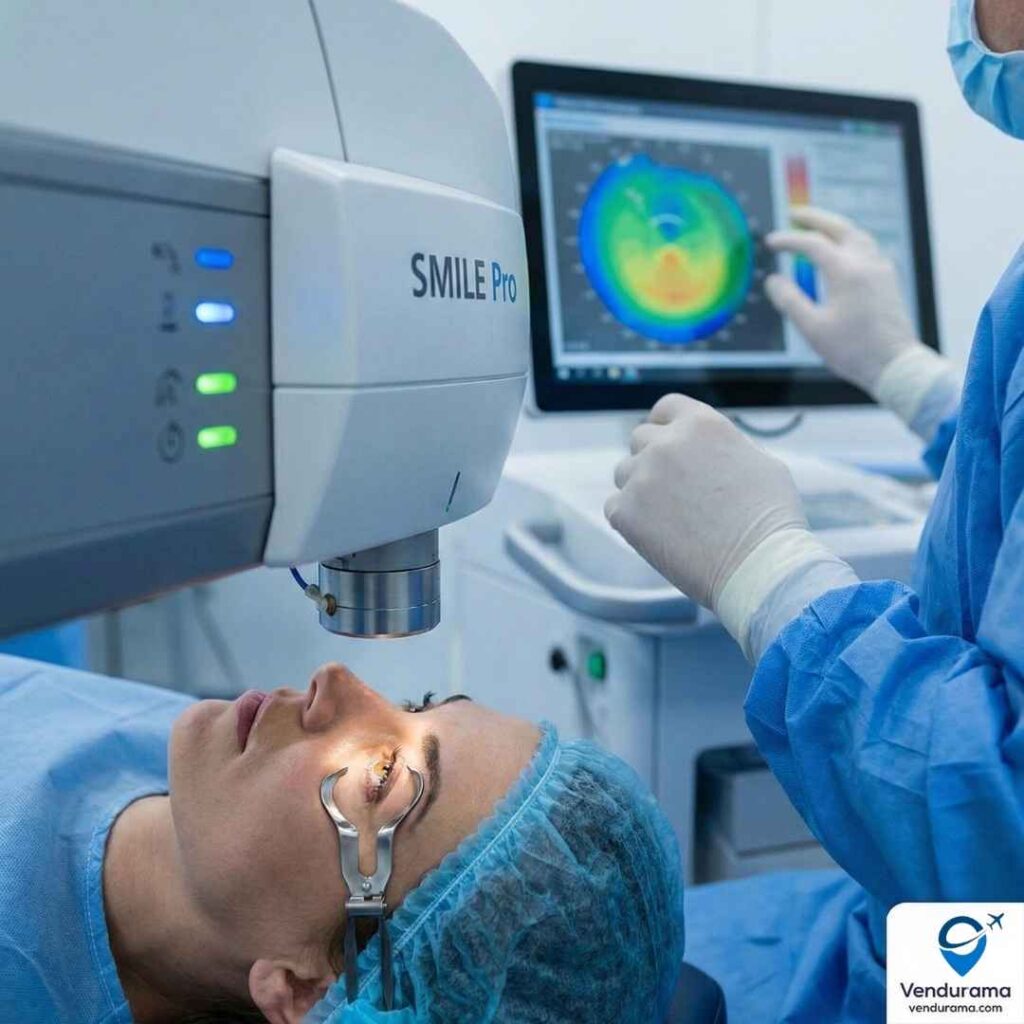
This is the most advanced evolution of laser vision correction, often marketed as “ReLEx SMILE.”
- The Mechanism: It is a “flapless” and “keyhole” procedure. A femtosecond laser (usually the Zeiss VisuMax) carves a microscopic disc of tissue (a lenticule) inside the intact cornea. The surgeon then removes this disc through a tiny 2-4mm incision. Removing the disc changes the cornea’s shape.
- The Ideal Candidate: Myopic patients, especially those with higher prescriptions, athletes, or those involved in contact sports, and those prone to dry eyes.
- The Pros: Biomechanically stronger cornea as fewer nerve fibers are cut (less dry eye), no risk of flap complications.
- The Cons: Slower visual recovery than LASIK (takes a few days to weeks for “crispness”), generally not suited for hyperopia (farsightedness) treatment yet.
B. Lens-Based Solutions (For the 45+ Demographic)
If you are over 45 and rely on reading glasses or bifocals, laser eye surgery is likely a temporary fix. The definitive solution is addressing the aging lens itself.
Refractive Lens Exchange (RLE) with Trifocal IOLs
This is essentially cataract surgery performed for refractive purposes before a cataract has fully developed. The dysfunctional natural lens is ultrasonically removed and replaced with a high-tech artificial Intraocular Lens (IOL).
The Game Changer: The Trifocal Diffractive IOL
Early IOLs were “monofocal”—they set your vision to one distance (usually far), requiring you to still wear reading glasses.
Modern Trifocal Lenses (e.g., Zeiss AT LISA tri, Alcon PanOptix, Johnson & Johnson Synergy) are masterpieces of optical engineering. They use concentric diffractive rings etched onto the lens surface to split incoming light into three distinct focal points simultaneously:
- Distance: Driving, watching TV, looking at scenery.
- Intermediate: Computer screens, car dashboards, seeing faces across a table.
- Near: Reading a phone, a menu, or a book.
- The Ideal Candidate: Patients over 45-50 with presbyopia, high hyperopia, or early cataracts who desire complete spectacle independence.
- The Pros: A permanent solution—you will never develop cataracts. Provides vision at all distances.
- The Cons: It is intraocular surgery (more invasive than laser). The diffractive rings can cause visual phenomena like “haloes” or “starbursts” around lights at night, which the brain usually adapts to (neuroadaptation) over 3-6 months.
Part IV: The Surgeon Selection Matrix – A Vetting Protocol
In medical tourism, the quality of the surgeon is the single biggest variable. Do not rely on Instagram influencers. You must interrogate the data.
1. The Technology Audit
A surgeon is only as good as their tools. Elite clinics will be transparent about their technology.
- For Laser: Look for current-generation platforms like the Zeiss VisuMax 800 (for SMILE Pro) or the Schwind Amaris 1050RS. Avoid clinics using nearly-obsolete lasers.
- For Lenses: Ensure they offer premium European or American IOLs (Zeiss, Alcon, J&J). Beware of clinics offering generic or “house brand” lenses to cut costs.
2. The Surgeon’s Credentials
- Volume & Specialization: Are they a general ophthalmologist or a dedicated refractive surgeon? How many thousands of procedures have they performed?
- International Standing: Are they members of the ESCRS (European Society of Cataract and Refractive Surgeons) or AAO (American Academy of Ophthalmology)? Do they publish research or speak at international conferences?
3. The Consultation Tone
A world-class surgeon will spend more time trying to talk you out of surgery than into it. They should meticulously explain why you might not be a good candidate (e.g., thin corneas, keratoconus, unrealistic expectations regarding trifocal haloes). If the consultation feels like a sales pitch, walk away.
Part V: The Logistical Architecture of a Medical Deployment
Traveling for eye surgery requires precise planning. Unlike a vacation, you are managing pre-operative anxiety and post-operative visual limitations.
Phase 1: Pre-Flight Clearance and Strategic Booking
Before booking a flight, you must send your local eye exam records (topography, prescription) to the clinic for a preliminary assessment. Only once you are deemed a likely candidate should you commit to travel.
Because medical schedules shift and final eligibility is determined only during the in-person examination on Day 1, your travel plans need a buffer. Booking rigid, non-refundable flights is a strategic error. You require flight options that offer maximum flexibility and the most direct routes to hubs like Istanbul (IST) or Berlin (BER) to minimize transit fatigue. Utilizing sophisticated international flight analysis platforms is essential for visualizing these routes, comparing airlines, and securing fares that allow for changes if medical clearance is delayed.
Phase 2: The Secure Arrival Protocol
Arriving in a massive international hub like Istanbul for surgery is a high-stress touchpoint. You are entering a foreign environment for a procedure that will temporarily incapacitate your primary sense. Navigating public transport or haggling with taxi drivers while pre-operatively anxious raises cortisol levels unnecessarily.
Elite clinics often include V-Class transfers in their packages. If they do not, independent arrangement of secure executive airport transfers is mandatory. You need the psychological anchor of a professional, vetted driver waiting with your name on a sign, ready to handle your luggage and transport you seamlessly to your pre-op hotel or the clinic. This “zero-friction” arrival is crucial for mental preparation.
Phase 3: The Surgical Lifecycle (Typical 3-4 Day Itinerary)
- Day 1 (The Deep Dive): Arrival. Transport to the clinic for exhaustive diagnostic testing (Pentacam topography, OCT scans, dilation). Final consultation with the surgeon to confirm the procedure plan (e.g., LASIK vs. SMILE, or final IOL power calculation).
- Day 2 (Procedure Day): You are at the clinic for 3-4 hours. The surgery itself takes only 10-15 minutes per eye (laser) or 20-30 minutes (lens exchange). It is painless due to numbing drops. You leave wearing dark shields. Your vision will be foggy.
- Day 3 (The Reveal): Post-op check-up. Shields are removed. For LASIK/RLE, this is often the “wow” moment where functional vision returns. For SMILE, vision will still be slightly hazy. You are given a strict regimen of antibiotic and steroid eye drops.
Phase 4: The Return Journey with Compromised Vision
On your departure day, your eyes will be sensitive to light, perhaps slightly gritty, and your vision may fluctuate. You are not in a condition to navigate a chaotic airport terminal under stress.
Just as with arrival, the return transfer must be executed with precision. Relying on professional ground transport services again for the journey back to the airport ensures a calm, smooth ride directly to the correct departure gate, protecting your vulnerable eyes during the critical early healing phase.
Part VI: The Financial Breakdown and Value Proposition
A transparent look at the costs clarifies the economic logic of “The Clarity Protocol.”
Comparative Cost Analysis (Estimated)
| Procedure (Per Eye) | USA / UK Cost | Turkey / Eastern EU Hub Cost |
| Femto-LASIK | $2,000 – $3,500 | $800 – $1,500 |
| SMILE Pro | $2,500 – $4,000 | $1,200 – $2,000 |
| Trifocal RLE | $4,000 – $8,000 | $2,000 – $3,500 |
The All-Inclusive Package Model:
Premium clinics in hubs like Istanbul often bundle services for international patients. A typical package for bilateral SMILE Pro might cost €2,500 – €3,500, including:
- Procedure fees for both eyes.
- All pre- and post-op consultations and scans.
- 3 nights in a 4/5-star partner hotel.
- VIP airport transfers.
- Post-op medication pack.
Even when adding the cost of flights, the total expenditure is often 50% less than the procedure cost alone in Western countries, while utilizing identical or superior technology.
Part VII: Recovery, Neuroadaptation, and the Long Game
Managing expectations is the key to satisfaction with advanced eye surgery.
- LASIK Recovery: Functional vision in 24 hours. Dry eye is the main issue for the first 3 months, requiring frequent lubricating drops.
- SMILE Recovery: “Functional fog” for the first 3-5 days. Full crispness can take 2-4 weeks. Less dry eye than LASIK.
- Trifocal RLE Recovery (The Brain Game): The eye heals quickly, but the brain takes time to learn how to use the new optics. This process, called neuroadaptation, takes 3 to 6 months. During this time, you will likely see haloes around streetlights and car headlights at night. For 95% of patients, these phenomena fade as the brain learns to filter them out. Patience is mandatory.
Conclusion: The irreversible decision
Refractive surgery is one of the few medical interventions that offers an immediate, profound upgrade to the human experience. It is a liberation from prosthetics.
However, it is surgery on your eyes. It is elective, and it is largely irreversible. The decision to pursue “The Clarity Protocol” abroad demands rigorous due diligence, a clear understanding of the technology, and meticulous logistical planning. It is not a journey for the impulsive bargain hunter, but for the informed individual seeking the best intersection of technology, surgical expertise, and value.
When executed correctly, the result is not just 20/20 vision; it is a fundamental shift in how you interact with the world—a restoration of the seamless interface with reality that nature intended.