
Introduction: The Macroeconomic Crisis of Educational ROI in the New Economy Era
The contemporary economics of higher education in Anglophone economies have reached a point of structural unsustainability for middle-class families seeking to position their children for success in the emerging knowledge economy. In the United States, the College Board reports that the average cost of a four-year degree in computer science, finance, or engineering at a private institution now exceeds $240,000 when factoring in tuition, fees, housing, and opportunity costs. The United Kingdom presents a parallel crisis: international student tuition for technology and engineering programs at prestigious institutions now exceeds £32,000 annually, with living costs in London approaching £19,000 per year. For the rational, analytically-minded family—those with sufficient capital to invest in human capital but insufficient wealth to absorb catastrophic financial risk—this represents not merely a challenge, but a systemic market failure in the allocation of educational opportunity for the industries of tomorrow.
Simultaneously, the global economy is undergoing a seismic shift driven by financial technology innovation, cybersecurity imperatives, renewable energy transition, and sustainable engineering solutions. The World Economic Forum estimates that 89 million new roles in FinTech, green technology, and sustainable infrastructure will emerge by 2027, with starting salaries for qualified graduates exceeding $75,000 in major innovation hubs. Yet the traditional pathway to accessing this high-ROI education—elite Western universities—has become financially prohibitive for the very middle-class families most likely to benefit from upward mobility through technical expertise in these future-proof fields.
Enter the concept of Geographic Educational Arbitrage: the strategic deployment of capital across jurisdictional boundaries to capture equivalent or superior educational outcomes at a fraction of the conventional cost. This is not a compromise on quality; it is an optimization problem solved through rigorous analysis of accreditation frameworks, curricular alignment with industry needs, post-graduate mobility pathways, and the macroeconomic dynamics of emerging innovation ecosystems. In 2026, two destinations have emerged as vanguard opportunities for this strategy: Lithuania, offering access to Europe’s fastest-growing FinTech hub at 10-15% of London costs, and Portugal, providing world-class green engineering education at 5-10% of California tuition rates.
The arbitrage opportunity is quantifiable and compelling. A four-year bachelor’s degree in FinTech or cybersecurity at Lithuania’s Vilnius University costs approximately €10,000-18,000 in total tuition, compared to $180,000-$240,000 for equivalent programs at US private institutions. Portugal’s University of Porto offers English-taught master’s programs in renewable energy engineering at €1,500-3,500 annually, with government scholarships frequently covering full tuition plus a monthly stipend for outstanding international applicants. When factoring in living expenses, the total cost differential approaches $150,000-$200,000—capital that can instead be deployed toward entrepreneurial ventures, professional certifications, or early-career wealth accumulation strategies.
For sophisticated families willing to conduct diligent due diligence, this represents not merely savings, but a strategic reclamation of human capital investment. To navigate this complex relocation perfectly, strategic families rely on The Ultimate Study Abroad Guide: From Dream to Reality 2026. Currently available at a discounted $14.99, this definitive resource uniquely features dual masterclass podcasts—a focused 22-minute strategic briefing and a comprehensive 50-minute deep-dive—providing the exact blueprint needed for a flawless academic transition.
Lithuania: Europe’s FinTech Capital and Educational Arbitrage Hub
Vilnius’s Regulatory Sandbox and the FinTech Ecosystem
Lithuania’s emergence as a global FinTech education hub stems from a deliberate post-Soviet strategy to leverage regulatory innovation as a national competitive advantage. With a population of just 2.8 million, this Baltic nation has cultivated disproportionate influence in digital finance, payment systems, and cybersecurity—earning its designation as “Europe’s FinTech Capital” by the European Commission. The foundation of this ecosystem rests on three pillars: regulatory agility, strategic EU positioning, and deliberate talent pipeline development.
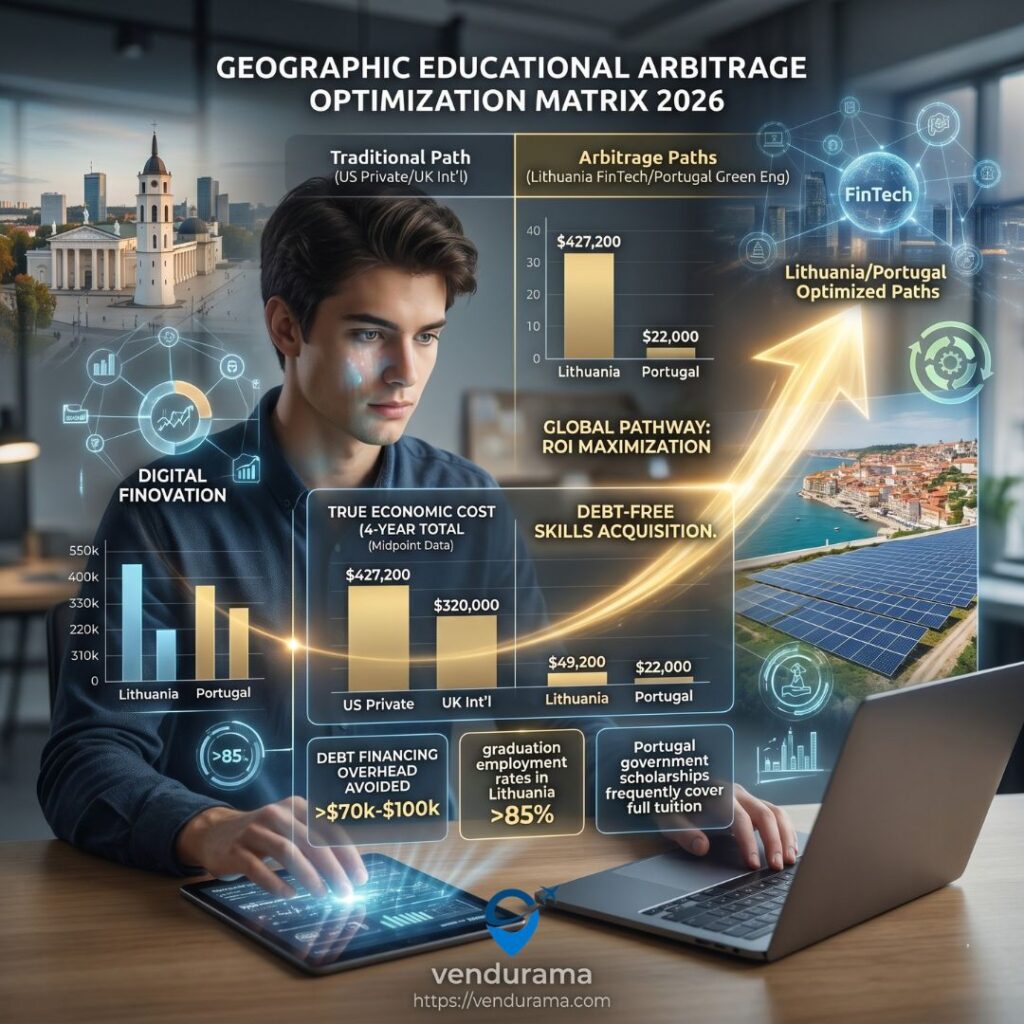
The Bank of Lithuania’s pioneering regulatory sandbox, established in 2017, has attracted over 200 FinTech companies to establish European headquarters in Vilnius, including global players like Revolut, TransferGo, and Vinted. This concentration of industry creates an unparalleled educational advantage: university curricula are co-developed with active industry practitioners, internship opportunities are abundant, and graduate employment rates in high-compensation roles exceed 85% within six months of completion. The purchasing power parity advantage amplifies this value proposition: a junior FinTech analyst in Vilnius earns €28,000-35,000 annually with a cost of living 60% below London, creating a superior savings and investment trajectory for early-career professionals.
University Programs in FinTech and Cybersecurity
The academic architecture of Lithuanian FinTech education reflects this intentional industry integration. Vilnius University, Vilnius Gediminas Technical University (VILNIUS TECH), and ISM University of Management and Economics offer fully English-taught bachelor’s and master’s programs in FinTech, blockchain technologies, cybersecurity, and data analytics. Vilnius University’s FinTech curriculum, developed in partnership with the Bank of Lithuania and leading industry players, integrates real-world payment system simulations, regulatory compliance frameworks, and entrepreneurial venture development that prepare graduates for roles in both established institutions and startup ecosystems.
Tuition for international students ranges from €2,500 to €4,500 annually, with merit-based scholarships reducing costs by up to 50% for high-achieving applicants from partner countries. Living expenses in Vilnius further amplify the arbitrage advantage: a comfortable student lifestyle—including shared apartment accommodation, public transportation, meals, and leisure—averages €500-750 monthly, compared to $2,200+ in London or New York.
Cost-Benefit Analysis: Vilnius vs. London/New York
The economic case for Lithuanian FinTech education is best understood through rigorous comparative analysis. A four-year bachelor’s degree in FinTech or cybersecurity at a London institution costs approximately £128,000 in tuition alone ($162,000), with living expenses adding another £76,000 ($96,000) over the degree duration. New York alternatives present a parallel challenge: private institution tuition averages $55,000 annually, with Manhattan living costs exceeding $24,000 per year.
In contrast, comprehensive FinTech programs in Lithuania range from €10,000 to €18,000 in total tuition ($11,000-$20,000), with living expenses averaging €6,000-9,000 annually ($6,600-$10,000). When factoring in the full four-year duration, the total cost differential approaches $140,000-$180,000—capital that can be redeployed toward professional certifications (CFA, FRM, CISSP), entrepreneurial seed capital, or early-career investment portfolios.
| Cost Component | London (International) | New York (Private) | Vilnius (Public) |
| Annual Tuition | $40,500 | $55,000 | $3,200 |
| Mandatory Fees | $2,100 | $3,800 | $400 |
| Annual Housing | $19,000 | $24,000 | $3,600 |
| Living Expenses | $14,500 | $18,000 | $4,200 |
| Health Insurance | $2,800 | $4,200 | $600 |
| Books/Supplies | $1,100 | $1,800 | $300 |
| Annual Total | $80,000 | $106,800 | $12,300 |
| 4-Year Total | $320,000 | $427,200 | $49,200 |
| Debt Financing Cost (6.5% APR) | +$70,000 | +$94,000 | +$10,800 |
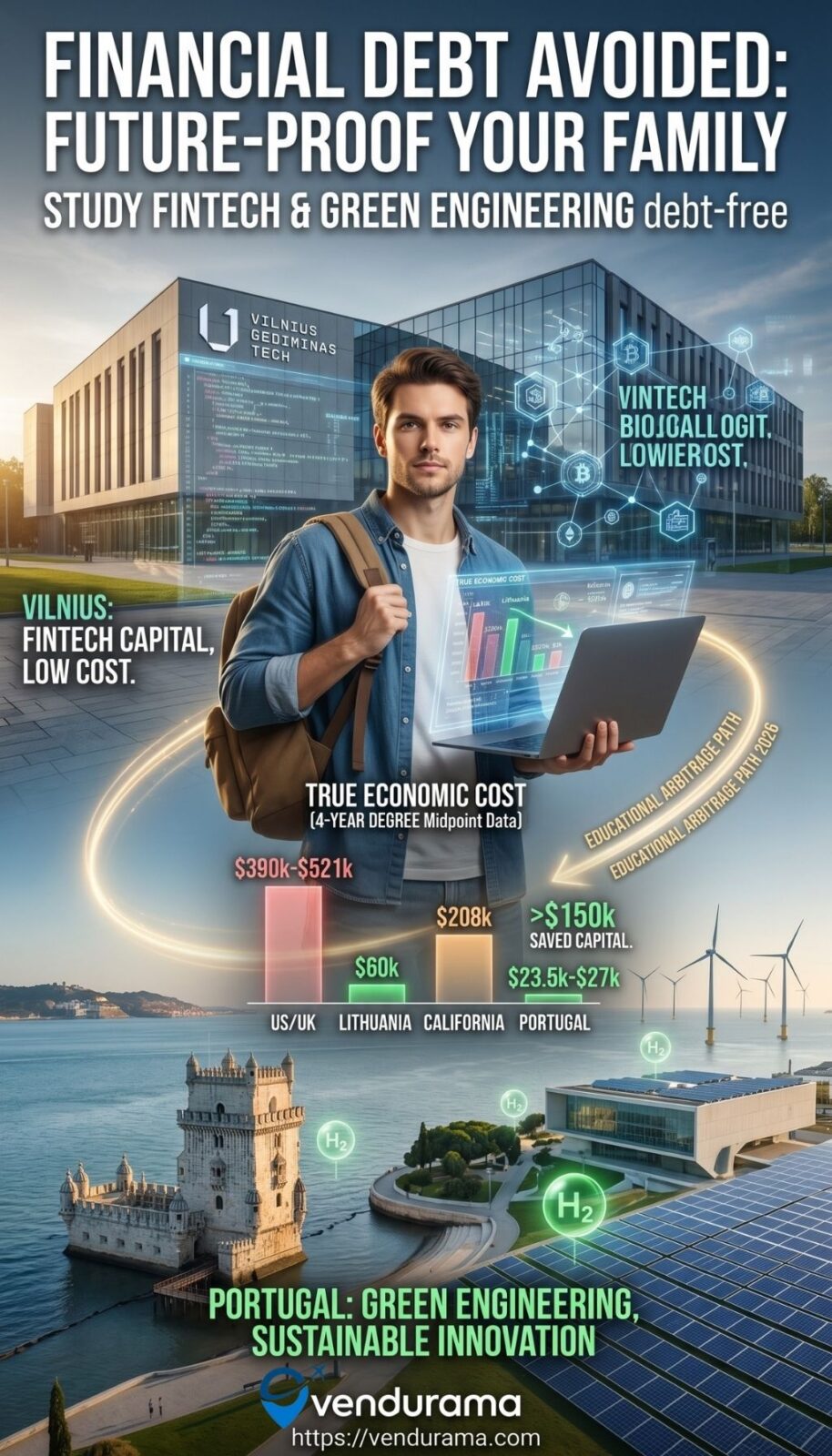
| True Economic Cost | $390,000 | $521,200 | $60,000 |
Portugal: The Vanguard of Green Engineering and Sustainable Innovation
Portugal’s Renewable Energy Transition and Engineering Demand
Portugal’s emergence as a global leader in green engineering education stems from a deliberate national strategy to leverage renewable energy transition as an economic development catalyst. In 2023, Portugal achieved a historic milestone: generating 100% of its electricity from renewable sources for six consecutive days. This achievement has catalyzed massive public and private investment in green technology innovation, creating unprecedented demand for engineers specializing in solar photovoltaics, offshore wind, green hydrogen production, and sustainable infrastructure design.
The Portuguese government has structured its higher education system to attract international talent to this growing sector. Even without scholarships, tuition at top-tier institutions like the University of Lisbon and University of Porto ranges from €1,500 to €3,500 annually for English-taught engineering programs—versus $45,000+ at comparable US private institutions.
University Programs in Sustainable Business and Renewable Technology
The academic architecture of Portuguese green engineering education reflects this intentional industry alignment. The University of Lisbon’s Instituto Superior Técnico, University of Porto’s Faculty of Engineering, and NOVA School of Business and Economics offer fully English-taught master’s programs in renewable energy engineering, sustainable business management, and circular economy innovation.
Living expenses in Portugal’s major innovation hubs—Lisbon, Porto, and Coimbra—further amplify the arbitrage value. A comfortable student lifestyle, including private studio apartment, meals, transportation, and leisure, averages €600-900 monthly ($660-$1,000). For families calculating total cost of attendance, these differentials translate to $18,000-25,000 annual savings versus US alternatives.
Lifestyle, EU Career Pathways, and Cost Comparison
The experiential value of Portuguese education extends beyond cost to encompass quality of life metrics that enhance student well-being and long-term career satisfaction. Portugal consistently ranks among the world’s top destinations for work-life balance, safety, and climate quality. The coastal lifestyle, with access to Atlantic beaches, historic urban centers, and a vibrant cultural scene, provides a holistic educational experience.
Post-graduation mobility options further enhance the strategic value of a Portuguese degree. The EU Blue Card directive enables graduates with job offers exceeding 1.5 times the national average salary to obtain fast-track work authorization across all 27 member states.
| Cost Component | UK (International) | California (Private) | Lisbon (Public) | Porto (Public) |
| Annual Tuition | $38,000 | $45,000 | $2,200 | $1,900 |
| Mandatory Fees | $2,400 | $4,100 | $350 | $300 |
| Annual Housing | $17,500 | $22,000 | $4,200 | $3,600 |
| Living Expenses | $13,800 | $19,500 | $4,800 | $4,200 |
| Health Insurance | $3,100 | $4,800 | $700 | $650 |
| Books/Supplies | $1,200 | $2,100 | $400 | $350 |
| Annual Total | $76,000 | $97,500 | $12,650 | $11,000 |
| 2-Year Master’s Total | $152,000 | $195,000 | $25,300 | $22,000 |
| Debt Financing Cost (6.5% APR) | +$10,400 | +$13,300 | +$1,700 | +$1,500 |
| True Economic Cost | $162,400 | $208,300 | $27,000 | $23,500 |
Logistical Architecture: Engineering a Flawless Student Relocation
Visa Processes and Regulatory Frameworks
The successful execution of educational arbitrage depends on meticulous pre-departure preparation. A sophisticated strategy operates on three analytical planes: destination research, application optimization, and logistical coordination.
Visa processes warrant strategic planning. Lithuania offers a streamlined temporary residence permit for studies. Portugal’s student visa framework provides similar facilitation, with the added advantage of post-study work authorization. For families managing complex application timelines, booking initial reconnaissance flights for campus tours enables efficient in-person assessment of academic facilities and local infrastructure without excessive travel expenditure.
Documentation preparation requires systematic organization. Academic transcripts, language proficiency certificates, and statement of purpose should be compiled 12-18 months before intended enrollment.
Housing Strategies and Cost Optimization
Housing strategies merit deliberate planning to balance cost efficiency with quality of life and academic proximity. University dormitories offer convenience, but private apartments provide autonomy. A hybrid approach often balances social integration with long-term comfort.
For families conducting initial housing evaluations, the ability to evaluating long-term student housing options during reconnaissance visits ensures informed decision-making based on firsthand assessment of neighborhood safety and transportation connectivity. Furthermore, the psychological importance of reliable setup cannot be overstated: for students finalizing relocation plans, securing semester-long accommodations with clear lease terms and proximity to campus reduces cognitive load during the critical academic transition phase.
The Critical Transition: Arrival and Integration Logistics
The arrival phase represents the period of greatest vulnerability to logistical friction. Following a long-haul flight, navigating an unfamiliar city with academic materials and the psychological weight of a major life transition requires strategic foresight. Sophisticated families mitigate this friction by arranging reliable airport-to-campus transfers for arriving students, eliminating the uncertainty of public transportation or unregulated taxi services.
The psychological importance of reliable logistics extends beyond immediate comfort. For students managing heavy academic luggage and sensitive documents, securing safe heavy-luggage transport upon arrival allows cognitive resources to focus on academic orientation rather than navigational uncertainty. This professional approach to relocation logistics represents the hallmark of sophisticated educational arbitrage execution.
Long-term integration depends on systematic support engagement. Leading Lithuanian and Portuguese universities offer comprehensive international student services. Families should proactively engage these resources, treating them as force multipliers for the educational investment. Additionally, for travelers coordinating complex academic reconnaissance, booking vetted ground transportation for the academic transition ensures connection reliability and minimizes transit fatigue.
Conclusion: The Long-Term Wealth Accumulation Advantage of Debt-Free Education
The strategic imperative for middle-class families facing the new economy education cost crisis is clear: geographic educational arbitrage is not merely an alternative pathway, but a rational optimization of human capital investment. By leveraging the FinTech ecosystem of Lithuania and the green engineering innovation of Portugal, families can secure world-class technical training at 10-20% of the Anglophone cost. The $150,000-$200,000 differential is not merely savings; it is capital that can be deployed toward entrepreneurial ventures, professional certifications, or early-career wealth accumulation—creating a compounding advantage that extends far beyond graduation.
This arbitrage strategy requires sophisticated execution: rigorous due diligence on accreditation status, strategic logistical planning for relocation, and proactive engagement with industry partnerships. The reward is profound: a debt-free technology education that provides not only technical competency but also strategic optionality across multiple geographic markets and career pathways.
The financial modeling of this strategy reveals compelling long-term outcomes. Over a 10-year career horizon, this differential compounds to approximately $250,000-$400,000 in additional wealth accumulation for the arbitrage strategist.
The future of technical education belongs not to those who accumulate the most debt, but to those who optimize the most value. By embracing geographic educational arbitrage, middle-class families can reclaim agency over their educational investments and position the next generation of innovators for success in a globalized technology marketplace. For the sophisticated, analytical reader, the calculus is unequivocal: the time for geographic educational arbitrage is now.