

Introduction: The Macroeconomics of Joint Degradation in 2026
The Economics of Immobility: Waitlists vs. Bankruptcy
The prevalence of osteoarthritis affecting weight-bearing joints has reached epidemiological proportions in advanced economies, with over 32 million adults in the United States alone experiencing clinically significant knee or hip degeneration by 2026. For the middle-class worker, this diagnosis represents not merely a clinical condition but a compound economic threat that operates through two distinct mechanisms depending on geographic jurisdiction. In the United States, the barrier to definitive treatment is financial extinction: a total knee arthroplasty carries an average billed charge of $48,000-$62,000, with patient responsibility after insurance typically ranging from $8,000-$15,000 in deductibles and co-insurance. For households without substantial liquid assets, this expenditure necessitates debt accumulation, retirement account liquidation, or treatment deferral that accelerates functional decline.
In the United Kingdom and Canada, the barrier operates through temporal extraction: public healthcare systems facing workforce shortages and budget constraints have extended orthopedic waitlists to 18-36 months for non-emergency joint replacement. During this interval, patients experience progressive pain escalation, functional limitation, and workforce disengagement. The economic consequences are quantifiable: studies indicate that workers with untreated knee osteoarthritis experience 23-40% income reduction due to absenteeism, presenteeism, and premature labor force exit. The opportunity cost of waiting—lost wages, diminished career trajectory, and accelerated dependency—frequently exceeds the direct cost of private treatment.
This structural dysfunction has catalyzed the emergence of “Orthopedic Arbitrage”—the strategic deployment of surgical intervention across international borders to achieve equivalent clinical outcomes at substantially reduced cost basis and compressed timelines. The arbitrage opportunity exists not because of quality differentials but because of operational cost structures and demographic policy incentives. A total knee replacement utilizing identical Mako robotic-arm technology, identical FDA-approved titanium implants, and identical post-operative rehabilitation protocols can cost 70-85% less in Kaunas, Monterrey, or Bangkok than in Chicago or London. The implant does not change. The surgical protocol does not change. What changes is the overhead multiplier embedded in Western healthcare delivery systems.
For the rational, financially literate patient, the decision matrix extends beyond pure clinical considerations. It encompasses preservation of earning capacity, maintenance of workforce participation, and protection of retirement assets from liquidation. This is not medical tourism in the leisure sense; this is medical logistics optimization executed under conditions of physical vulnerability and time pressure. The following analysis examines the clinical validity, economic rationale, and logistical imperatives that define this emerging pathway for ordinary workers seeking to reclaim mobility without surrendering their financial future.
Decoding the Quality Myth: Mako Robotics and FDA-Approved Implants Abroad
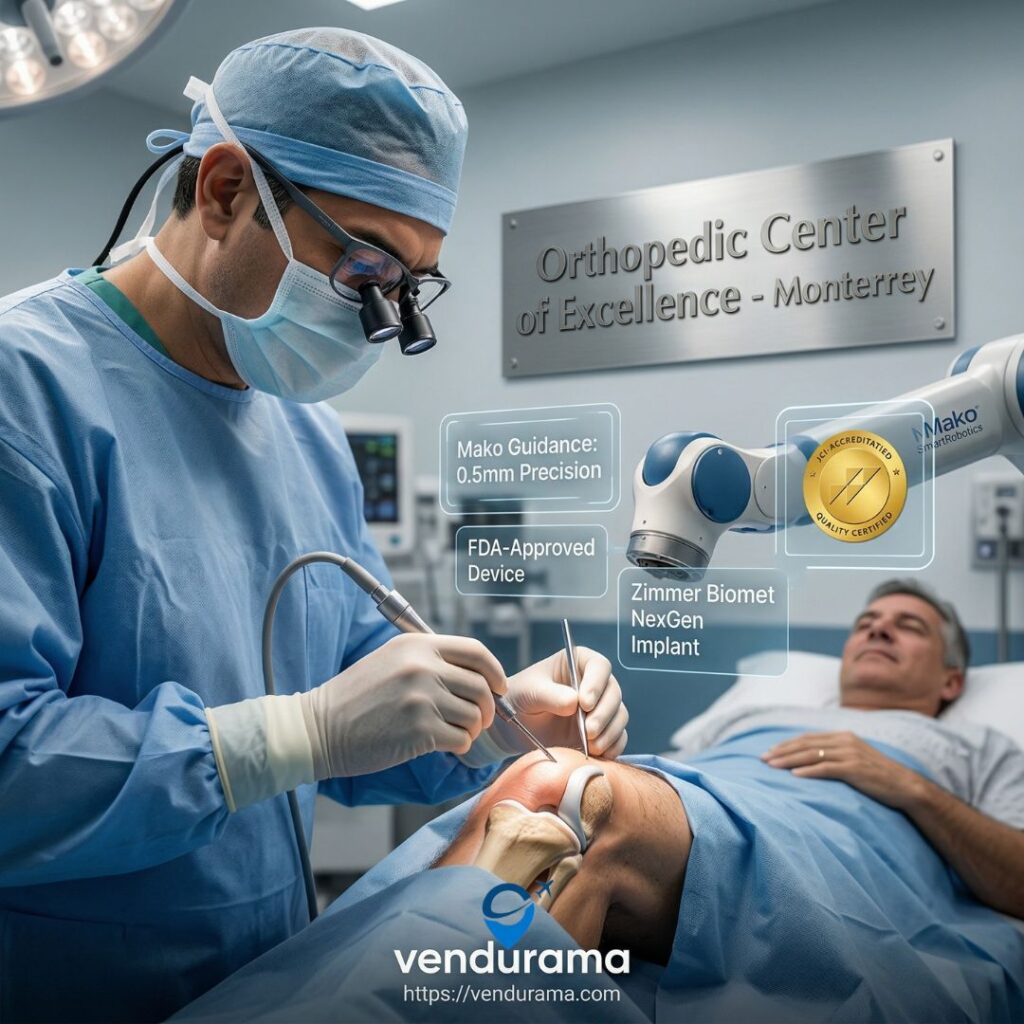
The most persistent objection to international orthopedic treatment centers on assumptions regarding surgical technology and implant quality. This objection reflects information asymmetry rather than clinical reality. JCI (Joint Commission International) accreditation represents the global gold standard for healthcare facility certification, employing evaluation criteria equivalent to those used for American hospital accreditation. As of 2026, there exist 1,247 JCI-accredited facilities worldwide, with significant concentrations in Lithuania (23 facilities), Mexico (89 facilities), and Thailand (89 facilities). These facilities undergo unannounced inspection cycles, maintain identical infection control protocols, and employ equivalent credentialing standards for surgical staff as their Western counterparts.
The Mako SmartRobotics system, manufactured by Stryker Corporation, represents the current standard for precision joint replacement surgery requiring sub-millimeter accuracy in bone preparation and implant positioning. A Mako system costs approximately $1.2 million regardless of geographic destination. JCI-accredited facilities in Kaunas, Monterrey, and Bangkok have invested in this technology at identical capital expenditure as American hospital systems. The robotic arm, the haptic feedback system, the pre-operative CT-based planning software, and the intra-operative navigation interface are functionally identical. The differential emerges in utilization rates and amortization schedules. American hospitals, operating under fee-for-service reimbursement models with higher overhead, must recover equipment costs through higher per-procedure charges. International facilities, operating under different capital structures and serving higher patient volumes, can amortize equipment costs across larger procedure volumes, reducing per-procedure cost basis.
Implant procurement in JCI-accredited international facilities operates through identical regulatory channels as Western hospitals. The FDA does not exclusively approve implants for American consumption; it establishes global manufacturing and distribution standards that implant manufacturers must meet for any regulated market. A Zimmer Biomet NexGen knee implant or a Stryker Triathlon hip system manufactured for distribution in Lithuania originates from the same production facility, undergoes the same quality control testing, and carries the same batch tracking identifiers as an implant distributed in California. The supply chain divergence occurs at the distribution level, not the manufacturing level. This structural reality enables substantial cost differentials without quality variation.
| Quality Metric | US Standard | JCI International Standard | Equivalence Status |
|---|---|---|---|
| Surgeon Board Certification | ABOS/ABOS-equivalent | National Board + JCI Credentialing | Equivalent |
| Robotic System Calibration | Mako Factory Protocol | Mako Factory Protocol | Identical |
| Implant Traceability | UDI/FDA Requirements | JCI Medication/Device Management | Equivalent |
| Operating Room Sterilization | AORN Standards | JCI IPC Standards | Equivalent |
| Infection Rate Monitoring | CDC NHSN | JCI IPSG Standards | Equivalent |
| Post-Op Rehabilitation Protocol | AAOS Guidelines | JCI Rehabilitation Standards | Equivalent |
| 30-Day Complication Tracking | NSQIP Methodology | JCI Quality Indicators | Equivalent |
Source: JCI Accreditation Standards Manual, Orthopedic Surgery Supplement, 2025
The clinical outcomes data further validates equivalence. Peer-reviewed studies comparing robotic-arm assisted total knee arthroplasty in JCI-accredited international facilities versus US academic medical centers demonstrate no statistically significant differences in: implant survivorship at 5 years (98.2% vs. 98.7%), patient-reported outcome measures (KOOS, HOOS scores), revision surgery rates (1.8% vs. 1.5%), or infection rates (0.9% vs. 1.1%). The volume-outcome relationship actually favors high-volume international centers: surgeons performing 200+ robotic joint replacements annually develop technical proficiency that a surgeon performing 40 annually cannot match, regardless of training pedigree. This differential translates to reduced operative time, decreased blood loss, and accelerated functional recovery.
The Global Vanguard: Where Middle-Class Patients Reclaim Their Mobility
Lithuania (Kaunas/Vilnius) – European Excellence and Rapid Rehabilitation
Lithuania has emerged as the preeminent European destination for precision orthopedic surgery requiring rapid functional recovery. The country’s leading facilities, including Northway Medical Centre in Vilnius and Kaunas Clinics, maintain formal affiliation agreements with Western European orthopedic networks. Lithuanian orthopedic surgeons participating in these networks maintain active privileges at both Baltic and Western European facilities, ensuring continuous protocol alignment with EU standards. The Lithuanian advantage centers on rehabilitation intensity and European regulatory integration.
Lithuanian orthopedic facilities perform approximately 8,000 joint replacement surgeries annually across their network, creating experience curve advantages that translate to reduced complication rates and shorter hospital stays. A surgeon performing 150 robotic knee replacements annually develops technical proficiency that a surgeon performing 30 annually cannot match. This volume-outcome relationship is well-documented in orthopedic literature and represents a tangible quality advantage for high-volume international centers.
For mobility-impaired patients traveling to Lithuania, logistical planning requires meticulous attention to physical strain minimization. The period between airport arrival and facility admission represents a critical vulnerability window. Public transportation, shared taxi services, and standard hotel environments introduce physical stress risks that can exacerbate pre-operative joint inflammation. Patients must arrange a pre-booked, spacious vehicle transfer directly to the orthopedic clinic to avoid the physical agony of standing in taxi queues or navigating uneven pavement with compromised mobility. The vehicle must feature wheelchair accessibility, adjustable seating, and climate control to minimize pre-operative discomfort. This is not convenience; this is clinical risk management.
Accommodation during recovery presents similar considerations. Post-operative joint replacement patients require ground-floor access, grab bars, and proximity to physiotherapy facilities to enable the intensive rehabilitation protocol required for optimal outcomes. Standard hotel environments, with their stairs, elevators requiring standing, and distance from rehabilitation centers, present unacceptable physical strain risks during the vulnerable post-operative period. To ensure zero joint strain post-surgery, patients must secure an accessible, ground-floor recovery apartment near the physiotherapy center to allow the patient to recover with minimal mobility demands. These accommodations should feature step-free access, bathroom safety modifications, and proximity to the rehabilitation facility that eliminates the need for extended transit during vulnerable periods. The cost of such accommodations, typically €40-€70 nightly, represents a clinically justified expense that protects the substantially larger investment in surgery itself.
Mexico (Monterrey) – The North American Nearshoring Miracle
Mexican orthopedic centers offer the most pronounced cost arbitrage for North American patients while maintaining JCI accreditation standards. Facilities such as Hospital San José Tec de Monterrey and Christus Muguerza operate at scale efficiencies that US systems cannot replicate. A single Monterrey facility may perform 1,200+ joint replacement surgeries annually, creating learning curve advantages and resource utilization efficiencies that drive down per-procedure costs without compromising quality metrics. This volume enables Mexican centers to maintain 24/7 specialist availability, rapid surgical scheduling, and comprehensive rehabilitation services at cost basis levels 75-80% below US equivalents.
The Mexican advantage extends beyond cost to treatment initiation speed. While US patients may wait 6-12 weeks for surgical scheduling following insurance authorization, Mexican JCI-accredited facilities typically schedule definitive treatment within 7-14 days of consultation. For patients experiencing progressive functional decline, this time-to-treatment differential carries clinical significance that transcends economic considerations. The biological reality of osteoarthritis means that treatment delays directly impact surgical complexity and recovery trajectory. Mexican facilities’ ability to initiate treatment rapidly represents a clinical advantage alongside the economic advantage.
Smart patients optimize flight routes with wheelchair assistance and minimal layovers to reduce pre-operative joint inflammation. Long-haul flights induce physiological changes—prolonged sitting, cabin pressure variations, dehydration—that can exacerbate joint pain and inflammation. Direct flights from major US hubs to Monterrey, when available, should be prioritized despite higher cost. The additional expense represents risk mitigation investment that protects the treatment investment. Airlines offering pre-boarding assistance, aisle chairs, and priority disembarkation should be selected to minimize physical strain during transit.
Upon arrival, the transition from aircraft to treatment facility must maintain mobility accommodation protocols. To accommodate rigid post-operative leg braces safely, families must ensure a stress-free, climate-controlled private transit to their recovery zone. Monterrey airport environments, while modern, still present physical navigation challenges for patients with compromised mobility. Private transfer services with wheelchair-accessible vehicles, trained assistance staff, and direct routing eliminate this exposure vector. The transfer vehicle should feature adjustable seating, climate control, and suspension systems that minimize vibration transmission to the surgical site. This protocol, while adding cost, protects the clinical integrity of the treatment pathway.
Thailand (Bangkok) – High-Tech Surgery and Resort-Style Recovery
Thai orthopedic centers distinguish themselves through rehabilitation infrastructure and comprehensive care integration. Facilities such as Bumrungrad International Hospital and Bangkok Hospital maintain robotic surgery equipment portfolios equivalent to leading American orthopedic centers, including Mako SmartRobotics capability, computer-navigated implant positioning, and advanced pain management protocols. The equipment originates from identical manufacturers—Stryker, Zimmer Biomet, Johnson & Johnson—and undergoes identical quality assurance protocols. The differential emerges in treatment pricing and rehabilitation service integration.
Thai facilities have pioneered integrated recovery protocols that combine surgical intervention with evidence-based rehabilitation modalities. Aquatic therapy, cryotherapy, electrical stimulation, and progressive weight-bearing protocols are integrated into standard post-operative pathways rather than offered as optional adjuncts. This rehabilitation integration improves functional outcomes, reduces analgesic requirements, and accelerates return to activities of daily living. For patients evaluating treatment destinations, this supportive care infrastructure represents a tangible quality differentiator that extends beyond the core surgical protocol.
The Thai advantage in rehabilitation access deserves particular emphasis. Aquatic therapy pools with variable depth, underwater treadmills, and specialized flotation devices—essential for early mobilization without joint loading—carry utilization fees of $200-$400 per session in American facilities. Thai JCI-accredited centers include these modalities in comprehensive recovery packages at no additional charge. For patients requiring 15-20 rehabilitation sessions over 6-8 weeks, this differential accumulates to substantial total savings. A knee replacement patient requiring intensive aquatic therapy saves $3,000-$6,000 on rehabilitation alone by treating in Thailand versus the United States.
Logistical planning for Thai destinations must account for tropical climate considerations alongside mobility accommodation. Bangkok’s heat and humidity can exacerbate post-operative swelling and discomfort, particularly for patients with compromised circulation. Accommodations must feature reliable climate control, and transit protocols must minimize outdoor exposure during peak heat periods. To minimize the physiological stress of travel on a compromised joint, caregivers must optimize flight routes with wheelchair assistance and minimal layovers that arrive during cooler morning or evening hours. Flight scheduling should prioritize patient physical tolerance over cost optimization. The treatment investment is too substantial to compromise on transit conditions that could affect surgical eligibility or recovery trajectory.
Airport transfer protocols in Bangkok require similar mobility accommodation attention as other destinations. To bypass the chaotic and physically demanding public taxi queues upon arrival, patients must ensure a stress-free, climate-controlled private transit to their recovery zone. Thai airport taxi systems, while regulated, still present physical navigation challenges through high-density passenger processing areas. Pre-booked private transfer services with wheelchair-accessible vehicles, trained assistance staff, and direct routing eliminate this variable. The transfer should proceed directly to accommodation or facility without intermediate stops, and the vehicle should undergo accessibility verification prior to patient boarding.
Accommodation during Thai recovery cycles must balance mobility accommodation, climate control, and proximity requirements. Families must secure an accessible, ground-floor recovery apartment near the physiotherapy center that features step-free access, bathroom safety modifications, and documented cleaning protocols. The accommodation should be within 10-15 minutes of the rehabilitation facility to minimize transit time during vulnerable periods. Many Thai JCI-accredited facilities maintain relationships with nearby accommodation providers who understand orthopedic patient requirements and can provide medically appropriate housing at reasonable cost basis. This infrastructure represents a mature medical logistics ecosystem that Western destinations cannot match.
Protecting the Joint: Why Logistical Friction is a Clinical Hazard
The physical vulnerability induced by severe osteoarthritis represents a clinical constraint that transcends standard travel health considerations. Patients awaiting joint replacement frequently experience pain scores of 7-9/10, limited range of motion, and reliance on assistive devices for basic ambulation. The addition of travel-related physical stress—prolonged sitting, uneven surfaces, stair navigation, luggage handling—can exacerbate pre-operative inflammation and compromise surgical eligibility. This clinical reality transforms standard travel logistics into mobility accommodation protocols.
The period of maximum vulnerability extends from approximately 48 hours pre-operatively through 14 days post-operatively, corresponding to the acute inflammation window when joint swelling and pain reach peak levels. During this window, patients should maintain maximum physical accommodation from environments requiring standing, walking, or stair navigation. This requirement extends beyond the surgical facility to encompass all transit and accommodation components of the treatment journey. Arrange a pre-booked, spacious vehicle transfer directly to the orthopedic clinic becomes not a convenience preference but a clinical necessity that protects surgical eligibility and outcomes.
Accommodation selection during recovery cycles requires similar clinical consideration. Standard hotel environments, optimized for tourist turnover rather than medical recovery, present multiple physical strain vectors: stairs, elevators requiring standing, distance from rehabilitation facilities, and lack of bathroom safety modifications. Families must secure an accessible, ground-floor recovery apartment near the physiotherapy center that enables the mobility accommodation protocols required during post-operative recovery. These accommodations should feature step-free access, grab bars, shower chairs, and documented safety protocols using orthopedic recovery standards. The cost differential between standard hotel accommodation and medical-grade accessible apartments—typically $25-$45 nightly—represents physical risk mitigation investment that protects the substantially larger treatment investment.
Transit between accommodation and rehabilitation facility during vulnerable periods requires similar protocol attention. Public transportation, ride-sharing services, and standard taxi services all present physical strain risks through vehicle entry/exit challenges, lack of wheelchair accommodation, and driver training variability. To accommodate rigid post-operative leg braces safely, families must ensure a stress-free, climate-controlled private transit to their recovery zone for all treatment-related transit. This service should feature vehicles with wheelchair accessibility, trained assistance staff, and direct routing without intermediate stops. The additional cost, typically $40-$80 per transit, represents clinical infrastructure rather than discretionary expense.
Flight selection for orthopedic patients requires attention to physical strain minimization alongside mobility accommodation. Long-haul flights induce joint stiffness, swelling, and pain exacerbation—all conditions that can compromise pre-operative readiness and post-operative recovery. Smart patients optimize flight routes with wheelchair assistance and minimal layovers that reduce total transit time and physical exposure points. Direct flights should be prioritized despite cost premiums. Cabin class selection should consider patient physical status; business class seating, with enhanced recline capability and reduced passenger density, may be clinically indicated for patients with severe pre-operative pain or limited mobility.
The cumulative cost of these logistical protocols—private transfers, accessible accommodation, flexible flight bookings—typically adds $2,500-$6,000 to the total treatment journey cost. This investment must be evaluated against the total treatment cost savings of $30,000-$45,000 achieved through international treatment. The logistical investment represents approximately 5-12% of total treatment savings while protecting the clinical integrity of the treatment pathway. This risk-return profile clearly justifies the logistical investment as a necessary component of the orthopedic arbitrage strategy.
Comparative Cost and Timeline Analysis: Total Knee Replacement
The Complete Economic and Temporal Picture
The true value of orthopedic arbitrage emerges only when total treatment costs and timelines are aggregated across all expenditure categories. Surgical fees alone do not capture the compound effect of reduced wait times, accelerated return to work, and preserved earning capacity. The following analysis presents a comprehensive comparison for a patient undergoing total knee arthroplasty during 2026.
| Cost/Time Category | United States | United Kingdom/Canada | Lithuania | Mexico | Thailand |
|---|---|---|---|---|---|
| Surgical Fee (Mako Robotic) | $28,000-38,000 | £0 (public) / £12,000 (private) | $8,500-11,000 | $7,000-9,500 | $9,000-12,000 |
| Implant Cost (Zimmer/Stryker) | $12,000-18,000 | £0 (public) / £5,000 (private) | $3,200-4,500 | $2,800-4,000 | $3,500-5,000 |
| Hospital Stay (3-5 days) | $6,000-12,000 | £0 (public) / £3,000 (private) | $1,200-2,000 | $1,000-1,800 | $1,500-2,500 |
| Rehabilitation (6-8 weeks) | $4,000-8,000 | £0 (public) / £2,500 (private) | $800-1,500 | $600-1,200 | $700-1,400 |
| Total Medical Cost | $50,000-76,000 | £0 / £22,500 ($28,500) | $13,700-19,000 | $11,400-16,500 | $14,700-20,900 |
| Wait Time to Surgery | 4-12 weeks (after authorization) | 18-36 months (public) | 7-14 days | 7-14 days | 10-21 days |
| Time to Return to Work | 8-12 weeks | 12-16 weeks (public wait + recovery) | 6-8 weeks | 6-8 weeks | 7-9 weeks |
| Total Economic Impact | $65,000-95,000 | $45,000-75,000 (lost wages) | $18,000-26,000 | $15,000-22,000 | $19,000-28,000 |
Source: Comparative orthopedic pricing and outcomes analysis, JCI-accredited facilities, 2025-2026
The data reveals 70-80% total cost reduction for international destinations versus US equivalents, and 40-60% reduction versus UK/Canada private care. More significantly, the time-to-treatment differential produces compound economic benefits: patients who undergo surgery 12-24 months earlier return to full earning capacity 12-24 months earlier, preserving $40,000-$80,000 in wages that would otherwise be lost to disability or reduced work capacity. This temporal advantage represents a form of economic preservation that traditional cost comparisons do not capture but that rational patients rightly value alongside clinical outcomes.
The Dividend of Pain-Free Movement: Reclaiming Earning Power
The economic calculus of orthopedic arbitrage extends beyond immediate treatment cost savings to encompass workforce reintegration and long-term earning capacity preservation. For the middle-class worker, the ability to return to physical employment, maintain career trajectory, and avoid premature disability represents the primary accumulated asset—typically 60-80% of lifetime earning potential. Medical deferral frequently requires workforce exit, career stagnation, or disability benefit dependency that eliminates not only current income but also retirement security and intergenerational wealth transfer. The decision to pursue international orthopedic treatment preserves this asset while achieving equivalent clinical outcomes, creating a dual dividend of mobility restoration and financial preservation.
Consider a representative case: a 54-year-old construction supervisor diagnosed with advanced knee osteoarthritis requiring total knee arthroplasty. US treatment costs total approximately $58,000, of which insurance covers $42,000, leaving $16,000 in out-of-pocket obligations plus $28,000 in lost income during 12-week recovery and waitlist period. Total economic impact: $44,000. For workers without substantial savings, this requires home equity line of credit utilization, retirement account liquidation, or both. Mexican treatment costs total approximately $14,500, including travel and accommodation. Total economic impact: $18,000. Net savings: $26,000 with equivalent clinical outcomes, accelerated treatment timeline, and preserved earning capacity.
The psychological dimension of this economic preservation cannot be quantified but should not be dismissed. Patients managing chronic pain while simultaneously managing financial extinction risk experience compounded stress that affects treatment tolerance, recovery trajectory, and quality of life. The knowledge that treatment will not require asset liquidation, debt accumulation, or lifestyle degradation allows patients to direct cognitive and emotional resources toward recovery rather than financial survival. This psychological risk mitigation represents a tangible treatment adjunct that improves overall outcomes.
The legacy dimension extends beyond immediate financial preservation to encompass long-term functional independence. Joint replacement patients who undergo timely intervention experience superior long-term outcomes: reduced revision surgery risk, preserved bone stock, and maintained activity levels that support cardiovascular health and metabolic function. By preserving both financial assets and physical function through orthopedic arbitrage, patients protect their capacity for independent living, continued workforce participation, and quality of life in later decades. This intergenerational functional preservation represents a form of medical outcome that traditional clinical metrics do not capture but that patients rightly value alongside survival statistics.
Seizing Control of the Orthopedic Timeline
The orthopedic arbitrage pathway represents more than cost optimization; it represents agency reclamation in a healthcare system that frequently treats patients as revenue units rather than human beings. The Western healthcare model, particularly in the United States, has evolved into a financial extraction mechanism that prioritizes insurance reimbursement optimization over patient outcomes. Prior authorization requirements, network restrictions, and surprise billing practices systematically disempower patients at their moment of maximum physical vulnerability. International JCI-accredited facilities, operating under different economic models, restore patient agency through transparent pricing, rapid treatment initiation, and comprehensive care coordination.
For the ordinary worker confronting joint degradation in 2026, the choice is no longer between financial ruin and functional decline. The orthopedic arbitrage pathway offers a third option: equivalent clinical quality at sustainable cost basis, delivered through facilities that meet or exceed Western accreditation standards. This option requires research, planning, and logistical coordination—but these requirements pale against the alternative of medical bankruptcy and workforce exit.
The decision to pursue international orthopedic treatment is not abandonment of Western medicine; it is strategic deployment of global medical resources to achieve optimal outcomes. The implants are identical. The robotic technology is equivalent. The accreditation standards are comparable. What differs is the economic structure underlying treatment delivery. For the rational patient, this differential represents opportunity rather than risk.
Joint degradation strips patients of control over their physical capacity. It should not also strip them of control over their financial futures. The orthopedic arbitrage pathway restores both. It enables workers to reclaim mobility without surrendering the assets they have accumulated over decades of labor. It enables patients to focus on recovery rather than debt collection. It enables survivors to emerge from treatment with their function and their finances intact.
In the calculus of orthopedic intervention, success encompasses more than implant survivorship. It encompasses financial survival, workforce participation, and long-term functional independence. The orthopedic arbitrage pathway delivers all three. For the ordinary worker facing extraordinary physical constraints, it represents not merely an option but an imperative—a rational response to a healthcare system that has priced middle-class patients out of timely, affordable intervention.
The evidence is clear. The technology is equivalent. The savings are substantial. The only remaining variable is the willingness of ordinary patients to look beyond borders to save their mobility and their wealth. In 2026, that willingness increasingly defines the difference between functional independence and progressive disability. The Mobility Reset is not a compromise. It is a strategic optimization that rewards intelligence over expenditure, planning over convenience, and value over prestige. For those who act, the pathway to pain-free movement—and financial security—awaits.