Introduction: The Macroeconomics of the 2026 Educational Arbitrage
The year 2026 marks a structural inflection point in the global economics of higher education. For the ordinary middle-class family, the traditional pathway to a university degree in the United States or the United Kingdom has transformed from a reliable investment in human capital into a high-leverage financial instrument fraught with systemic risk. In the United States, the aggregate student loan portfolio has surpassed $1.7 trillion, with the average borrower graduating with approximately $37,000 in debt. However, this average masks the severity of the burden for professional degrees, where liabilities frequently exceed $100,000. When compounded over a standard 10-year repayment term at prevailing interest rates, the total cost of attendance often doubles, effectively mortgaging the graduate’s third decade of life. This debt overhang delays critical economic milestones: home ownership, marriage, and retirement savings. The opportunity cost is staggering. A monthly payment of $1,000 invested in a diversified index fund over 30 years would yield significantly more wealth than the educational premium gained from a mid-tier Western university.
Consequently, a strategic pivot is occurring among financially literate families. They are decoupling the concept of “educational quality” from “geographic prestige.” The realization is dawning that a degree is a credential signaling competency, and that competency can be acquired in multiple jurisdictions without the accompanying debt penalty. This is not merely cost-cutting; it is educational arbitrage. It involves identifying markets where the price of tuition and living expenses is disconnected from the global value of the credential earned. In 2026, four specific destinations have emerged as optimal nodes for this strategy: Spain, South Korea, Hungary, and Argentina. These nations offer robust infrastructure, recognized accreditation, and, crucially, cost structures that allow for debt-free graduation.
The psychological burden of the Western model cannot be overstated. The anxiety of financing education often precedes the academic stress, impairing student performance. By contrast, the global model offers a psychological dividend: the freedom to pursue career paths based on interest and aptitude rather than immediate salary requirements needed to service debt. This article provides a comprehensive analytical framework for evaluating these destinations. It examines the tuition structures, the return on investment (ROI) regarding post-graduation employment, and the logistical realities of student relocation. It is designed for the family that views education as a long-term asset class to be managed with fiscal discipline.
For families seeking a complete roadmap to navigate this complex landscape, Vendurama has compiled a strategic blueprint. Readers looking for actionable visa checklists and university selection matrices should secure The Ultimate Study Abroad Guide: From Dream to Reality 2026. Priced at a discounted rate of $14.99, this resource includes two exclusive audio masterclasses (a 22-minute overview and a 50-minute deep-dive) that walk parents through the logistical intricacies of securing a debt-free future.
Spain: European Heritage and Affordable Excellence
The Economic Structure of Spanish Public Universities
Spain represents the most accessible entry point into the European Higher Education Area (EHEA) for the middle-class family. The Spanish university system is predominantly public, funded by regional governments, which allows for tuition fees that are subsidized heavily by the state. In 2026, the cost of attendance for international students at public universities ranges from €1,000 to €3,000 per academic year, depending on the autonomous community. This is a fraction of the cost of private institutions in the UK or US, yet the academic rigor remains high. Universities such as the University of Barcelona, Complutense University of Madrid, and Pompeu Fabra University consistently rank within the top 500 globally, offering degrees that are recognized across the European Union and North America.
The economic advantage extends beyond tuition. The cost of living in Spain, while higher than in Eastern Europe or South America, remains significantly below that of Northern Europe or major American cities. In cities like Valencia, Seville, or Granada, a student can maintain a comfortable lifestyle—including rent, food, and transport—for €800 to €1,000 per month. Madrid and Barcelona are more expensive, but still offer better value than London or New York. The purchasing power parity (PPP) for a student in Spain is favorable, allowing for a quality of life that supports academic focus without the financial precarity common in Western hubs.
Strategic Language Asset
Beyond the immediate cost savings, studying in Spain provides a long-term economic asset: fluency in Spanish. As the second most spoken native language in the world, Spanish opens labor markets across Latin America and the United States. For a graduate entering the global economy, bilingualism is a significant differentiator that can command a salary premium of 5-10% in multinational corporations. This linguistic capital adds to the ROI of the degree. When parents book flexible student flights for the autumn intake, they should consider the specific regional costs, as Andalusia often offers lower living expenses than Catalonia.
Table 1: Comparative Cost of a 4-Year Undergraduate Degree (2026 Estimates)
| Cost Component | United States (Public Out-of-State) | United Kingdom (International) | Spain (Public University) |
|---|---|---|---|
| Tuition Fees | $180,000 | $114,000 | $12,000 – $20,000 (Total) |
| Living Expenses | $60,000 | $54,000 | $40,000 |
| Total Direct Cost | $240,000 | $168,000 | $52,000 – $60,000 |
| Avg. Graduating Debt | $37,000+ | $40,000+ | $0 – $5,000 |
| ROI Timeline | 10+ Years | 8+ Years | Immediate |
The data illustrates the magnitude of the arbitrage. A Spanish degree costs roughly 25% of a US equivalent. The credential holds equal weight in global labor markets, particularly in business, humanities, and sciences. The primary logistical challenge is the visa process, which requires proof of funds and health insurance. However, the long-term economic benefit vastly outweighs the administrative friction. For a student arriving in Madrid or Barcelona, the transition is facilitated by efficient public transport. However, for the initial arrival with heavy luggage, it is a non-negotiable safety measure to arrange a pre-booked, vetted airport transfer directly to the campus dormitory. This ensures the student is not vulnerable to taxi scams or navigation errors in a new language environment during their first few hours.
South Korea: Elite STEM Degrees and Government Subsidies
Maximizing the Asian Tech Boom
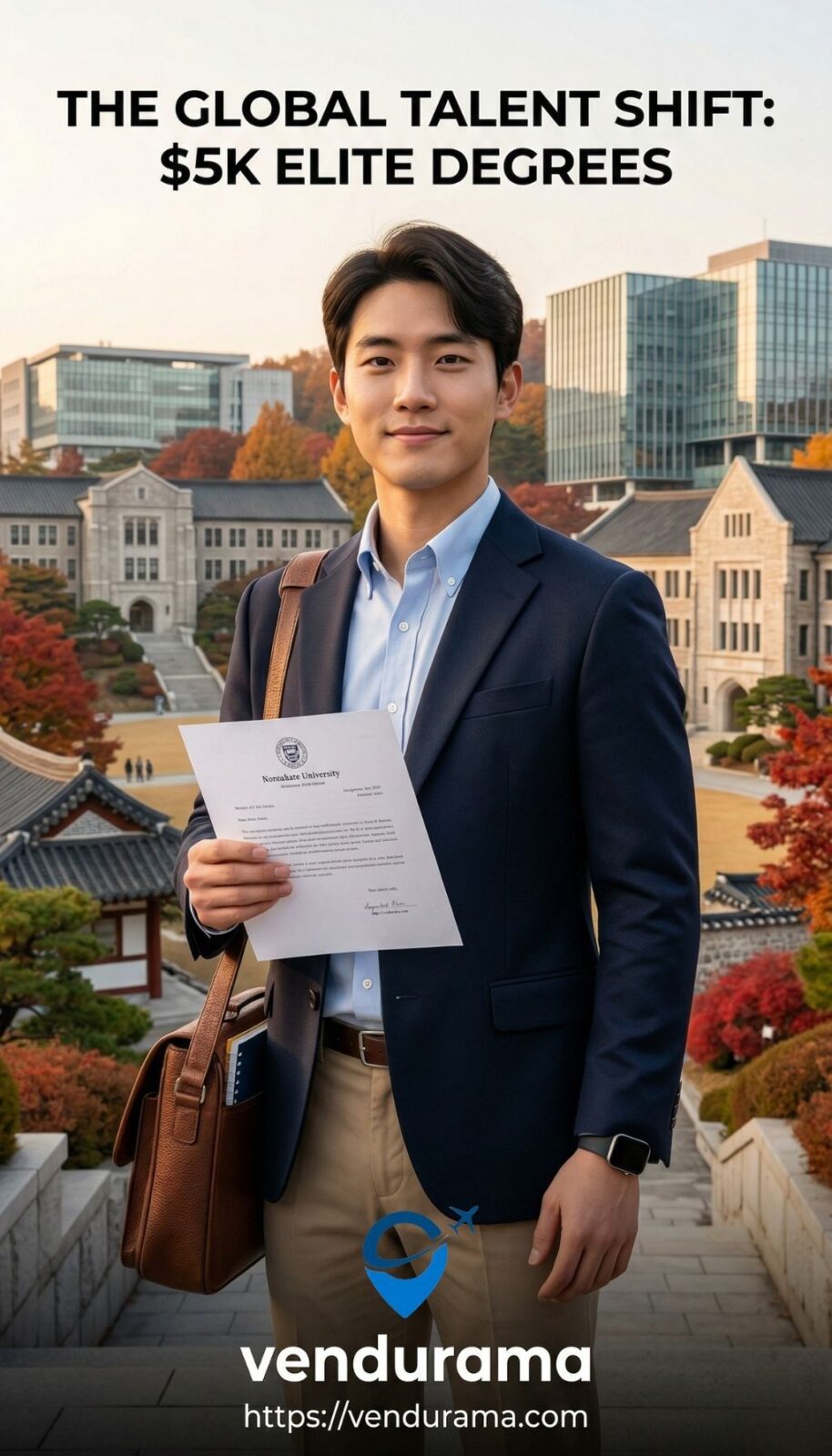
South Korea has strategically positioned itself as a global leader in technology and innovation, and its higher education system reflects this national priority. The government views international students as a source of soft power and future talent, leading to substantial subsidies and scholarship programs. The Global Korea Scholarship (GKS) is the flagship initiative, covering full tuition, airfare, and a monthly stipend for selected students. Even without full scholarships, tuition fees at Korean universities are significantly lower than in the US, typically ranging from $3,000 to $6,000 per year for international students.
For students pursuing STEM (Science, Technology, Engineering, Mathematics) fields, South Korea offers unparalleled industry integration. Universities like KAIST (Korea Advanced Institute of Science and Technology) and Seoul National University have direct pipelines to conglomerates such as Samsung, LG, and Hyundai. Internships are often integrated into the curriculum, providing students with work experience and professional networks before graduation. The ROI for engineering and computer science degrees from Korean institutions is exceptionally high, given the demand for tech talent globally.
Living Costs and Infrastructure
Seoul is a megacity with a cost of living that is high by Asian standards but still competitive globally. However, students can reduce costs significantly by choosing universities in provincial cities like Daejeon, Gwangju, or Busan. In these regions, accommodation and food costs can be 40% lower than in the capital. The public transportation infrastructure is world-class, reducing the need for private vehicles. When students secure reliable temporary housing near the university to scout the neighborhoods safely, they should prioritize locations near subway lines to minimize commute times and costs.
Safety and Cultural Adaptation
South Korea is one of the safest countries in the world, with low crime rates and a high regard for education. For parents concerned about the safety of their child traveling alone, the risk profile is minimal. However, the cultural and language barrier can be significant. While many graduate programs are in English, daily life requires some Korean proficiency. Universities offer language courses, and immersion is rapid. The logistical chain is efficient; Incheon International Airport is a global hub. To protect the student from arrival exhaustion and navigation stress, it is an absolute necessity to …arrange a pre-booked, air-conditioned airport transfer directly to the student dormitory or campus housing. (or dormitory). This ensures a seamless transition from the aircraft to the accommodation, preserving the student’s energy for orientation.
Hungary: The Stipendium Hungaricum and Cost-Effective Rigor
Accessing the EU Labor Market Debt-Free
Hungary has emerged as a critical gateway for students seeking careers in medicine, engineering, and technology within the European Union. The country’s higher education system is rigorous, adhering to the Bologna Process standards, which ensures degree recognition across Europe and compatibility with US systems. The Stipendium Hungaricum scholarship program is a key driver of this destination’s popularity, offering full tuition waivers, monthly stipends, and accommodation support to thousands of international students annually. Even for self-funded students, tuition fees are affordable, typically ranging from €2,500 to €5,000 per year.
Medical and Engineering Excellence
For pre-medical students, Hungary offers 6-year MD programs in English that are significantly more affordable than US pre-med tracks followed by medical school. The total cost of a medical degree in Hungary is often less than the cost of a single year of medical school in the United States. Graduates are eligible to sit for licensing exams in the US (USMLE), UK (PLAB), and across the EU. With the physician shortage projected to worsen in Western nations by 2030, the demand for qualified doctors is inelastic. A Hungarian medical degree provides a competitive entry into this high-income profession without the $200,000+ debt burden typical of American medical graduates.
Cost of Living and Quality of Life
Hungary offers a high quality of life at a cost that is manageable for middle-class families. Cities like Budapest, Debrecen, and Szeged are culturally rich, safe, and well-connected. Rent for a student apartment ranges from €400 to €700 per month. Food and transportation are subsidized and efficient. The Schengen Area membership allows students to travel freely across 26 European countries, enhancing the cultural educational component of the degree. This mobility is a hidden benefit, allowing for networking and internships across borders without visa friction. When parents book flexible student flights for the autumn intake, they must account for the university’s orientation week, which often starts before official classes. Arriving a week early allows for acclimatization and administrative setup (bank accounts, SIM cards) without academic pressure.
Navigating the Bureaucracy
The primary challenge in Hungary is bureaucratic. Visa processes and residence permit applications can be slow and require precise documentation. Health insurance is mandatory and must be purchased from a Hungarian provider or a recognized international scheme. For students arriving in Budapest, the airport infrastructure is modern. However, public transport from the airport to the city center, while cheap, can be cumbersome with heavy luggage. For a young student arriving in a new country, it is a non-negotiable safety measure to arrange a pre-booked, vetted airport transfer directly to the campus dormitory. This eliminates the risk of getting lost or overcharged during the vulnerable arrival window.
Argentina: Free Public Universities and Profound Cultural Immersion
Navigating the Economic Realities of South America
Argentina represents the most extreme form of educational arbitrage available in 2026. The country’s public university system, including the prestigious University of Buenos Aires (UBA), charges zero tuition fees for international students. This policy is rooted in the constitutional right to education. Students pay only nominal administrative fees, making the direct cost of the degree negligible. For the middle-class family, this eliminates the largest line item in the education budget entirely.
The Currency Dividend
The economic advantage is compounded by the exchange rate. For students holding USD, EUR, or GBP, the Argentine Peso offers immense purchasing power. While inflation is high domestically, foreign currency holders can access goods and services at a fraction of global costs. Accommodation, food, and transport can be secured for $300 to $500 per month, allowing for a comfortable lifestyle on a modest budget. This currency dividend allows students to focus on their studies without the need for extensive part-time work, which can detract from academic performance.
Cultural and Linguistic Environment
Argentina offers a rich cultural environment with a strong emphasis on the arts, humanities, and social sciences. Spanish is the primary language, providing the same linguistic asset as studying in Spain. The society is welcoming to international students, and the academic culture is rigorous and debate-oriented. For students pursuing law, social sciences, or medicine, Argentina offers a unique perspective on Global South issues that is increasingly valued in international organizations. When securing reliable temporary housing near the university, families should verify safety features and proximity to public transport, as Buenos Aires is a large metropolis.
Logistical Considerations
Travel to Argentina involves long-haul flights, which can be costly and fatiguing. The time zone difference is significant for students coming from Europe or Asia. Upon arrival at Ezeiza International Airport, the distance to the city center is considerable. The taxi market at the airport can be predatory if not managed. It is highly recommended to arrange a reliable private transfer to the university housing to ensure a fixed rate and a safe vehicle. The drive to the city takes about 45 minutes, but having a pre-vetted driver eliminates the friction of arrival. The strategic advantage of Argentina lies in its ability to offer a prestigious credential with a near-zero cost base, effectively decoupling the price of the degree from its market value.
Securing the Student’s Arrival: Logistical Safety as a Priority for Parents

Risk Management in Student Relocation
The strategic selection of a university is only the first phase of the educational arbitrage. The execution phase—relocation—carries its own risks and costs. For an 18-year-old student traveling alone to a foreign continent, the margin for error is slim. Lost luggage, missed connections, or unsafe transit upon arrival can derail the start of the semester, causing psychological distress that impacts academic performance. Therefore, logistics must be managed with the same rigor as the academic application.
Flight Strategy and Budgeting
Airfare is the largest upfront variable cost in this travel model. Unlike Western Europe, which is served by a dense network of low-cost carriers, these emerging hubs may rely more on legacy carriers and regional airlines. Booking windows are critical. Prices for flights to Seoul, Budapest, or Buenos Aires tend to spike sharply within six weeks of departure. Smart travelers optimize flight routes to reduce total travel time and potential physiological strain when departing for a university hub months in advance. Flexibility with dates is a powerful lever; shifting travel by 48 hours can reduce airfare by 30%. Families should also consider nearby airports. For example, flying into Vienna and taking a train to Budapest, or flying into São Paulo and connecting to Buenos Aires, can sometimes yield better flight options than direct routes.
Accommodation Screening and Vetting
Housing is the second largest expense and the primary safety concern. University dormitories are safest but fill quickly. Private housing requires verification of leases, safety features (locks, fire escapes), and neighborhood safety. In cities like Buenos Aires or Seoul, rental scams targeting foreigners exist. Using reputable platforms and verifying landlord identities is crucial. Before signing a long-term lease, families should secure reliable temporary housing near the university to scout the neighborhoods safely. A slightly higher rent for a safer, central location is a worthwhile insurance premium.
The Critical First Transfer
The moment of arrival at the destination airport is the highest risk point for scams and stress. Drivers at airports often target fresh arrivals with inflated rates. The fatigue of a long flight makes students vulnerable to poor decision-making. To protect the family from arrival exhaustion and local taxi scams, it is an absolute necessity to arrange a pre-booked, air-conditioned airport transfer directly to your villa (or dormitory). This service locks in the price, ensures the vehicle is suitable for the family size, and provides a vetted driver who speaks English. This small upfront investment protects the entire trip’s budget from immediate leakage.
Navigating Visa and Housing Contracts
The complexity of coordinating flights, transfers, and accommodation in emerging markets requires a centralized plan. Navigating visa applications and housing contracts requires a blueprint. The Vendurama Ultimate Study Abroad Guide addresses this complexity. For a nominal investment of $14.99, families gain access to a comprehensive logistical framework. Specifically, the 50-minute podcast included in the guide walks parents through exactly how to set up their child abroad safely, covering everything from bank account setup to emergency protocols. This audio masterclass condenses months of research into actionable intelligence, reducing the risk of costly administrative errors. You can access this resource at The Ultimate Study Abroad Guide: From Dream to Reality 2026.
Health and Insurance
Health insurance is mandatory in all four destinations. Coverage must meet specific visa requirements. Students should carry a digital and physical copy of their policy. Prescriptions should be translated into the local language. Access to mental health support is also critical; the stress of relocation can trigger underlying issues. Universities typically offer counseling services, but familiarity with the system before arrival is beneficial.
Table 2: Post-Graduation Employment Prospects and Visa Ease (2026)
| Destination | Post-Study Work Visa | Avg. Starting Salary (USD) | Industry Strength |
|---|---|---|---|
| Spain | 12 Months (Job Search) | $35,000 – $50,000 | Tourism, Business, Tech |
| South Korea | 12 Months (D-10 Visa) | $45,000 – $65,000 | Tech, Engineering, Manufacturing |
| Hungary | 12 Months (Job Search) | $40,000 – $60,000 | Medical, IT, Engineering |
| Argentina | 6-12 Months (Temporary) | $20,000 – $40,000 | Agriculture, Law, Social Sciences |
The table highlights that debt-free education does not compromise employability. In fact, the lack of debt allows graduates to be more selective, potentially waiting for higher-value roles rather than accepting the first offer to service loans.
Financial Intelligence as the Foundation of Academic Success
The Portable Nature of Educational Capital in 2026
In the final analysis, the decision of where to pursue higher education is the first major financial transaction of a young adult’s life. In the 2026 economic landscape, the traditional Western model carries a risk profile that is increasingly difficult to justify for the ordinary middle-class family. The debt-free degree is not a compromise on quality; it is an optimization of capital allocation. By choosing destinations like Spain, South Korea, Hungary, or Argentina, families are leveraging global market inefficiencies to secure high-value assets (degrees) at low cost. This strategy preserves the student’s future earning power, allowing them to invest in their own future rather than servicing past debt.
The psychological impact of this financial freedom is profound. A graduate without debt has the agency to pursue entrepreneurship, further education, or lower-paid but socially valuable work. They are not tethered to a specific salary bracket by loan obligations. This flexibility is the true dividend of the debt-free strategy. It transforms education from a financial burden into a pure investment in human potential. The logistical challenges of international study are manageable with proper planning and the right tools. The safety and wellbeing of the student are paramount, and investing in secure logistics is a small price to pay for peace of mind.
To execute this strategy flawlessly, preparation is paramount. The difference between a successful relocation and a chaotic one often lies in the details of logistics and documentation. Framing the Vendurama Ultimate Study Abroad Guide as the ultimate investment in a student’s safe and debt-free future is a logical conclusion. For just $14.99, this resource provides the specific tactical knowledge needed to navigate these regions with confidence. It includes two exclusive audio podcasts (a 22-minute overview and a 50-minute deep-dive) that offer expert guidance on visa processes, housing safety, and cultural integration. In an economy where every dollar of educational capital counts, this small investment yields a disproportionately high return in risk mitigation and strategic clarity. The global classroom is open, and for the financially intelligent family, it offers a path to prosperity that the debt-laden Western model can no longer match. Secure your copy now at The Ultimate Study Abroad Guide: From Dream to Reality 2026.