
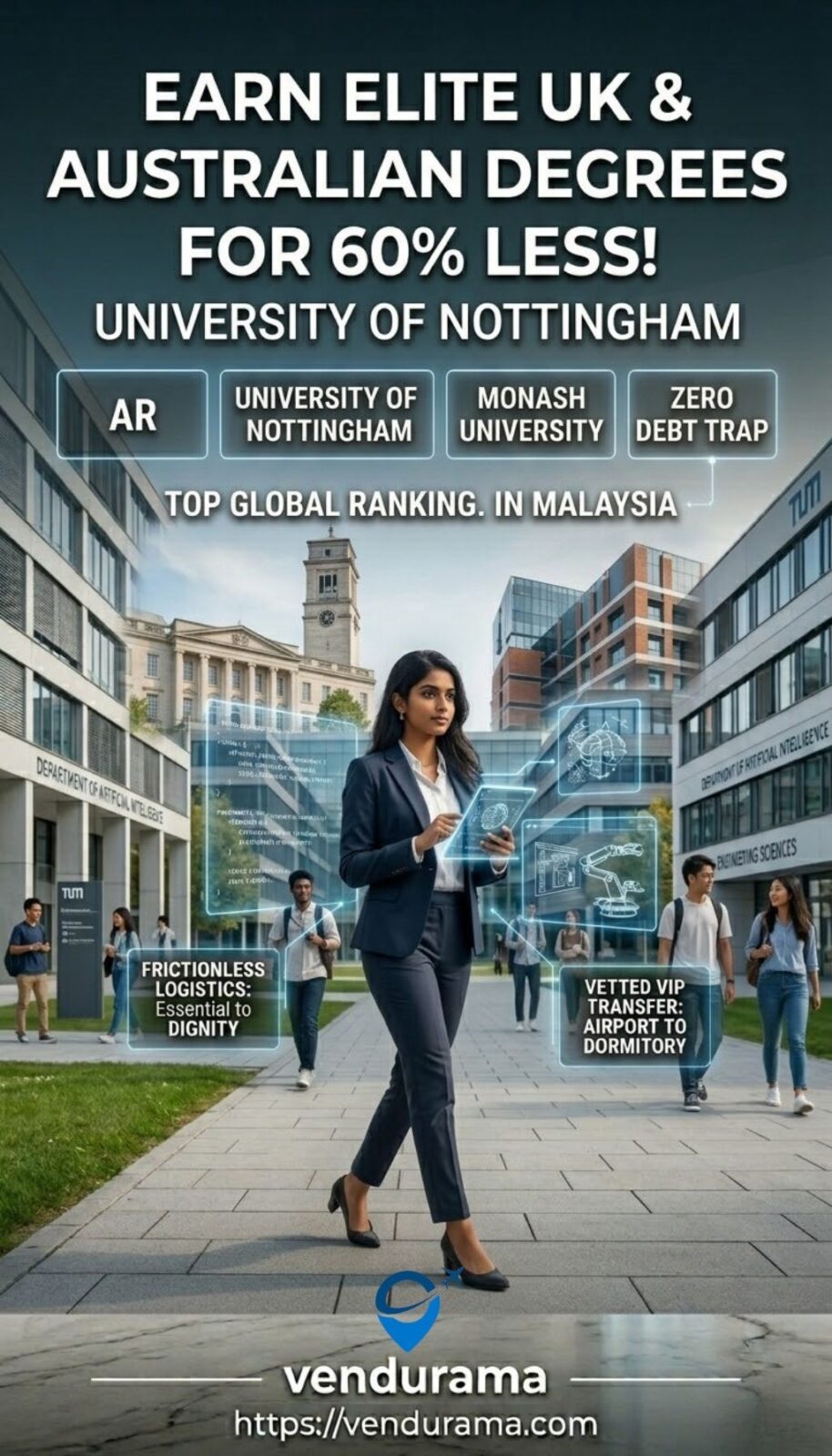
Introduction: The 2026 Western Education Debt Trap
In 2026, the dream of obtaining a prestigious UK or Australian university degree has become a financial nightmare for the global middle class. The numbers are no longer debatable: a complete undergraduate degree at a top-tier institution in London, Melbourne, or Sydney now routinely exceeds $250,000 when tuition, accommodation, living expenses, and ancillary costs are calculated over three to four years. For ambitious students and parents who want globally recognized qualifications, this reality creates an impossible choice: either burden your family with crushing debt that will follow you well into your thirties, or compromise on educational quality and institutional prestige.
But what if there was a third option? What if you could graduate with the exact same authentic degree from the University of Nottingham or Monash University, with identical curriculum standards, the same grading systems, and no distinguishing mark on the final diploma indicating where the studies took place—all while saving up to 60% on total costs?
This is not a hypothetical scenario. This is the reality of branch campus education in Malaysia, and it represents the most significant educational geo-arbitrage opportunity available to smart, financially astute students and families in 2026.
Malaysia has quietly emerged as the world’s premier hub for foreign branch campus education, hosting elite institutions from the United Kingdom, Australia, and beyond. These are not satellite programs or distance learning arrangements. These are full-fledged, physical campuses operated directly by the home universities, employing the same academic standards, the same examination boards, and the same quality assurance mechanisms as their metropolitan counterparts.
The core value proposition is straightforward: you receive the exact same degree certificate issued by the home campus (UK or Australia), taught 100% in English by international faculty, but the total cost of attendance is dramatically lower due to financial arbitrage. Tuition fees are often reduced, but the real savings emerge from living expenses—rent, food, transportation, and daily costs in Kuala Lumpur or Johor are approximately 60% lower than London, Melbourne, or Sydney.
For students and parents who understand that true wealth preservation means making strategically superior decisions rather than following conventional paths, Malaysian branch campuses represent a paradigm shift. You graduate with the same credential, enter the same global job market, and carry none of the debt anchor that cripples your Western-educated peers. This article will provide you with the complete analytical framework to evaluate this opportunity, the specific institutions worth considering, and the logistical protocols to ensure your transition is as secure and stress-free as possible.
The financial implications extend far beyond tuition savings. A family that chooses Malaysian branch campus education over direct Western study saves approximately $150,000 to $200,000 per student. This capital can be deployed toward graduate studies, home purchases, business investments, or retirement accounts. The compound wealth effect over a generation is extraordinary. When students understand that they can secure reliable flights to Kuala Lumpur for the transition period while still saving 60% compared to Western education costs, the decision becomes analytically obvious.
This article serves as the definitive blueprint for middle-class students and parents considering Malaysian branch campus education. It will provide the financial mathematics, the institutional knowledge, the application protocols, and the logistical frameworks necessary to execute this strategy successfully. For families who refuse to accept the false choice between quality and affordability, Malaysia’s branch campuses represent the path forward—elite education without the debt trap.
The Malaysian Solution: Why This Southeast Asian Hub Dominates Branch Campus Education
Strategic Positioning for International Education
Malaysia’s emergence as the global leader in branch campus education is not accidental. The country has systematically positioned itself as the optimal destination for international students seeking Western credentials at accessible costs. Several factors converge to create this advantage:
Government Support: The Malaysian government actively promotes education tourism through favorable visa policies, infrastructure investment, and regulatory frameworks that protect international student interests. The Ministry of Higher Education maintains dedicated departments for international student services, streamlining processes that would otherwise create bureaucratic friction.
English Language Environment: Malaysia maintains English as a secondary official language, with business and education conducted primarily in English. This eliminates the language barrier that complicates study in non-English-speaking countries while preserving the cultural richness of Southeast Asian location.
Cost Structure: The fundamental economic advantage cannot be overstated. Malaysia’s cost of living remains substantially below Western metropolitan centers while maintaining modern infrastructure, quality healthcare, and international-standard amenities. This creates sustainable affordability rather than temporary promotional pricing.
Geographic Accessibility: Kuala Lumpur International Airport (KLIA) connects directly to major cities across Asia, Australia, Europe, and the Middle East. Flight times from Sydney (8 hours), London (13 hours), and regional Asian hubs (2-5 hours) make Malaysia accessible for family visits and student travel.
Safety and Quality of Life Considerations
For parents evaluating branch campus options, safety represents a primary concern. Malaysia consistently ranks among the safest countries in Southeast Asia for international students:
Crime Statistics: Violent crime against international students in Malaysian university towns is exceptionally rare. The primary safety concerns are petty theft and traffic accidents—risks that exist in any urban environment globally, including London and Melbourne.
Healthcare Quality: Malaysia maintains excellent private healthcare facilities at affordable costs. International students are required to maintain health insurance, and major universities have on-campus medical centers with English-speaking staff.
Cultural Acceptance: Malaysia is a multicultural society with significant Malay, Chinese, Indian, and expatriate populations. International students from diverse backgrounds report high levels of social acceptance and integration.
Infrastructure Quality: Malaysian cities feature modern public transportation, reliable internet connectivity, international cuisine options, and shopping facilities that match Western standards. Students do not sacrifice quality of life for cost savings.
The Multicultural Advantage
Studying in Malaysia provides exposure to multiple cultures simultaneously. Your classmates include Malaysians, other Asian international students, Middle Eastern students, and Western expatriates. This creates networking opportunities across multiple geographic markets—valuable for students planning international careers in 2026’s globalized economy.
Language exposure extends beyond English. Students naturally acquire familiarity with Malay, Mandarin, and Tamil through daily interactions, developing genuine multilingual competence that monolingual Western campuses cannot offer. This cultural intelligence increasingly matters to multinational employers evaluating graduate candidates.
Defining the ‘Branch Campus’ Model: Not Partnerships, But Direct Operations
Understanding the Structural Difference
A critical distinction separates branch campuses from franchise programs or twinning arrangements. Branch campuses are owned, managed, and academically controlled by the parent university. They are not partner institutions licensing a name—they are the university operating in a different geographic location.
University of Nottingham Malaysia is not a Malaysian university using the Nottingham name. It is the University of Nottingham—one of the UK’s Russell Group research-intensive universities—operating a campus in Semenyih, Malaysia. The same applies to Monash University Malaysia, Curtin University Malaysia, and Swinburne University of Technology Sarawak.
Academic Governance: The academic governance flows from the home campus. Examination papers are often standardized. External examiners from the home country review assessment outcomes. Quality assurance is maintained through the same institutional mechanisms across all campuses.
Faculty Standards: Branch campuses employ international faculty meeting the same qualification requirements as home campus positions. Many faculty members hold PhDs from Western universities and maintain research connections with home campus colleagues.
Student Mobility: Many branch campus programs offer student exchange opportunities, allowing Malaysian campus students to spend one or two semesters at the home campus. This provides Western campus experience while maintaining the cost advantages of Malaysian study.
Leading Branch Campus Institutions in Malaysia
Monash University Malaysia (Established 1998)
- Home Institution: Monash University (Melbourne, Australia)
- Global Ranking: Top 50 worldwide (QS World University Rankings)
- Location: Bandar Sunway, Selangor
- Programs: Engineering, Business, Science, Medicine, Arts
- Annual Tuition: $10,000 to $18,000 USD
University of Nottingham Malaysia (Established 2000)
- Home Institution: University of Nottingham (United Kingdom)
- Global Ranking: Top 100 worldwide (QS World University Rankings)
- Location: Semenyih, Selangor
- Programs: Engineering, Business, Science, Medicine, Humanities
- Annual Tuition: $9,500 to $16,000 USD
Curtin University Malaysia (Established 2000)
- Home Institution: Curtin University (Perth, Australia)
- Global Ranking: Top 200 worldwide
- Location: Miri, Sarawak and Kuala Lumpur
- Programs: Engineering, Business, Science, Health Sciences
- Annual Tuition: $8,500 to $14,000 USD
Swinburne University of Technology Sarawak (Established 2000)
- Home Institution: Swinburne University of Technology (Melbourne, Australia)
- Global Ranking: Top 300 worldwide
- Location: Kuching, Sarawak
- Programs: Engineering, Business, Design, ICT
- Annual Tuition: $8,000 to $13,000 USD
Heriot-Watt University Malaysia (Established 2014)
- Home Institution: Heriot-Watt University (Edinburgh, Scotland)
- Global Ranking: Top 300 worldwide
- Location: Putrajaya
- Programs: Engineering, Business, Built Environment
- Annual Tuition: $8,500 to $14,000 USD
Why Universities Operate Branch Campuses
Understanding institutional motivation reinforces the legitimacy of the model. Top-tier universities operate Malaysian branch campuses for several strategic reasons:
Market Access: These institutions gain access to the rapidly growing Asian higher education market without requiring students to relocate to expensive Western cities. This expands their global footprint and student diversity.
Cost Efficiency: Operating costs in Malaysia are substantially lower than in London, Melbourne, or Sydney. Faculty salaries, facility maintenance, and administrative overhead are all reduced, allowing the university to maintain profitability while charging significantly lower tuition.
Research Opportunities: These campuses serve as research hubs for region-specific studies, particularly in fields like tropical medicine, Southeast Asian economics, and regional engineering challenges.
For the student, this institutional motivation translates into a win-win scenario: the university expands its global presence profitably, and the student receives an identical credential at a fraction of the cost. There is no compromise on quality because the university’s reputation depends on maintaining consistent standards across all campuses.
The Drastic Financial Arbitrage: Tuition vs. Living Costs
Complete Cost Breakdown: Western Campus vs. Malaysian Branch Campus
To understand the magnitude of savings available through Malaysian branch campus education, we must calculate the complete three-to-four-year cost of attendance, including tuition, accommodation, food, transportation, health insurance, and miscellaneous expenses. The following analysis uses 2026 published figures and realistic living cost estimates.
Monash University Melbourne (Australia) – 4 Years
| Cost Category | Annual Cost (USD) | 4-Year Total (USD) |
|---|---|---|
| Tuition (Engineering/Business) | $45,000 | $180,000 |
| On-Campus Accommodation | $18,000 | $72,000 |
| Food & Living Expenses | $15,000 | $60,000 |
| Health Insurance (OSHC) | $1,200 | $4,800 |
| Books & Materials | $2,000 | $8,000 |
| Transportation | $1,500 | $6,000 |
| Total | $82,700 | $330,800 |
Monash University Malaysia – 4 Years
| Cost Category | Annual Cost (USD) | 4-Year Total (USD) |
|---|---|---|
| Tuition (Engineering/Business) | $12,000 | $48,000 |
| On-Campus Accommodation | $4,500 | $18,000 |
| Food & Living Expenses | $5,000 | $20,000 |
| Health Insurance | $400 | $1,600 |
| Books & Materials | $1,500 | $6,000 |
| Transportation | $600 | $2,400 |
| Total | $24,000 | $96,000 |
Total Savings: $234,800 (71% Reduction)
The Living Cost Advantage: 60% Savings Explained
While tuition differences are substantial, the living cost arbitrage represents the most significant savings component. Kuala Lumpur and Johor maintain modern urban amenities at costs dramatically below Western metropolitan centers:
Accommodation: Modern student apartments near branch campuses cost $300-500 monthly compared to $1,500-2,500 in London or Melbourne. Purpose-built student accommodation with facilities matching Western standards is widely available.
Food: Daily meals at local restaurants cost $5-10 compared to $20-35 in Western cities. University cafeterias provide affordable options. Grocery costs for self-catering are 60-70% lower.
Transportation: Public transportation is efficient and affordable. Monthly transit passes cost $20-40 compared to $150-200 in Western cities. Ride-sharing services are substantially cheaper.
Entertainment: Cinema tickets, gym memberships, and recreational activities cost 50-70% less than Western equivalents. Students maintain active social lives without financial strain.
Healthcare: Medical consultations and treatments cost substantially less while maintaining quality standards. International student insurance covers necessary care at affordable premiums.
The Debt-Free Advantage: Compounding Wealth Over a Lifetime
The savings calculation above represents only the immediate educational costs. The true financial advantage emerges when we consider what happens to the $150,000 to $230,000 that is not spent on education.
Scenario A: Western Degree with Debt
- Student graduates with $200,000 in student loans
- Monthly payment at 6% interest over 10 years: $2,220
- Total interest paid over loan lifetime: $66,400
- Delayed ability to save for home down payment
- Delayed retirement contributions
- Reduced career flexibility (must prioritize salary over fit)
Scenario B: Malaysian Branch Campus Degree, Debt-Free
- Student graduates with $0 in student loans
- Parents invest $100,000 of savings in diversified portfolio
- At 7% annual return over 30 years: $761,225
- Student can pursue career based on fit, not salary necessity
- Immediate ability to contribute to retirement accounts
- Potential for home purchase in late twenties
This is not merely about avoiding debt. This is about deploying capital strategically to create generational wealth advantages. The family that chooses branch campus education in Malaysia does not simply save money—they reposition their entire financial trajectory.
When families book comfortable initial accommodation for the arrival period, they invest approximately $200-400 in transition logistics. This represents less than 0.2% of total tuition savings, yet it protects the entire educational investment by ensuring a smooth, stress-free arrival. This is prudent risk management, not unnecessary expenditure.
Elite Degrees and Global Recognition

The Critical Question: Is the Degree Identical?
This is the single most important question every student and parent must have answered definitively. The answer, verified through direct institutional documentation and graduate employment data, is unequivocal: yes, the degree is identical.
When a student graduates from Monash University Malaysia, their diploma states “Monash University.” It does not state “Monash University Malaysia.” The same applies to Nottingham, Curtin, Swinburne, and Heriot-Watt. The transcript, the grading scale, the credit hour system, and the academic requirements are standardized across all campuses.
This is not marketing language. This is a structural feature of how these institutions operate. The academic governance flows from the home campus. Examination papers are often standardized. External examiners from the home country review assessment outcomes. Quality assurance is maintained through the same institutional mechanisms.
Accreditation Framework: MQA Plus Home Country Recognition
Malaysian branch campuses maintain dual accreditation that validates quality standards:
Malaysian Qualifications Agency (MQA): All programs operating in Malaysia must maintain MQA accreditation, ensuring compliance with Malaysian higher education standards. This provides local regulatory oversight and quality verification.
Home Country Accreditation: Branch campuses maintain accreditation from their home country’s quality assurance bodies. UK campuses maintain QAA (Quality Assurance Agency) standards. Australian campuses maintain TEQSA (Tertiary Education Quality and Standards Agency) standards.
Professional Accreditation: Engineering programs maintain Washington Accord accreditation. Business programs maintain AACSB or EQUIS accreditation where applicable. Medical programs maintain recognition from relevant professional bodies. These accreditations are campus-wide, not location-specific.
Employer Recognition and Graduate Outcomes
Graduate employment data supports credential equivalency. Monash University publishes consolidated graduate outcome statistics across all campuses. The employment rates, starting salaries, and employer satisfaction scores for Malaysia graduates are statistically comparable to home campus graduates within the same fields.
Multinational employers operating in Asia—particularly in Singapore, Malaysia, Thailand, and Indonesia—actively recruit from Malaysian branch campuses because they understand the quality standards. For students intending to work in Asia after graduation, a Malaysian campus degree may actually provide superior regional networking opportunities.
For students targeting Western employment after graduation, the identical degree credential means employers cannot distinguish campus location without asking the candidate directly. The credential opens identical doors regardless of where studies occurred.
Programs Offered: High-Demand Fields for 2026 Graduates
Engineering Programs
Branch campuses offer comprehensive engineering programs aligned with home campus curricula:
Chemical Engineering: Process design, petrochemical engineering, sustainable manufacturing Civil Engineering: Structural engineering, geotechnical engineering, transportation systems Electrical Engineering: Power systems, electronics, telecommunications Mechanical Engineering: Design, manufacturing, robotics, automotive systems
Engineering programs maintain Washington Accord accreditation, ensuring international recognition for professional practice. Graduates qualify for engineering licensure in multiple countries without additional qualification requirements.
Computer Science and Artificial Intelligence
For 2026 graduates, technology programs represent the highest-return investment. Branch campuses offer:
Computer Science: Software engineering, algorithms, systems design Data Science: Analytics, machine learning, statistical modeling Artificial Intelligence: Neural networks, natural language processing, computer vision Cybersecurity: Network security, cryptography, risk management
Technology programs benefit from Malaysia’s growing tech sector, providing internship opportunities with regional technology companies. Graduates enter a global job market with skills in highest demand.
Business and Finance
Business programs maintain AACSB or EQUIS accreditation where applicable:
Business Administration: Management, marketing, operations Accounting: Professional accounting qualifications integrated Finance: Investment analysis, corporate finance, financial planning Economics: Applied economics, policy analysis
Business programs emphasize practical skills through industry partnerships and internship requirements. Graduates enter finance, consulting, and corporate sectors with competitive qualifications.
Medicine and Health Sciences
Select branch campuses offer medical programs:
Medicine (MBBS/MD): 5-year programs with clinical placements Pharmacy: 4-year programs with professional accreditation Psychology: Undergraduate and postgraduate pathways Health Sciences: Public health, nutrition, biomedical sciences
Medical programs maintain recognition from relevant professional bodies, enabling graduate practice in multiple jurisdictions subject to local licensing requirements.
Post-Study Work Opportunities
Malaysian Post-Study Visa Options
Malaysia offers favorable post-study work arrangements for international graduates:
Graduate Pass: International graduates can apply for a 12-month Graduate Pass allowing employment in Malaysia. This provides time to secure employment and gain regional work experience.
Employment Pass: Graduates securing employment with Malaysian companies can transition to Employment Pass status, renewable based on employment continuation.
Pathway to Permanent Residence: After continuous residence meeting specified requirements, graduates can explore permanent residence options. Malaysia maintains selective immigration policies favoring skilled professionals.
Regional Employment Opportunities
Malaysian branch campus graduates access employment across Southeast Asia:
Singapore: Proximity enables job applications and interviews. Many graduates secure Singapore employment with regional headquarters of multinational companies.
Malaysia: Growing economy with demand for skilled professionals in technology, finance, and engineering sectors.
Regional Markets: Thailand, Indonesia, Vietnam, and Philippines offer opportunities for graduates willing to relocate within Southeast Asia.
Western Employment Pathways
Graduates targeting Western employment maintain identical credential recognition:
United Kingdom: UK branch campus graduates can access UK Graduate Route visa pathways subject to standard requirements.
Australia: Australian branch campus graduates maintain eligibility for Australian post-study work visas subject to standard immigration requirements.
Global Mobility: The identical degree credential means graduates apply for positions worldwide without credential evaluation complications.
How to Execute the Malaysian Hack Successfully: Application & Logistics
Application Process Timeline
Successful admission to Malaysian branch campuses requires advance planning and documentation preparation. The following timeline represents the minimum standard for competitive applications:
| Timeline | Action Item |
|---|---|
| 12 months before enrollment | Research programs and verify entry requirements |
| 10 months before enrollment | Prepare academic transcripts and English test scores |
| 8 months before enrollment | Submit university applications (deadlines vary by institution) |
| 6 months before enrollment | Receive admission decisions and confirm enrollment |
| 4 months before enrollment | Complete student visa application |
| 3 months before enrollment | Secure reliable flights to Kuala Lumpur |
| 2 months before enrollment | Pre-book a safe private transfer directly from the airport |
| 1 month before enrollment | Finalize accommodation and health insurance |
This timeline ensures no critical deadlines are missed and allows adequate time for visa processing, which can take 8-12 weeks during peak application periods.
Student Visa Requirements
Malaysian student visa (Student Pass) requirements include:
Offer Letter: Official admission letter from the branch campus university Financial Proof: Evidence of sufficient funds for tuition and living expenses Health Insurance: Mandatory international student health coverage Medical Examination: Health screening from approved medical facilities Passport Validity: Minimum 18 months validity from intended arrival date
University international student departments assist with visa application processes, providing documentation support and guidance through requirements.
Pre-Departure Preparation
Smart students complete comprehensive preparation before departure:
Document Organization: Maintain digital and physical copies of all important documents including passport, visa, admission letters, academic transcripts, and medical records.
Financial Arrangements: Establish Malaysian bank account access, notify home banks of international travel, and arrange initial fund transfers.
Communication Setup: Ensure mobile phone compatibility with Malaysian networks, arrange international calling plans, and establish communication protocols with family.
Cultural Preparation: Research Malaysian customs, climate, and cultural expectations to facilitate smooth adjustment upon arrival.
Frictionless Arrival: Securing Safe Transport and Initial Accommodation
The Hidden Risk of Poor Arrival Planning
When students save over $150,000 on tuition through the Malaysian branch campus route, they must reinvest a tiny fraction of those savings into ensuring the transition is flawless. This is not optional. This is a non-negotiable safety investment that protects both the student’s wellbeing and the family’s peace of mind.
Sending a young adult to a foreign country for the first time represents one of the most anxiety-inducing experiences a family can navigate. The student is navigating a new country, a new education system, new social dynamics, new cultural environment, and new living arrangements simultaneously. Any logistical friction during the arrival phase compounds this stress exponentially.
Kuala Lumpur International Airport (KLIA) is a modern, efficient facility. However, for an eighteen-year-old arriving with two large suitcases, unfamiliar currency, and no local knowledge, the transition from aircraft to university dormitory can become a significant stress point. Public transportation options require navigation skills. Ride-sharing services present safety uncertainties. Taxi queues can be chaotic and unpredictable.
The Airport Arrival Protocol: Why VIP Transfers Are Essential
Smart students and parents eliminate transportation risk entirely by pre-book a safe private transfer directly from the airport well in advance. This is not a luxury indulgence. This is a risk mitigation strategy.
A pre-booked VIP transfer ensures:
- A vetted, professional driver waiting at arrivals with a name sign
- Direct transportation to the university dormitory with no stops
- Assistance with luggage from aircraft to dorm room
- A familiar face during the first hours in a new country
- Fixed pricing with no surprise charges or negotiation
- English-speaking driver capable of answering initial questions
The cost of this service—typically $60 to $100 USD depending on distance—is less than 0.1% of the total tuition savings. For this minimal investment, students purchase certainty, safety, and immediate stress reduction.
When families secure a vetted driver from KLIA to reduce arrival stress, they protect the student from the most vulnerable period of international relocation. The first 24 hours set the tone for the entire transition experience. A smooth, supported arrival creates confidence. A chaotic, confusing arrival creates anxiety that can persist for weeks and potentially affect initial academic performance.
Flight Optimization and Initial Accommodation
The arrival phase typically involves parents accompanying the student for the first three to five days. This period is critical for dormitory setup, university registration, bank account opening, health insurance enrollment, and emotional acclimatization. Parents need comfortable, conveniently located accommodation during this period, and the entire family needs optimized flight arrangements that minimize travel fatigue.
Experienced education strategists recommend book comfortable initial accommodation near the university campus before departure. This allows the family to:
- Arrive rested rather than exhausted from poorly timed connections
- Stay in a secure, comfortable environment during the settling-in period
- Maintain proximity to campus for registration and orientation activities
- Have a comfortable retreat space when the emotional intensity becomes overwhelming
The psychological benefit of this preparation cannot be overstated. When parents feel confident that the logistical foundation is secure, they transmit calm to their child. When the student senses parental confidence, their own anxiety decreases proportionally. This creates a positive feedback loop that sets the tone for the entire academic journey.
When parents arrange direct flight routes to Malaysia, they should schedule arrival at least one full day before university orientation. This buffer day allows for:
- Recovery from flight fatigue
- Time zone adjustment
- Mental decompression before academic activities begin
- Unpacking and settling into accommodation
The Pre-Departure Checklist for Smart Families
To ensure no logistical element is overlooked, families should complete the following checklist at least six weeks before departure:
| Task | Timeline | Responsibility |
|---|---|---|
| Secure reliable flights to Kuala Lumpur | 8 weeks before | Parents |
| Pre-book a safe private transfer directly from the airport | 6 weeks before | Parents |
| Book comfortable initial accommodation | 6 weeks before | Parents |
| Complete university registration | 4 weeks before | Student |
| Obtain student visa | 8 weeks before | Parents/Student |
| Purchase international health insurance | 4 weeks before | Parents |
| Open Malaysian bank account (pre-arrival) | 2 weeks before | Parents |
| Pack essentials and documents | 1 week before | Student |
| Confirm all transfer and hotel bookings | 3 days before | Parents |
This checklist represents the minimum standard for families who understand that logistical excellence is not optional—it is foundational to academic success.
The Cognitive Load Argument
There is a deeper reason why logistical preparation matters beyond mere convenience. Research in educational psychology consistently demonstrates that students perform better academically when their cognitive bandwidth is not consumed by basic survival concerns.
A student who arrives exhausted, confused about transportation, worried about safety, and uncertain about accommodation begins their academic journey with depleted mental resources. A student who arrives rested, knowing their transportation is secured, understanding their accommodation is confirmed, and feeling their parents have created a safety net begins with full cognitive capacity available for learning.
When parents arrange a seamless and spacious transfer for your children and luggage, they are not simply purchasing transportation. They are purchasing their child’s cognitive focus for the first critical weeks of university life. This is an investment in academic performance, not merely a travel expense.
Similarly, when families secure optimized flights and a serene recovery hotel, they are creating the conditions for emotional stability during the transition period. The parents can focus on supporting their child rather than managing travel crises. The student can focus on orientation and coursework rather than navigating unfamiliar transit systems.
The Return on Investment for Logistical Planning
Let us quantify the return on investment for proper logistical planning:
| Investment | Cost (USD) | Value Created |
|---|---|---|
| VIP Airport Transfer | $80 | Eliminated safety risk, stress reduction, time savings |
| Premium Family Flights | $3,500 | Rested arrival, better decision-making capacity |
| Initial Hotel (5 nights) | $600 | Secure base for settling-in activities |
| Total | $4,180 | Peace of mind, cognitive protection, safety assurance |
Compare this $4,180 investment against the $150,000 to $230,000 saved through Malaysian branch campus education. This represents approximately 2% of total savings deployed to protect the entire educational investment. Any financial advisor would characterize this as an exceptionally prudent risk management strategy.
When families pre-book a safe private transfer directly from the airport, they complete the safety infrastructure that protects their educational investment. The university ensures academic excellence; the transportation infrastructure ensures logistical excellence. Together, they create the conditions for optimal outcomes.
Conclusion: The Paradigm Shift in Smart Education Strategy
In 2026, the definition of smart education strategy has fundamentally transformed. The conventional wisdom—that elite education requires elite locations accompanied by elite debt—has been rendered obsolete by the globalization of higher education.
Malaysian branch campuses represent more than a cost-saving strategy. They represent a fundamental rethinking of what educational value means. The value of a degree lies not in the geographic location where it was earned, but in the institutional standards that governed the learning, the skills the student developed, and the opportunities the credential unlocks.
When a student graduates from Monash University Malaysia with $0 in debt while their peer graduates from Monash University Melbourne with $200,000 in loans, the Malaysian graduate begins their adult life with a $200,000 advantage. This advantage compounds over decades through earlier home purchases, earlier retirement contributions, greater career flexibility, and reduced financial stress.
Smart students and parents in 2026 understand that their role is not to follow conventional paths unquestioningly. Their role is to analyze options rigorously, identify structural advantages, and deploy family resources strategically. Malaysian branch campus education is one of the clearest structural advantages available in contemporary higher education.
The logistical framework to support this decision is equally important. When parents secure reliable flights to Kuala Lumpur for the arrival period, and when they pre-book a safe private transfer directly from the airport, they complete the strategic picture. They have optimized both the financial structure and the human experience of the educational journey.
The families who embrace this model in 2026 will not merely save money. They will position their children for debt-free adulthood, accelerated wealth accumulation, and genuine career flexibility. They will have understood that in a globalized world, educational geo-arbitrage is not a compromise—it is a competitive advantage.
Malaysia’s combination of quality branch campuses, English-language instruction, favorable visa policies, and low living costs creates an opportunity that is both rare and time-sensitive. As more families discover this pathway, competition for admission will increase. The families who act decisively in 2026 will secure advantages that may not remain available at current accessibility levels.
The question is no longer whether Malaysian branch campuses can deliver elite education. The evidence overwhelmingly confirms they can and do. The question is whether you will recognize this opportunity before admission becomes more competitive. For analytical students and parents reading this in 2026, the answer should be clear.
Your education is your foundation. Your family’s financial stability is your security. Malaysia’s branch campuses offer the rare opportunity to honor both priorities simultaneously. The blueprint is complete. The path is clear. The choice is yours.
Vendurama is a premium digital publication dedicated to empowering the global middle class with sophisticated, value-driven educational and financial strategies. Our analysis is independently researched and designed to help families make informed decisions about wealth preservation and educational investment in an increasingly complex world.