Introduction: The 2026 Student Debt Crisis and the German Alternative
In 2026, the global middle class faces an educational financing crisis that threatens to undermine decades of careful financial planning. The numbers are no longer debatable: a complete undergraduate degree in Engineering, Computer Science, or Artificial Intelligence at a reputable institution in the United States, United Kingdom, or Australia now routinely exceeds $200,000 when tuition, accommodation, living expenses, and ancillary costs are calculated over three to four years. For ambitious parents who want to provide their children with elite, globally recognized qualifications, this reality creates an impossible choice: either burden your family with crushing debt that will follow your child well into their thirties, or compromise on educational quality and institutional prestige.
But what if there was a third option? What if your child could graduate with a globally respected engineering degree from a institution ranked alongside MIT and Stanford, with identical career outcomes and industry recognition, while paying zero tuition fees? What if the total cost of attendance—including all living expenses—could be reduced to under $50,000 for a complete four-year degree?
This is not a hypothetical scenario. This is the reality of public higher education in Germany, and it represents the most significant educational arbitrage opportunity available to smart, financially astute parents in 2026.
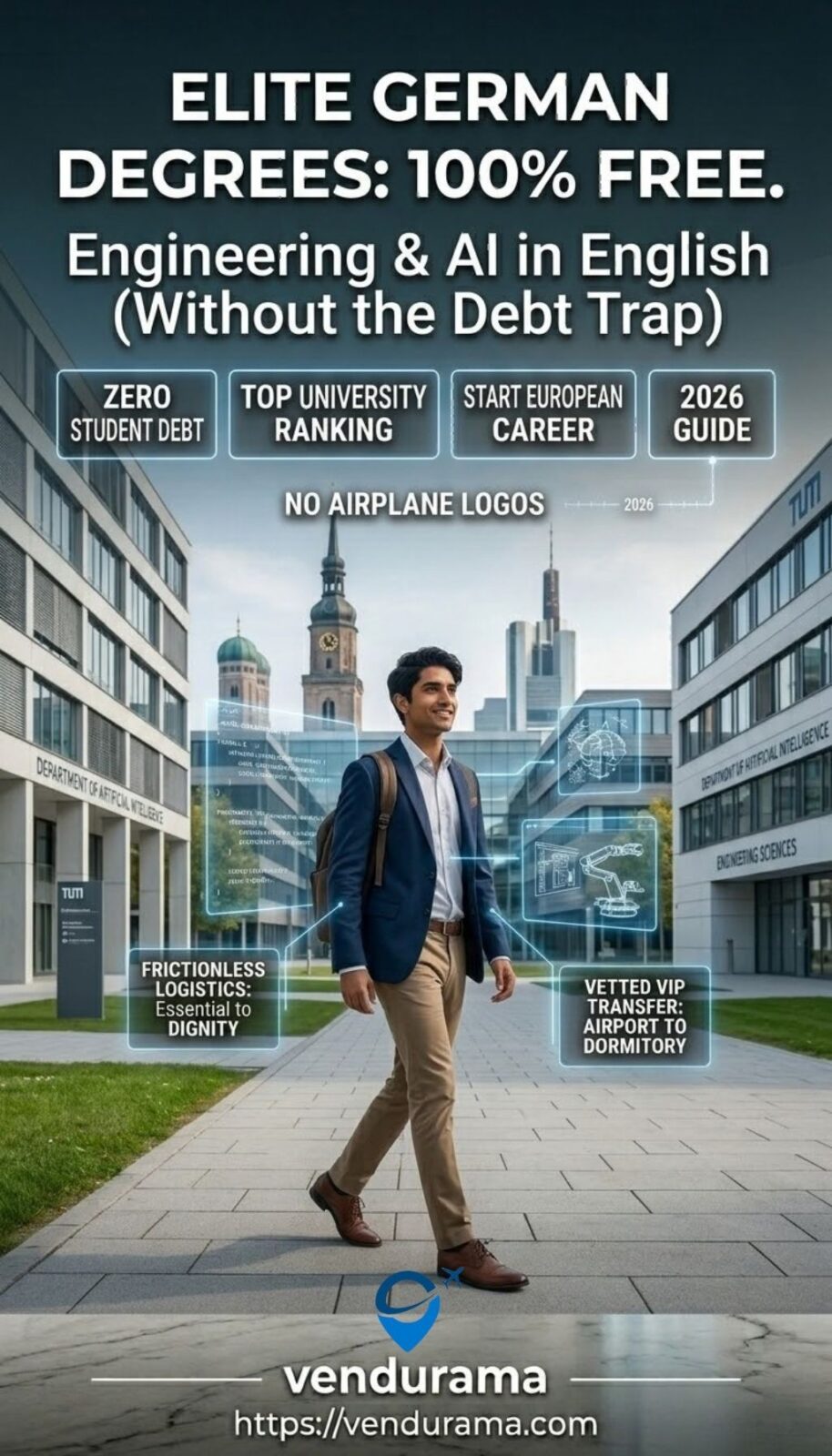
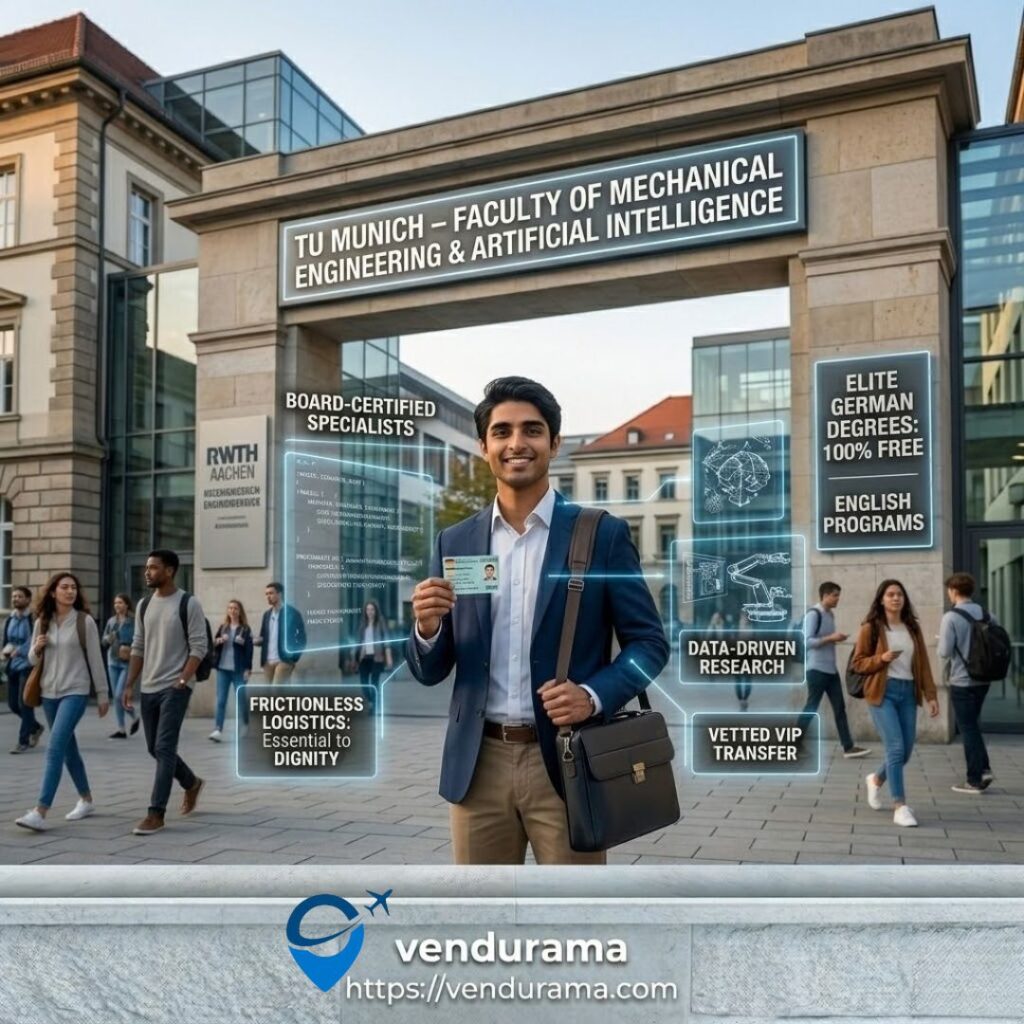
Germany has quietly emerged as the world’s premier destination for debt-free elite education, hosting some of the planet’s most respected engineering and technology universities. These institutions offer Bachelor’s and Master’s degrees entirely in English, maintain rigorous academic standards that exceed many Western counterparts, and charge zero tuition fees to international students—including those from outside the European Union. This is not a limited scholarship program or a temporary promotional offer. This is the fundamental structure of Germany’s public university system, rooted in the principle that education is a public good rather than a commodity.
For parents who understand that true wealth preservation means making strategically superior decisions rather than following conventional paths, German public education represents a paradigm shift. Your child graduates with the same credential quality, enters the same global job market, and carries none of the debt anchor that cripples their Western-educated peers. This article will provide you with the complete analytical framework to evaluate this opportunity, the specific institutions worth considering, and the logistical protocols to ensure your child’s transition is as secure and stress-free as possible.
The financial implications extend far beyond tuition savings. A family that chooses German education over American education saves approximately $180,000 per child. This capital can be deployed toward home purchases, retirement accounts, business investments, or additional children’s education. The compound wealth effect over a generation is extraordinary. When parents understand that they can secure optimized premium flights and initial family accommodation for the transition period while still saving 90% compared to Western education costs, the decision becomes analytically obvious.
This article serves as the definitive blueprint for middle-class parents considering German university education for their children. It will provide the financial mathematics, the institutional knowledge, the application protocols, and the logistical frameworks necessary to execute this strategy successfully. For families who refuse to accept the false choice between quality and affordability, Germany’s public universities represent the path forward—elite education without the debt trap.
The Financial Mathematics of the German Model
Total Cost Breakdown: United States vs. Germany
To understand the magnitude of savings available through German public education, we must calculate the complete four-year cost of attendance, including tuition, accommodation, food, transportation, health insurance, and miscellaneous expenses. The following analysis uses 2026 published figures and realistic living cost estimates.
Top US Engineering Program (4 Years)
| Cost Category | Annual Cost (USD) | 4-Year Total (USD) |
|---|---|---|
| Tuition (Public Out-of-State) | $45,000 | $180,000 |
| On-Campus Accommodation | $15,000 | $60,000 |
| Food & Living Expenses | $12,000 | $48,000 |
| Health Insurance | $3,000 | $12,000 |
| Books & Materials | $2,000 | $8,000 |
| Transportation | $2,500 | $10,000 |
| Total | $79,500 | $318,000 |
Top UK Engineering Program (3 Years)
| Cost Category | Annual Cost (USD) | 3-Year Total (USD) |
|---|---|---|
| Tuition (International) | $38,000 | $114,000 |
| Accommodation | $18,000 | $54,000 |
| Food & Living Expenses | $14,000 | $42,000 |
| Health Insurance (IHS) | $1,000 | $3,000 |
| Books & Materials | $1,800 | $5,400 |
| Transportation | $1,500 | $4,500 |
| Total | $74,300 | $222,900 |
German Public University Program (4 Years)
| Cost Category | Annual Cost (USD) | 4-Year Total (USD) |
|---|---|---|
| Tuition | $0 | $0 |
| Semester Contribution (Admin Fees) | $350 | $1,400 |
| Accommodation (Student Housing) | $6,000 | $24,000 |
| Food & Living Expenses | $8,000 | $32,000 |
| Health Insurance (Mandatory) | $1,200 | $4,800 |
| Books & Materials | $800 | $3,200 |
| Transportation (Semester Ticket Included) | $0 | $0 |
| Total | $16,350 | $65,400 |
Total Savings vs. US: $252,600 (79% Reduction)
Total Savings vs. UK: $157,500 (71% Reduction)
Understanding the Blocked Account (Sperrkonto) Requirement
The German student visa system requires international students to demonstrate financial self-sufficiency through a blocked account mechanism. This requirement often creates confusion among parents, but understanding it properly reveals its actual function as a protective measure rather than a barrier.
The blocked account requires students to deposit approximately €11,208 per year (roughly $12,500 USD) into a German bank account before visa approval. This money remains “blocked” in the sense that students can only withdraw approximately €934 per month for living expenses. The purpose is to ensure that international students have adequate funds to support themselves without becoming dependent on German social services.
Critically, this money is not a fee or a payment to the university. This is your child’s living expense capital—money that would be spent on accommodation, food, and daily needs regardless of study location. The blocked account simply ensures disciplined monthly budgeting and provides visa authorities with verification of financial stability.
For parents comparing this to Western education costs, the distinction is crucial. In the United States, tuition payments disappear permanently as fees to the institution. In Germany, the blocked account money remains your family’s capital, spent on your child’s actual living needs. The tuition component—the largest single expense in Western education—is eliminated entirely.
The Compound Wealth Effect of Debt-Free Education
The savings calculation above represents only the immediate educational costs. The true financial advantage emerges when we consider what happens to the $150,000 to $250,000 that is not spent on education.
Scenario A: US Degree with Debt
- Student graduates with $150,000 in student loans
- Monthly payment at 6% interest over 10 years: $1,665
- Total interest paid over loan lifetime: $49,800
- Delayed ability to save for home down payment
- Delayed retirement contributions
- Reduced career flexibility (must prioritize salary over fit)
Scenario B: German Degree, Debt-Free
- Student graduates with $0 in student loans
- Parents invest $150,000 of savings in diversified portfolio
- At 7% annual return over 30 years: $1,142,275
- Student can pursue career based on fit, not salary necessity
- Immediate ability to contribute to retirement accounts
- Potential for home purchase in mid-twenties
This is not merely about avoiding debt. This is about deploying capital strategically to create generational wealth advantages. The family that chooses German public education does not simply save money—they reposition their entire financial trajectory.
When families arrange the most direct and comfortable flight routes for their child’s arrival in Germany, they invest approximately $2,000-4,000 in transition logistics. This represents less than 2% of total tuition savings, yet it protects the entire educational investment by ensuring a smooth, stress-free arrival. This is prudent risk management, not unnecessary expenditure.
Top Elite German Universities Offering English Programs
Technical University of Munich (TUM)
Global Ranking: Top 50 worldwide (QS World University Rankings 2026) Location: Munich, Bavaria Established: 1868 English Programs Available: Bachelor’s and Master’s in Engineering, Computer Science, AI
The Technical University of Munich represents Germany’s premier institution for engineering and technology education. TUM maintains extensive partnerships with BMW, Siemens, Allianz, and other German industrial giants, providing students with direct pathways to internships and employment. The university’s Entrepreneurship Center supports student startups, with numerous successful technology companies emerging from TUM incubator programs.
Featured English Programs:
- B.Sc. in Engineering Science (fully English-taught)
- M.Sc. in Robotics, Cognition, Intelligence (fully English-taught)
- M.Sc. in Data Engineering and Analytics (fully English-taught)
- M.Sc. in Artificial Intelligence (fully English-taught)
Industry Connections: TUM graduates are heavily recruited by German automotive companies, technology firms, and research institutions. The university’s location in Munich—Germany’s technology capital—provides unparalleled access to industry networking and employment opportunities. Starting salaries for TUM engineering graduates average €55,000-65,000 annually, with significant growth potential.
RWTH Aachen University
Global Ranking: Top 150 worldwide Location: Aachen, North Rhine-Westphalia Established: 1870 English Programs Available: Master’s programs in Engineering and Technology
RWTH Aachen specializes in engineering disciplines with particular strength in mechanical, electrical, and materials engineering. The university maintains one of Europe’s largest engineering research facilities, with extensive industry collaboration programs. RWTH’s proximity to the Dutch and Belgian borders provides additional European employment opportunities for graduates.
Featured English Programs:
- M.Sc. in Mechanical Engineering (fully English-taught)
- M.Sc. in Electrical Engineering and Information Technology (fully English-taught)
- M.Sc. in Materials Science and Engineering (fully English-taught)
- M.Sc. in Data Science (fully English-taught)
Industry Connections: RWTH maintains formal partnerships with Ford, Bosch, Philips, and numerous engineering consultancies. The university’s career services department facilitates direct recruitment connections, with many students securing employment before graduation completion.
Karlsruhe Institute of Technology (KIT)
Global Ranking: Top 200 worldwide Location: Karlsruhe, Baden-Württemberg Established: 2009 (merger of university and research center) English Programs Available: Bachelor’s and Master’s in Engineering and Natural Sciences
KIT operates as both a university and a national research center, providing students with access to cutting-edge research facilities and projects. The institution emphasizes the integration of theoretical education with practical research experience, producing graduates who are immediately productive in research and industry settings.
Featured English Programs:
- B.Sc. in Chemical Engineering (fully English-taught)
- M.Sc. in Computer Science (fully English-taught)
- M.Sc. in Mechanical Engineering (fully English-taught)
- M.Sc. in Physics (fully English-taught)
Industry Connections: KIT’s location in Germany’s technology corridor provides access to SAP, Bosch, and numerous technology startups. The institute’s research partnerships extend to international organizations including CERN and NASA.
Universities of Applied Sciences (Fachhochschulen)
Beyond the technical universities, Germany’s Universities of Applied Sciences offer practice-oriented education with strong industry integration. These institutions emphasize practical skills and internship requirements, producing graduates who are immediately productive in workplace settings.
Notable Fachhochschulen with English Programs:
- Munich University of Applied Sciences (HM)
- Frankfurt University of Applied Sciences
- Berlin University of Applied Sciences and Technology
- Hamburg University of Applied Sciences
Advantages:
- Mandatory internship semesters built into curriculum
- Smaller class sizes than research universities
- Stronger focus on practical application
- Direct industry project collaborations
For parents evaluating institutional options, the distinction between research universities and applied sciences universities should align with the child’s career objectives. Research universities prepare students for advanced technical roles and potential doctoral studies. Applied sciences universities prepare students for immediate industry productivity with practical skill emphasis.
The Application Timeline and Requirements
Successful admission to German universities requires advance planning and documentation preparation. The following timeline represents the minimum standard for competitive applications:
| Timeline | Action Item |
|---|---|
| 18 months before enrollment | Research programs and verify English language requirements |
| 15 months before enrollment | Begin German student visa financial preparation (blocked account) |
| 12 months before enrollment | Submit university applications (deadlines vary by institution) |
| 9 months before enrollment | Receive admission decisions and confirm enrollment |
| 6 months before enrollment | Complete student visa application with blocked account verification |
| 3 months before enrollment | Book a comfortable hotel for the settling-in period for family arrival |
| 2 months before enrollment | Pre-book a safe VIP private transfer directly to the university dorms |
| 1 month before enrollment | Finalize accommodation, health insurance, and registration |
This timeline ensures no critical deadlines are missed and allows adequate time for visa processing, which can take 8-12 weeks during peak application periods.
Addressing the Skeptics: Common Parental Concerns Answered
Is the Quality Really That High If It’s Free?
This is the most frequently asked question, and it deserves a direct, evidence-based answer.
The German public university system operates on a fundamentally different financing model than Anglo-American higher education. Rather than charging tuition fees to students, German universities receive substantial government funding based on enrollment numbers and research output. This funding model reflects the German societal principle that education is a public investment that generates economic returns through an educated workforce.
Quality Indicators:
- German technical universities consistently rank in the global top 200, with TUM and others in the top 50
- German engineering degrees maintain international accreditation through EUR-ACE and Washington Accord frameworks
- Graduate employment rates exceed 90% within six months of completion
- Starting salaries for German engineering graduates are competitive with US and UK equivalents when adjusted for cost of living
Research Output: German universities produce substantial research output in engineering and technology fields. TUM alone publishes over 8,000 research papers annually. KIT operates nuclear research facilities and contributes to international physics projects. This research activity directly benefits undergraduate students through exposure to cutting-edge developments and potential research assistant positions.
Faculty Credentials: German university professors maintain rigorous qualification requirements including doctoral degrees, post-doctoral research experience, and demonstrated teaching capability. Many faculty members maintain industry consulting relationships that keep curricula aligned with current professional practice.
The free tuition model does not indicate quality compromise. It indicates a different societal prioritization of education funding. The educational quality is verified through international rankings, accreditation bodies, and graduate employment outcomes—all of which confirm German engineering education meets or exceeds Western alternatives.
Do Students Truly Not Need to Speak German to Graduate?
This concern reflects uncertainty about language requirements and daily life functionality. The answer requires distinguishing between academic language requirements and daily life language needs.
Academic Language Requirements: English-taught programs require proof of English proficiency (TOEFL 90+ or IELTS 6.5+) but do not require German language proficiency for graduation. All coursework, examinations, thesis work, and academic communications occur in English. Students can complete entire degrees without German language capability.
Daily Life Language Reality: While academic life functions in English, daily life in Germany operates primarily in German. Grocery shopping, banking, healthcare, and social interactions typically require basic German capability. Most universities offer free or subsidized German language courses for international students, and smart students enroll in these courses during their first semester.
Employment Language Considerations: For students intending to work in Germany after graduation, German language capability significantly expands employment opportunities. While multinational companies and technology startups often operate in English, traditional German companies typically require German proficiency. Students who invest in German language learning during their studies position themselves for broader career options.
The Practical Recommendation: Parents should encourage their children to pursue basic German language acquisition (A1-A2 level) during the first year of study. This investment requires approximately 200-300 hours of study and enables functional daily life navigation. Academic success does not depend on German, but quality of life and career flexibility improve substantially with basic language capability.
How Easy Is It to Get a Post-Study Work Visa?
Germany’s immigration policies actively favor skilled international graduates, particularly in engineering and technology fields where labor shortages persist.
The 18-Month Job Seeker Visa: Upon graduation, international students qualify for an 18-month residence permit specifically for job seeking. This permit allows full-time work authorization while searching for employment related to their field of study. There is no requirement to leave Germany between graduation and employment commencement.
The EU Blue Card: Once employed with a salary exceeding €45,300 annually (2026 threshold for shortage occupations including engineering), graduates qualify for the EU Blue Card. This residence permit provides:
- Initial validity of 4 years with renewal options
- Pathway to permanent residence after 21-33 months
- Family reunification rights for spouses and children
- Mobility rights within European Union member states
Employment Outcomes: German engineering graduates from international programs report employment rates exceeding 85% within the 18-month job seeker period. The combination of technical skills, English language capability, and German work authorization makes these graduates attractive to both German and international employers.
Long-Term Residence: After five years of legal residence (including study years), international graduates can apply for permanent settlement permits. After six to eight years, naturalization as German citizens becomes available. This pathway provides long-term stability for families intending to establish European residence.
For parents concerned about their child’s post-graduation prospects, Germany’s immigration framework provides clearer pathways than most Western alternatives. The combination of skills-based immigration policy and labor market demand creates favorable conditions for international graduate retention.
Frictionless Logistics: Protecting the 18-Year-Old’s Transition
The Hidden Risk of Poor Arrival Planning
When parents save over $200,000 on tuition through the German public education route, they must reinvest a tiny fraction of those savings into ensuring the student’s transition is flawless. This is not optional. This is a non-negotiable safety investment that protects both the student’s wellbeing and the parents’ peace of mind.
Sending an eighteen-year-old to a foreign country for the first time represents one of the most anxiety-inducing experiences a family can navigate. The student is navigating a new country, a new education system, new social dynamics, new language environment, and new living arrangements simultaneously. Any logistical friction during the arrival phase compounds this stress exponentially.
German cities feature excellent public transportation systems, but these systems present significant challenges for newly arrived international students. Munich’s Hauptbahnhof (main train station) handles over 450,000 passengers daily. Frankfurt Airport is Europe’s fourth-busiest aviation hub. For an eighteen-year-old arriving with two large suitcases, unfamiliar currency, limited German language capability, and no local knowledge, the transition from aircraft or train to university dormitory can become a significant stress point.
The Airport Arrival Protocol: Why VIP Transfers Are Essential
Smart parents eliminate transportation risk entirely by pre-book a safe VIP private transfer directly to the university dorms well in advance. This is not a luxury indulgence. This is a risk mitigation strategy.
A pre-booked VIP transfer ensures:
- A vetted, professional driver waiting at arrivals with a name sign
- Direct transportation to the university dormitory with no stops
- Assistance with luggage from aircraft to dorm room
- A familiar face during the first hours in a new country
- Fixed pricing with no surprise charges or negotiation
- English-speaking driver capable of answering initial questions
The cost of this service—typically €80 to €150 EUR depending on distance—is less than 0.1% of the total tuition savings. For this minimal investment, parents purchase certainty, safety, and immediate stress reduction for their child.
When families secure a vetted driver from the airport to eliminate transit risks, they protect their child from the most vulnerable period of international relocation. The first 24 hours set the tone for the entire transition experience. A smooth, supported arrival creates confidence. A chaotic, confusing arrival creates anxiety that can persist for weeks.
Flight Optimization and Initial Family Accommodation
The arrival phase typically involves parents accompanying the student for the first three to five days. This period is critical for dormitory setup, university registration, bank account opening, health insurance enrollment, and emotional acclimatization. Parents need comfortable, conveniently located accommodation during this period, and the entire family needs optimized flight arrangements that minimize travel fatigue.
Experienced education strategists recommend secure optimized premium flights and initial family accommodation near the university campus before departure. This allows the family to:
- Arrive rested rather than exhausted from poorly timed connections
- Stay in a secure, comfortable environment during the settling-in period
- Maintain proximity to campus for registration and orientation activities
- Have a comfortable retreat space when the emotional intensity becomes overwhelming
The psychological benefit of this preparation cannot be overstated. When parents feel confident that the logistical foundation is secure, they transmit calm to their child. When the student senses parental confidence, their own anxiety decreases proportionally. This creates a positive feedback loop that sets the tone for the entire academic journey.
When parents book a comfortable hotel for the settling-in period, they should prioritize locations within 30 minutes of the university campus. This enables easy daily commutes for registration activities while providing a comfortable base for the family’s final days together before departure.
The Pre-Departure Checklist for Smart Families
To ensure no logistical element is overlooked, families should complete the following checklist at least six weeks before departure:
| Task | Timeline | Responsibility |
|---|---|---|
| Arrange the most direct and comfortable flight routes | 8 weeks before | Parents |
| Pre-book a safe VIP private transfer directly to the university dorms | 6 weeks before | Parents |
| Book a comfortable hotel for the settling-in period | 6 weeks before | Parents |
| Complete university registration | 4 weeks before | Student |
| Obtain student visa | 8 weeks before | Parents/Student |
| Open blocked account | 10 weeks before | Parents |
| Purchase German health insurance | 4 weeks before | Parents |
| Open German bank account (pre-arrival) | 2 weeks before | Parents |
| Pack essentials and documents | 1 week before | Student |
| Confirm all transfer and hotel bookings | 3 days before | Parents |
This checklist represents the minimum standard for families who understand that logistical excellence is not optional—it is foundational to academic success.
The Cognitive Load Argument
There is a deeper reason why logistical preparation matters beyond mere convenience. Research in educational psychology consistently demonstrates that students perform better academically when their cognitive bandwidth is not consumed by basic survival concerns.
A student who arrives exhausted, confused about transportation, worried about safety, and uncertain about accommodation begins their academic journey with depleted mental resources. A student who arrives rested, knowing their transportation is secured, understanding their accommodation is confirmed, and feeling their parents have created a safety net begins with full cognitive capacity available for learning.
When parents arrange a stress-free airport pickup for your child, they are not simply purchasing transportation. They are purchasing their child’s cognitive focus for the first critical weeks of university life. This is an investment in academic performance, not merely a travel expense.
Similarly, when families secure optimized premium flights and initial family accommodation, they are creating the conditions for emotional stability during the transition period. The parents can focus on supporting their child rather than managing travel crises. The student can focus on orientation and coursework rather than navigating unfamiliar transit systems.
The Return on Investment for Logistical Planning
Let us quantify the return on investment for proper logistical planning:
| Investment | Cost (USD) | Value Created |
|---|---|---|
| VIP Airport Transfer | $150 | Eliminated safety risk, stress reduction, time savings |
| Premium Family Flights | $4,000 | Rested arrival, better decision-making capacity |
| Initial Hotel (5 nights) | $800 | Secure base for settling-in activities |
| Total | $4,950 | Peace of mind, cognitive protection, safety assurance |
Compare this $4,950 investment against the $200,000 to $250,000 saved through German public education. This represents approximately 2% of total savings deployed to protect the entire educational investment. Any financial advisor would characterize this as an exceptionally prudent risk management strategy.
When families pre-book a safe VIP private transfer directly to the university dorms, they complete the safety infrastructure that protects their educational investment. The university ensures academic excellence; the transportation infrastructure ensures logistical excellence. Together, they create the conditions for optimal outcomes.
Conclusion: The Paradigm Shift in Smart Parenting
In 2026, the definition of smart parenting in education has fundamentally changed. The conventional wisdom—that elite education requires elite locations accompanied by elite debt—has been rendered obsolete by the globalization of higher education.
German public universities represent more than a cost-saving strategy. They represent a fundamental rethinking of what educational value means. The value of a degree lies not in the geographic location where it was earned, but in the institutional standards that governed the learning, the skills the student developed, and the opportunities the credential unlocks.
When a student graduates from Technical University of Munich with $0 in debt while their peer graduates from a US engineering program with $150,000 in loans, the German graduate begins their adult life with a $150,000 advantage. This advantage compounds over decades through earlier home purchases, earlier retirement contributions, greater career flexibility, and reduced financial stress.
Smart parents in 2026 understand that their role is not to follow conventional paths unquestioningly. Their role is to analyze options rigorously, identify structural advantages, and deploy family resources strategically. German public education is one of the clearest structural advantages available in contemporary higher education.
The logistical framework to support this decision is equally important. When parents secure optimized premium flights and initial family accommodation for the arrival period, and when they arrange a stress-free airport pickup for your child, they complete the strategic picture. They have optimized both the financial structure and the human experience of the educational journey.
The families who embrace this model in 2026 will not merely save money. They will position their children for debt-free adulthood, accelerated wealth accumulation, and genuine career flexibility. They will have understood that in a globalized world, educational geo-arbitrage is not a compromise—it is a competitive advantage.
Germany’s combination of zero tuition, world-class engineering programs, English-language instruction, and favorable post-study work policies creates an opportunity that is both rare and time-sensitive. As more families discover this pathway, competition for admission will increase. The families who act decisively in 2026 will secure advantages that may not remain available at current accessibility levels.
The question is no longer whether German public universities can deliver elite education. The evidence overwhelmingly confirms they can and do. The question is whether you will recognize this opportunity before admission becomes more competitive. For analytical parents reading this in 2026, the answer should be clear.
Your child’s education is their foundation. Your family’s financial stability is your security. Germany’s public universities offer the rare opportunity to honor both priorities simultaneously. The blueprint is complete. The path is clear. The choice is yours.
Vendurama is a premium digital publication dedicated to empowering the global middle class with sophisticated, value-driven educational and financial strategies. Our analysis is independently researched and designed to help families make informed decisions about wealth preservation and educational investment in an increasingly complex world.